Flip Da Visor
We’ve been spending time working on operations with fractions. We’ve looked at a few ways of working out solutions, with drawings, and also with algorithms.
Here is how to add and subtract fractions visually:
Each rectangle represents one whole. We draw out one fraction with horizontal lines, and the other with vertical lines. We colour in the fractions, but to add them, we need to have pieces that are the same size, so we make the horizontal and vertical lines in the other rectangle. This is equivalent to making a common denominator.

Now that the pieces are the same size we can add them up. We get a number greater than 1. We could physically move pieces from one rectangle to another to fill it up. We’d see that there are 14/24 ths remaining after the one rectangle is full. We simplify to 1 and 7/12ths.
To multiply we use the area model. Area is length times width. We use a rectangle again, and make 3/4 shaded horizontally, and 2/5 shaded vertically. The intersection of the shaded regions is the area, which is 6 pieces out of a total of 20 so the result of the multiplication is 6/20=3/10

Dividing can be done visually as well. We make 2 rectangles, each representing one whole. We divide one horizontally into quarters and colour in 1/4, next we divide the other into 5ths vertically and colour in 3/5.
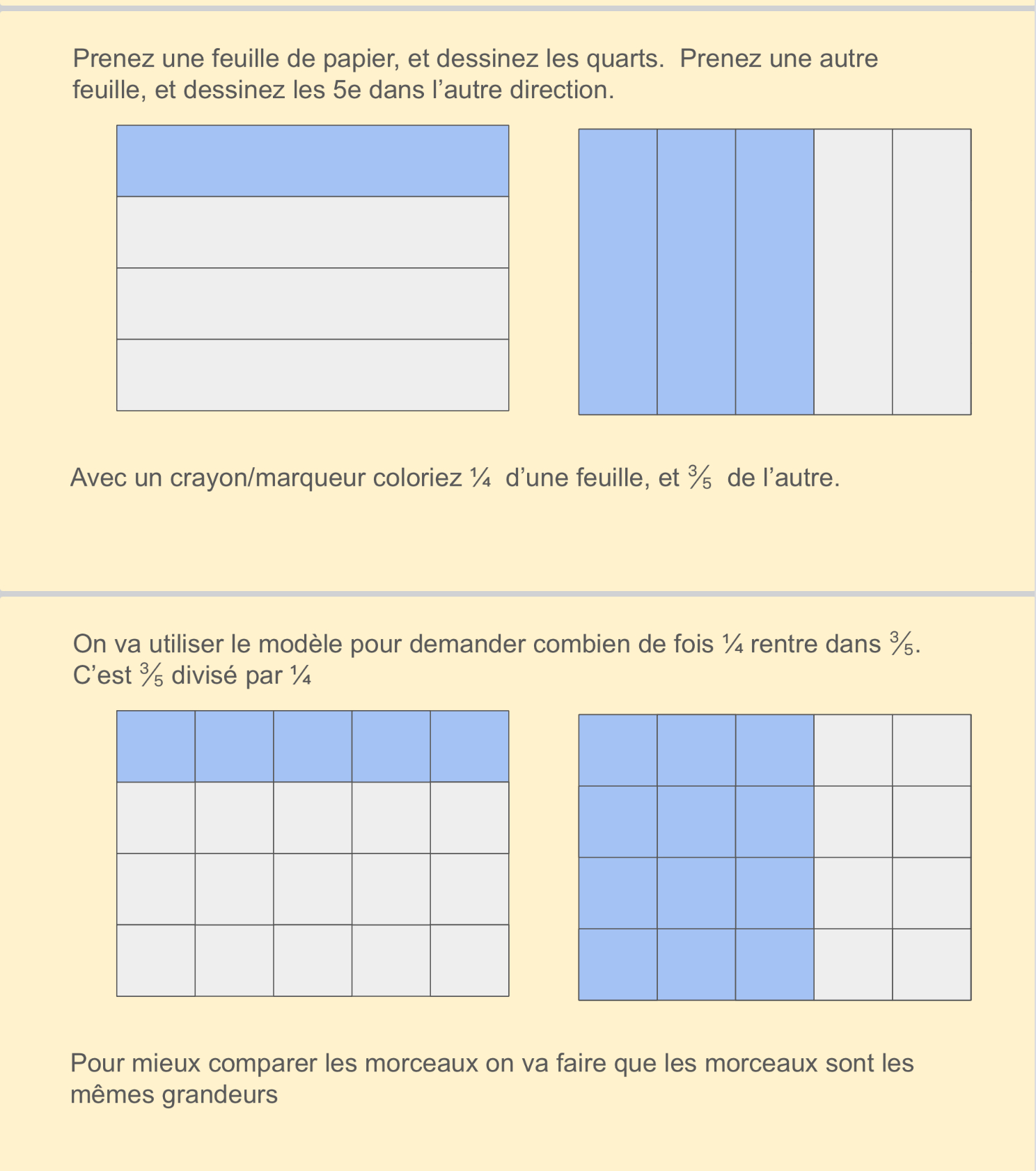
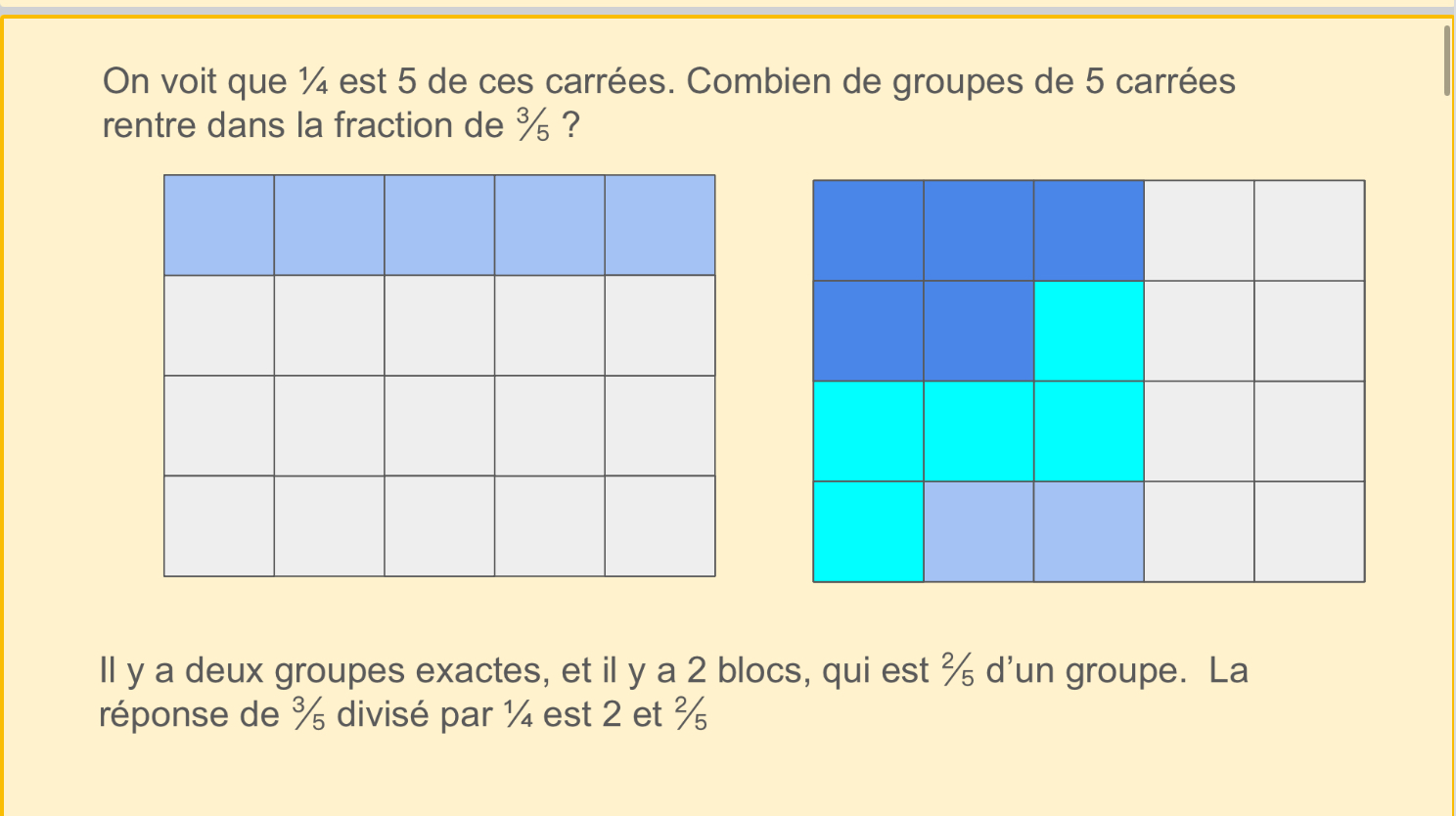
we will determine how many times 1/4 goes into 3/5, which is the same as asking 3/5 divided by 1/4. To figure this out, we make the pieces the same size, then count out 5 pieces in 1/4. We now look for how many groups of 5 pieces are in 3/5. I’ve coloured them in differently. There are 2 groups, and then 2/5 left. The answer is 2 and 2/5.
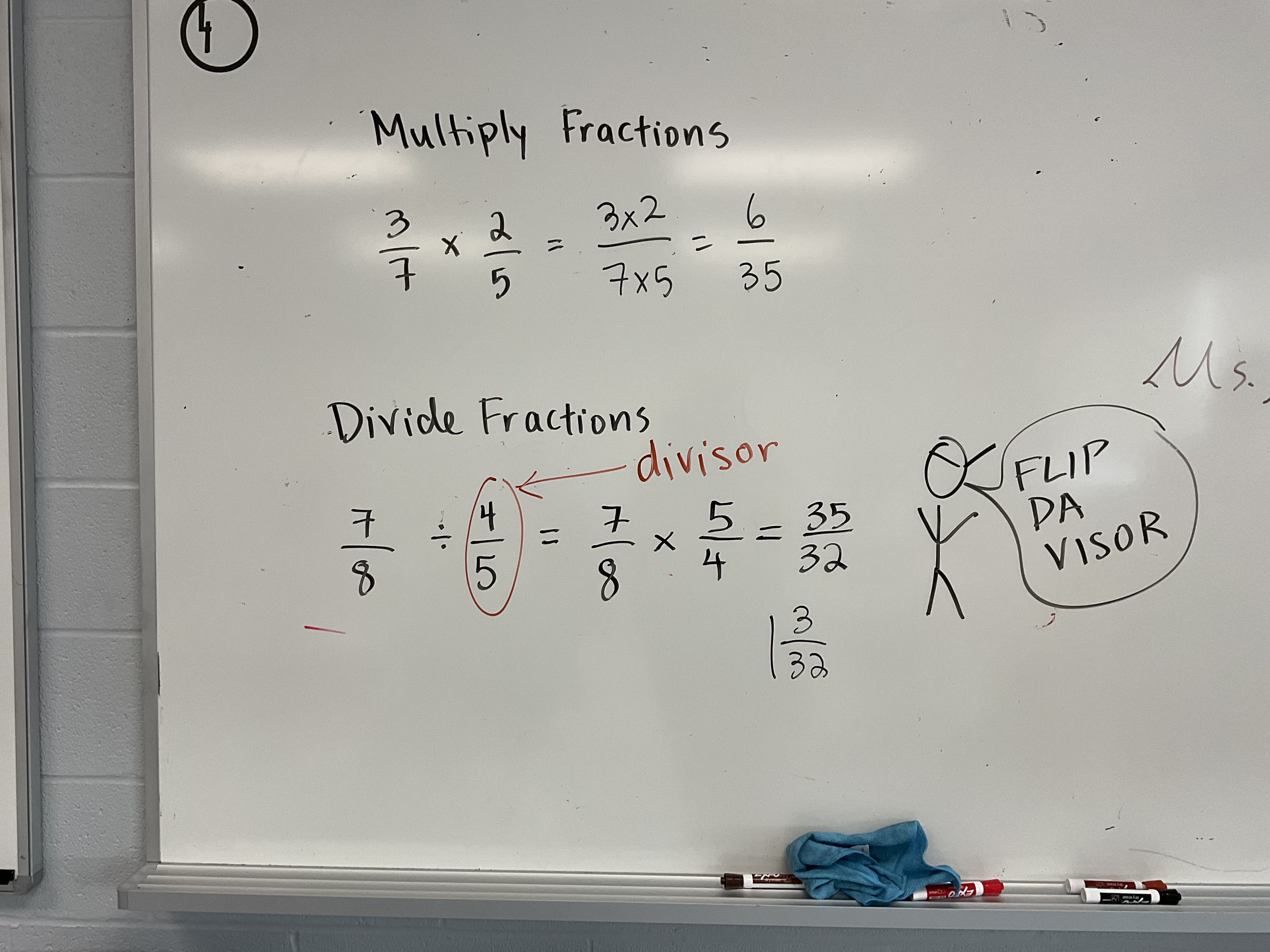
A trick I use to help with dividing fractions is to wear a visor upside down in class. Students wonder why I have flipped my visor. I link that to flipping the divisor (“flip da visor”) when we have a fraction division question. We flip the second fraction (the divisor) then multiply.
 Ms. Bearse's Site