Distributive Property
Today several grade 9 classes were working on the distributive property and how that applies to multiplying monomials by binomials.
We started with representing multiplication with tiles. Here is an example of (2)(3), a 2×3 rectangle involving 6 unit tiles. The area is the product and the dimensions are the factors.

Next we tried 3x, which can be seen as 3 groups of x (below)

or we can make a rectangle with one dimension as 3 and the other as x.

The next interesting thing to try is to make as many rectangles as possible for 12x.
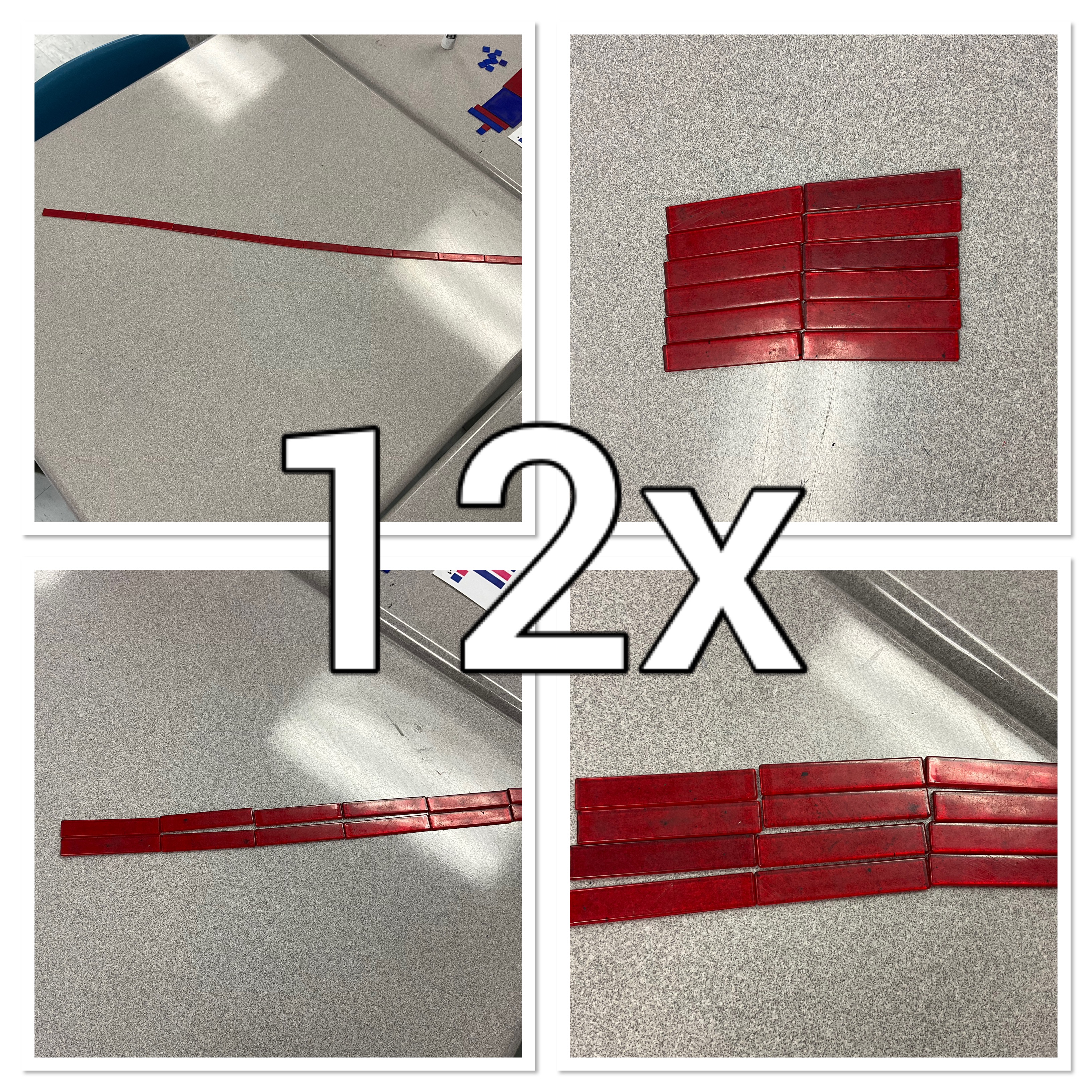
we can write these as products. (1)(12x) is the long thin rectangle (top left), then (2)(6x) which is bottom left, then (4)(3x) bottom right and (6)(2x) top right. There could also be (3)(4x) and (12)(x) which are not shown.
Here is another challenge. There are different ways of writing 2(3x+1)

many students see and understand this as 2 groups of (3x+1) which is great. We know there will be 2 groups of 3x, and 2 groups of 1. We can also show this as a rectangle with dimensions of (2) and (3x+1).
The rectangle idea is important when we get to a situation of x(x+2). We struggle to understand x groups of x+2, but we can create a rectangle with dimensions of (x) and (x+2).

We next cut up a puzzle and tried to match the sides that have equivalent expressions

We got them sorted out! It took a while, but our teams worked hard and mastered the challenge.

For more puzzles like this check out monclasseurdemaths
 Ms. Bearse's Site