Surface Area and Volume of Rectangular Prisms
Today in grade 9 we built rectangular prisms with a volume of 300 cubic centimetres. There was a lot of freedom of choice. Students could choose the dimensions that they wanted to, as long as the volume worked out.

They then used cardboard to create their prism.

Some groups had interesting strategies for coming up with their dimensions. One used the box that they had, because it was already a rectangular prism, and they just needed to determine the height, and cut it to size.

It was 19.5cm by 16cm, which already is bigger than 300 when multiplied.
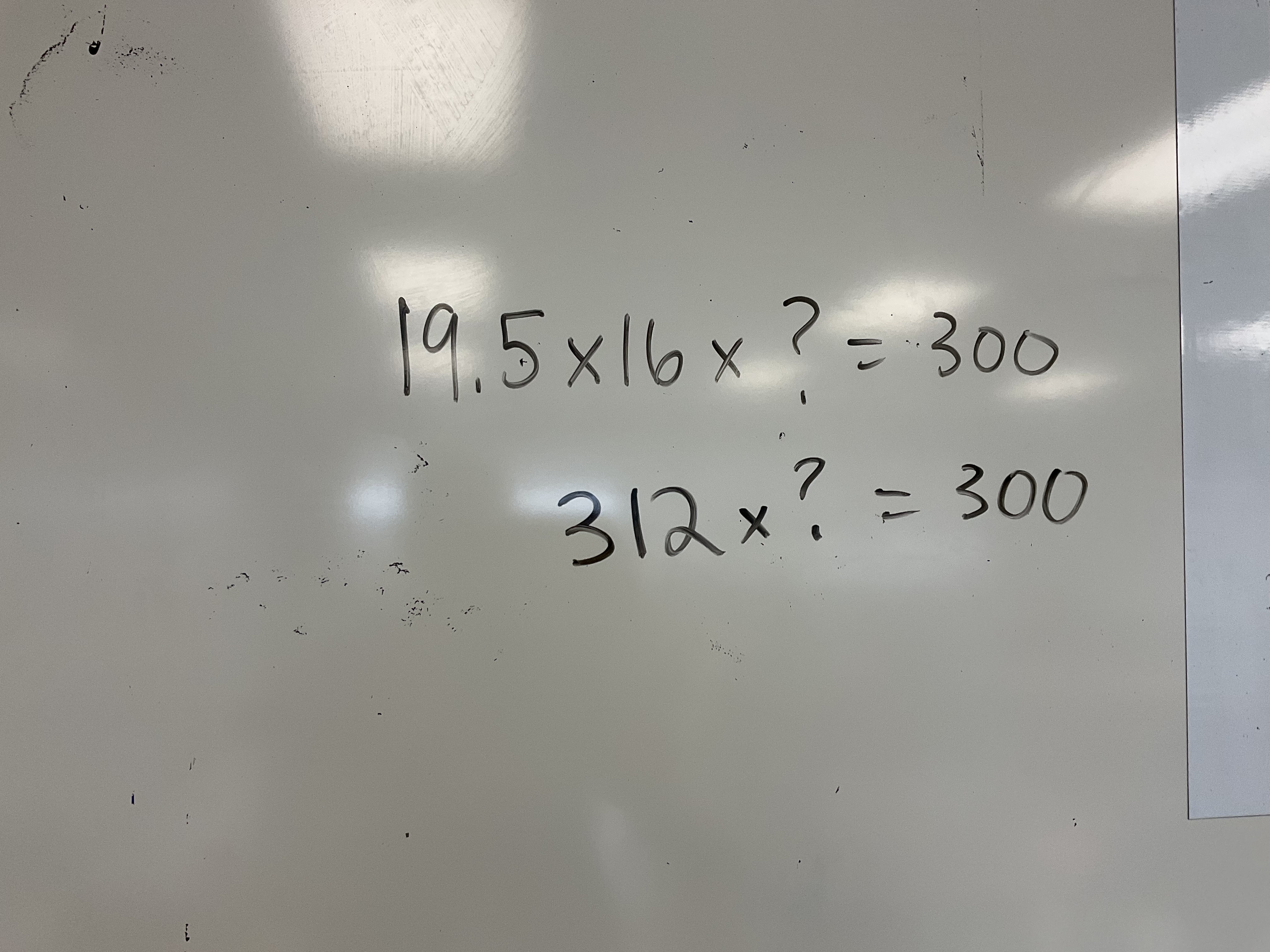
there was some excellent trial and error involved in calculating the height of the prism, and that it needed to be between 0 and 1.
Groups worked on building their prisms, and then calculating the surface area when they were finished. Some groups who were up for a little extra push got the challenge of building a cube, or building a second prism with a larger or smaller surface area.

This was our time to review what prisms are, and how to use the formulas to calculate volume and surface area, and also to introduce the idea that an object with a specific volume can have a different surface area depending on the dimensions.

Students have already done these calculations in elementary school, but they may not have seen that there is such a variety of possible prisms for the same volume, nor how different the surface area can be.
We took all the finished prisms and put them in order by surface area.

Cubes have the smallest surface area, and the more worm-like, or plate-like prisms had the largest surface areas.
We connected the idea of surface area and volume to packaging problems, where you could spend less money on packaging if you use a cube as a box. We also talked about how cells divide when they get too large, to maintain the optimal surface area to volume ratio, how worms can breathe through their skin because they have a big surface area compared to their volume, and how we have a large surface area in our lungs for gas exchange.
We also talked about how you can find the dimensions of the cube with volume 300 cubic centimetres, by using the cube root on a calculator.
We will build on our prism knowledge and next week tackle the fun challenge of building a square based pyramid with the same volume.
 Ms. Bearse's Site