Building Pyramids and Confronting Misconceptions
We’ve had 2 inclement weather days to start the week. It threw off our schedule a bit, and caused us to do some tasks in a different way. This allows for some interesting observations.
First of all, each class can react very differently to a given task depending on many factors (personalities, willingness to take risks, time of day), so these observations may be based on many factors.
Usually I do a day 1 task of “build me a rectangular prism with a volume of 300 cubic centimetres”. This allows students to have an introduction to building things, working in groups on an open task, and reminds them of volume calculations from their prior learning.
Because of timing, students did some work on the inclement weather days on volume and surface area of prisms, and then today we started our building task.
After watching and participating in the demo with water
The challenge is then given to build a square based pyramid with a volume of 300 cubic centimetres. Groups flocked to whiteboards to plan, and it was interesting to see what aspects were challenges.

After some productive struggle the connection was made between the water demo and the task. The volume of a prism with same base and height would be 900 cubic centimetres. Many groups drew on the work on the whiteboards for inspiration, and there were lots of pyramids with sides of the base that were 6cm. They knew that (36)(25)=900, and they took the square root of the 36 to get the side lengths of the square. They then decided to take the square root of the 25 to get side lengths of the triangles, which was an interesting misconception that took off around the room.
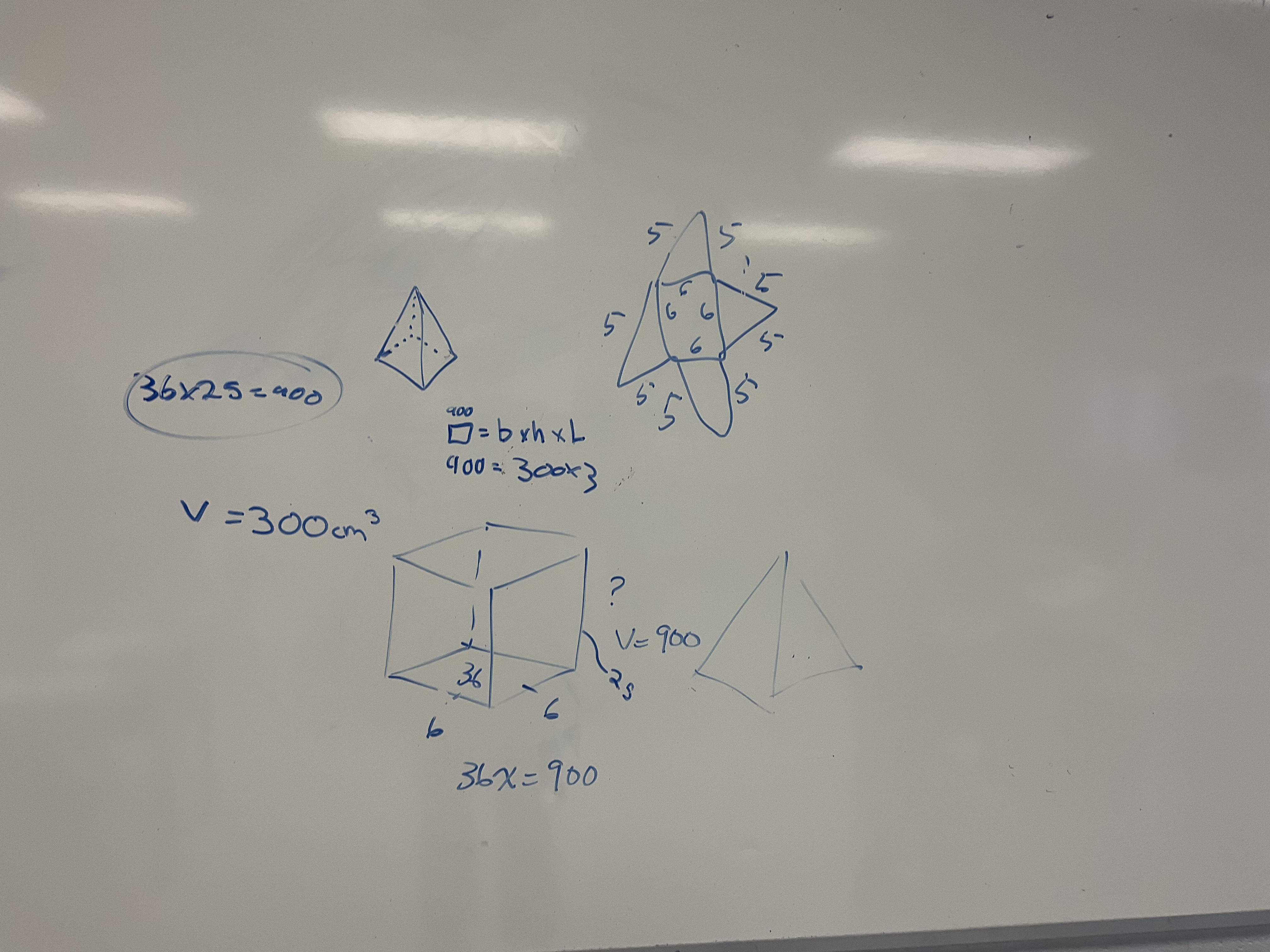
We had some groups make their pyramids and bring them to me for verification. They were adorable pyramids, but did not have the correct volume.

Groups were sent back to the drawing board to make the volume bigger, with sides of the base being 6cm and the height of the pyramid as 25cm.
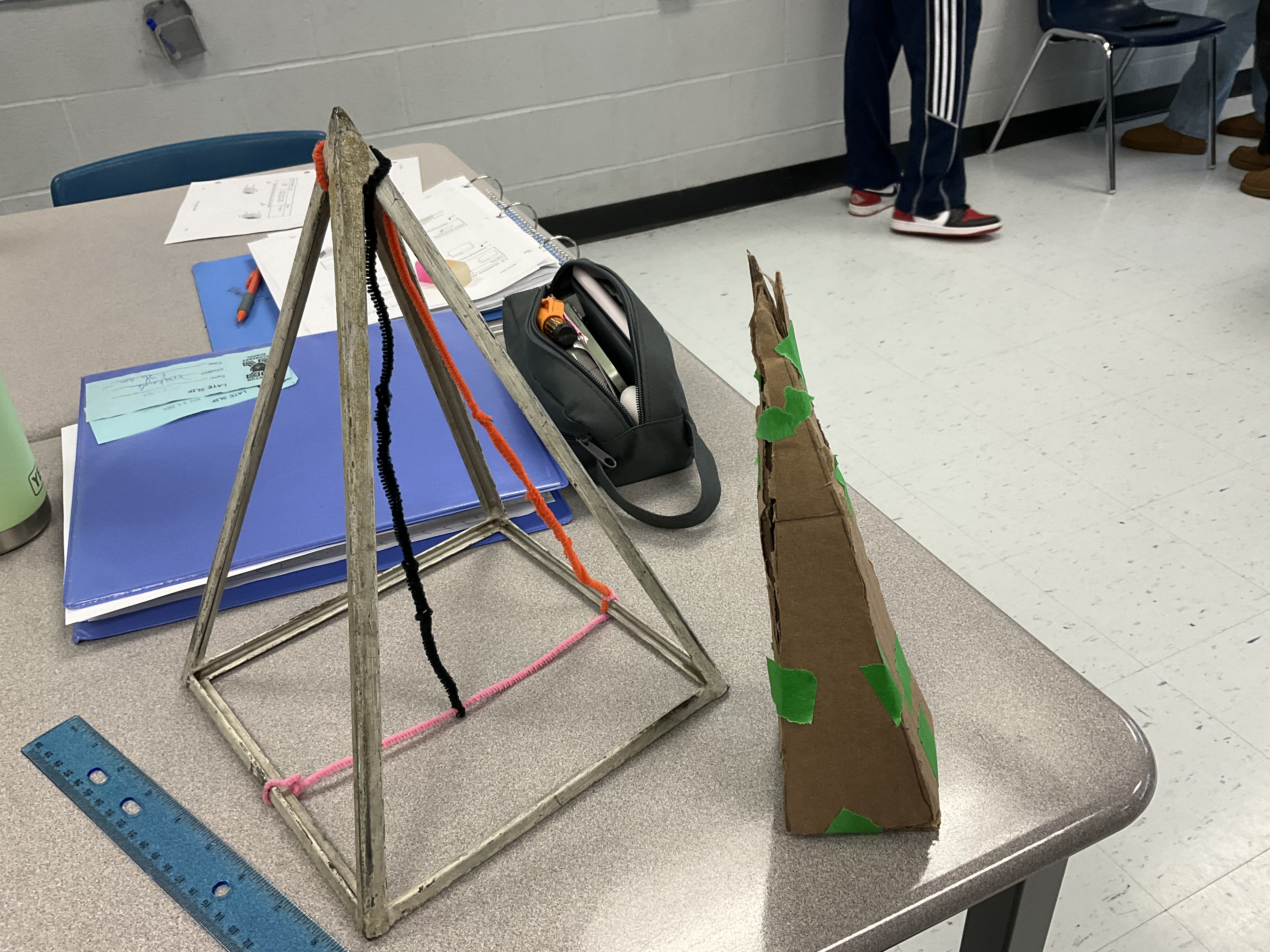
Eventually we had some that were closer. These were just a bit short though! The students measured the desired height of the pyramid as the height of each triangle, which causes the pyramid to be too short. This can be remedied by using the Pythagorean theorem to calculate the slant height of the pyramid, as shown with the pipe cleaners on the wireframe model.
Other groups had some unique ideas for dimensions: this one had a base of 9.65 cm by 9.65 cm and a height of 9.65cm. They needed a Pythagorean adjustment to make theirs work in the end. It was neat that they used the cube root of 900 to get their dimensions.

Here’s another that found a new misconception. They made the base of the pyramid 10cm by 10cm and then measured the side of the triangle as 9cm. It was much shorter than they had anticipated, and went back to the drawingboard to make it taller.
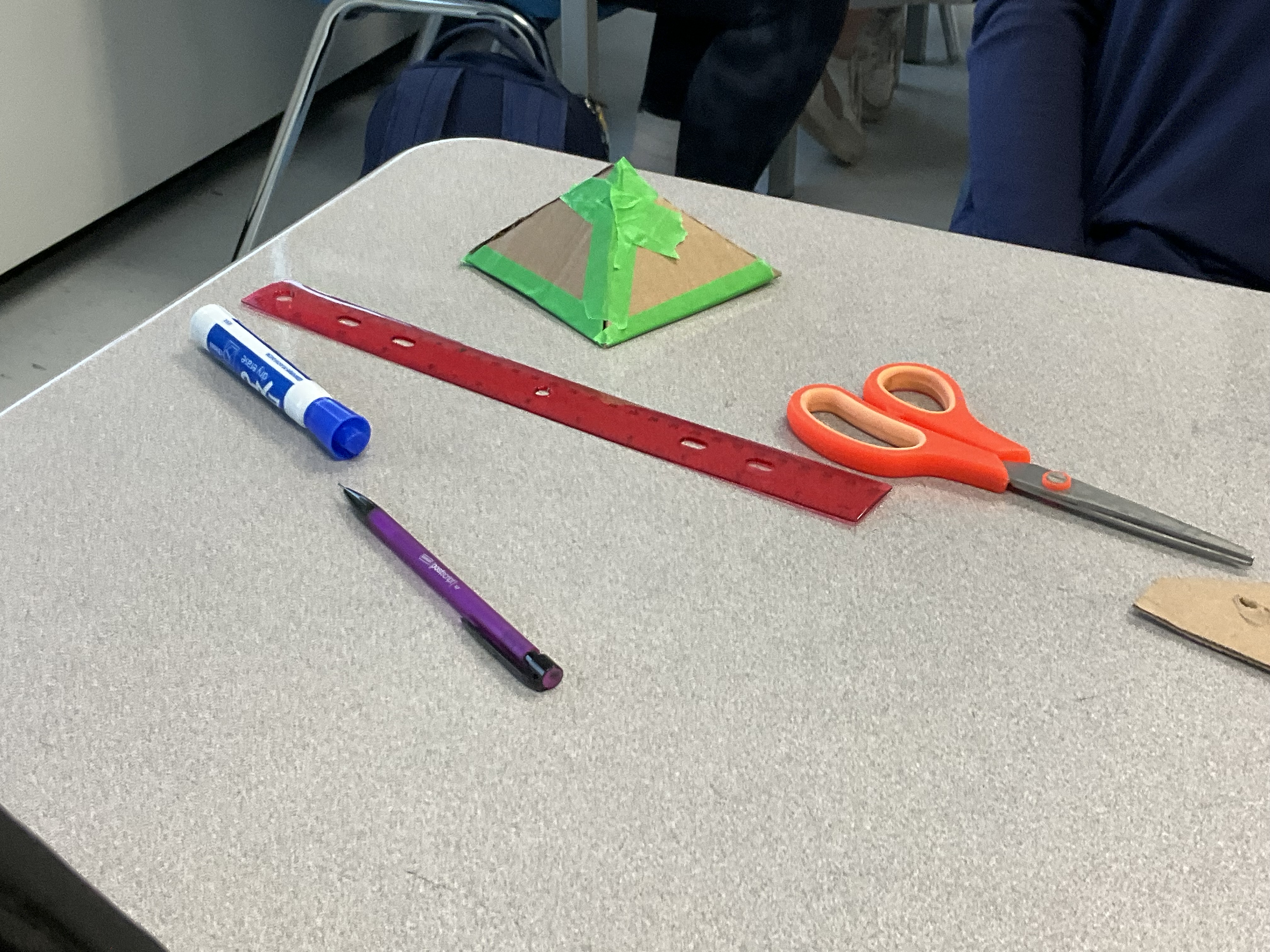
Some groups were able to confront their misconceptions and rebuild, and other groups had major issues with even starting the task once. There is something to be said about struggling through an iterative design process! This task has never taken this many turns before, and it makes me wonder whether it was the fact that they didn’t build prisms the day before, or whether it was first period back after a weekend prolonged by 2 snow days.
 Ms. Bearse's Site