Catapults: Culminating Task in Grade 10
In grade 10 we started working on our culminating task: analysing the trajectory of catapults that we build in class.
Today we started building and testing and collecting data.

Each group gets about 10 tongue depressors or popsicle sticks, a plastic spoon, several elastic bands and some tape. We use painters tape because we are aiming for something that can be disassembled, so the pieces can be used again next term. Each group also gets a target, a pompom, and a package of work to do.
After they have created a catapult (with or without online tutorials) we go into the hallway and collect some data.
We film the pompom being catapulted, then use the app Visual Physics to track it.
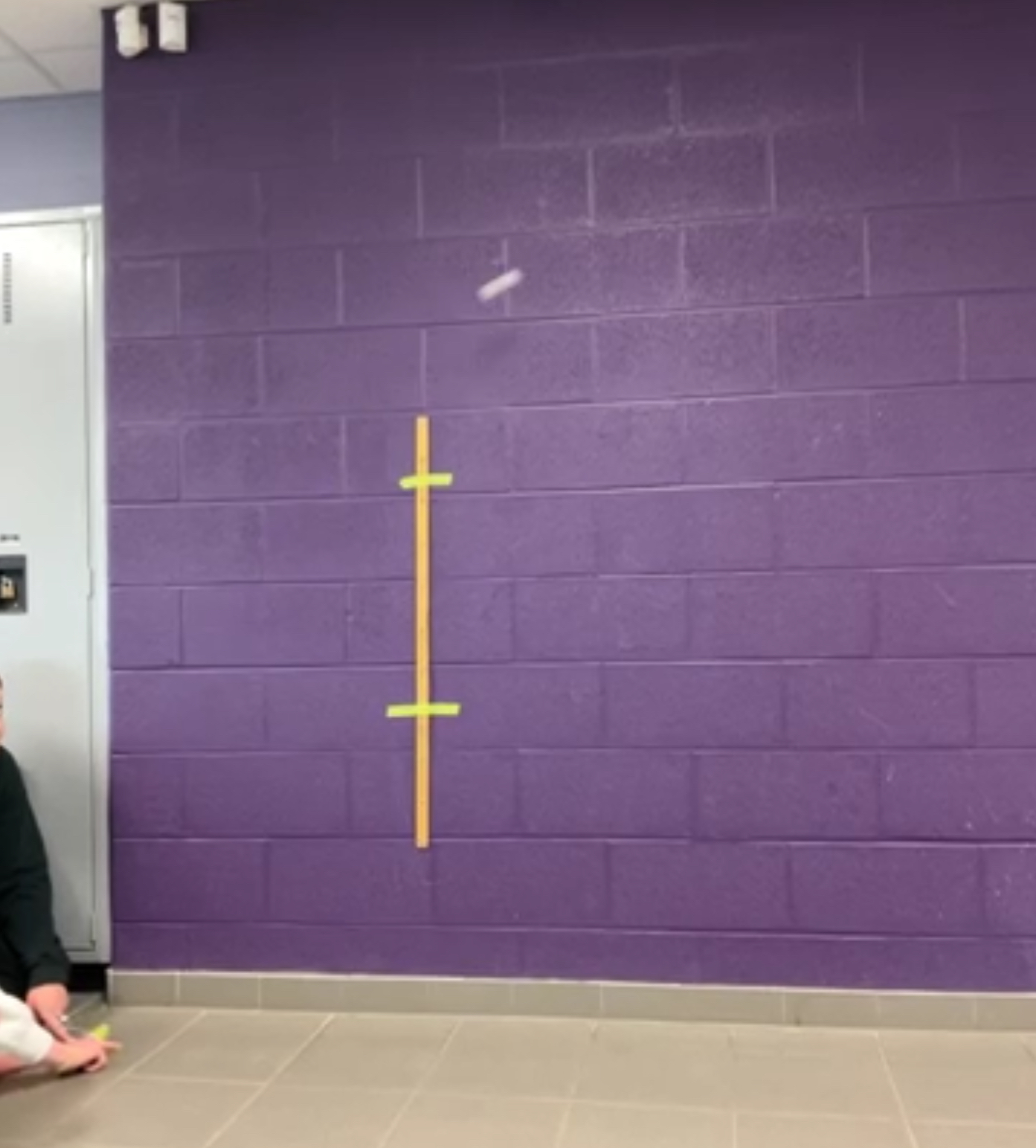
Here’s a different one being tracked. We need to scale the image (that’s why there’s a meter stick on the wall). We need to touch the screen where we see the pompom (we track the leading edge of the blur). The program advances time slowly so we can see the pompom at many points along its trajectory.

Finally we upload the file to a different app where some analysis can be done. In this case we can see a table of values, and a graph with a smoothed quadratic overlayed. The a b c values are given for the quadratic.

The next step for students is to see if they can use the table of values to calculate a similar “a” value to the one the program gives. Also they use both equations to calculate where the pompom lands.
The extensions are questions like: if the catapult was on the floor and trying to hit a target on a chair, determine how far back the chair should be. If the catapult is on a desk, where should the target be on the floor? By adjusting the initial conditions we can play around with how that changes our calculations.
After working in groups for a few days, we will each try to do something similar individually as part of the culminating task.
 Ms. Bearse's Site