Locker Task
Today in grade 9 we challenged ourselves to solve a problem. We experienced productive struggle and persevered for the entire 70 minutes of class time on this one problem.
Here is the prompt:
There are 100 lockers and 100 people. The first person walks past and opens each locker. The 2nd person walks past and closes every 2nd locker. The 3rd person walks past and changes the state (open/closed) for every 3rd locker. This continues with the 4th person changing the state (open/closed) for every 4th locker etc. When the 100 people have walked past the lockers which lockers will be open?
Students worked on representing the problem in a manageable way.

some used 1 and 0 to represent open and closed. Others used mark and no mark to represent open and closed, and other groups used colours to track the open and closed lockers.
It took us a long time to go through the task without making mistakes. Some groups decided to shrink the problem and work on a case of 30 lockers and 30 people.

We eventually landed on the following open lockers:1,4,9,16
From there, some students saw that the numbers increased by increasing amounts in a predictable way. Others saw that these numbers are all square numbers.
The next question is: why do these lockers stay open?
We talked a bit about how we used our multiples to open and close lockers, but also we saw that the factors of the numbers represent the people who touch the lockers to either open or close them.
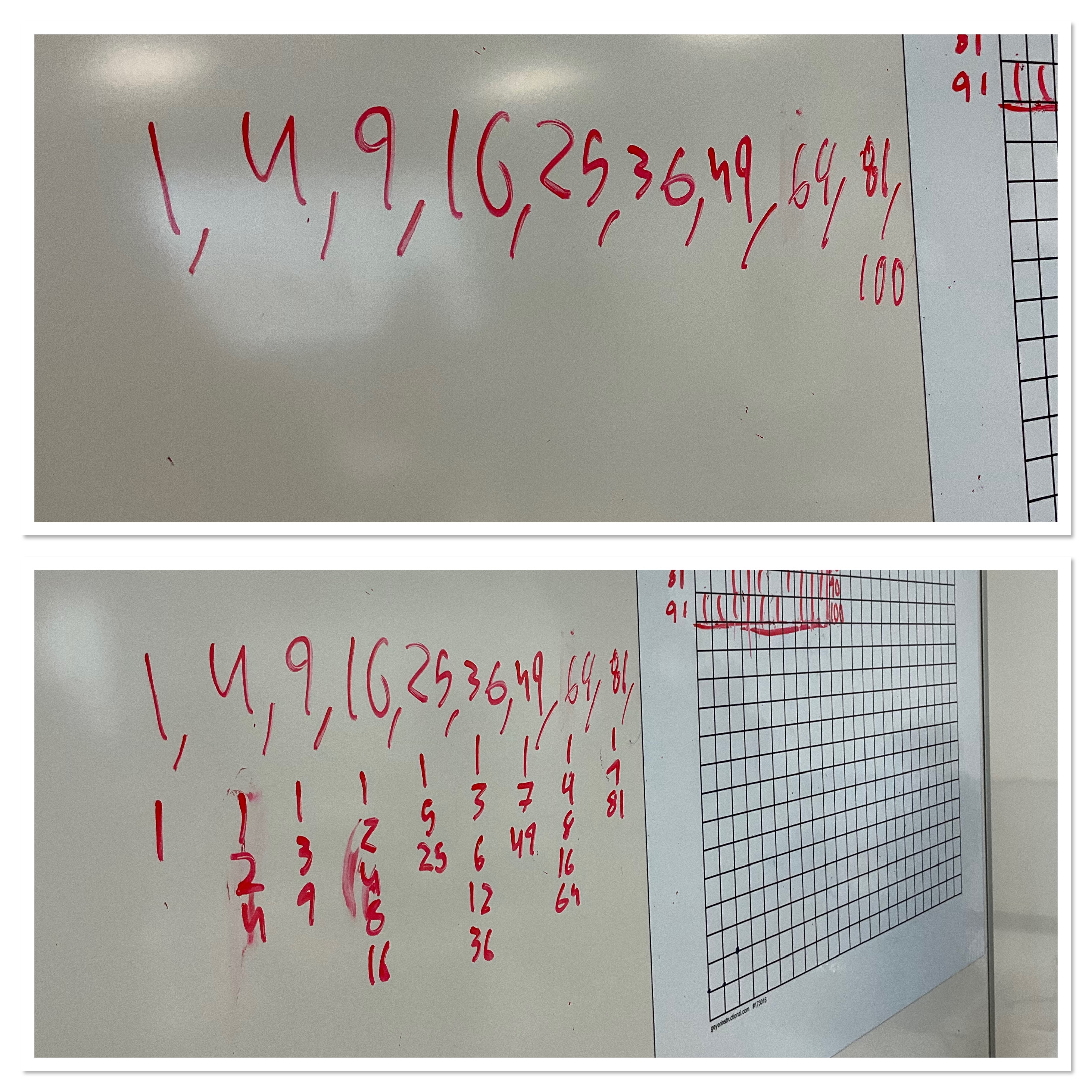
All of the square numbers have an odd number of factors (since the middle factor represents the square), so the lockers are open, closed then open again.
I was impressed by the stamina that was shown in the class, and how they were keen to explore the problem in a few ways, and to make use of their skills in factors and multiples in the problem solving.
 Ms. Bearse's Site