Area of Regular Polygons
Today in MFM2P we looked at area calculations, to review and activate prior knowledge and then apply it to some new challenges.
Groups started with a sheet that led them through some calculations. They worked collaboratively in pairs or groups of 3 to go through these early questions. It’s interesting to me what ideas stick (area=basexheight seemed to be in their memory, but they had forgotten the word parallelogram)

We talked about how you could find the area of the triangle pieces and the rectangle piece and add them up, but ALSO how you could slide the triangle piece over and create a rectangle. The formula for area is still base times height, but we have to remember that height is perpendicular to base always.
Next in the sequence was to look at a right angle triangle and relate that formula to what we know about rectangles. This is half a rectangle, so the area should be (1/2)(base)(height).
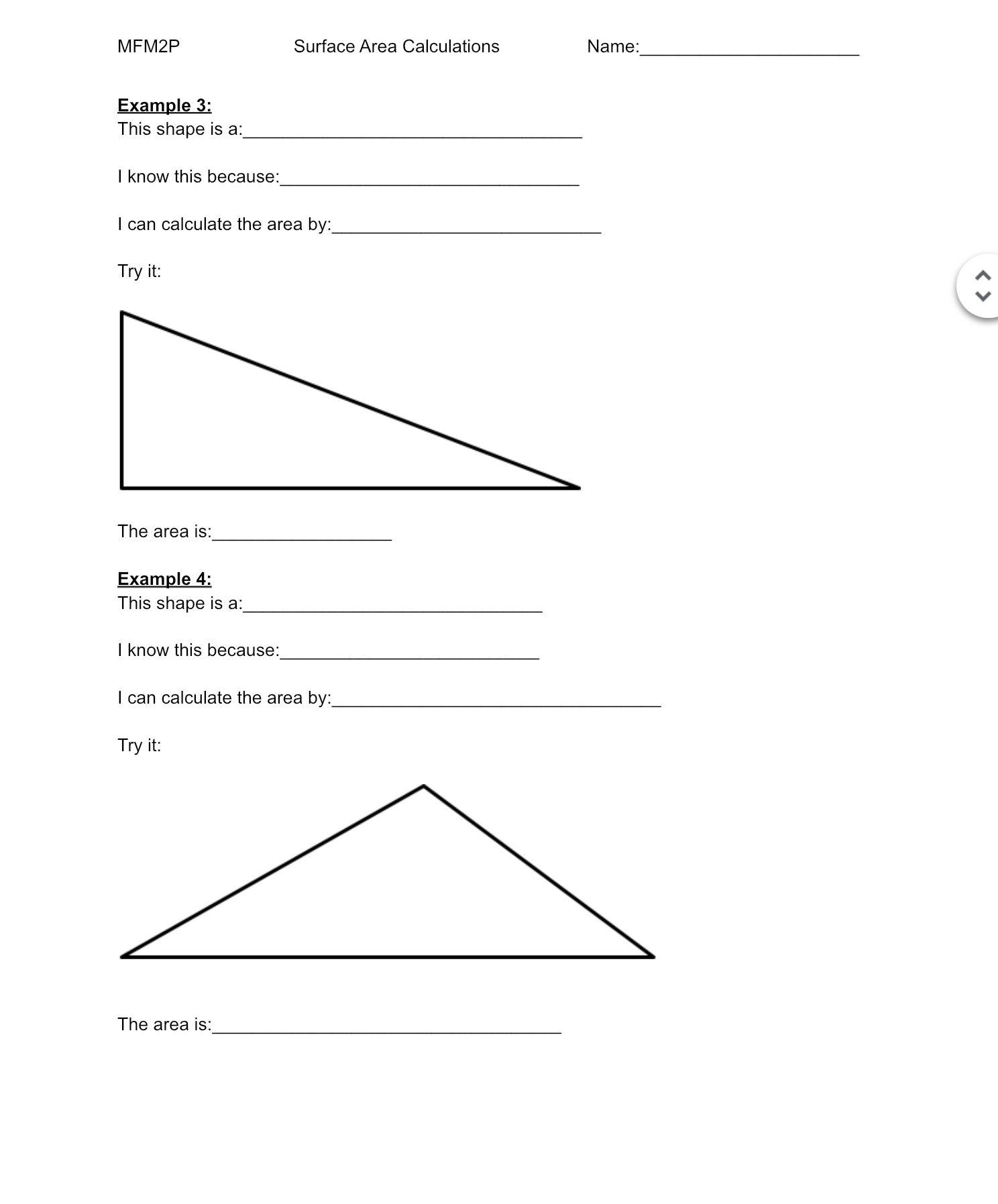
The bottom triangle has the same formula for the same reasons. We can draw a rectangle around the triangle. Looking at each side, half of the rectangle is in the triangle, and half is not.

Next we branched out to regular polygons. This was a bit of a leap, it is so visually different that some students had a moment of giving up. It’s neat to see how we can make a visually different figure appear to be a parallelogram by using scissors!

We drew lines from the corners to the middle, then cut out along those lines. We could fit them together upright and inverted to build a parallelogram. If we cut one of the triangles in half and slide it over we would have a rectangle. The base would be half of the perimeter of the shape. For this dodecagon we can see that there are 6 of the “edge segments” that make up the top and bottom sides of the parallelogram. The height of the shape is the same as the height of one of the triangles. This distance is called the apothem (not an important word, but it’s like the radius of the non-circular shape).

We can make any regular polygon into a rectangle to calculate its area. We can explore how this helps us understand circle areas, but we’re not there yet. This also sets the stage to calculate volume of any regular polygon based prims (and later pyramids).
 Ms. Bearse's Site