Math Workshop
A colleague and I were invited to present a workshop after school all about fostering confident math learners. The audience was a group of elementary educators from our feeder schools.
We introduced our “graph our math life” task which we often do with our students. We thought back to how we felt as math learners and teachers over time. There is a big connection between feeling good about ourselves as math learners and how we will be able to progress through the productive struggles along the way. This task is based off of the work of Liesl McConchie.

We can use this as a springboard for conversations about what the stories we hear about math at home. Some of us grew up with positive experiences and messaging around math and challenge, and others have hit roadblocks where we didn’t have such positive feelings or messages. We know that students are hearing lots of messages at home or in pop culture. We want to be able to refute some of the negative messages they hear, and help them replace some negative self talk with more constructive messaging. Instead of I can’t do math, or math is hard, or I’m not a math person, they can say “math is tough but so am I” or “i can do hard things” or “i’m working on my math skills” or “i’m learning and asking for help”.
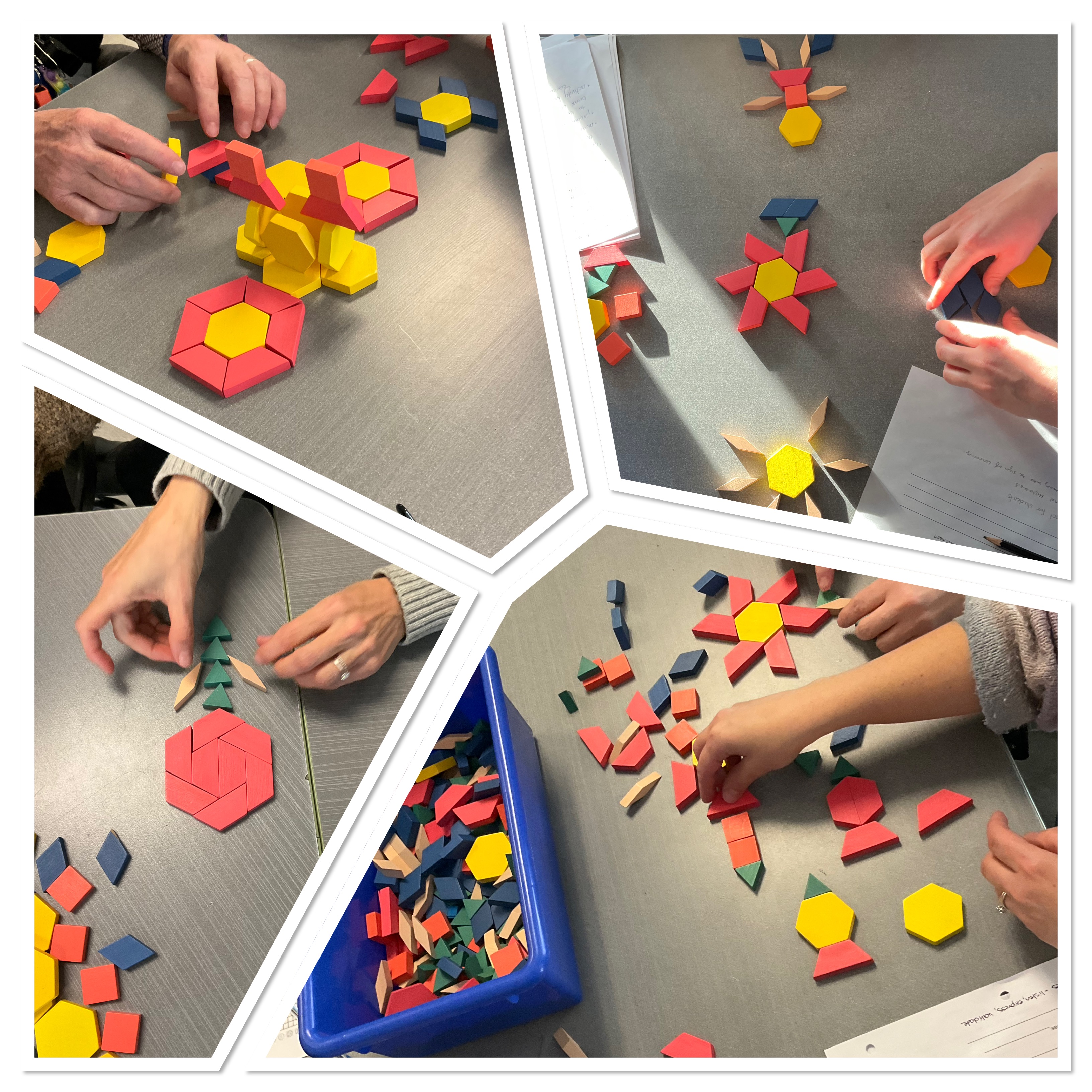
Our next task was to make some art with the patterning blocks. We looked at all the math we could see: rotational symmetry, lines of symmetry, fractions and percent of blocks that are of a certain colour, parallel lines, angles that are complementary, angles inside a polygon, perimeter, area…so many ideas. We also used the first letter of each colour and made an algebraic expression for each picture e.g. 1y+6r+1g+1b=flower
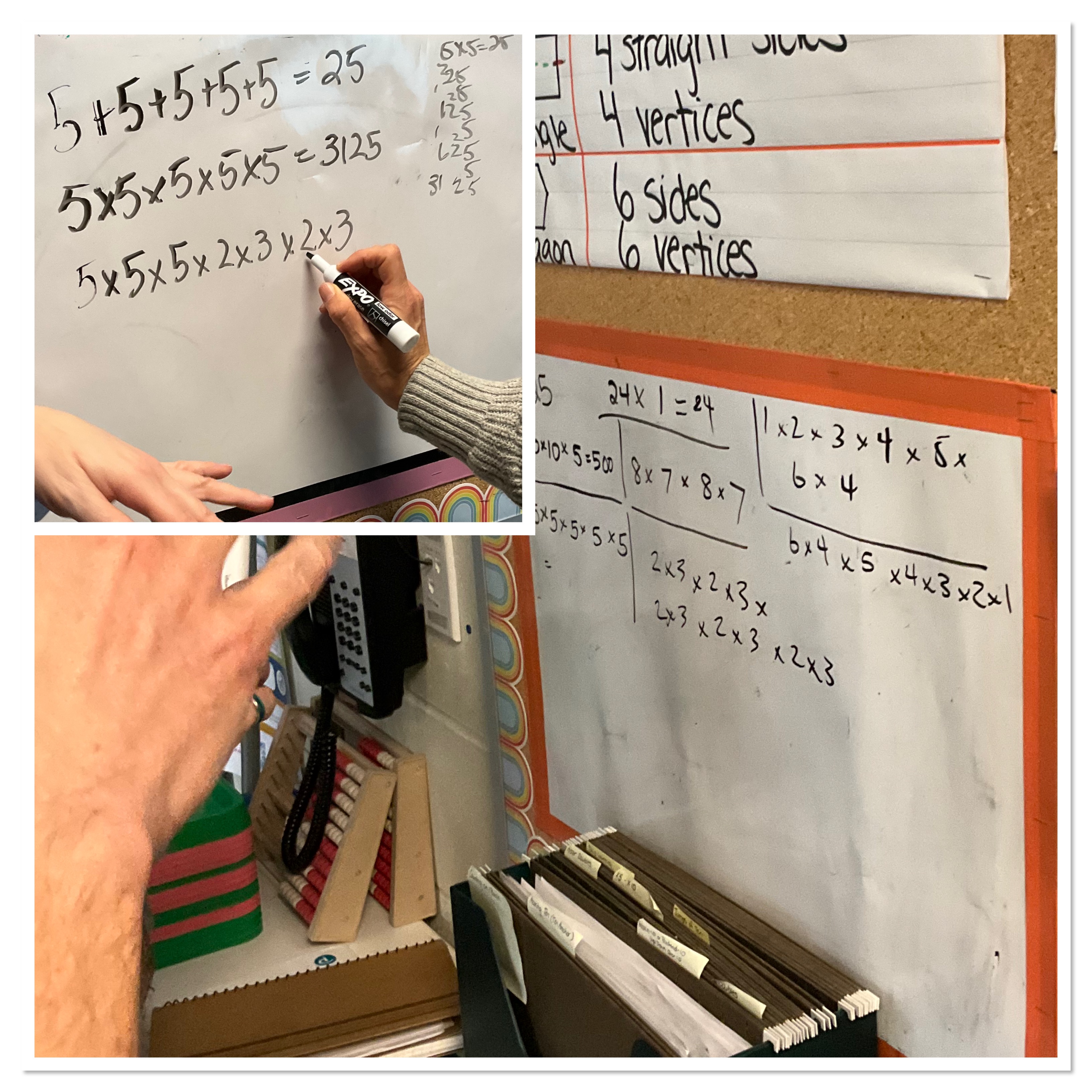
Next we did a thinking classroom style problem at the walls. The prompts were to break up 25 into pieces. All the pieces will add to 25. Next change the addition to multiplication and look for the biggest product.

It was neat to see how teachers of various grades tackled the question in different ways. Different groups imposed different frameworks and constraints. We haven’t yet got to the largest product, but some are still working away at it.
It was a great opportunity to share some of what we are doing at KSS with educators in our feeder schools. We are glad of the invitation and hope to go again in the spring and share some more tasks.
 Ms. Bearse's Site