Making Mistakes
Today was a day that made me glad that I had made a mistake. We all make mistakes, and the response my students had today made me so happy. It was a small moment, but made me realize that my messaging around mistakes is being heard and adopted by my students.
Here was the question that we were doing. Students were working in small groups up at the whiteboards. We’ve done lots of work with sequences and series, and now we are practicing reading problems and interpreting what we need to do to solve them.

After working for a while, one group was huddled by my laptop. The projector screen was frozen, and the students had advanced my slideshow to see the solution to the problem to check their work. I went over to see what they were doing, and they alerted me to the fact that their answer and my answer didn’t match. They had looked through my answer and noted where I had gone wrong. They were discussing how a 710 in one line had changed to a 720 in the next line. I had a look, realized that it was a typo, and agreed that they were right, and mine needed a correction. They told me their answers so I could update the slide, and then they told me that it was ok, it wasn’t a conceptual error, just a typo. They told me that my process was correct and this wasn’t a big deal of a mistake.
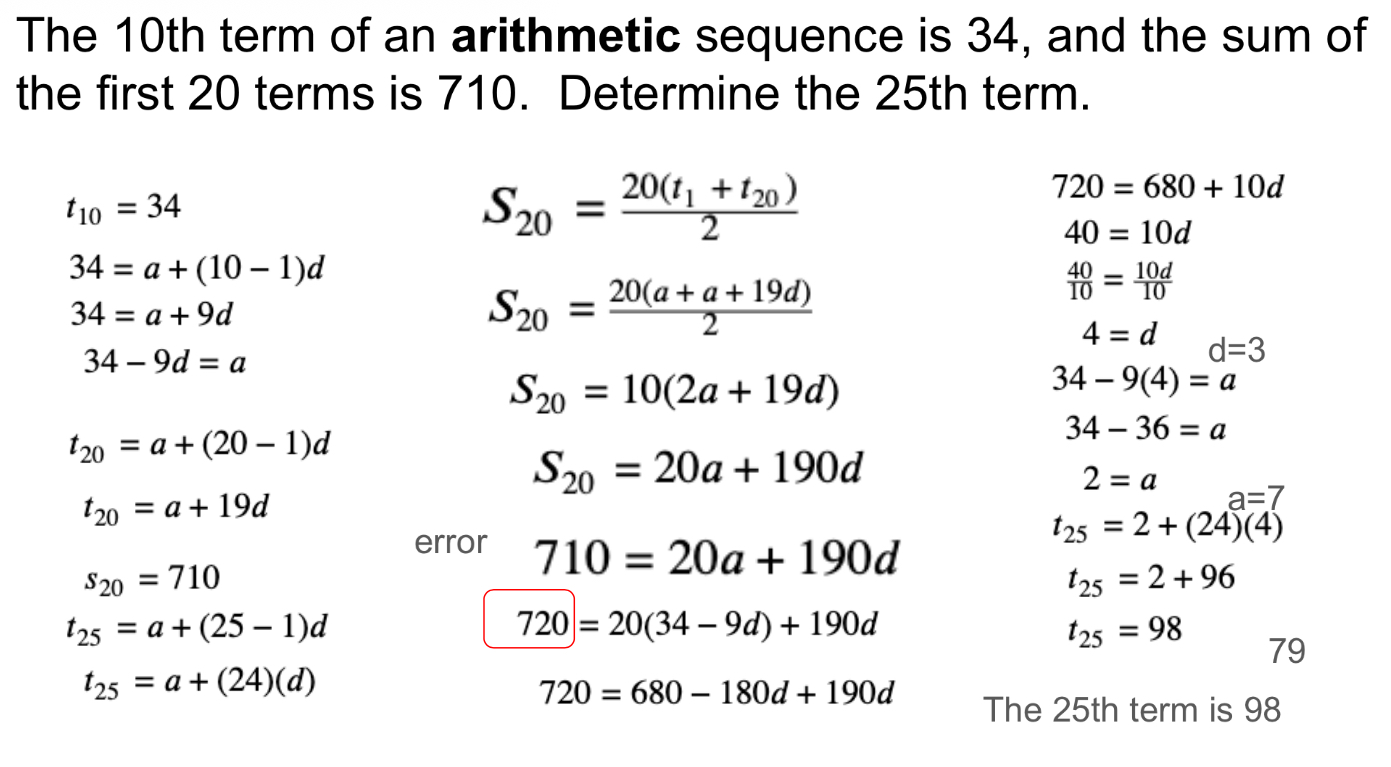
We’ve worked a lot this term on learning from our mistakes. We classify them as inattention (loss of focus or concentration…an “oops”), computation (mistake with integers, order of operations, exponents etc), precision (sloppy work that’s hard to follow/read, incomplete communication for introducing variables or doing final statements, missing units etc), and problem solving (conceptual issues, getting stuck, not having a plan). Each test gets handed back with an error analysis sheet for students to engage with their errors, identify what type of error it was and to write the correct solution. Those pages get handed back to me to get checked, returned, and revised if needed.
Today my students identified the error, classified the error, realized it was an “oops” and carried on. They were polite and respectful while letting me know about the whole thing.
The conversations that followed were pretty rich. We talked about how this question might be marked, and how many marks the question should be assigned. We agreed that a small error like this should not be a large impact on the mark, that this answer would be a level 4 answer, or a 4+, just not perfect, but so close. We’d want to have maybe 5 or 6 points total so that a loss of 0.5 would still leave a high mark for the question.
I’m glad that I made an accidental mistake, and allowed for some time and discussion about it. I’m thankful my students were able to share with me that they are understanding that not all errors are the same, and that they know which ones to worry about more. I hope they will give themselves the same grace they extended to me!

