Beans Update
I’m working with a grade 10 applied math class this semester introducing data collection and modelling tasks. Today we looked at the beans that we attempted to germinate over the past week. We opened up the sandwich baggies and unwrapped the paper towel and noticed thar some beans sprouted, and some rotted, becoming slimy and moldy. There were some different fungus too!
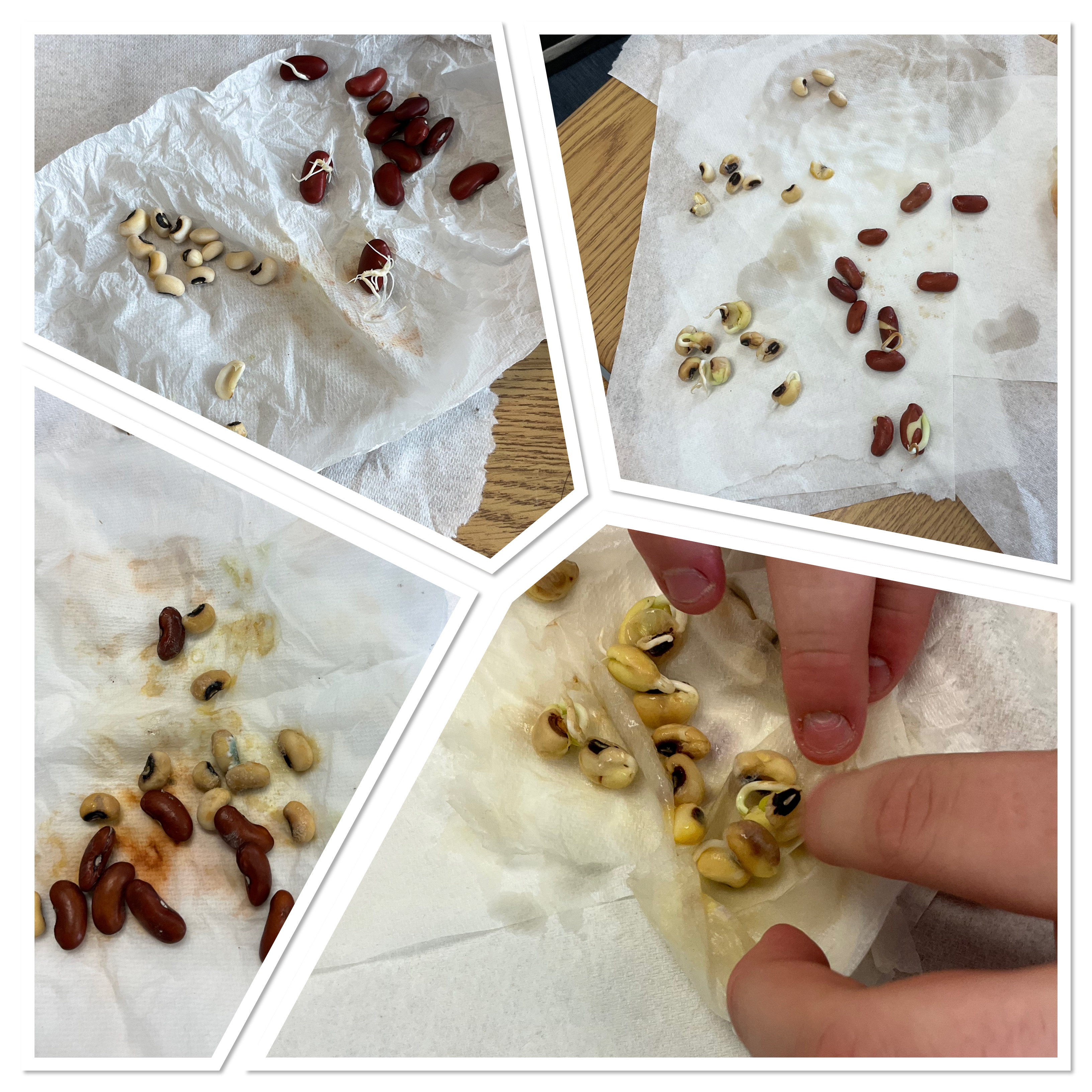
We noted the fraction of the beans that germinated and we will compare that to our predictions we made before planting.
We put the beans in little pots of soil and labelled each one with a popsicle stick. Each bean has a name so we can track the growth of each bean over time. We watered the little pots and have them in a clear bin by the window.
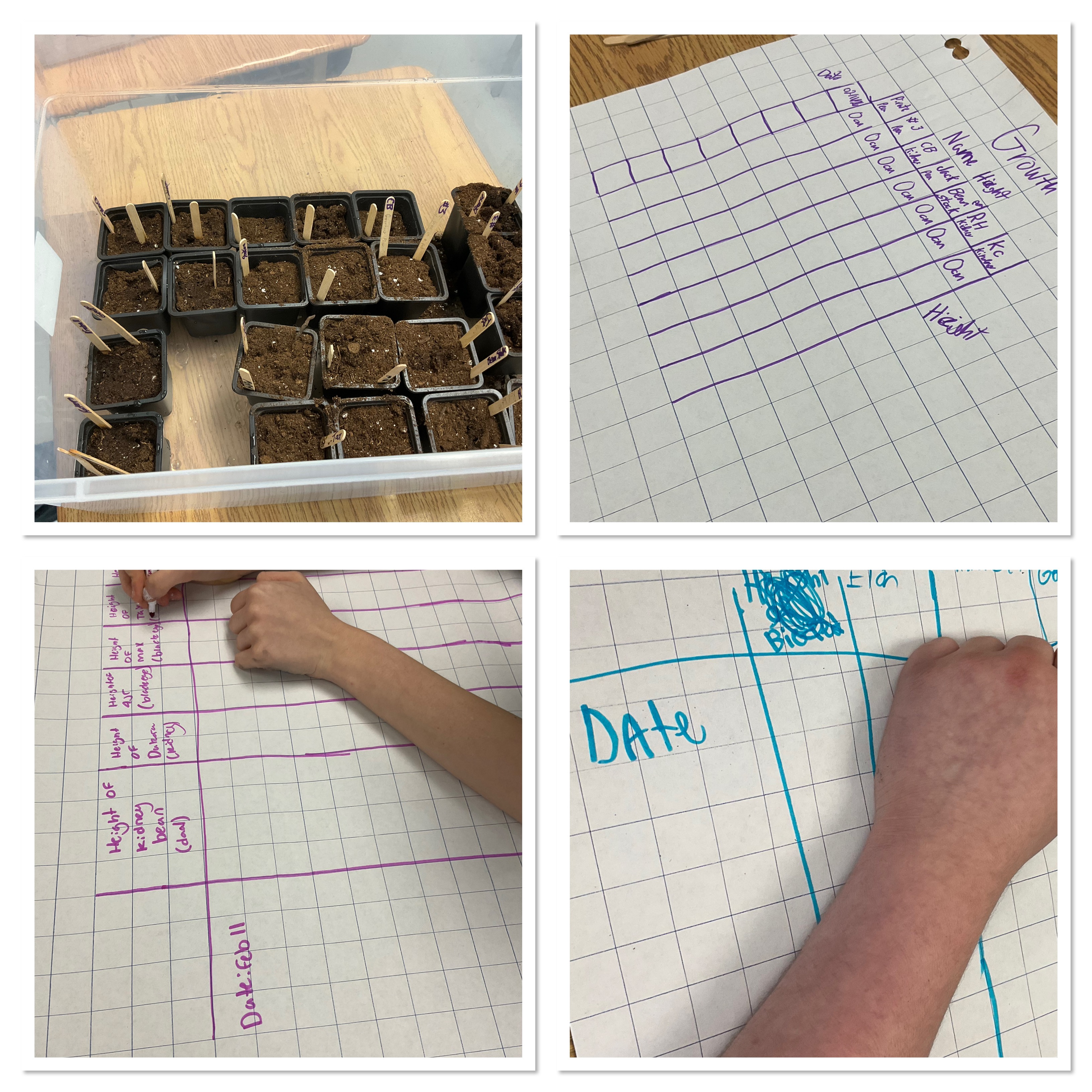
Our data tables are ready for when the beans start to grow. We will be watching every day for signs of sprouts, and adding water as needed.
Completing the Square
Today in grade 11 we worked on completing the square to get to vertex form.
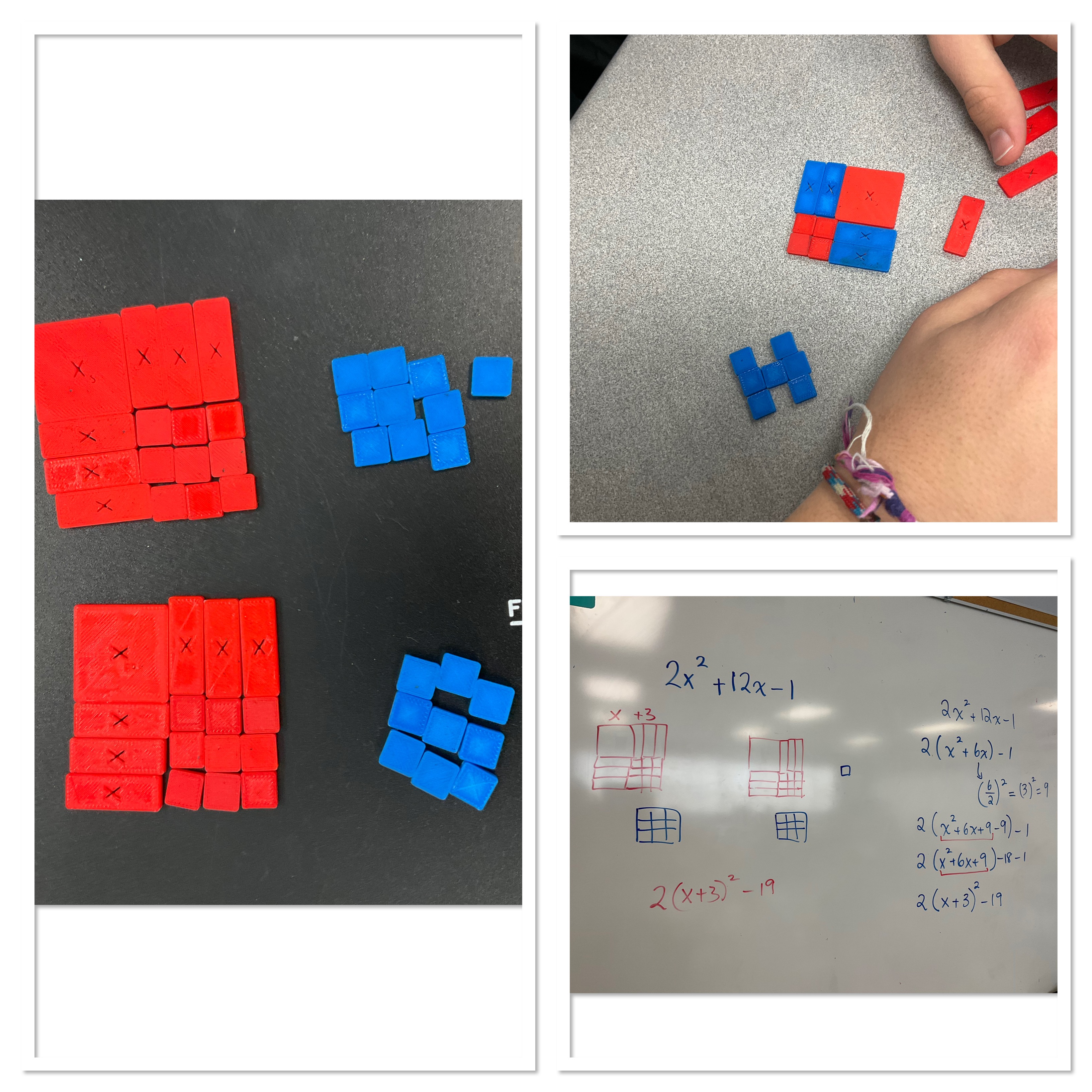
We used tiles, which many of us practiced last year. We connected it to the algebraic algorithm that we can use to complete the square as well.
Locker Task
I was working with 2 different MTH1W classes today, introducing the locker problem. It always impresses me the creativity that the students show as they approach the open questions.
Here is the question: There are 100 lockers and 100 people. The first person opens all the lockers. The 2nd person closes every second locker, the 3rd person changes (open/closed) every third locker, the 4th person changes every 4th locker (and so on). After 100 people have gone past, which lockers are open.
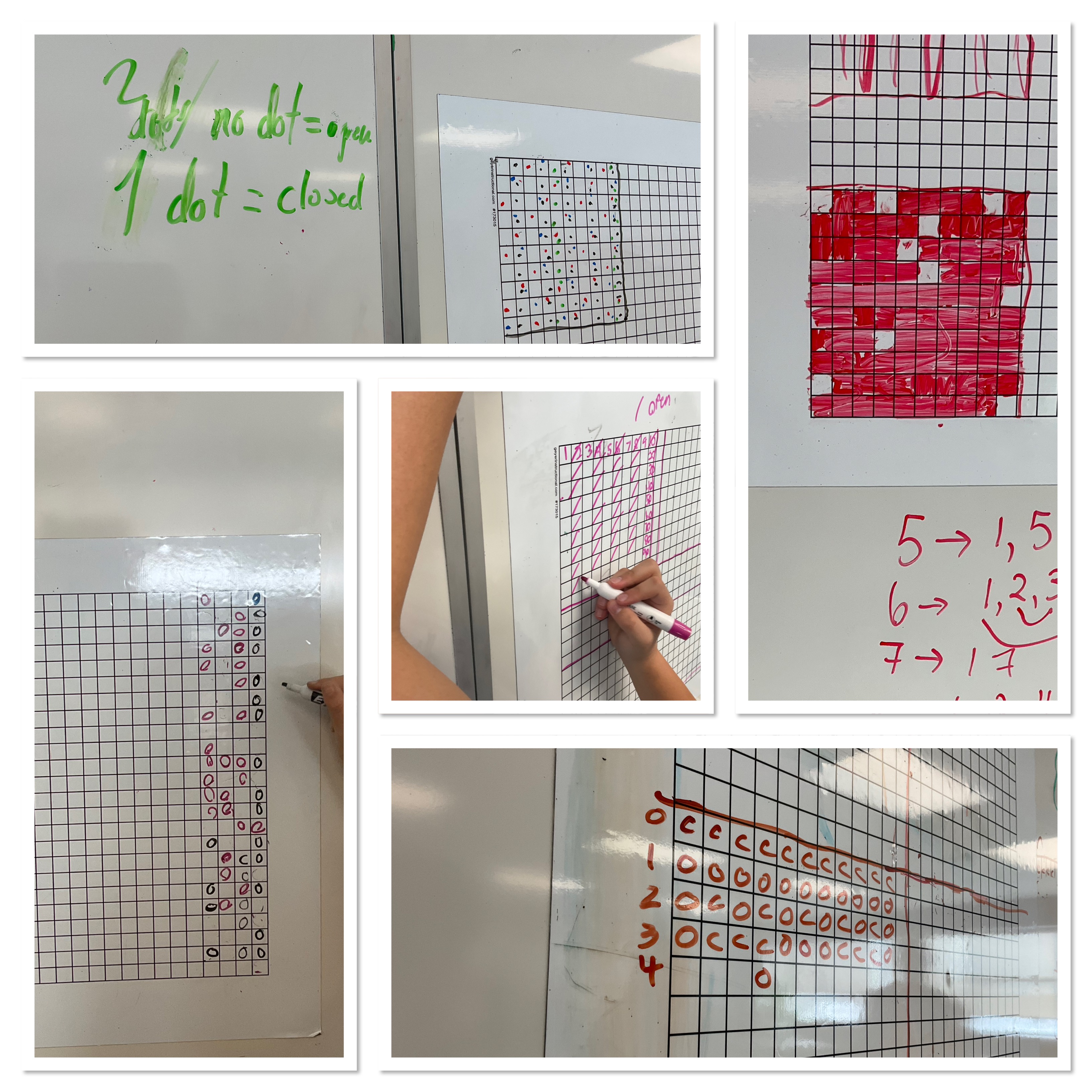
We had groups who drew the 100 lockers and went through each opening and closing them with various symbols ans colours. Some groups modelled the first 10 or 20 lockers and wrote the status of each locker after each person passed by the lockers. This method was easier to troubleshoot. One group used a different colour for each person, and then noticed that if there’s an even number of dots then the locker is closed, and if there’s an odd number the locker is open.
one group was very keen on proving that all prime number lockers were closed. Another group focused on the lockers, and which people touched them, and if it’s an odd number of people then the locker is open.
Others saw the pattern of 1,4,9,16 and could see that it’s perfect squares, and some people saw that in the end that we skipped over 2, skipped over 4, skipped over 6, skipped over 8, and they worked out the pattern from there.
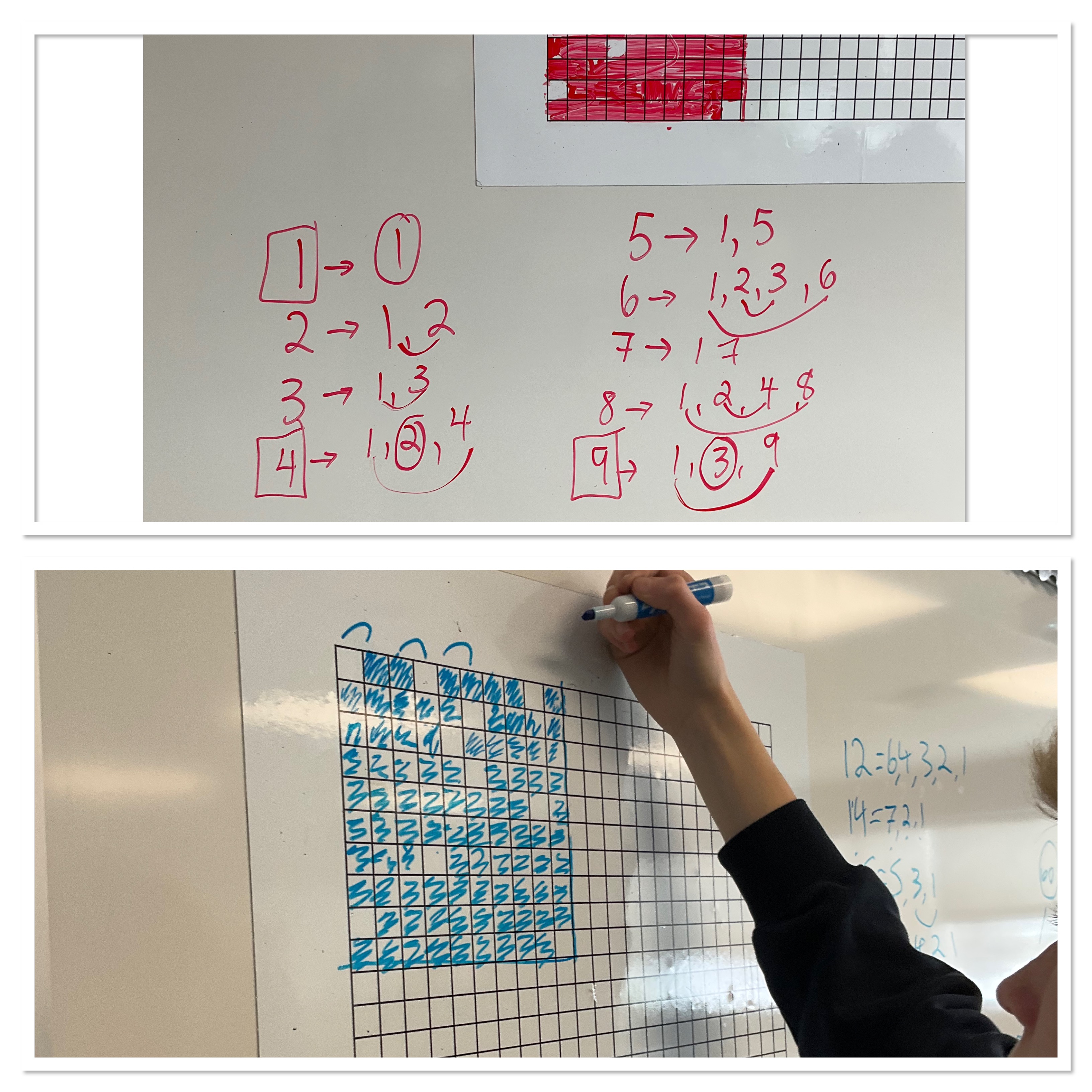
We consolidated the ideas of square numbers, and how they have an odd number of factors since there is a number that is multiplied by itself.
It’s fun to watch students get better at persevering through a challenging problem. We’re off to a good start already!
Locker Problem
There are 100 lockers, and 100 people. Person 1 walks past and opens all the lockers. Person 2 walks past the lockers and closes every 2nd locker. Person 3 walks by and changes the stare (open/closed) of each 3rd locker. This continues and each person walks past changing lockers depending on their position, the 5th changes every 5th locker and the 10th changes every 10th locker etc.
At the end, we want to know which lockers are open.
Students worked so hard in groups to solve the problem. Representing the information was a challenge!
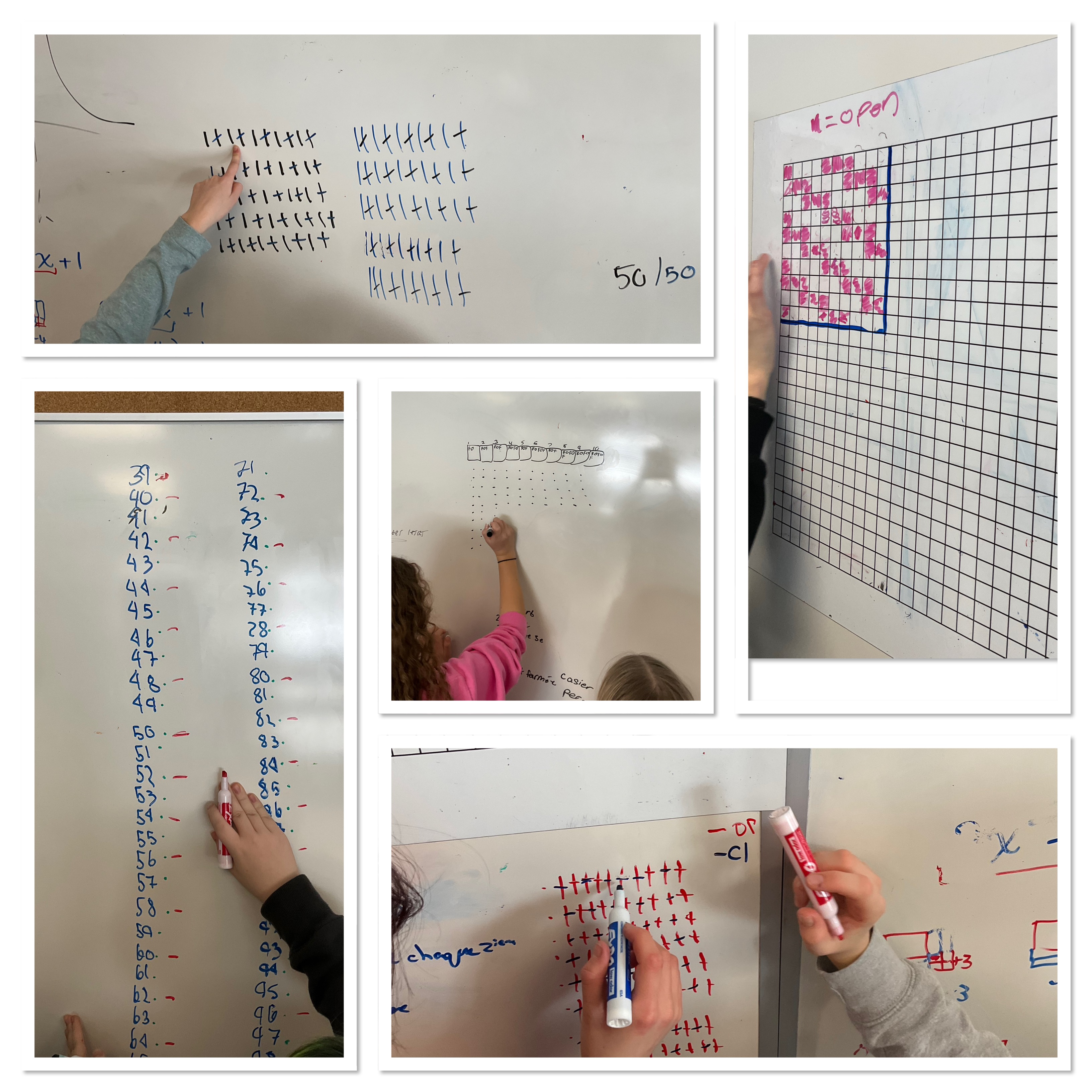
Many groups started to notice some patterns, and then they extended patterns to cover the 100 lockers.
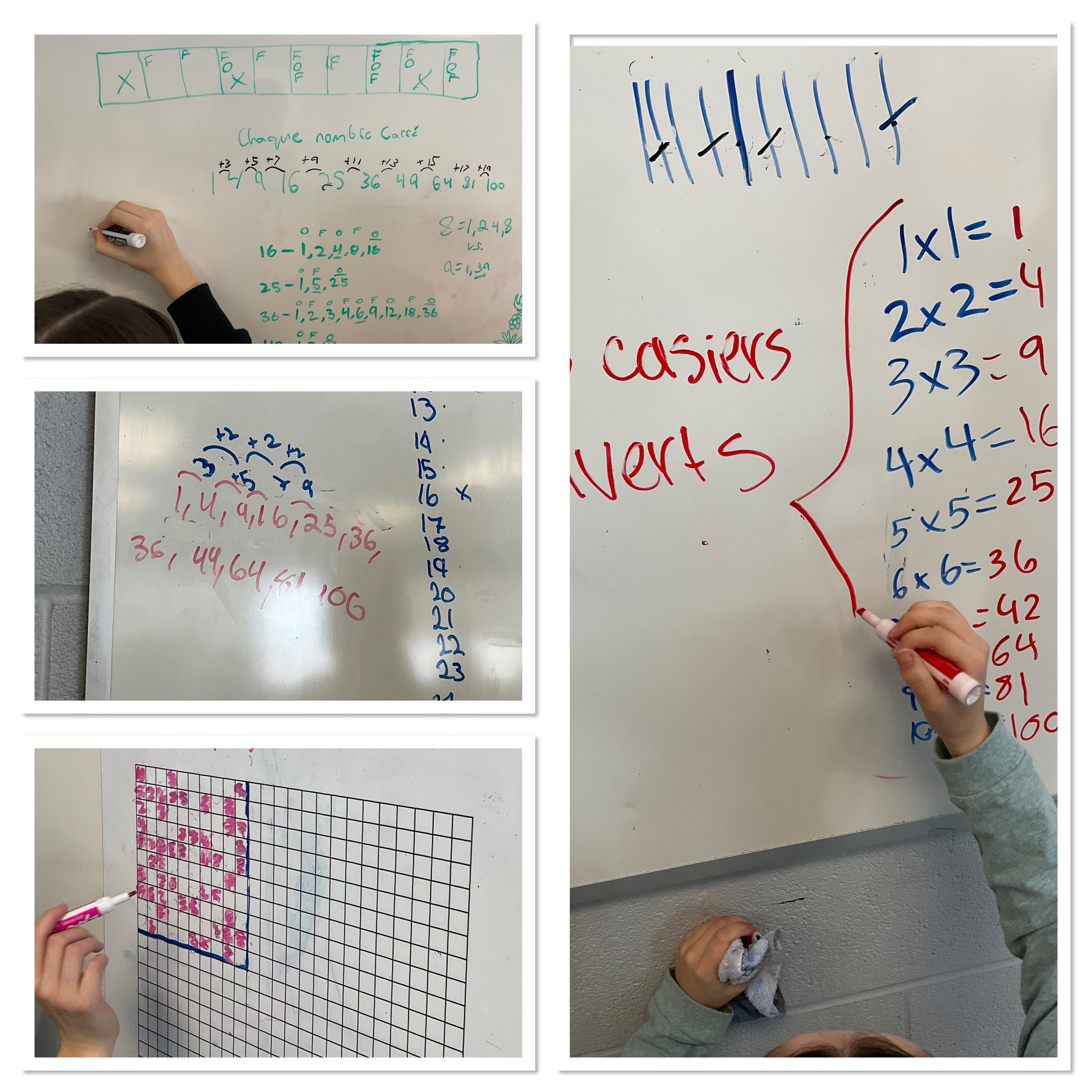
People caught on to the fact that the open lockers will be the ones that are square numbers. This is because they have an odd number of factors. We also noticed that the numbers go up by 3,5,7,9,… and that the 2nd differences (the change in the differences) is 2 each time.
After our debrief and consolidation we took a minute to email families. Students filled in some blanks in an email template, and sent it to me as well as their family. We keep emailing over the course of the term to keep communication going, and to provide moments for reflection.
Parabola Day!
We started our review of quadratics today and also introduced the concept and notation for domain and range.
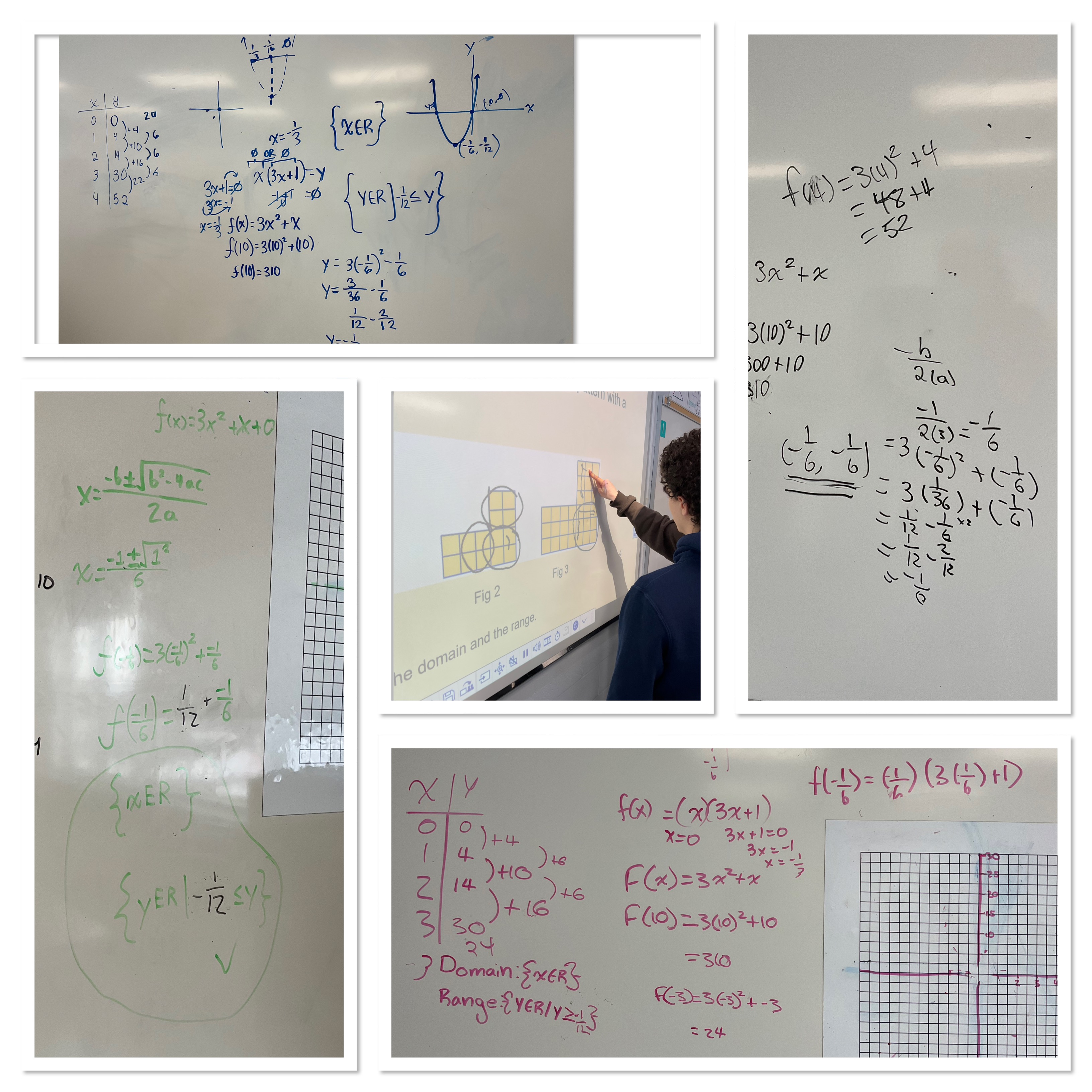
We looked at the visual pattern, modelled it with a function, made a table of values and a graph. We used our prior knowledge to determine the vertex (by factoring, quadratic formula, or knowing that the axis of symmetry is x=(-b)/(2a)). Once the axis of symmetry is found we sub that in as f and calculate the y value of the vertex. The range is going to be based on this value.
I was really proud of how students are helping others, and how many different strategies they are using.
Factors
I was in a colleague’s grade 9 class today and they were working on factors, prime factoring, and identifying common factors, and the greatest common factor between 2 numbers.
I was checking in with students and noticed that some were struggling with the idea of factors, because they were not comfortable with multiplying. They were approaching everything with skip counting, and getting overwhelmed.
As we worked through the factors for various numbers I got out some blocks to use.
here’s an example of the factors of 18.
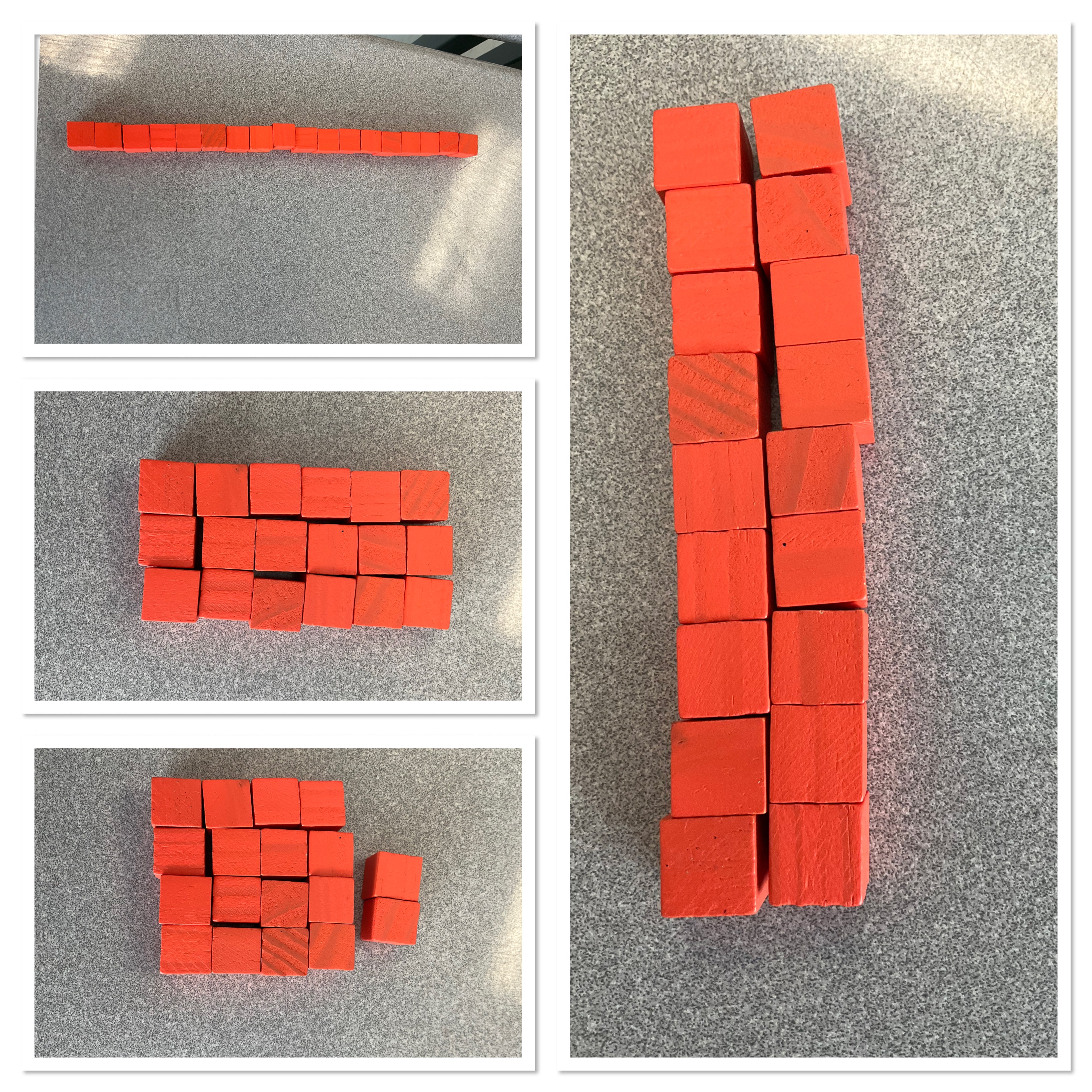
We made the easiest rectangle, 1×18 the dimensions are 1 and 18, and 1×18=18 so 1 and 18 are factors. We next made a 2×9 rectangle using the same 18 blocks. 2 and 9 are also factors. We made another rectangle using 18 blocks with dimensions of 3×6. 3 and 6 are also factors. If we try to make a rectangle with dimensions of 4 or 5 it wont work, so 4 and 5 are not factors.
Having manipulatives on hand is so important. By working with the concrete tools, we can rearrange them in different ways and deepen understanding about factors.
Learning Our Thinking Routines
My grade 9 class learned several thinking routines today. We did a 3 act task, where we started up at the boards in random groups. We did a “notice and wonder” chart as we watched act 1.
We watched it a few times until each group had at least one notice and one wonder.
We debriefed the list of notices and wonders and then set off to determine how many post-its it’d take to finish the picture. Students felt they could do it with the limited information they had, so gave it a good try. I was impressed at their ideas and estimating skills. They weren’t sure of the answers they got, and eventually asked for some more clarifying information.
I wait until students ask for more information to give them the “act 2” material. Here are the dimensions of the post-it and the board.
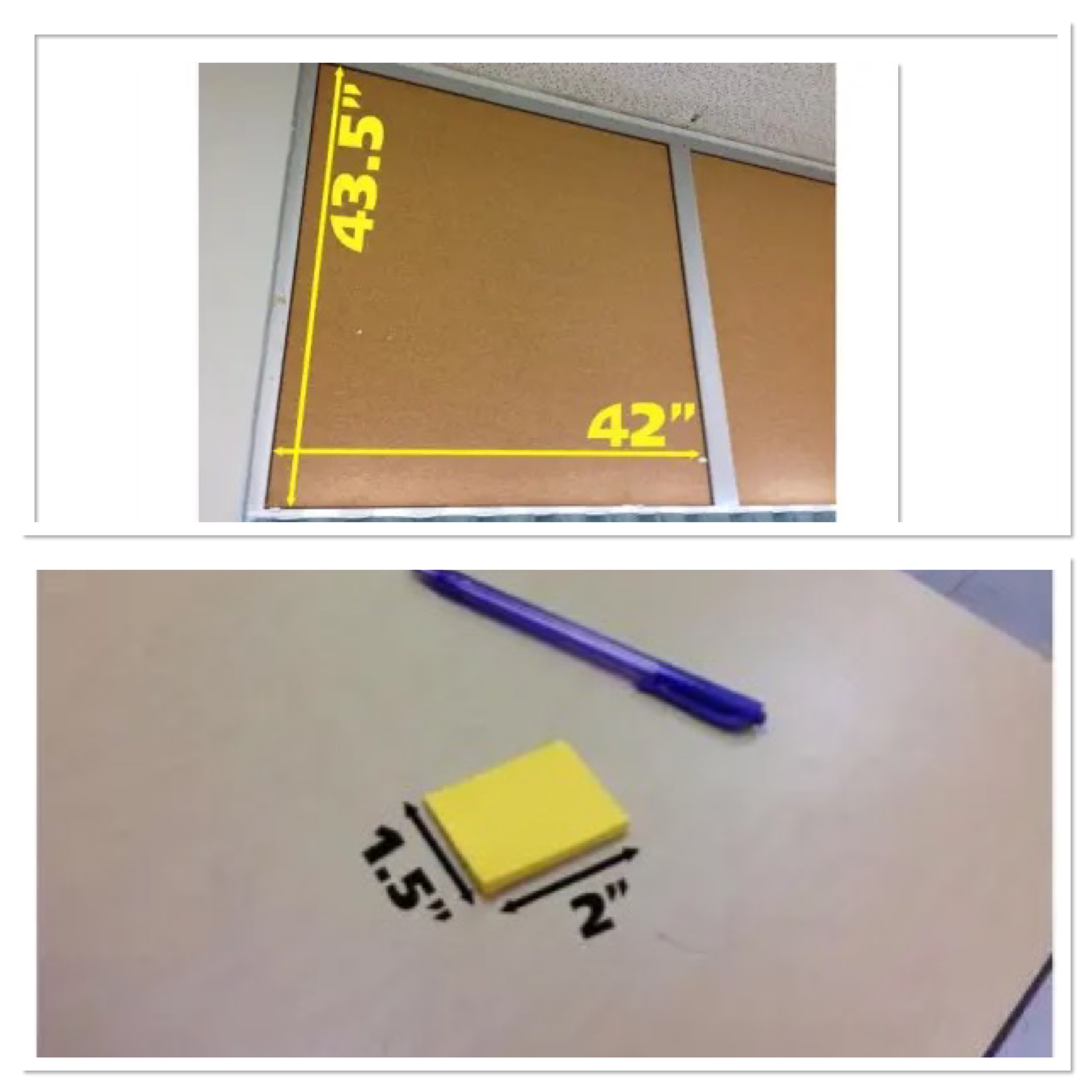
They got back to work again, figuring out how this information helped. I was purposefully not helpful, hanging back to watch how they tackled the problem, and only coming around to get people to stay on task and stay thinking. There’s a lot of good energy, so I didn’t do much but watch the action unfold.
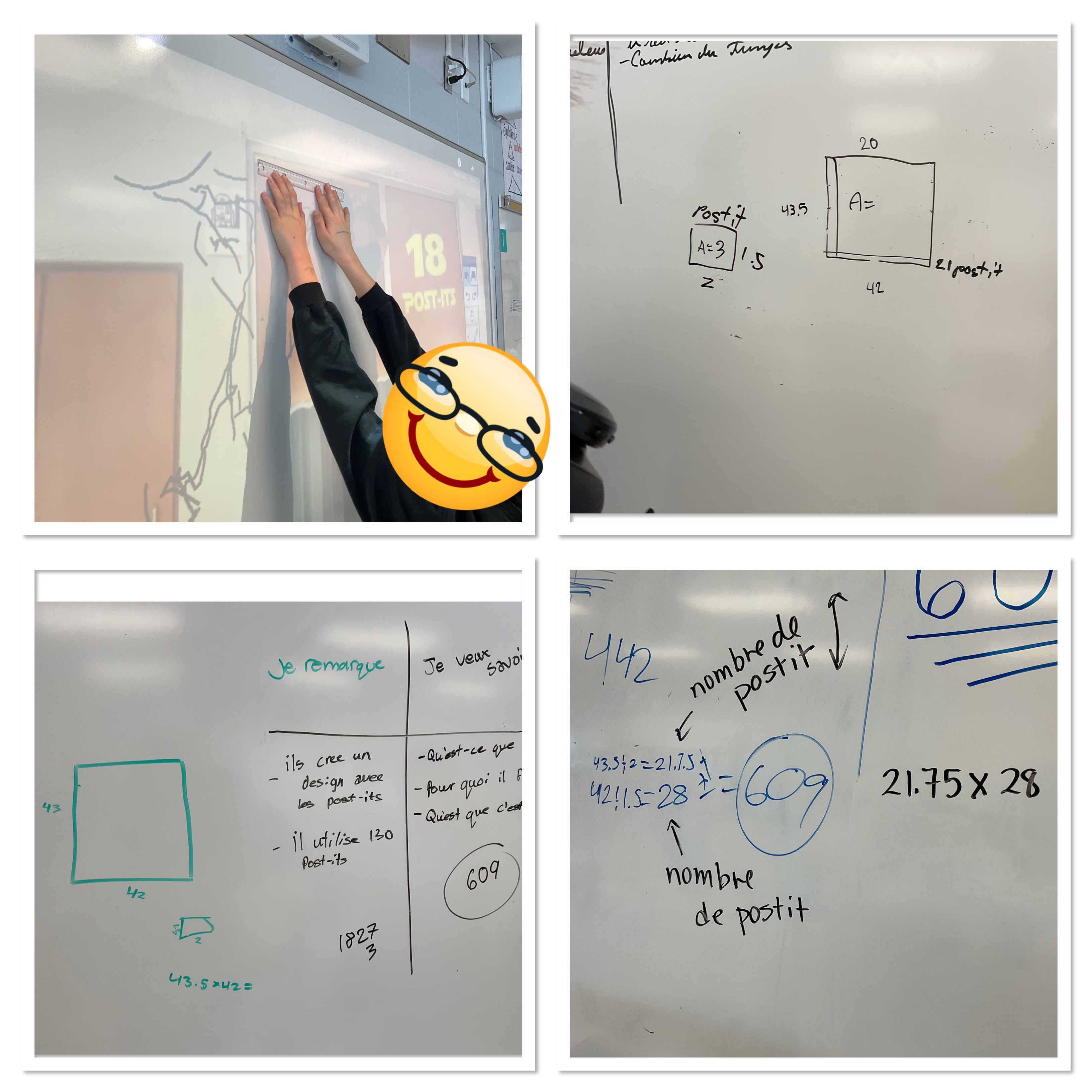
We gathered to the centre of the room, and I consolidated from the edges, we noticed that most groups drew a diagram and labelled it well. Some groups showed their mathematical thinking, and others only wrote some numbers down before arriving at a conclusion. I added some titles or formatted their numbers to be in equations to show how we can improve our communication, and I also pointed out how some groups solved it by doing area calculations and then dividing, while other groups divided dimensions of the board by dimensions of the post-it and then multiplied those values to find the answer. There were 2 solid approaches, and both were shown.
We sat down and then watched the final act
We had succeeded in our first 3 act task. We will be doing more of these over the term, and the process of getting into groups, up at the boards, noticing and wondering, asking for information, calculating and communicating, and consolidating will get better each time we practice.
We next looked at the thinking routines used for number talks. We did several dot talks today (images from here)
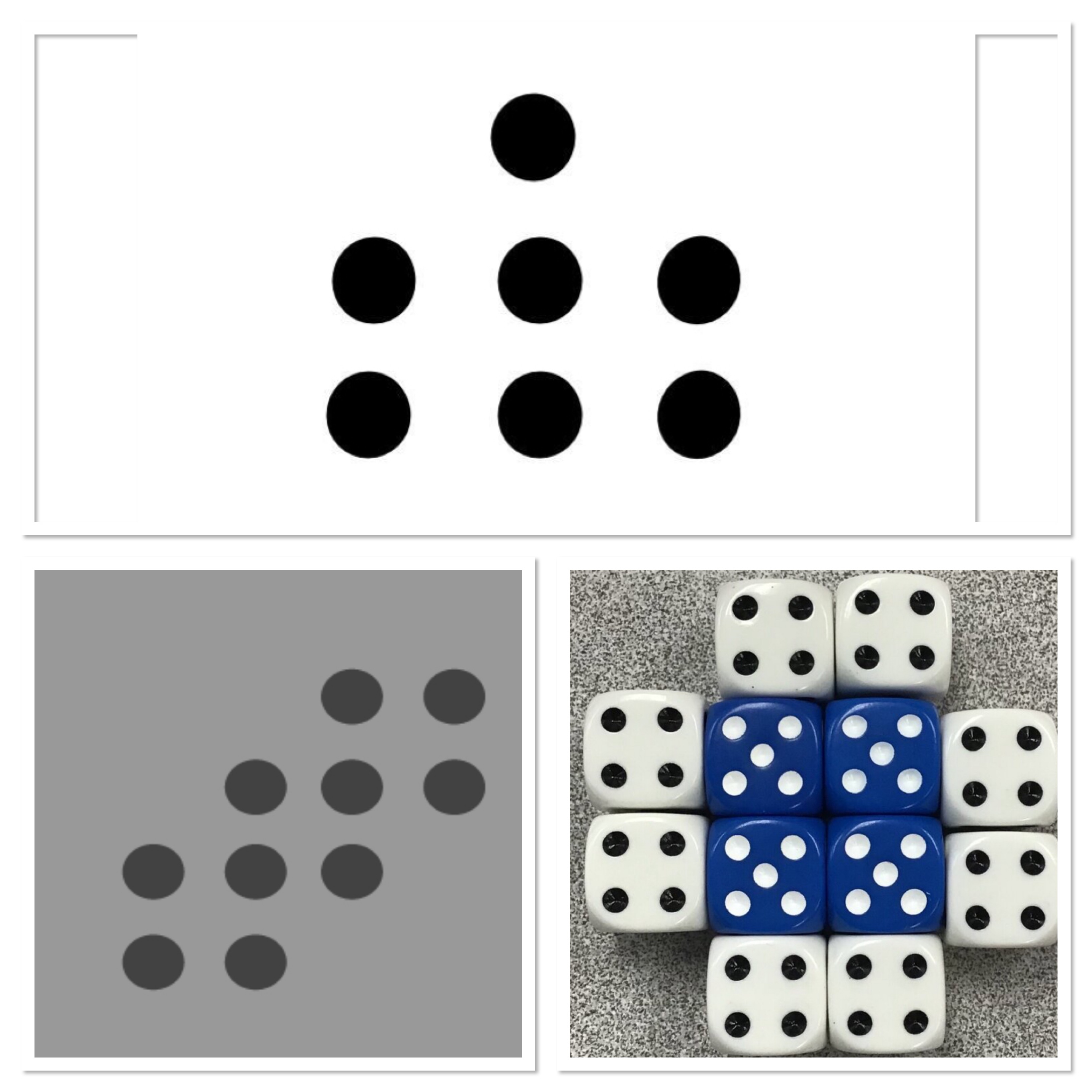
Each of these images were shown for about 3 seconds with the prompt: how many dots are there, and how do you know?
We mostly got the right answer, but that’s not the point. Looking at how we got the answer allowed us to see that different brains process the visual information in different ways. Using the projector markers we outlined how different people viewed the information in different colours, and in the end we saw that we can see things in different ways and that’s cool. Our different approaches can help others see the situation differently as well, so it’s important to share our ideas and viewpoints. We talked about subitizing and also being able to take a visual snapshot and keep it in your head to process when the image is gone, and how those skills can be worked on too.
The final image with the dice led to some conversations about multiplication and how we could represent the process we used to get the answer with algebra. Many did 4×5+4×8, but others did 4×5+4(2×4), and others did 4×8+2×10. Some even saw each dice as a 5 to start since counting by 5 is easy so they did 12(5)-8. Again, it was neat to see different approaches, and also to see how the enthusiasm to share their approach was building in the class.
We looked at the “which one doesn’t belong” routine as well, to spark conversation and get everyone keen to participate.
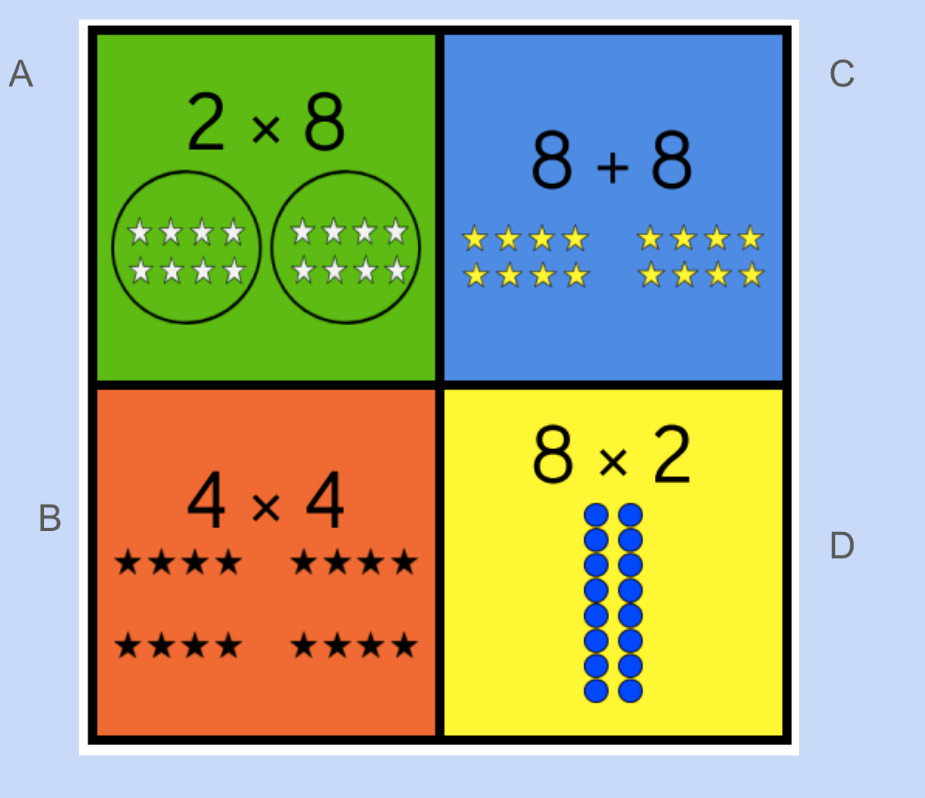
We noticed that there was multiplication and one addition, so maybe corner C didn’t belong. We noticed that each corner had an 8 except corner B, so maybe it didn’t belong. We saw that corner A identified 2 distinct groups, in circles, so maybe A didn’t belong, and that corner D has an array, and also we’re counting circles not stars, so maybe D doesn’t belong. There are reasons for each corner to not belong, and we can debrief ideas like “groups of” and repeated addition and multiplication and arrays. We had a lot of participation in the thinking and sharing of ideas, which led to lots of participation in our next number talk: “how many eggs”?
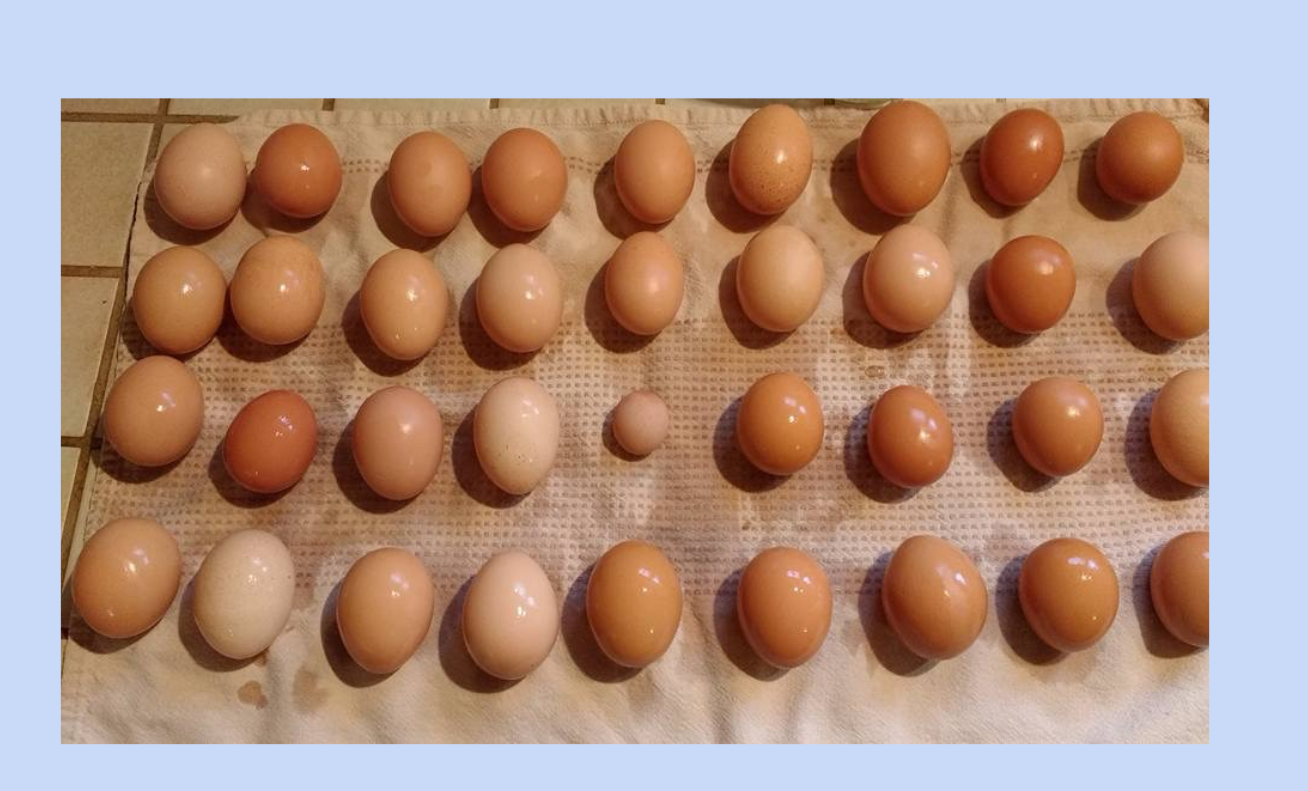
These talks are not so much about the answer, but about how we get there, and appreciating and sharing our thinking. Some immediately saw an array 4×9, but others said they counted groups of 8 (4×2 seen vertically) and there are 4.5 groups of them. I took the opportunity to show the skill of “doubling and halving” and how we could double the 4.5 and halve the 8 and arrive at the 4×9 multiplication as well. Others were keen to show how they counted by 2s, or counted by 4s, or how they subdivided it into 3 dozens. (2×6), (2×6) and (3×4) which again was lovely as a way to see how arrays of 12 can have different dimensions. As we debriefed, I was trying to touch on some multiplication fluency, as we will be embedding fluency as we proceed most days when we can.
Finally, since there was some time left, we got back to the boards and did the 4 4s challenge. Using only 4 copies of a number 4, and all the mathematical operations, and any exponents, and brackets, we were trying to create expressions that have a value of 1,2,3,4,5,6.7,8,9,10. I started them off with 4+4-4-4 as my example of how to get 0.
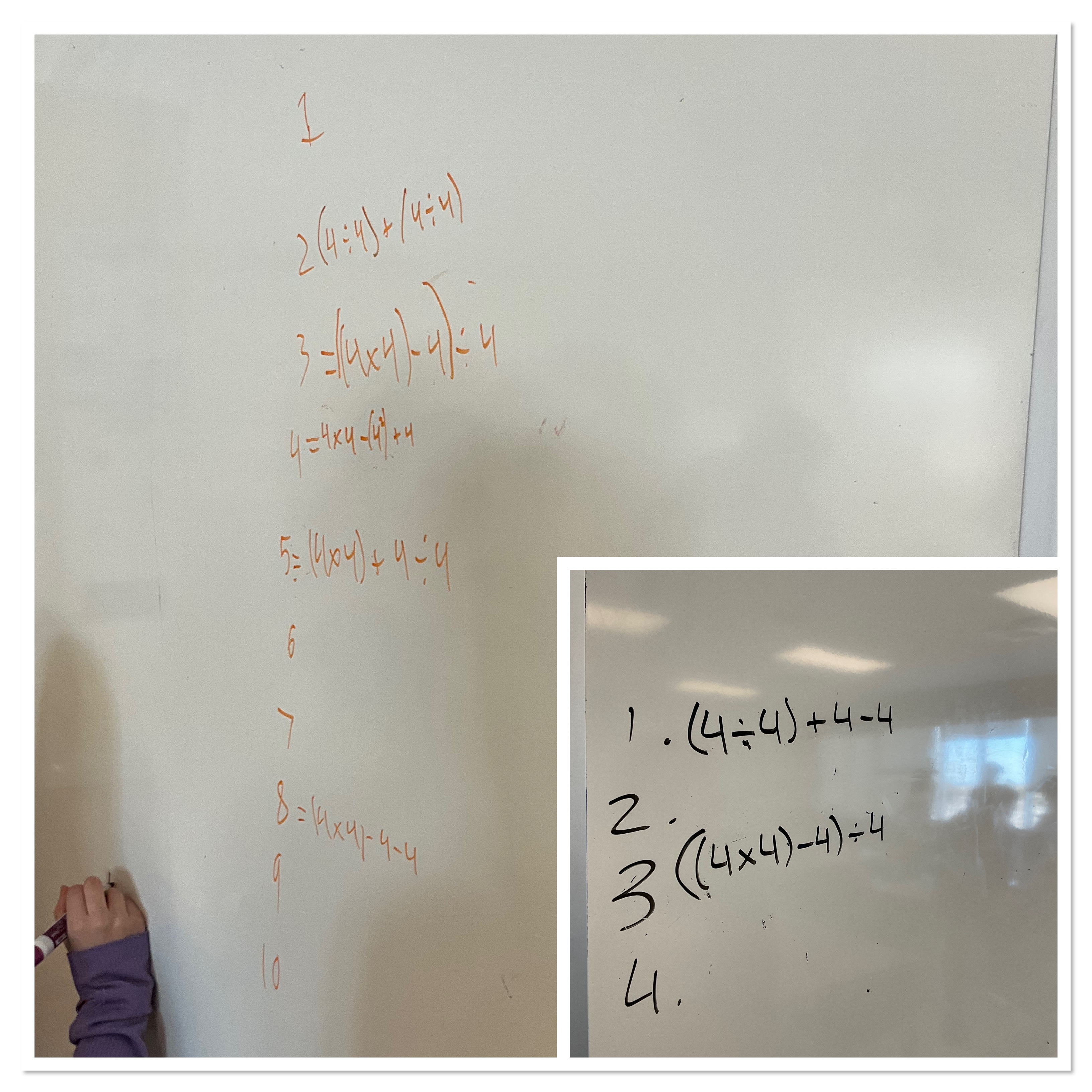
We had so many great conversations about if brackets are needed, and where to put them. Students were talking about BEDMAS before I got the chance! I love it when that happens. I just need to echo their “bedmas” realizations out loud to the class when I hear it as they work at the walls, and then so many memories are jogged, and they are all discussing what order to write things, or where to place brackets.
In the final moments of class (I am amazed at how much we covered) there was time for one of my favourite songs.
What an earworm!
Looking forward to more fun tomorrow. We’re building the routines we will use all term. So far it’s going great!
Unusual Baker
Today I was in a grade 9 math class while they worked through the unusual baker task from building thinking classrooms. There’s a baker who cuts cakes in unusual ways. If each cake has a total price of $10, what is the price of each piece.
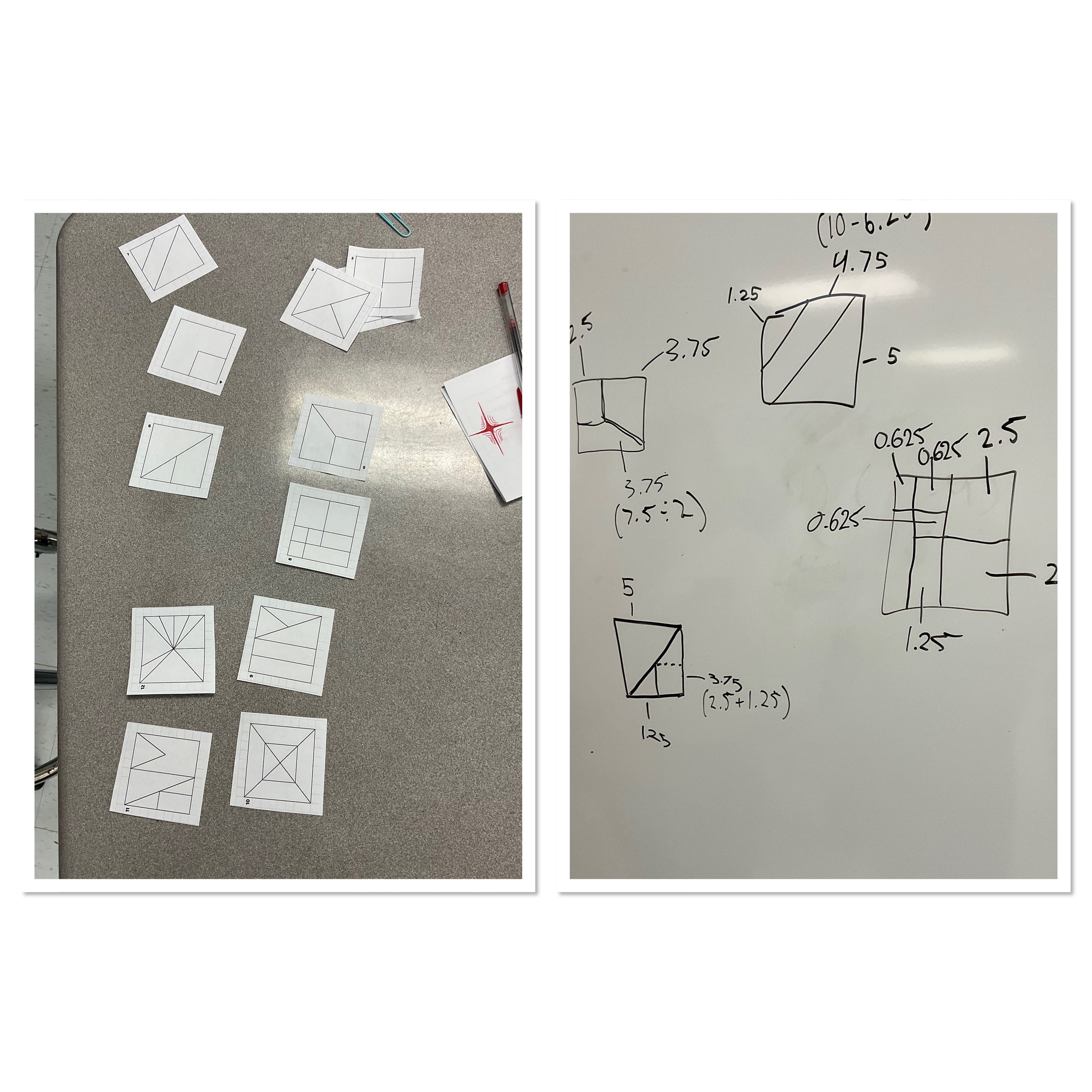
The class was using their reasoning skills and their fraction sense to split up the cake and split up the price. Once groups were done with one cake, they got the next more challenging cake to try.
I was working with a group that were unsure of how to approach the question. The visual representation was too abstract, so I brought it back to the concrete. Sometimes that will help.
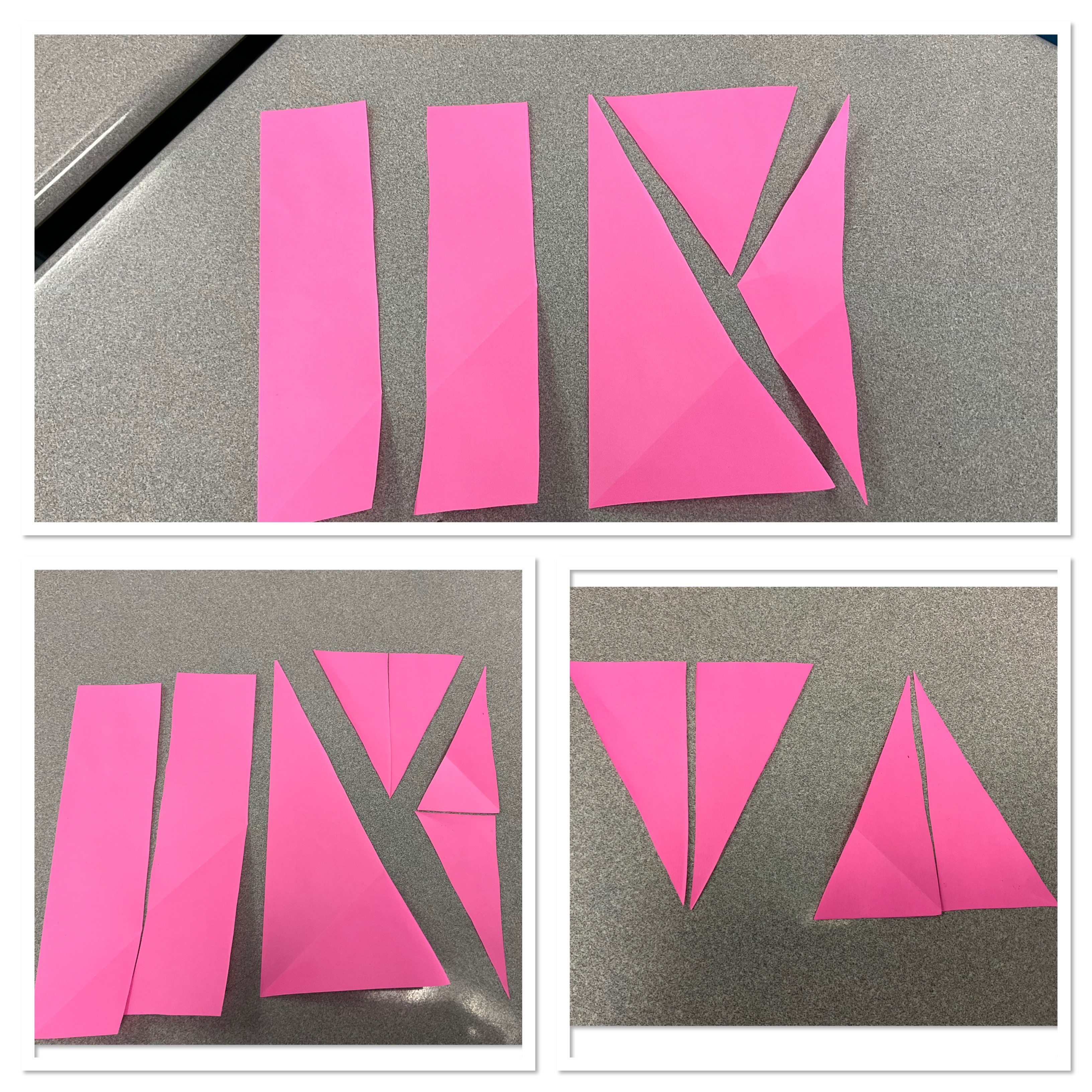
we looked at the entire cake, and one by one cut it up. We agreed that the 2 thin rectangles make up 1/2 of the cake, so they are each $2.50, and then with a bit more cutting and rearranging we could see that the big triangle was also half of half of the cake, so it is also $2.50. The tricky part was the 2 smaller triangles. If you cut the 2 smaller triangles in half, then rearrange them they are equal in area despite being different dimensions, so they are each $1.25
The concrete representation helped these students understand that 1/4 can look quite different, it could be a square, a rectangle or a triangle.
Factoring and expanding
Today in grade 11 we continues to work on factoring and expanding. We saw how the area model can be helpful when multiplying all kinda of things, like binomials, trinomials, and even mixed numbers. Arrows and the distributive property also work, but sometimes we can lose track of what we’ve multiplied.
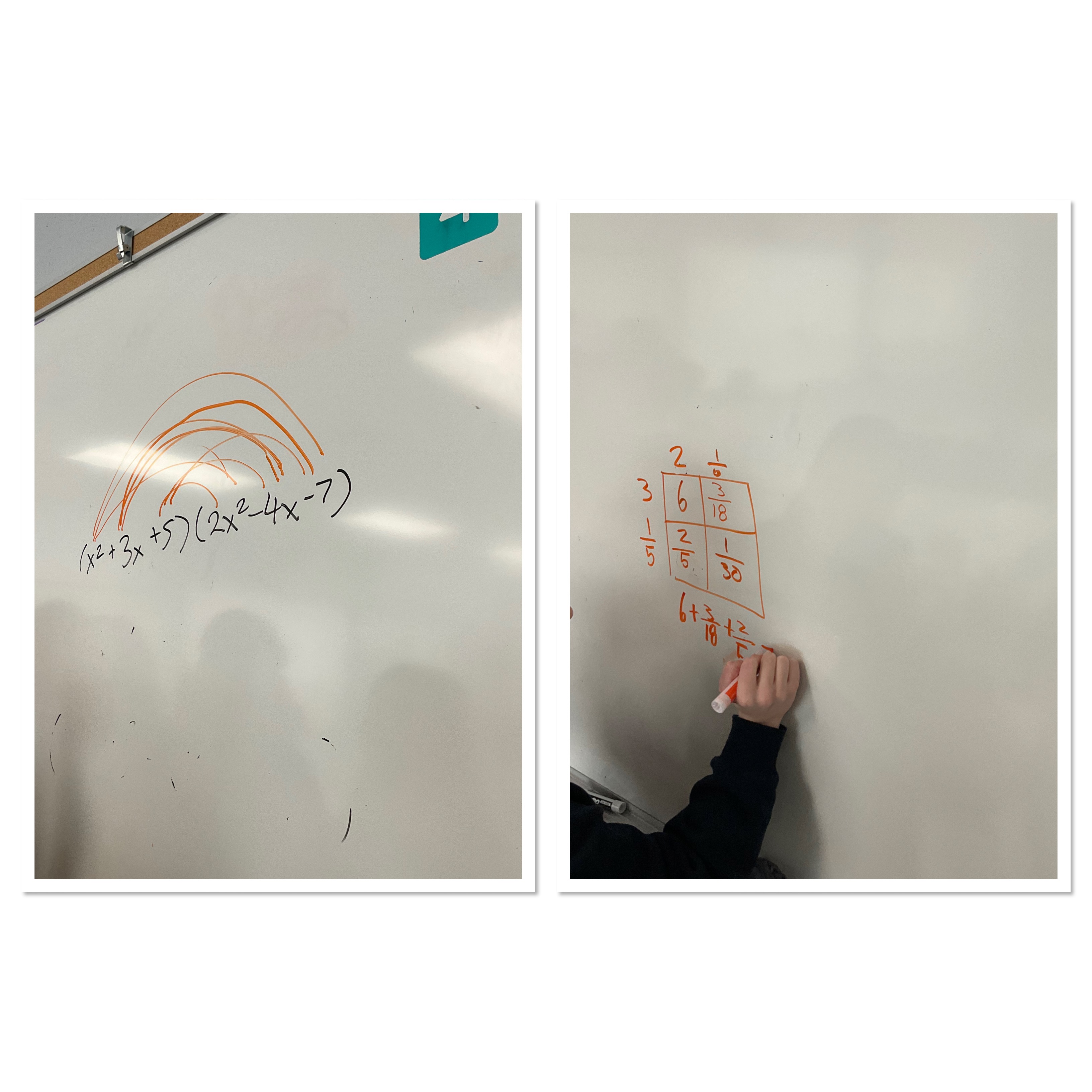
Here are 2 groups who tackled the same question in 2 different ways. The area model allows us to see that like terms are all along the diagonal and easy to collect together.
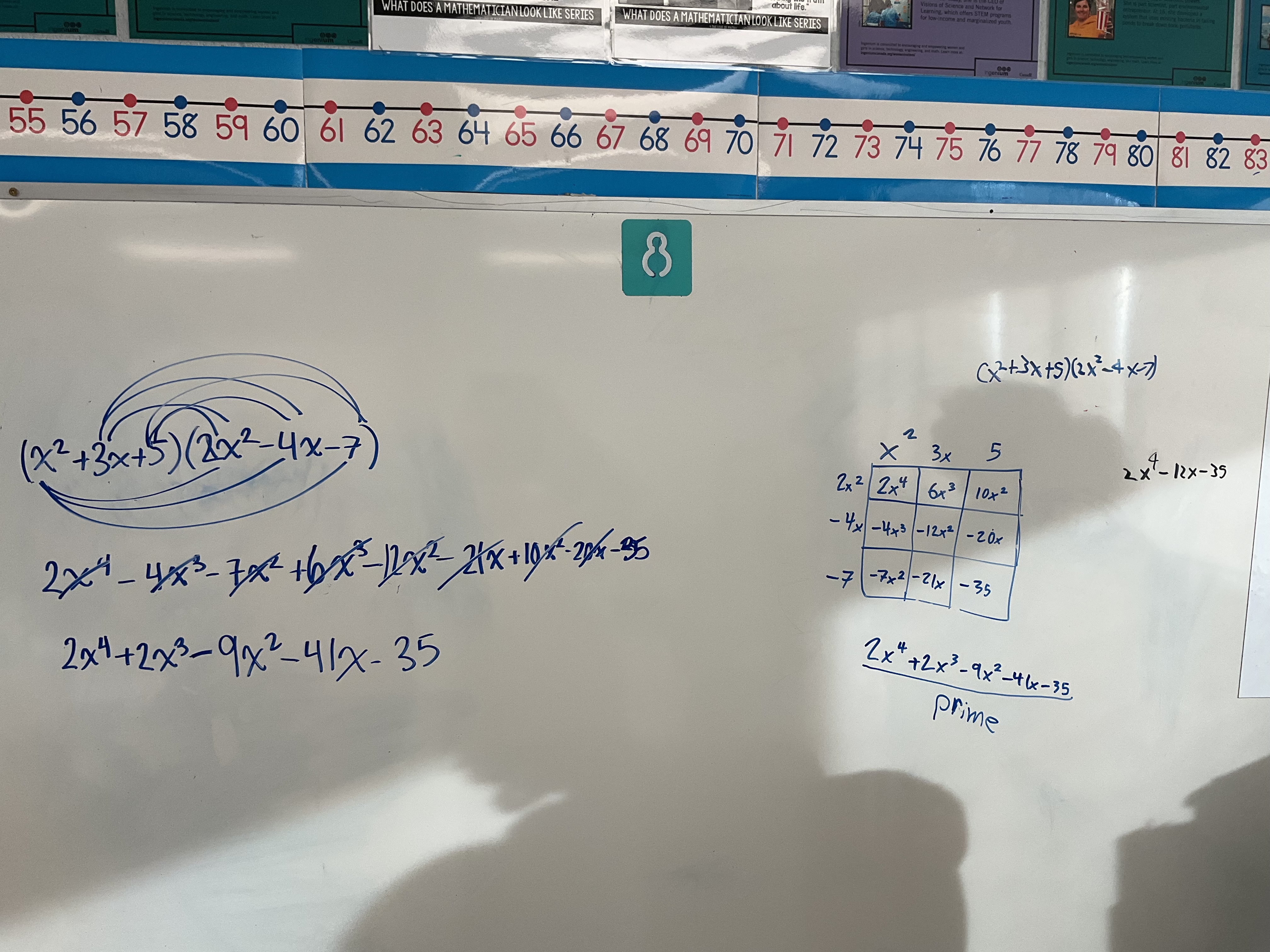
We also had some practice working backwards with both common factoring and factoring trinomials. We watched 2 excellent factoring music videos as well to get us pumped up.
Collaboration
Today we worked on our collaboration skills. We did the 1-100 task by Sarah Van Der Werf.
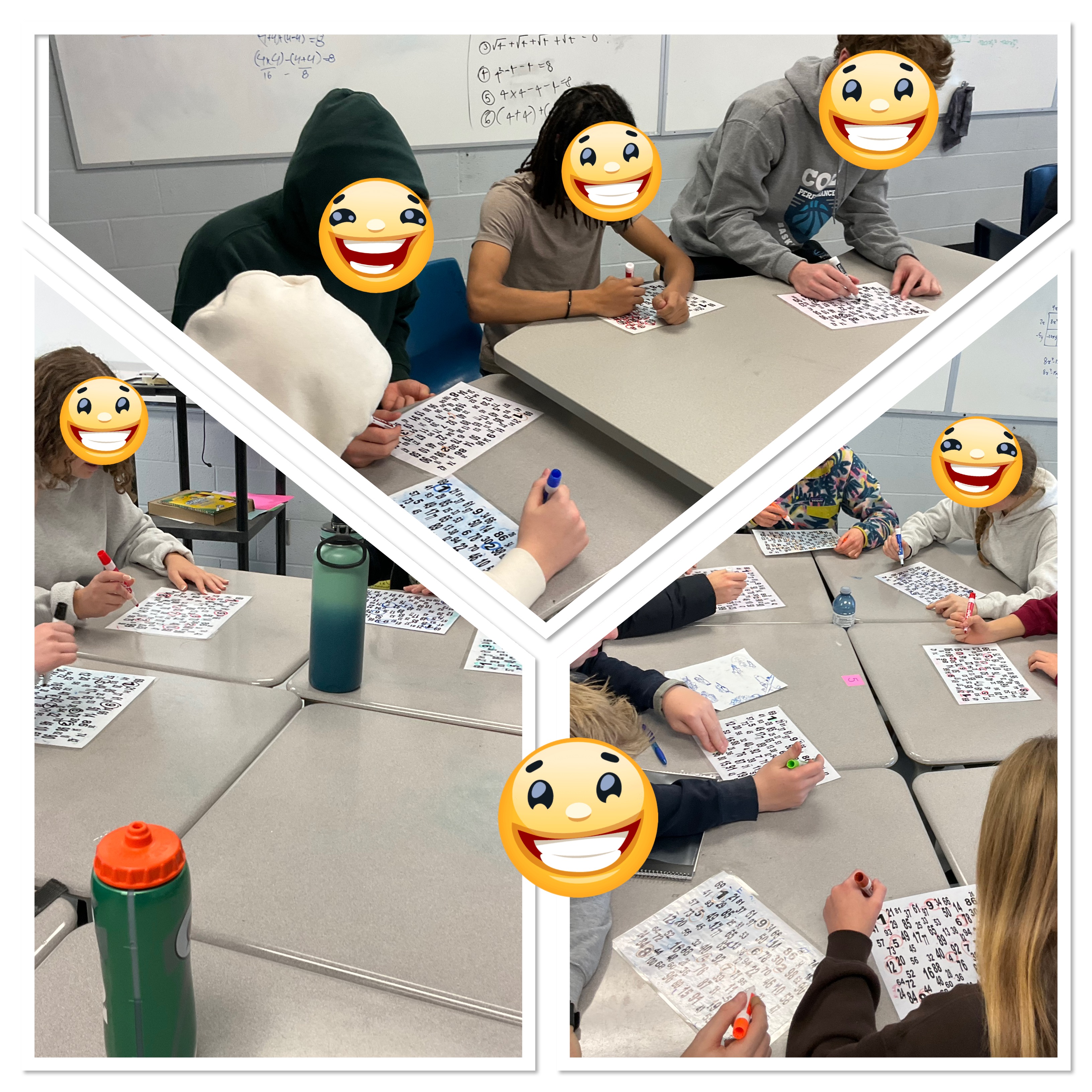
We did the task solo. It was estimated that we’d take 100 seconds to circle 100 numbers in order. That was a massive underestimation. It took us about 10 minutes and some were not finished after 10 minutes.
Next we tried in a team.
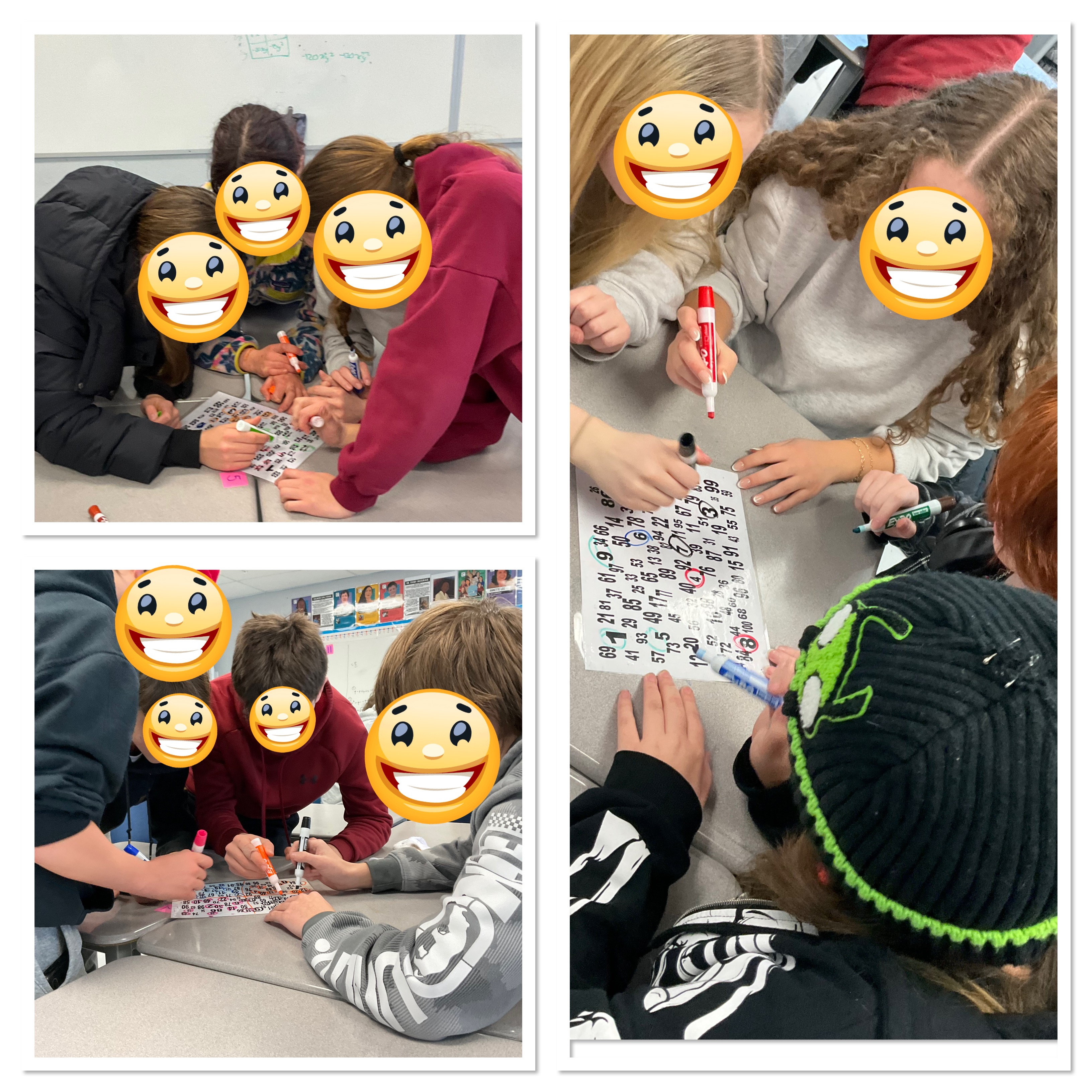
We did 2 different trials as a group, adding different strategies each time. We got the time down to about 2 minutes!
We debriefed by looking at pictures of our groups doing excellent work together. We noticed how we were on task and helping each other. There were positive encouraging words, and we were all included and participating equally. There was such an intensity of good stress, and joy and enthusiasm. It was a challenge to calm ourselves down after all that!
We ended the class celebrating our very first Vennsday, where we explore number sets using Venn diagrams.
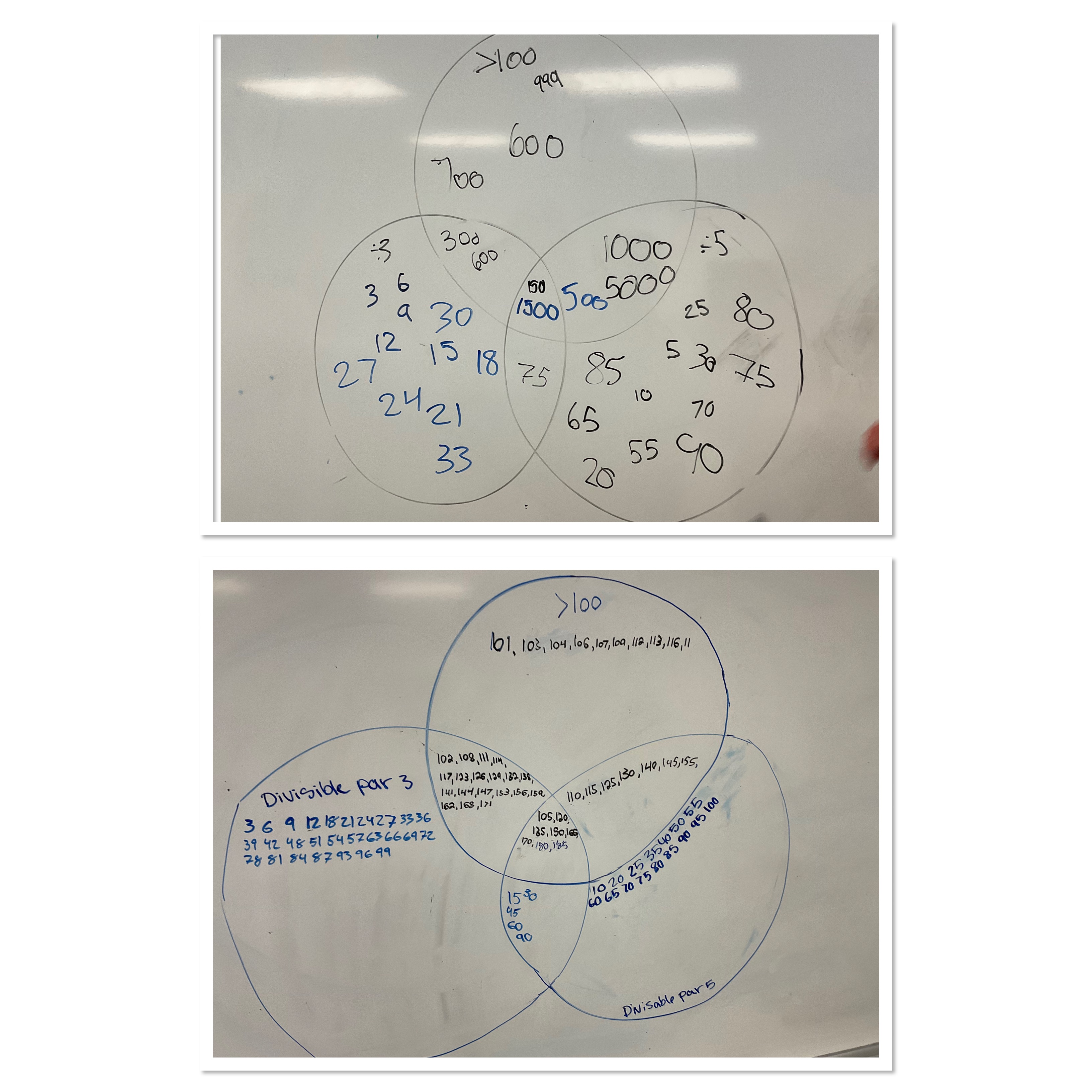
We looked at numbers that are greater than 100, divisible by 3 and divisible by 5. We debriefed some divisibility rules together at the end of the class. What a great collaborative day!
 Ms. Bearse's Site