College week 2
This week at college we were working on unit conversion, based heavily on our practice with multiplying fractions. To help us understand how to convert square and cube units we explored how changing a square’s side length changes its area, and how changing a cube’s side length changes its volume. We built some squares and cubes to help with the sense making.
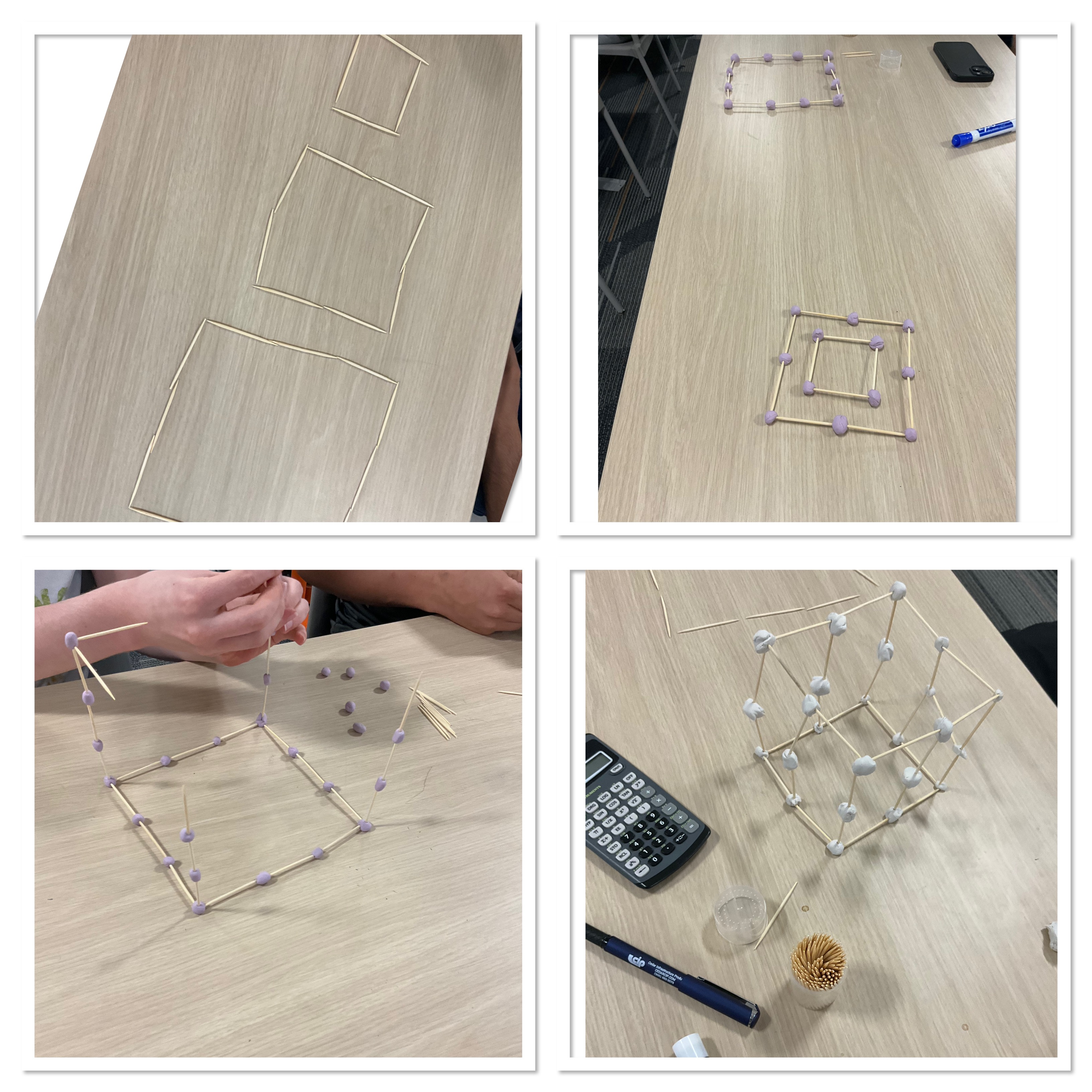
We now have a better sense of why we need to square or cube our conversion factors when we are working with square and cube units.
We used string to help us build a radian. For some of us, this was the first time we heard of this new way of measuring angles.
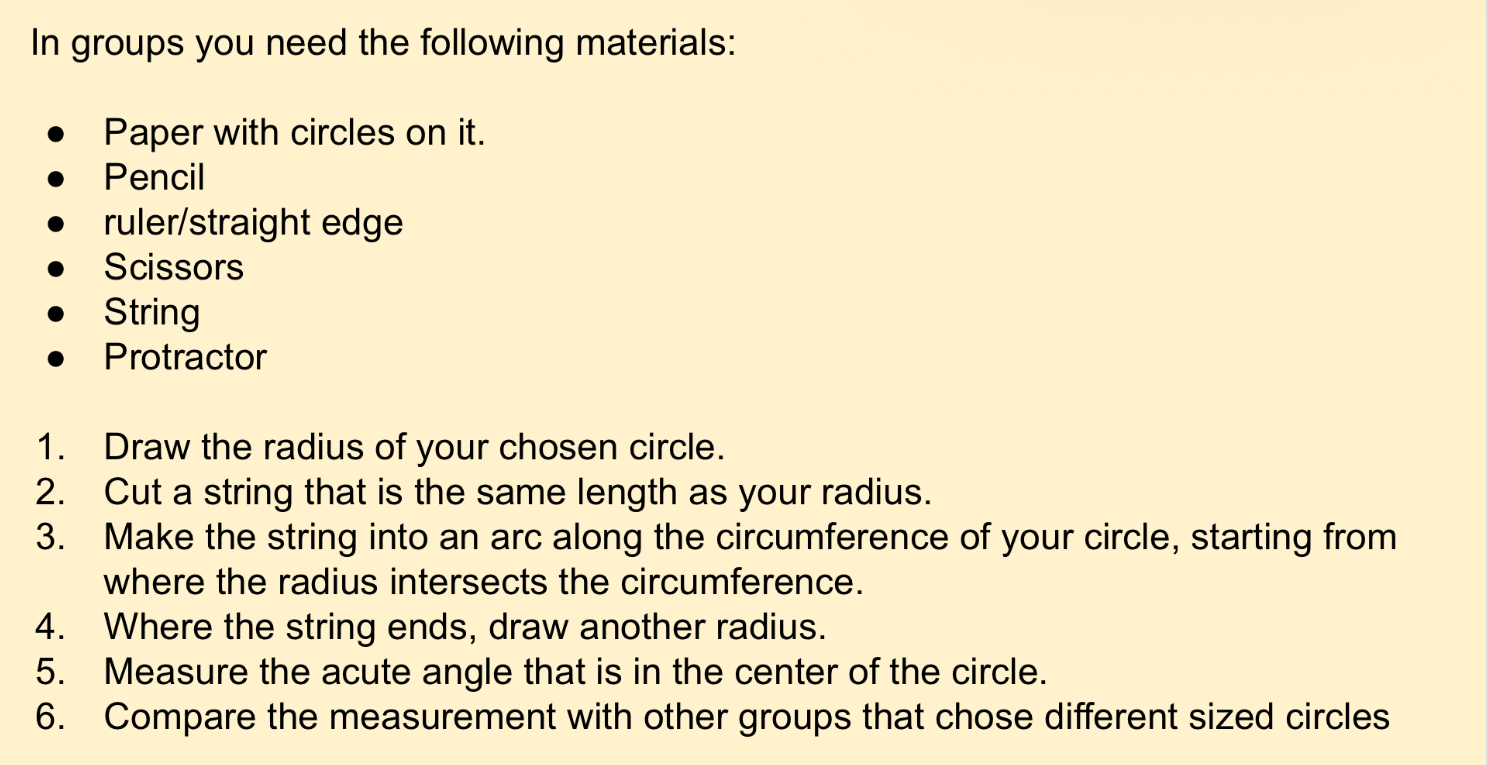
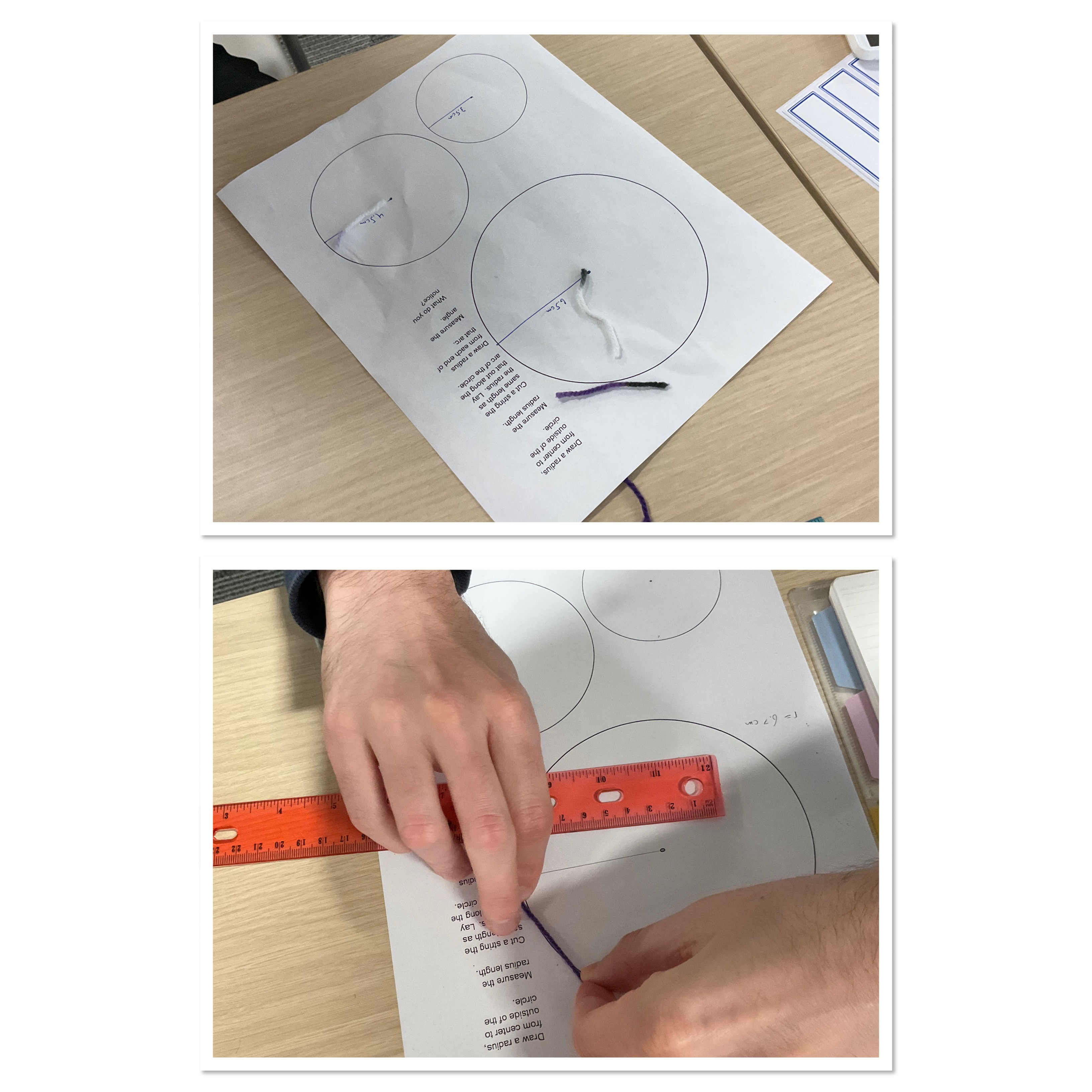
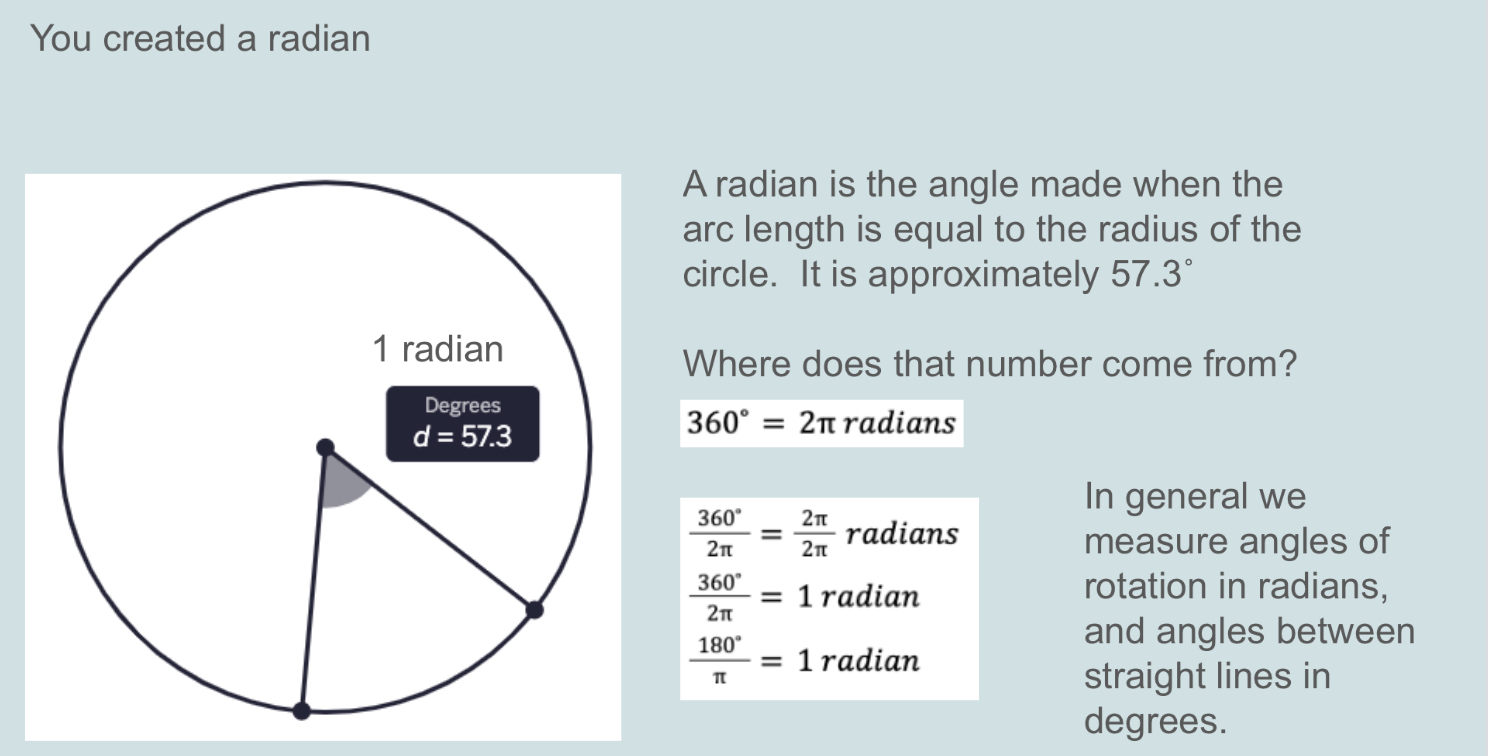
Later we put radian measures in order and made a number line, and tried to space out the radian measures appropriately along the string.
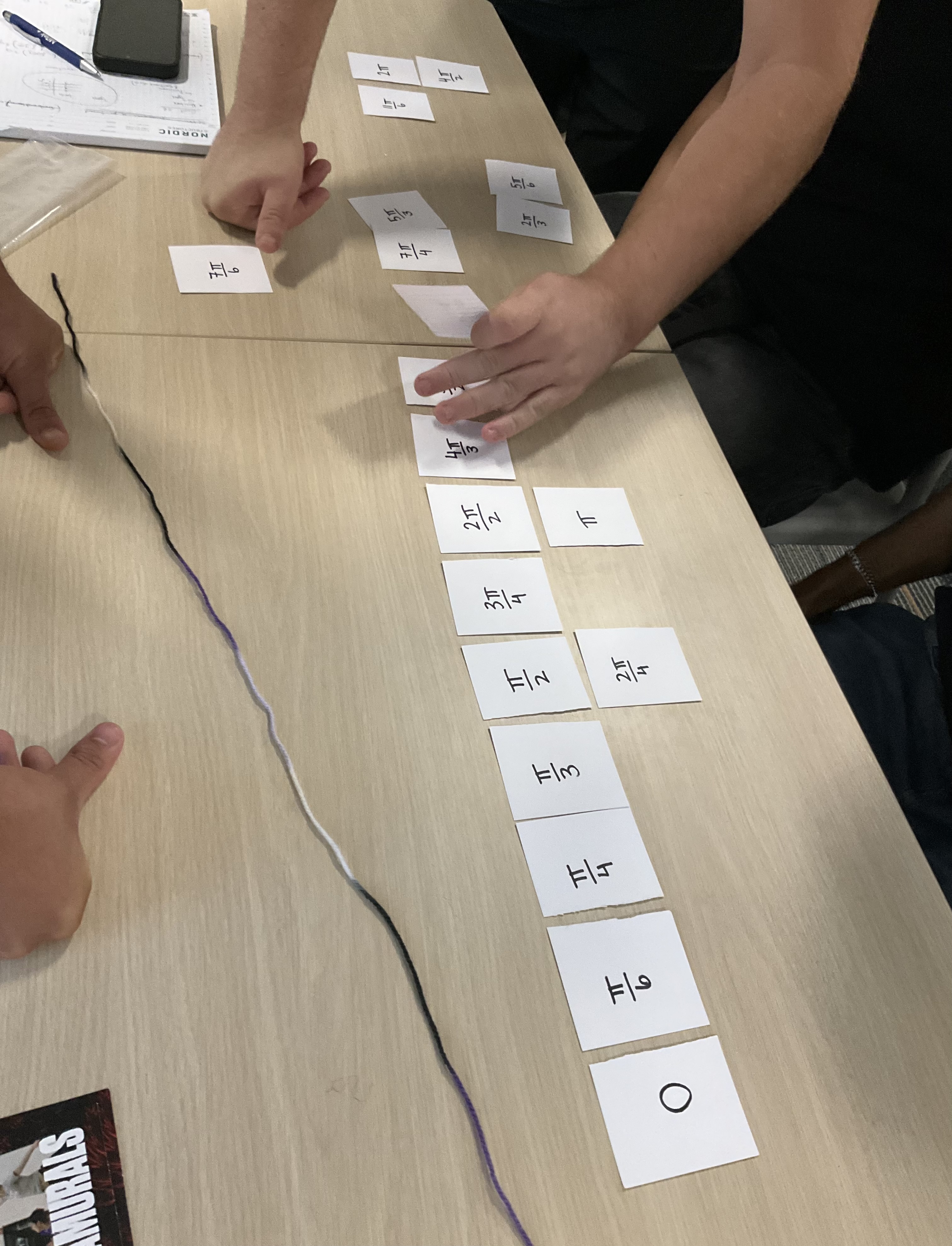
Then we joined up the string to make a loop and saw how each of the radian measures would correspond to the degrees that we are familiar with.
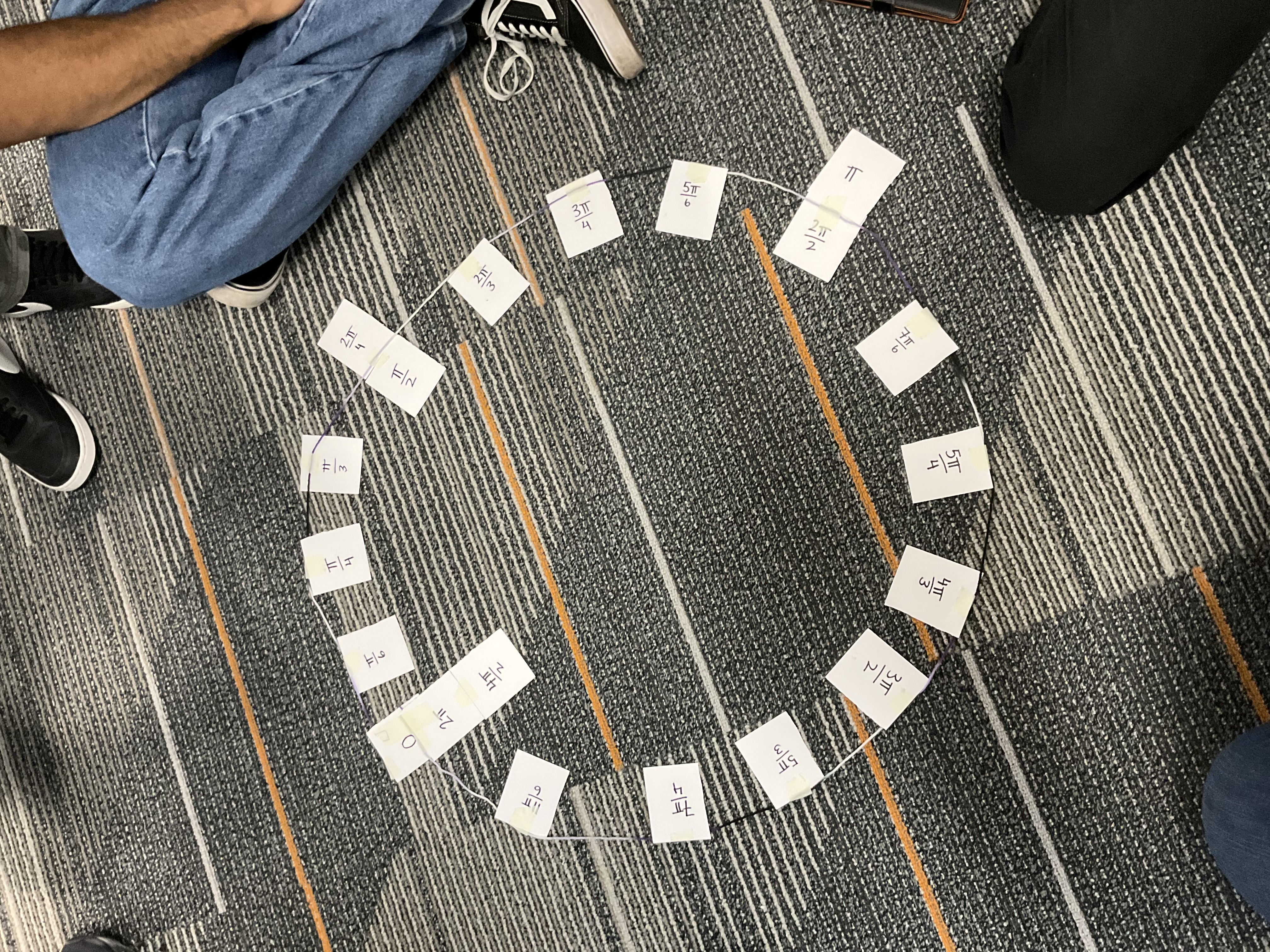
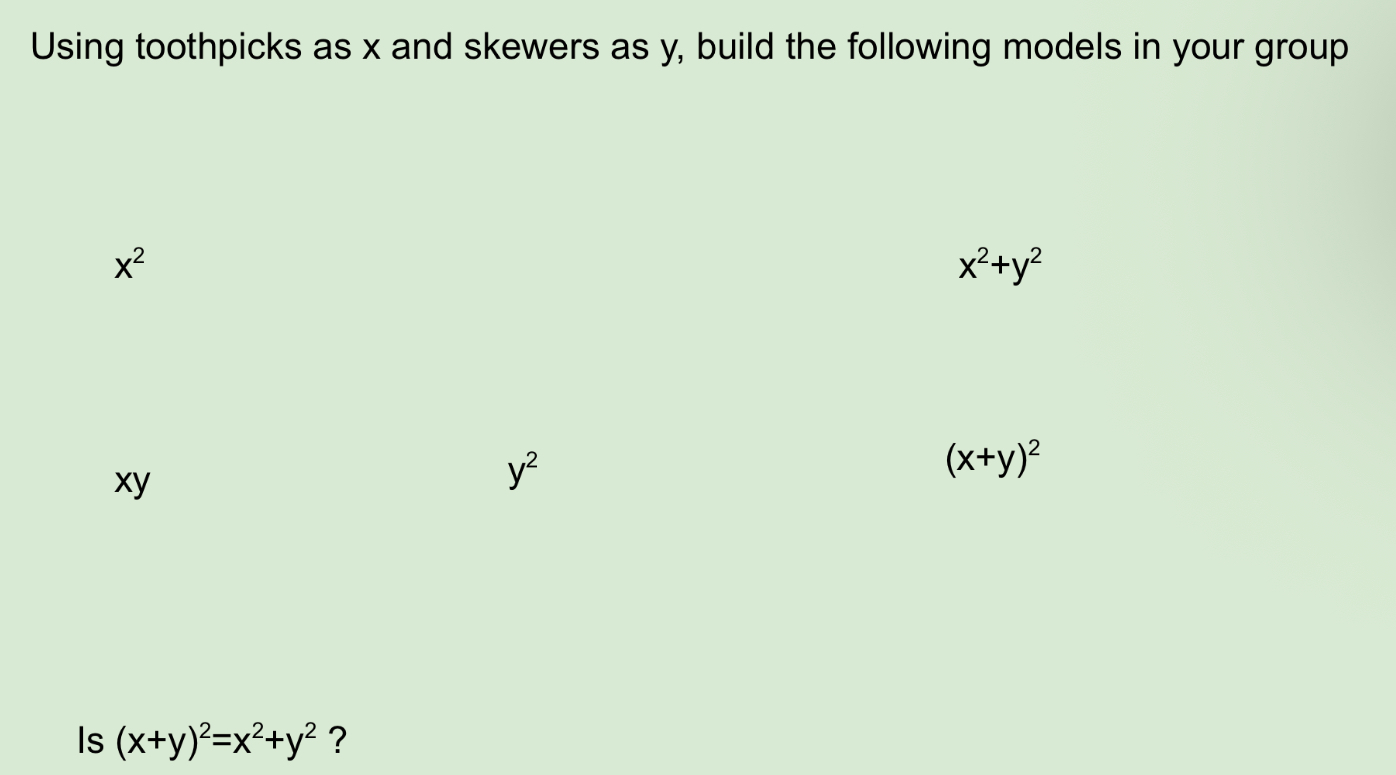
We did some more conversion practice with degrees and radians, then moved to a different building challenge to continue working on algebra understanding without the pressure of doing algebra.
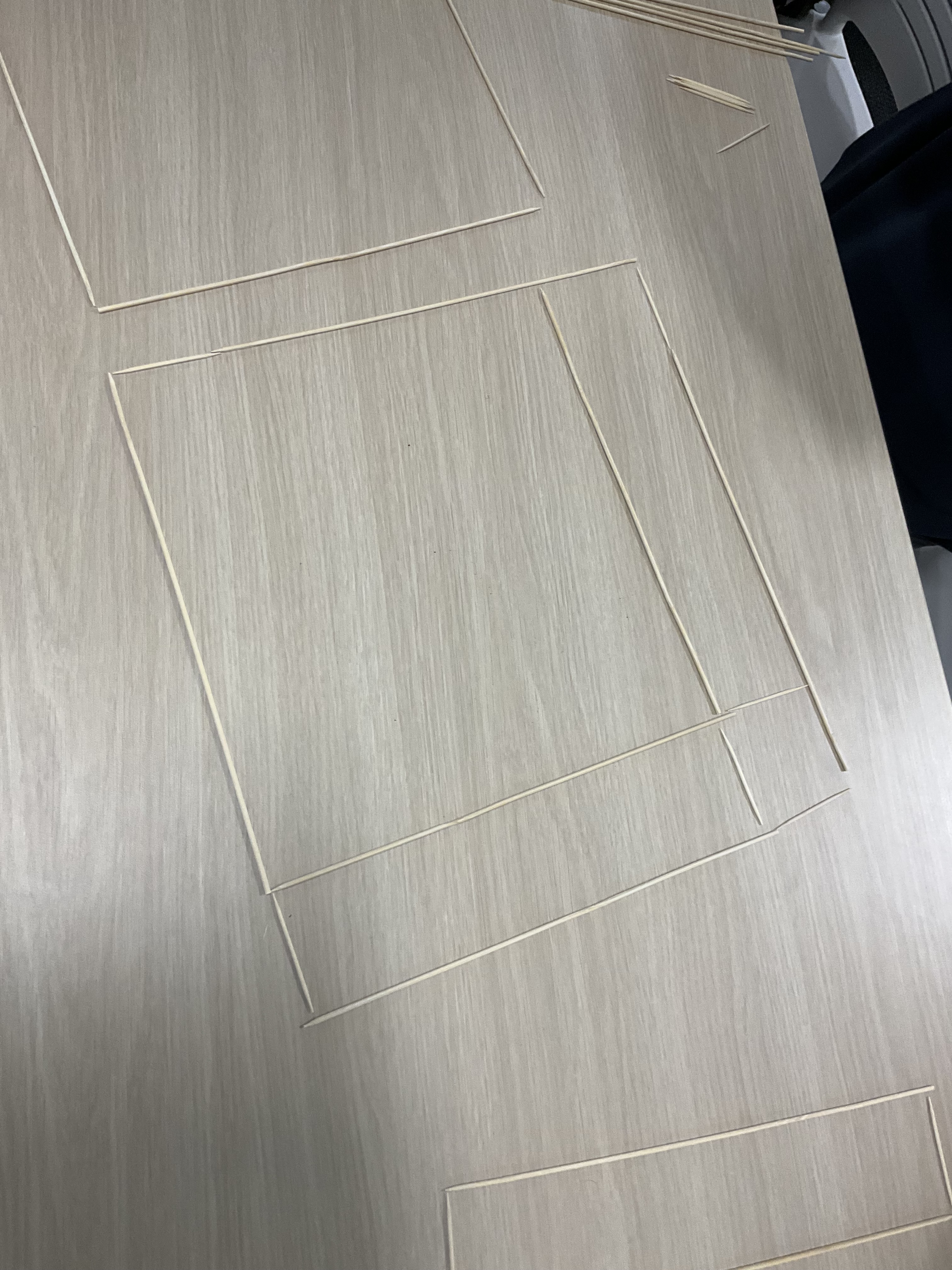
The most interesting model here was (x+y)^2. We can see the subdivision of x^2 and y^2 and 2 xy rectangles within the big square that has side lengths (x+y).
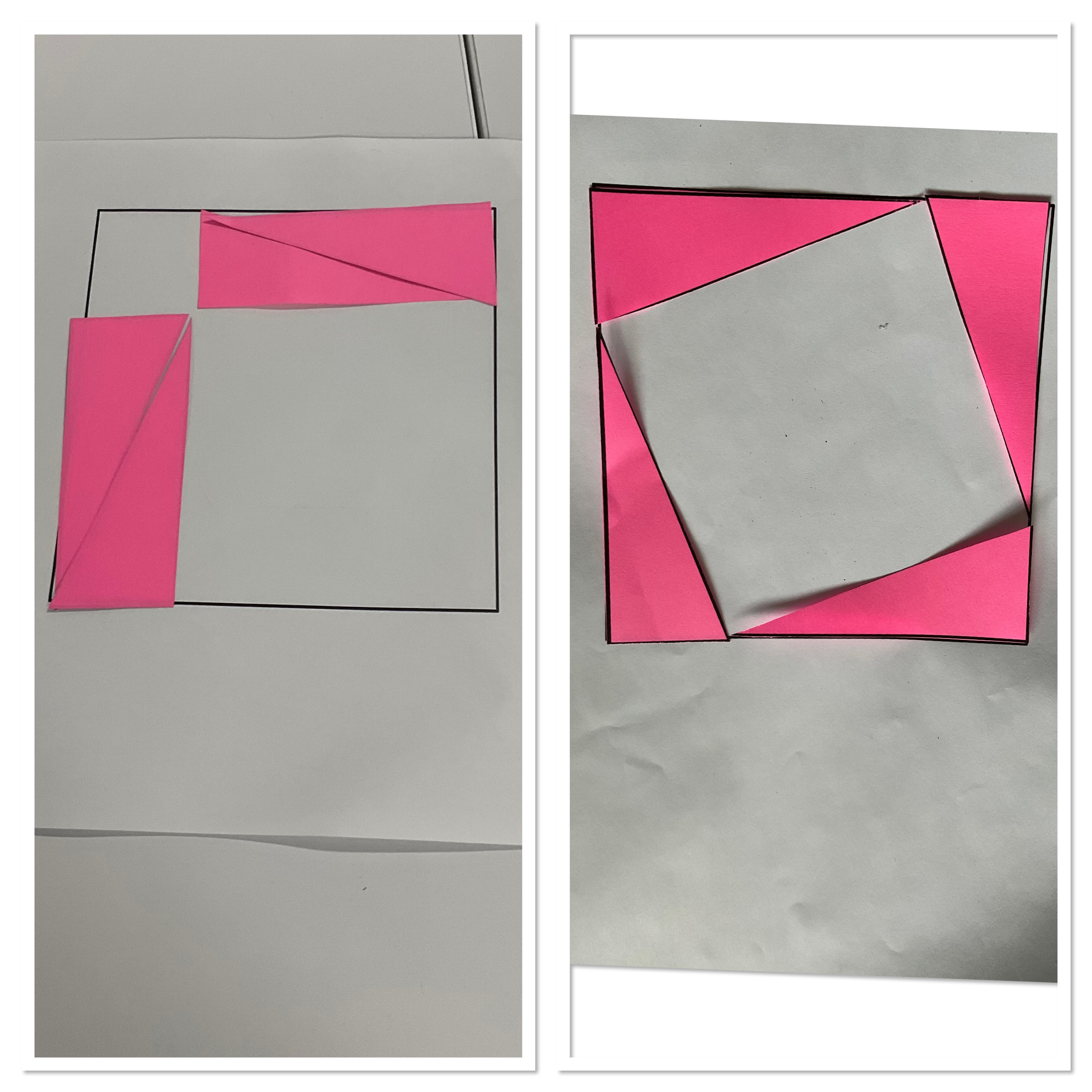
We carried on from this task to explore the Pythagorean theorem. Each pink triangle has legs of a and b, and hypotenuse c. They can be arranged on this square (a+b)^2 to mask off parts of the area. In one way there are 2 squares of negative space which are a^2 and b^2, or they can be moved around so they have only one square of negative space which is c^2, because we are using 4 triangles each time, the negative space is the same in each, so a^2+b^2=c^2.
We practiced some calculations, then got into an introduction/review of right angle trigonometry which we will continue next week.
Linear Systems
Grade 10s are working on remembering lots of what they learned in grade 9 which will help as we move forward in grade 10.
We’ve done lots of patterning, and tables and graphs and equations. Today I gave groups a pattern rule to model with blocks, then to line up the blocks from each figure vertically, and place a dot at the top left corner. Once groups had one pattern modelled, I gave another pattern to do on the same axes.
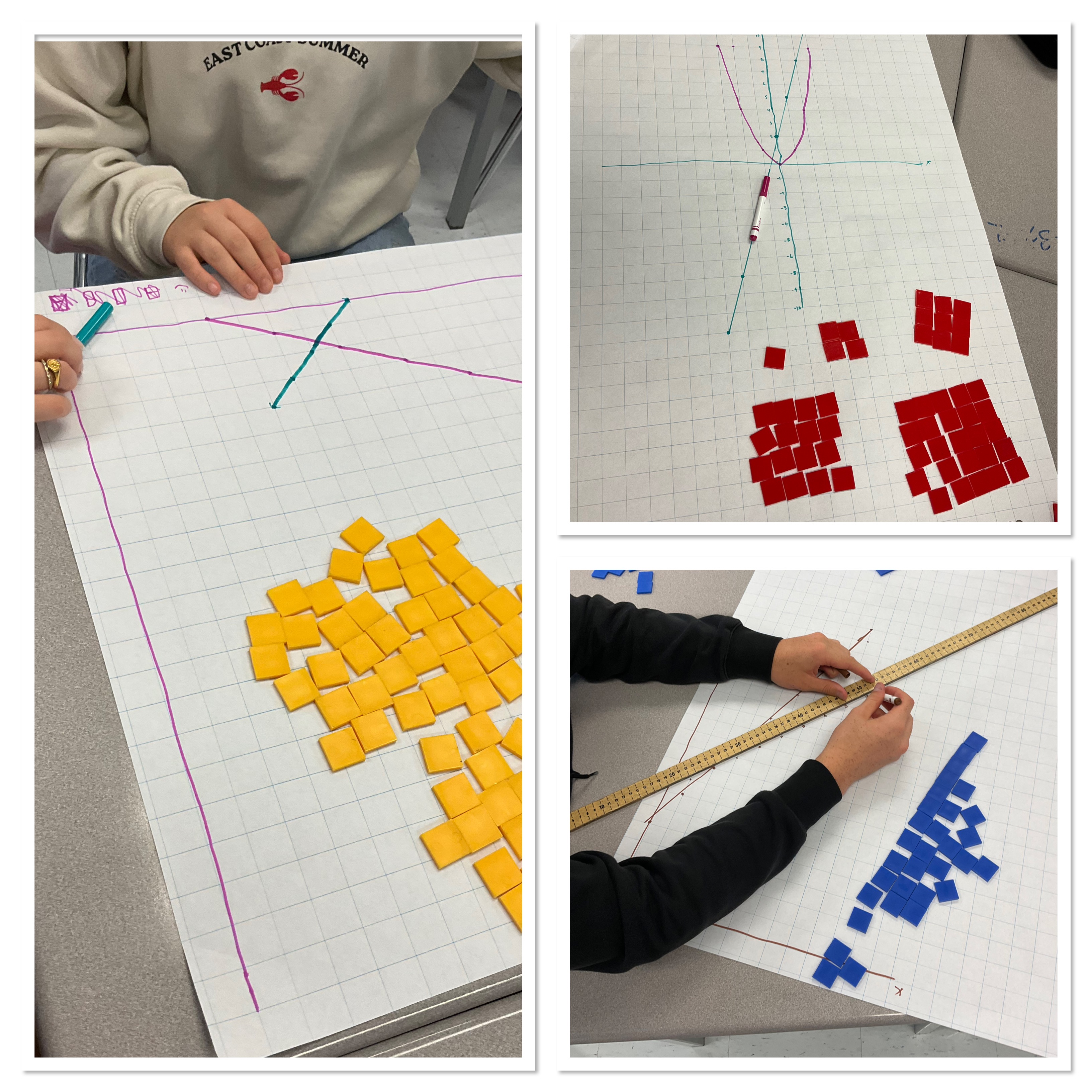
We then put all the graphs up on he boards and consolidated vocabulary and connected graphical features to parts of the equations.
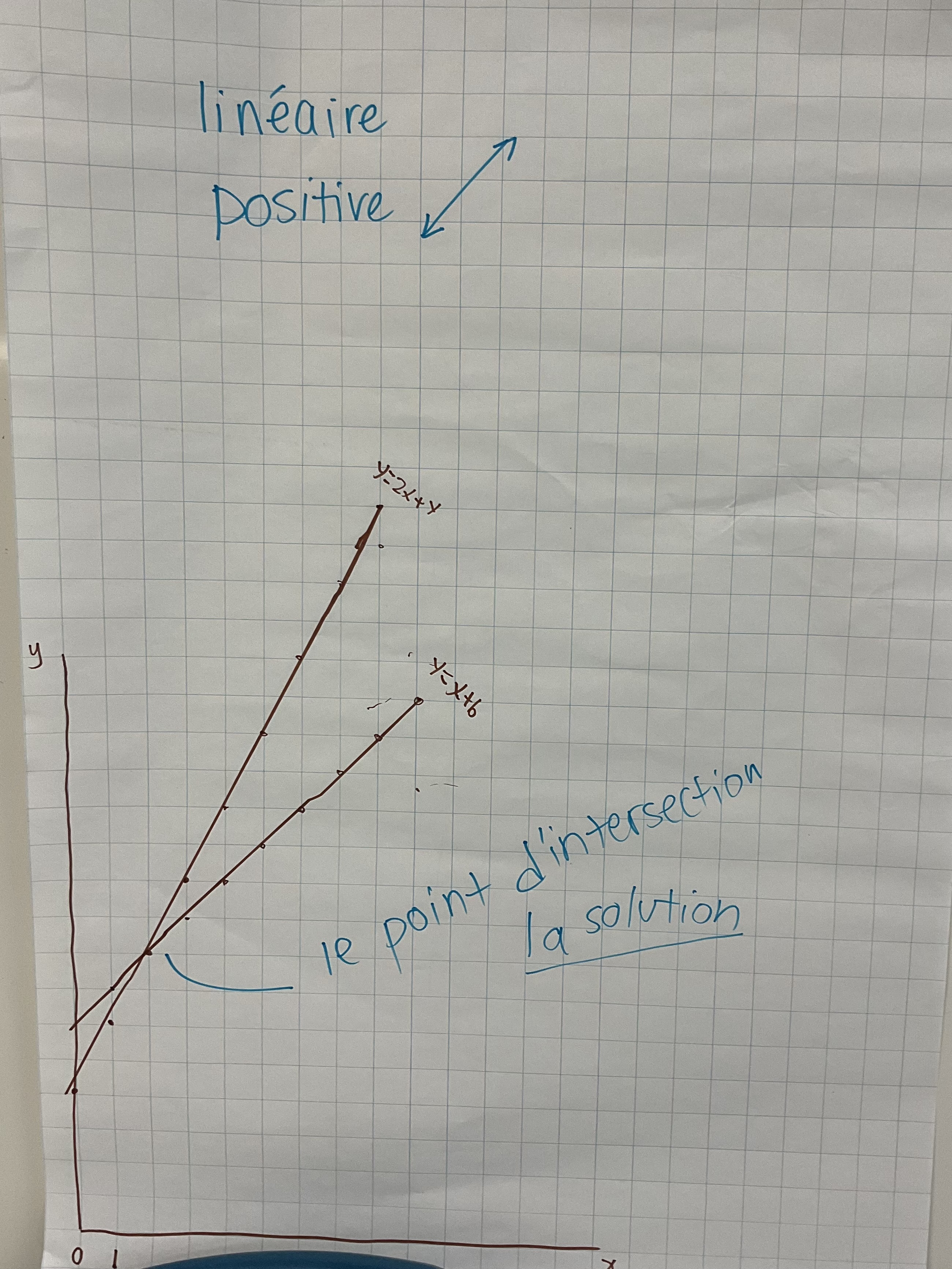
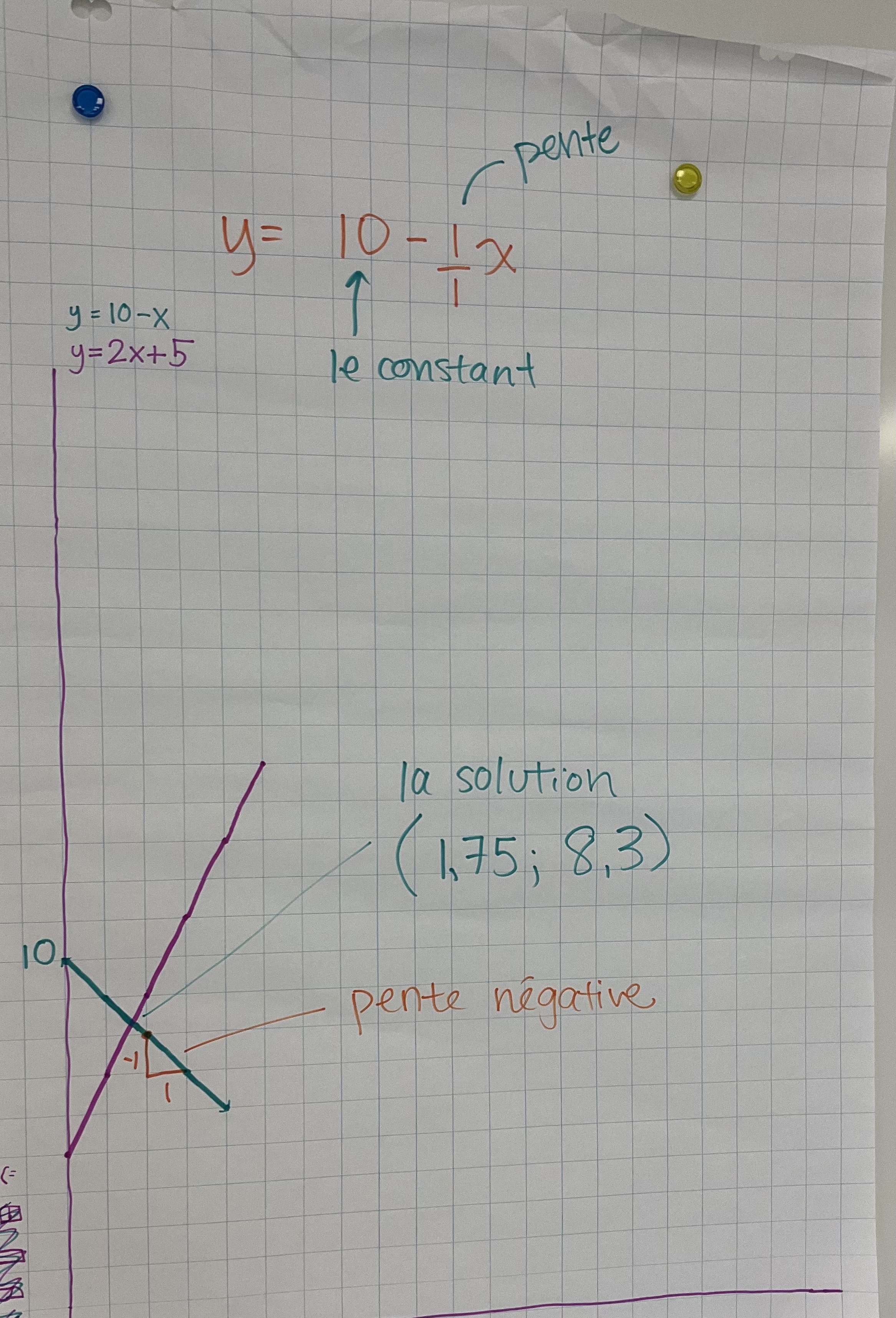
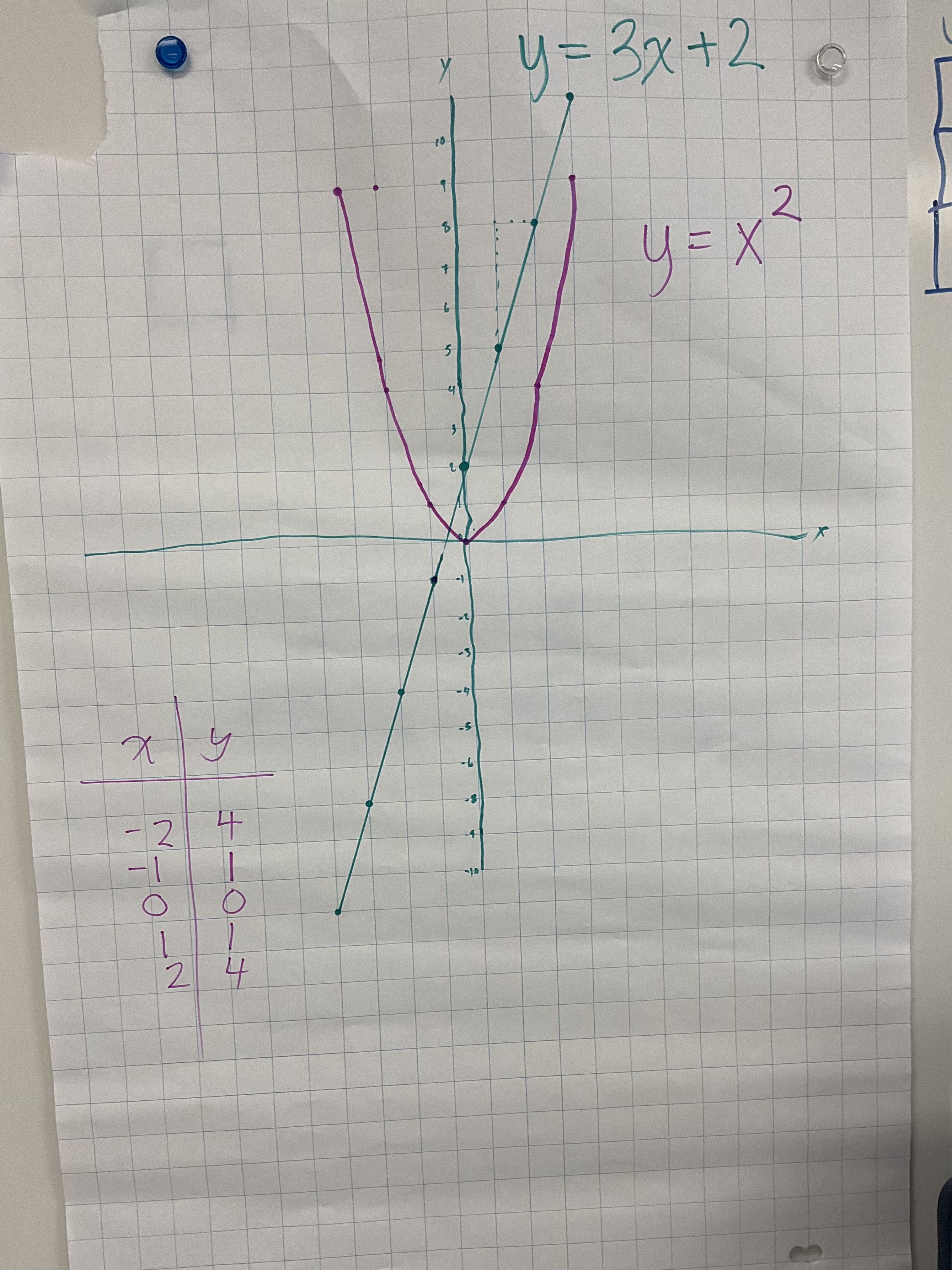
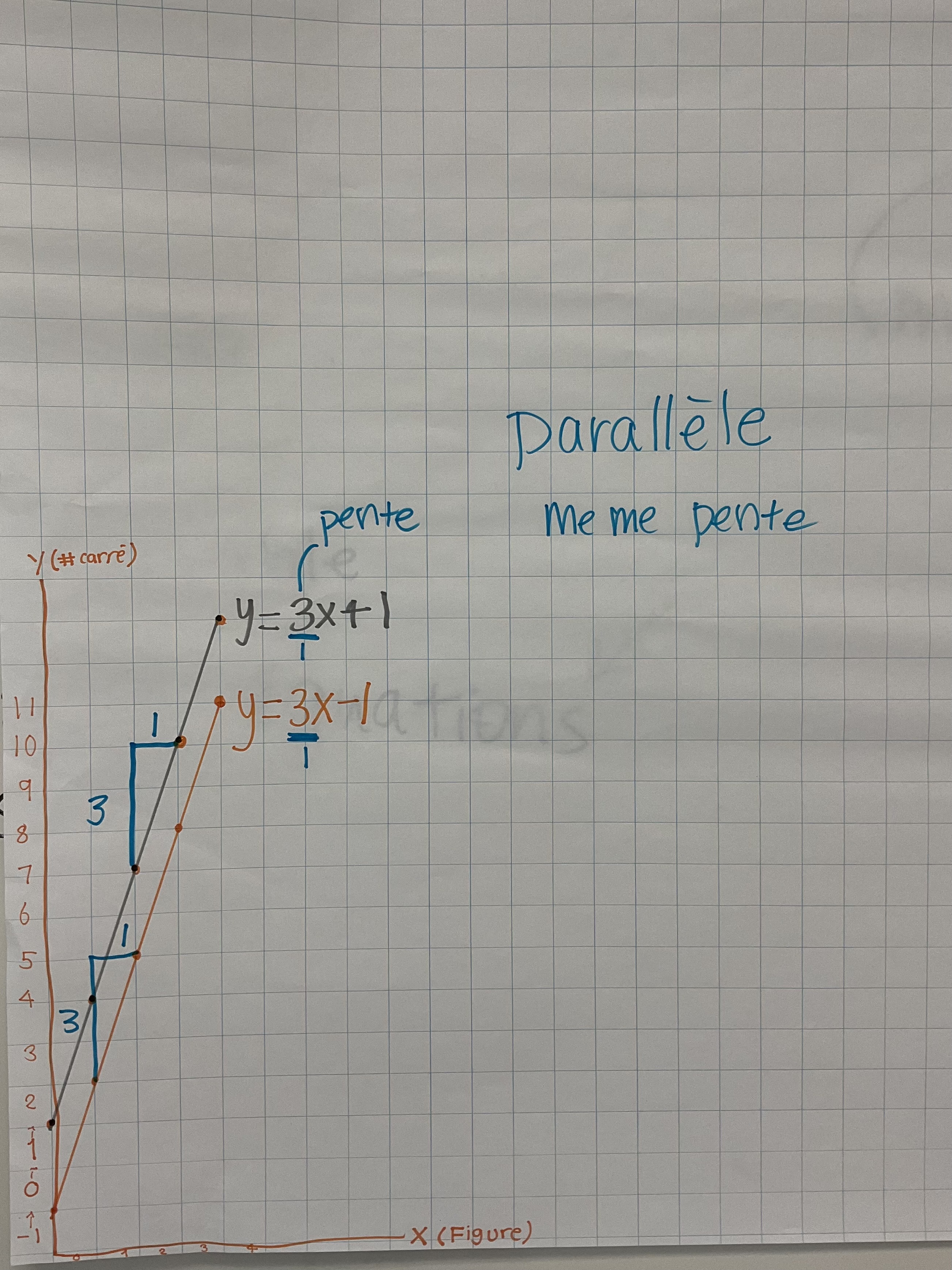
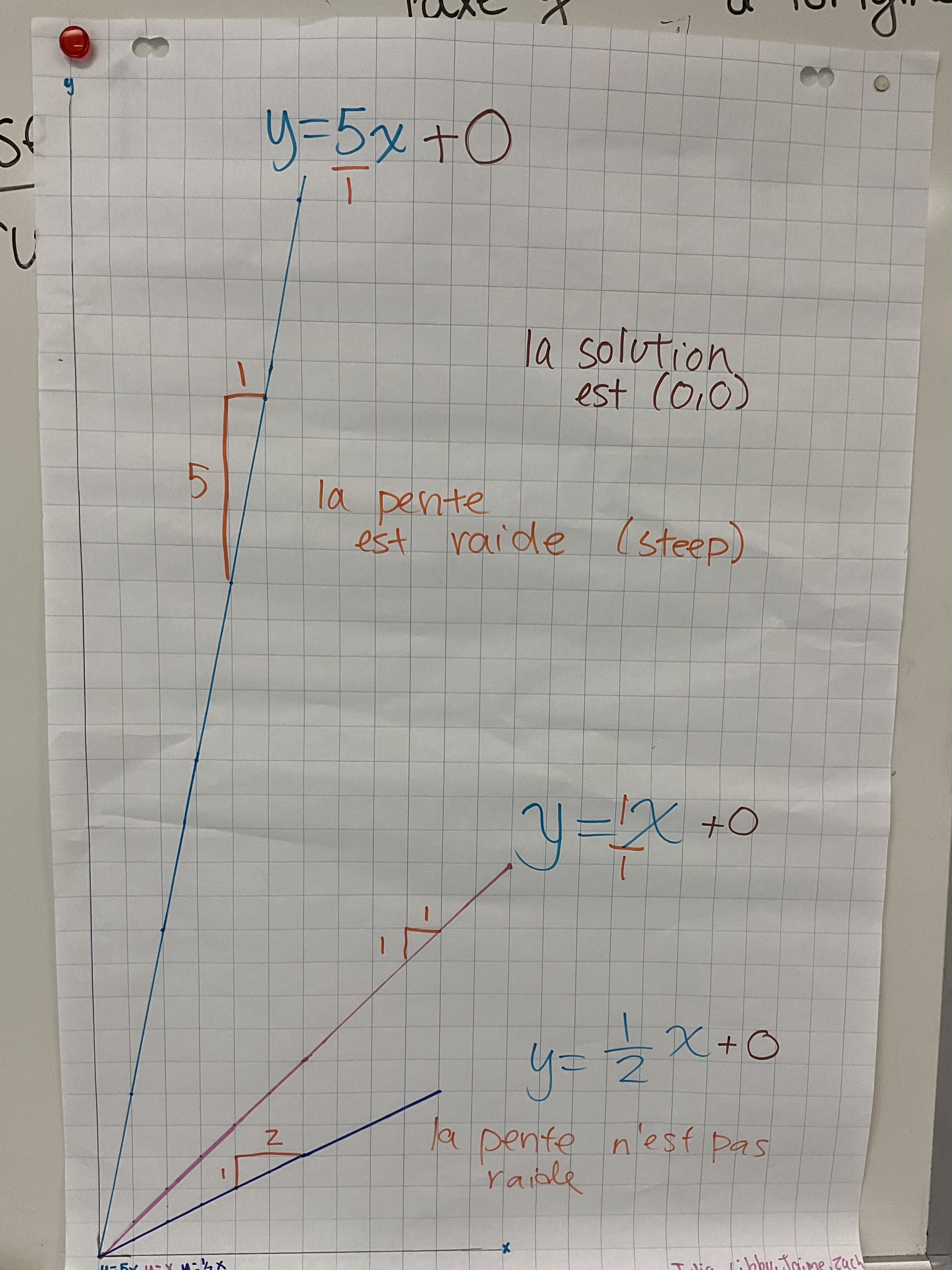
We talked about parallel lines never crossing because they have the same slope. We compared steep and shallow slopes, we looked at rise and run, and positive and negative slopes. We saw points of intersection, some we need to estimate. We looked at y intercepts. We also had one group that wanted a challenge to do one that’s not a line.
We’ll start to solve systems by graphing next.
inverses
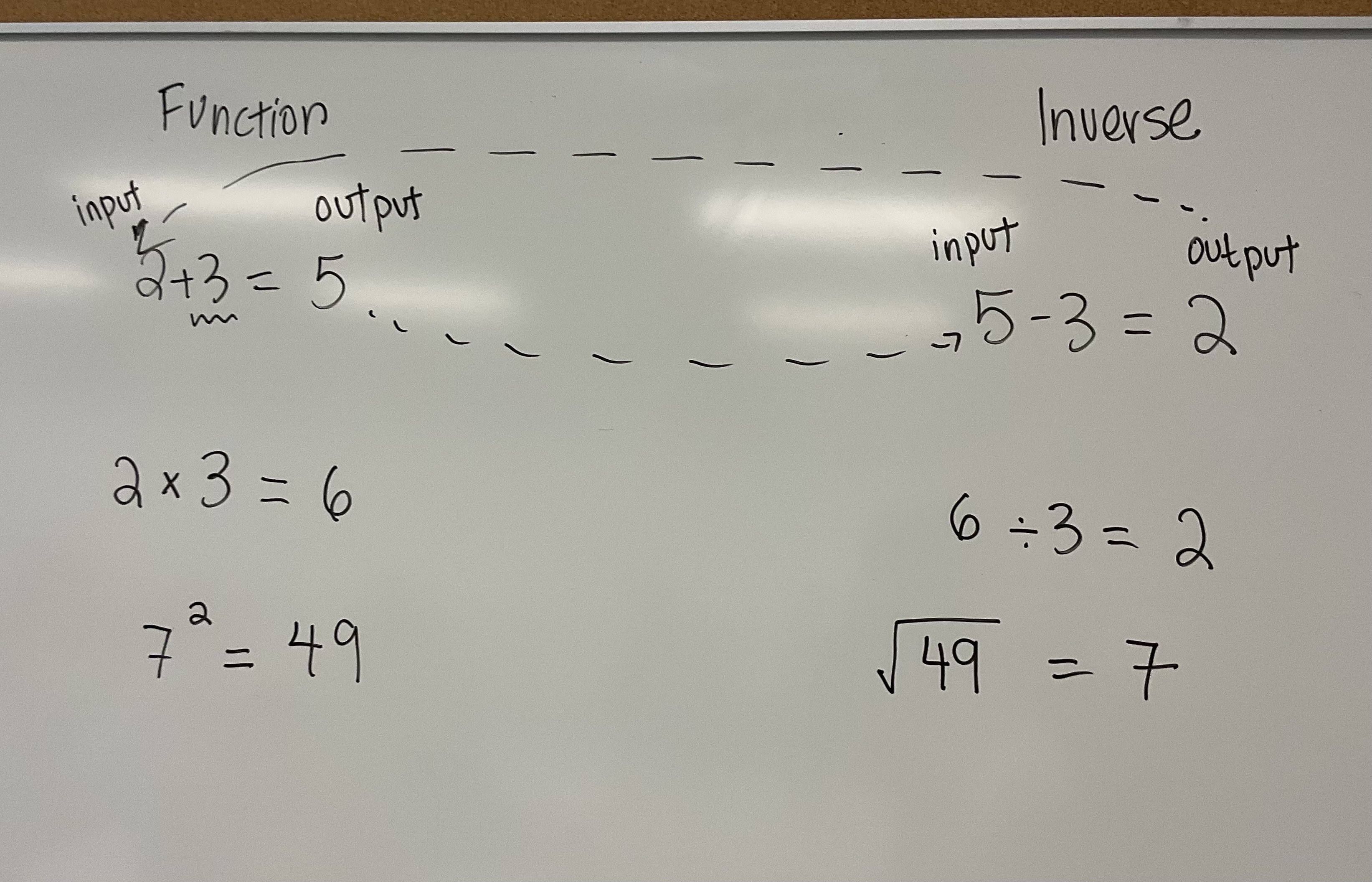
We’re working on understanding inverses in grade 12 math. We’re exploring what operations are inverses of each other. Inverses undo what the original function does. It takes the output of the function as the input of the inverse, and will return as output of the inverse what was the input of the function. Basically we swap inputs and outputs. All input related (x related) things for the function, including domain restrictions, will show up as output related (y related) things for the inverse, including range restrictions.
We talked about how we sometimes need to restrict the domain of the function so that it will be invertible. It must pass the horizontal line test to be invertible. Some notation confusion cropped up while we were talking about how we’d need to restrict the domain of the sine function to make it invertible. We’d choose from -90 to 90 so it passes the vertical line test. The inverse of sine x is sin^-1x, which some students thought was the same as cscx. The misconception and somewhat confusing notation of the exponent of -1 sometimes representing inverse, and when placed on numbers represents the reciprocal. What adds extra complication is that in French (some students are immersion) the word reciprocal is translated as “l’inverse”. We’ll have to keep working on this!
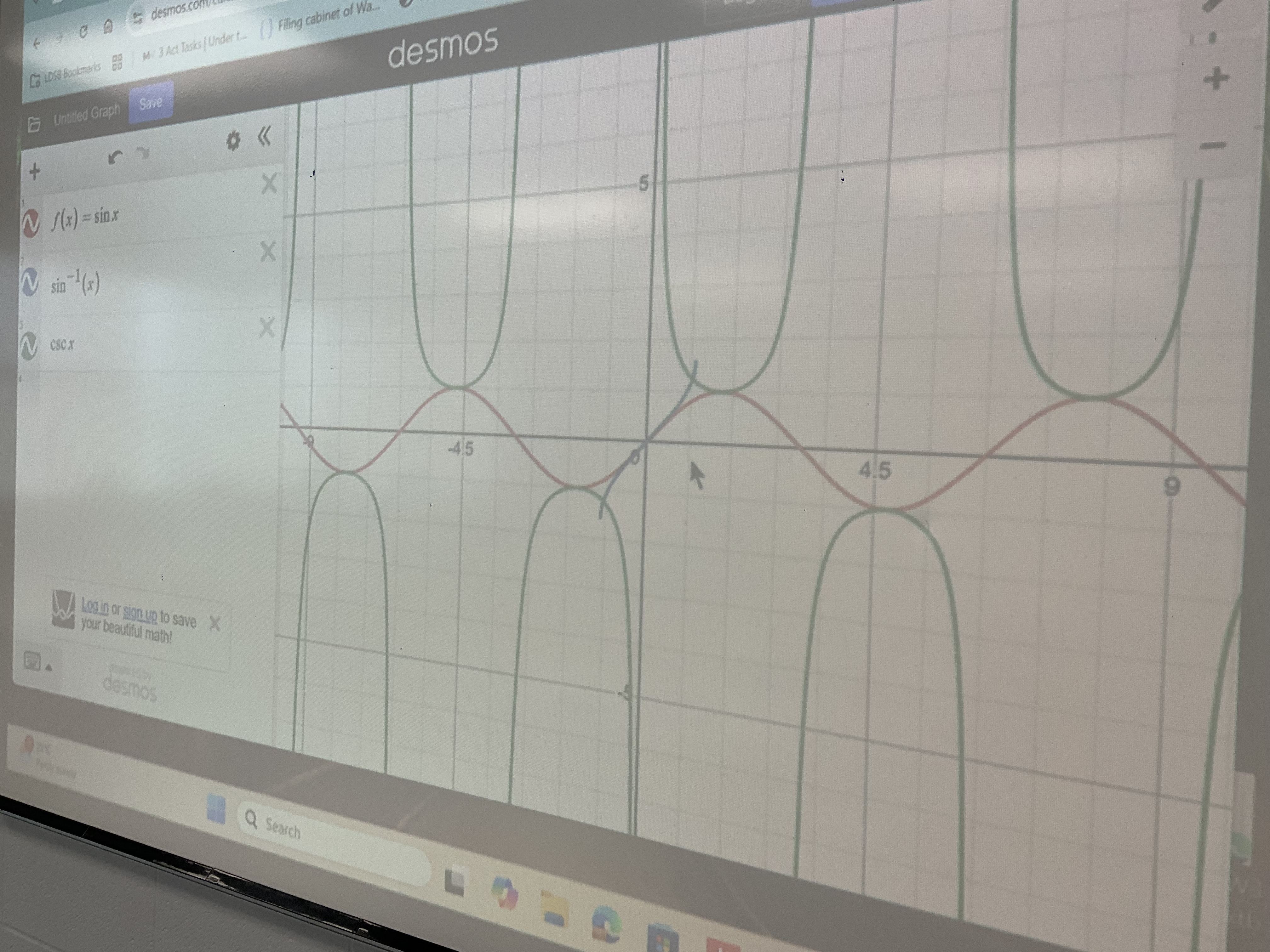
To be sure of the differences we plotted all 3 graphs together on desmos.
Making Predictions
I was working with a grade 9 class today as they explored a neat activity that allowed them to make and test their predictions, explore some geometry, and get their hands on some math.
Step 1: make 2 strips of paper into loops. Tape the loops together so that the loops are at 90 degrees to each other.
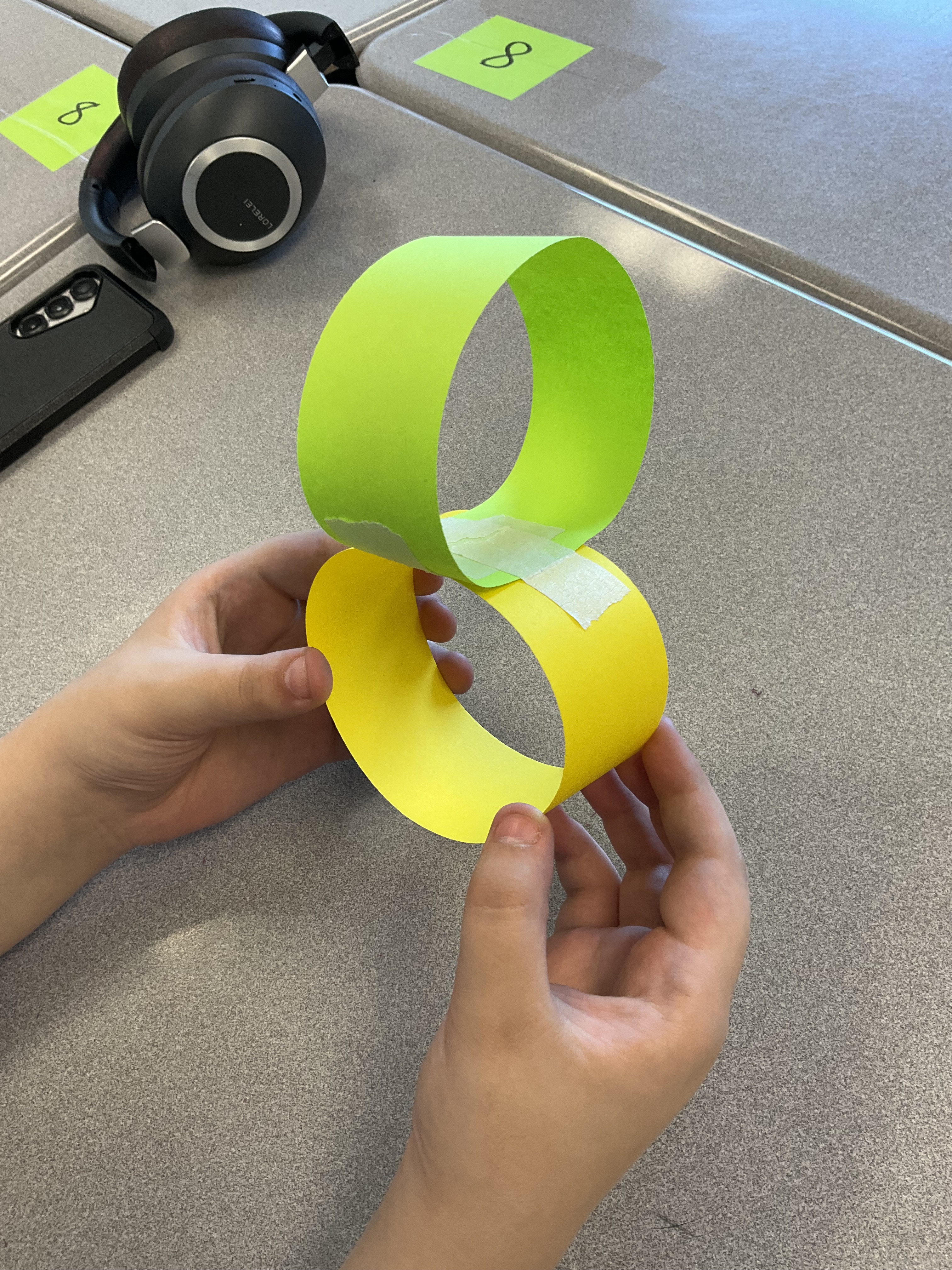
Step 2 is to predict what will happen when each loop is cut down the middle of each strip. Groups talked, and came up with several different possible outcomes before actually getting out the scissors.
Step 3: cut the loops, and unfold to see what happens. (Spoilers below)
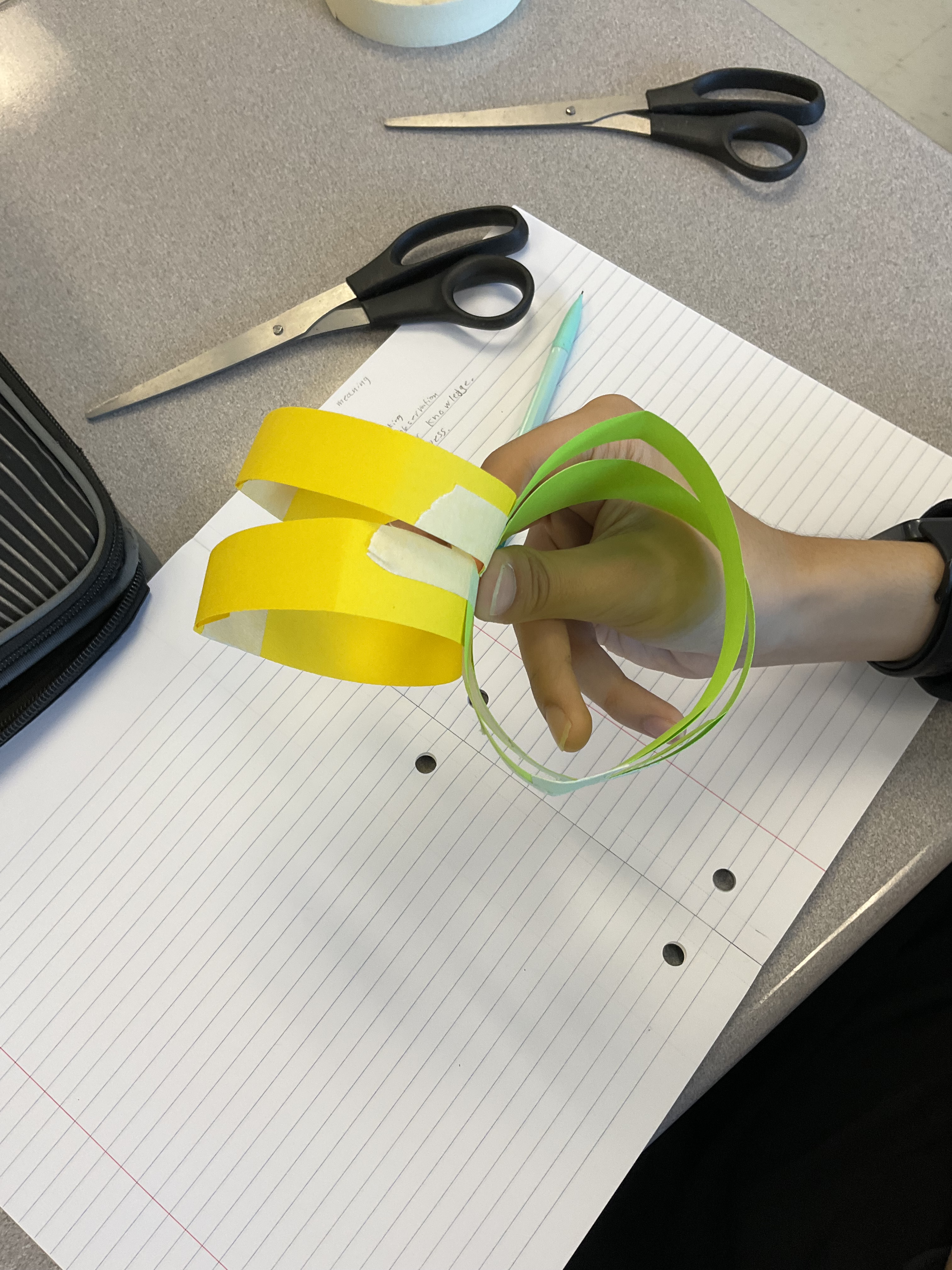
When one loop is cut and unfolded this is what we see.
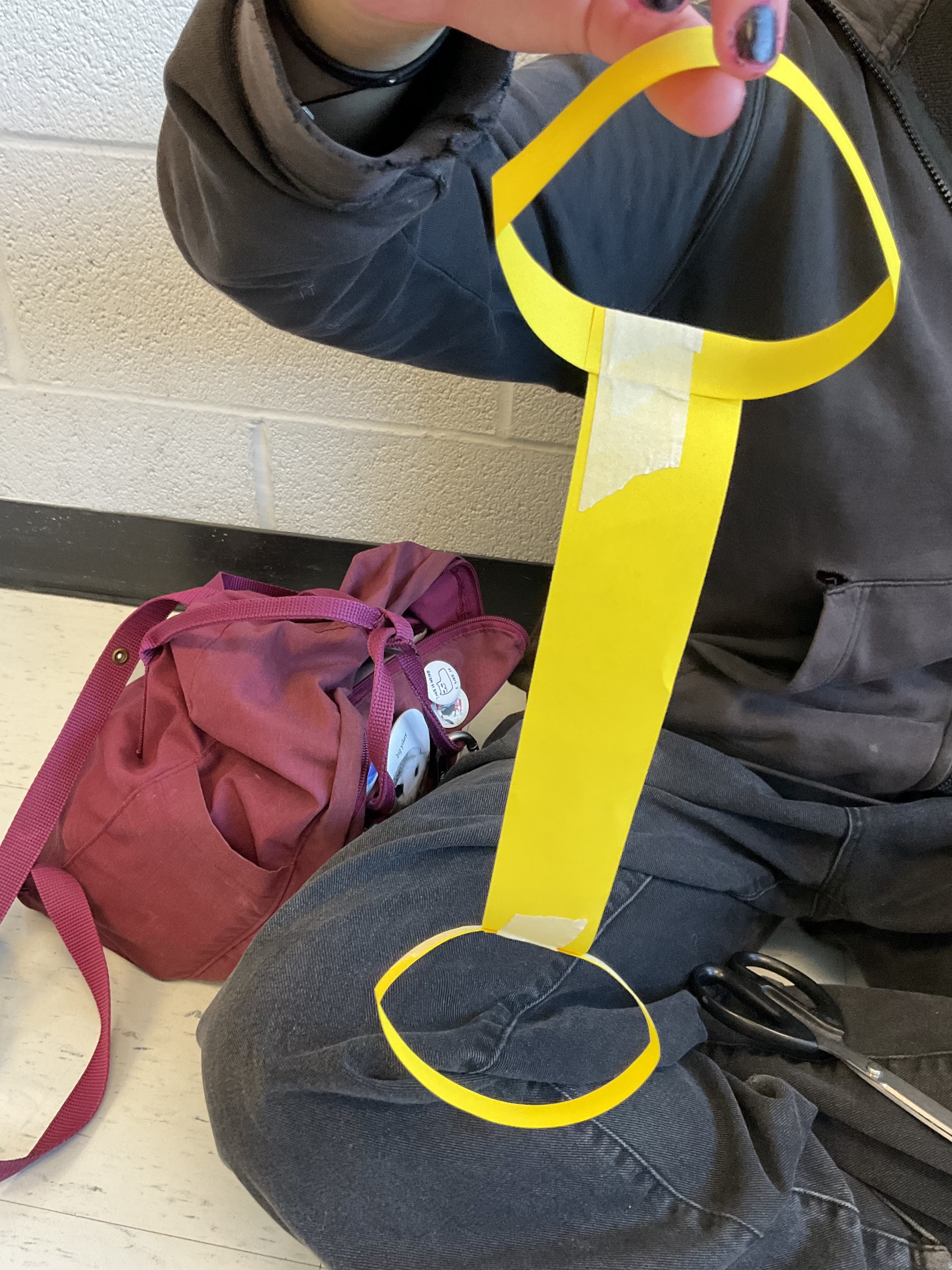
This might be enough to see what will happen when the next loop gets cut.
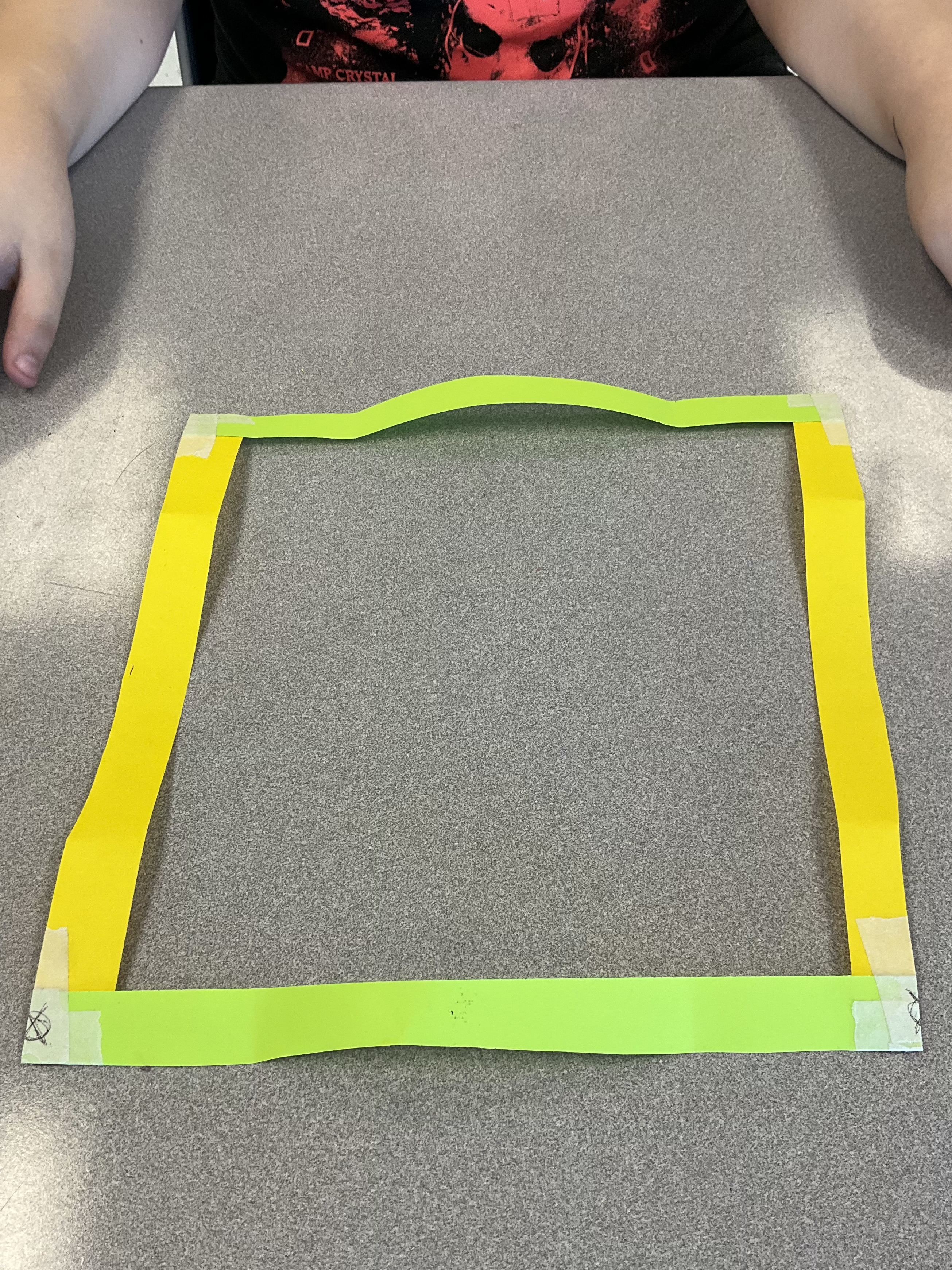
That was quite a surprise! Groups were pretty astonished to see that it’s a square that is formed. We looked at the characteristics of a square, and how we know it’s a square.
Students were then prompted to see what changes to the initial conditions would create a rectangle that was not a square. It was interesting to see what they chose to change. Many had a good idea, and then tested the hypothesis.
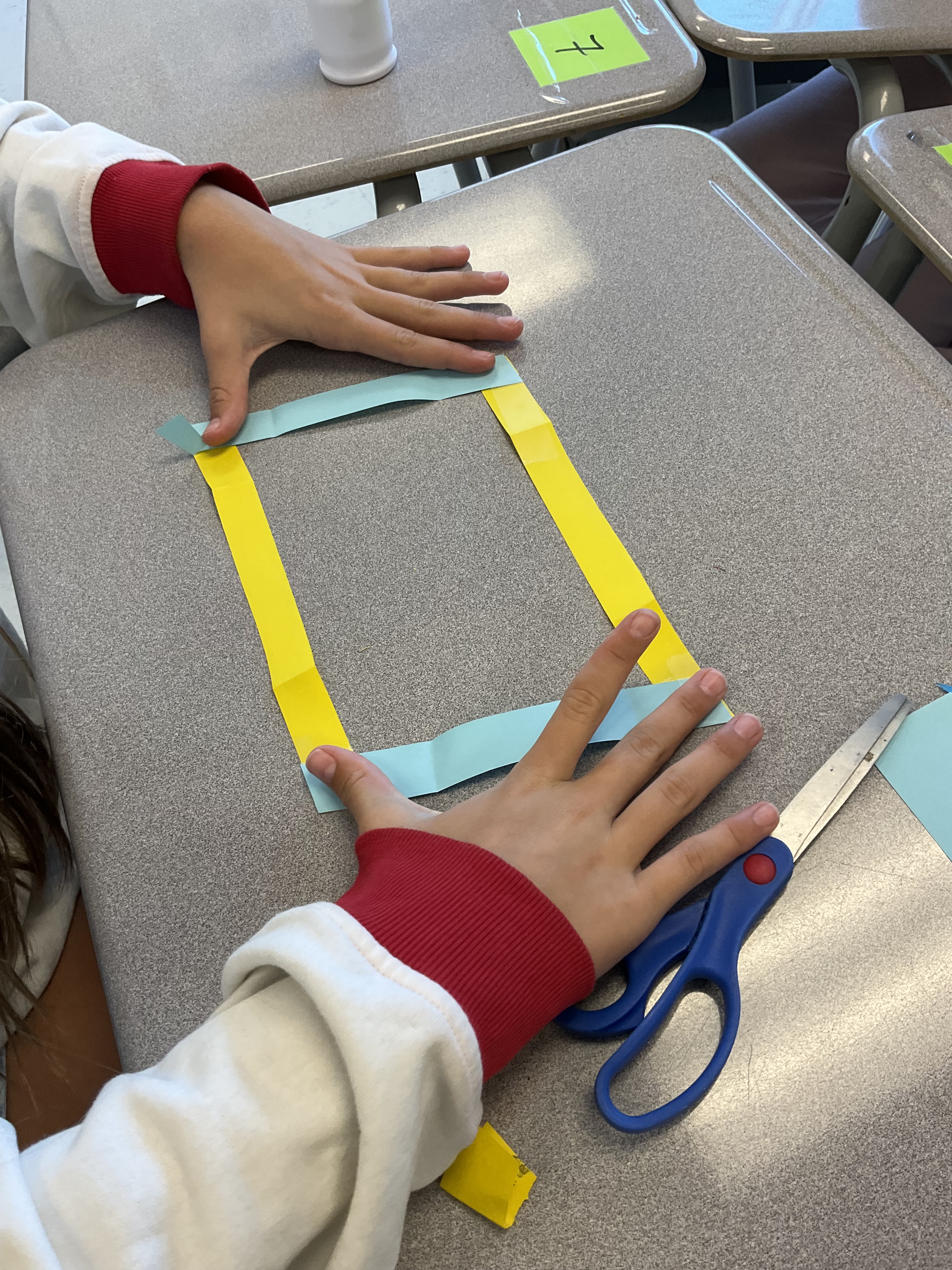
The next challenge was to see how to change the initial conditions to end up with a parallelogram that was not a rectangle. Several groups succeeded with this challenge.
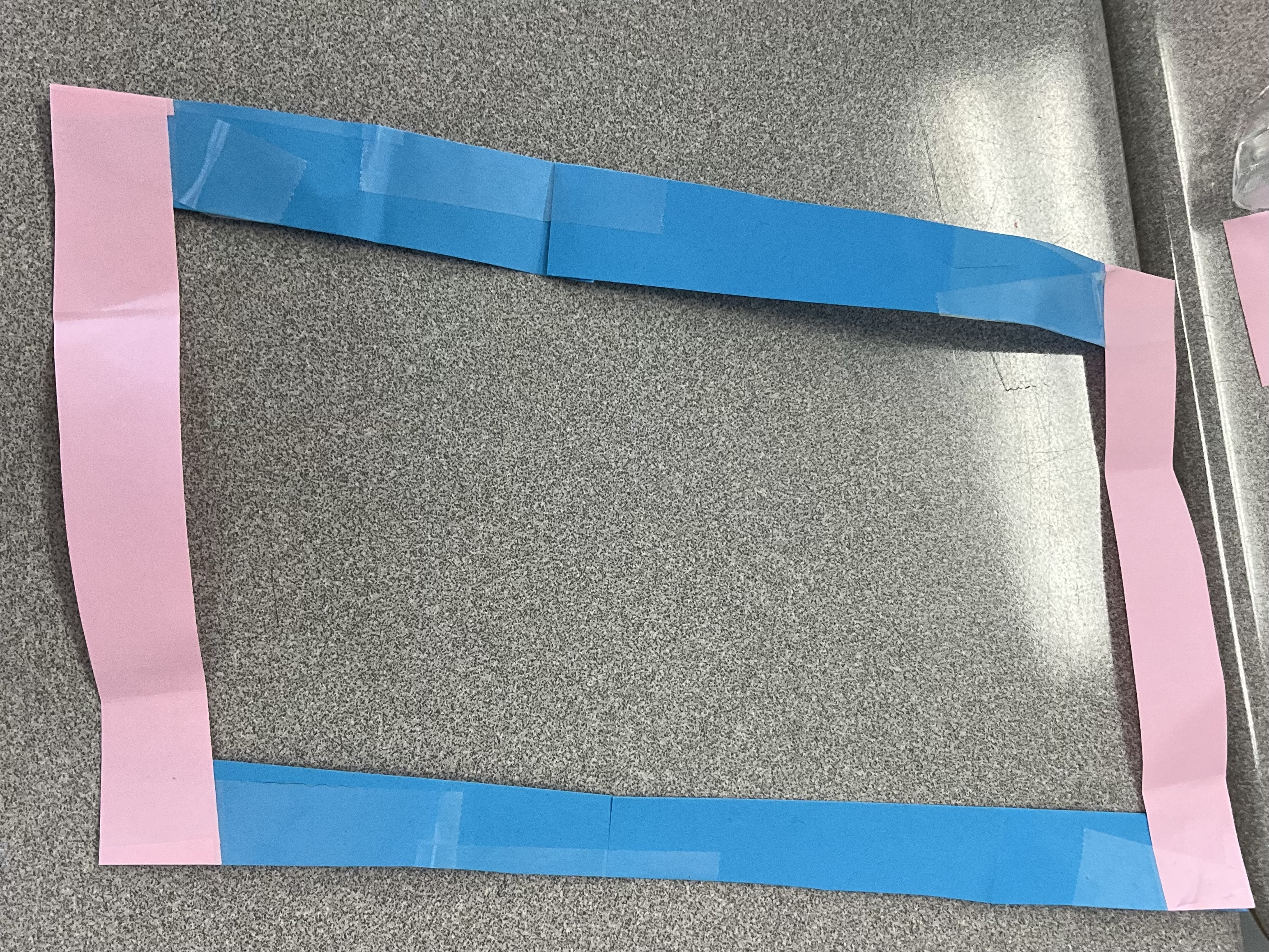
We had a good conversation about the properties of parallelograms, rectangles and squares, and will continue to debrief tomorrow on the topic.
This task encourages 3D spatial sense, making predictions, and deciding how changing initial conditions can help create different results. Through the task we could address properties of quadrilaterals, access many important vocabulary words, and lay the ground work for many more lessons and conversations.
New Adventures
This semester I’m teaching a college math course 2 nights a week. We’re off to a good start!
We covered many topics week 1 such as different sets of numbers, significant digits, scientific notation, while also getting practice working with each other in small groups.
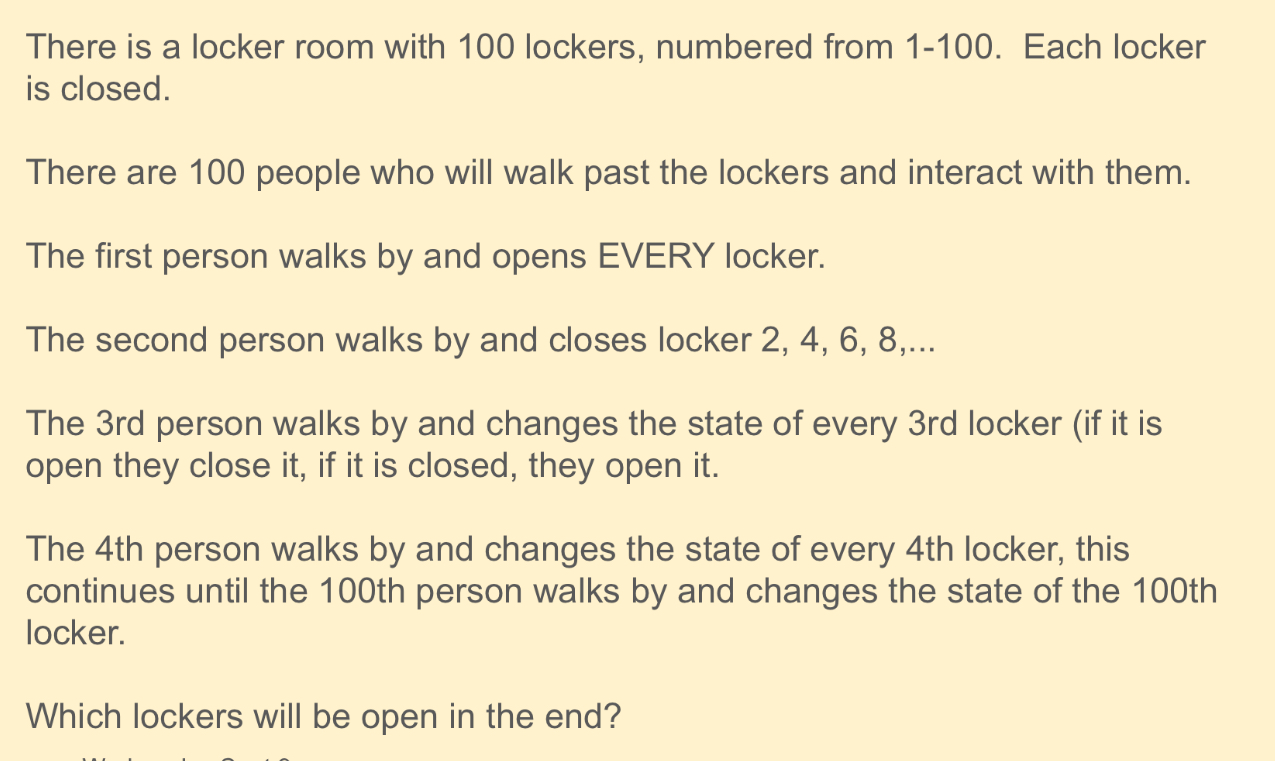
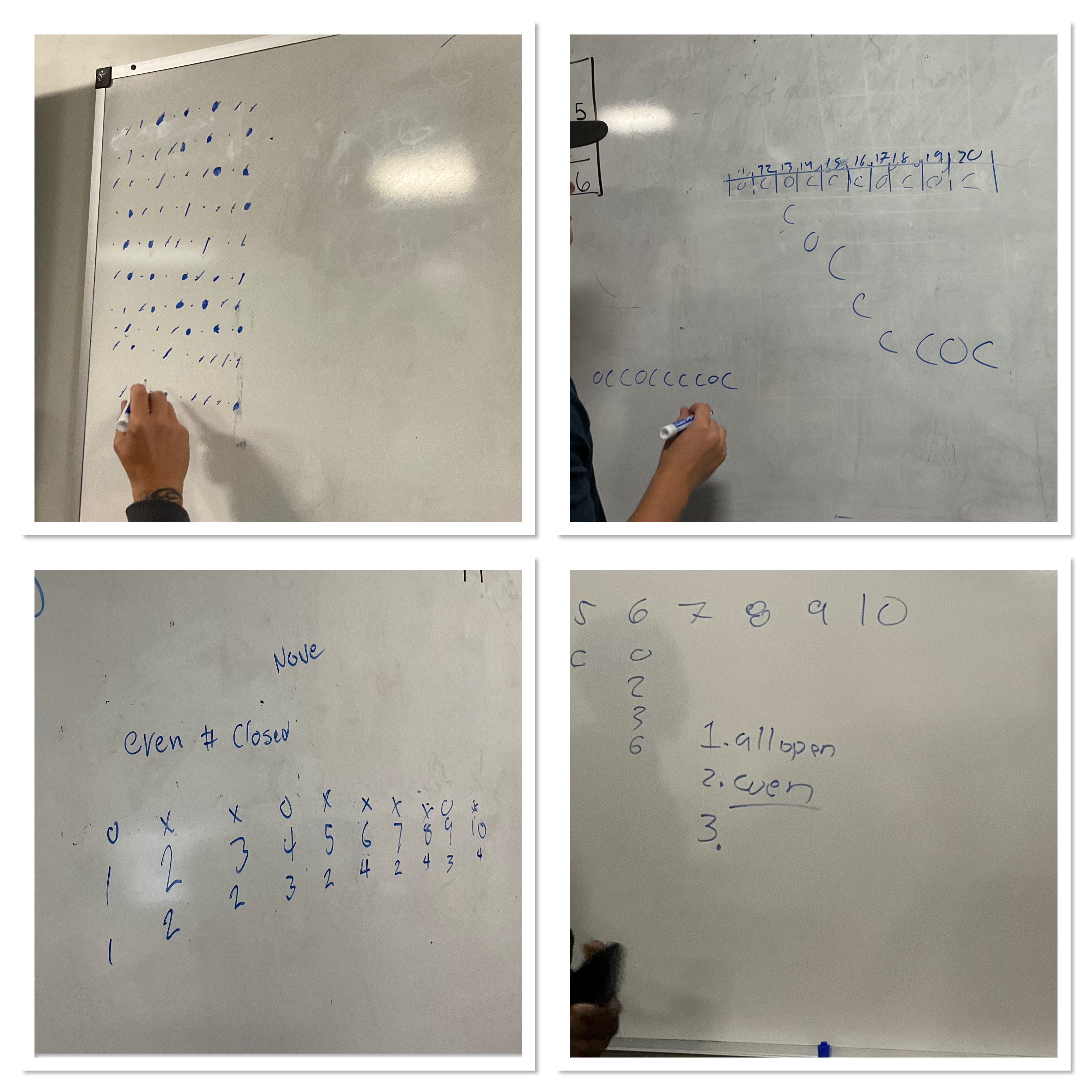
It was interesting to see the different methods the students used to determine which lockers would be open or closed at the end. There are many different approaches and we all got to the same answer in the end.
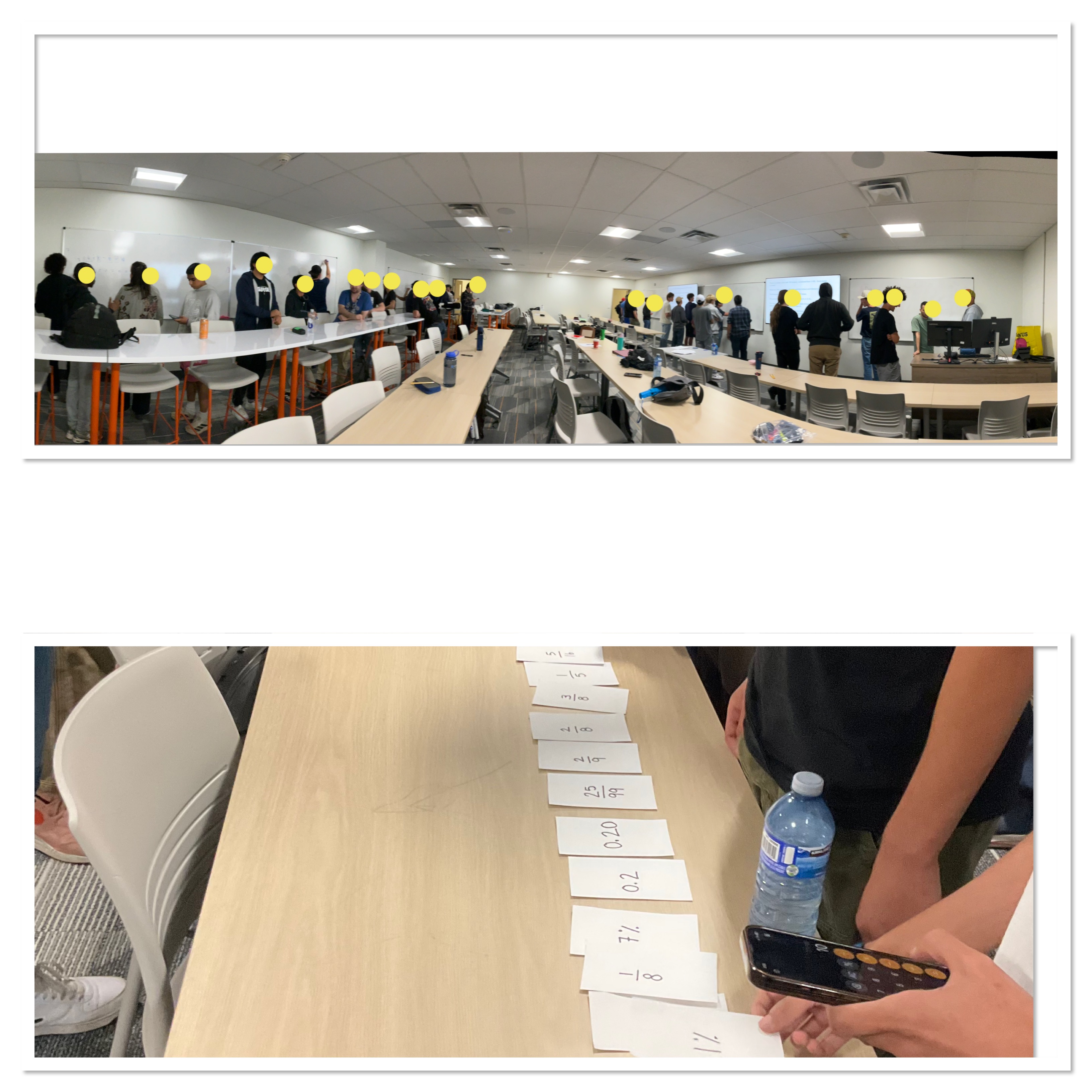
We next got into some skills like multiplying with the area model, working with fractions, and converting between and among fractions, decimals and percents. We worked in small groups to order a sequence of fraction/decimal/percent cards, and space them like a number line.
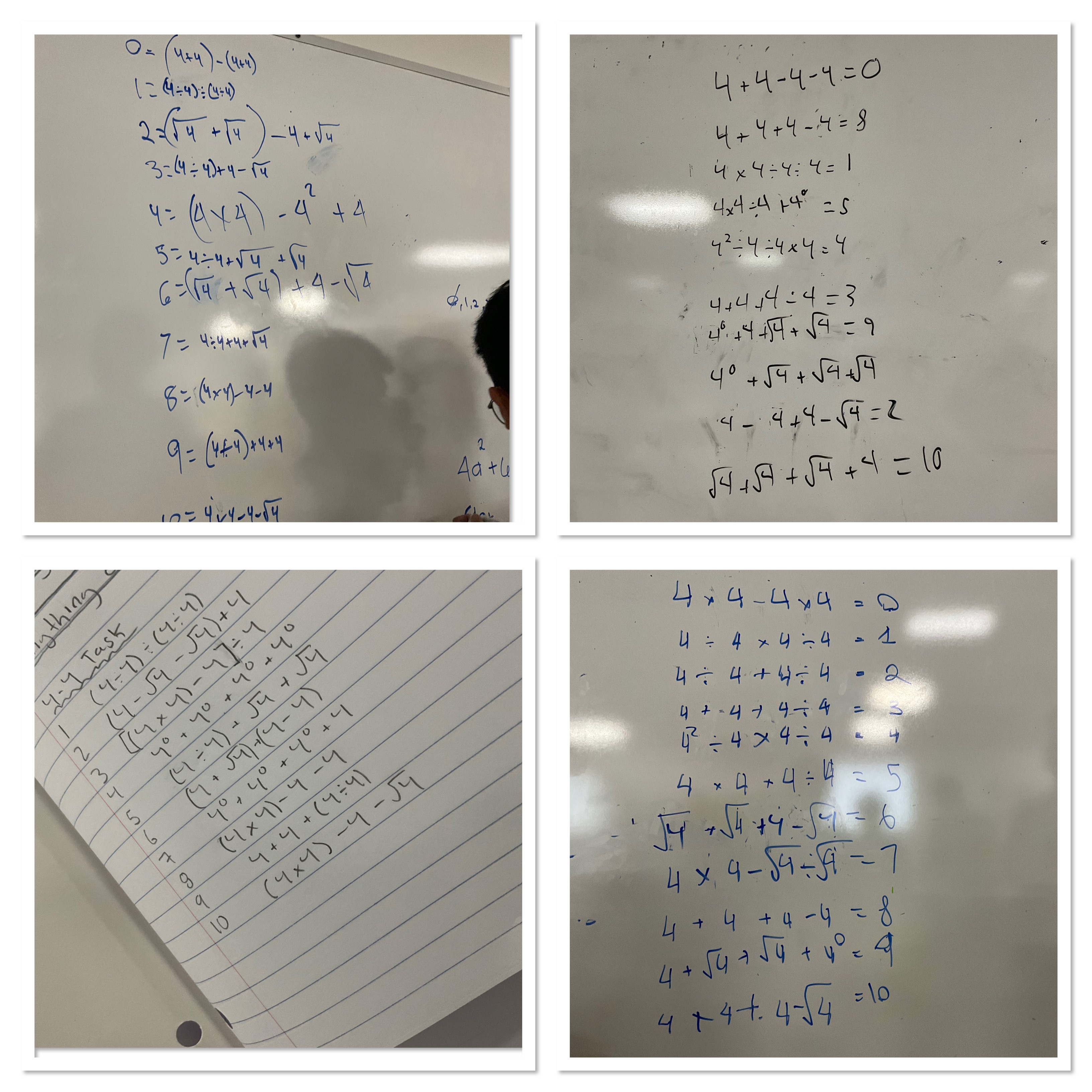
We started to do some calculation with order of operations. This task involves using 4 4s to build expressions equal to 1-10. Groups worked together well and remembered what exponents do, and the importance of using brackets.
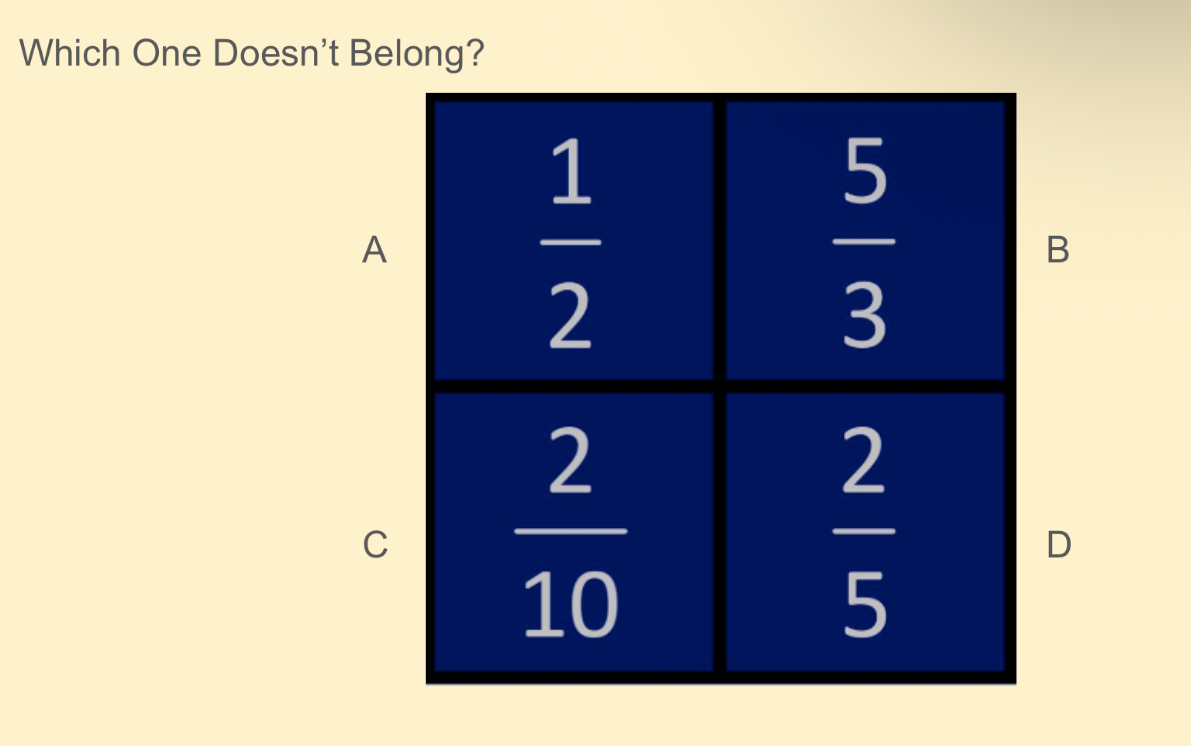
We also practiced some critical thinking about which corner doesn’t belong with the others.
It’s been a busy 2 days of math!
Conjectures in Grade 9
Today I was working with a grade 9 class as they are starting up their number sense activities. We talked about multiplication as repeated addition and as the area model. We introduced the idea of commutative operations, and looked at how we can use doubling and halving to help us understand how to use our multiplying by 10 skills to be able to multiply by 5
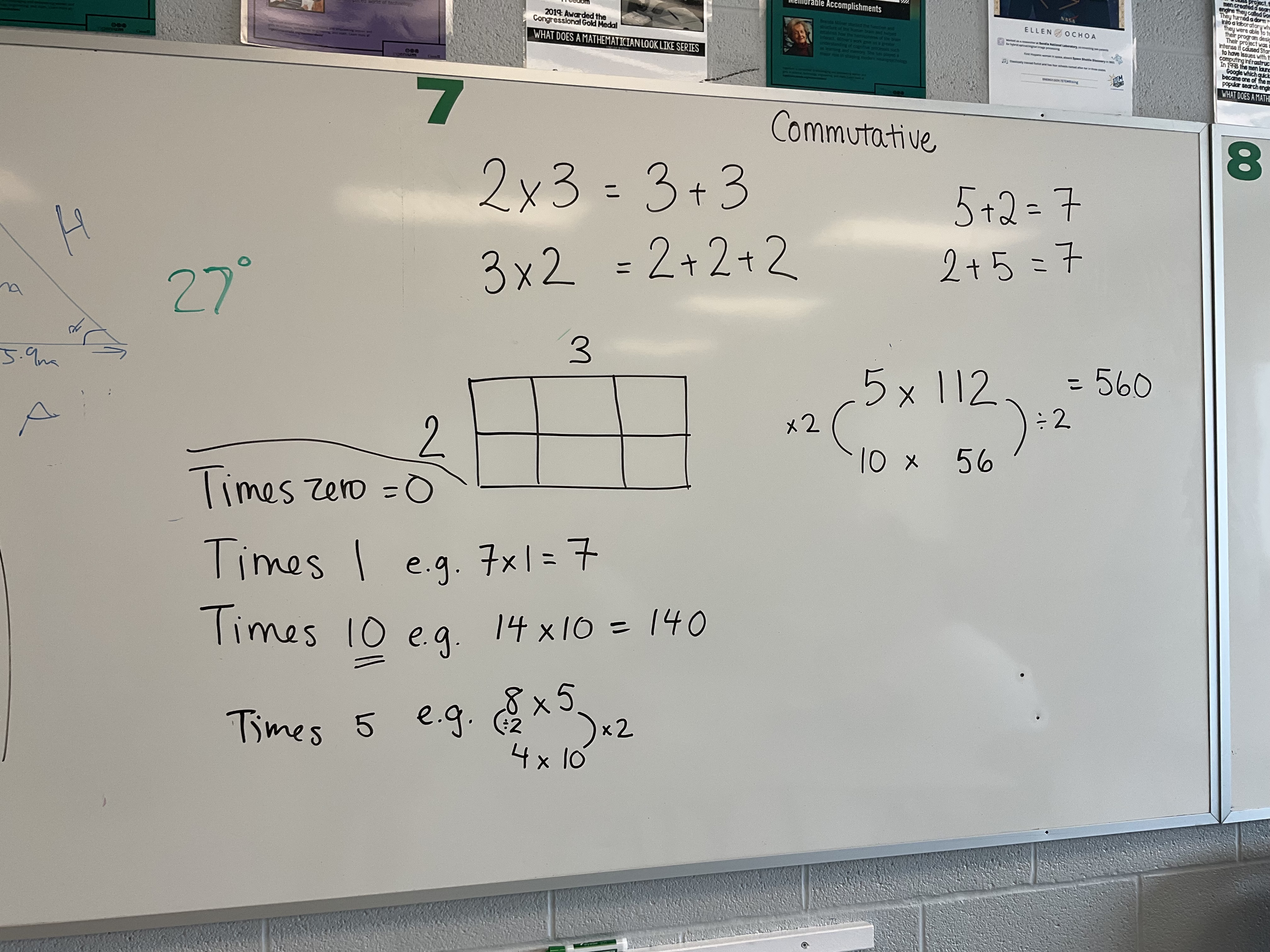
Students tried to fill in as many multiplications they could do in 5 minutes, then we debriefed some of the patterns we saw.
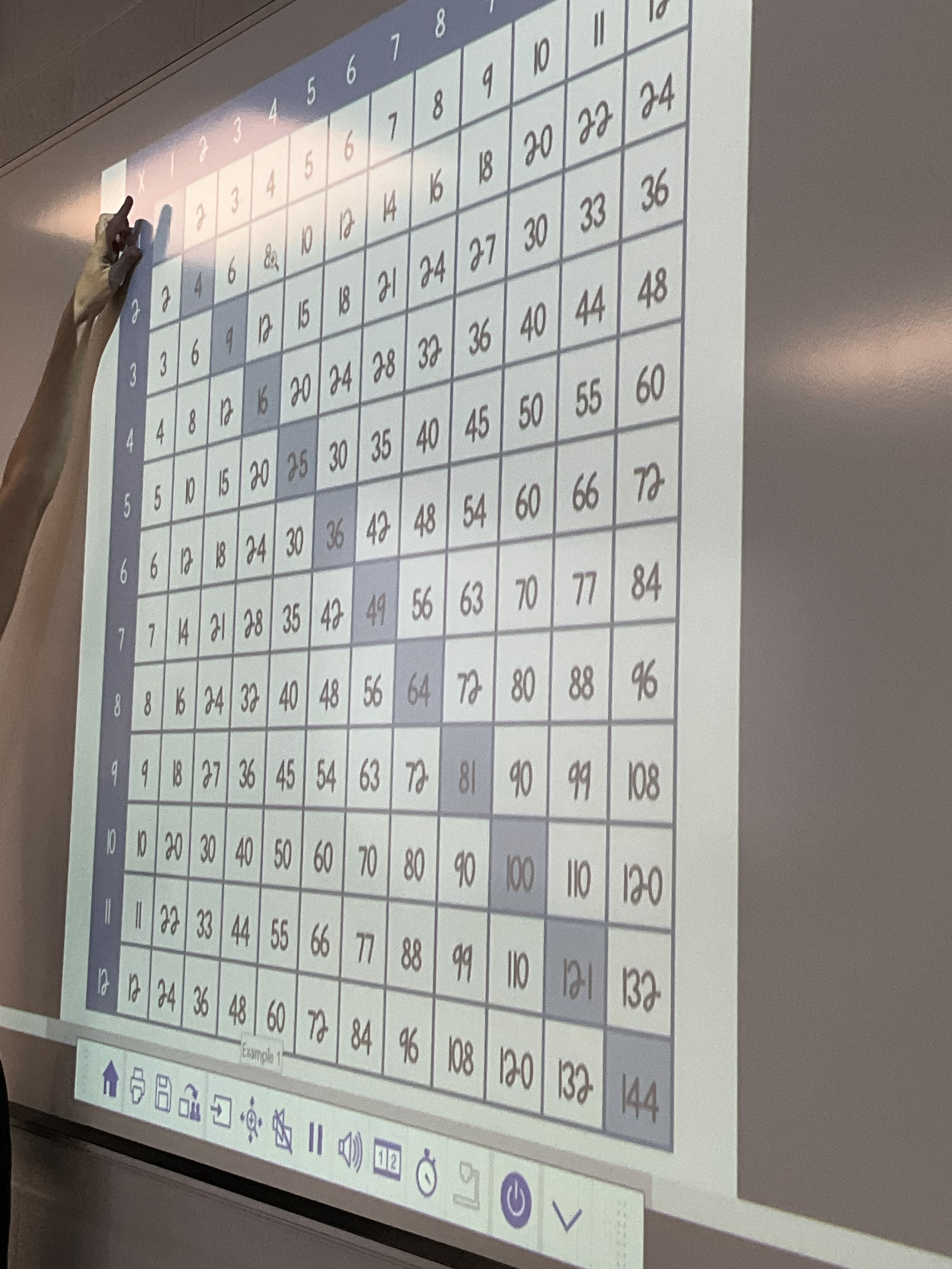
Students were curious about the patterns along the diagonal. They saw that the blue diagonal went odd, even, odd even, odd, even. The adjacent diagonals are all even, then the next adjacent are alternating even and odd again.
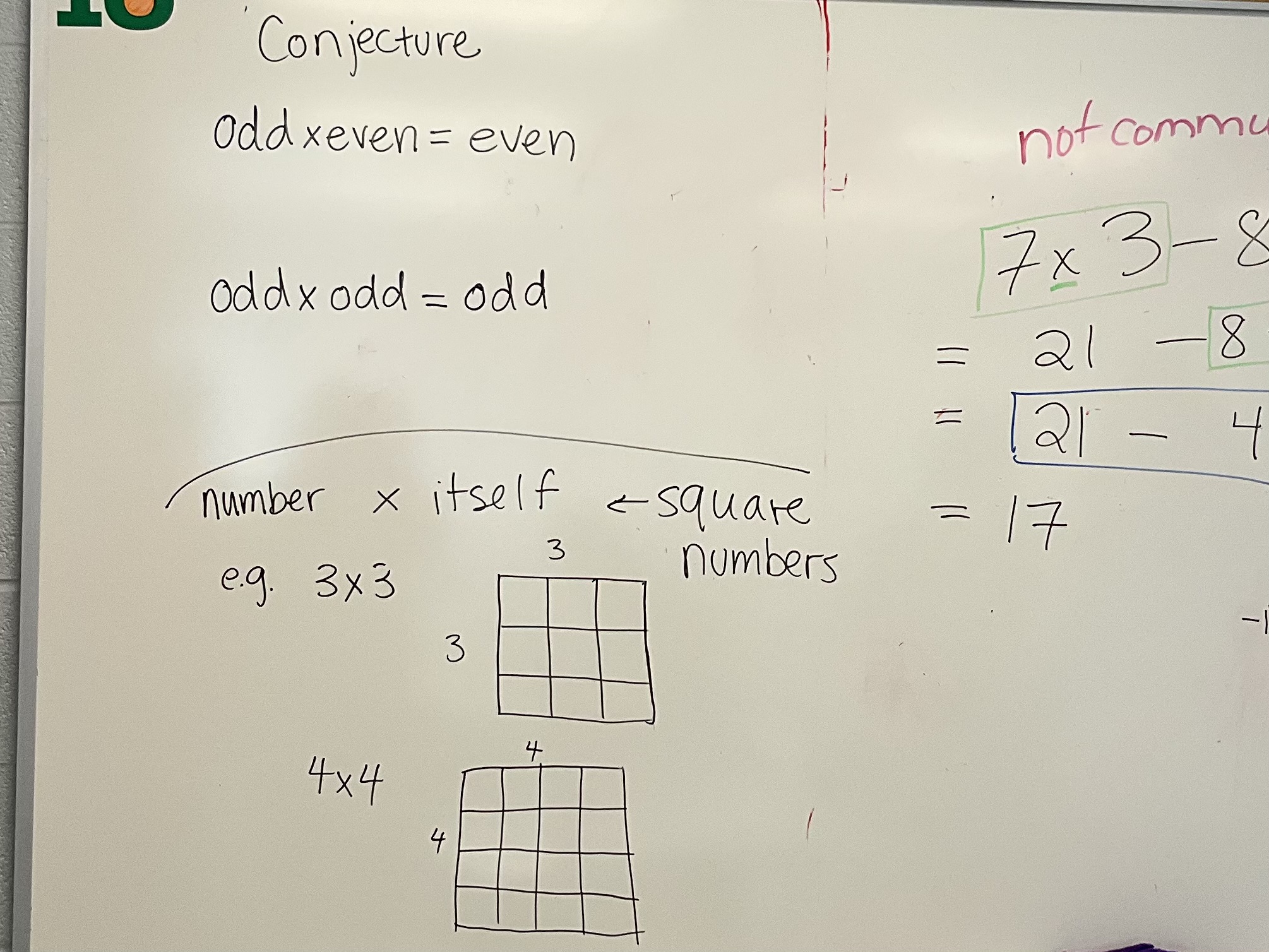
They made some conjectures about what’s going on.
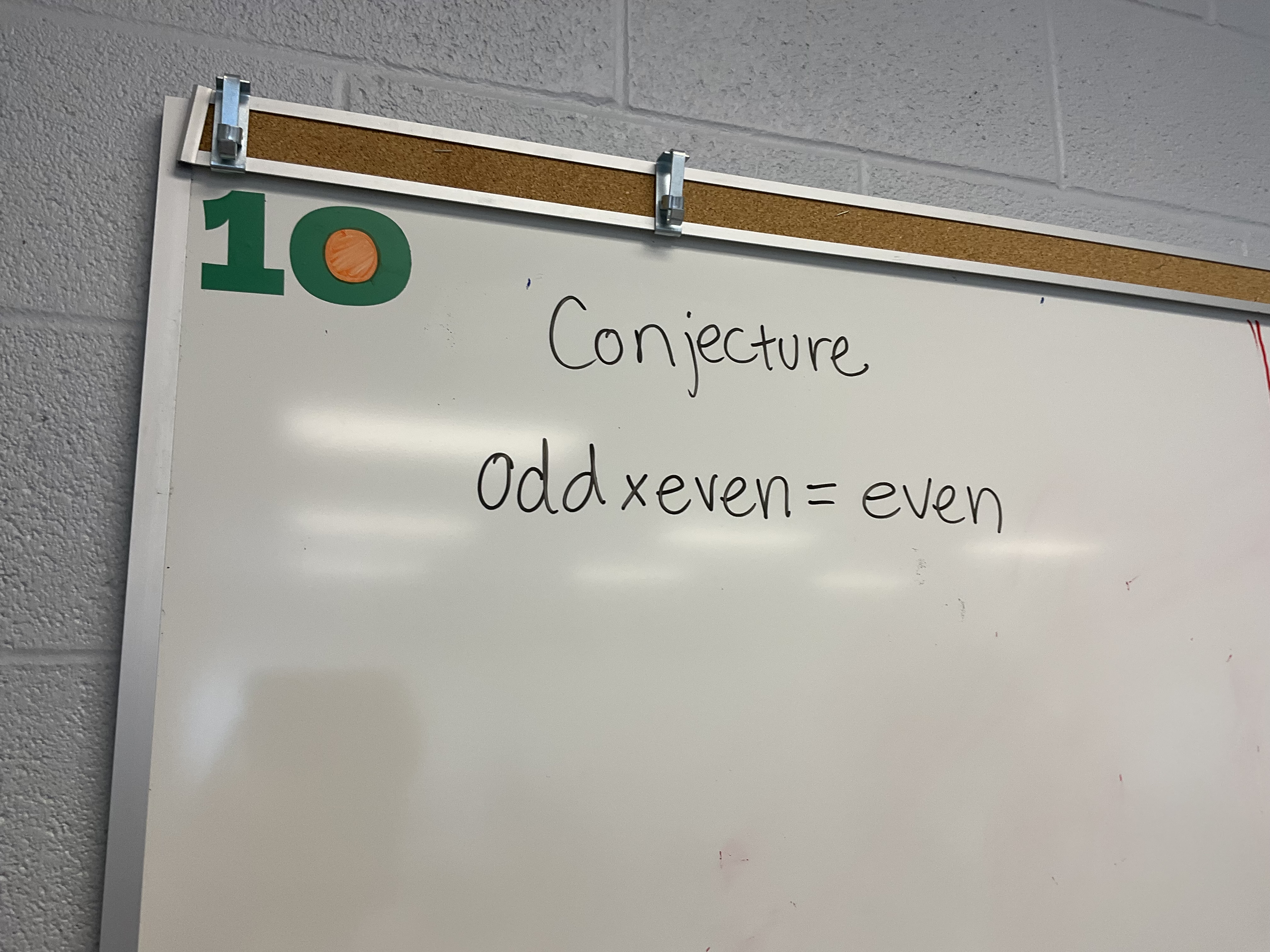
next we tried to see if it’s true. We used some big numbers to check if it’s still valid for numbers off our grid.
students chose 112×1011. We used area model to multiply the numbers.
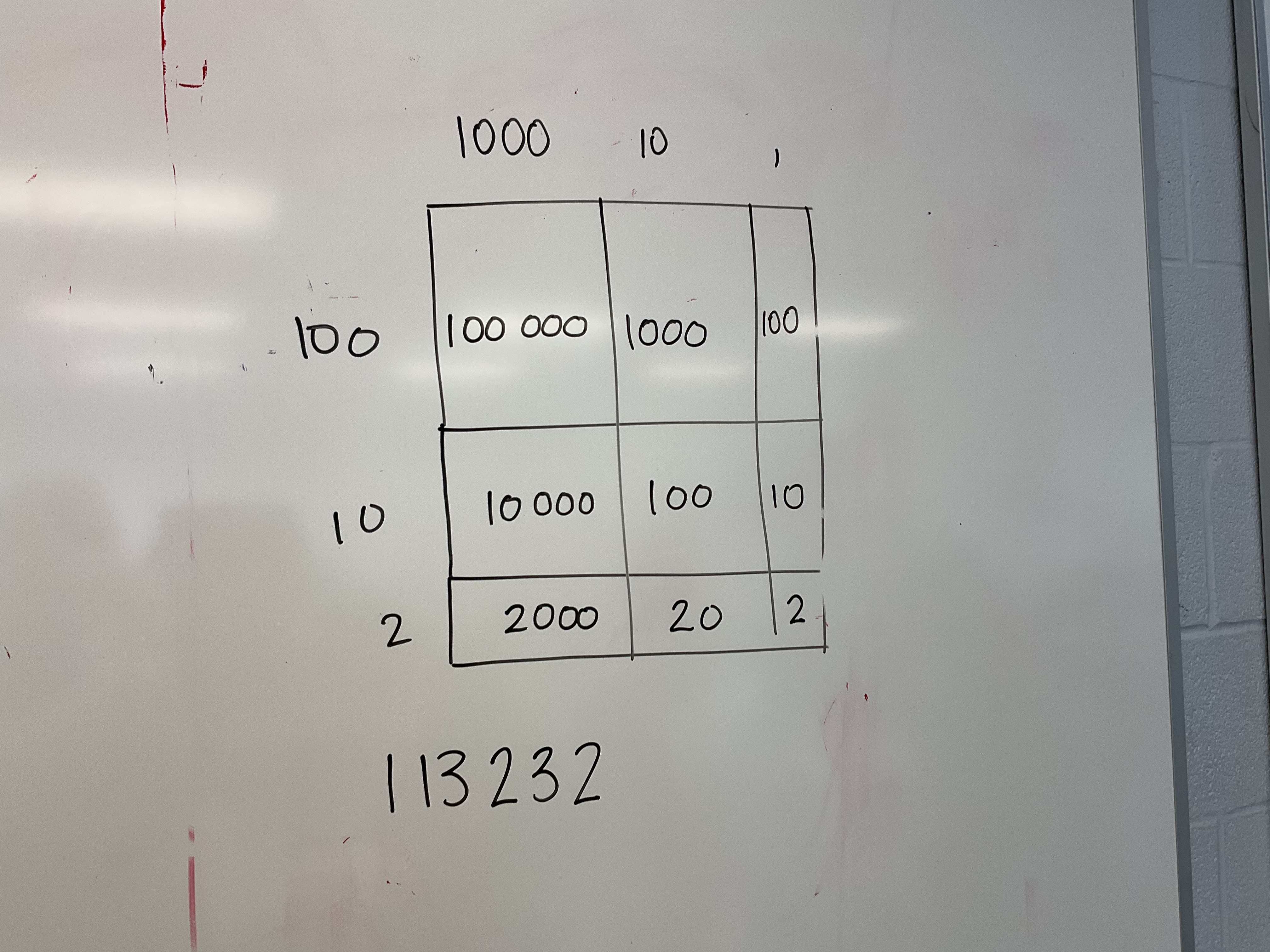
we see that oddxeven=even yet again!
we also had a conjecture that oddxodd=odd.
Finally we noticed that when we draw all the shaded numbers like an area model the rectangles are squares.
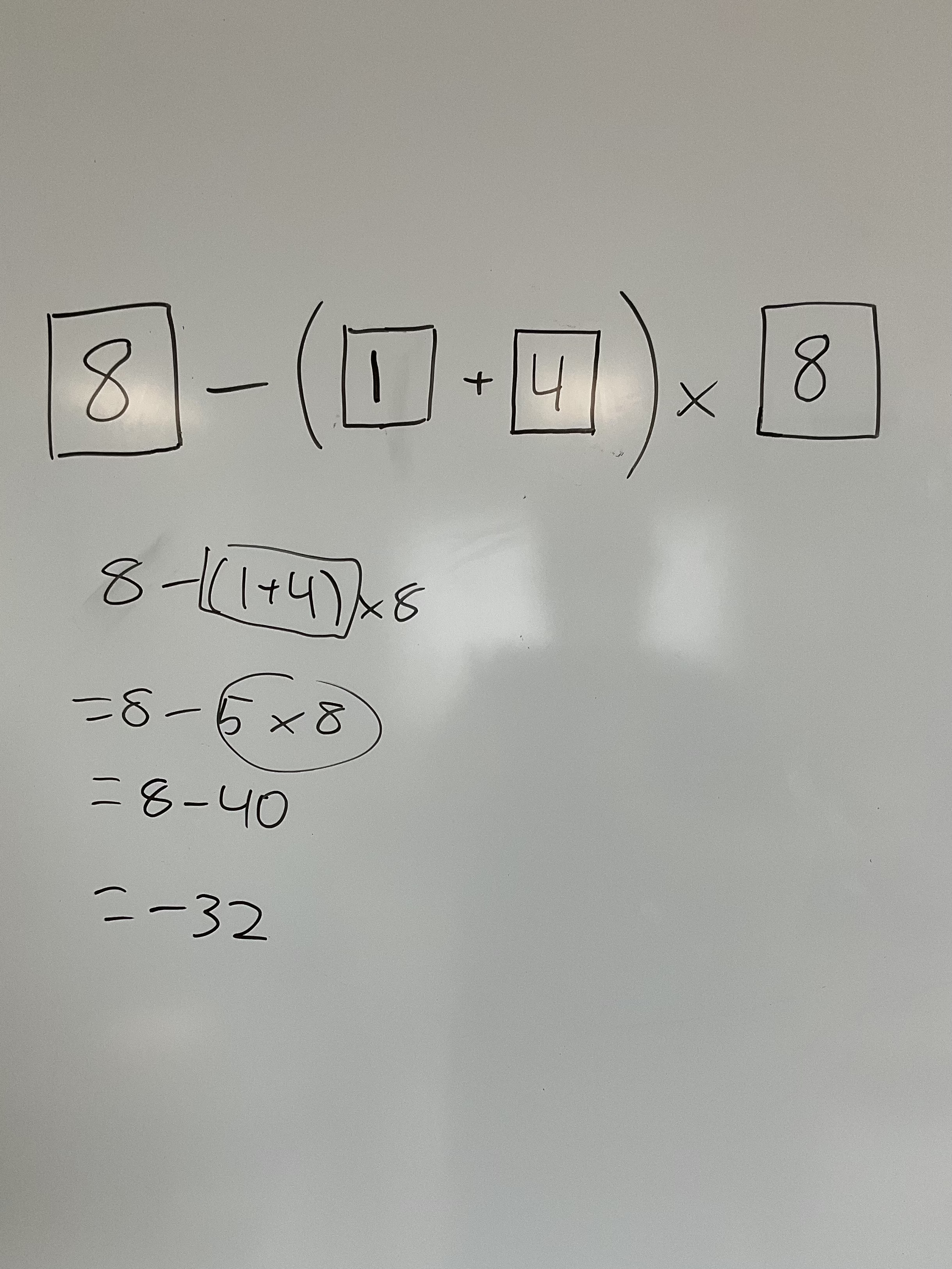
After a brief BEDMAS review we ended with a round of max/min dice game, where we start with a framework, then madlibs style we fill in the numbers from a 10 sided dice. We were aiming for the biggest number we could get.
What’s the next row?
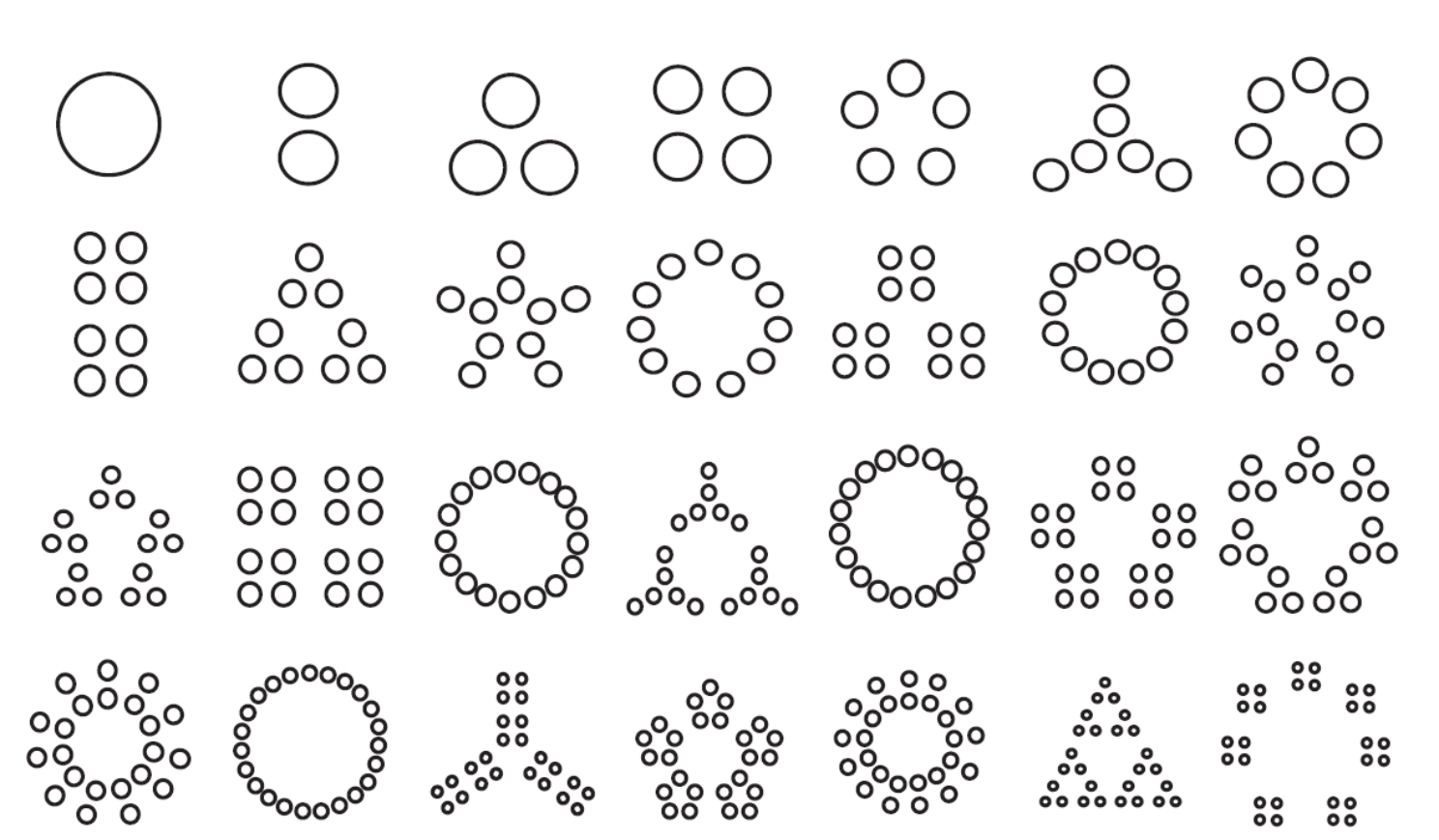
In my classes this year we started off looking at this pattern and noticing what’s going on, and making predictions about what would come next.
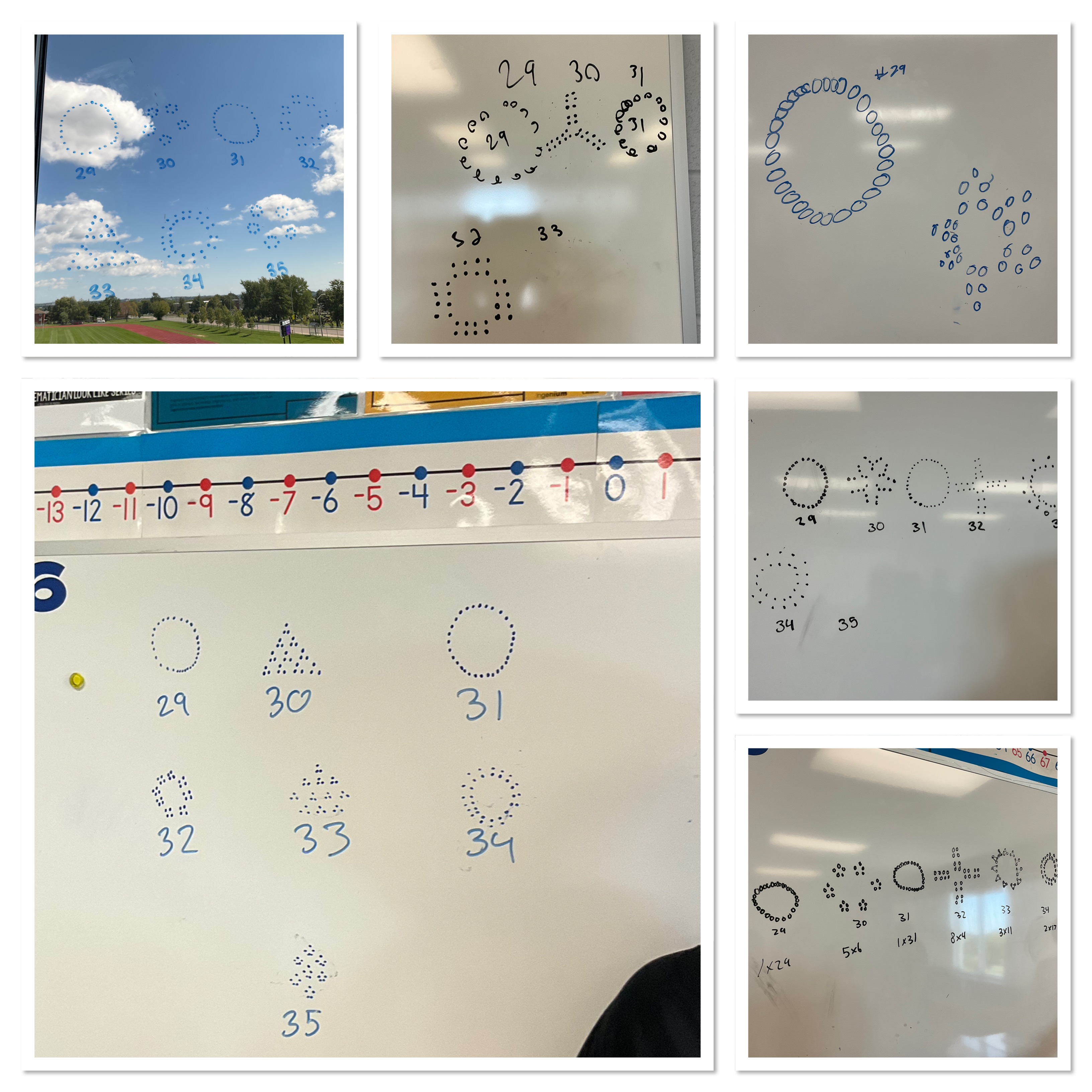
We had some interesting discussion about factors, prime factors, and prime numbers. There’s been no consensus among my students about what the next few diagrams are, but they are getting good at explaining their reasoning and justifying their choices.
Exams!
We made it to exams. Best of luck to all who are writing. Thanks for joining us on our math adventures this semester.
Ambiguous Case Desmos
My class was working on exam review and came across an ambiguous case question. Here it is:
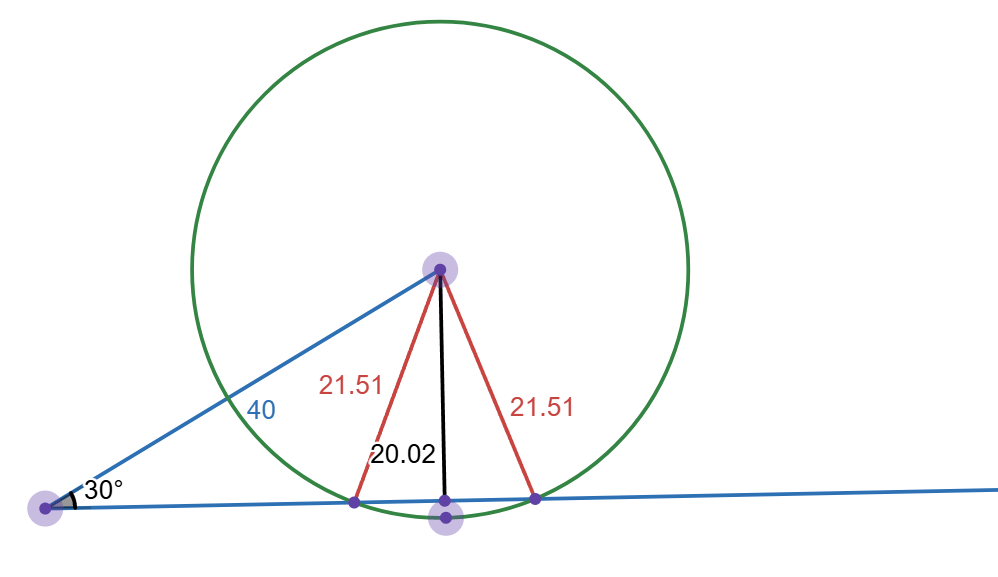
Angle A is 30 degrees, side b is 40 cm. Find the side length of BC that will allow for 2 triangles to be formed.
I’ve done some fiddling with desmos geometry and I think I have a pretty good illustration for this question
https://www.desmos.com/geometry/ac2yadxuui
The bottom point, on the circle can move, and that will show the red sides of the 2 triangles created. The black side is the case where there is 1 triangle, the right triangle, when the side length is 20. There will be 2 triangles until the side length is 40 and from there there will only be one again. It’s neat to be able to build and show these models to explore relationships in geometry.
Fractions with Cuisinaire Rods
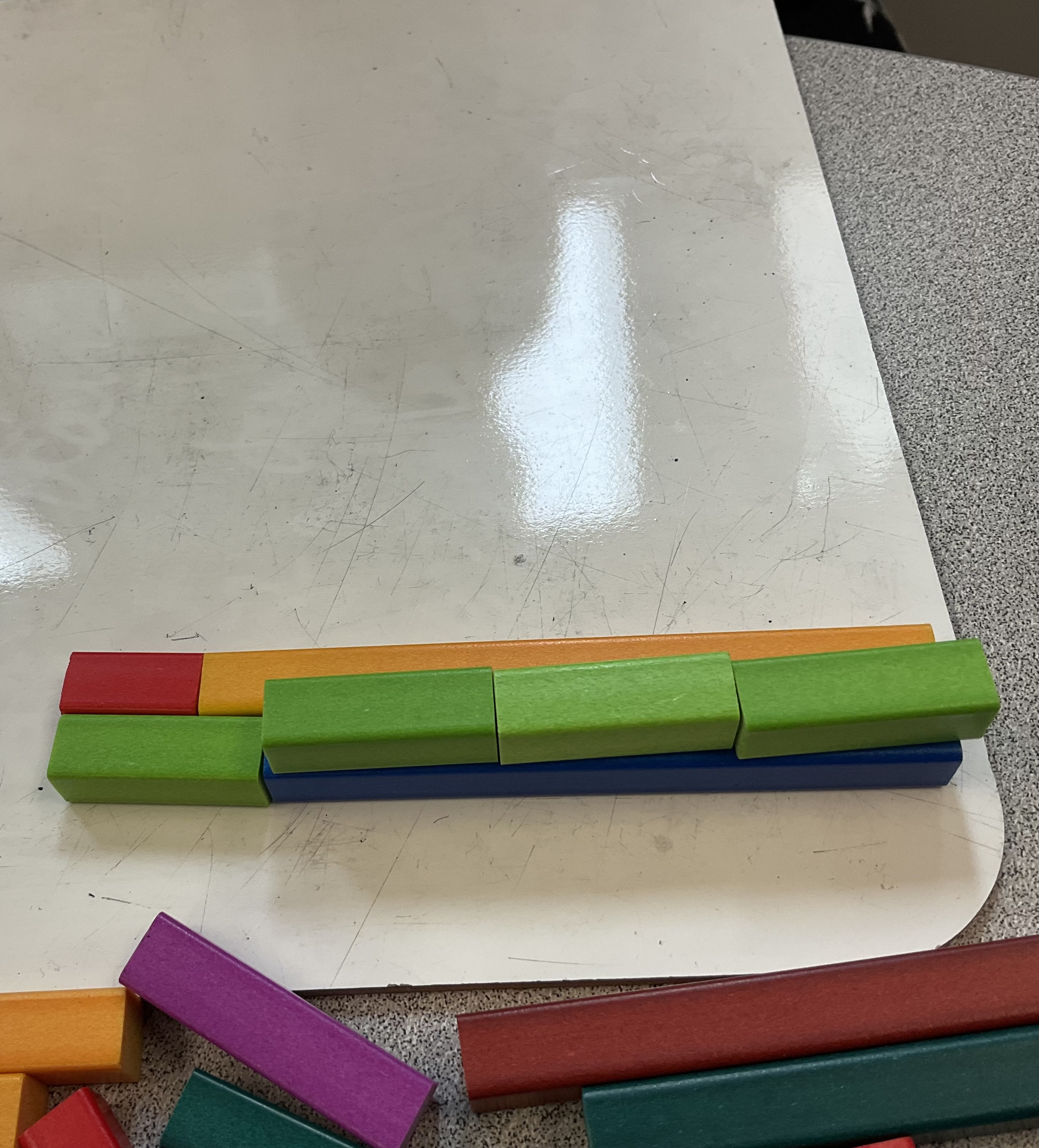
I was working with grade 8s again this week and we’re building our fraction number sense. This time we worked through a sequence of steps from this document. The goal is to work with fractions greater than 1 and less than 1, and to understand that quantities are fractions of other quantities. We would give different rods different fractional identities and then solve using other rods.
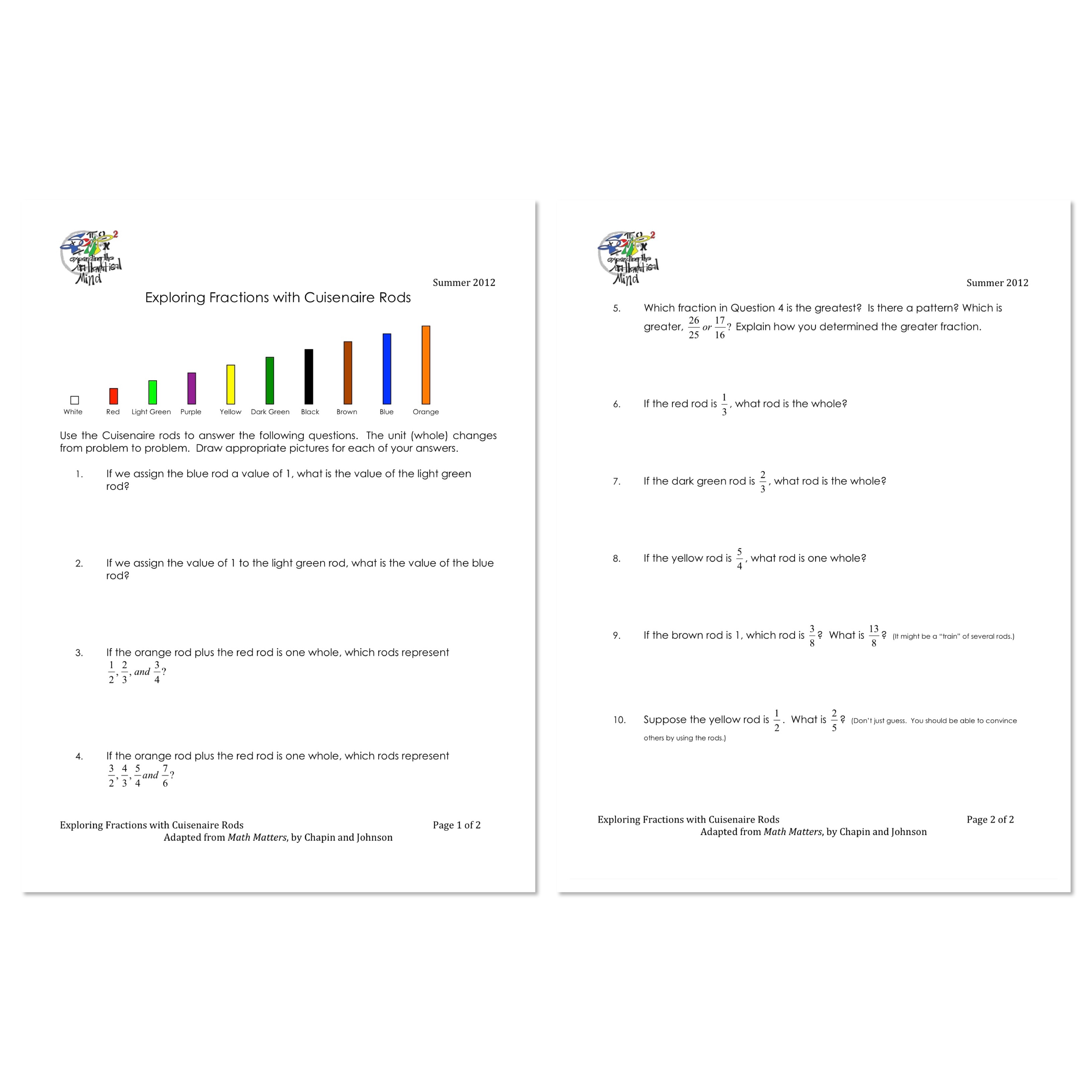
For #3 if the orange rod and red rod together is one whole, make 1/2, 2/3, 3/4 and then #4 make 3/2, 4/3, 5/4 and 7/6, we could wrestle with the understanding of the numerator and denominator, seeing that in #3 the numerator is 1 less than the denominator, and in #4 the numerator is 1 greater. Then we use the learning to help us solve #5 which can’t be done with the rods.
We needed to first figure out which block showed thirds, then find a block as long as 2 of them, which would show 2/3.
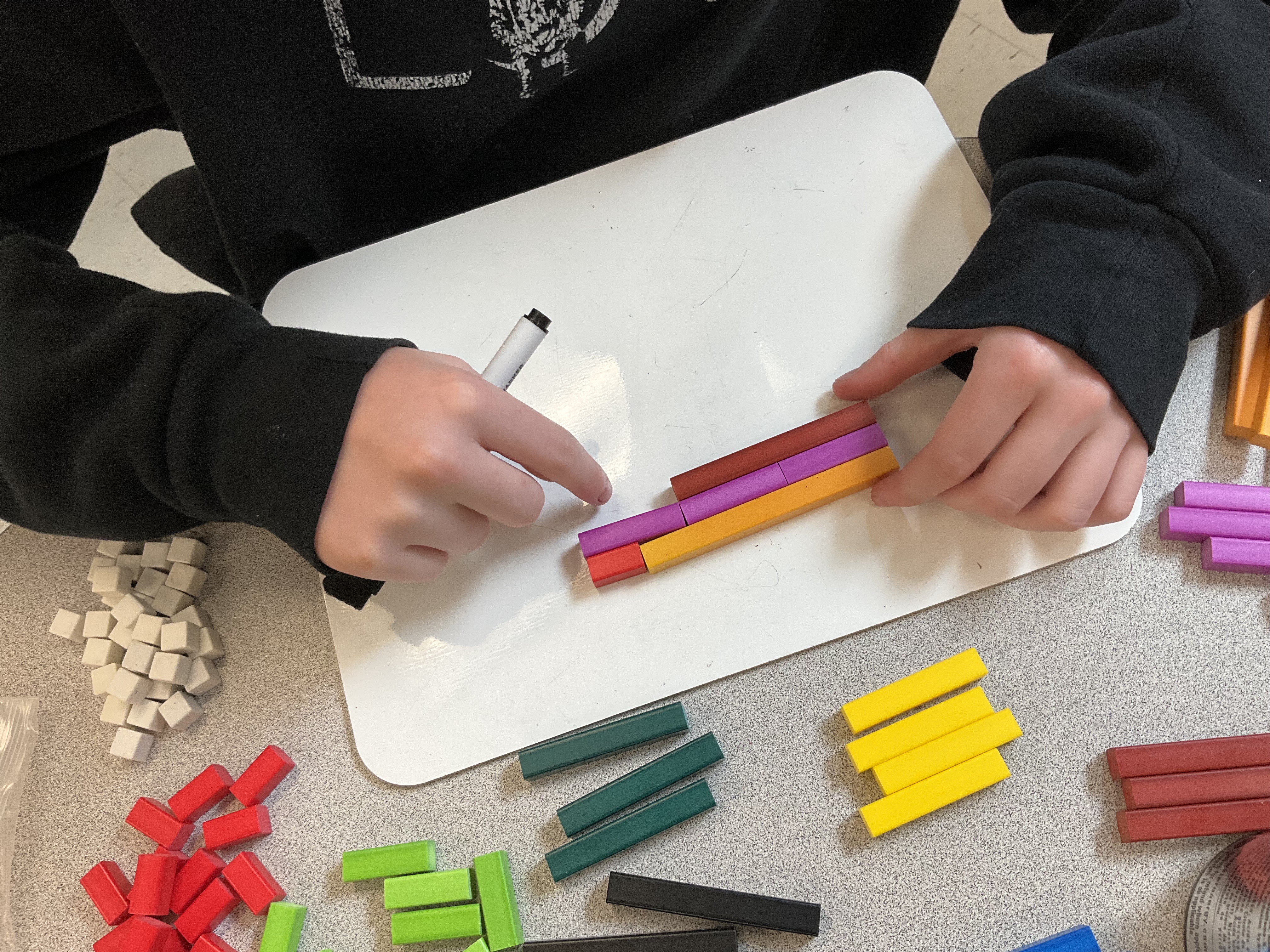
We did something similar for 3/4. We found out which block represents quarters, then found a block that was the length of 3 of them.
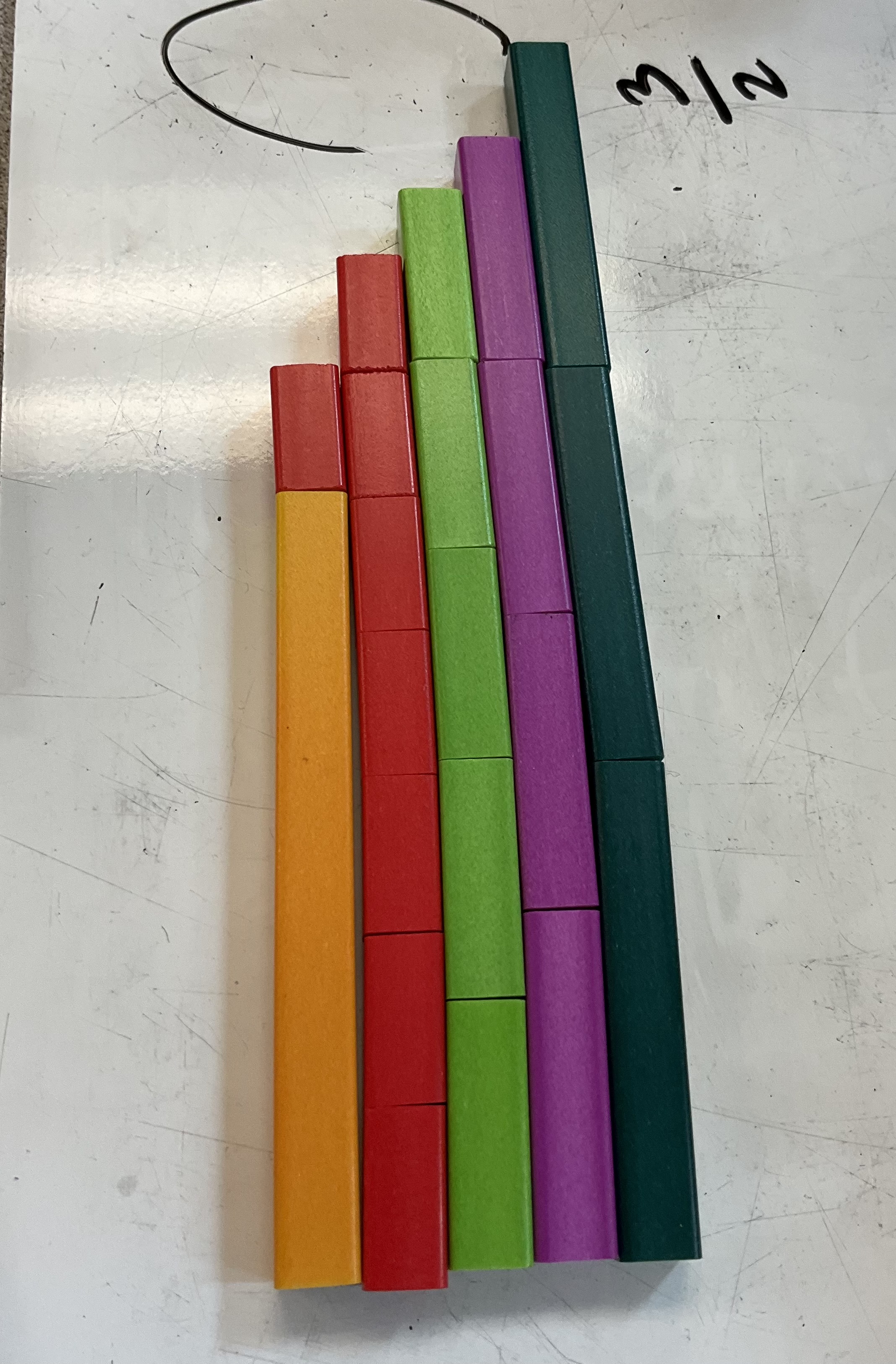
Here’s the compilation of all of the fractions greater than 1 to help make some inferences about what makes them bigger or smaller. Some guessed that 7/6 is bigger than 3/2 because the numbers are bigger. The rods really help show that 3/2 is bigger because the unit fraction 1/2 is larger than the other unit fractions since the “one” is split into fewer pieces.
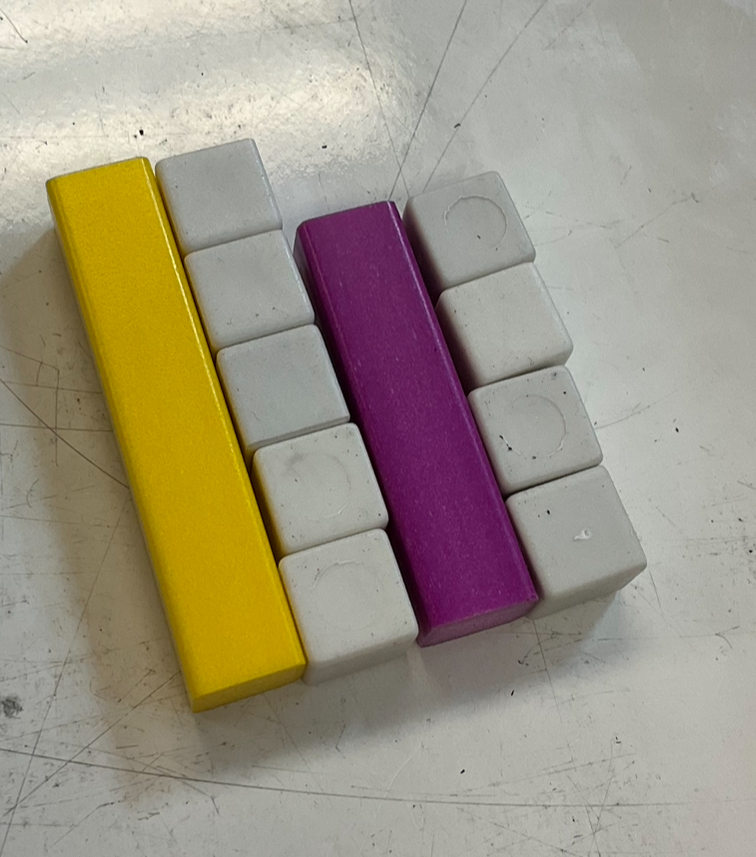
Next we assigned some rods different fractional values, and use that to solve problems. Here the yellow is 5/4, and out job was to find the rod that is 1 whole.
It was a good sequence to work through. We had some moments of struggle as we got used to the blocks having different names sometimes. The red could be 1/2 in one question or 1/4 in another, because the “whole” was changing. Hopefully associating the fractions with concrete objects help with the understanding, and that it can endure over the summer!

