Introduction to Algebra
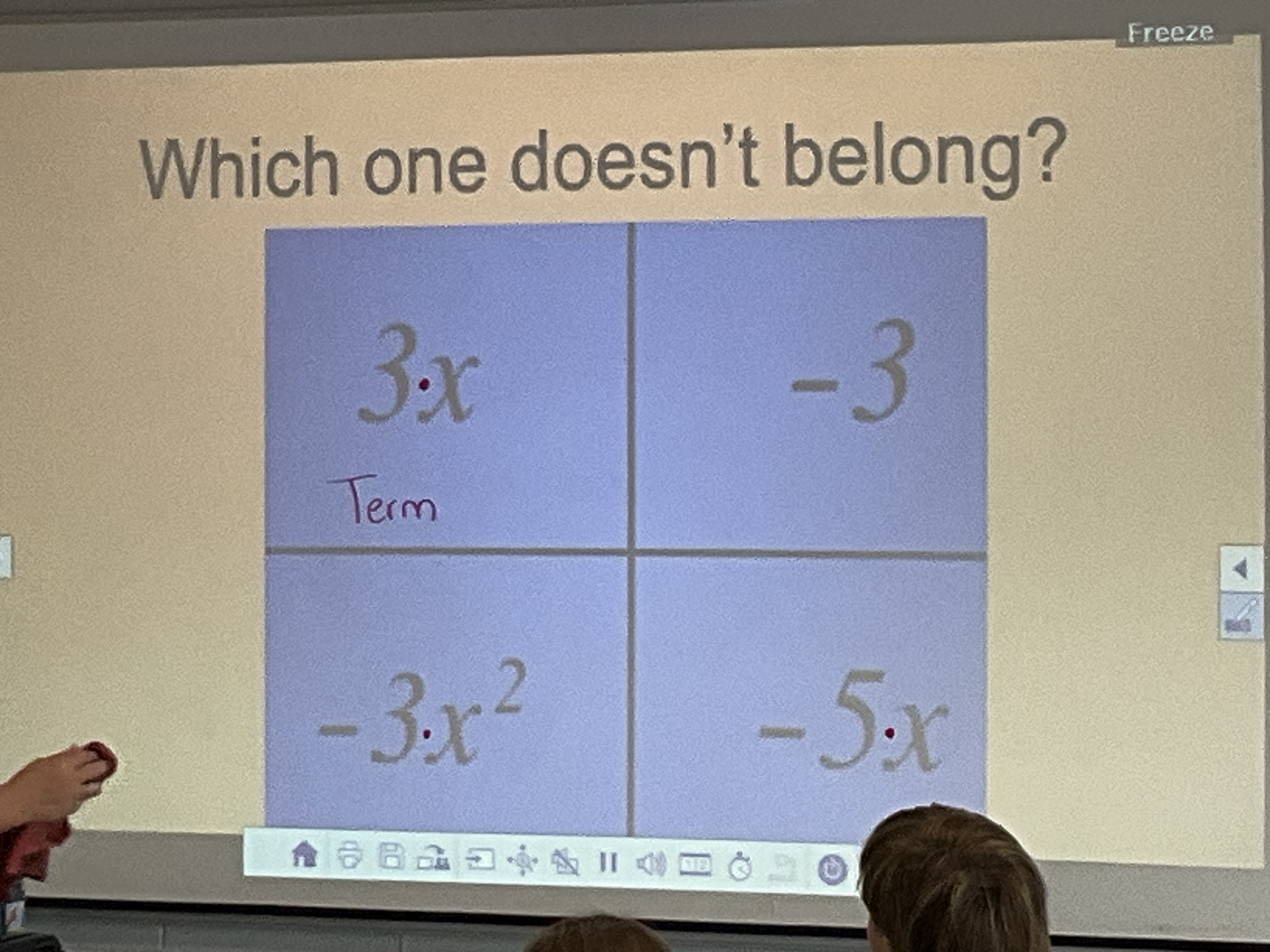
I had the pleasure of being in a grade 9 class as they started their algebra lessons. There was a “which one doesn’t belong” which helped to introduce the need for some vocabulary to discuss algebra. Terms, and coefficients, and constants, and like terms, and exponents were all discussed, and students had some neat ideas about what a variable is: something that holds value, but can change. One student suggested that -3 is the only number of the 4 that we actually know.
Following this, algebra tiles were introduced, and students built pictures.

After the pictures were built, they wrote expressions for their pictures, then simplified the polynomials into their simplest form. New vocabulary was introduced to talk about monomials, binomials and trinomials.
A concept that is sometimes intimidating for students can be much more approachable when starting in this gentle way.
Factoring and Expanding with Tiles
Today I had the pleasure of working with a grade 10 academic math class to help introduce factoring and expanding using algebra tiles.

To start with, students were working on recreating the rectangles provided and stating their areas and dimensions. Here is the sequence of questions we used.

We know the area is the insides, so that is x^2+8x+15, and the dimensions are (x+3) and (x+5). We know the long sides are x, and the short sides are 1, and we read the dimensions of length and width of the rectangle.

We looked at how negative times a negative is a positive, and that is why we need 10 red squares in the corner.

Here we looked at zero pairs, and how the +x and -x will cancel each other to make zero.

Students had to work on making rectangles from these given sets of tiles. The 2nd example allows us to talk about perfect squares. The 3rd and 4th require some zero pairs to make the rectangles work out.
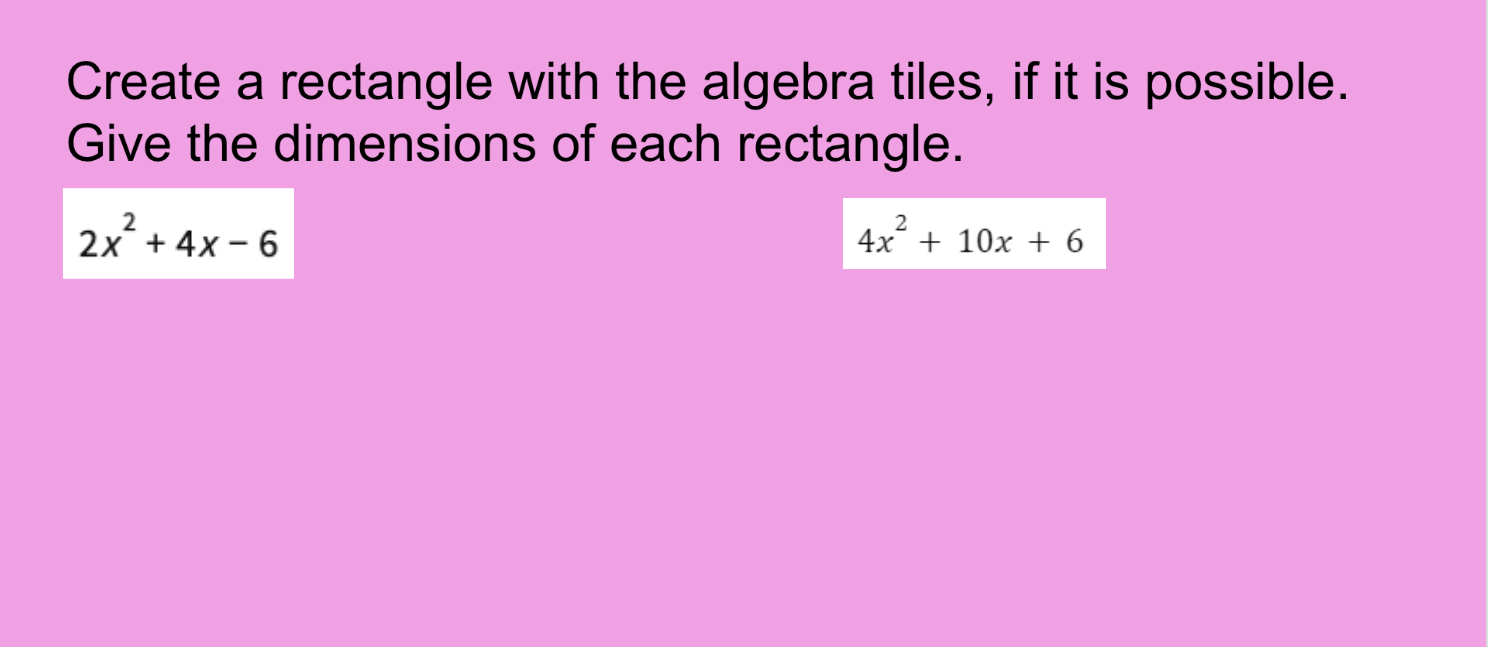
These examples have a few different ways to make rectangles. This is because there is a common factor of 2. We could split each polynomial up into 2 equal rectangles as well.
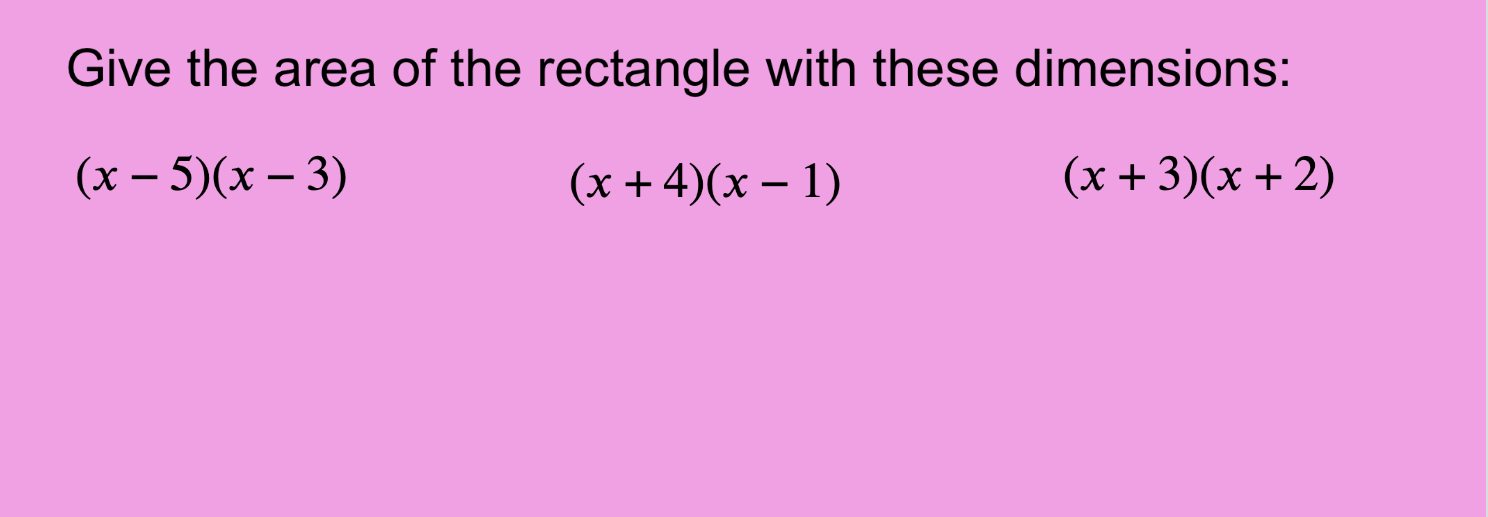
Finally, we tried giving dimensions, then building the rectangles to determine the area.

From these questions, students are essentially factoring and expanding using tiles. In spiral 2 we will go back and attach more algebra to these skills, and explore some patterns that are visible with the tiles.
Cookie Towers
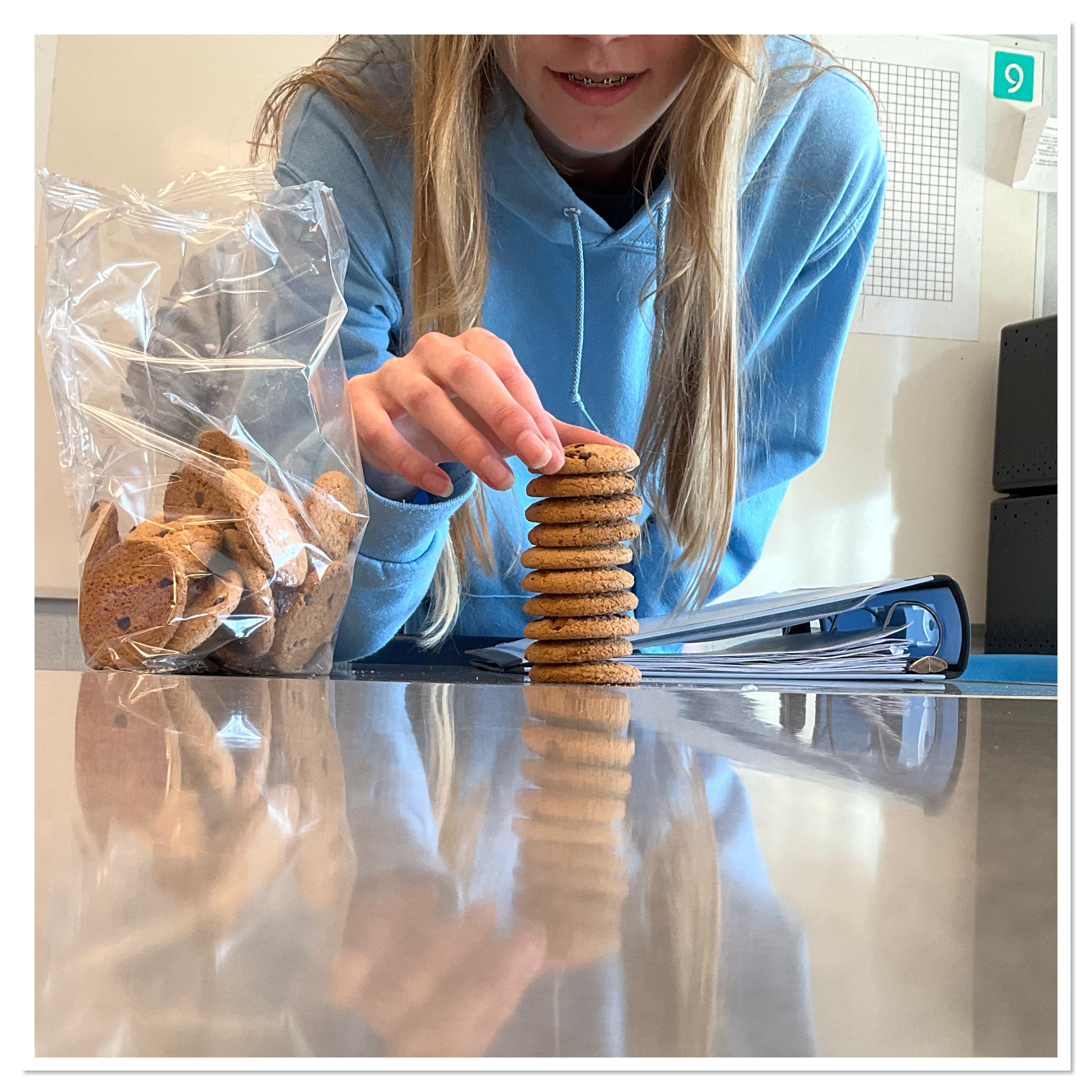
Grade 9s are working on data collection and representation. Today we gathered some single variable data by making cookie towers. The rules are: hold one cookie at a time and place it on the tower. Cookies are stacked one on top of the other. We want to create the tallest tower possible.

There were various strategies attempted. Our tallest tower was 16 cookies.
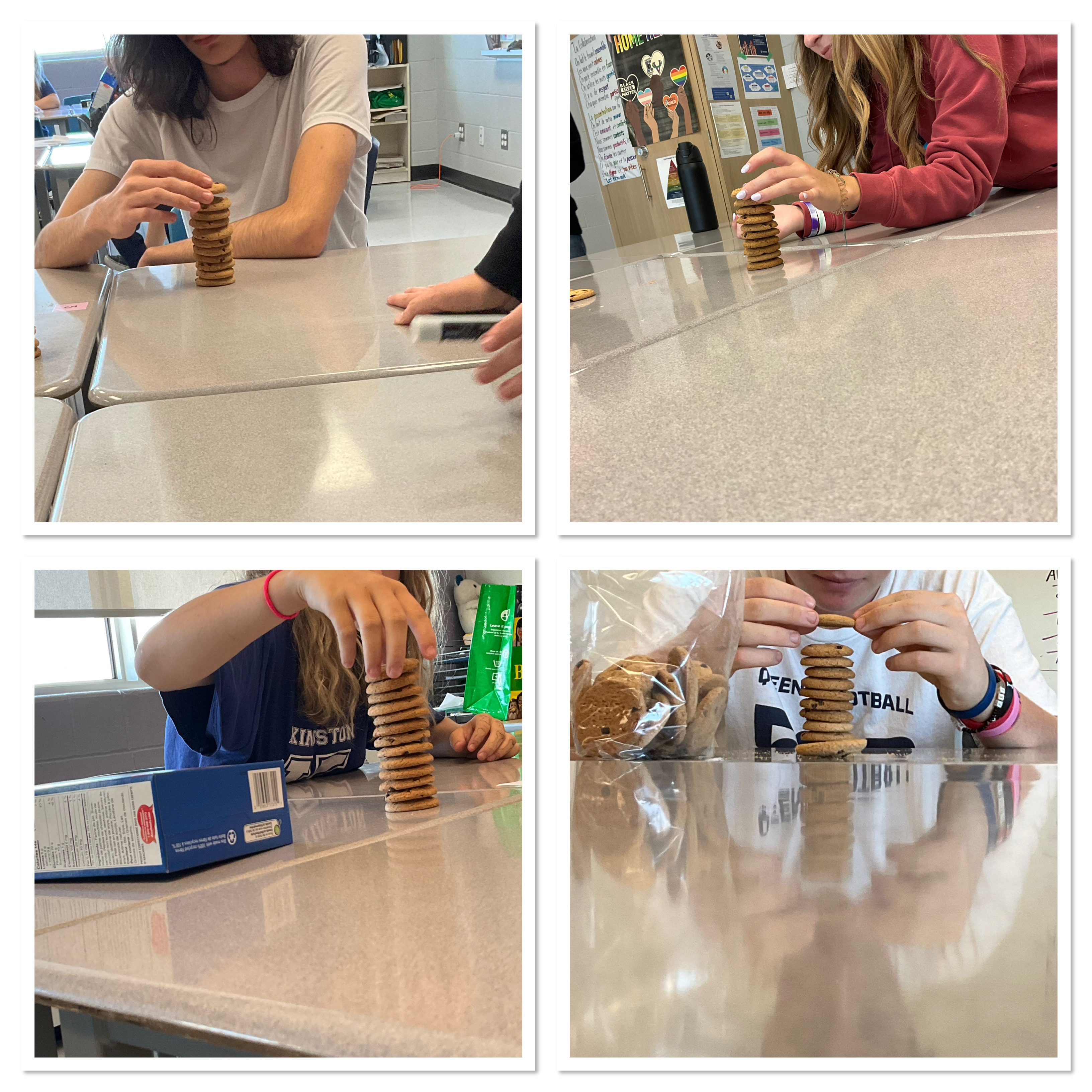
After each group had 12 attempts we calculated the mean, median, mode, and range. Then we learned how to represent data in a box and whisker plot.

It was a fun way to end the week.
Parallèle: Même Pente!
In grade 10 my class has learned a call and answer….when I call out “parallèle” they will reply with “même pente” (same slope). We had not talked about this for a while, and were doing some review work in groups at the boards, and I flipped to this slide to end the class. The challenge is to find which figure number will have the same perimeter.
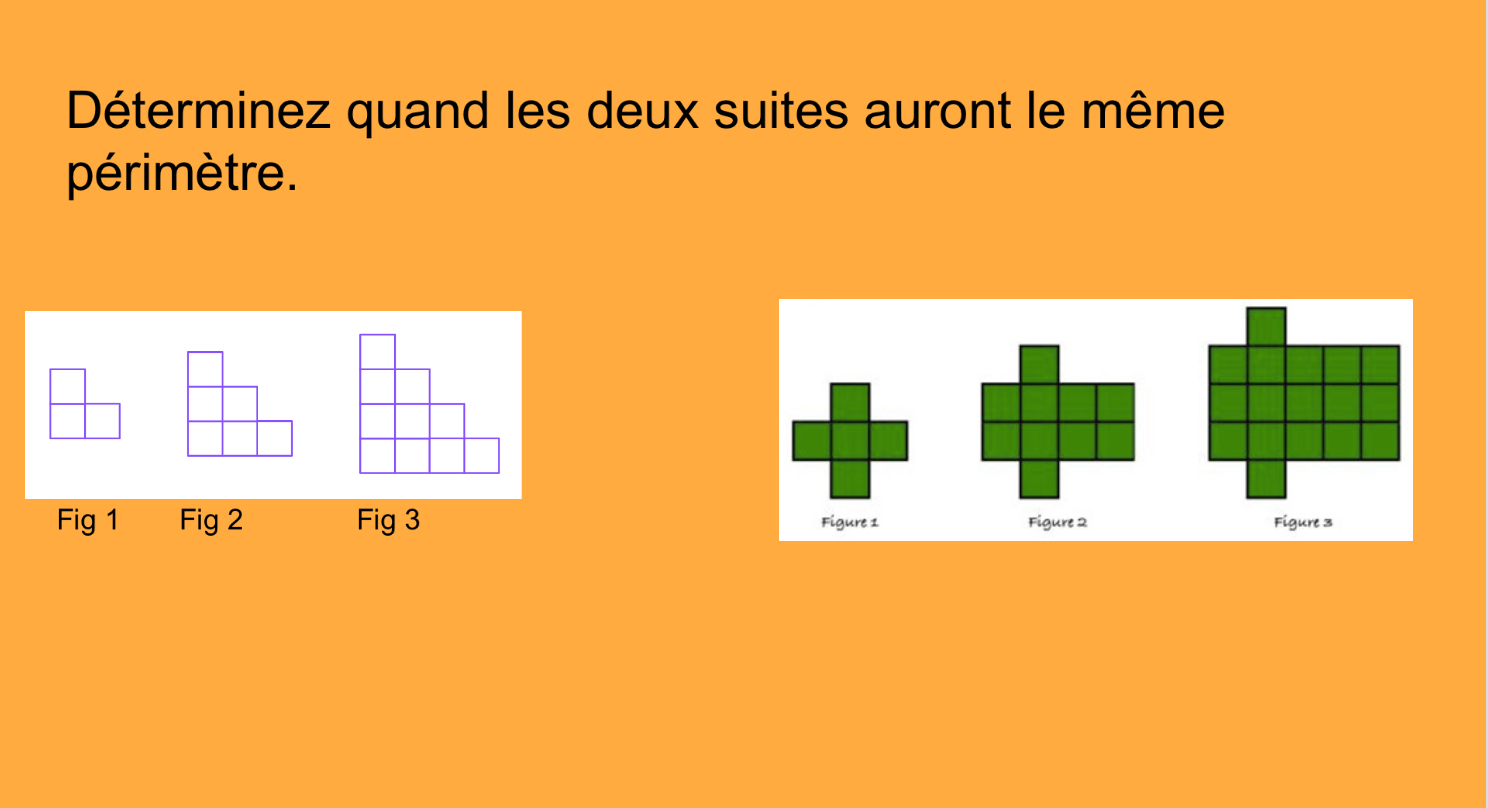
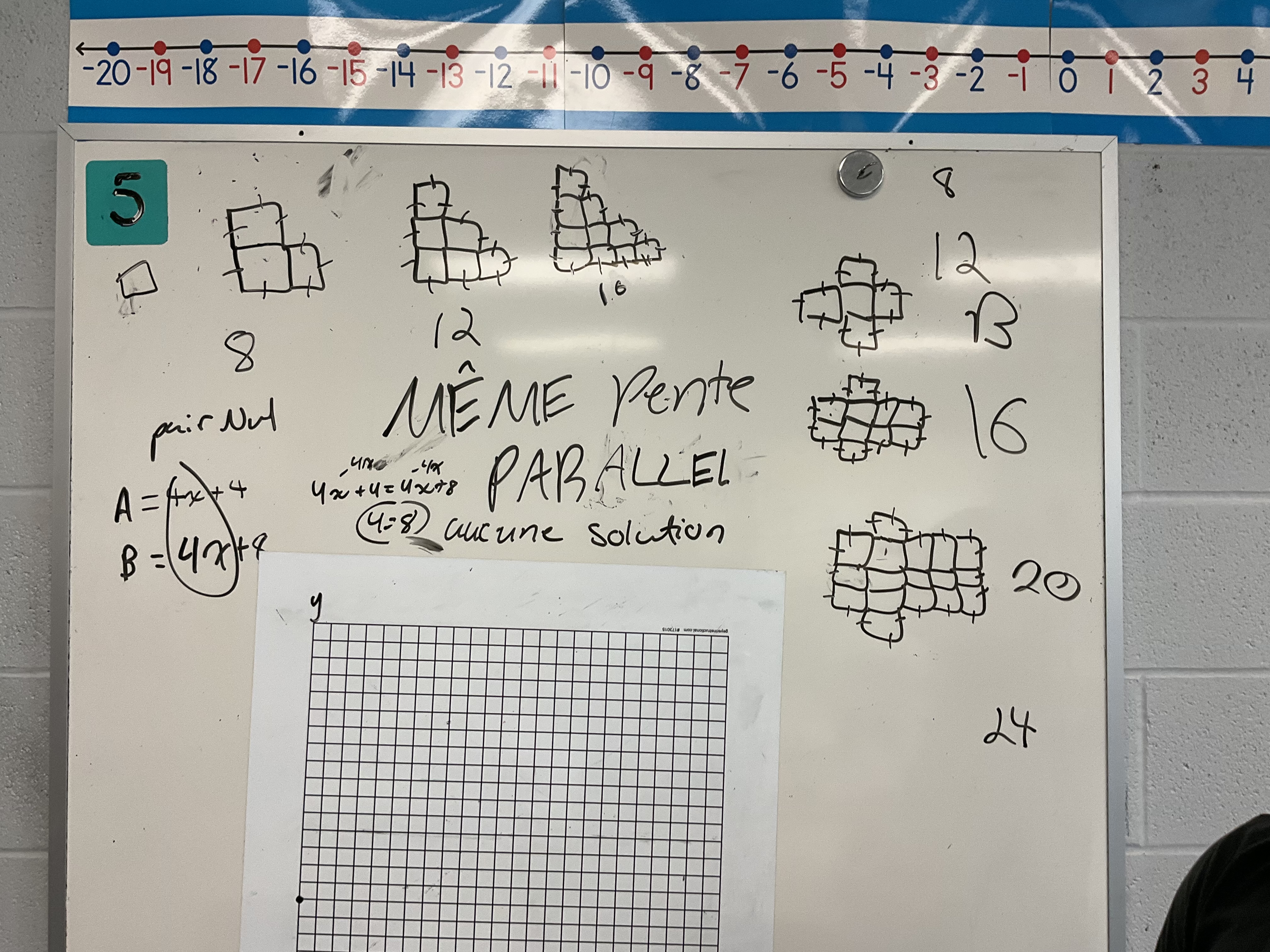
I was very impressed to see their way of working through the problem. This group made equations, then realized the slopes are the same, so they are parallel and will not intersect.
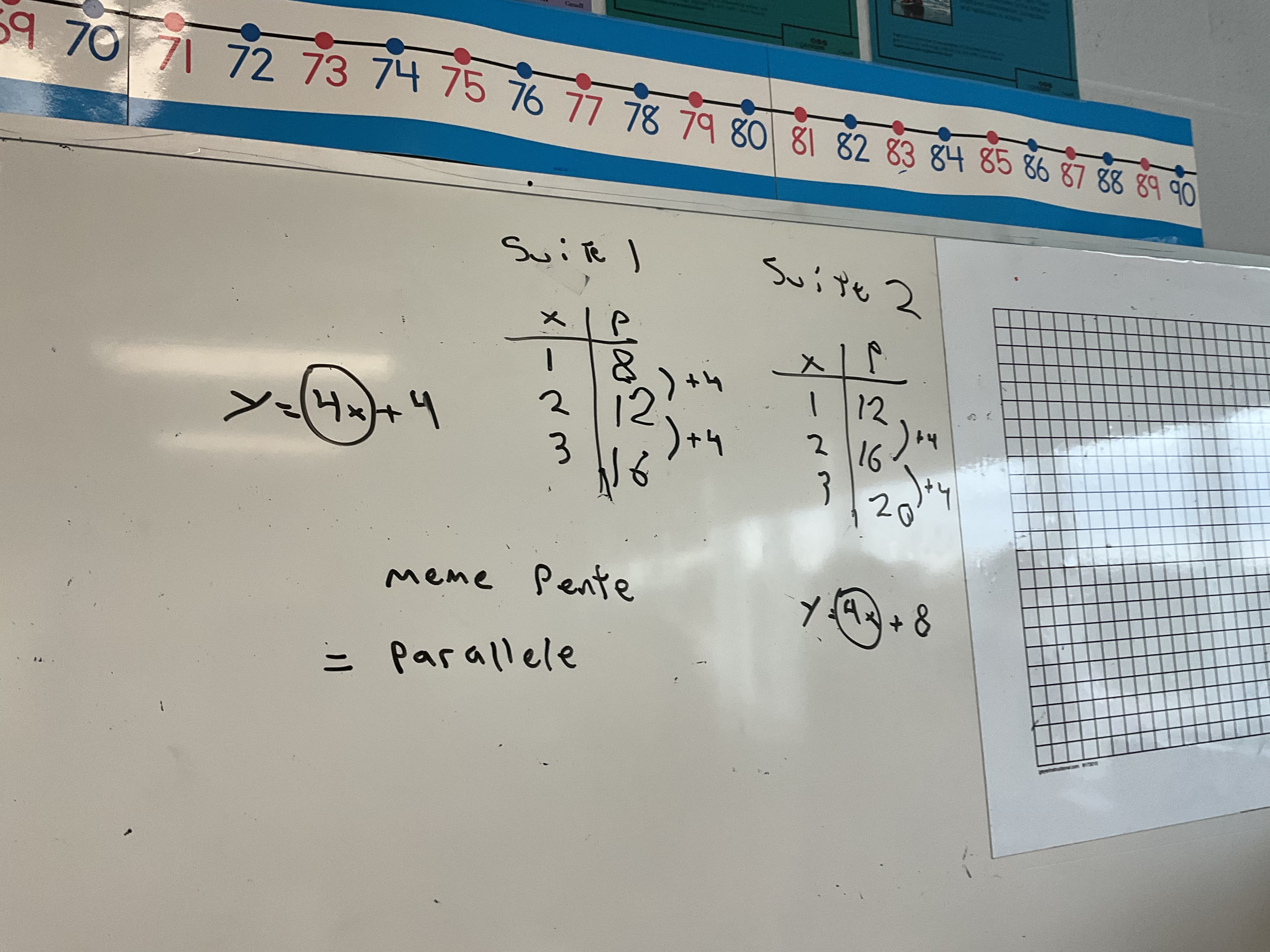
This group made a table of values for each pattern and noticed that the first differences are the same, so the slopes are the same, so they are parallel.
I am very pleased that even after not talking about it for a few days, that students have remembered that parallel lines have the same slope!

Progress in Grade 9
Since it’s Vennsday we did another numeracy task with Venn diagrams. This time we had one circle for even numbers, one for multiples of 3, and one for square numbers.
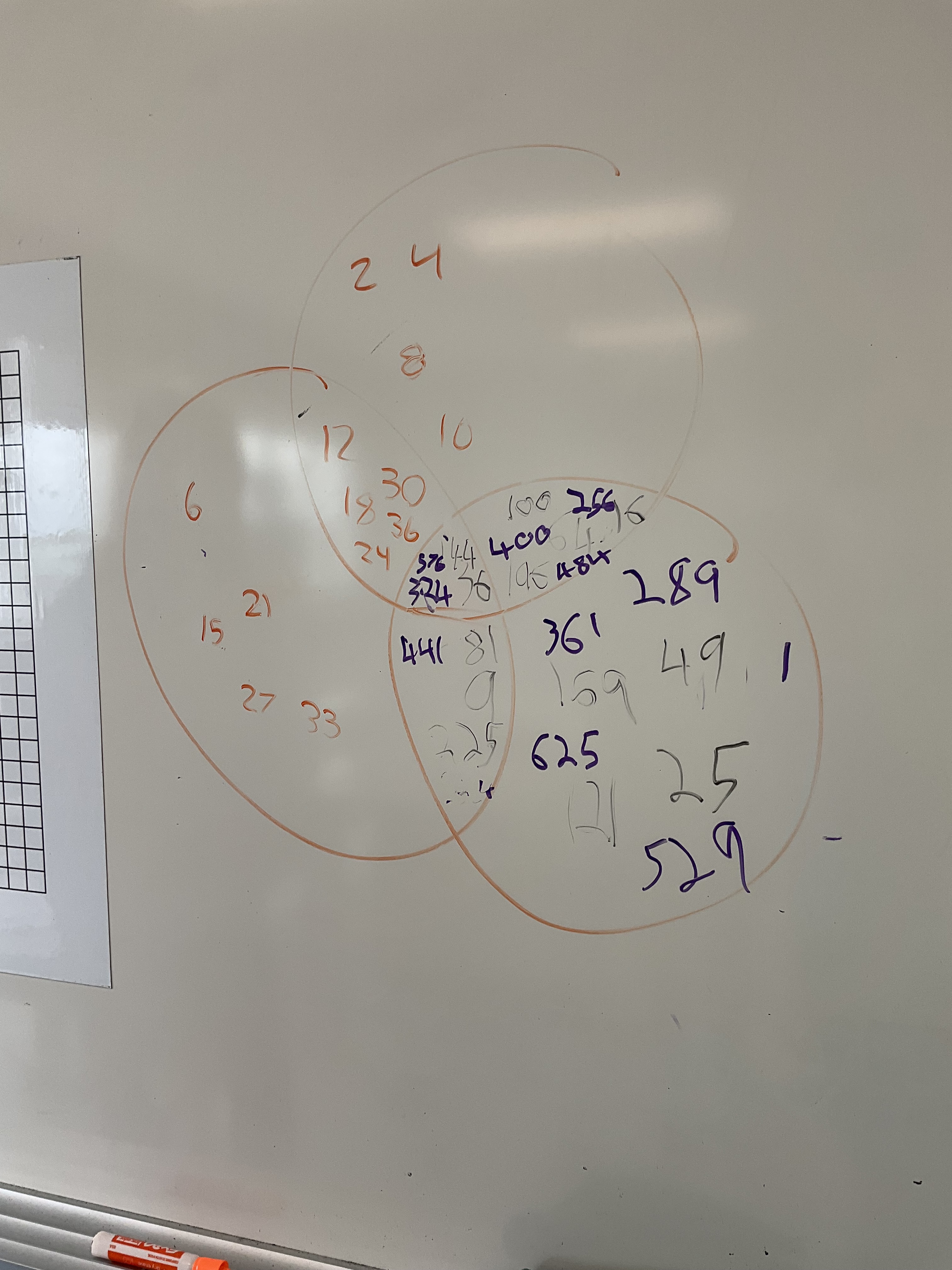
After this task, we did some work on composite perimeter and area. This is an area of challenge for the class this term.
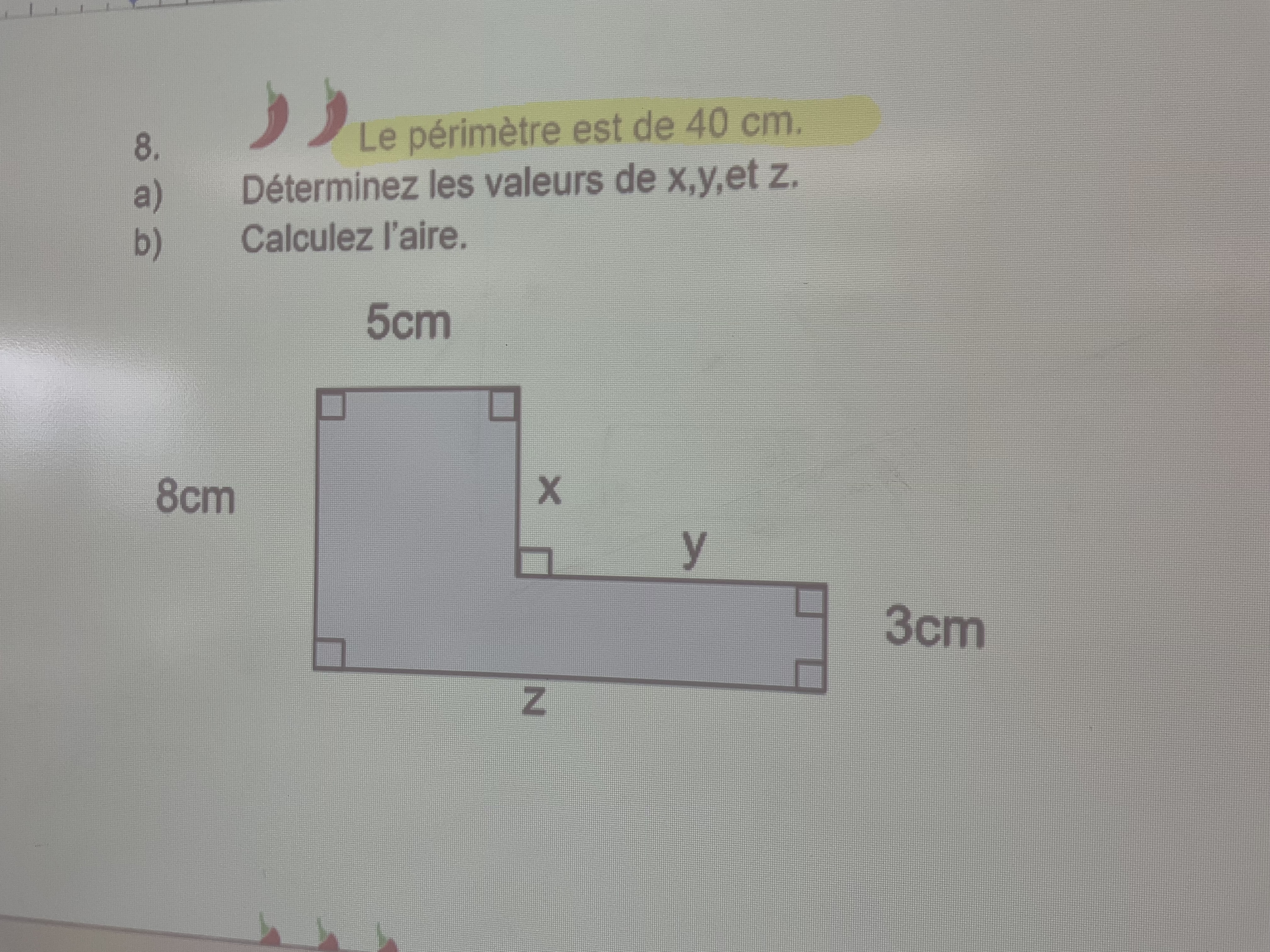
We needed to use some logic to determine the missing side lengths, and then find the area of each rectangle, and then add them up.
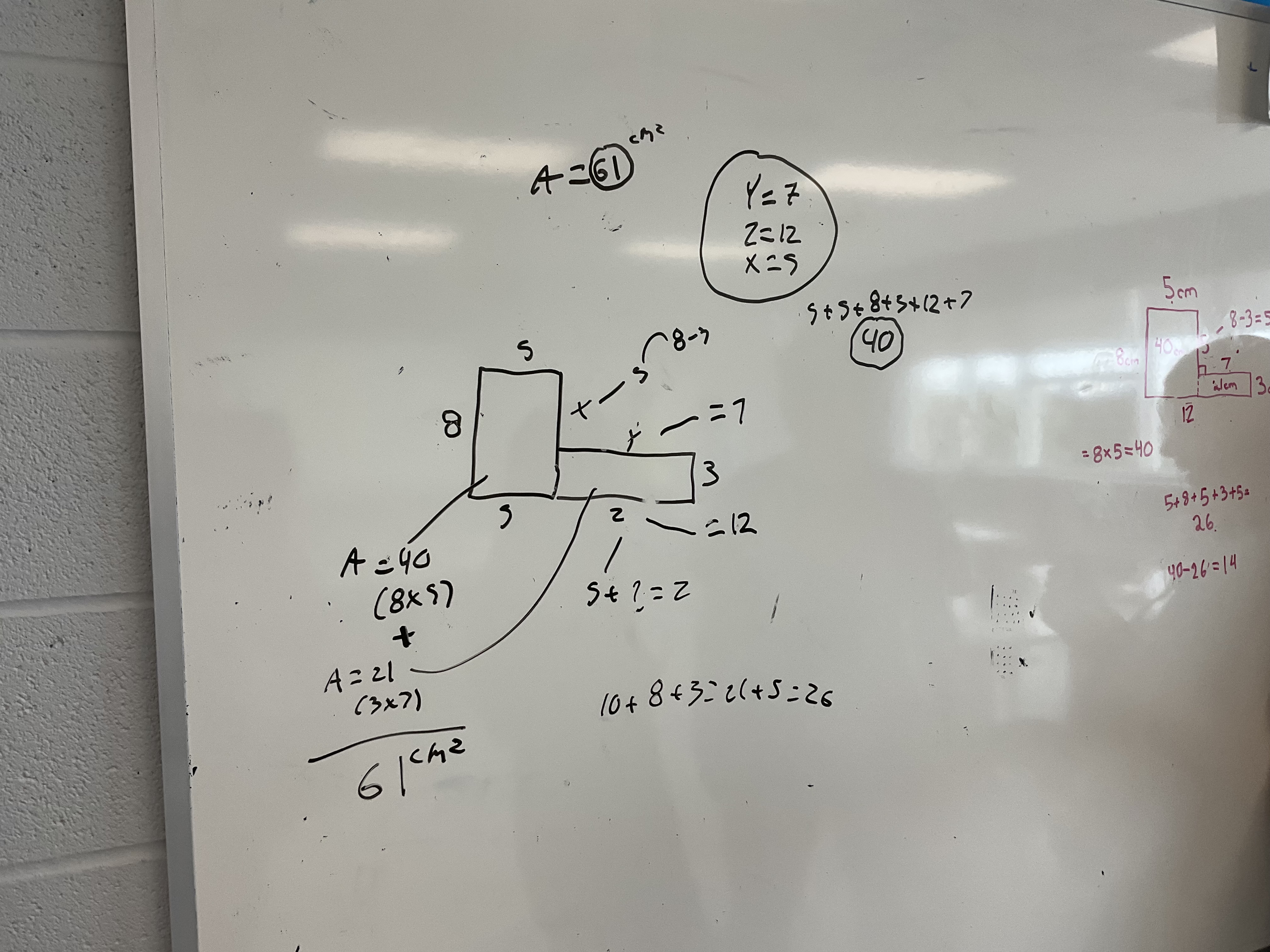
This question was a nice spicy one!
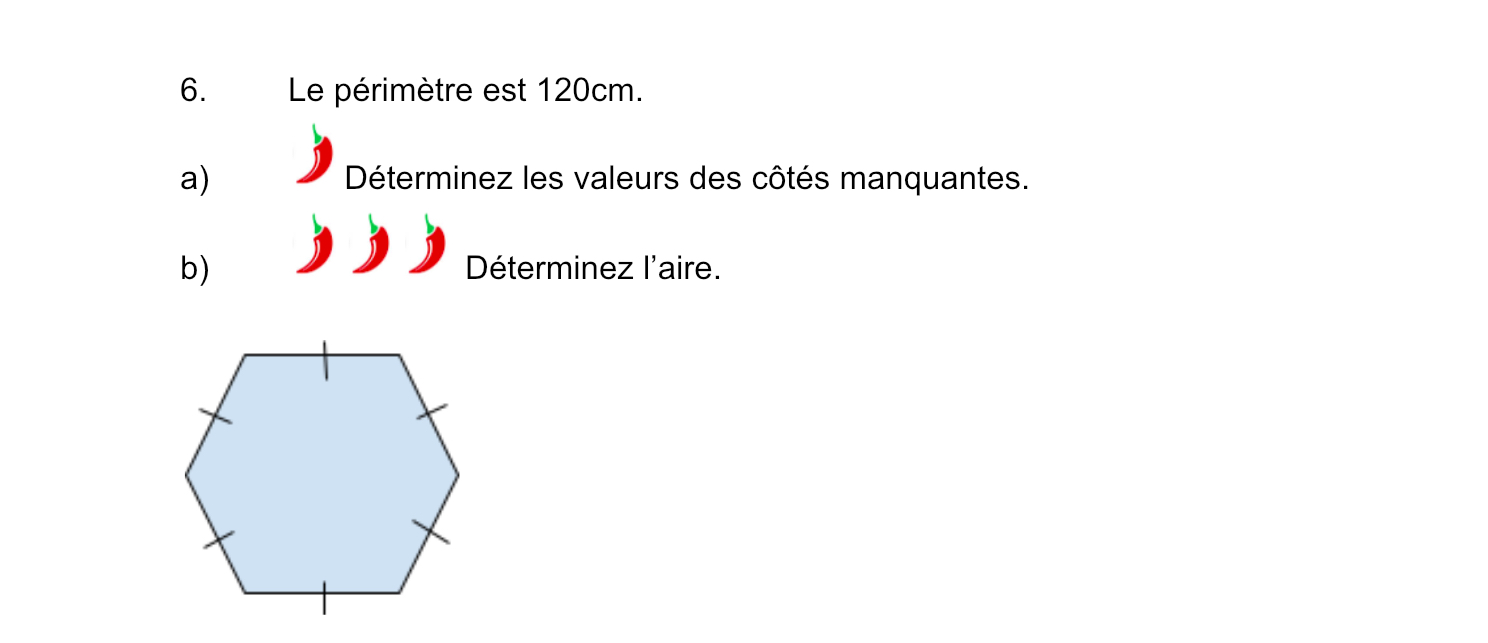
The side length is 20 for each side, but to determine the area we needed a bit of a hint.
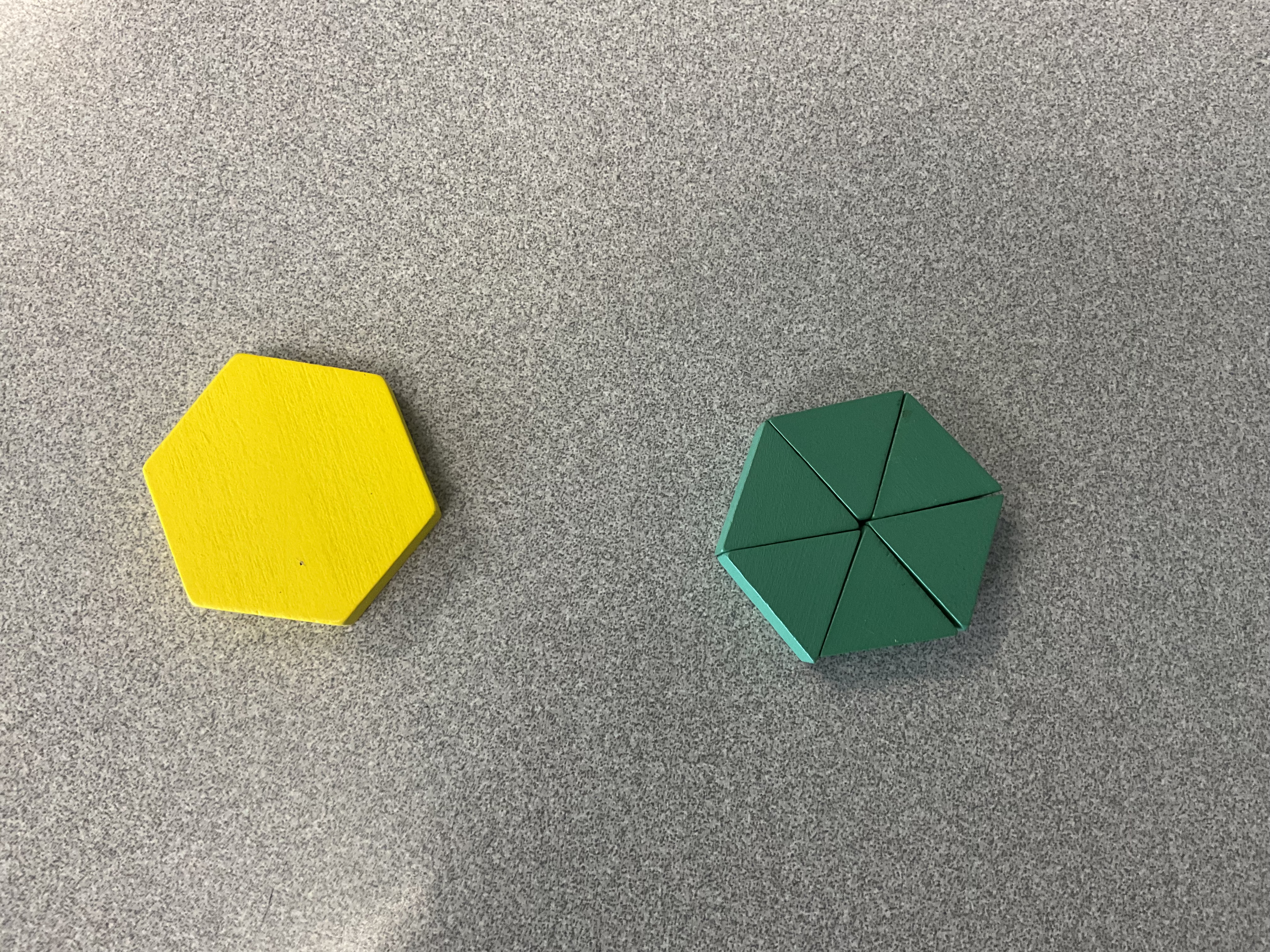
A regular hexagon is made of 6 equilateral triangles, and the sides are all 20cm.
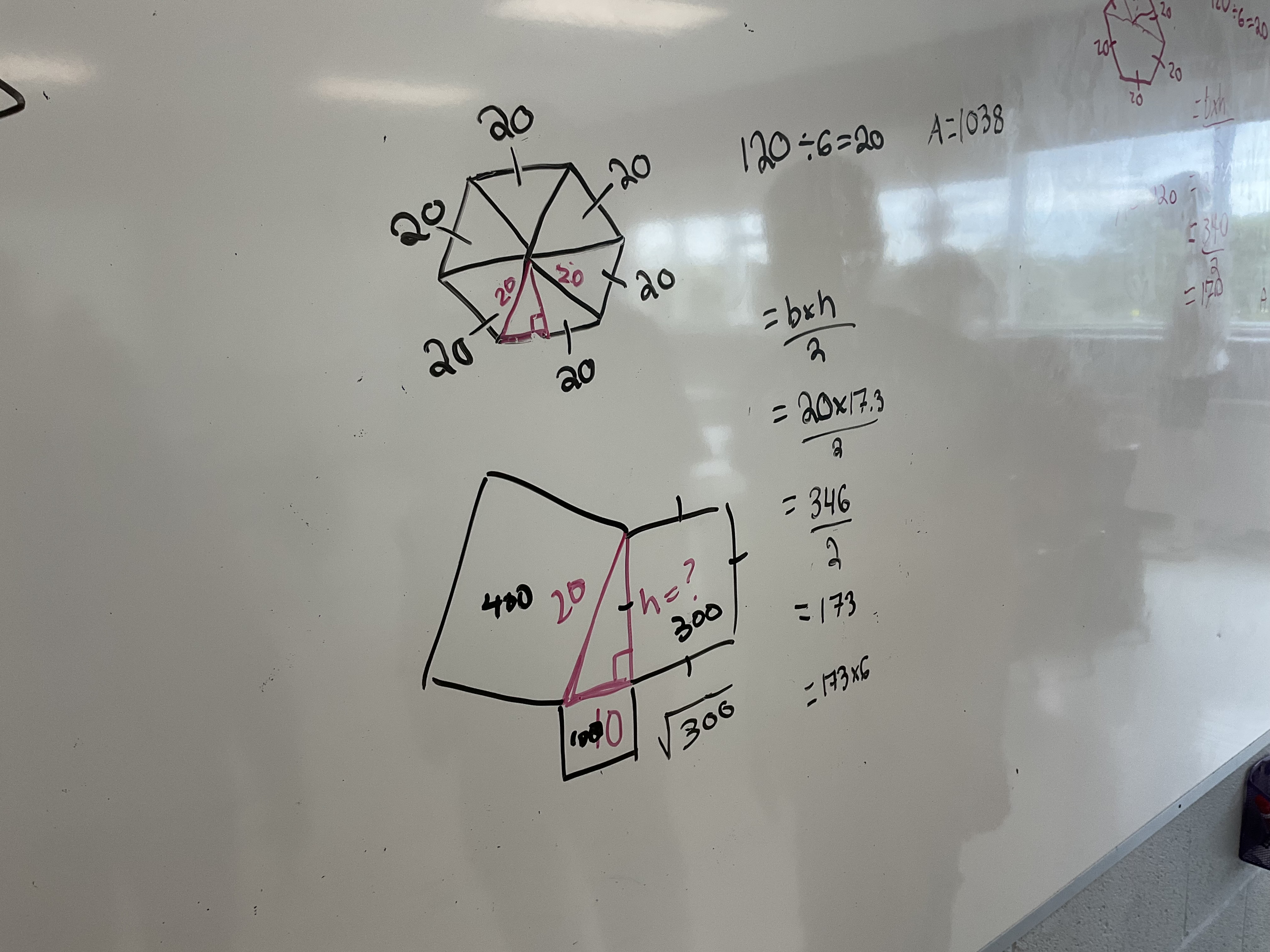
This is a nice diagnostic to see if students remember the pythagorean theorem. We’ll explore this more later, but we need to use it to find the height of each triangle.
We need to keep working on perimeter of composite shapes moving forward, but we are getting better with area.
Thinking Classroom
I had an opportunity to try a thinking classroom task with an MBF3C class. They have been working on quadratics and problem solving.
I introduced the rules of standing up at the boards, in random groups of 3, and each group has one marker, and the person who has the marker is not in charge of doing the thinking.
I gave the students a scenario of someone seeking riches through popcorn sales. They have talked with a business analyst who gave a profit equation. P=-60(x-4)^2+120, where P is profit and x is price of a bag of popcorn. I asked them if my friend’s plan of selling a bag for $6 is a smart plan.
Students worked in their groups, and many started with graphs. We needed a bit of prompting and some redirecting, but groups got there in the end, showing graphs that open down, with a vertex at (4,120).

Some groups decided to substitute a price of $6 into their equation to start.
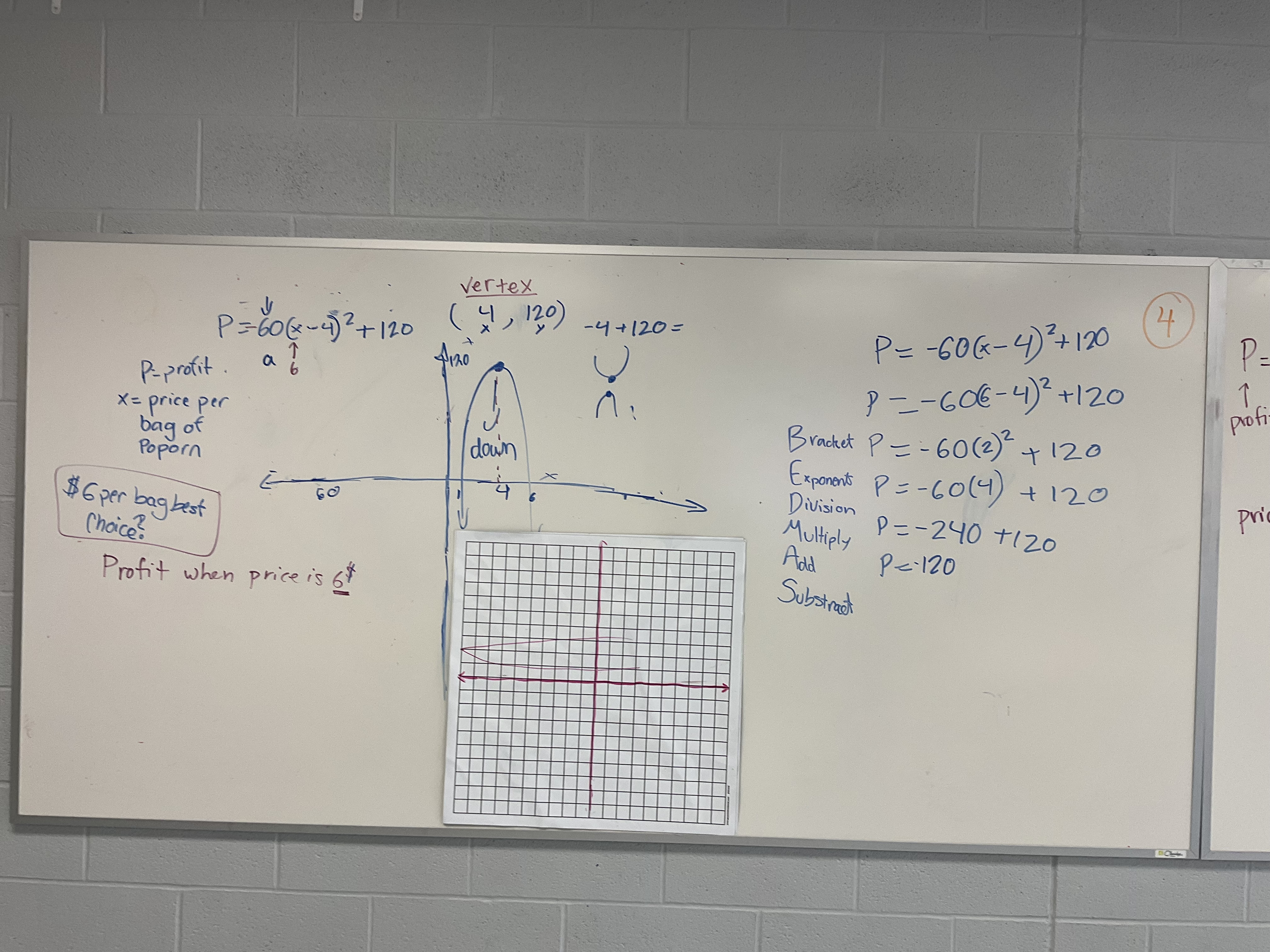
making a negative profit is never a good idea!
Groups decided that the best price would be $4 per bag.
Expanding, Using The Area Model
Today my grade 10 class worked on multiplying binomials using tiles and again using the area model.

Instead of drawing all the tiles each time, we can notice that there are quadrants that form. We have the x squared terms in one corner, and diagonal to that we have the unit squares. On the other diagonal we have all of the x terms. We could draw out the tiles each time, or we can use the area model or the box method to multiply.
One interesting thing to observe is that the diagonals in the box have the same product. This will be important later!

We did a lot of multiplying today, including expanding a binomial squared.
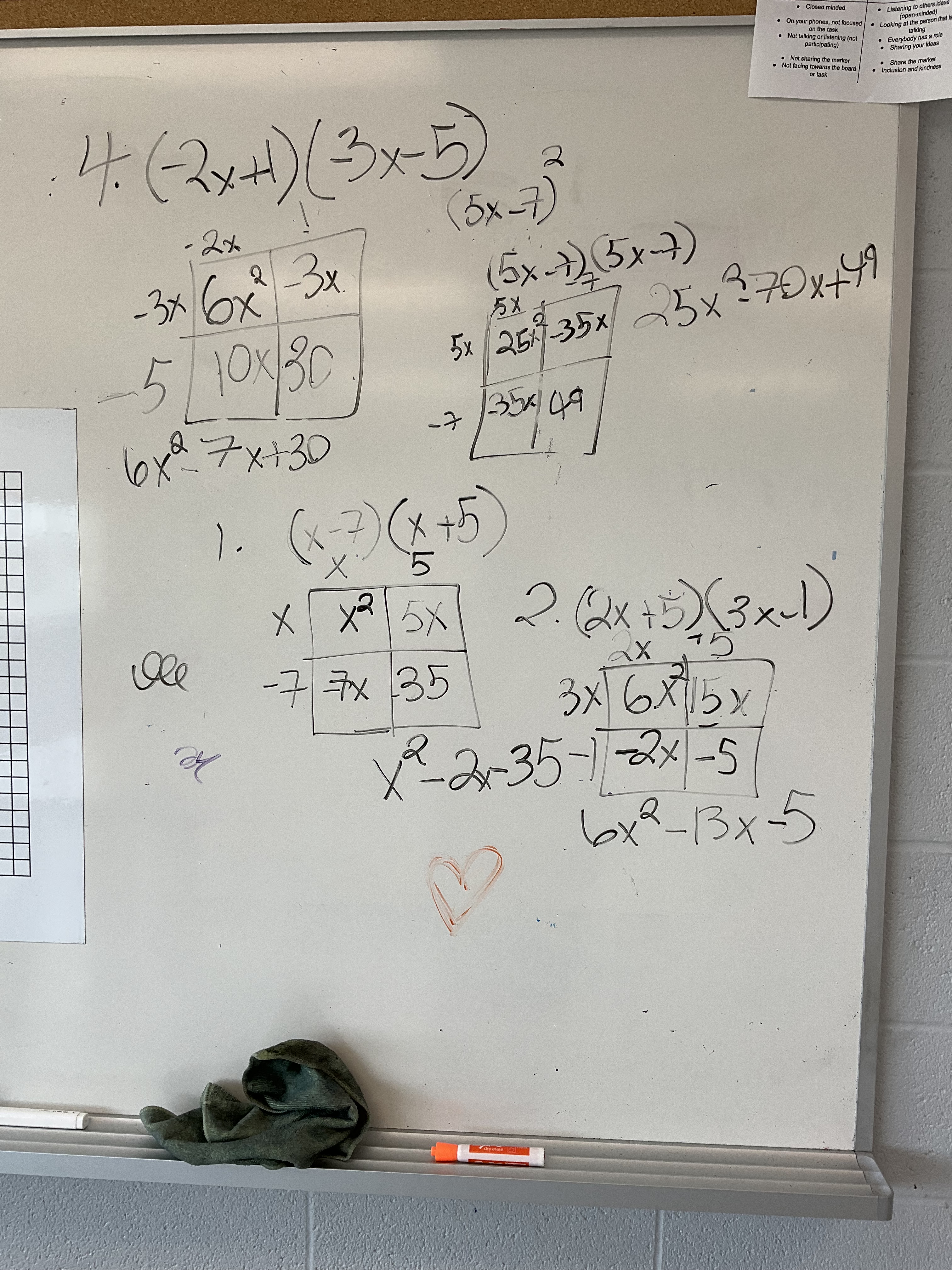
It’s heartwarming to see these kinds of doodles! Glad we are all enjoying the math!

Algebra Tiles, Factoring and Expanding
Grade 10s are working hard to factor trinomials and to multiply binomials using algebra tiles.
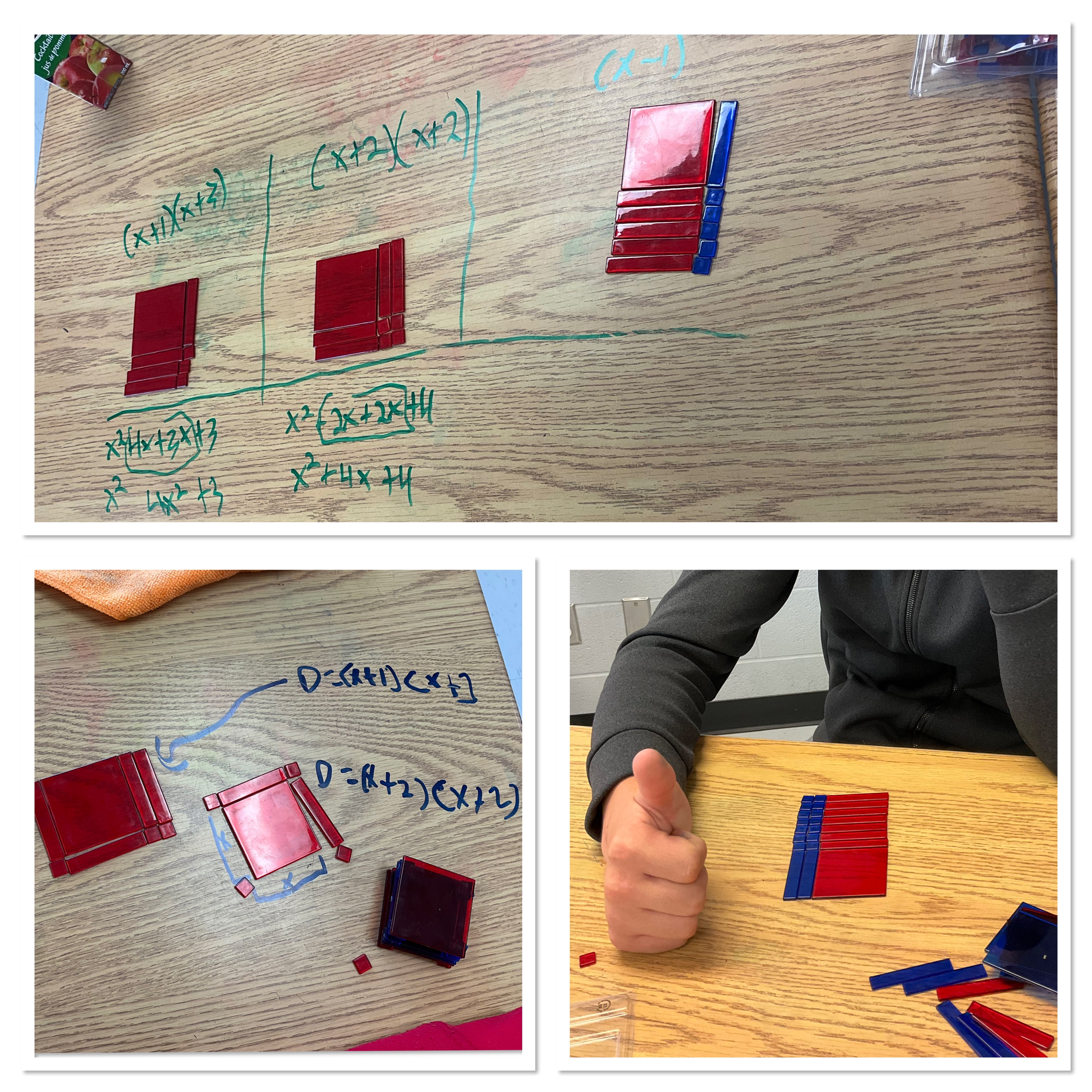
Students are becoming proficient at building rectangles with given tiles, including cases where they need to add zero pairs (of x and -x tiles) to complete the rectangles.
Confidence is growing with each day!
Measuring, Perimeter and Area
A grade 9 class I was in today was working on perimeter and area. They started by looking at these triangles and working out which one had the largest perimeter and largest area.
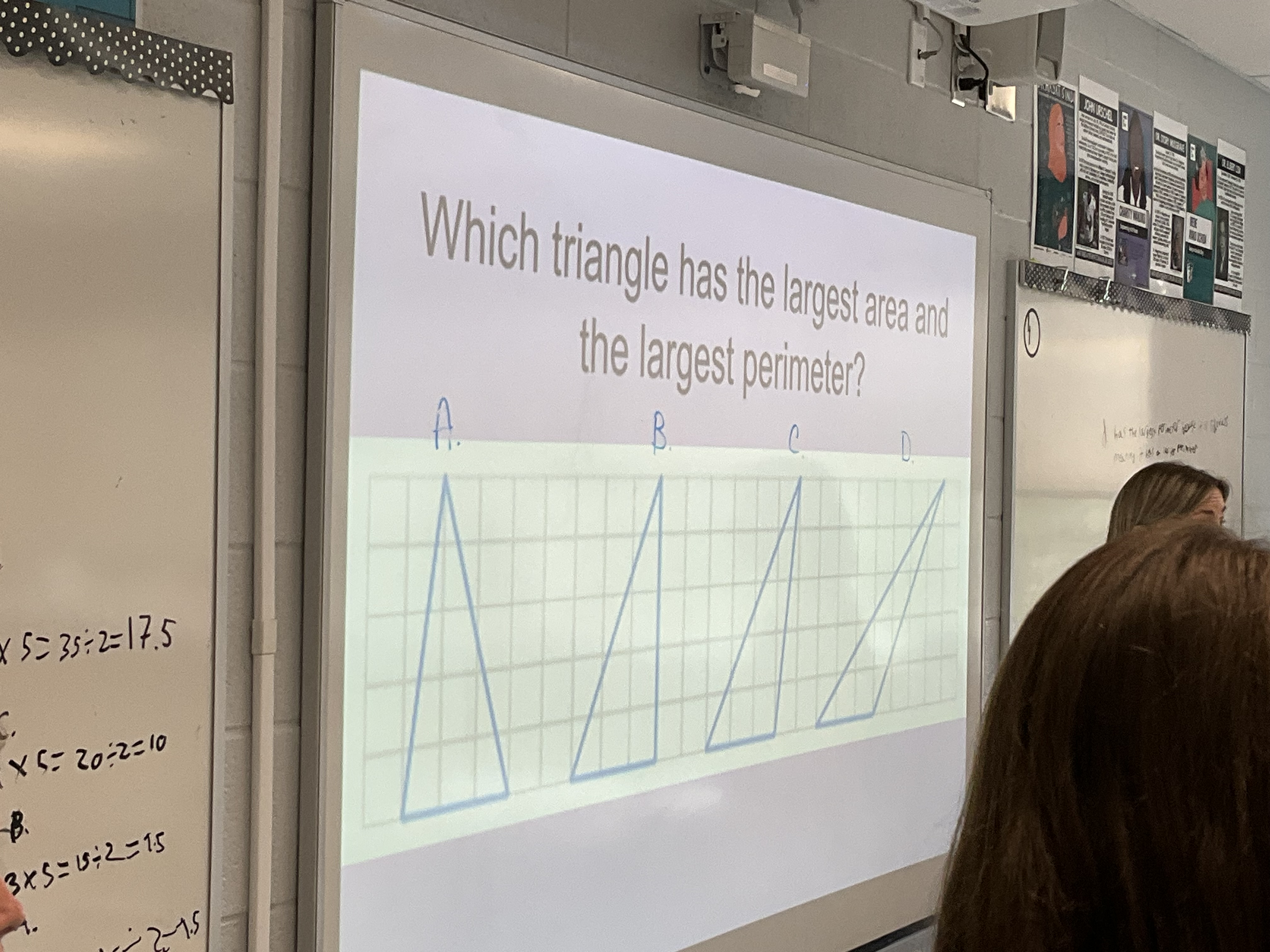
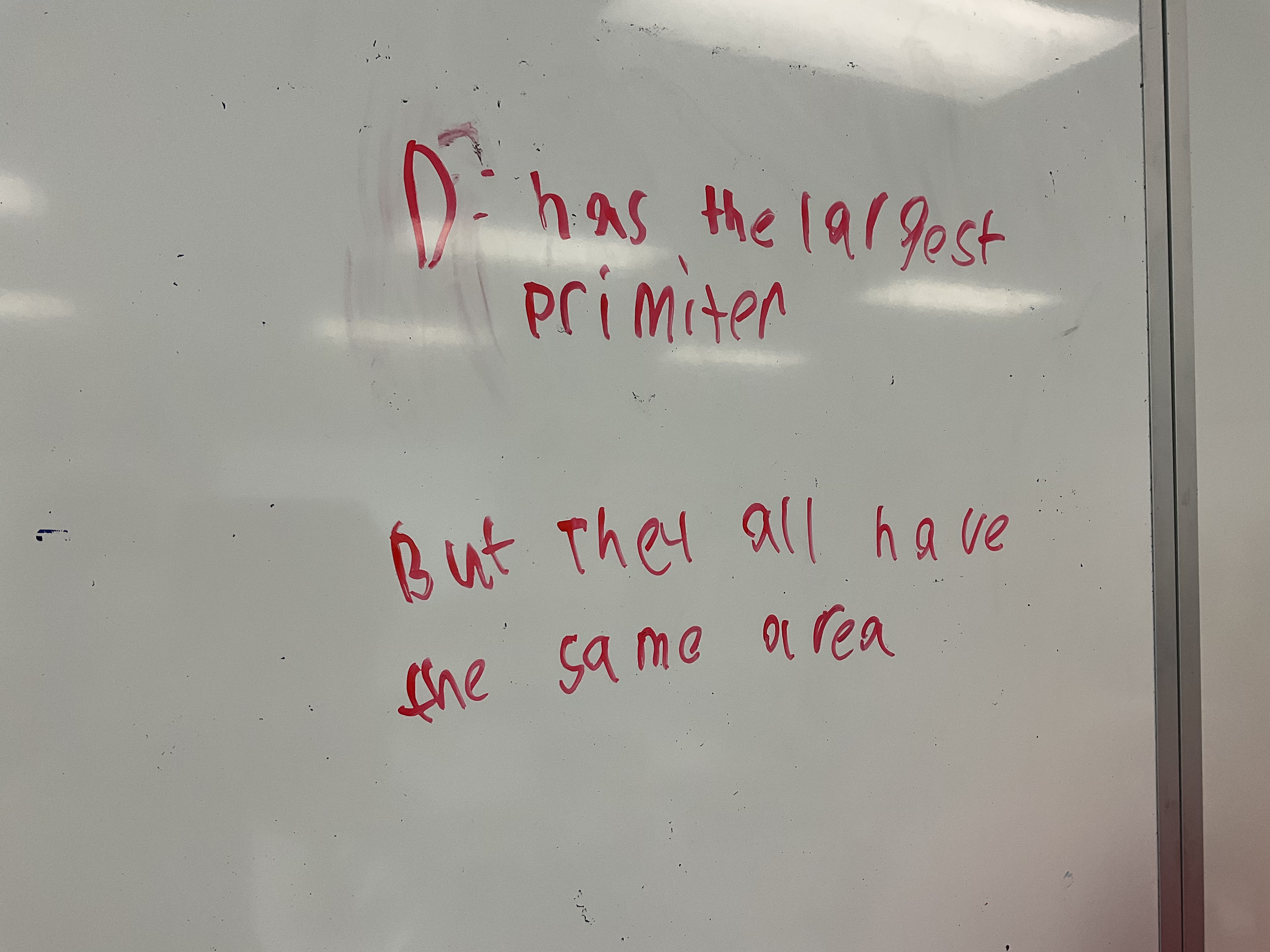
There was some good discussion about how to determine the area and perimeter, and some students used logic, while others measured on the screen using a variety of measuring tools (some conventional, and and some less so).
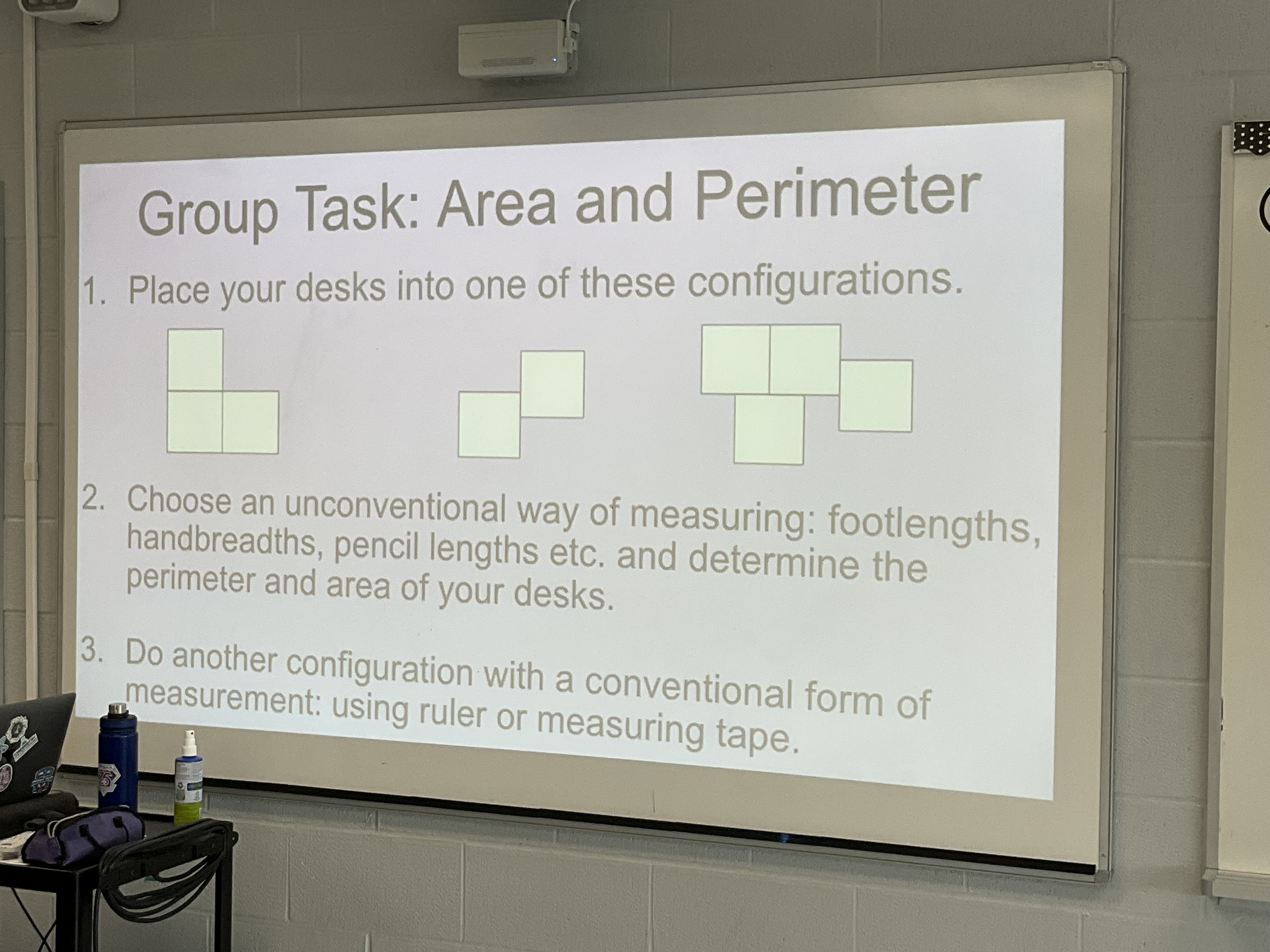
The next part of the lesson was to arrange desks according to the prompt on the screen, and measure the desks using unconventional items, and then to try it again and measure with more conventional tools.
Students got right into measuring! Some used bananas or cheese strings or markers, or hands, or feet to measure.
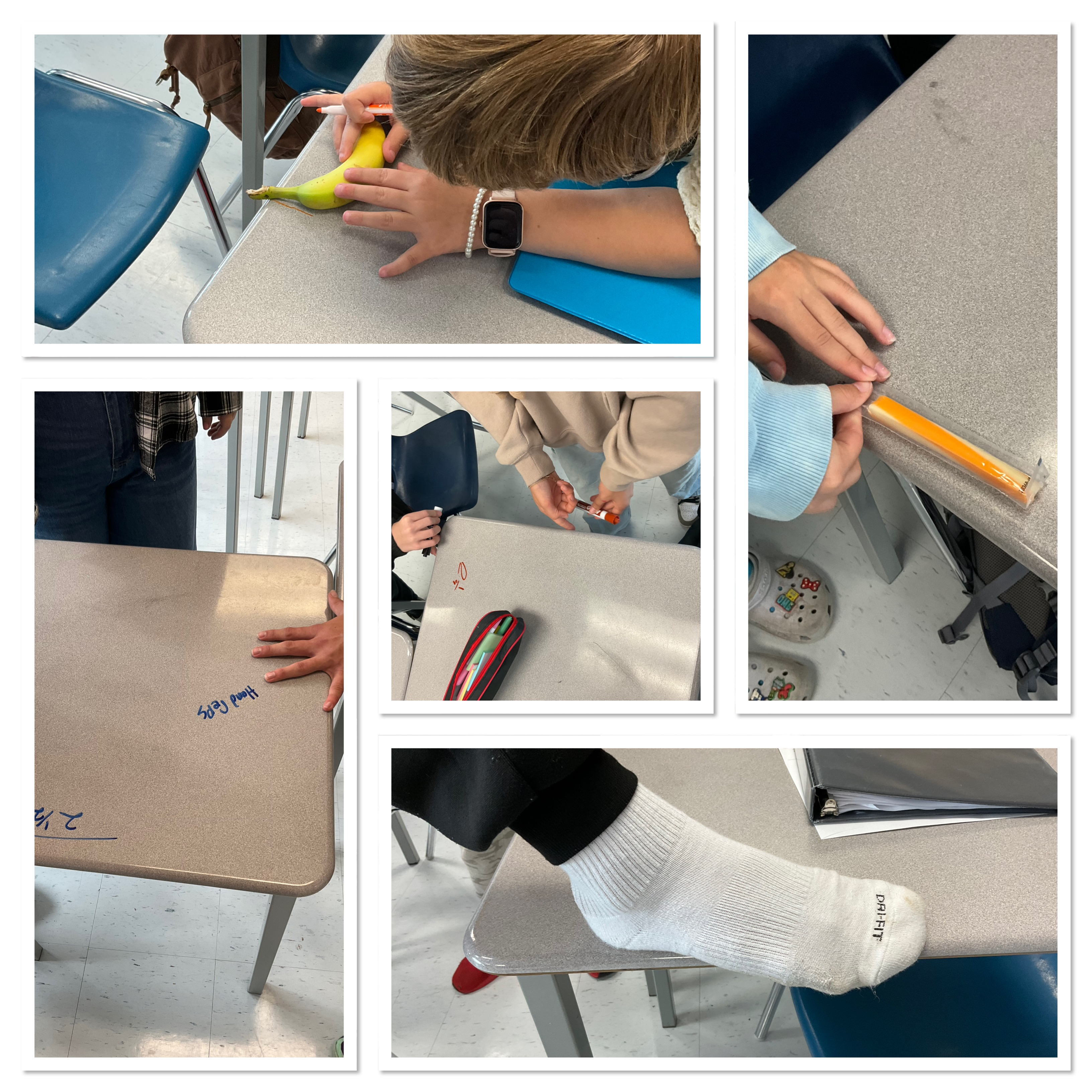
They wrote their work on the desks as they proceeded. There was a lot of great discussion about which sides contributed to the perimeter—only the outside edges!
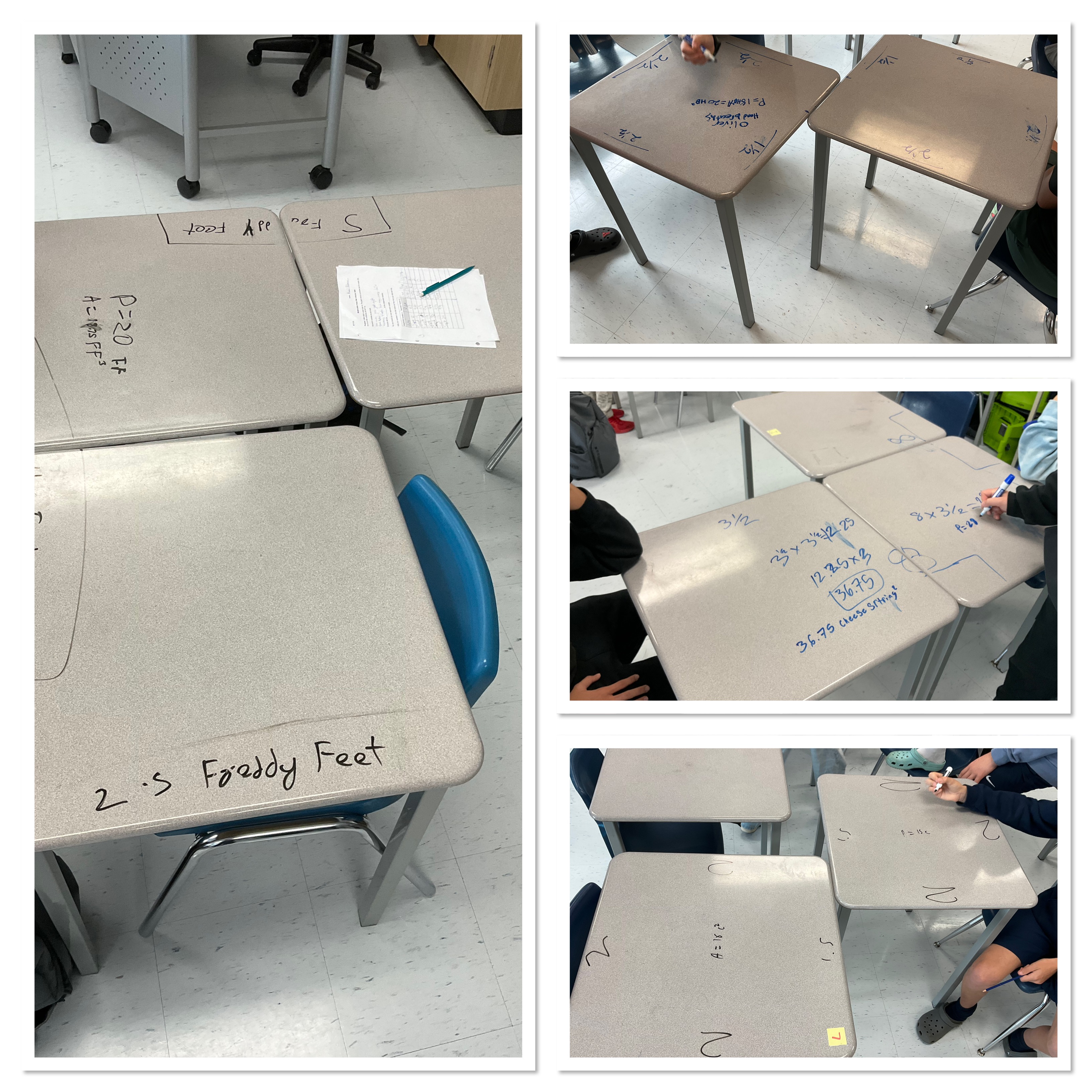
Groups worked on presenting their calculations with units. This was the first time I’ve ever considered what a cheesestring squared would be.
Common Factoring
I’ve been working on a sequence for common factoring, as this has been an area of struggle for my students in the past. This time round, we started at the very beginning, finding the factors of 12, and the factors of 20. We wrote them all out:
12 is (1)(12) or (2)(6) or (3)(4) or (-1)(-12) or (-2)(-6) or (-3)(-4).
20 is (1)(20) or (2)(10) or (4)(5) or (-1)(-20) or (-2)(-10) or (-4)(-5).
We then looked for any common factors, which we identified. Then we looked for the greatest common factor. In this case it is 4.
Next I asked about the greatest common factor between 12 and 3x
Then the greatest common factor between 16x^3 and 12x
Then we looked at 45(x^2)(y^4) and 225(x^5)(y^3). Students noticed that the lowest power on each variable will be in the greatest common factor.
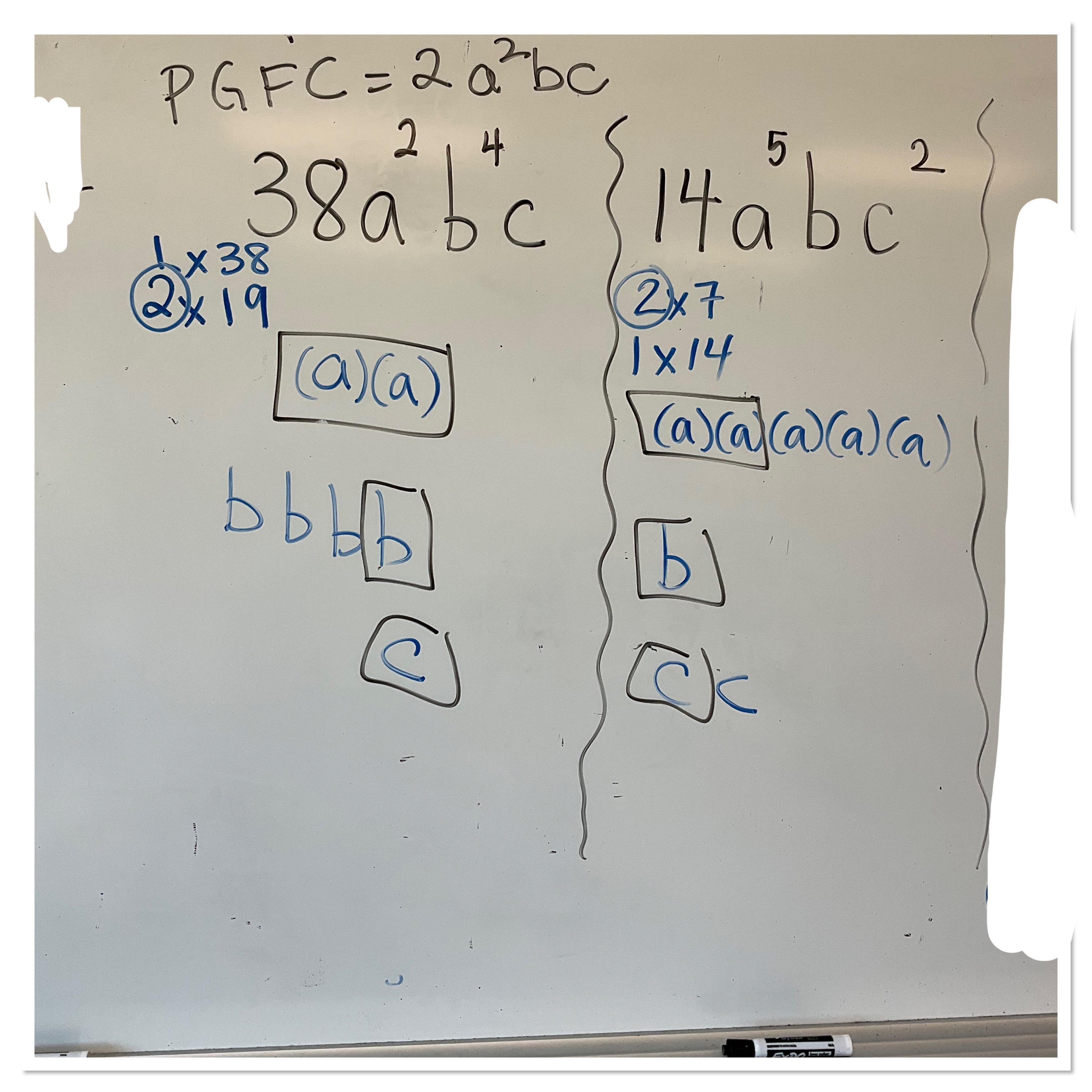
Next we looked at 38(a^2)(b^4)(c) and 14(a^5)(b)(c^2). Students were working on how to represent the factors and find the greatest common factor of 2(a^2)(b)(c). They also started to group the “leftovers” together.
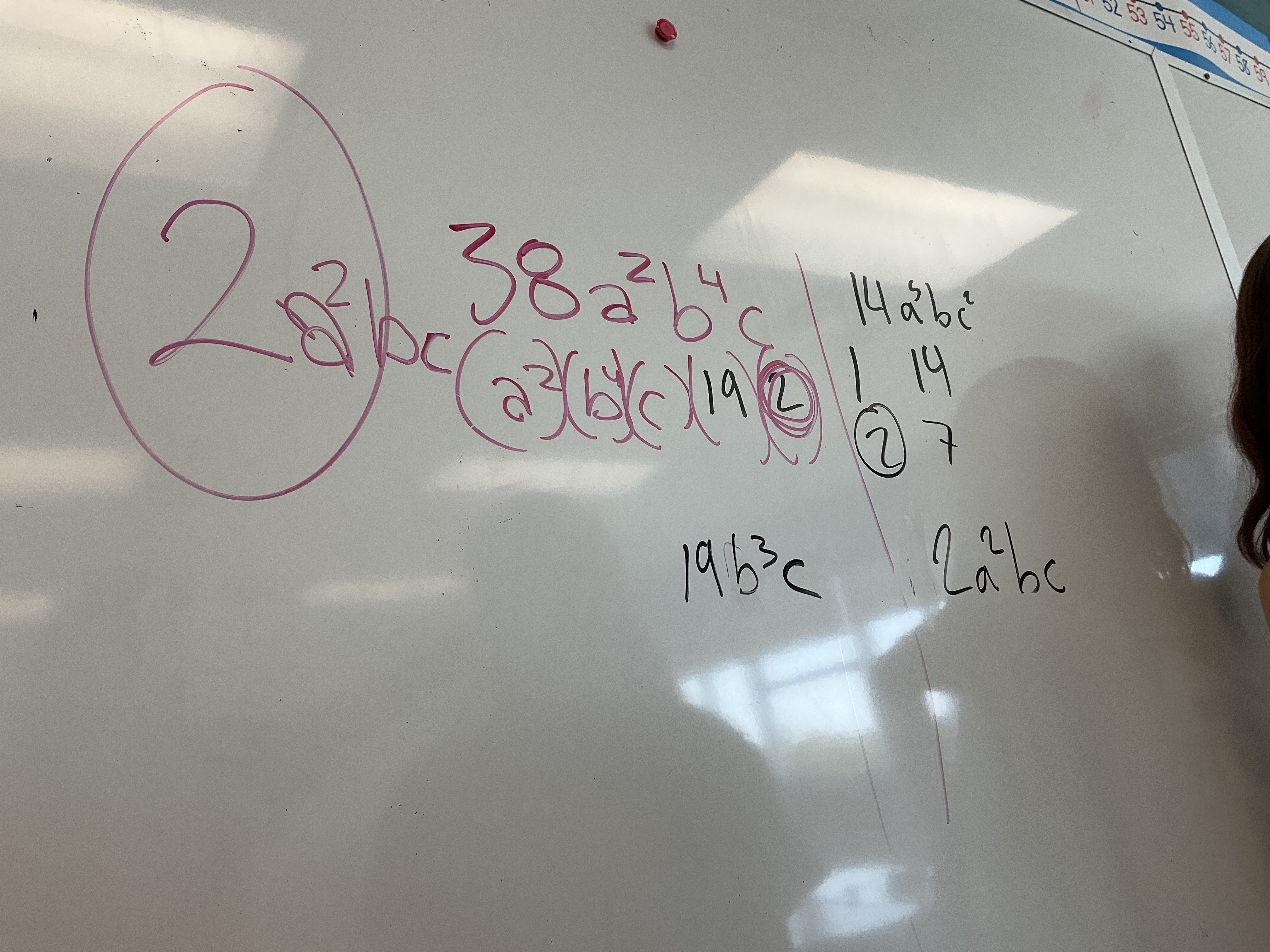
We next started to formalize a way to think through the process. We reviewed a bit about exponent laws in the process.
Finally we got to common factoring a polynomial. We find the greatest common factor, and put that outside of the brackets, and we end up creating a distributive property question with the “leftovers” (the not common factors) remaining in the brackets.

we can check our work with distributive property and exponent laws.
Students were keen to keep practicing. They asked for more and more chances to show that they got it. I’m pleased with how well the sequence went today, and am hopeful that retention will be strong. We’ll see next week!
 Ms. Bearse's Site