Welcome Back Grade 9s!

Today in Grade 9 we started off with some collaborative problem solving with skyscraper games (available here). Some of our groups were brave and tried the 5×5 challenges.

On day 1 we practice what we value, teamwork, and productive struggle as we tackle a challenging problem. We worked on speaking in French, sharing our ideas, taking charge sometimes, but not taking over. This problem in particular is a good one for valuing different perspectives and viewpoints (literally).

When we had done enough of those challenges, we tried the Max-min dice challenge.
The way this works is a framework BEDMAS question is given, fill in the blank style.

Students, up at the boards in random groupings of 3 copy the framework provided. Next we decide as a class if we’re aiming for the maximum number or the minimum number. We then have volunteers roll a 10 sided dice and one by one the numbers are entered into the framework. Groups decide on where each number goes before the next is rolled.

Each group then uses their BEDMAS skills to evaluate their expression. An extension can be to ask if we actually made the max or min…or if there is a better way to arrange the numbers if you knew them at the start to make a bigger/smaller number.
That game was a win. We played 3 or 4 rounds, until the bell went!
High Fives in Grade 10
Today in grade 10 we determined how many unique high fives there were among the 26 people in our classroom.
Groups split up and got to work modelling the situation and trying to determine the answer, and how to communicate it.
some groups imagined a line of 26 people. The first person goes down the line high fiving everyone, then leaves. There are 25 high fives done at that point. The next person does 24 high fives, and the pattern continues, adding one fewer high five to the total each time.

other groups viewed the number of people in the group as the x value, and the number of high fives in the group as the y. They can determine how many high fives exist in a pair, and a group of 3 and 4 and 5 and put that in a table. They noticed that the first differences increase by 1 each time.

Both groups found parabolas, but different ones to model the same situation. We worked on making equations, and extending tables to find key points like x intercepts and the vertex.
some groups viewed the challenge a bit differently, making equations and testing them out.

Other groups were working visually, showing the connections between dots and the high fives that exist
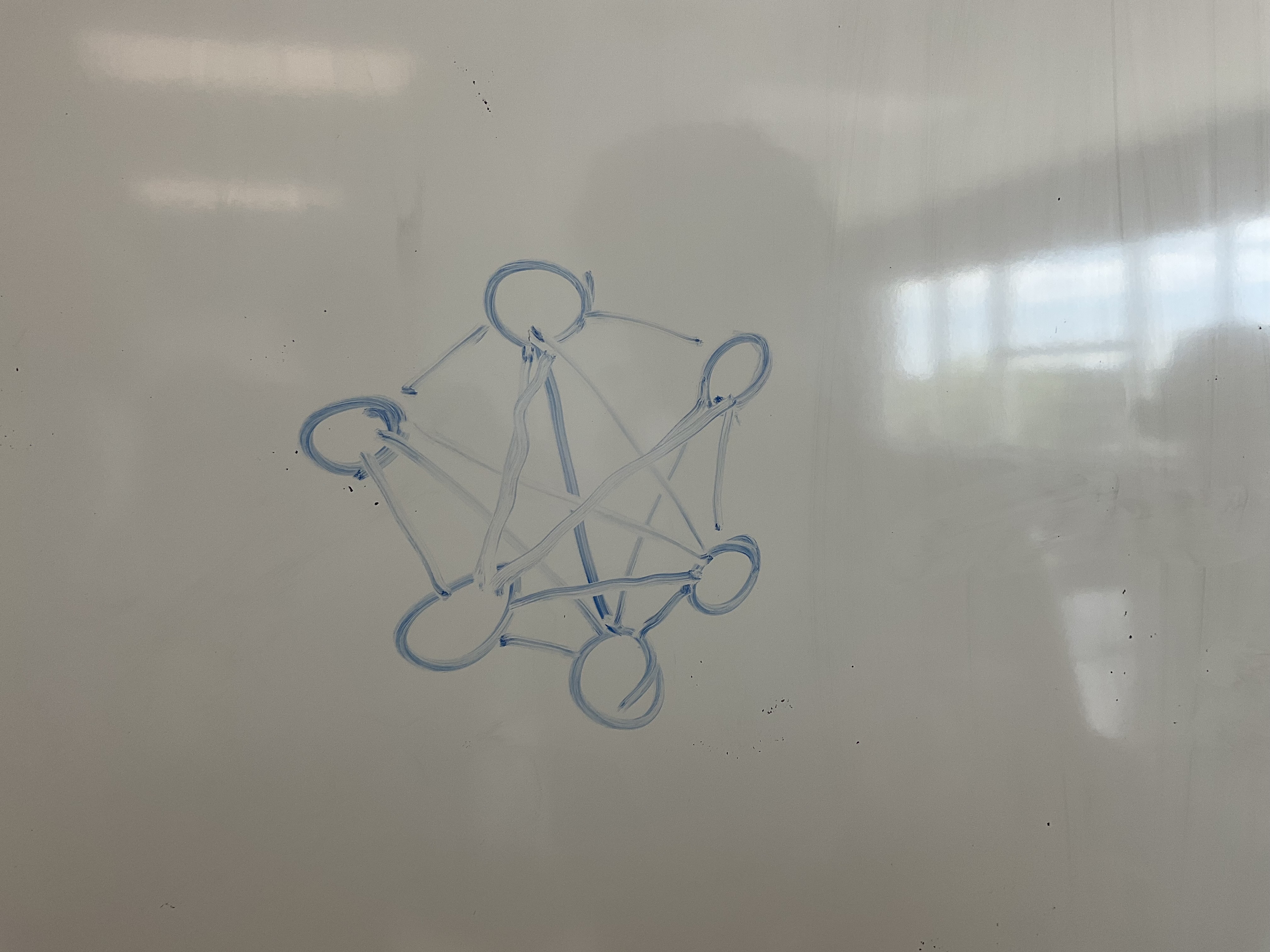
By the end of class there were graphs and equations showing up and being worked on. Students then used their models to solve the question about the number of high fives in a class of 26, which quickly changed into “how many high fives are there in a school of 1000 people”. Models got changed, and adapted, and students could see the power of using an equation rather than continuing a table for 1000 rows.

I showed a neat solution that students presented last year which turns the entire situation into a visual pattern. They modelled the blue triangle as the number of high fives. The blue triangle is half of the rectangle. The rectangle has dimensions (x)(x-1), so we need y=0.5(x)(x-1) as our equation.
As a wrap up we went back to some questions we’d worked on in the first week of class, that were quite challenging in February.
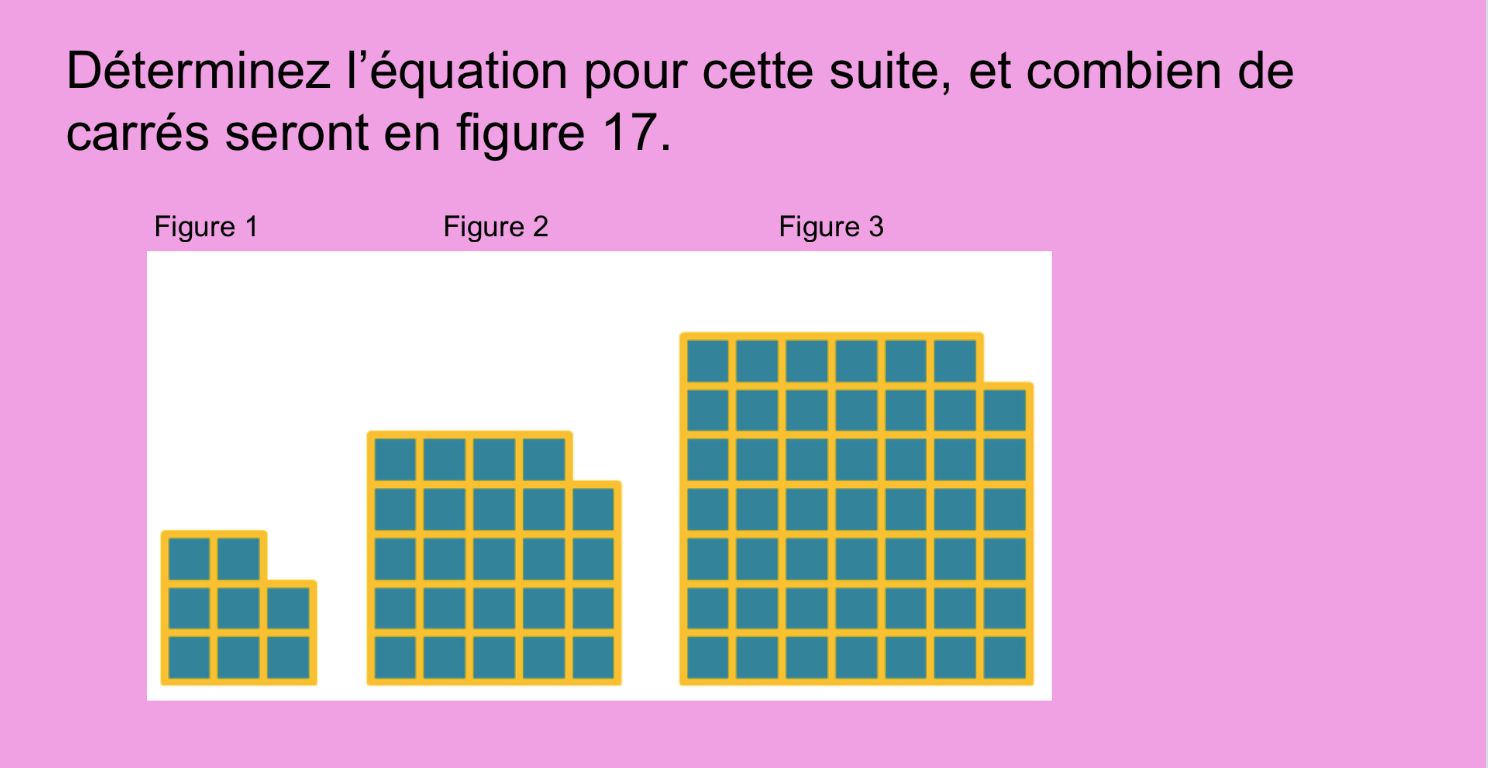
What was lovely to see is that students immediately dived into the problem, drawing and modelling, and finding equations. Where they had been hesitant in February, they are much more confident now, and helped their peers when they got stuck.


Once the equation was modelled and the number of squares in figure 17 determined, the extension questions were to graph it, or find the x intercepts, or complete the square or determine the vertex. This one pattern kept us going right until the bell on a Friday afternoon in June.
Culminating Task Day 1
Grade 9s worked in small groups today to create questions that were mild/medium/spicy based on an image of our school BBQ. They needed a question about numeracy, and one about geometry and measurement, and one about financial math.
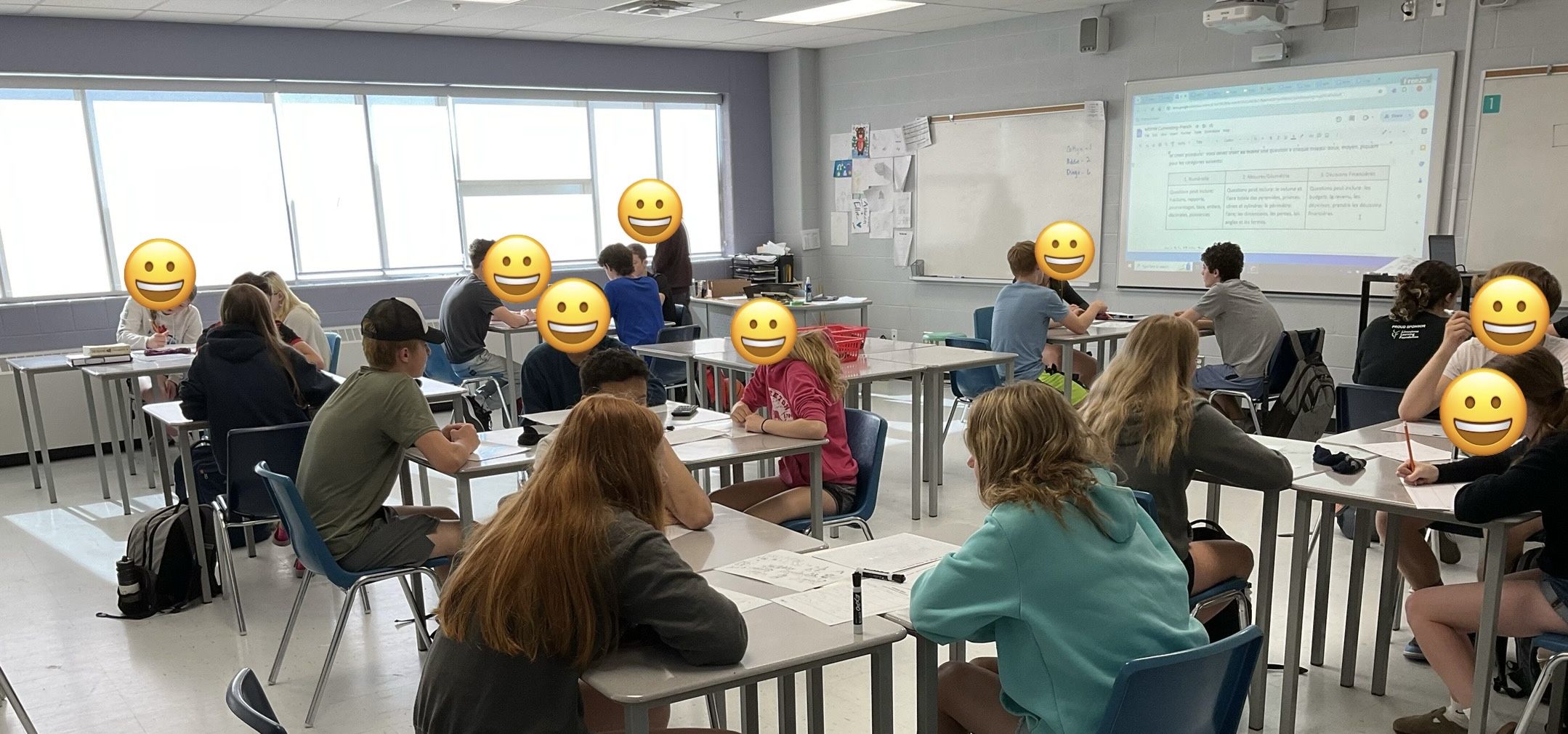
Groups collaborated well and discussed what kinda of questions they’d be able to answer, and then created questions for each level. They next had to request which will be provided on Monday, so they can use that information and complete their calculations.

We have been working in groups all semester, and we’ve been noticing and wondering with our 3 act tasks, and our slow reveal graphs. This culminating task values the collaborative nature of our experience this term, and allows students to take ownership of their learning.

By the end of the class each group had their questions prepared and submitted, and everyone knows exactly what to expect for Monday, so hopefully there will be less anxiety surrounding this culminating compared to a math test.

Grade 9 Culminating Practice
Grade 9s have a culminating task soon. They will be given a picture and they will need to create questions to answer related to measurement&geometry, number sense, and also financial decision making.
We have been practicing lately, and we made questions to solve using these images as inspiration.
Today we took some of the questions and then sorted them into mild, medium and spicy based on the calculations involved, the number of steps, and the complexity.
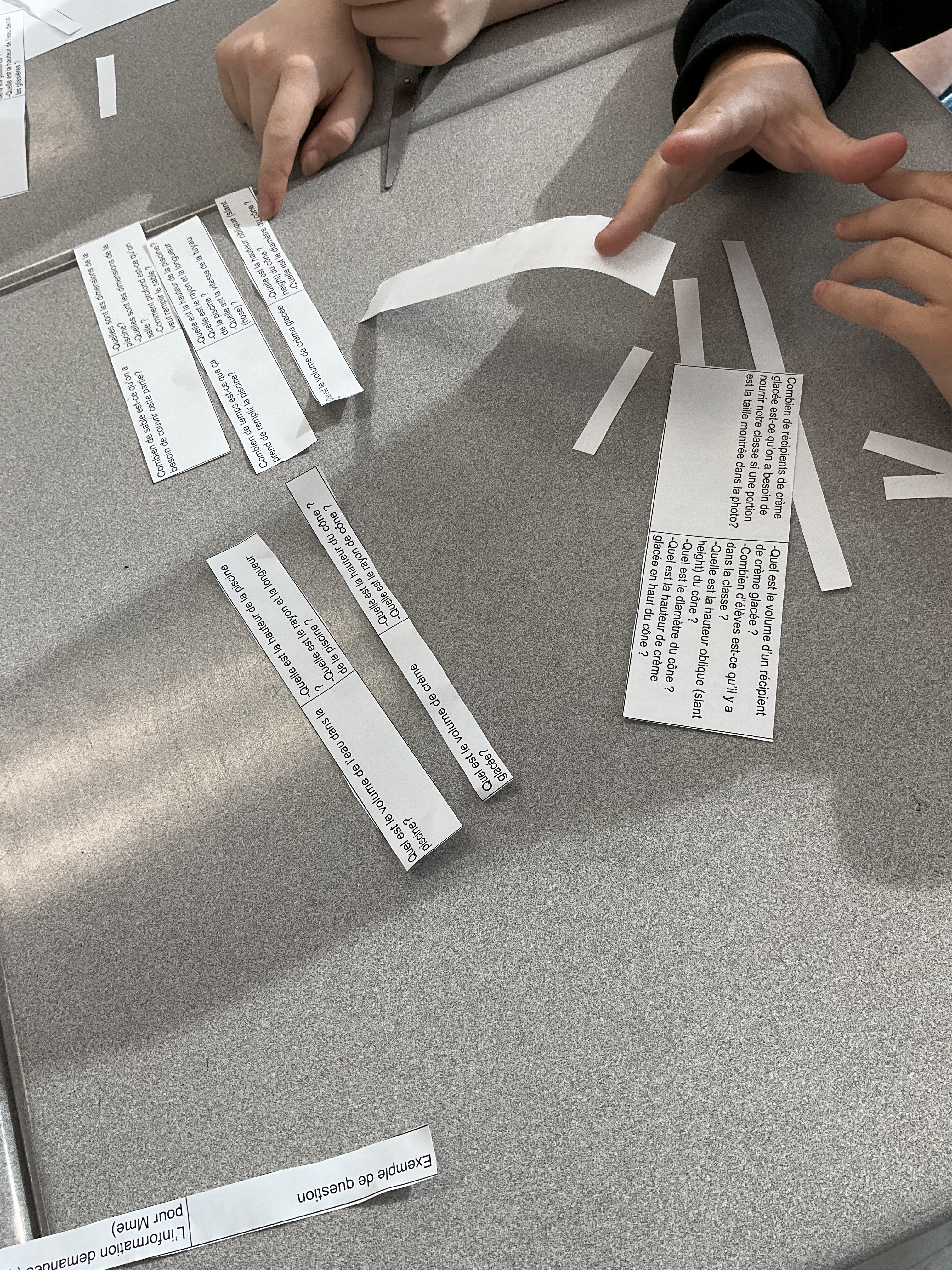
We chatted in our groups and tried to decide which questions involved more calculating than others, and we chatted about what we’d do to solve them.
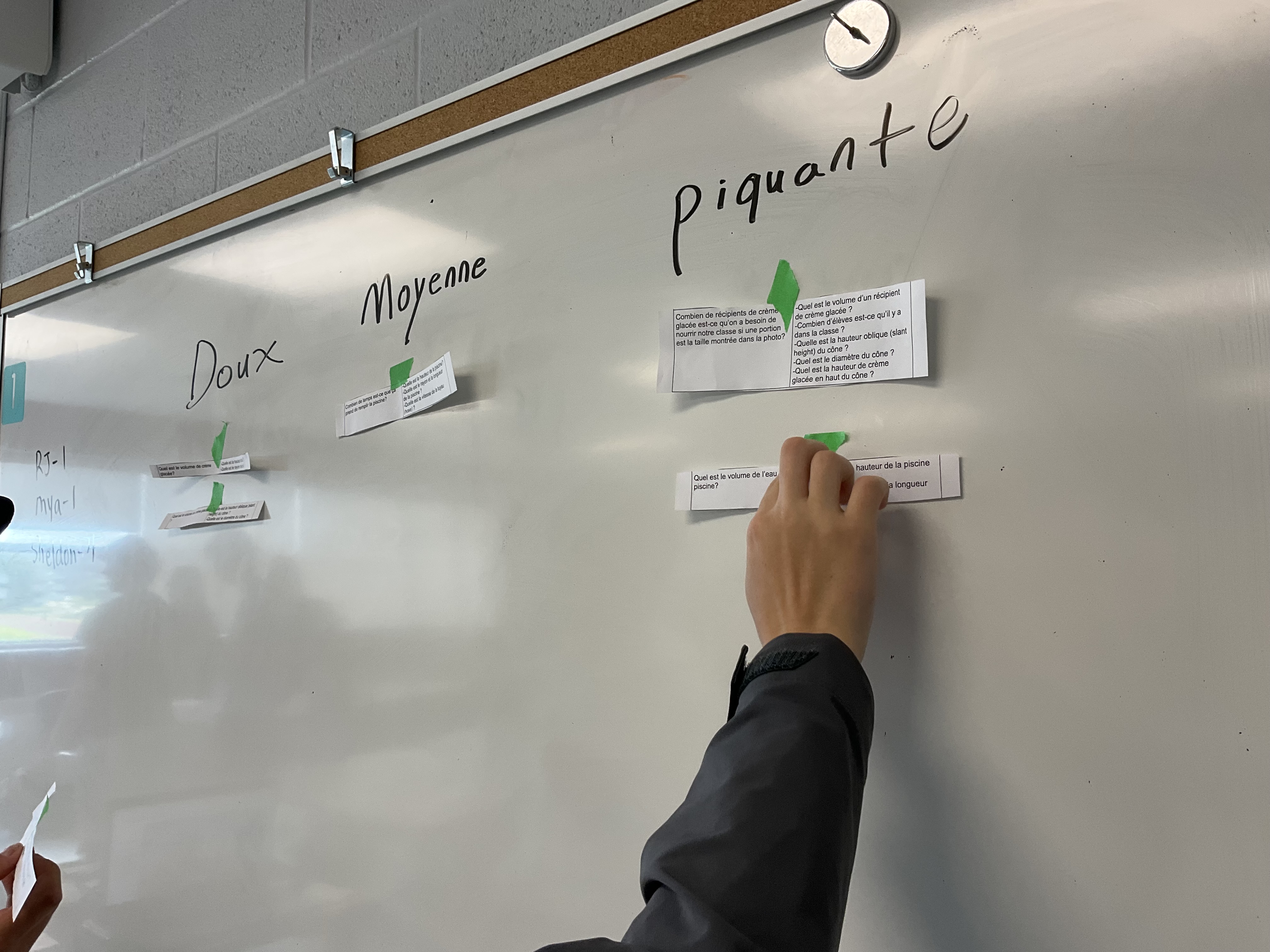
It was interesting to see how some groups classified the same question in different categories.
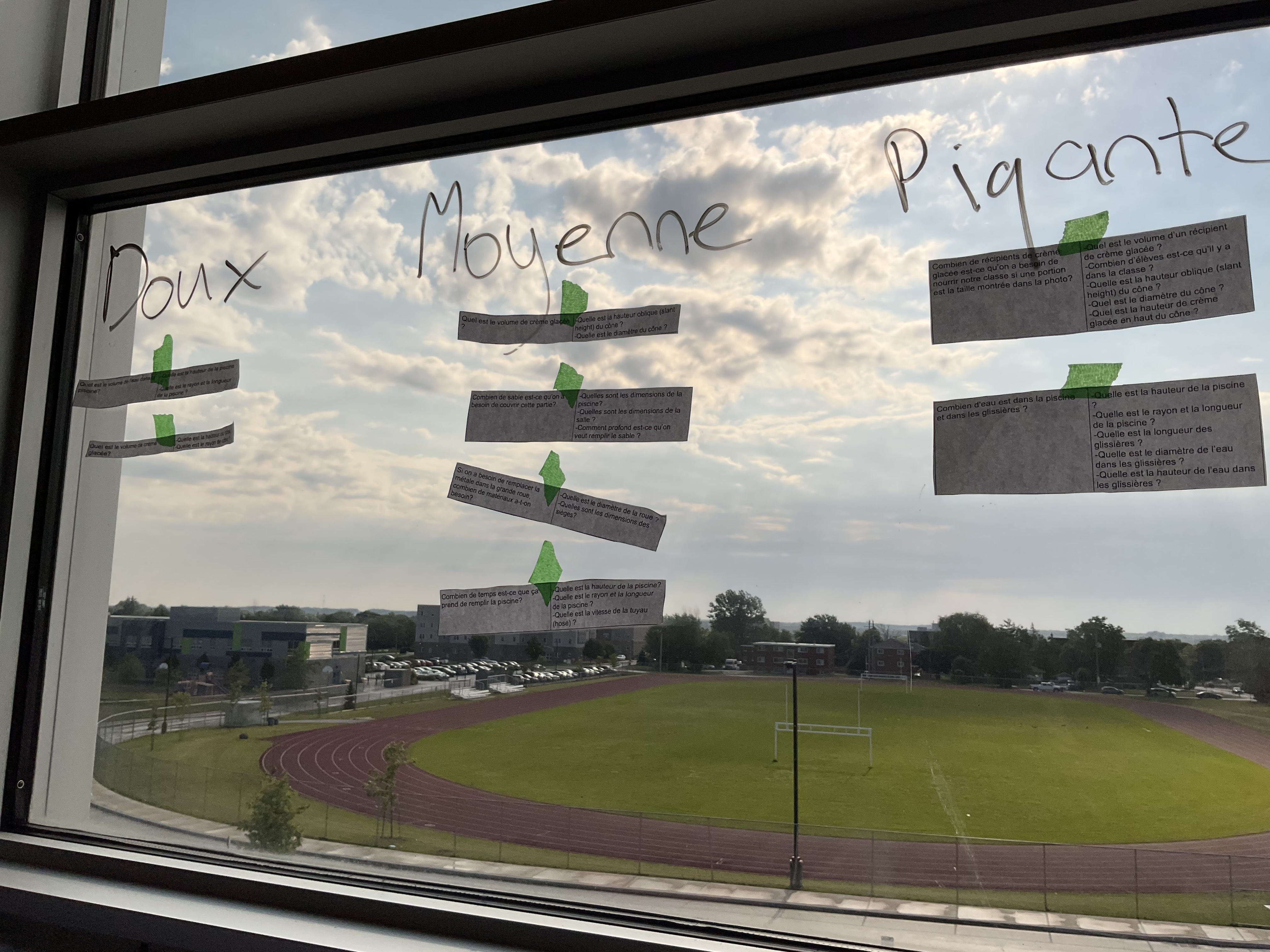
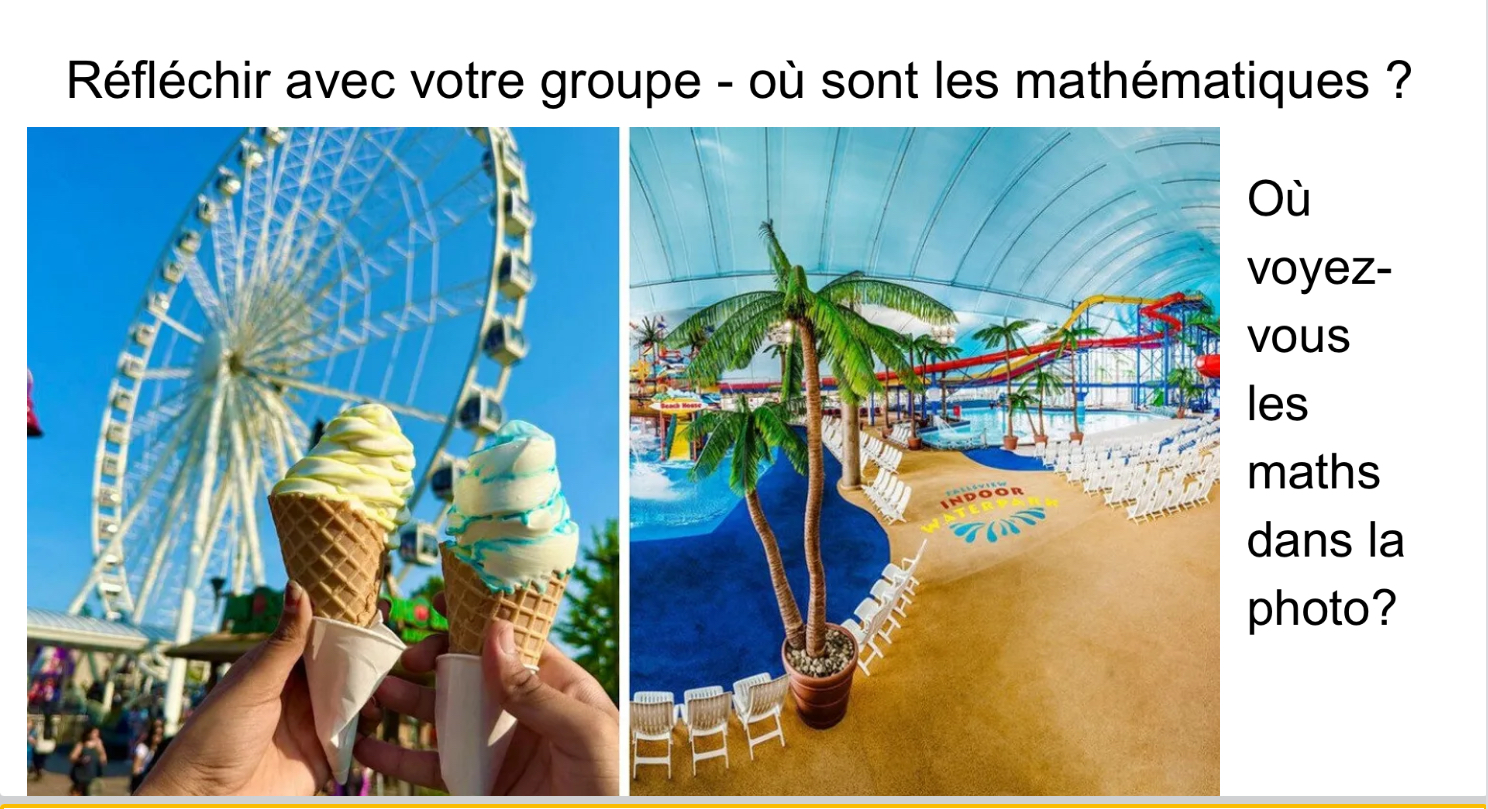
We talked about how calculating the volume of ice cream in the cone could be a mild question if you ask for radius and height for each cone.
To make the question a medium one, we could ask for the cone’s circumference and slant height, and then asking how tall the ice cream will be above the cone part if the height of the ice cream that’s piled on top of the cone is 60% of the height of the cone. This question involves calculating the radius and using the pythagorean theorem to calculate the height of the cone. The height of the ice cream is used to help calculate another cone.
To make it a spicy question you could ask how many containers of ice cream to buy from the store to serve each classmate a cone like the ones illustrated. This question involves calculating all the ice cream in the cone, using dimensions, and then also using the volume of the container which could be given in litres to add unit conversion to the question.
Groups then split up and tackled a question from the list with information that was provided to them.
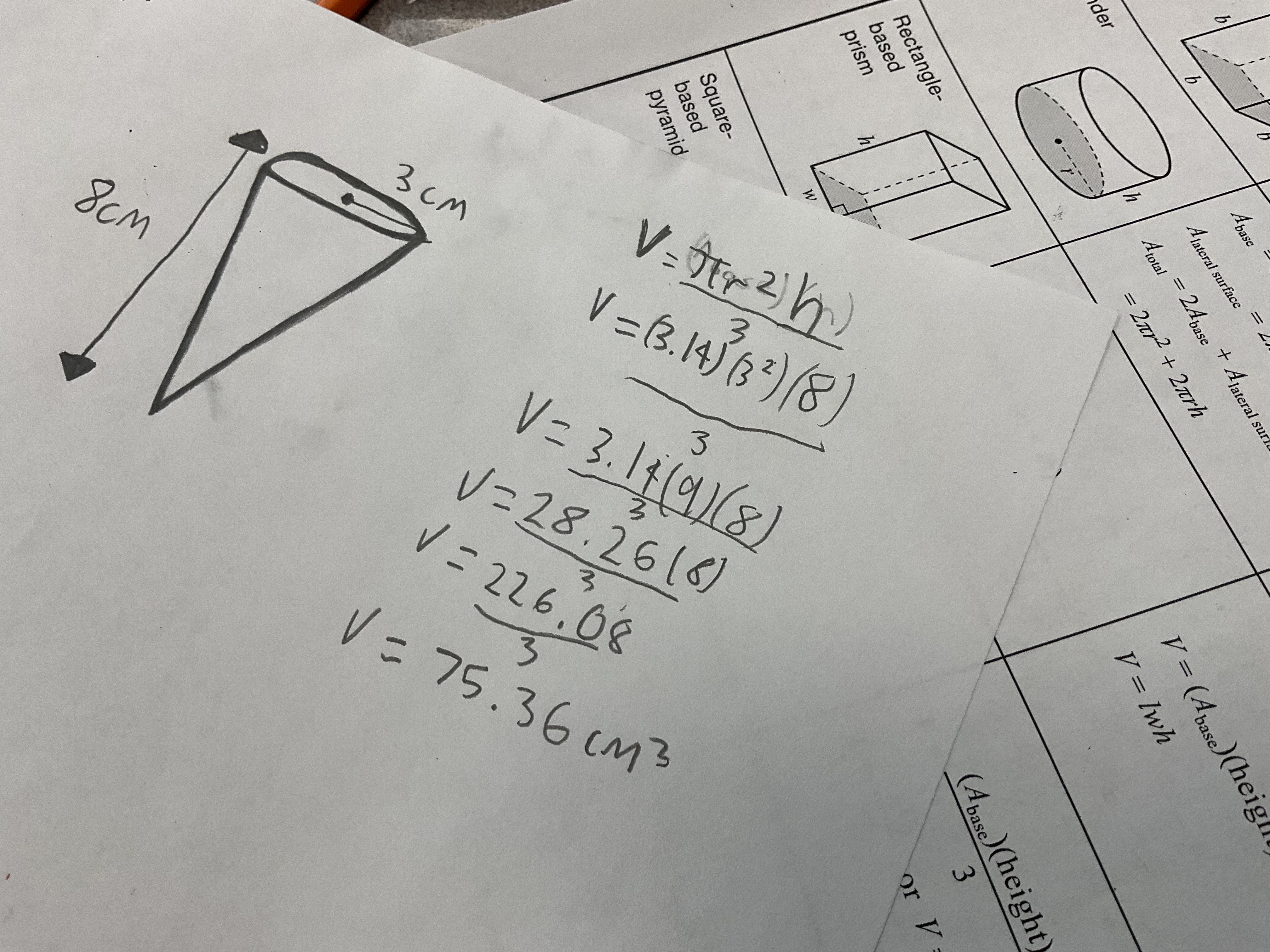
here’s one student who chose to calculate the volume of the pool and water slide.
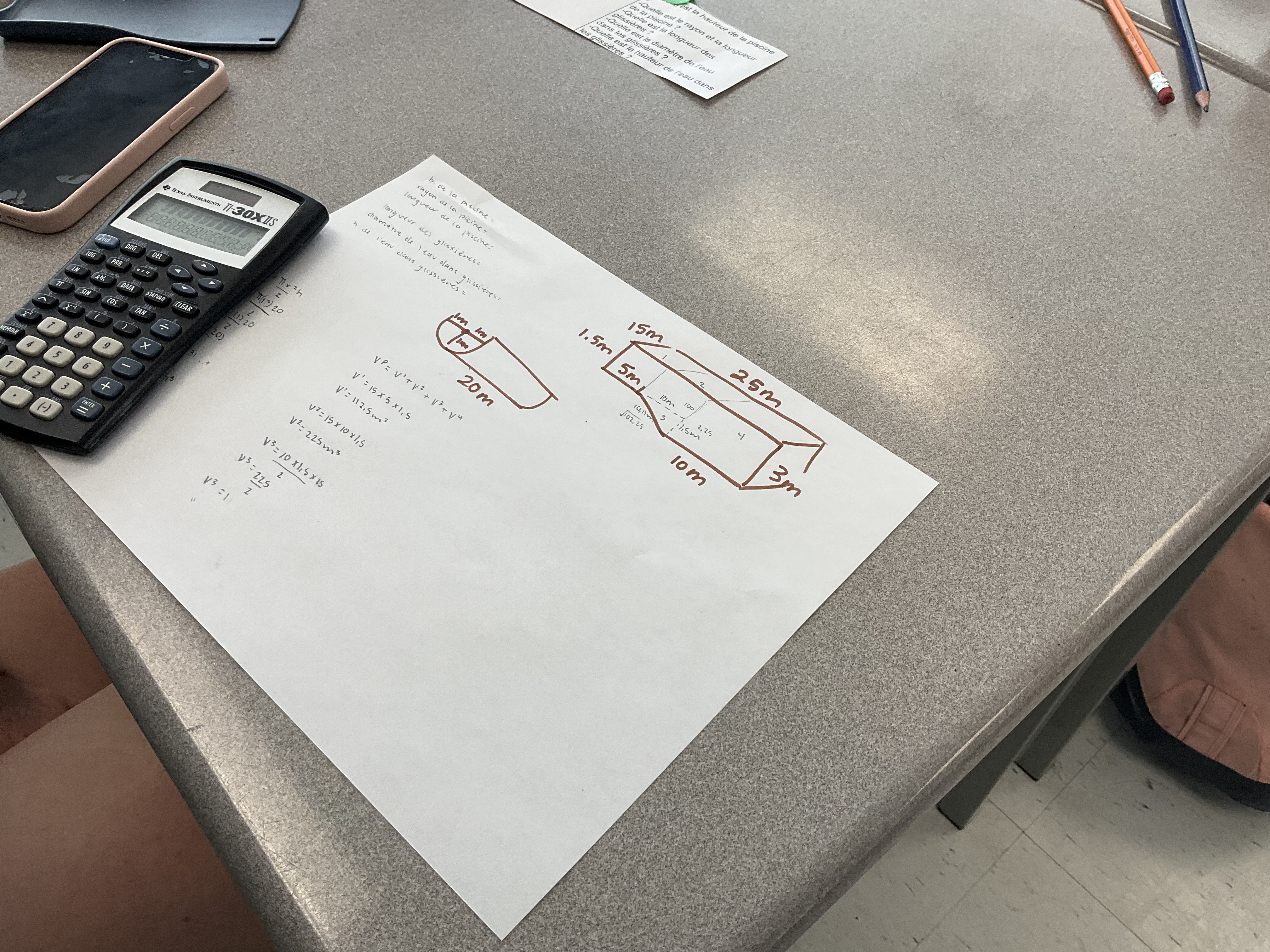
Tomorrow is the big day where we’ll see the image we’re using for inspiration. We’ll get our groups together and make up questions to solve, and submit our requests for information.
Monday we’ll be working individually to solve the questions that were made in groups.
Tarsia Calculus Review
We had a fun time in calculus today refreshing all of the derivatives we know.

This puzzle has a lot of different derivatives to do, and then evaluate at x=1.
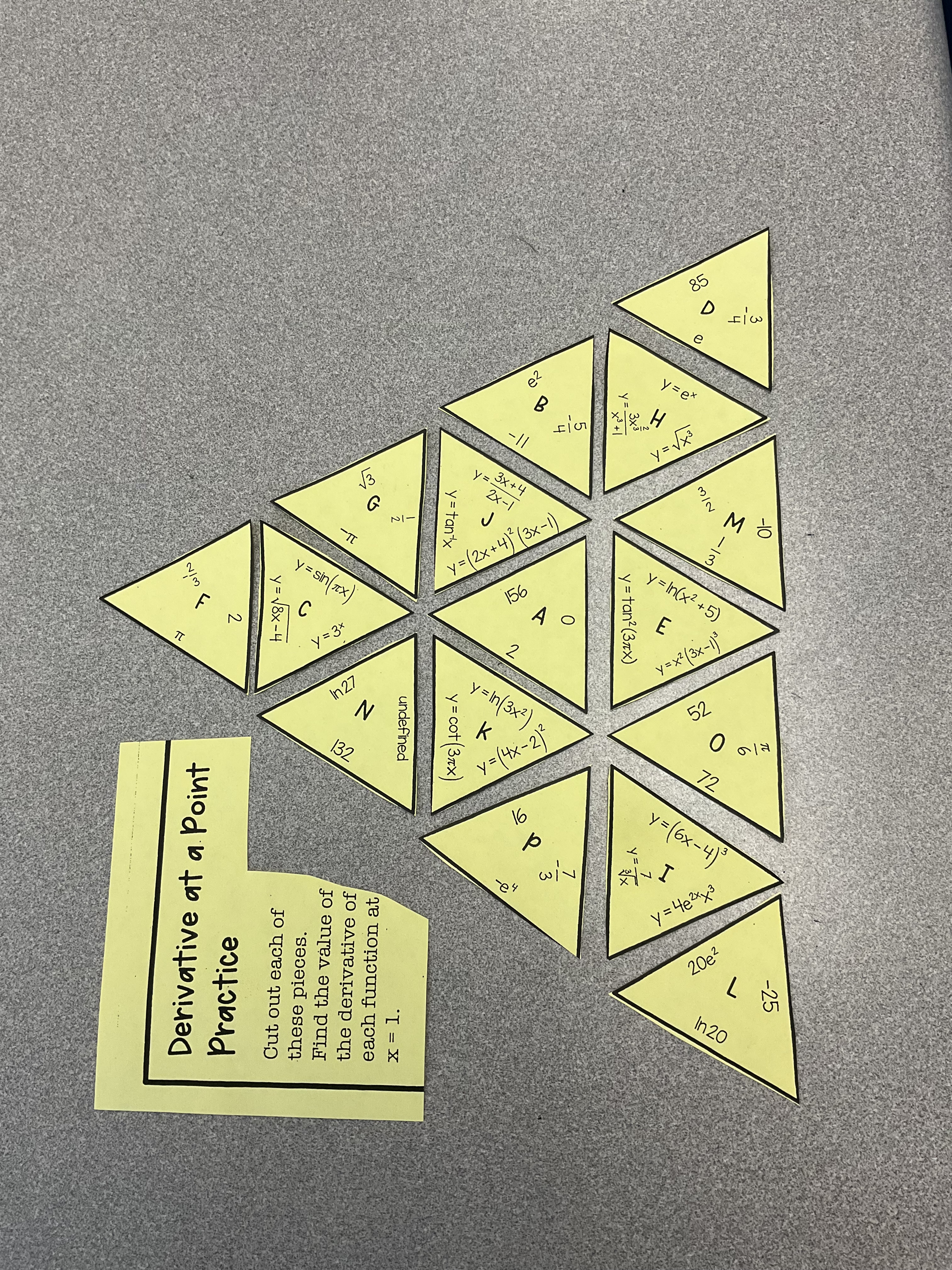
There’s one issue with this puzzle. There is a repetition of the value 2. One student has offered to make some changes to the puzzle. There was also the suggestion of making the puzzle form a 3D object in the end if the pieces are taped together. I’m intrigued to see what they come up with! I’d like to use it next time I teach the course.
Intersection of 3 Planes
Today in Calculus and Vectors we were working on understanding the different ways 3 planes can intersect. We explored several situations as a class, and then each student was given a set of 3 planes to explore.

Students used matrices or elimination to decide if the planes intersected in a point, or a line, or didn’t intersect all together because they were either like an H (2 parallel and 1 not) or a triangular prism.
When they had decided, they cut out the 3 pieces of paper and slid them together to form a physical copy of their planes intersecting.

Having a different colour of card stock for each situation helped students find others with the same case, and they could trouble shoot their intersection calculations.
It was a nice way to end the week!
Math is Everywhere!
We are working towards our culminating task in grade 9, which involves exploring the math that we see in an image, or the math that the image inspires.
Today we debriefed the example that we tried on our quiz.
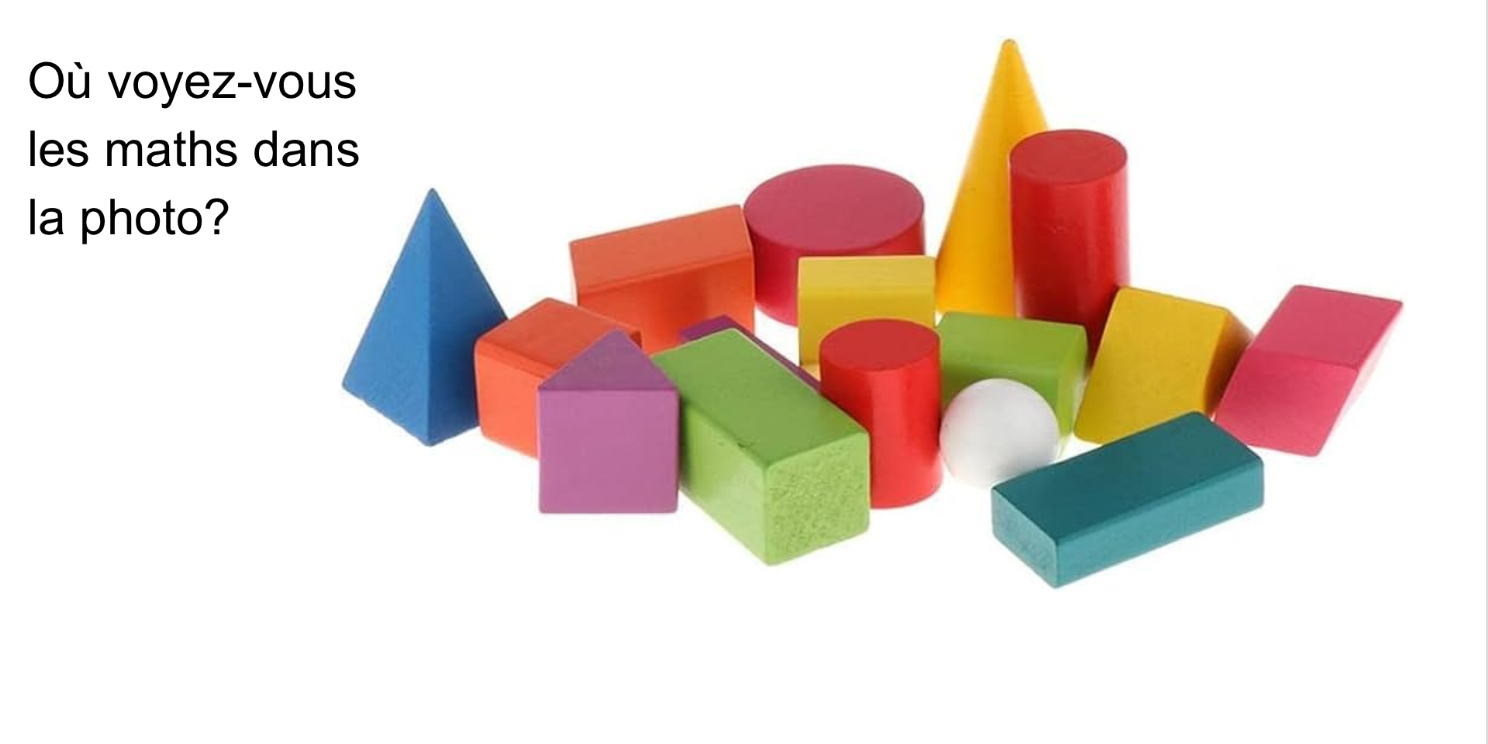
We talked about volume, area calculations and comparison. We talked about questions like “if you know the volumes are the same, and one radius is 3 times the other, how are the heights related”, we looked at classifying shapes by number of faces and showing that as a ratio, fraction, decimal, percent. We talked about how tall a tower we could build. We looked at Euler’s formula “faces + vertices=edges+2” and examined which solids fit that rule.
As a class, we then split up into groups and brainstormed questions we could ask about these images.
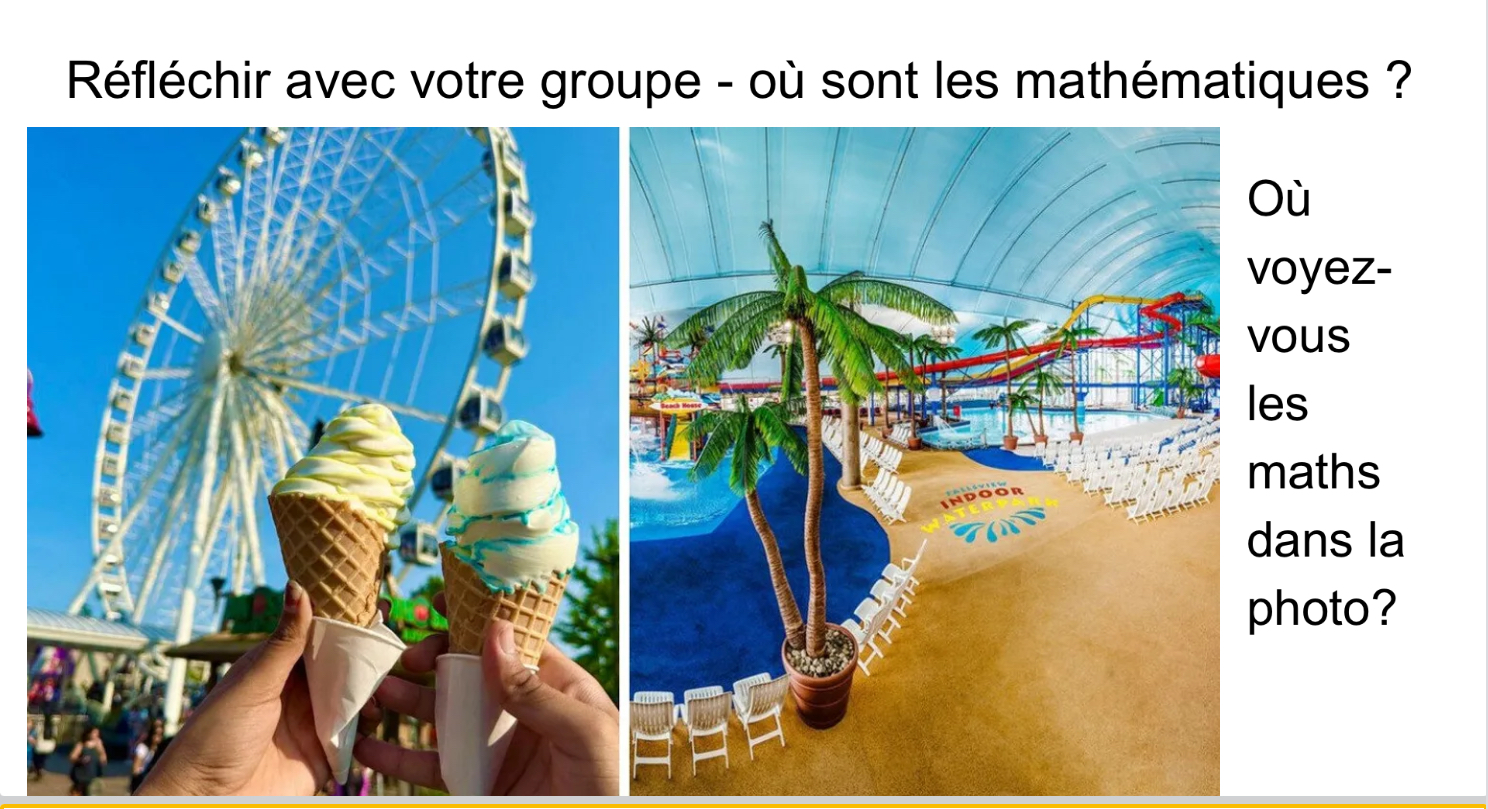
We had very creative ideas! Many students wanted to calculate volume of ice cream, or surface area of the cone, or look at the angles of the palm trees. Some wanted to fill the ferris wheel with ice cream and wondered about how many cones it would take. That led to another group wanting to fill the slide with ice cream! Lots of creative math to tackle.
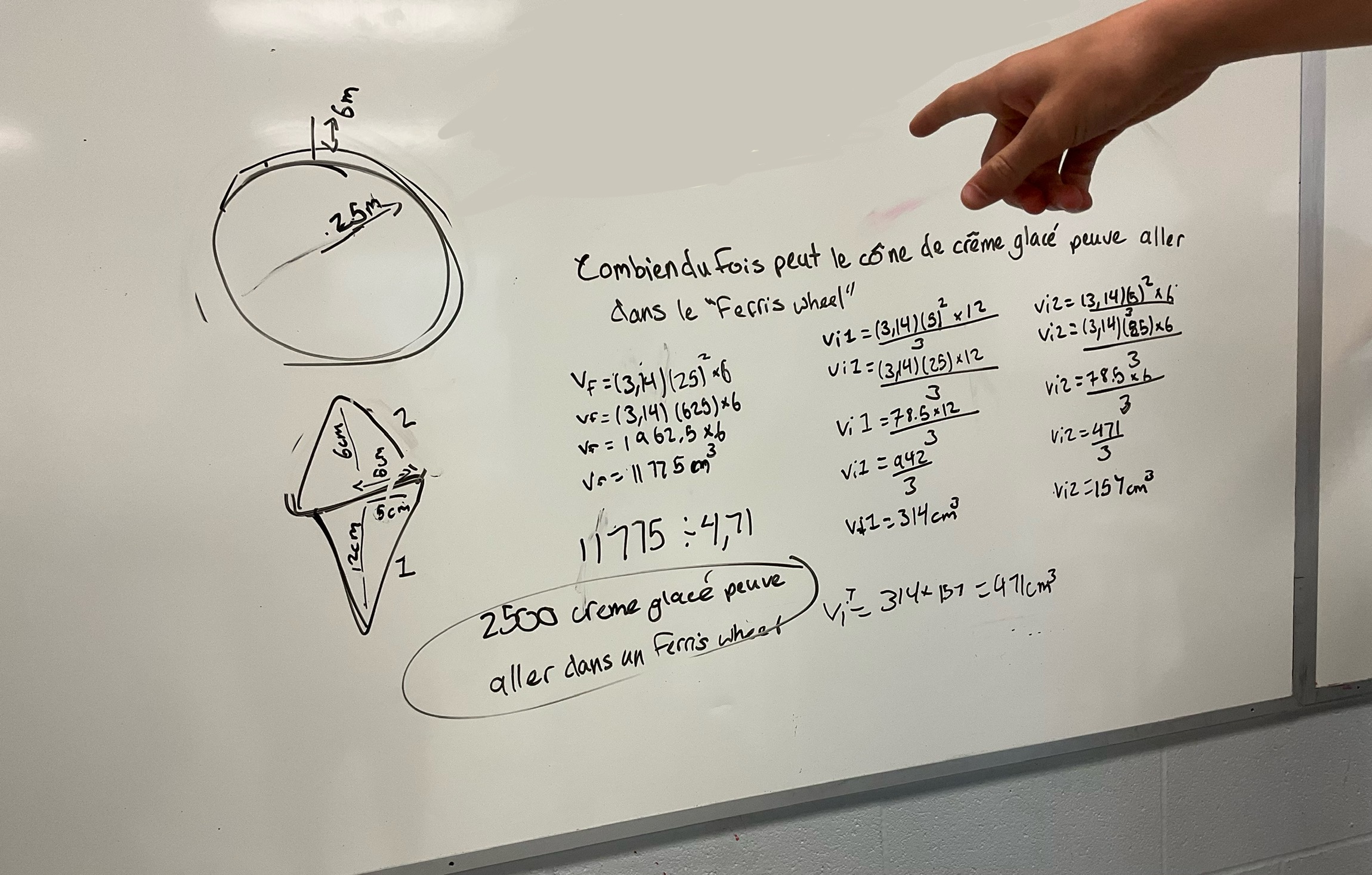
We’ll keep working on creating mild/medium/spicy questions as we head toward our culminating task at the end of term.
Algebra Review
Grade 9s are deep into algebra review today. We dug out some math Tarsia Puzzles and had some fun putting them together.

We had 2 different puzzles to do, which kept most students actively involved and discussing math for most of the period.

Puzzle had fractions and order of operations work, vocabulary, exponent laws, different forms of linear equations, distributive property and equation solving.
I made these tarsia puzzles in a word processor, but in the olden days I made them by hand, copied them on card stock, and cut them out. Some groups tried one of my puzzles from years ago. They had fun putting it together.
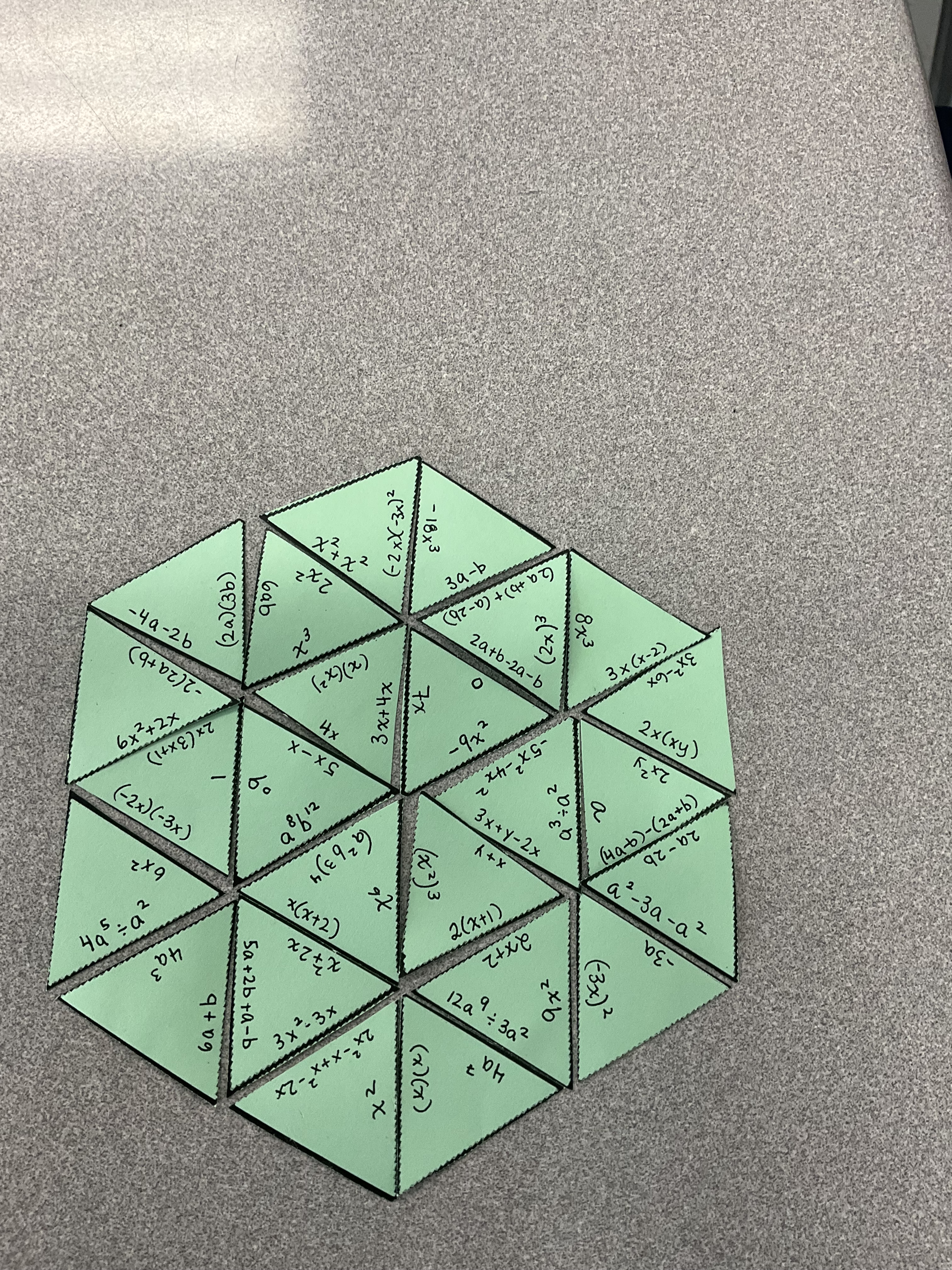
I was impressed at how they were working hard, and having good discussions with peers, and reminding each other about what we’ve learned this term.
Here are the .pdf copies of the puzzles.
Remember to print them single sided, and if doing more than one puzzle in a class, having different colours for different puzzles is helpful. When I am very organized I’ll give groups sandwich bags, and have them put their puzzle pieces in the bag to either bring home to practice, or for me to keep and use with future classes.
More about Matrices
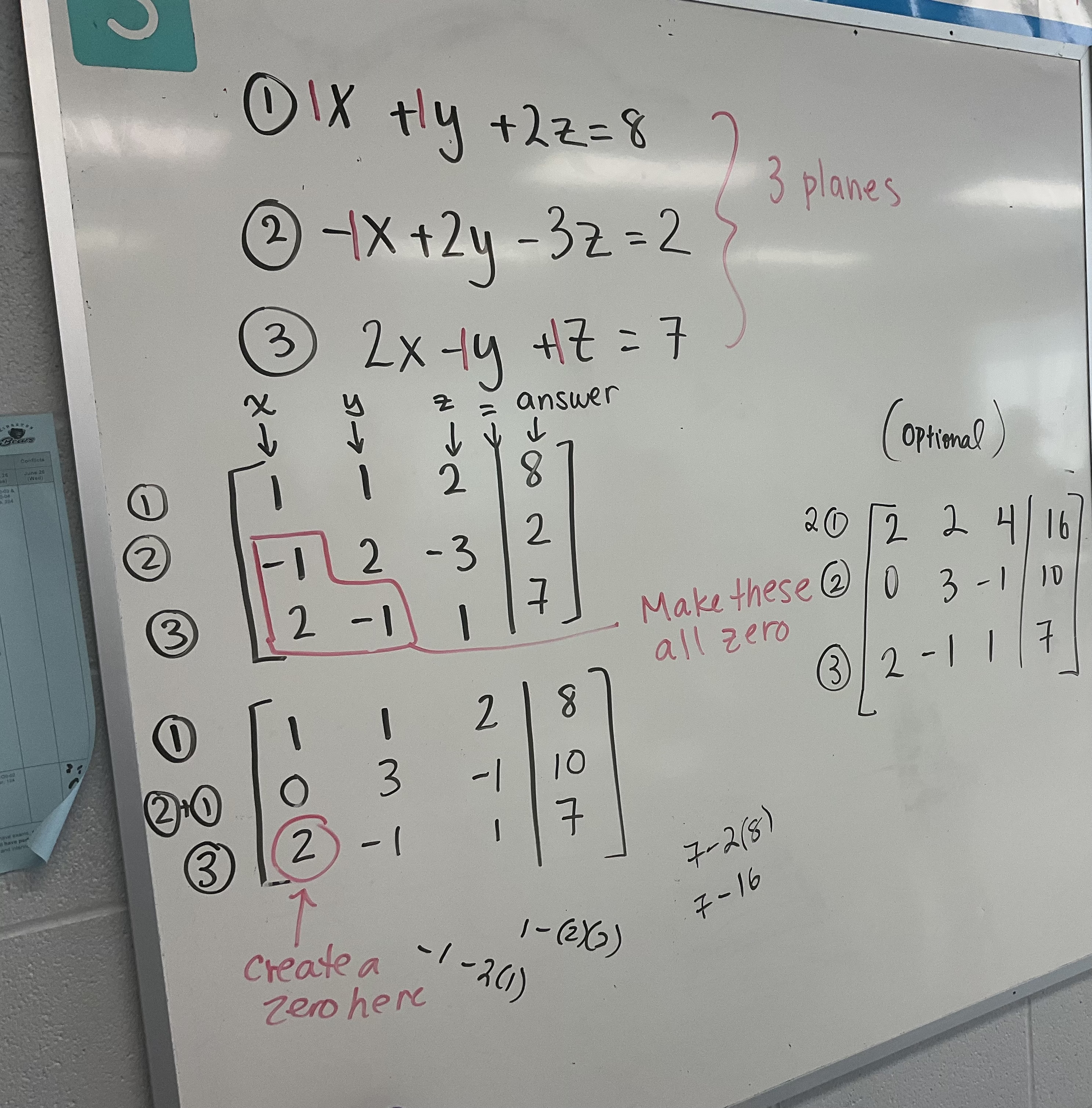
We dove in to matrices today and solved a system of 3 equations in 3 unknowns.
We are getting good at making the bottom left corner into zeros, and now we know how that will help us solve the system.
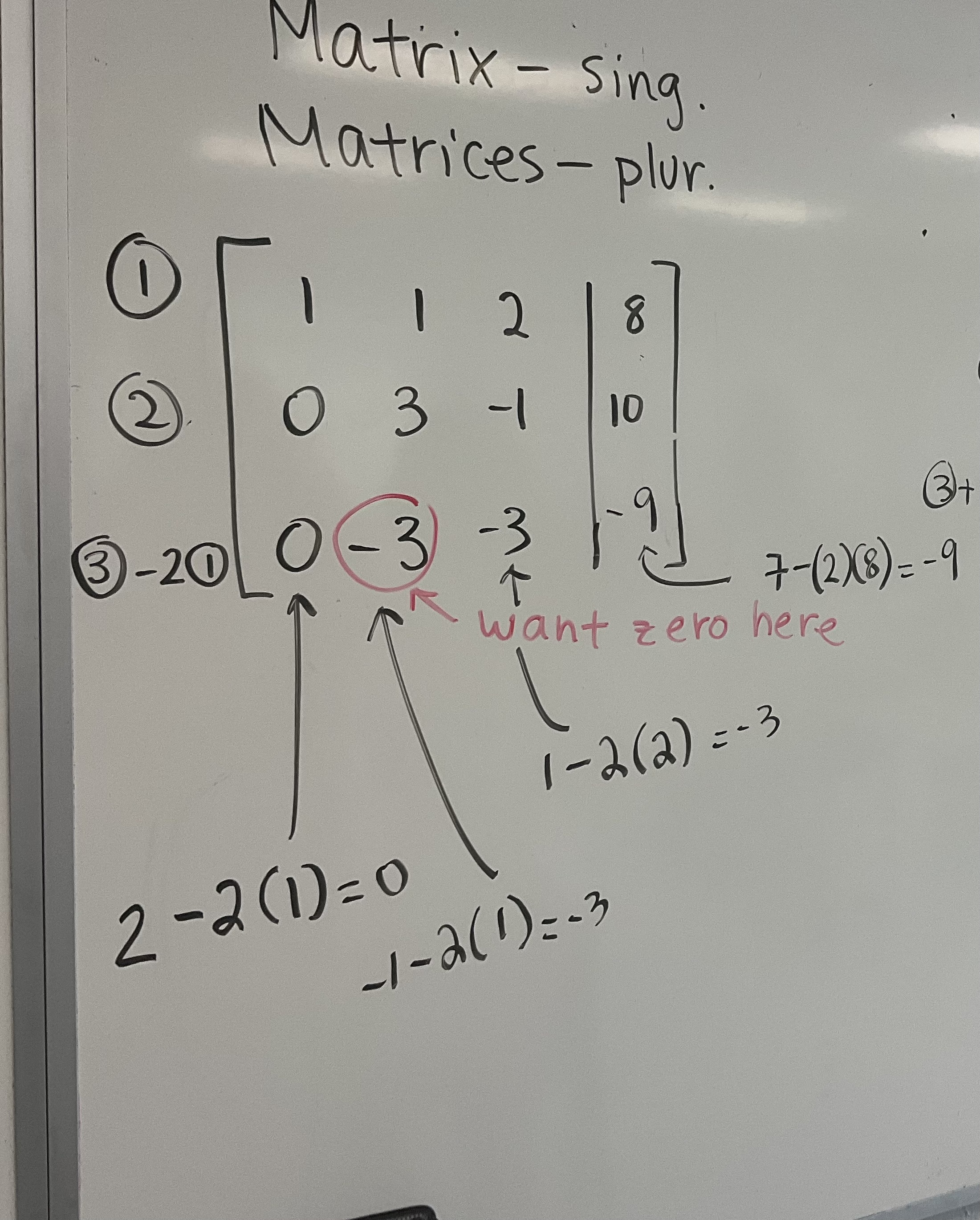

Once we have reduced our matrix to this point, we can jump back into equations to arrive at the final solution.


Something new this year that I’ve been exploring is the desmos 3D graphing. It is powerful to see that this solution is actually the intersection point of the 3 planes we started with.
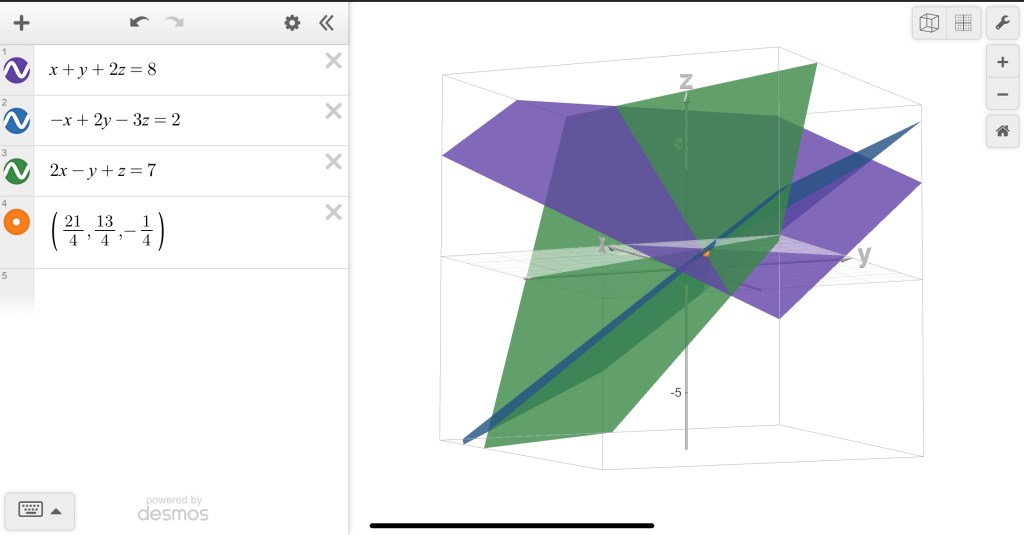
here is a link to the desmos graph so you can interact with it and try it out.
Understanding Bias in Algorithms

Grade 9s looked at several articles today and we practiced marking up text and summarizing. We talked about strategies good readers use to interact with the text, and then we broke off into smaller groups jigsaw style to read and learn from several articles.

One article talked about pulse oximeters registering different values depending on the skin’s melanin content (because melanin is interpreted as higher hemoglobin counts and higher oxygen content of blood), so algorithms and devices have a built in bias. Another article talked about how AI can be a big help, but if it is trained on biased materials, it will reinforce and amplify the bias. Another talked about how data security is important, and how people should consider what health information is entered onto apps, using the example of period tracking apps in the United States where abortion is becoming more illegal in certain states. Another talked about data security of apps like tiktok where foreign countries can have influence and access.
We had some interesting discussions, and some students are rethinking which apps they are using, and who may have access to their information. We also recognize the importance of having a diverse group of people represented at the coding table!
 Ms. Bearse's Site