Les transformations des paraboles
Voici un graphique de desmos qui montre les transformations d’une parabole

Number of high fives in the room
Today grade 10s looked at how many unique high fives there are in our classroom. We had 32 in the room today, and a unique high five is considered a high fove between 2 people.

With 32 it gets challenging to draw out…
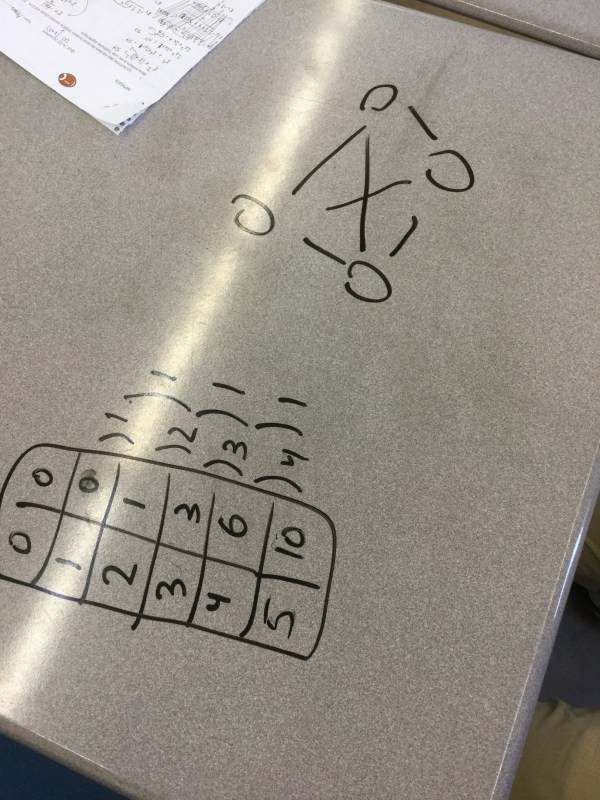
Easier to draw smaller cases
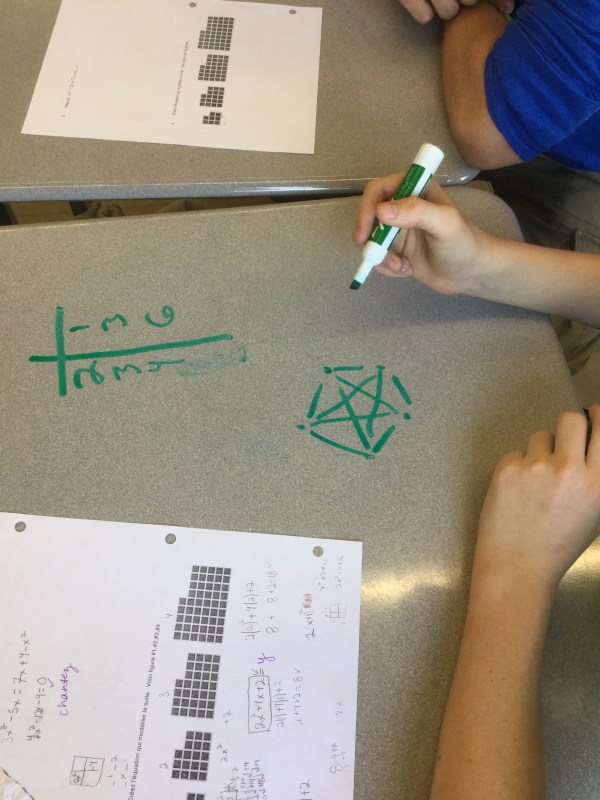
We looked at the table of vales we created from these smaller cases, and found patterns which we extended to our number of 32 people. We also looked for a general case, and from the second differences, calculated “a”, from the table we found the constant, or “c” term, and then calculated the value of “b” in our standard form equation.
Creative representations
We have 3 Owens in our class. The Owens have used themselves to create some algebraic representations.
Here is 3 Owen

And here is Owen^3 (Owen cubed)

Mighty creative!
Test preparation
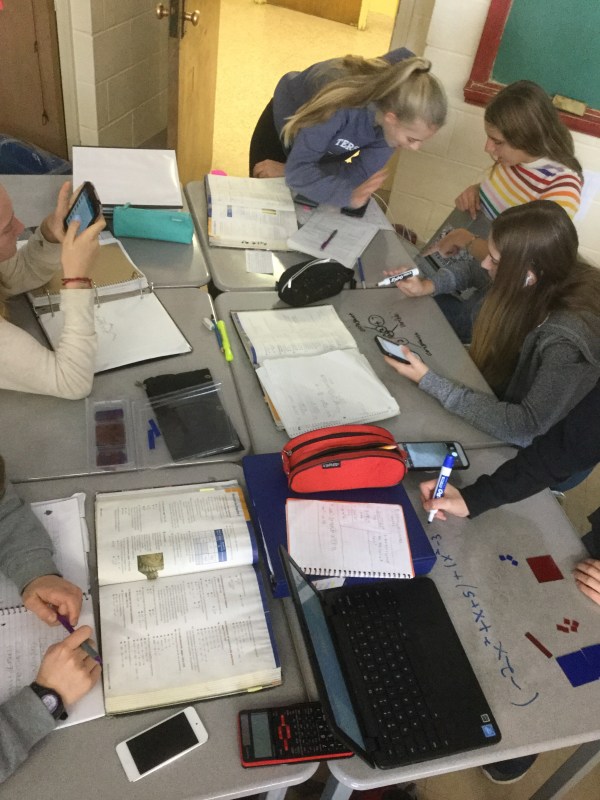
We’re working really hard to get ready for tomorrow’s test. We’re practicing with tiles, practicing with text books, taking pictures of our work, using google classroom, and making our digital study notes. We’re working together to get last minute questions answered, and to be sure of all of the algebra rules we need.
We all need calculators for tomorrow! We’re ready. We’ll do well tomorrow.
Algebra practice
Grade 9s worked “speed dating style” to review algebra concepts today, and solve problems together.
 by working in pairs, across the table, we can help each other out, and coach our peers to understand and perfect our algebra skills.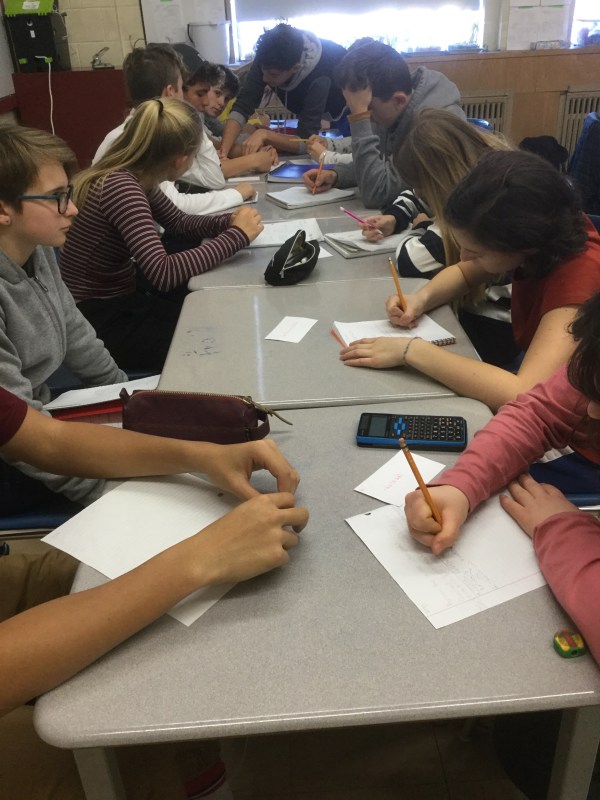
We are having fun too!

Quadratic formula
Today’s the big day in grade 10! Here’s the derivation of the quadratic formula. It shows how to complete the square for any trinomial, and then, to set y=0 and isolate x to find the roots, as we’ve been practicing lately.
 we isolate x by doing opposite operations on both sides.
In the end, we have a beautiful formula (in the box) which we will use a lot. We even learned how to sing this formula to the tune of “pop goes the weasel”.
We use the formula to calculate roots of a quadratic.
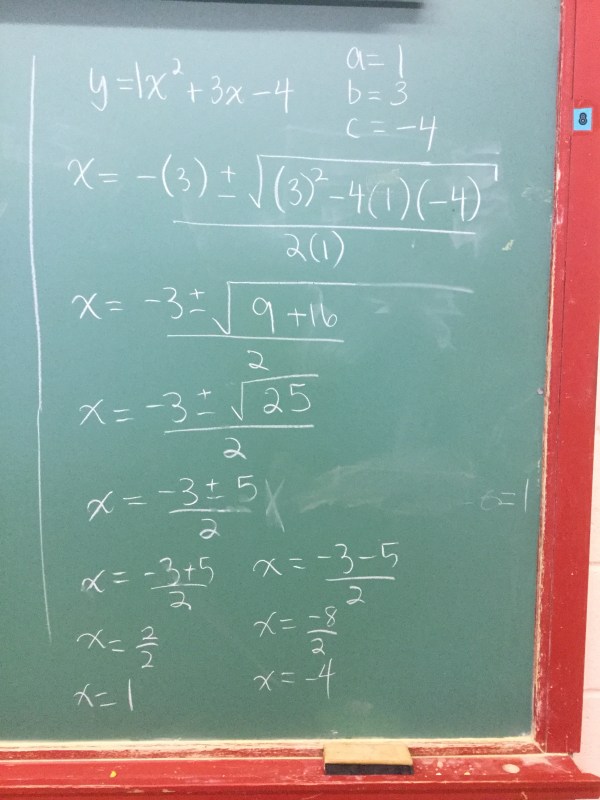
We could have done the same thing by factoring

But not all equations are factorable. We can always use the formula!
We also saw what happens when there are no roots
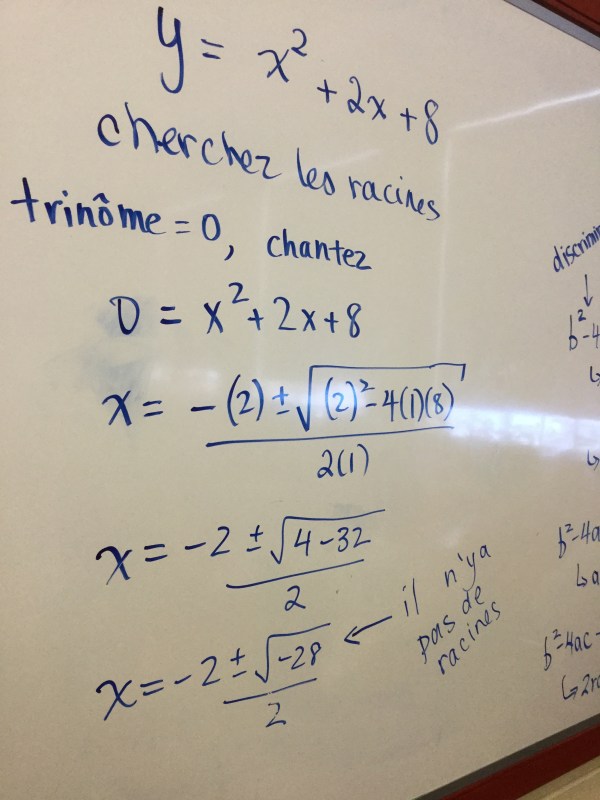
We will be using this a lot to solve problems tomorrow.
Modelling quadratic patterns

Using the website visualpatterns.org we explored a few patterns. We looked at them in a similar way to patterns we explored in grade 9, linking the visual pattern to an equation, a table and a graph.
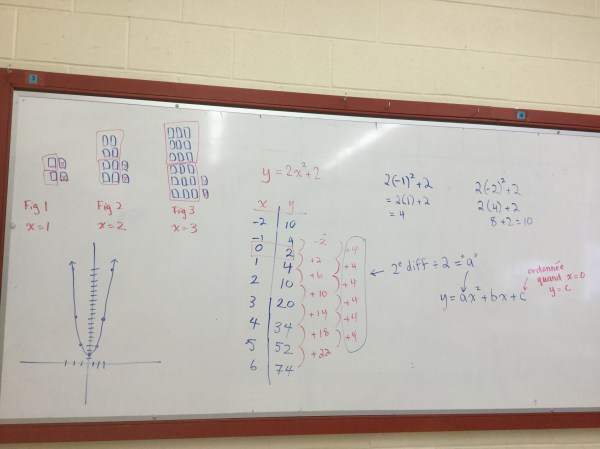
We remembered how to look for groups of “n” and squares of “n” to help us build an equation. We also remembered that the data in the tables correspond to (x,y) coordinates for the graph. We looked at the first differences, and second differences. For linear growth the first differences are constant. For quadratic (parabolic) growth the second differences are constant. We looked at how the 2nd difference is related to our equation (our “a” value is always half of the constant second difference). We looked at how figure 0 is related to our constant term in our equation, and the y intercept of the graph.

We had a look at a cubic function too, just to notice that the 3rd differences are constant, and that the graph looks different from a parabola.

There are sometimes some tricks to use when visualizing and making equations. For this pattern it helps to add another set on top to create a rectangle that is (x+1)(x+2) and then since we only need half of that we can multiply by 1/2 or divide the whole thing by 2.

For this pattern some people looked at groups of “n” to model the yellow squares. We see 8n^2+4n+1 this way.
Others looked at creating expressions for the yellow squares.

And some looked at an expression for the entire square, with white rectangles removed.

And in the end they all simplify to the same thing! Algebra is neat that way.
We will continue to explore these trends over the next few weeks.
Tarsia Puzzles
Grade 9s worked on exponent laws and algebra practice today by putting together tarsia puzzles.

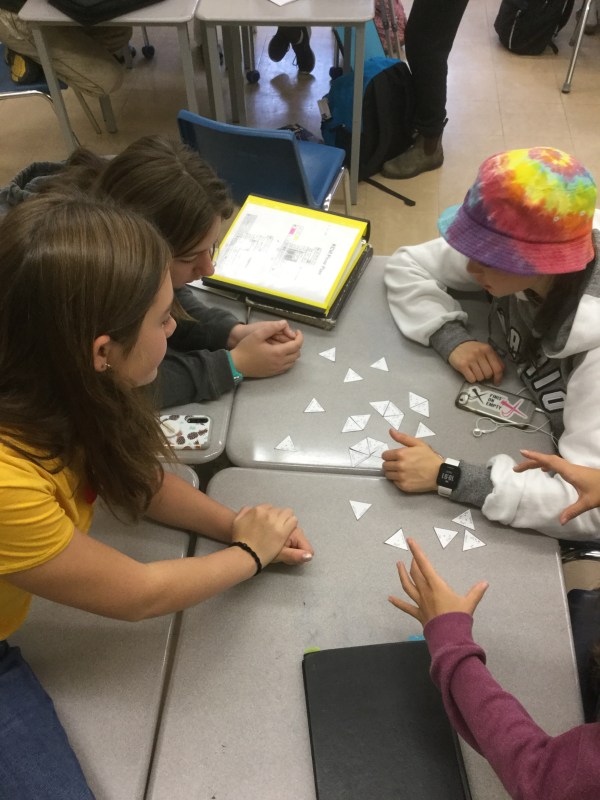

Each triangular piece has algebraic expressions on the sides. We matched up simplified and unsimplified versions.
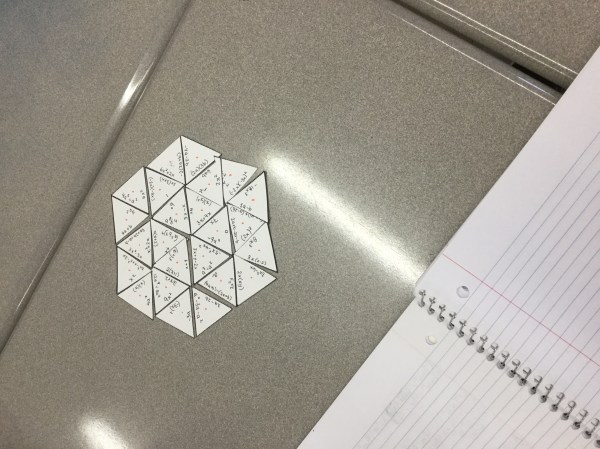
We needed to work together to catch our errors and stay on track.
Review for test
In Grade 10 we are reviewing before our test tomorrow.
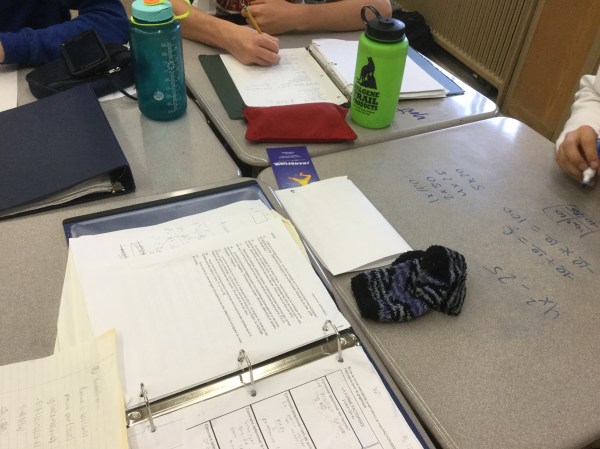
We’re working on word problems, and factoring…
 we are writing answers up on boards, and working well with our classmates to verify answers.

We’re taking pictures to put our work into our study notes which are due tomorrow.
Distributive property
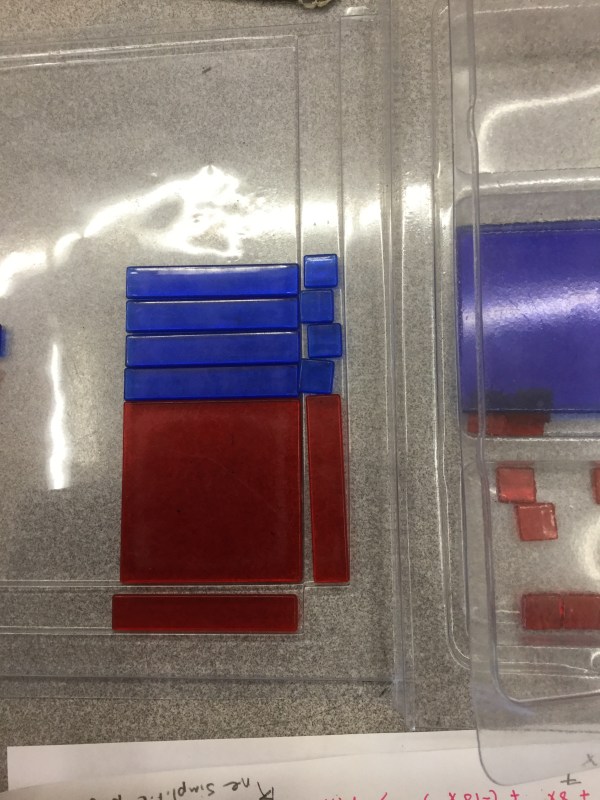
Grade 9s are multiplying with algebra tiles now! This photo shows (x)(x-4) and the answer to that multiplication is x^2-4x.
 Ms. Bearse's Site