Exponents
Grade 9s explored exponents today, and made connections between exponents and the area and volume concepts we have been looking at.
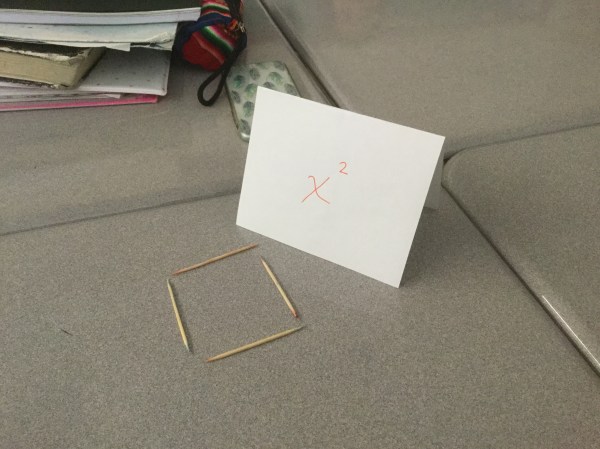
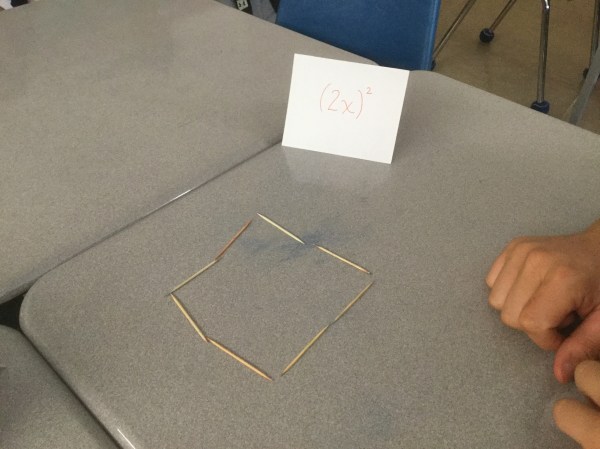
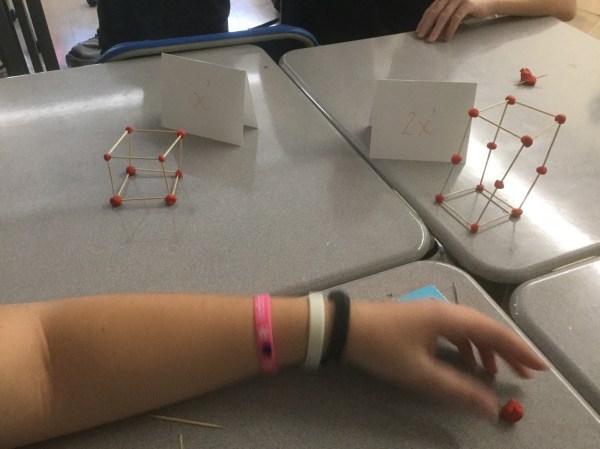
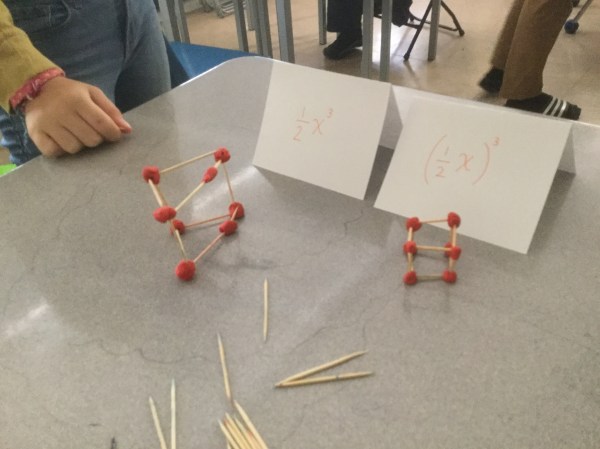
We are looking at what exponents of 2 mean, and what exponents of 3 mean. We also are looking at what happens when there are coefficients inside brackets that are raised to a power.
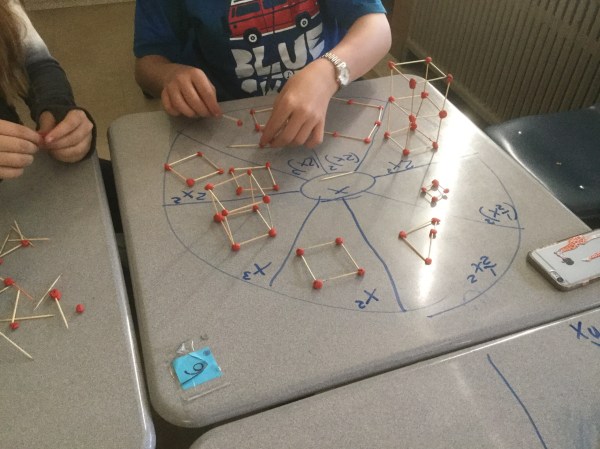
We worked on filling concept circles with different representations.
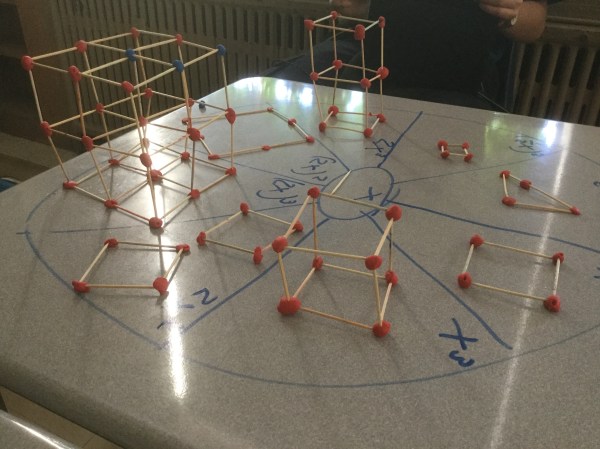
And then “levelled up” to using 2 variables (toothpicks and skewers)
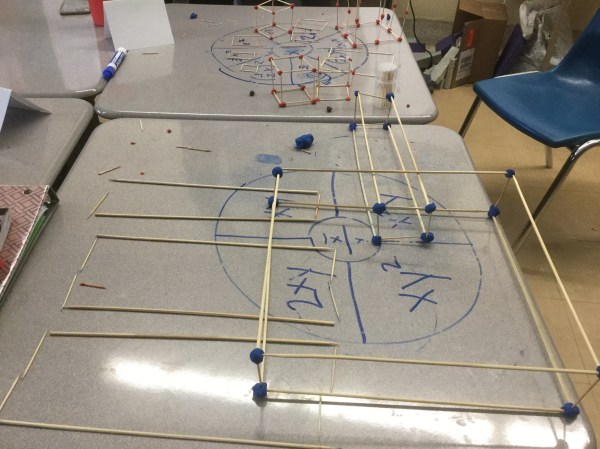
We recognized that expressions like x^2y would represent the volume of a square based prism with dimensions of x,x,y.
Some of us took this farther to explore what the area of such a prism might be.
Lots of learning and lightbulb moments today! Good job grade 9s.
Stations for Review
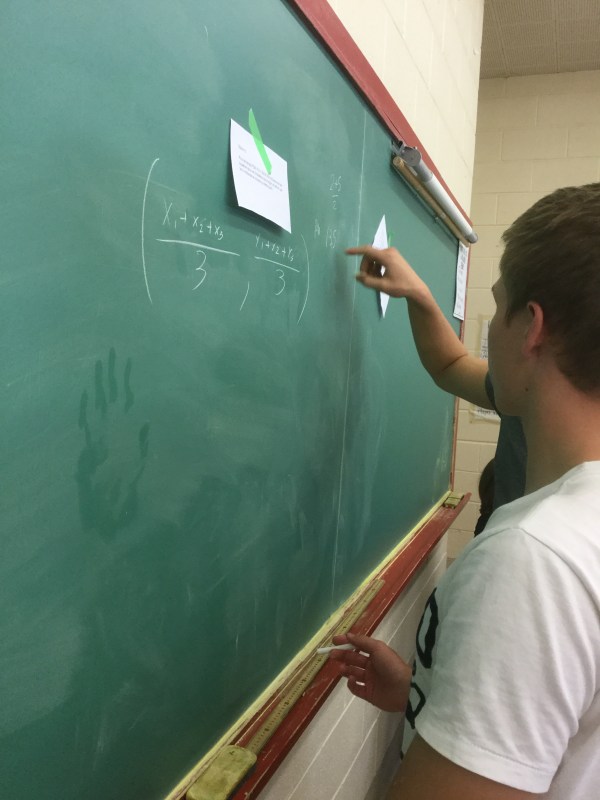 Grade 10s worked on questions posted around the room today to review for the test on Friday.
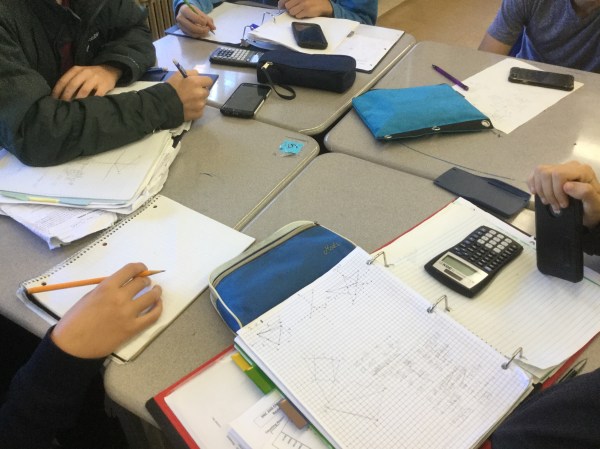 we are working hard to classify shapes by their sides (lengths and slopes) and by their diagonals as well. We will continue our work to improve our skills until test day.
Stations For Learning
Today grade 9s worked through 3 stations to learn about how to use various formulae to calculate surface area and volume of cones, pyramids and spheres.

We used a displacement method to show that a sphere will displace enough water to fill a cylinder that has height and diameter equal to the sphere diameter by 2/3.
We can use the fact that the height of the cylinder=2r to modify the formula of the cylinder from V=(pi)(r)^2(h) to V=(pi)(r)^2(2h) to V=2(pi)(r)^3
The sphere’s volume is 2/3 of this or V=(4pir^3)/3

Another station was for calculating the surface area of the sphere. We drew circles with the same radius as the orange. Then we peeled the orange, and filled the circles that we could. We can fill 4 circles, so the formula for the surface area of a sphere is A=4(pi)(r)^2

Other stations were for calculating different aspects of a pyramid.
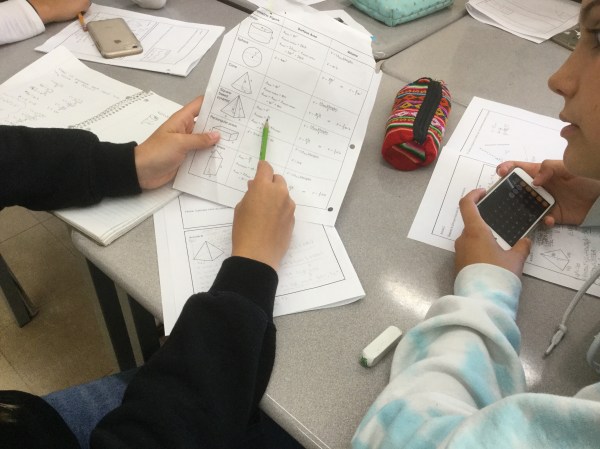
And exploring about cones. We looked at the lateral surface area, and the slant height, and radius and height and verified that the pythagorean theorem works to calculate missing information.
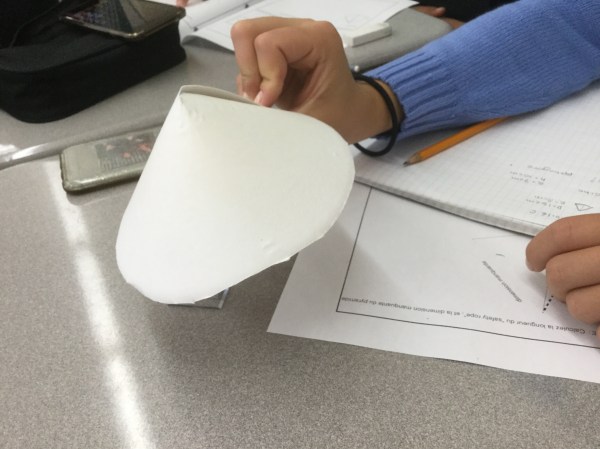
Tomorrow we will finish our remaining stations and apply our knowledge to solve problems.
Word problems in grade 10

We read the text and discussed what it means. We needed to look up a few words and draw a few pictures to make sense of the problem.
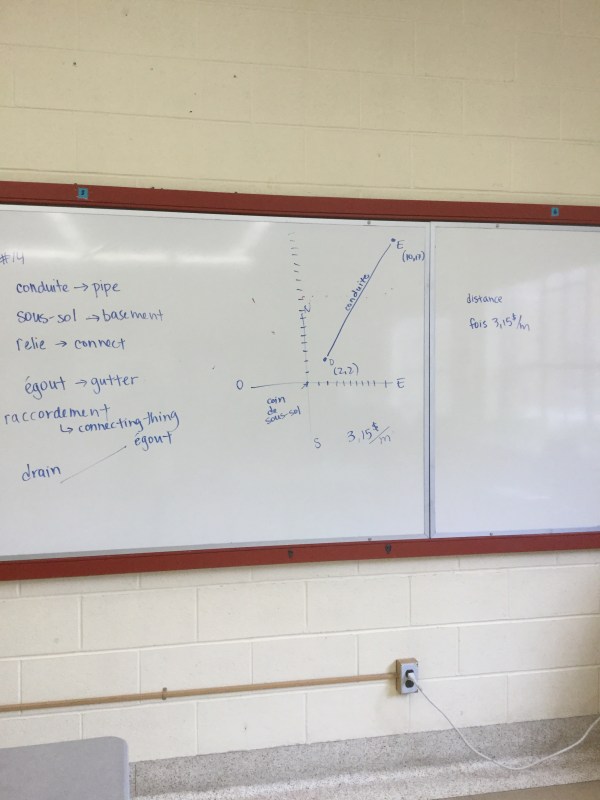
We strategized about how to solve the problem and made a good plan.
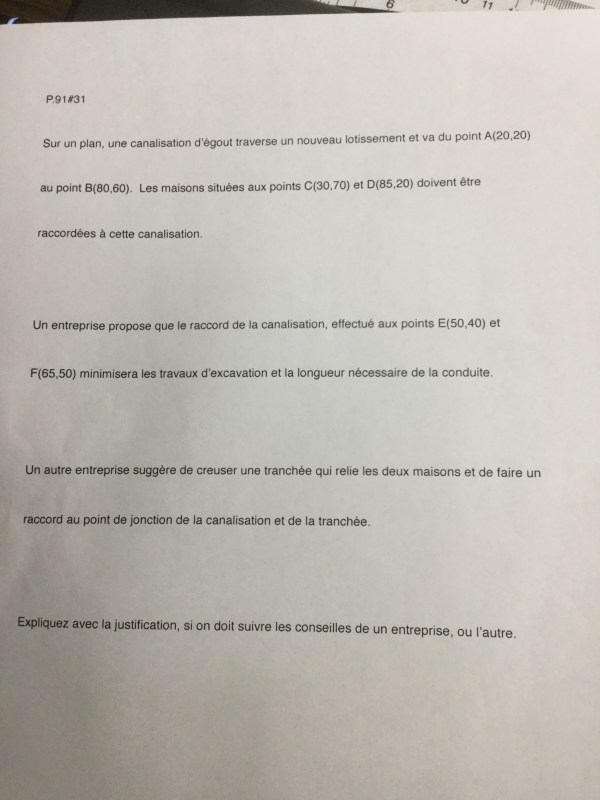 sometimes a lot of text makes it look like a scary question. Text gives us information, so more text is sometimes better!
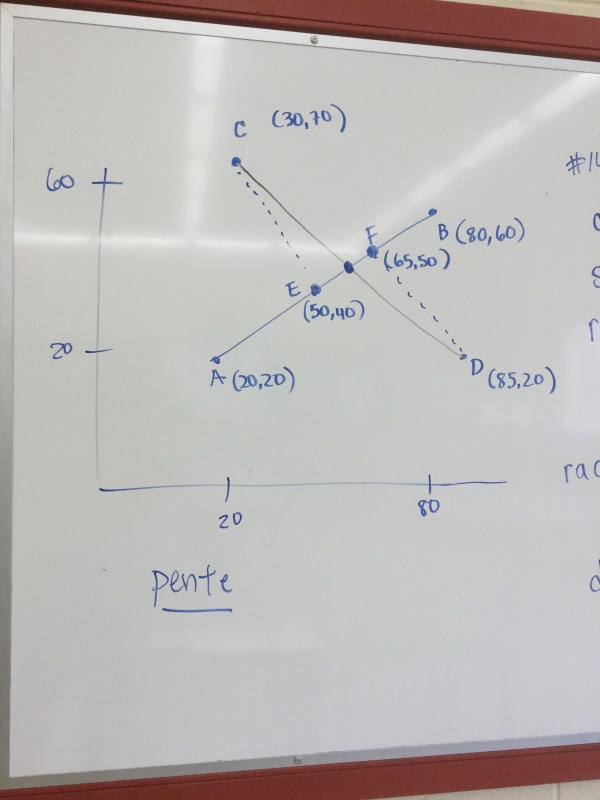
We are working toward a test on Friday, and study notes are due on Friday as well.
Making pyramids
In Grade 9 today we looked at how pyramids are related to prisms of the same base and height.
We filled the pyramids with water, and could dump them 3 times into the prism to fill them up. The volume of the pyramid is one third the volume of the prism with the same base and height.
We then worked on building pyramids with a volume of 300cm^3.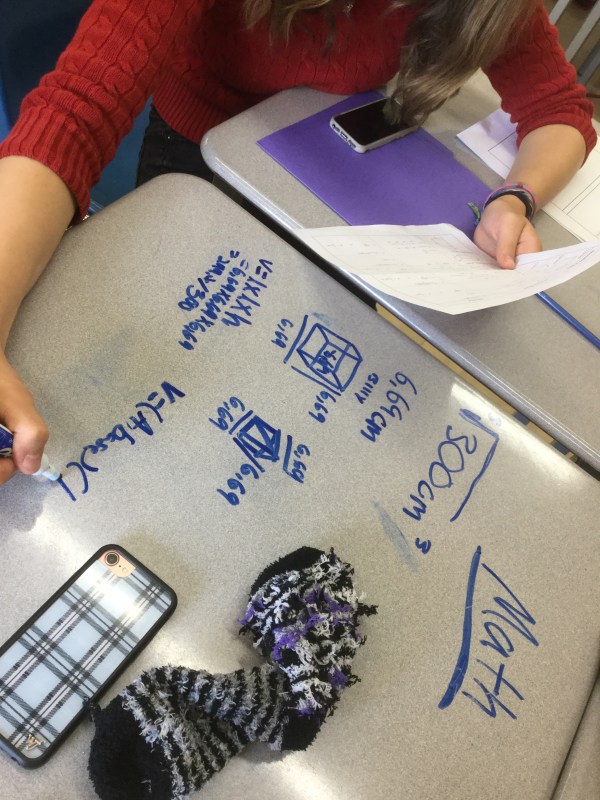
Some of us made an error that we can learn from. For some of us the pyramids ended up being shorter than we planned. We measured the pyramid height as the slant height of the pyramid (the height of the triangular face).

We can see that there is a right angle triangle hidden in this pyramid. Half of the base of the pyramid (pink), the pyramid height(black), and the slant height (orange) form the triangle.

So our first step is to choose good prism dimensions (there are many combinations that work. The base must be square, and the product of all dimensions must be 900cm^3).
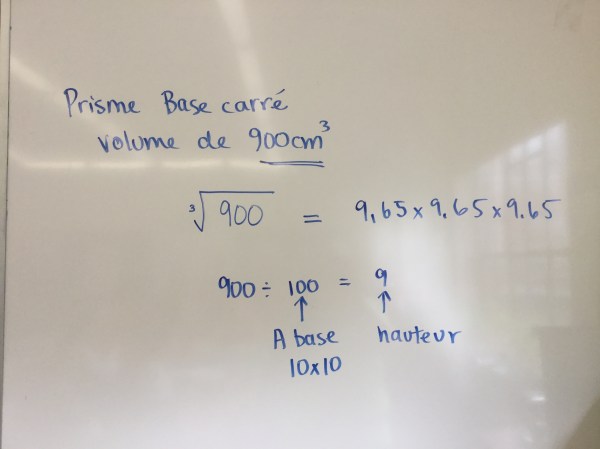
Using the 10x10x9 case, we can calculate the height of each triangular face that we need to arrive at the correct pyramid height.

We looked at how this works with an example of a cone as well.

In order to find the volume of a cone, if given the slant height, we need to use the pythagorean theorem to calculate the height of the cone first, and then we can calculate the volume of the cone after.
Text marking and portfolio bump-ups
Grade 9s had a look at some model portfolio responses and colour coded the sentences that they felt were evidence, reflection, and summary statements.

While they worked they brainstormed ideas for improving the writing samples, and decided on the “teacher comments” they’d write.
After that, students had a look at their own portfolios, to see how they could work on improving their own writing based on the feedback they’ve received. For the first submission portfolios can be bumped up after they’ve been marked.
An important thing to remember on quiz day

Planning a good strategy
Grade 10s are working on problem solving, especially planning a good strategy.
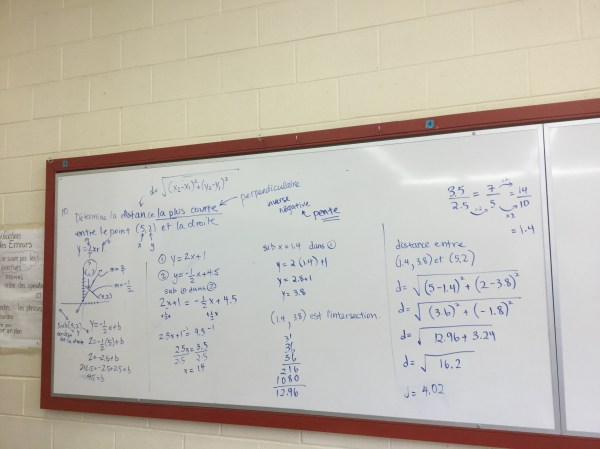
We looked at how to decipher a problem to pull out important aspects that are hints for what strategies we may need.
We talked through some of the homework questions that had been challenging, and we also learned a new fact about quadrilaterals. If you join the midpoints of each side, the interior quadrilateral that is formed is always a parallelogram).

We calculated slopes and classified that the central shape is a parallelogram, and then we verified that it will always be the case by making a dynamic model with desmos geometry. We can measure angles and side lengths, and then adjust the drawing and see what happens to the side lengths and angles.
Math Speed Dating
Today, in grade 9, we did some problem solving practice, in a new format.
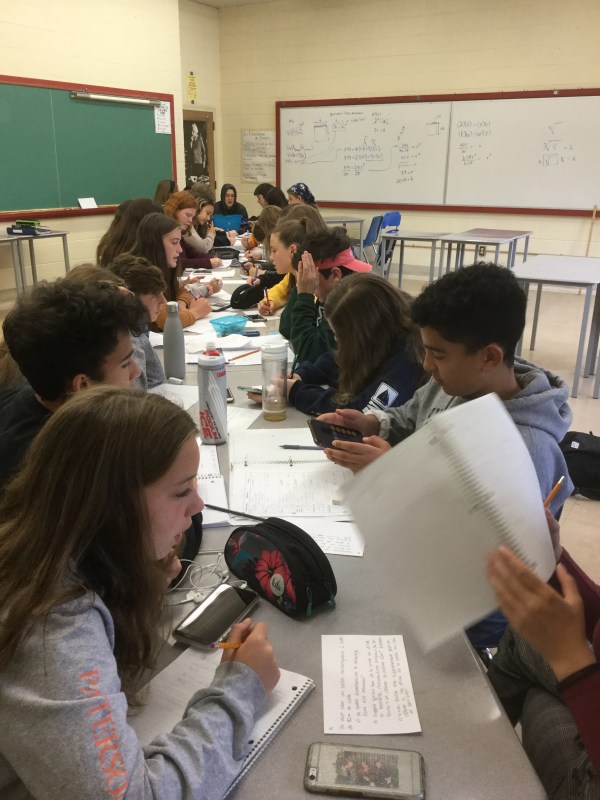
We had a long row of desks, and we worked with our partner across the table. We used our formula sheets, and strategized to solve optimization questions, or composite volume problems, or pythagorean theorem problems.

After all problems are adequately solved, one side of the table is named the “experts”, and they stay put, while the other side stands and shifts to their right. They, the newcomers to the problem, will do the problem, with the support of the expert if needed. 
The newcomer then is named the expert, and they stay put, while the other side, stands and shifts to their right, creating a new partnership.
This reciprocal teaching/review method works well for many activities. We’ll be doing it again regularly.
Cylinders
Today grade 9s had an interesting problem to solve. We investigated the cylinders made from a sheet of paper lengthwise vs widthwise. We compared the volumes of these cylinders.

We made the connection between the page dimensions and the circumference, and then calculated the diameter and radius.
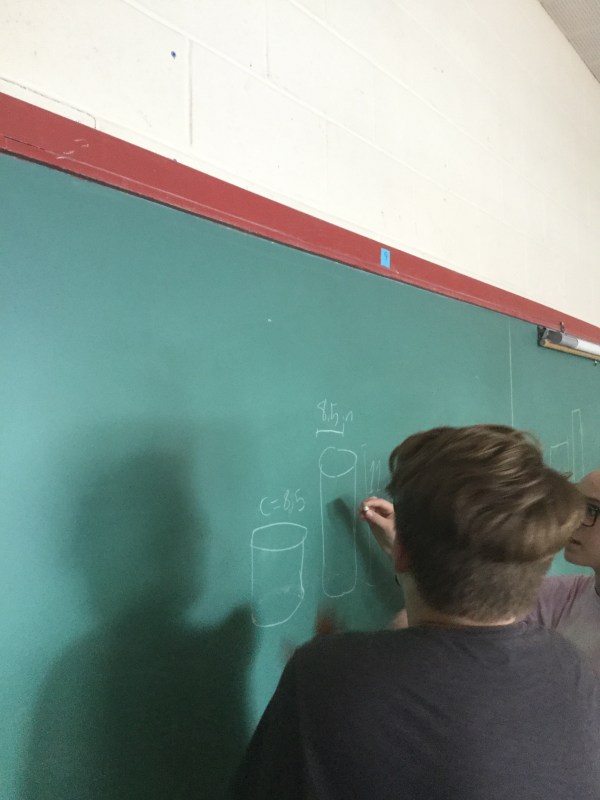
We used the radius to calculate the volume.

And then we compared the two cylinders based on their volumes.

We did a lot of great thinking today!
Finally we consolidated and learned that the more cube like the cylinder, the smaller the area will be for a given volume. So when the cylinder’s height is equal to the diameter, the area is the smallest. Or for a fixed area, the volume will be the largest.
 Ms. Bearse's Site