Equation Solving
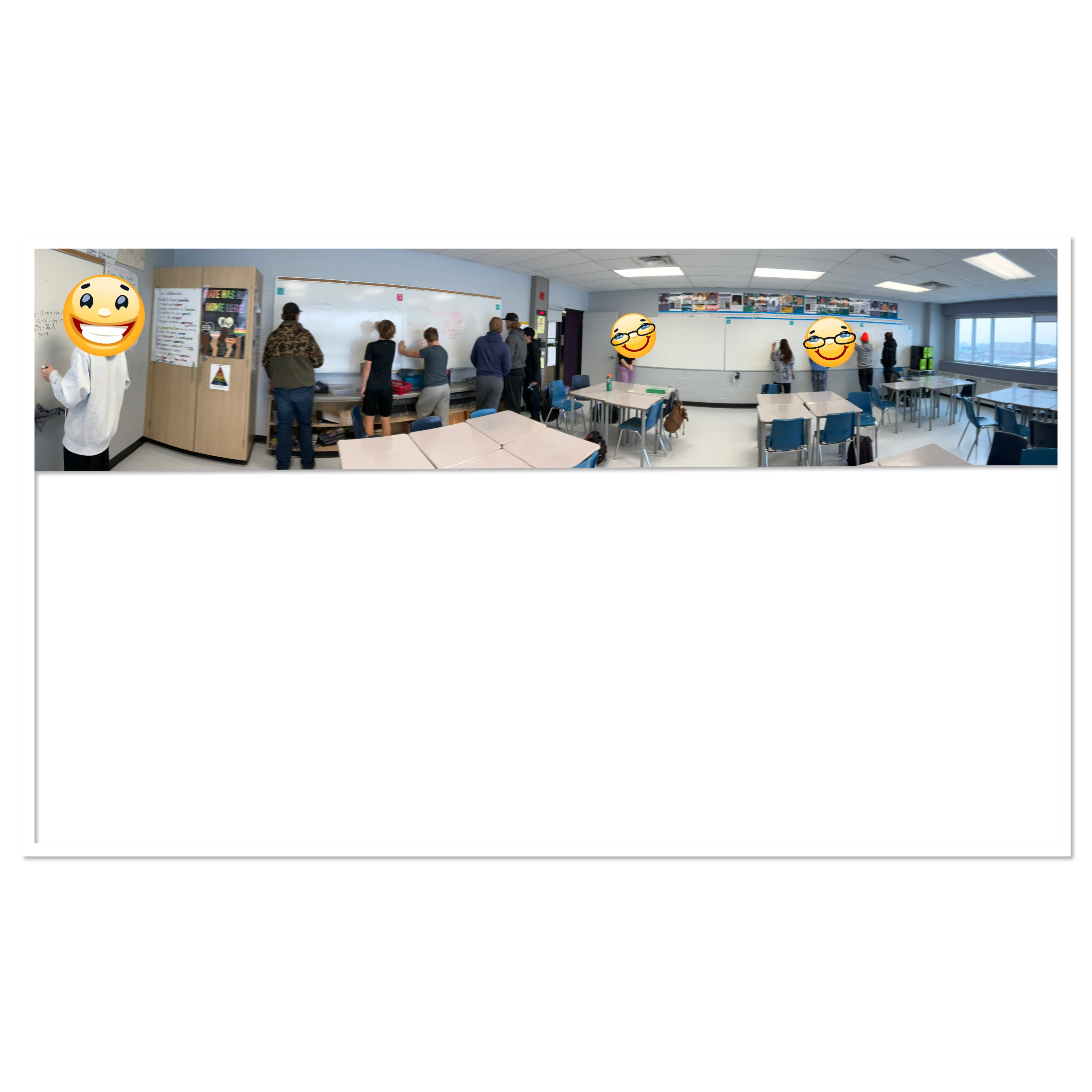
Today in grade 10 we started off by solving equations at the walls. We had enough space and markers for each student to write and practice solving. We solved equations with x on both sides, and worked our way up to solving equations with distributive property as well.
Our next challenge, since we were ready to try something new, was a word problem.

We noticed that there were 3 bananas in both situations. The change in price must be related to the change in number of apples. 2 apples is 1.50, so each apple is 0.75. We can use that information to calculate the price of a banana now.

For this question we didn’t have the same number of calculators or books, but we notice that we could double one equation to make the number of books or calculators be the same. We solved this problem, then went on to solve this 3 act task
This required us to multiply BOTH equations to get a common coefficient, and then we could solve from there. Overall a very productive class, too bad only half of the students were present. We’ll do more of the same tomorrow to catch everyone back up.
The Great Cookie Stacking Competition
This activity is quickly becoming a favourite. It’s a nice way to revisit mean, median, mode and range, and also introduce the idea of quartiles and a box and whisker plot.
There are very strict rules for this challenge. People use one hand and stack one cookie at a time to build a freestanding cookie tower. I gave each group a box of cookies to use (I get the cheapest cookies I can find that are not sandwich cookies because they stack too well).
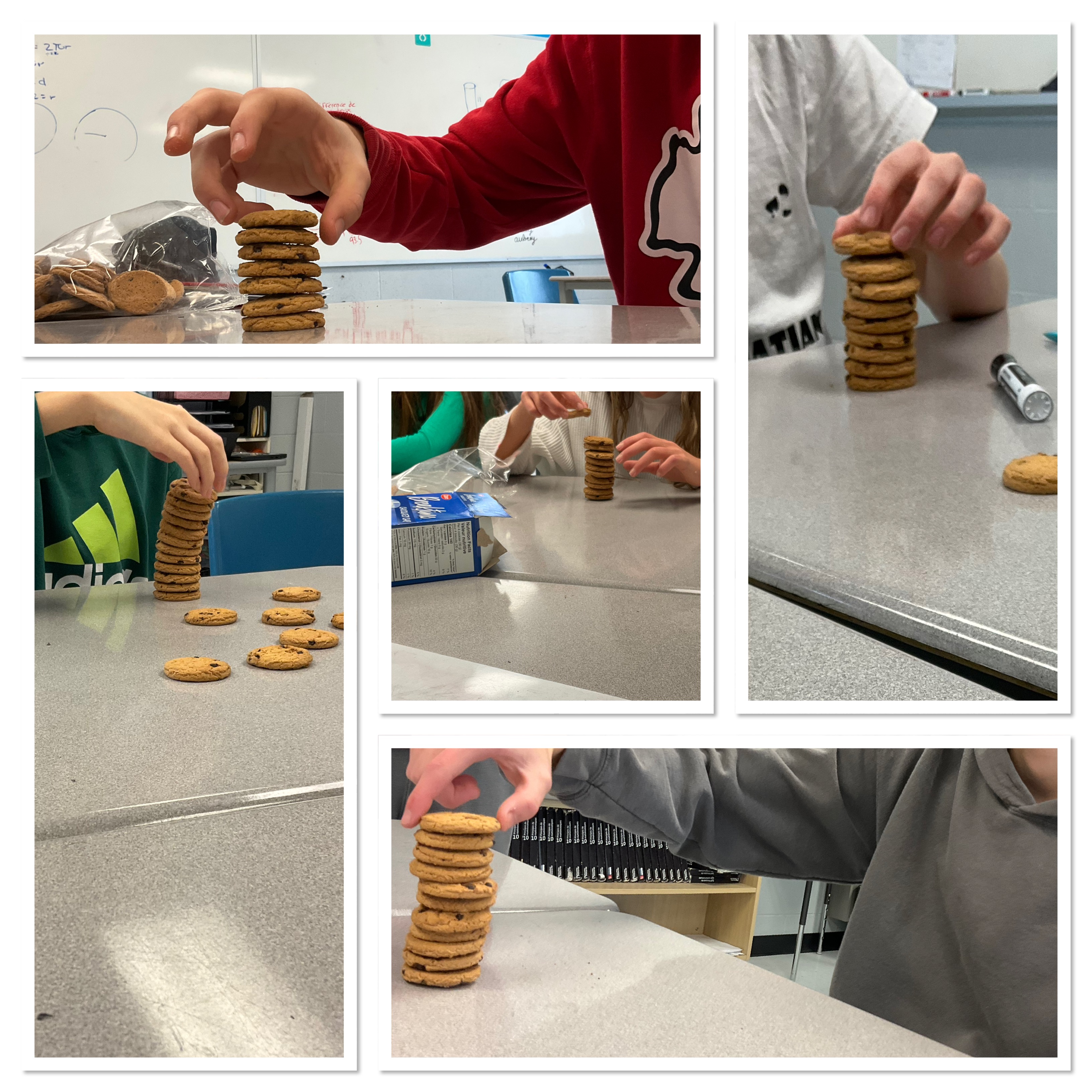
There’s high drama as everyone stacks towers. We keep going until each group has 12 data points. The best stack of the day was 19 cookies. I didn’t get a picture of that one, but here’s a pretty good one.

When we all have our data written down, the next step is to calculate the mean, median, mode and range.

and after that, we took a pause to explain what quartiles are (we cut the halves in half), and then we made box and whisker plots of our cookie tower data.

It’s nice for the class to see that data in a table has all the information, but it’s harder to compare the data between groups by looking at the table. We can make comparisons easier by looking at the box and whisker plots. We’ll come back to this again tomorrow with some practice.
Popcorn Picker
I was invited to run a 3 act task with a colleague’s class this morning. We did popcorn picker. Here’s act 1
Each page was 8.5×11 inches. One was made into a tube by joining the short sides. The other was made into a tube by joining the long sides. The question is: which one holds more popcorn, or are they the same?
Students worked at the boards in random groups of 3. Some struggled to engage in the task at first, but others gave it a solid effort right from the start.

The task involves calculating volume of a cylinder, but before that happens there’s some calculations needed to get the radius of each cylinder. A major misconception that I noticed today was that students thought that the radius was half of the circumference. When I brought over a paper and made a tube and gave a ruler to check, it was easy to see that we needed a different approach. Some made a breakthrough when we got the equation for circumference. Others needed a bit of prompting, but we got there eventually with most groups.
We had a good chat at the end, looking around the room, we saw where we could add some clarification to the work (some needed some arrows and a starting point indicator, some needed equations written, or titles and sub headings).
In the end, we know that if two cylinders have the same lateral surface it does not mean that the volume is the same.
Scientific Notation
Today we had a fun time exploring the universe of really small things, and really big things.
We used this website
we noticed the difference in units, and that when quantities get to be very big or very small that there are a lot of zeros, so as a shortcut we use scientific notation.
we made good connections to our exponent law practice yesterday where we explored what negative exponents mean.
Building Pyramids
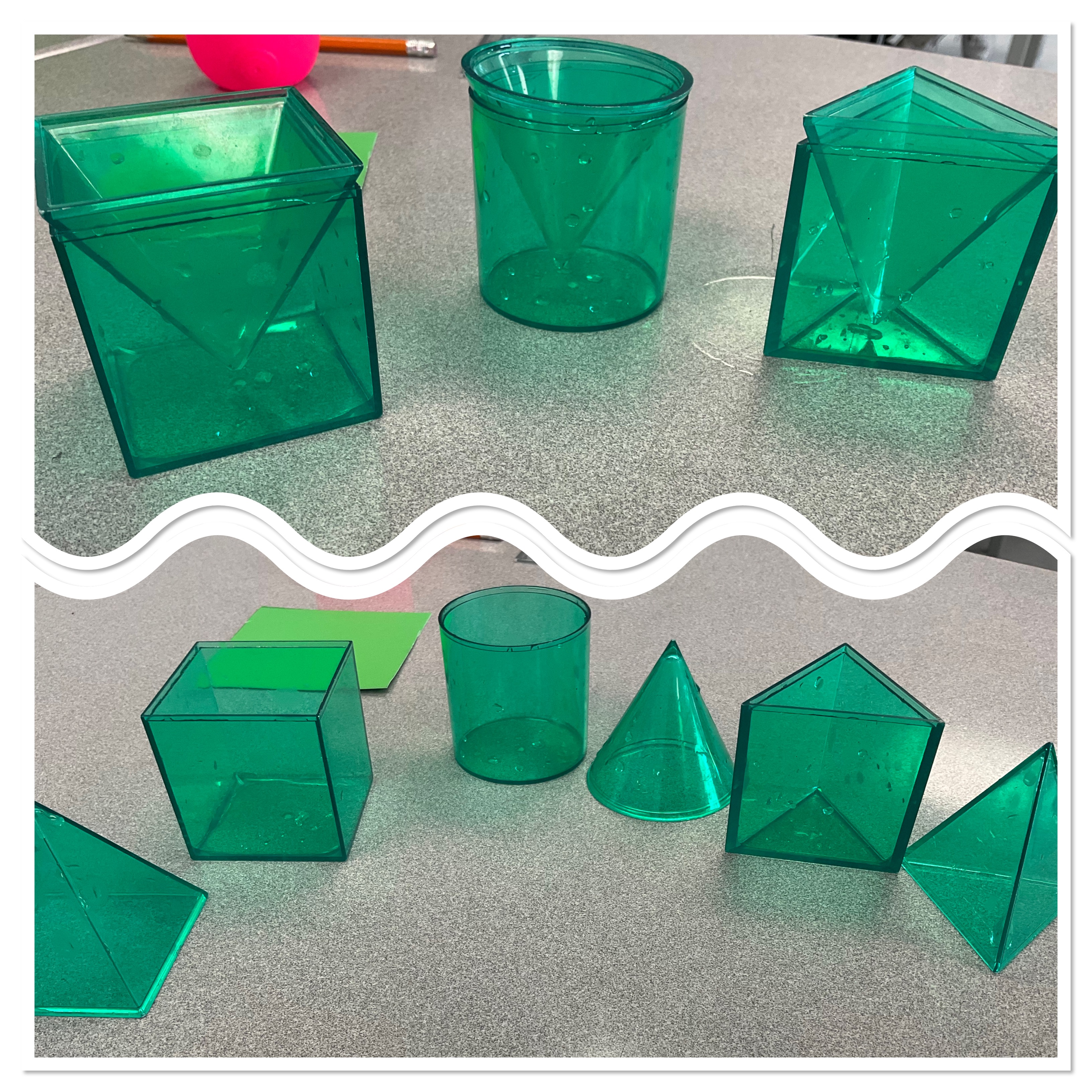
Grade 9s today learned about the volume ratio of pyramids and prisms with the same base and height. We used the 3D solids and poured pyramids full of water one at a time until we filled the prism. Many guessed that the prism is half the volume of the pyramid at first, but after seeing it 3 times realized that the pyramids are always 1/3 the volume of the prism.
Next we had a design challenge. Students were asked to build square bases pyramids with a volume of 300 cubic centimetres.

Groups had file folders, scissors, rulers and tape, and they were able to make some design choices about their dimensions, but in the end the pyramid needed the correct volume.
I did this task not that long ago with my grade 10 applied class, and noticed that my grade 9s were much more confident with starting the task. They drew a plan, and divided the task up, and worked together to build.
When faced with the fact that many were not tall enough (because usually students do not realize that the slant height and pyramid height are not the same), this class was very resilient and regrouped and made a new plan.

When some group members were frustrated, others encouraged them to keep going. Other groups knew thar I was trying to shake their confidence (because I’ve told them that sometimes teachers inject some doubt into situations to check to see how certain students are with their answers.) so they didn’t want me to shake their confidence and kept spirits high throughout the process.
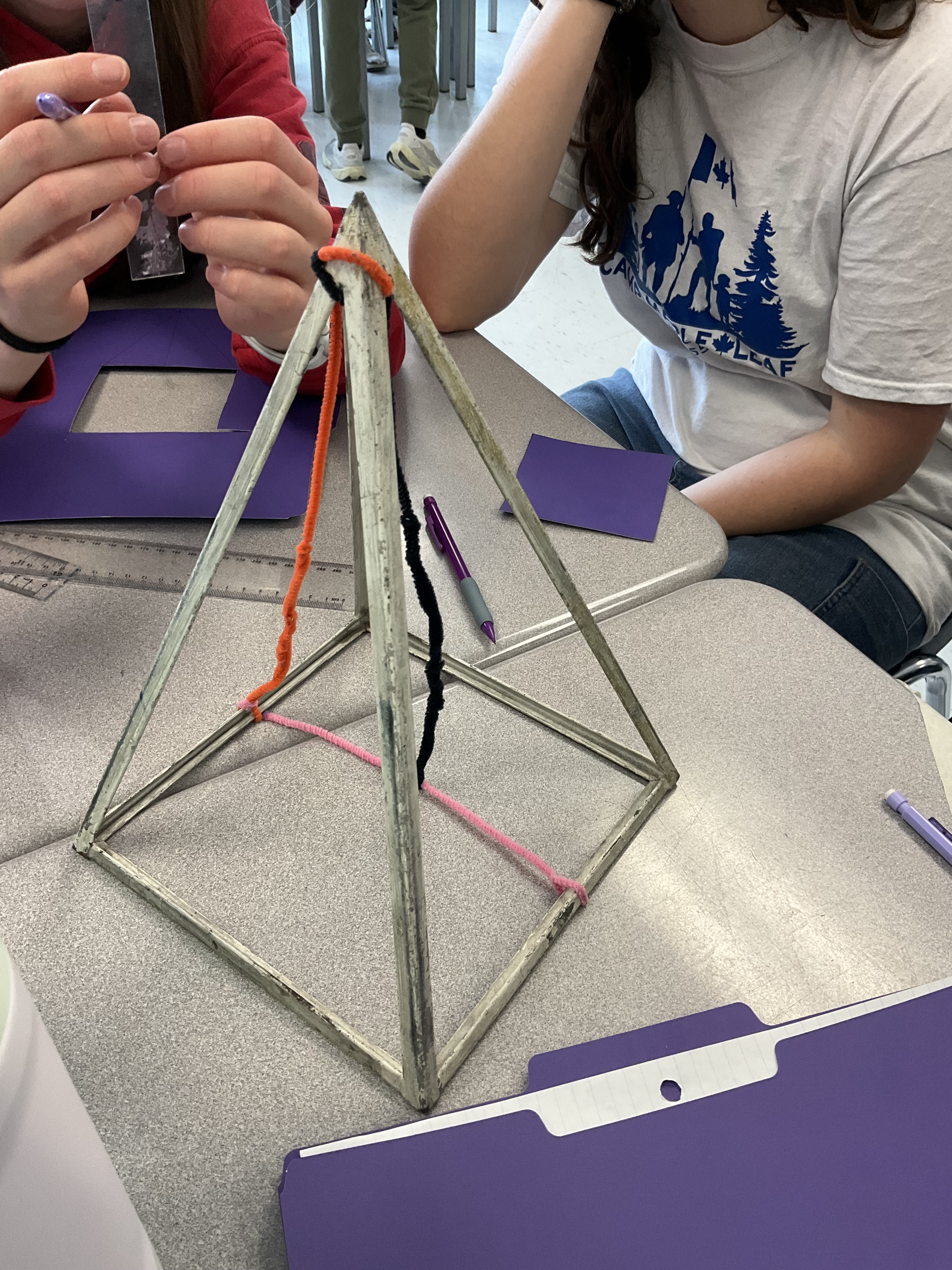
My model helped to illustrate how the slant height (orange pipe cleaner) and the pyramid height (black pipe cleaner) are not the same, but are related though the pythagorean theorem.
One group had such a novel approach to solve the problem that avoided using the pythagorean theorem altogether. They created a skeleton for their pyramid. They knew the height needed to be 9 and their base was 10, so they made 2 triangles like that, and slit one from top to middle, and one from bottom to middle along the vertical axis, and slid them together.

They then measured the slant height that they needed, and built triangles to cover the pyramid. It was the first time I’d seen that approach, and it worked really well.
We debriefed at the end of class about how to calculate the height or the slant height using the pythagorean theorem, and hopefully we’ll remember over the weekend. I enjoy creating memorable moment through activities like this that help students connect to the math in a (hopefully) meaningful way.
How Tall is the Atrium?
Welcome to our atrium.
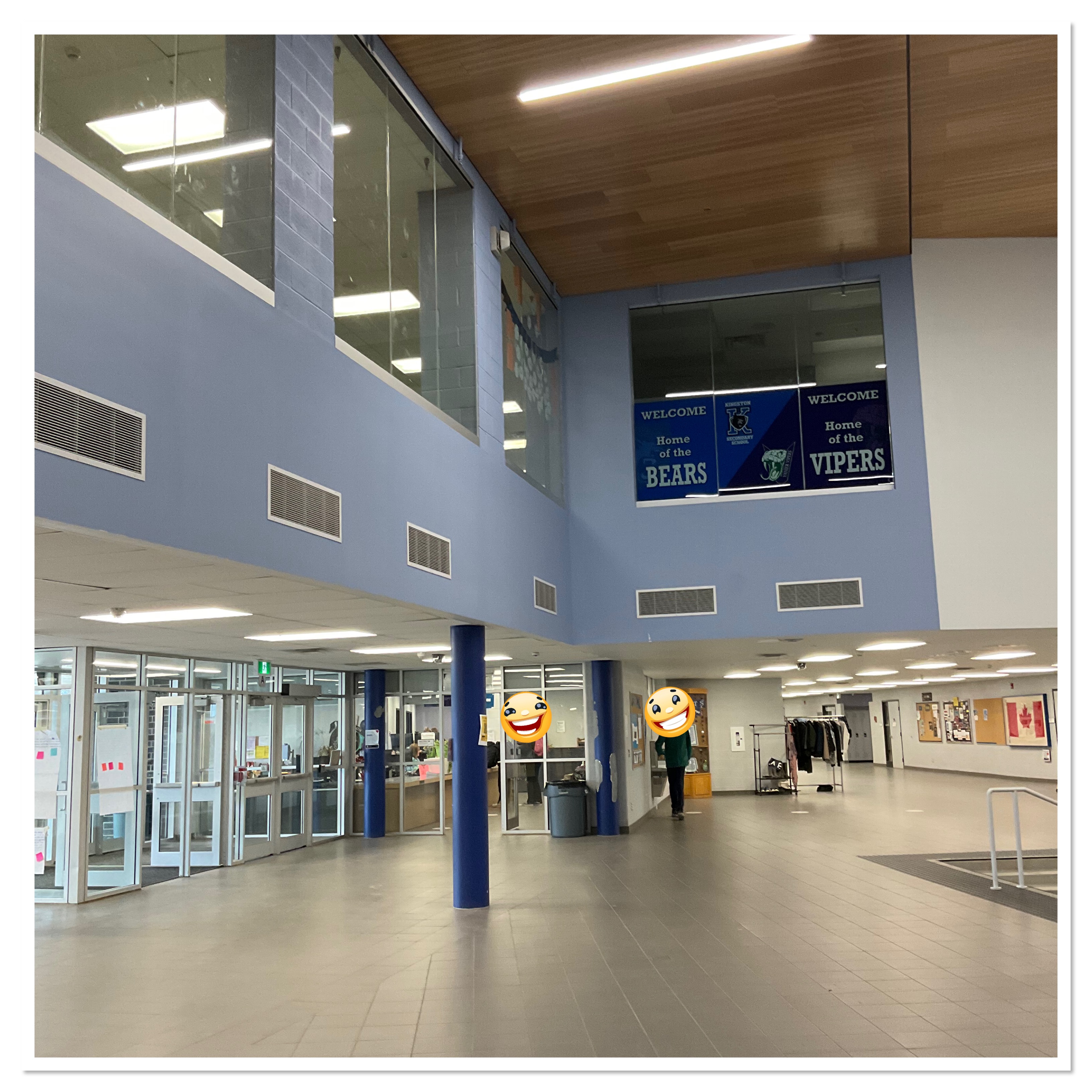
Today the challenge for my colleague’s grade 12 college math class is to determine how tall the ceiling is in the blue section of the atrium.
We started off estimating and justifying our estimates. Guesses ranged from 20-50 feet. Ideas were justified by imagining a 7 foot basement stacked up on itself, or by estimating the height of the classroom using the door frame height or a person’s height, then doubling it since the atrium covers 2 storeys of the school. Interestingly enough the students preferred to estimate in feet, but defaulted to measuring in metric to do our data collection.
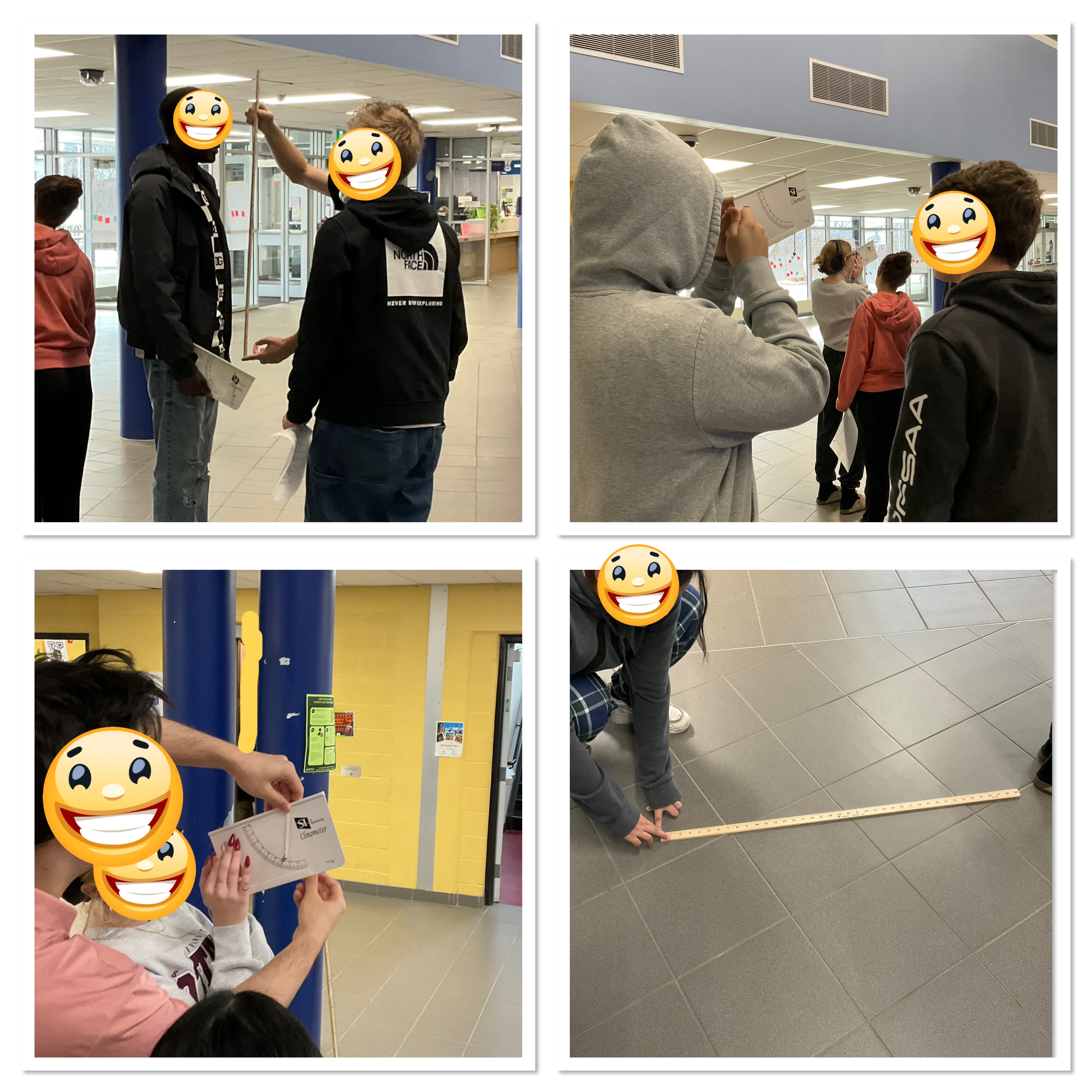
To collect data we stood at the back of the atrium, just at where the overhang ended. We marked our position, then measured with the clinometer. We walked forward by a measured distance, then repeated the process. These 3 measurements, along with the height of the clinometer operator’s eyes were enough to allow the calculation of the atrium height.
The calculations include some supplementary angle calculations, and sine law and sine. We got part way through the calculations and there are some pinky swears given that the calculations will be finished for tomorrow. We’ll see. I’m quite curious to see what the height is, and how that compares to the school height that my grade 10s calculated.

Popcorn!
This question was inspired by the popcorn picker 3 act task. I showed act 1 yesterday and asked the class to think about which holds the most popcorn, an 8.5”x11” paper made into a tube in portrait orientation (we called this hotdog) or in landscape orientation (we called this hamburger).
The students asked if we’d have popcorn the next day…so I agreed.
Today my popcorn popper was in full gear as the students worked through the task.
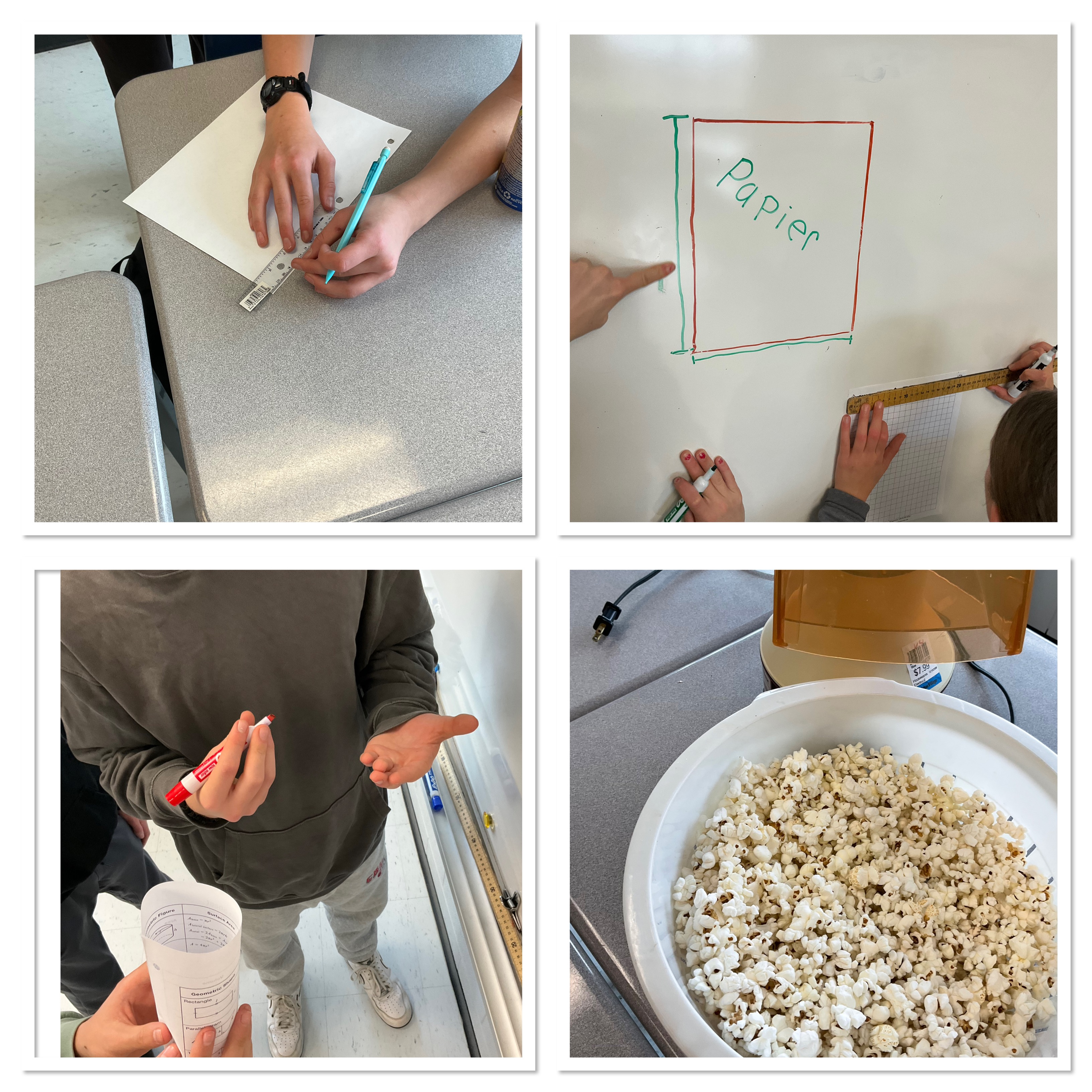
Some decided to work in cm and others in inches. It was great to see students flock to the formula sheets and use their skills with algebra and equation solving to isolate and solve for different variables. They knew how to calculate the radius when given the circumference.

They knew to calculate the volume, and did a great job communicating their work and checking it over.
To begin with we had people in 3 distinct camps: the tubes will hold the same amount, the tall one will hold more, the short one will hold more.
In the end, we all agreed that the short tube would hold more based on the math. It was time to test it out.

We added popcorn to the tubes. Then dumped them out and counted. There were 50 more pieces in the shorter tube.
The reason this works is that the radius is really important. The radius is squared. Squaring a bigger number makes it grow a lot, so this has a big impact on the volume. Height in the volume calculation is not squared, so an increase in height does not cause as big of an increase in volume.
Building Pyramids A Lesson in Productive Struggle
Today we tackled a challenge. This challenge had some constraints, but was open enough to allow each group to do something different if they chose to. The task is to build a square based pyramid with a volume of 300 cubic centimetres. This followed up on us building rectangular prisms with a volume of 300 cubic centimetres.

It took some reminders with water and our solid forms to get that a pyramid with a volume of 300 cubic centimetres has the same length width and height as a prism that has a volume of 900 cubic centimetres.
Many groups chose dimensions of 10 by 10 and a height of 9.
Making the square base was the easy part. There was some trial and error when it came time for the triangles (and this is where the productive struggles began). Some groups made triangles with sides of 10, 9 and 9. That made a pyramid that was too short. Some made triangles with a base of 10 and a height of 9, which when inclined to form a pyramid left the height too short.

Some groups decided the triangles needed to be taller than 10 so that when inclined the pyramid height would be 9. They guessed and checked and ended up pretty close to accurate. Other groups used the pythagorean theorem to calculate the height that they needed for the triangles.
Another group decided to just make their own pyramid and to not care about the constraints! I guess we all choose an entry point to the task.
Next time I might give different entry points, and provide different extensions.
mild version: Make a pyramid, calculate the volume and surface area.
medium version: make a pyramid with a specific volume, calculate the surface area if there’s time (there will be iterations needed to get the volume correct).
spicy version (for those who need more extensions): make a pyramid with a specific volume, calculate the surface area and the angle of elevation of the pyramid walls.
How Tall Is The School?
We had an interesting time estimating how tall the school is. Guesses ranged from 100m to 20 times the height of a student (which would be 120ft), to 40-60 ft, and we decided 15 ft would be too small. We were working on narrowing in on what would be reasonable before we went outside to do the measurements and calculations.
We had groups of 3: a measurer, a recorder, and a clinometer operator. Each person had responsibility for bringing a piece of equipment downstairs and back up. Clinometer, meter stick, paper and pencil.
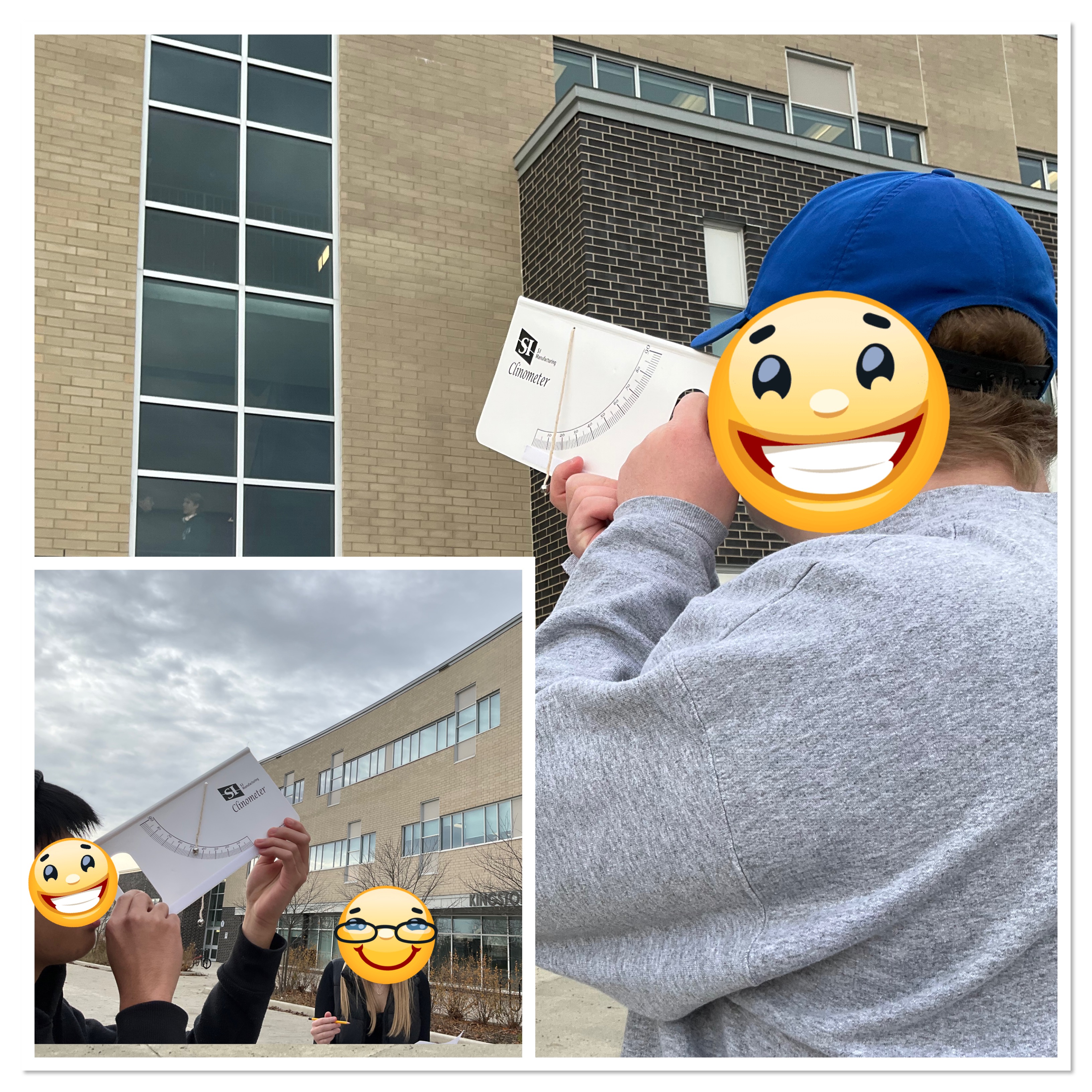
Groups looked through the tube on the clinometer to see the roof of the school. We measured where the string fell which tells us the number of degrees in the angle of elevation.

We measured to the height of our clinometer operator’s eyes, and we measured the distance to the school.
From there we had enough to calculate the height of the school. We went back inside and worked away at our trigonometry. With practice we’re getting better. Hopefully with this context we can make some connections to what the calculations mean and when they could be useful.
Math Workshop
A colleague and I were invited to present a workshop after school all about fostering confident math learners. The audience was a group of elementary educators from our feeder schools.
We introduced our “graph our math life” task which we often do with our students. We thought back to how we felt as math learners and teachers over time. There is a big connection between feeling good about ourselves as math learners and how we will be able to progress through the productive struggles along the way. This task is based off of the work of Liesl McConchie.

We can use this as a springboard for conversations about what the stories we hear about math at home. Some of us grew up with positive experiences and messaging around math and challenge, and others have hit roadblocks where we didn’t have such positive feelings or messages. We know that students are hearing lots of messages at home or in pop culture. We want to be able to refute some of the negative messages they hear, and help them replace some negative self talk with more constructive messaging. Instead of I can’t do math, or math is hard, or I’m not a math person, they can say “math is tough but so am I” or “i can do hard things” or “i’m working on my math skills” or “i’m learning and asking for help”.
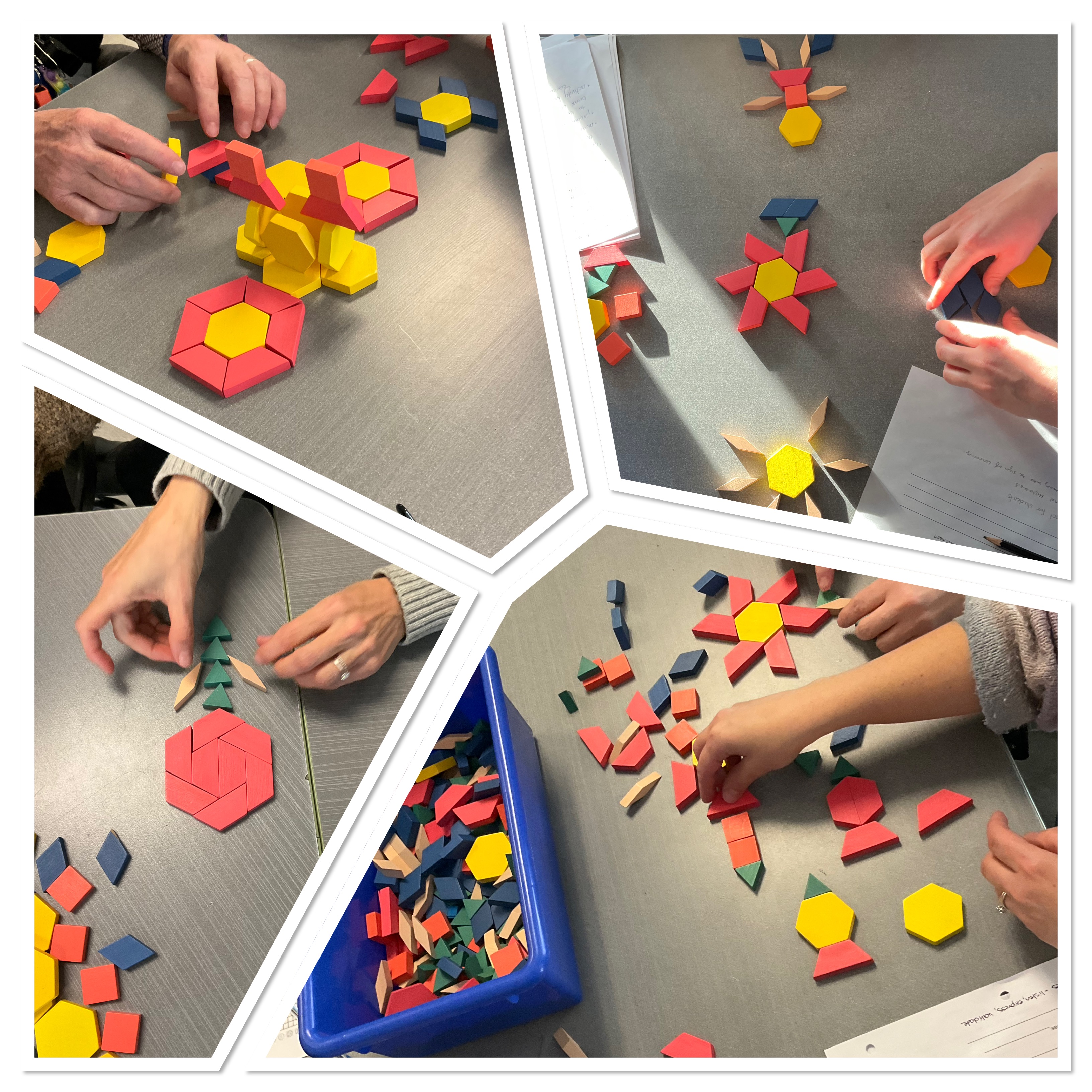
Our next task was to make some art with the patterning blocks. We looked at all the math we could see: rotational symmetry, lines of symmetry, fractions and percent of blocks that are of a certain colour, parallel lines, angles that are complementary, angles inside a polygon, perimeter, area…so many ideas. We also used the first letter of each colour and made an algebraic expression for each picture e.g. 1y+6r+1g+1b=flower
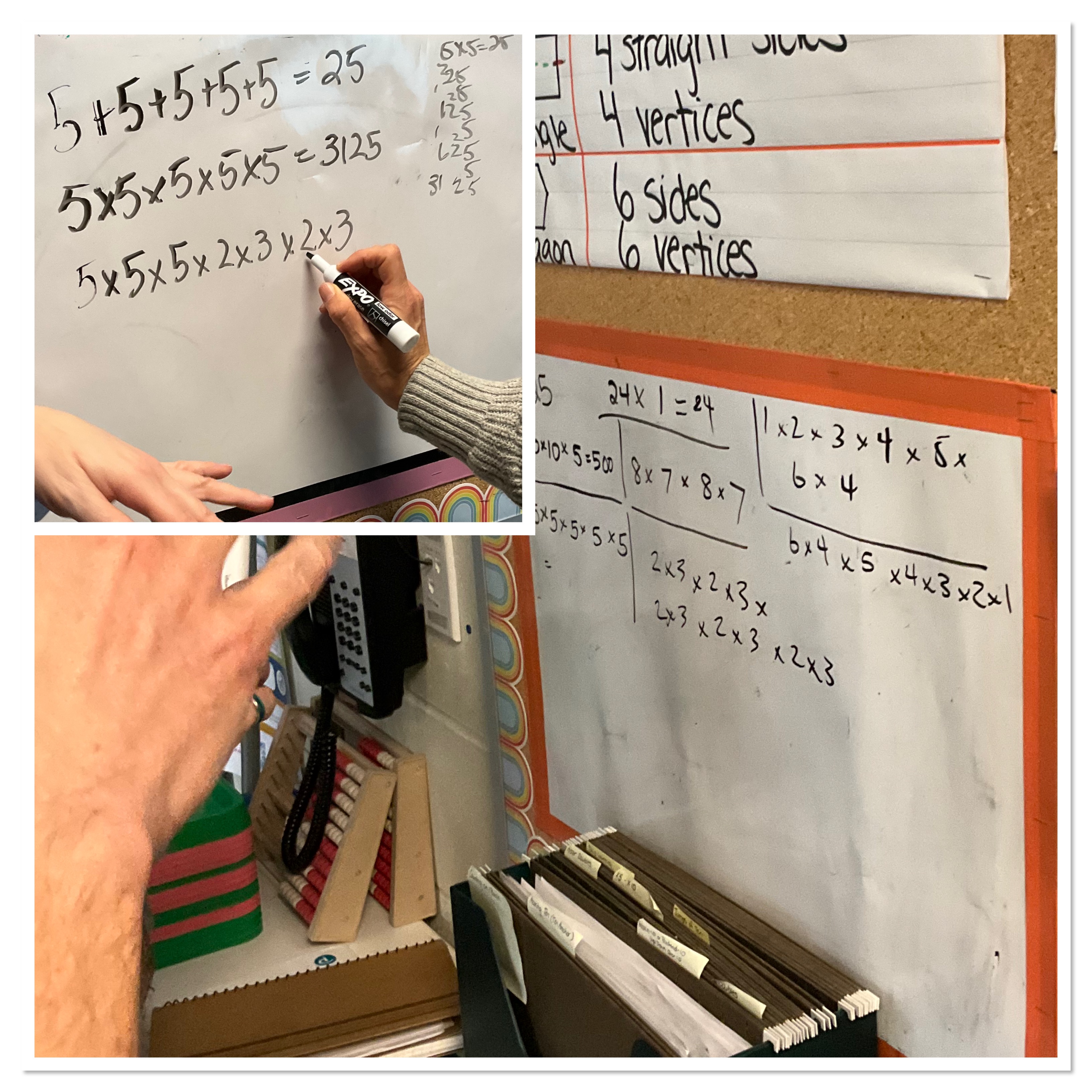
Next we did a thinking classroom style problem at the walls. The prompts were to break up 25 into pieces. All the pieces will add to 25. Next change the addition to multiplication and look for the biggest product.

It was neat to see how teachers of various grades tackled the question in different ways. Different groups imposed different frameworks and constraints. We haven’t yet got to the largest product, but some are still working away at it.
It was a great opportunity to share some of what we are doing at KSS with educators in our feeder schools. We are glad of the invitation and hope to go again in the spring and share some more tasks.
 Ms. Bearse's Site