Introduction to Fractions
in grade 9 we started working on some fraction fluency tasks. Today we got out the big bin of fraction strips and explored the connections we saw.
We noticed that the denominator showed how many equal sized parts that the 1 is split up into. We also noticed that when there are more parts each part is smaller.
Then we looked at how to make some equivalent fractions. We noticed for all of the things equal to 1/2 they had even number denominators. For all of the ways to make 1/3 the denominators were all multiples of 3 etc.

Then we started to get creative. We can see here that 1/2 can be written as 1/6+1/6+1/6 or 3/6. But it could also be written as 1/3 since 1/6+1/6=2/6 which is equivalent to 1/3. So we know 1/3+1/6 is another way to write 1/2.

Next we looked at this statement. 1/4=1/12+1/6. To make sense of this students saw that the 1/6 is also equal to 1/12+1/12 so we could write 1/4 as 1/12+1/12+1/12 which is 3/12. If we divide both the numerator and denominator by 3 we get 1/4. We know that if we split 1/4 up into 3 parts each one will be 1/12.
This could be written as 1/4=1/12+2/12. We saw that this could also be a subtraction. 1/4-1/6=1/12 as well.

We showed that we could start with the question written in fractions, model it, build it in the same sized pieces and then get the answer. 3/4+1/8 was the question. We built it as written. Students then saw that we needed to make each 1/4 into 2/8. Then we can count the number of 8ths.

next we tried adding 1/4+1/2+1/3+1/12. We decided that it made sense to write it as 12ths.
3/12+6/12+4/12+1/12=14/12 which is more than 1. We wrote it as 12/12+2/12 which is 1 and 2/12 which can be 1 and 1/6, which is exactly what we got with our blocks.

We are going to keep working on fractions for the next little while, building up skills and getting more confident with the concept and the different representations and manipulatives.
The Most Special Triangles
I had the opportunity to teach a lesson in a colleague’s MCR3U class, a course that I have never taught yet, so it was fun to explore a sequence of steps to learn about special triangles.
Here’s my sequence of prompts.


We noticed that all of the hypotenuse calculations resulted in the side length multiplied by root 2. We noticed that the sine cos and tan of 45 all simplified to be the same, regardless of the side length of the initial square.
We worked through a similar task to develop our next special triangles.

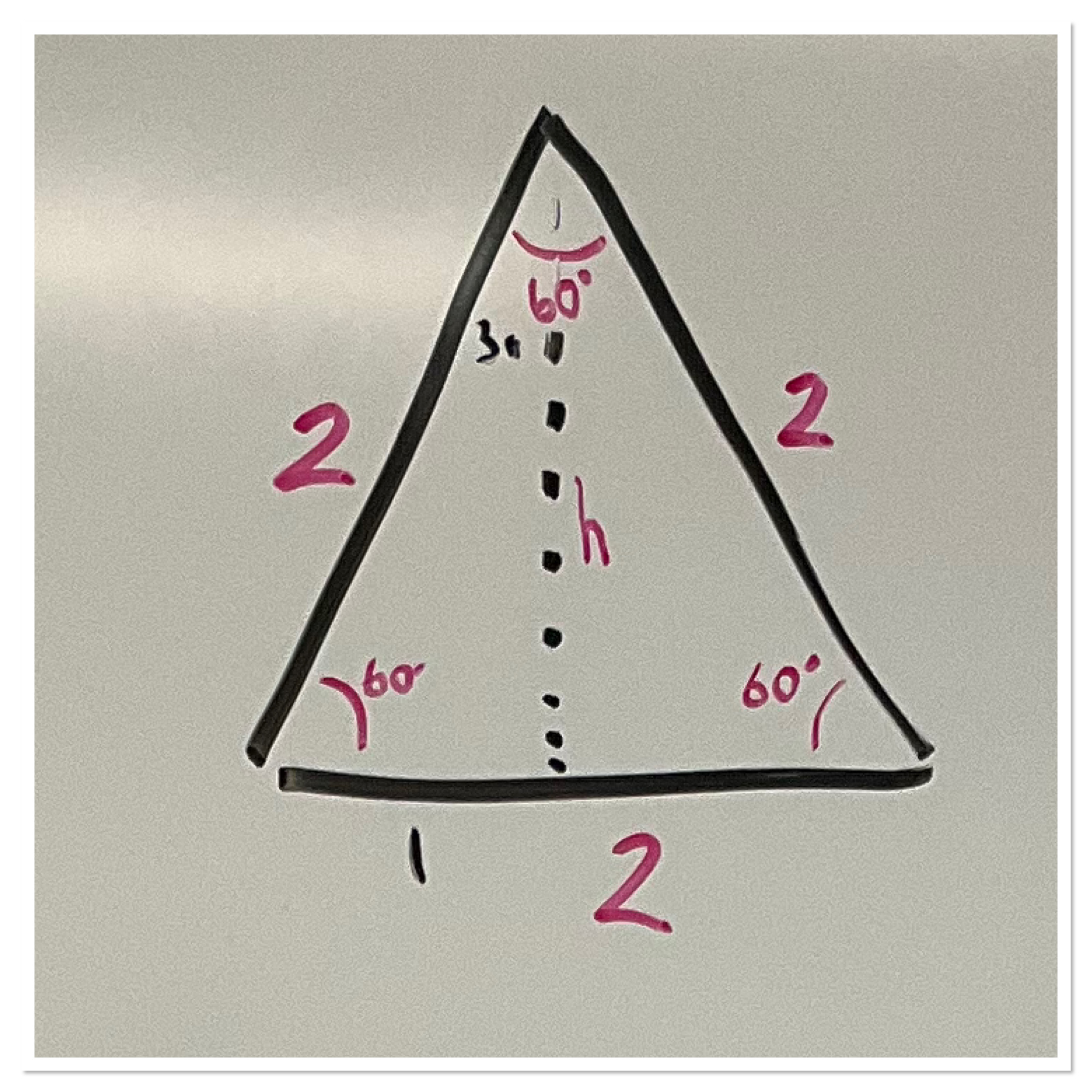
We calculated that the height is root 3. And we see that sin30 and cos60 are the same, and sin60 and cos30 are the same because when the reference angle changes the opposite and adjacent sides now refer to different sides. The adjacent to the 30 degree angle is root 3, and that is the opposite to the 60 degree angle.

Next step was to do a task. This challenge came from Peter Liljedahl’s old website of good problems for teachers.

Students worked hard to represent their thinking. We had some physical representation, some calculations of angles and sides, and some use of the new special triangle learning.

It was neat to see which direction various groups took, and whether we all arrived to the same place in the end.
Math test today
Grade 9s had a test today. We decided to make it fun and students could choose where they sat. We have a small class so I let them have free rein. It was a little chaotic. Some chose to sit so they faced the window and could look out. Some faced the whiteboard so they wouldn’t be distracted. One embraced and encouraged chaos and sat right behind the door, which would have been problematic had anyone needed to come in.
We also used Howie Hua’s test talk routine, where the first 5 minutes of the test is time to talk…pencils down, students read the test over and can talk with friends (without writing) to go over anything they’re confused about. This helps calm everyone’s nerves about the test, and encourages students to read things over and strategize about which questions to answer first.
Our tests have some questions that everyone answers, and some where there’s a choice of “mild” “medium” or “spicy” questions to do. The questions have more complexity, more steps, more thinking to do. Answering mild questions is the bare minimum, and earns a level 1, medium done well can earn level 3, spicy done well can earn level 4+.
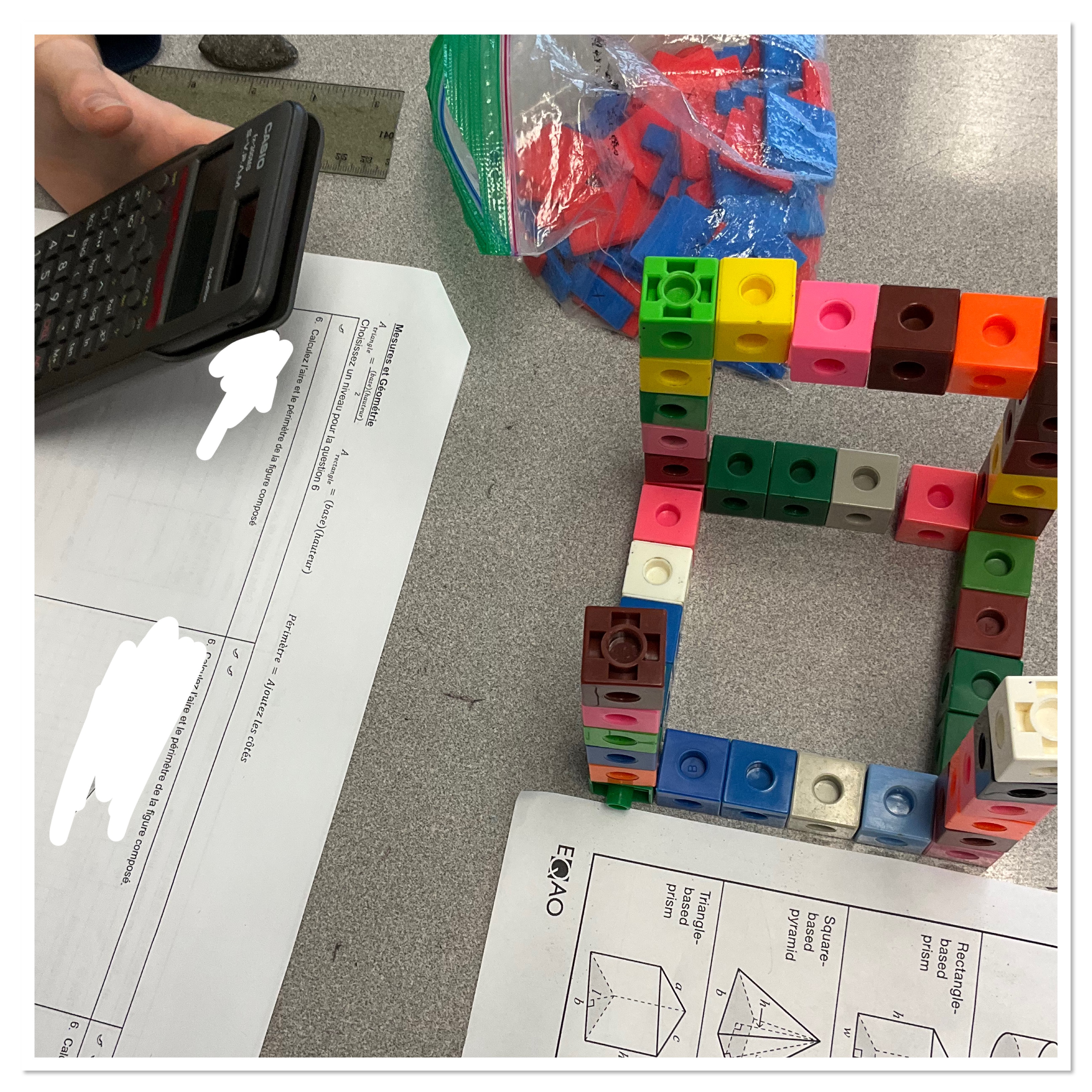
We make sure everyone has what they need, the same manipulatives as we use in class are available for the test. This test some students used algebra tiles, and linking cubes to help model the algebra and measurement questions. There’s also a little “roche dans la poche” (a smooth stone) that’s kind of like a worry rock that students have to help keep us grounded and focused.
3 act task: mowing the lawn
We worked on composite area and pythagorean theorem today in grade 9. There’s a good 3 act task called mowing the lawn. It starts with a lawnmowing video to pique the interest, and get questions flowing.
Next, another video, with a timer, and also dimensions given for the mower and for the lawn
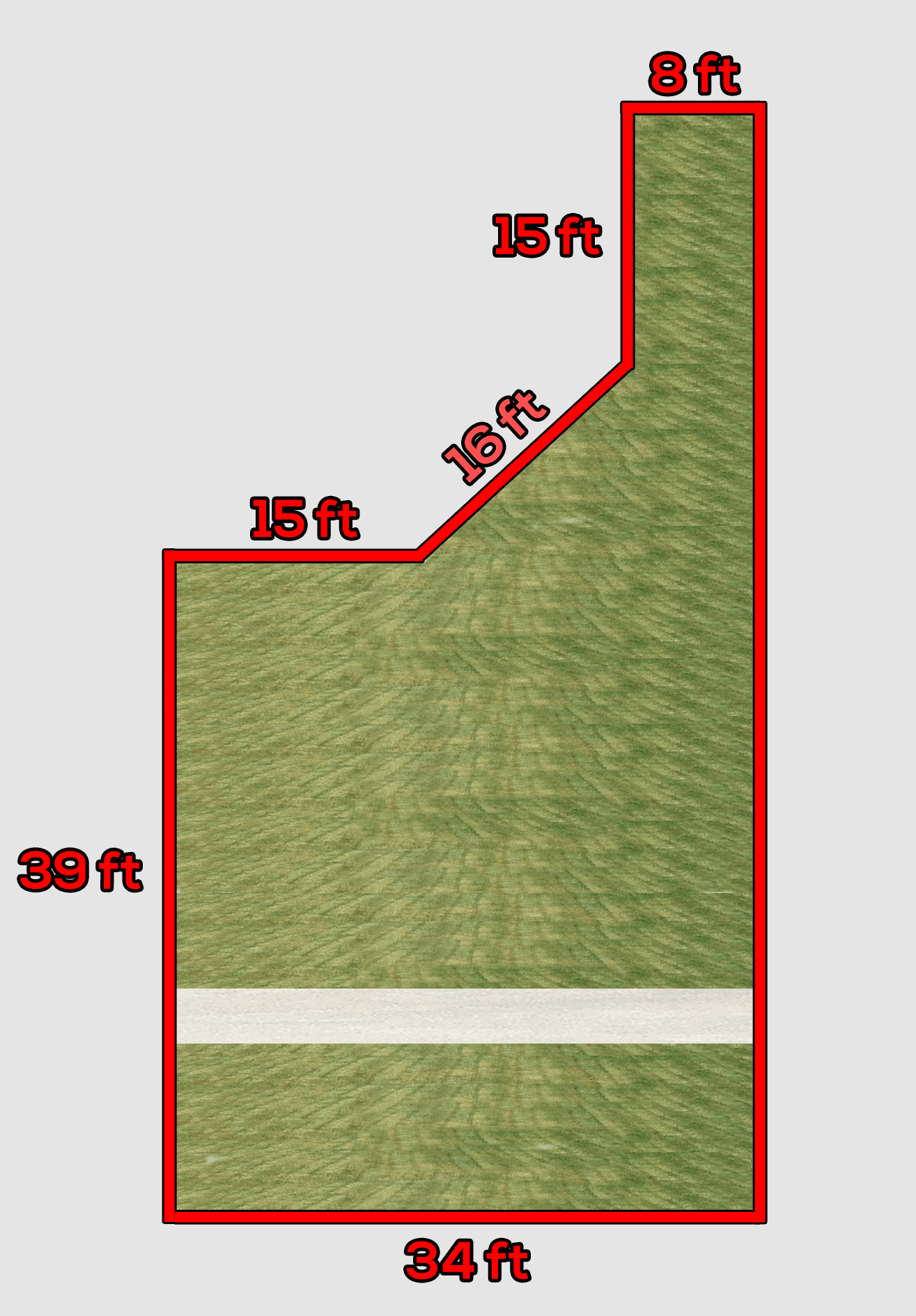
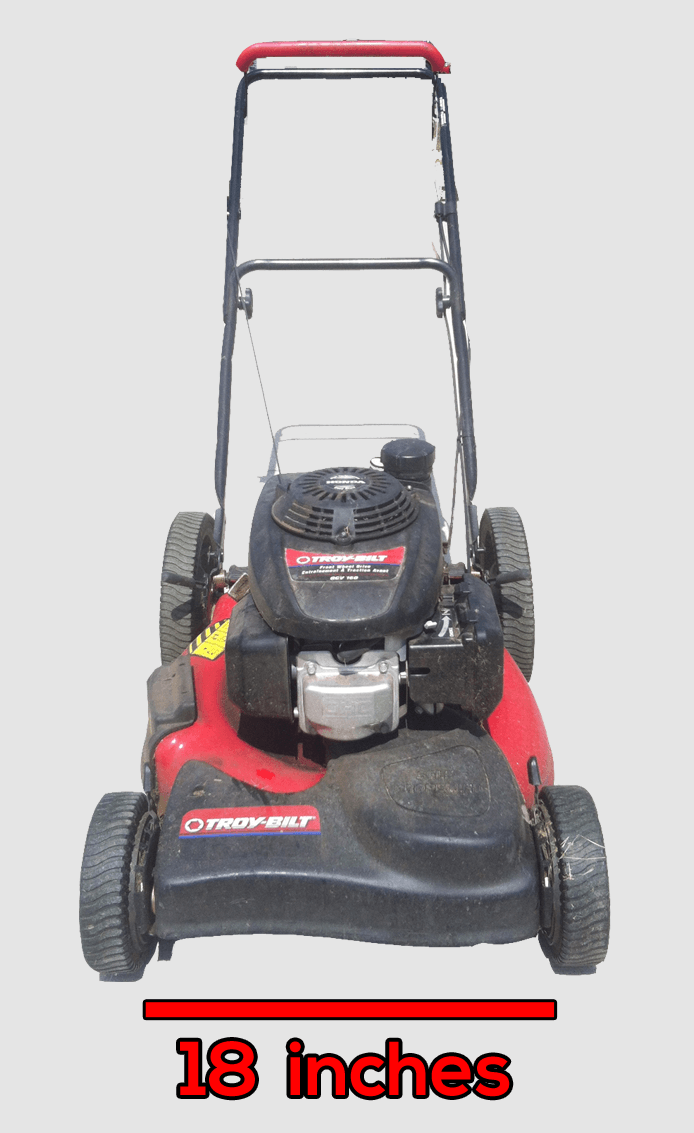
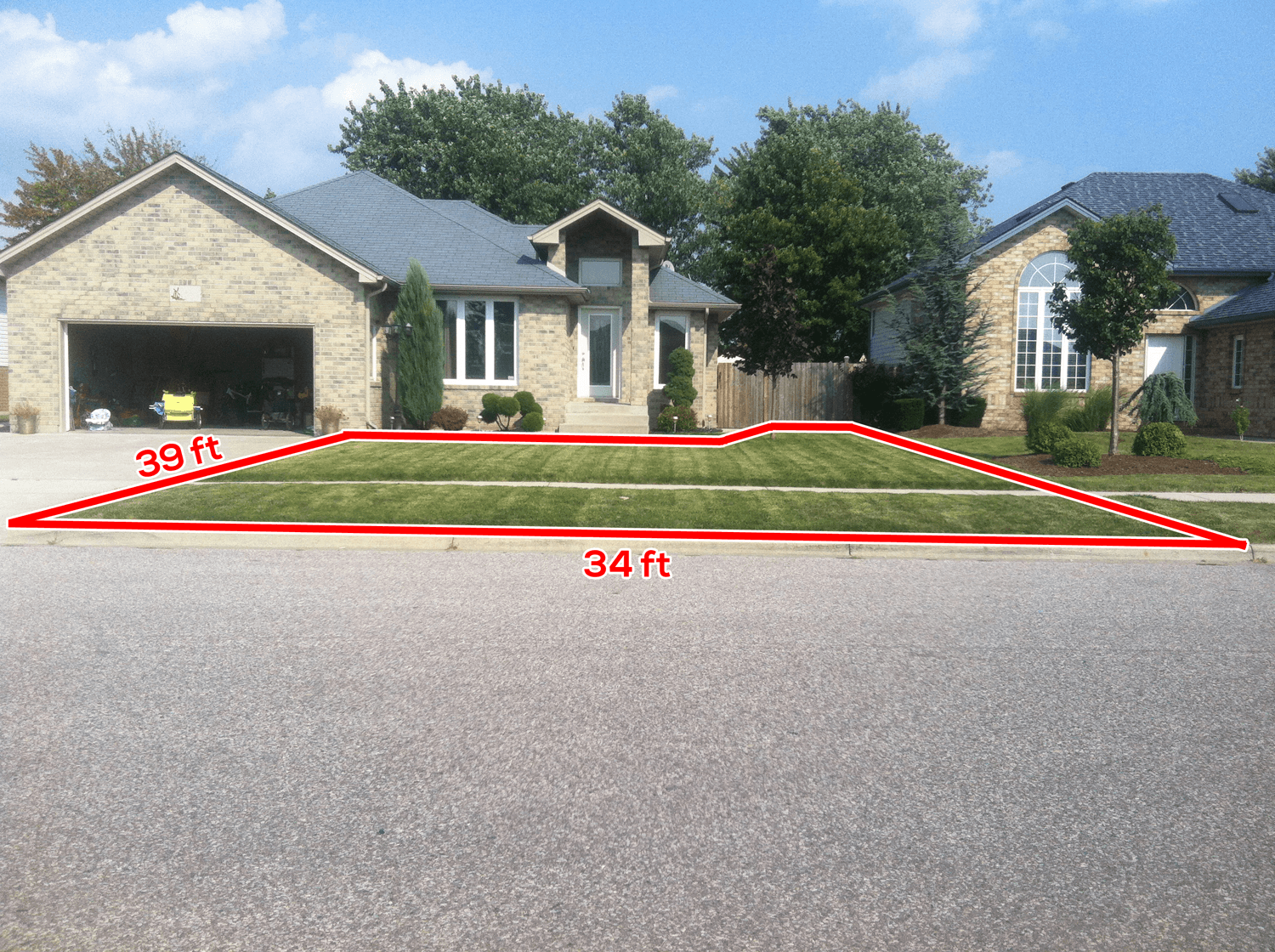
I usually wait until they ask how wide the mower is. Often we get so bogged down with area calculations that we forget the mower has a width too!
We then worked really hard for quite a while to calculate the area of the lawn and how long it would take to cut.
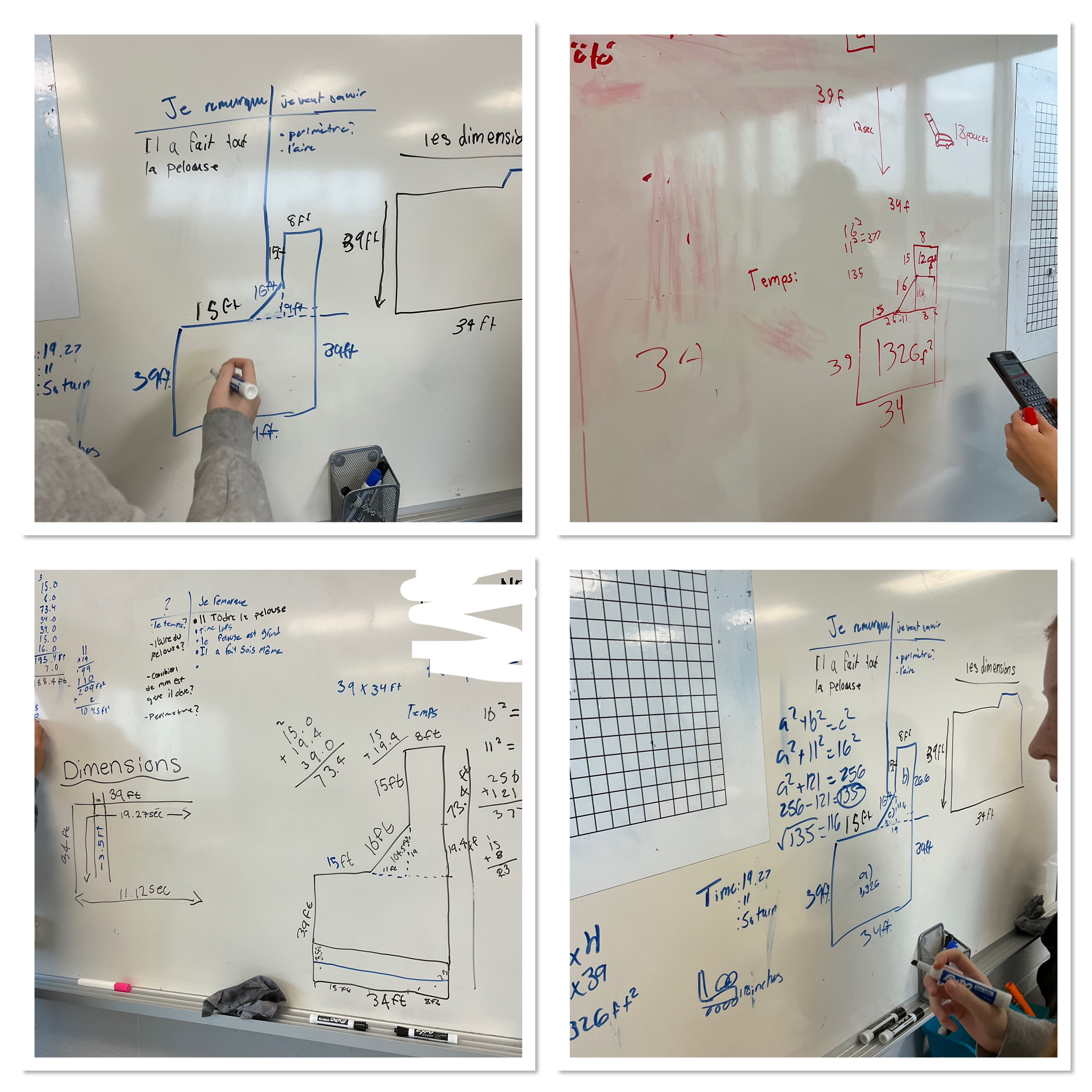
Some common errors I’ve noticed were in applying pythagorean theorem to calculate a triangle leg vs hypotenuse. Also some students struggled with 18 inches being 1 foot 6 inches which is 1.5 feet (not 1.6 feet). Others struggled with how to use unit rates that would be helpful like how many seconds it takes to cut one square foot of lawn. That can then be scaled up to figure out the time to cut the entire area of the lawn. There were good conversations about how many pieces to break the yard up into, and if it mattered if he mowed in a spiral pattern or back and forth in rows.
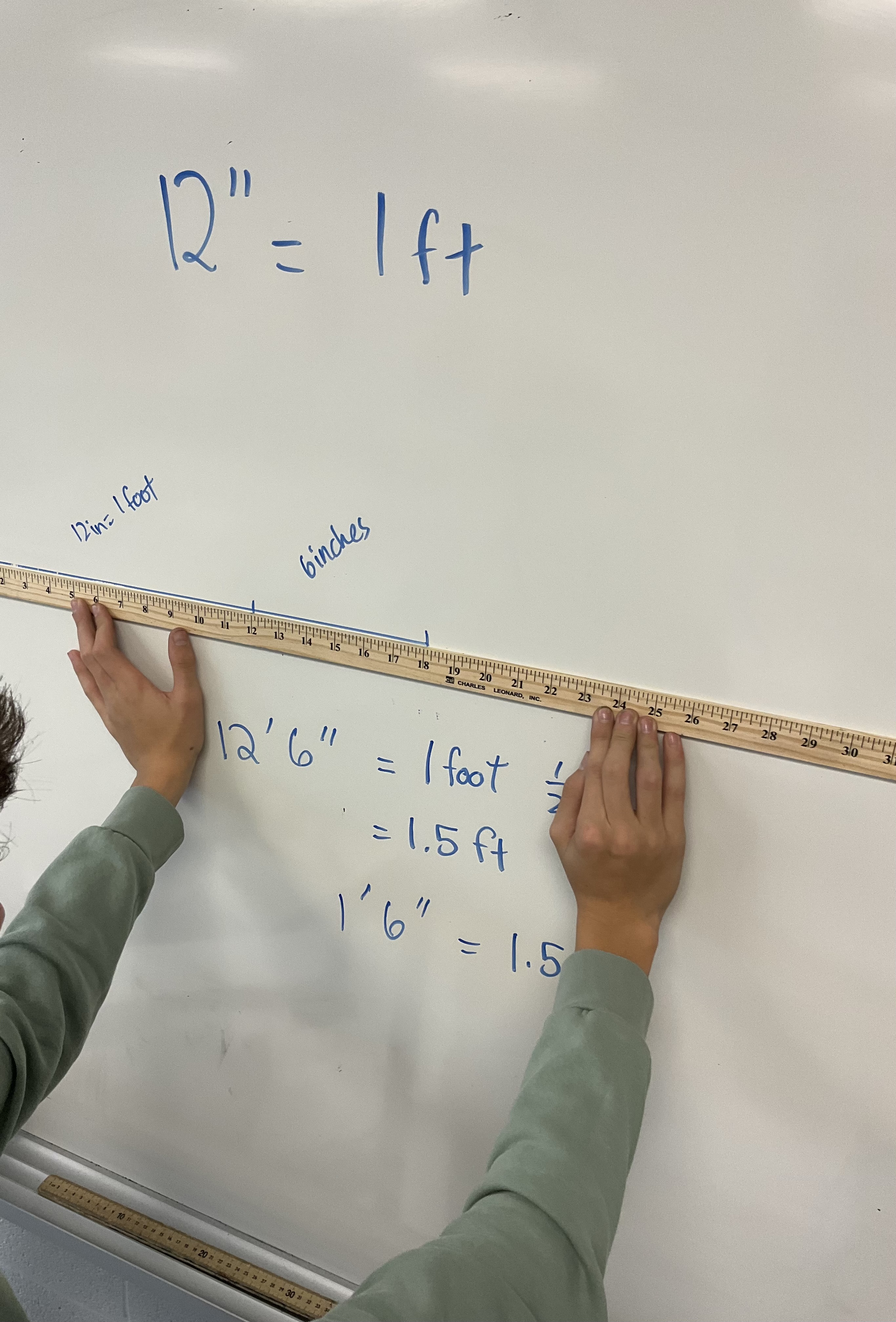
I’m thankful that our meter sticks are also yard sticks, so we can work in inches and feet when we need to.
In the end we watched the whole video to see the answer. Watch for motion sickness!
We did a lot of calculating and reasoning today. We need to work on our communicating…that will be our next step.
Area of Regular Polygons
Today in MFM2P we looked at area calculations, to review and activate prior knowledge and then apply it to some new challenges.
Groups started with a sheet that led them through some calculations. They worked collaboratively in pairs or groups of 3 to go through these early questions. It’s interesting to me what ideas stick (area=basexheight seemed to be in their memory, but they had forgotten the word parallelogram)

We talked about how you could find the area of the triangle pieces and the rectangle piece and add them up, but ALSO how you could slide the triangle piece over and create a rectangle. The formula for area is still base times height, but we have to remember that height is perpendicular to base always.
Next in the sequence was to look at a right angle triangle and relate that formula to what we know about rectangles. This is half a rectangle, so the area should be (1/2)(base)(height).
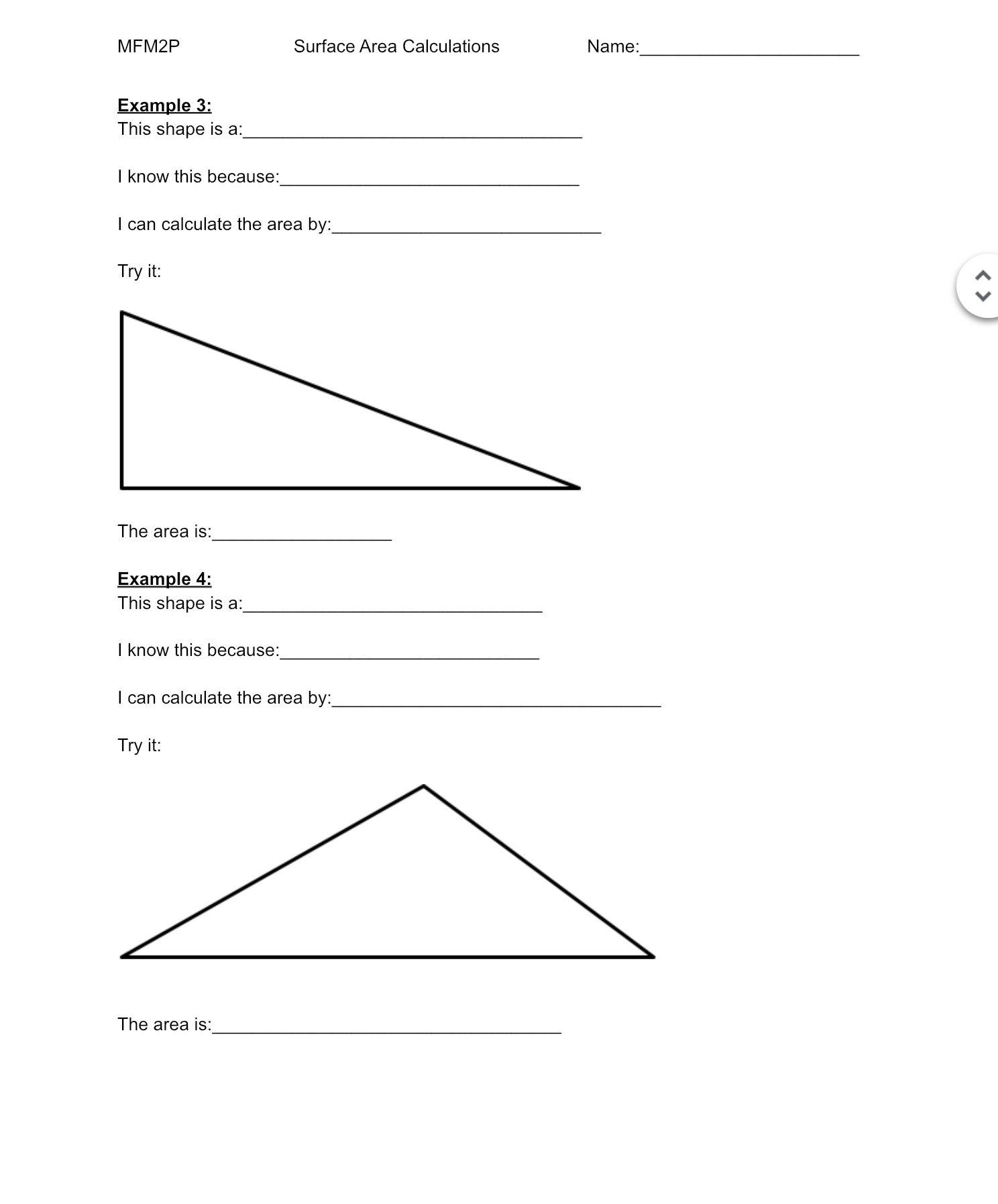
The bottom triangle has the same formula for the same reasons. We can draw a rectangle around the triangle. Looking at each side, half of the rectangle is in the triangle, and half is not.

Next we branched out to regular polygons. This was a bit of a leap, it is so visually different that some students had a moment of giving up. It’s neat to see how we can make a visually different figure appear to be a parallelogram by using scissors!

We drew lines from the corners to the middle, then cut out along those lines. We could fit them together upright and inverted to build a parallelogram. If we cut one of the triangles in half and slide it over we would have a rectangle. The base would be half of the perimeter of the shape. For this dodecagon we can see that there are 6 of the “edge segments” that make up the top and bottom sides of the parallelogram. The height of the shape is the same as the height of one of the triangles. This distance is called the apothem (not an important word, but it’s like the radius of the non-circular shape).

We can make any regular polygon into a rectangle to calculate its area. We can explore how this helps us understand circle areas, but we’re not there yet. This also sets the stage to calculate volume of any regular polygon based prims (and later pyramids).
M&Ms task
Today my grade 9 class tackled the M&Ms task.

Students counted, dumped, removed all the “M” side up candies, then counted, dumped and repeated the process. They added to a data table as they went, and noted that there was a big drop at first, and less and less of a drop as it went on. Some saw the connection to the drop being about half each time, which was neat to see. Again, we noticed that 8-12 candies had no M printed at all, so we never ended up eliminating all of them.

Groups created graphs and saw that the pattern was not linear, but looked like a decreasing curve. They made curves of best fit to model the data.
We talked about how to make an equation to generalize what we saw happening. We know that to find half of a number we can divide by 2 or multiply by 1/2. If we find half of THAT number then we’d have to multiply by 1/2 again. We showed that in our table of values for an example case of starting with 160 candies.

We could use our exponent knowledge to help us build the equation. This type of modelling will be important when we look at compound interest later on.
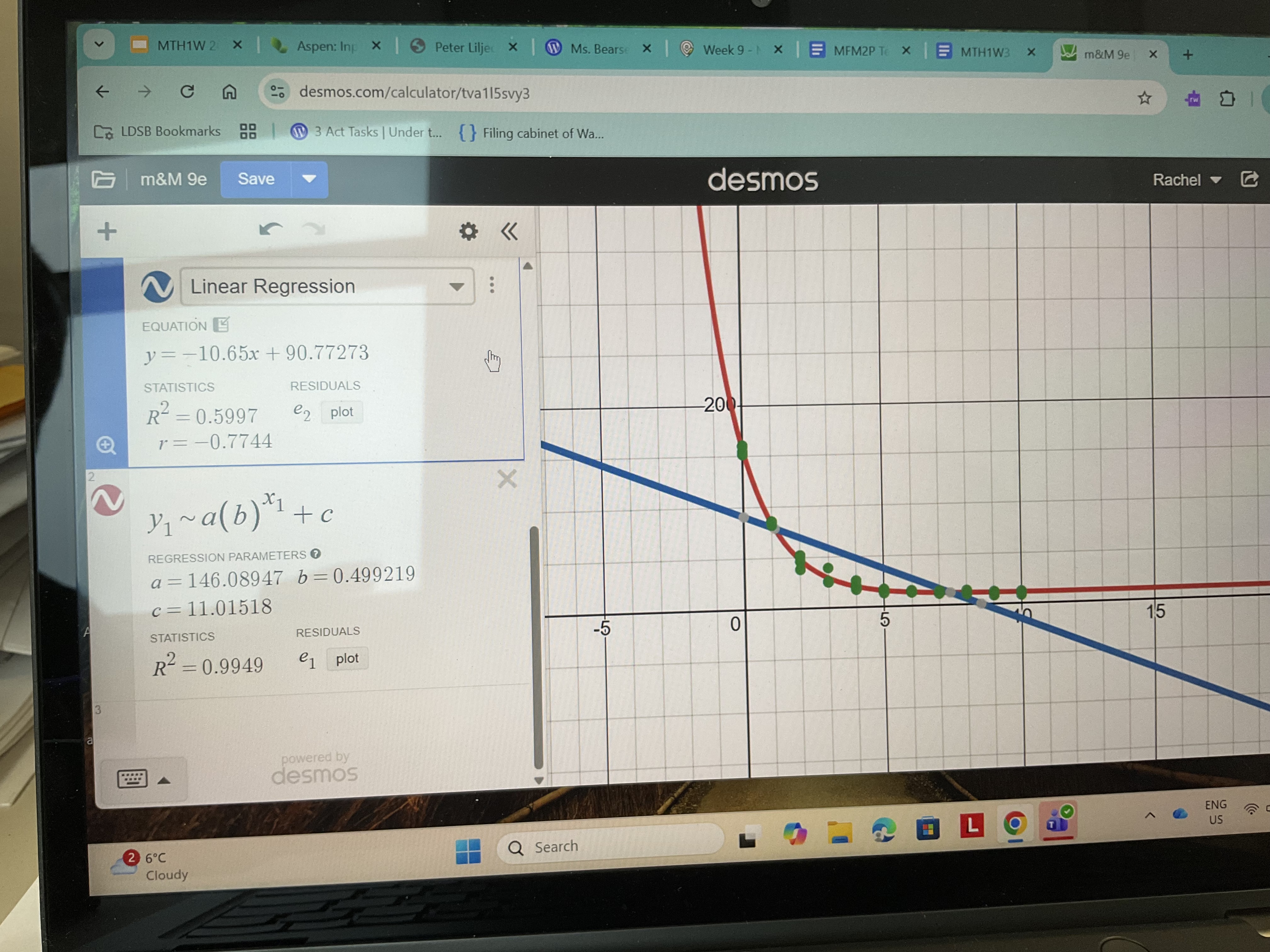
Finally we modelled the class data on desmos and looked at how to do a regression. We followed the same model as we created together, but left the initial value as “a”, the base of the exponent as “b” and the vertical shift for the horizontal asymptote as “c”. We talked about the R squared value and how it’s a really good fit. We compare this to the linear regression that Desmos does. We noticed that the linear regression has an R squared of 0.59 which is not as good a fit.
This was a nice way to spend a Hallowe’en Friday, eating some candy and making some graphs, and learning some pretty sophisticated modelling skills.
Equations to Graphs via Visual Patterns
Today I had the pleasure of running a task in a colleague’s grade 9 math class. We’ve been working on patterning, pattern rules (equations) and graphs. Today the goal was to start with an equation and end up with a graph, but we used visual patterns as the intermediate step.
Each small group of students were given an equation (pattern rule) and were challenged to build figure 0, figure 1, figure 2, figure 3 and figure 4.

Next they brought their tiles from each figure number one at a time to build columns on a graph. All the blocks from figure 0 were lined up on a tower along the y axis, all the blocks from figure 1 were lined up in a tower next to it etc.

Dots were placed at the top left of each column of blocks to indicate the height of the column, and later we removed the tiles and joined the dots to make a line.

Next students were given a different pattern rule and we did the same thing again, making a new pattern, new columns of blocks, and then new points and a new line, with a different colour marker.

Some groups did more than 2 graphs. Others did just 2. Some had some misplaced points which we left on the graphs and then used them for points of discussion later.

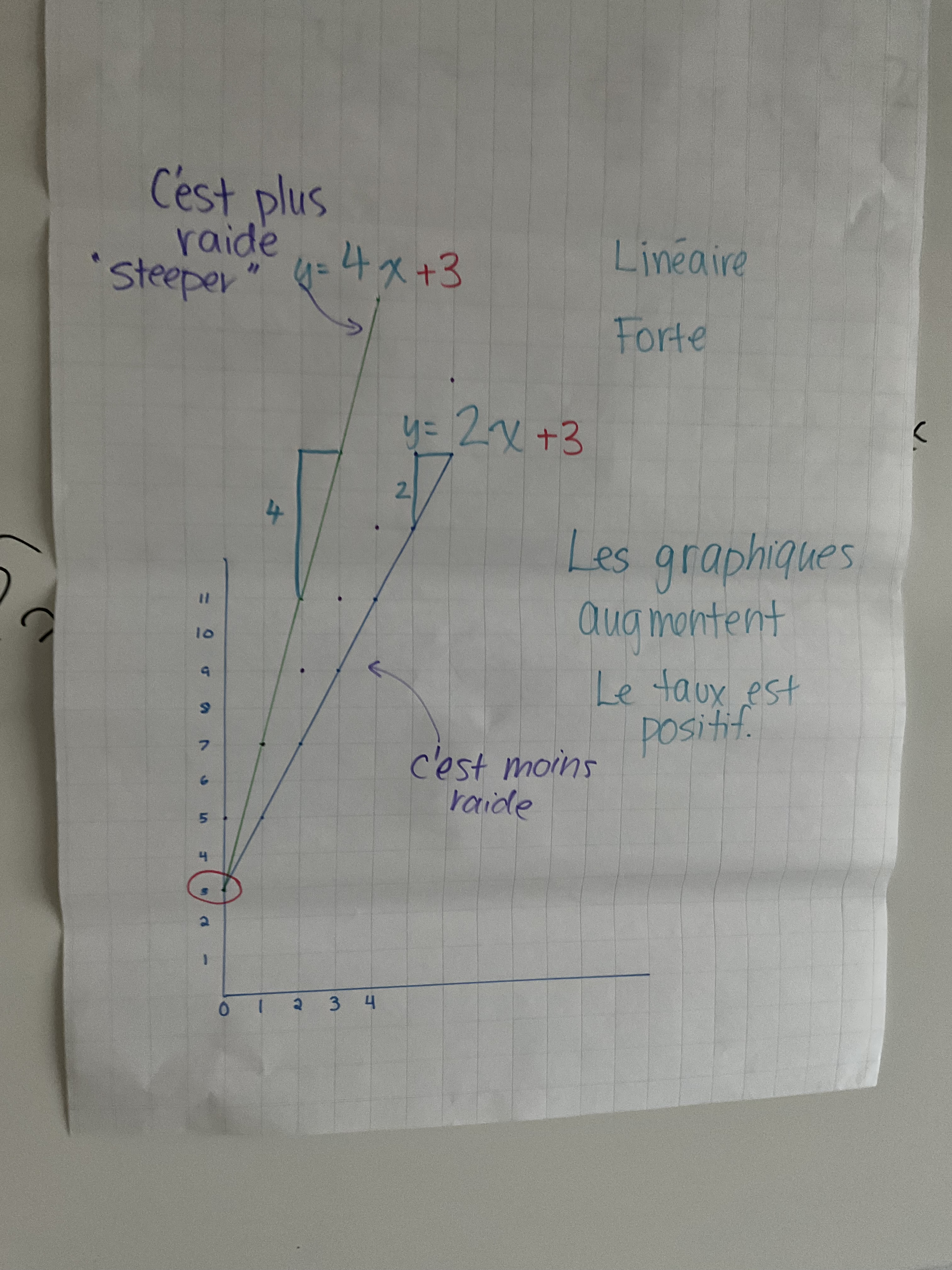
We got groups to clean up and then we posted the papers on the wall to use as our consolidation. Now, there is a bit of an art to getting a good consolidation on these tasks. It starts with pairing up the equations well to get something to discuss. I made sure to have some lines with positive slopes and negative slopes, some lines that had the same y intercept, some lines that would intersect with each other. Some lines with positive and negative y intercepts, and some parallel lines. The next part about the consolidation is to meet the class where they are at. Many students were comfortable talking about all of the graphs being lines, or about them being increasing (growing patterns) or decreasing (shrinking patterns). Once we got all of those ideas up on the pages we started looking at more similarities and differences among the lines, introducing new vocabulary when possible.
I get the class to do a call and response of “parallèle” “même pente” which I think is fun, and it helps reinforce the idea that parallel lines have the same slope.


We took a bit of a break and watched some of my favourite life changing math videos:
Next we consolidated the final graph. We showed more detail about the slope and how we can use various points to show the slope triangle, and the fraction can be simplified. We also looked at how the point of intersection is on both lines, so when you sub in the x ans y values it makes the equation true.

It was a really productive class, and quite fun to collaborate with my colleague and introduce her to this task.
M&Ms task
Today I had the pleasure of working with a grade 11 math class who have been studying exponential growth and decay.
we started by sanitizing our hands because we were going to be touching candy which we wanted to eat later.
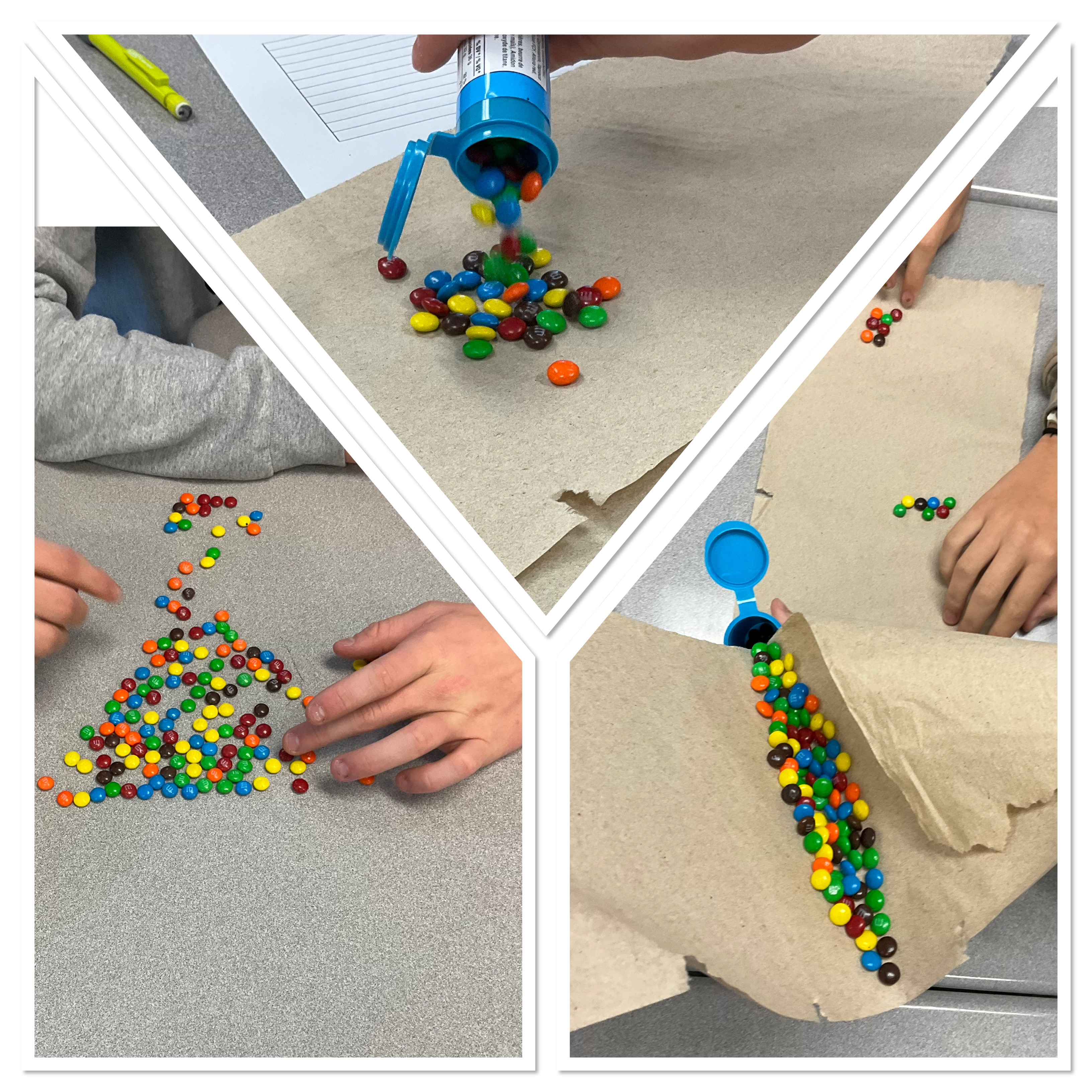
Each group got a tube of mini m&ms. They needed to count how many were there to start with, and add information to a data table.

Next we put all the m&ms into the tube and dumped them.
We eliminated (ate) all the ones with the M side up, and counted the remaining ones, added that to the data table, and repeated until we were done 10 repeats.
Next we made graphs using our data table, and tried to make sense of what type of relationship we saw, and what equation would model the data.

We noticed that the number of m&ms remaining dropped fast at first, and slowed as we continued. Some groups noticed that they had 8-13 remaining, even after repeating the process 15 times. It turns out some m&ms didn’t get printed!
We noticed that there was a horizontal asymptote that appeared. The graphs were showing exponential decay. Since we removed about half the m&ms each time, or since there was a 50-50 chance of them landing m side up, we used 0.5 as the base of the exponent. We know that the x will be the exponent. We needed a vertical shift to have the horizontal asymptote in the right spot, and we used the “a” value, a vertical stretch to get the y intercept in the right spot. Knowing that anything raised to the exponent 0 is 1 is very helpful!

Next groups got computers and put their data into desmos and used the extrapolations available there. We noticed that if you use the exponential regression that desmos has from their drop down menu that the horizontal asymptote is at the x axis. To do a more precise regression you can type it in. This graph is the aggregate of all of the class data, shown on one graph.

It’s important to remember the subscript 1 which ties the x and y values to the data table with x1 and y1. The ~ indicates that a regression is to be done, and there will be values given for each of the parameters provided in the equation. The r squared value will also be given.
It was neat to see the connections the students were making to their prior knowledge. They understood what the asymptote would represent in this situation, and how the base had to be a value between 0 and 1 since it was a decay situation. I was impressed at how well the data from the experiment worked out, and how clear it was that we were dealing with exponential decay.
I had debated having the students eat the m&ms without the m showing, but I think that they would have missed out on a rich conversation about the horizontal asymptote being representative of the “defective” candies that didn’t get printed. The task could be done with skittles as well, but the mini m&ms work well since they are small so each group starts with a large number, and can see the decay rather dramatically at the start.
Three Act Tasks
Today in grade 9 we did 2 different 3 act tasks to explore linear relations. The first one we did was Crazy Taxi.
We watched act 1 and we noticed and wondered for a bit. There’s lots going on! We talked about price and speed and distance…then we watched this video to see more and to get prompted with what to calculate. We looked at what the cost would be for a trip that was 30km.

Students used several representations, making tables, and equations and graphs to solve the problem.
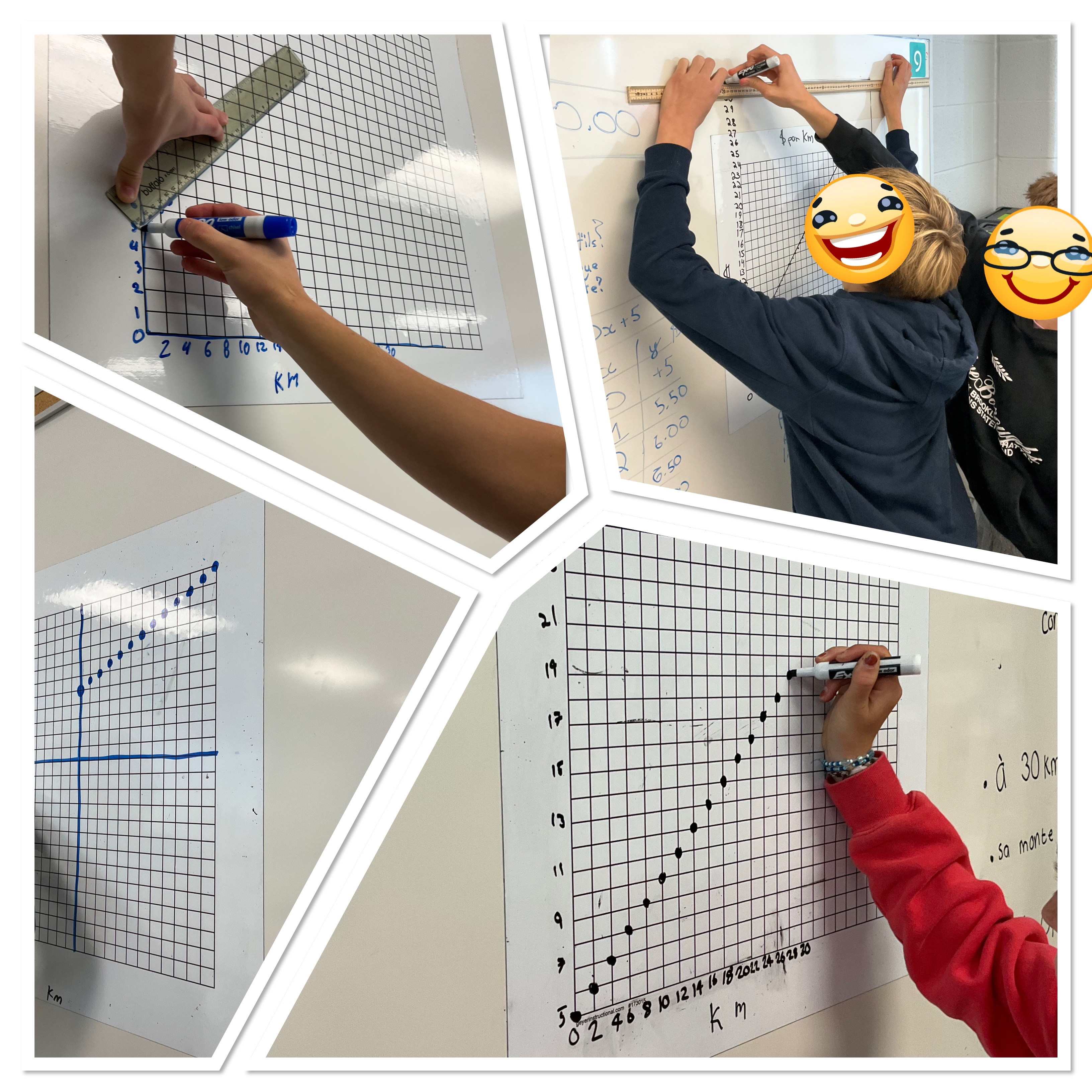
After graphing and making equations, they were given an extension question: if you have $30 how far could you travel?
Graphs were extended, tables were extended, equations were solved and we all agreed on an answer. The final video, for Act 3 is here. It shows the answer to the question posed in the 2nd video.
Our 2nd 3 act task was “Fast Clapper”.
here is the act 1 video which we watched, then noticed and wondered. We decided we needed more information to see if he would break the posted record or not.
The act 2 video shows a counter on the screen which helps us do some calculations to solve the problem.
Some groups found out how many seconds it takes for 1 clap, then used that to figure out how many claps he can do in 1 second, and then in 60 seconds.

This group found that he could do 63 claps on 4.6 seconds, which they said was about 4.5 seconds, and that 4.5×13.33 equals 60, so 63×13.33 would be the number of claps. Great use of proportional reasoning. They knew that they were over estimating since they used 4.5 instead of 4.6 seconds.

This group extended a table, counting by 5 second increments to figure out how many claps there’d be in a minute. They were showing that they understood the use of proportions and rate. There would be 5 times as many claps if we have 5 times as many seconds.

Lots of our work hinged on the idea that the rate stayed the same the whole time. We were not sure if he’d slow down or speed up during the minute, but that would also affect our calculations.
here is the act 3 video with the final reveal
We then wanted more information so we looked up to see if he is still the fastest clapper in the world. (Spoiler alert: he is NOT!)
Here’s a video about the current fastest clapper
Similar Triangles
We built triangles today out of pattern blocks. We looked at how the side lengths scale. The single triangle has a side length of 1, and an area of 1 triangle. We can see that the triangles in the photo have side lengths of 2, 3, and 4, and they have areas of 4 triangles, 9 triangles and 16 triangles.
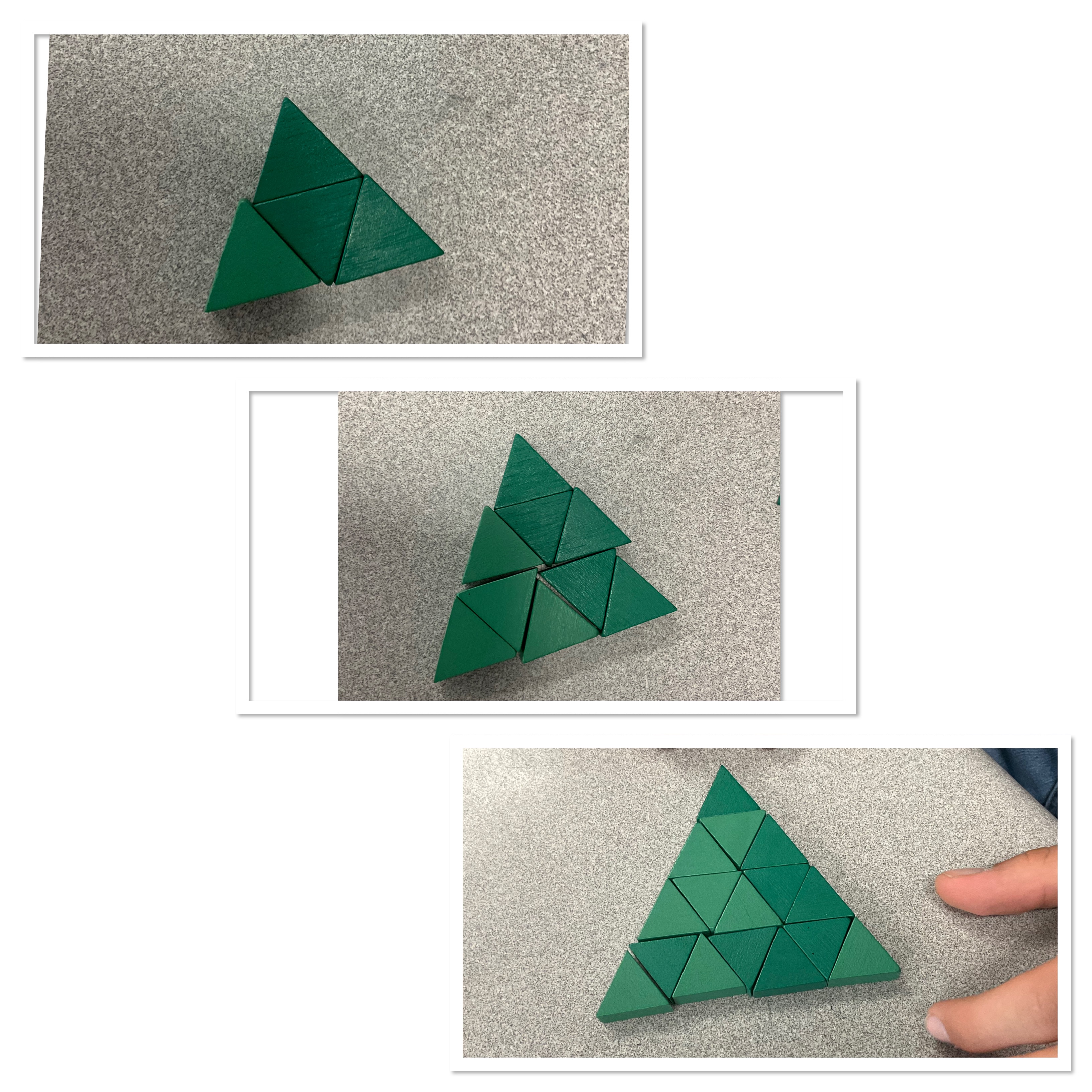
We made the inference that if we built a triangle that had a side lengths of 5 that it’d take 25 triangle tiles to do it.
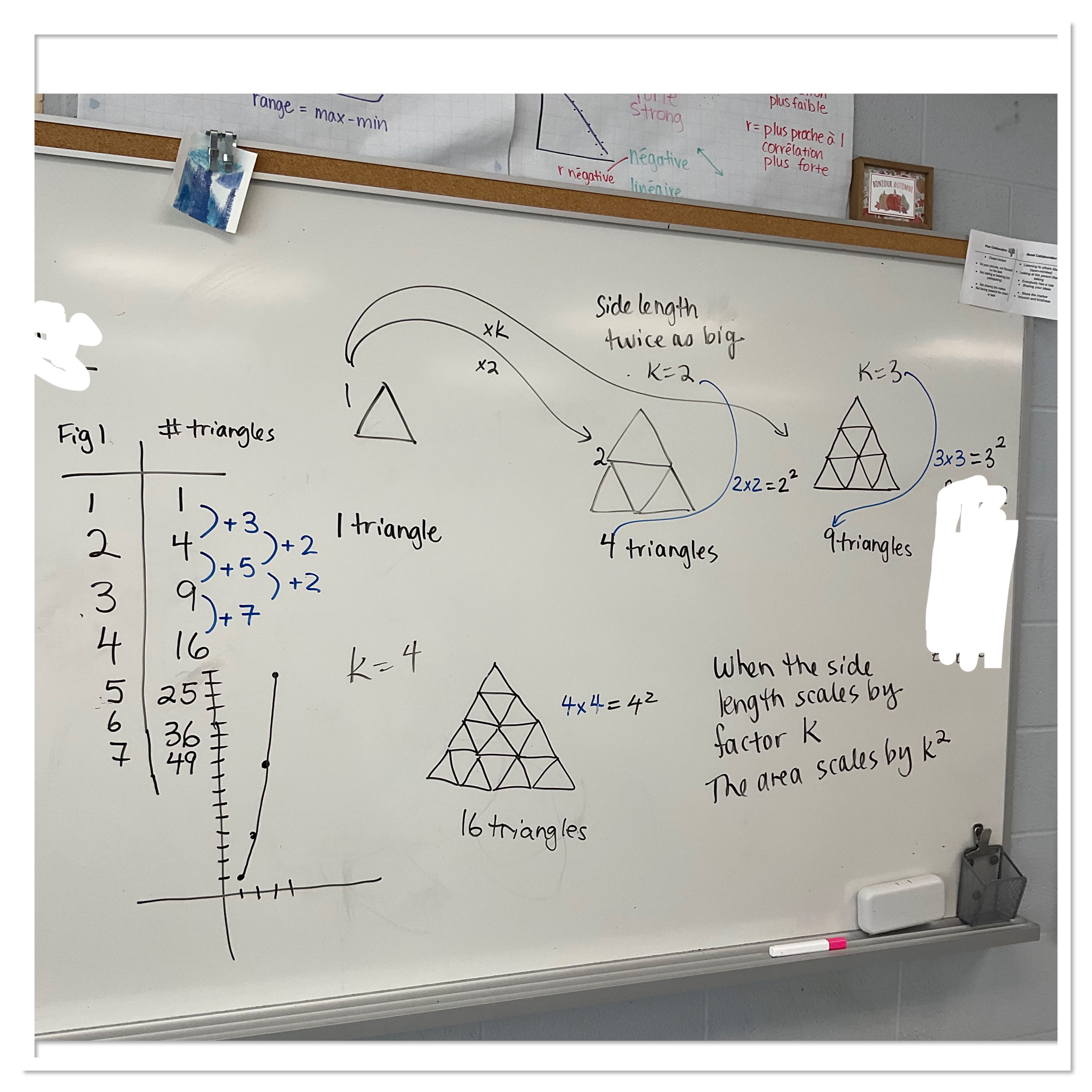
We consolidated the idea that if a side lengths scales by the factor k, the area will scale by the factor k squared. We noticed that this connects beautifully to our quadratic patterning that we had been looking at, with a second difference being the same each time, and a graph that is a curve, and the equation would be y=x^2 so there’s an exponent of 2 which indicates that the relationship is quadratic.
 Ms. Bearse's Site