Stacking Tower Game
My grade 11s are working on problem solving, and today we started with a game.
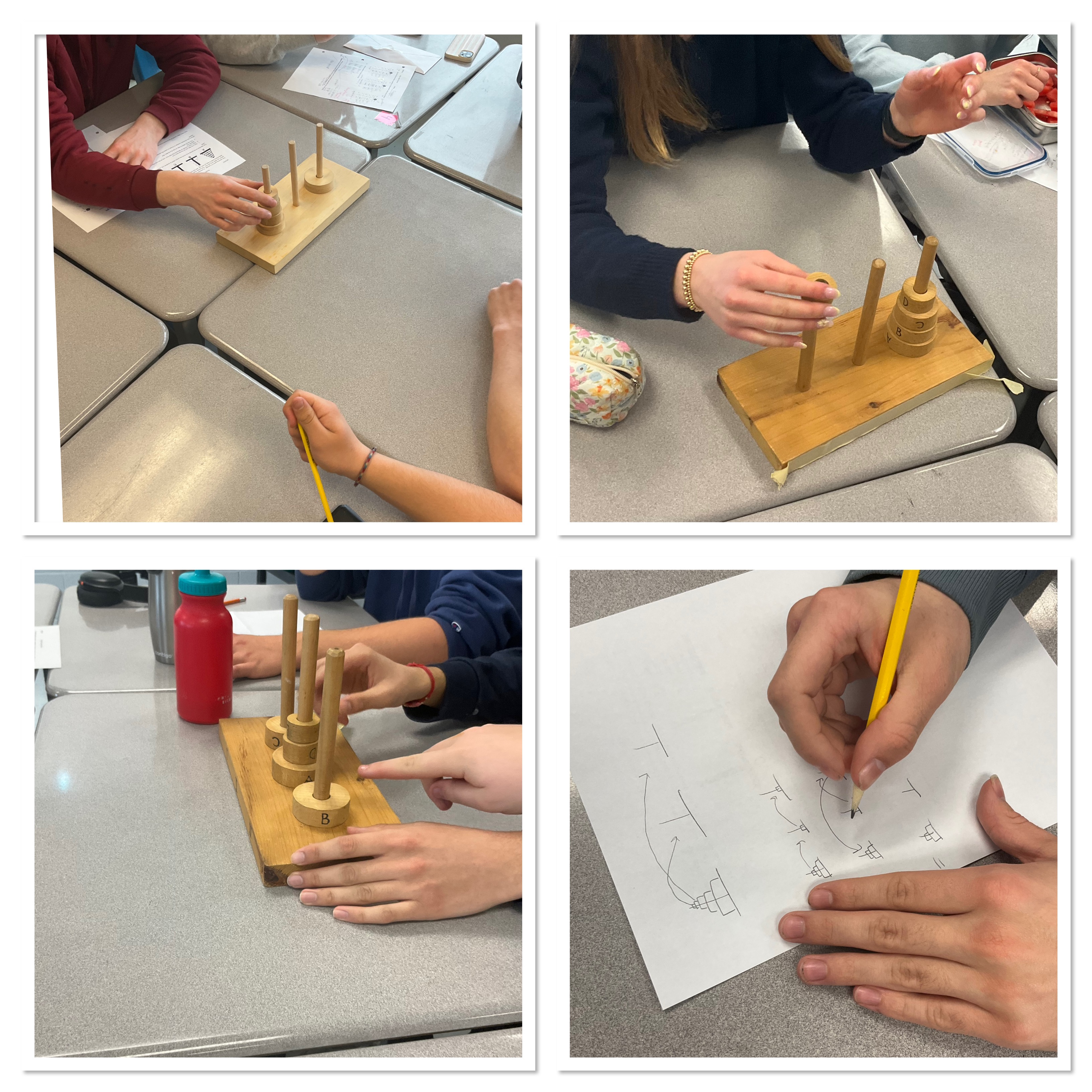
There are 5 discs of different sizes stacked on one peg. There are 2 empty pegs. Students need to find the minimum number of moves to get all discs to another peg. The rules are: one disc moved at a time. No disc can be put on top of a disc that is smaller.
The next challenge is to extend it to the number of moves needed to move 10 discs, and if a group says the minimum number of moves was 3267, how many discs did they use?
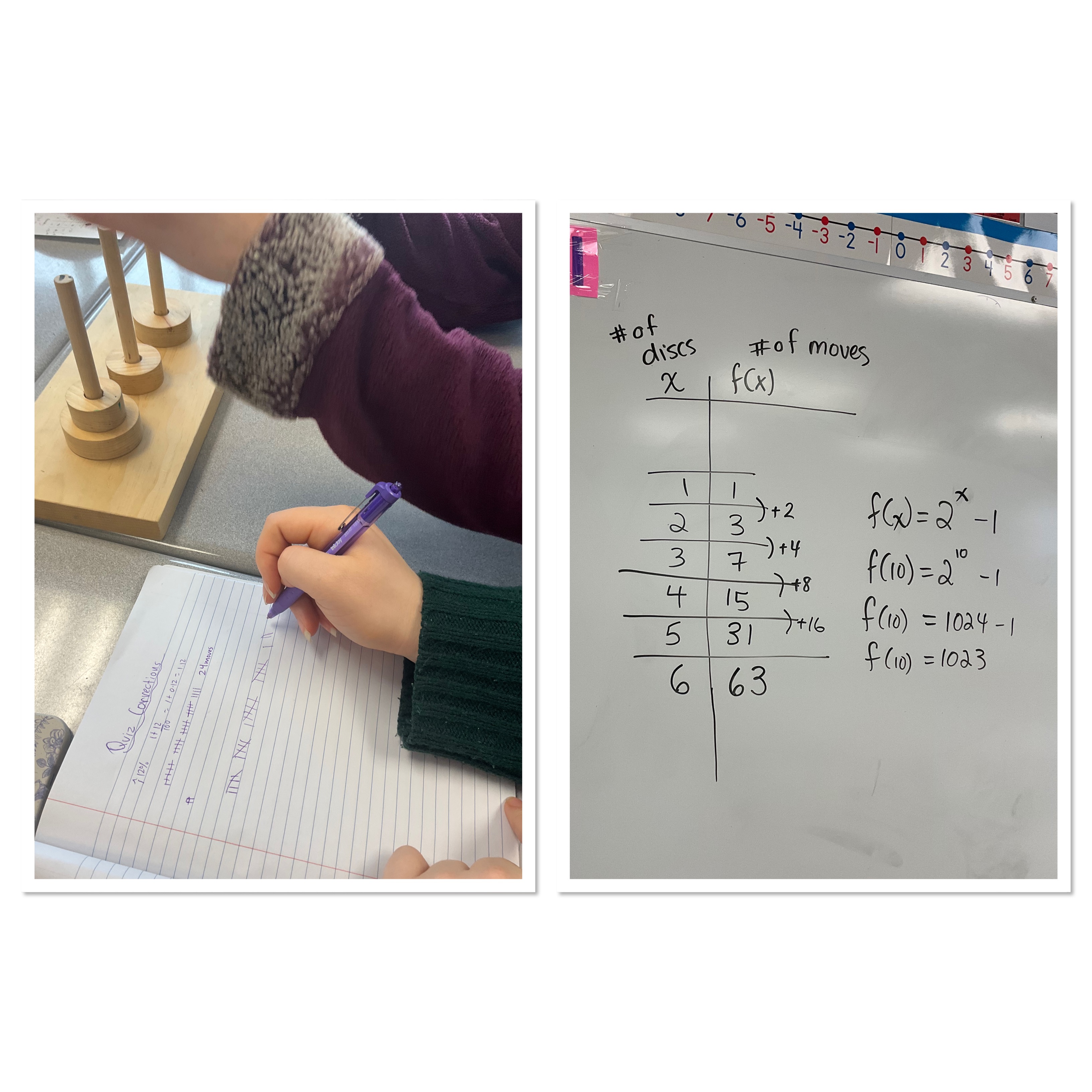
It was fun to watch students wrestle with the problem, and how they supported each other through the frustrations. Groups developed different ways to tracking moves, and modelling the situation.
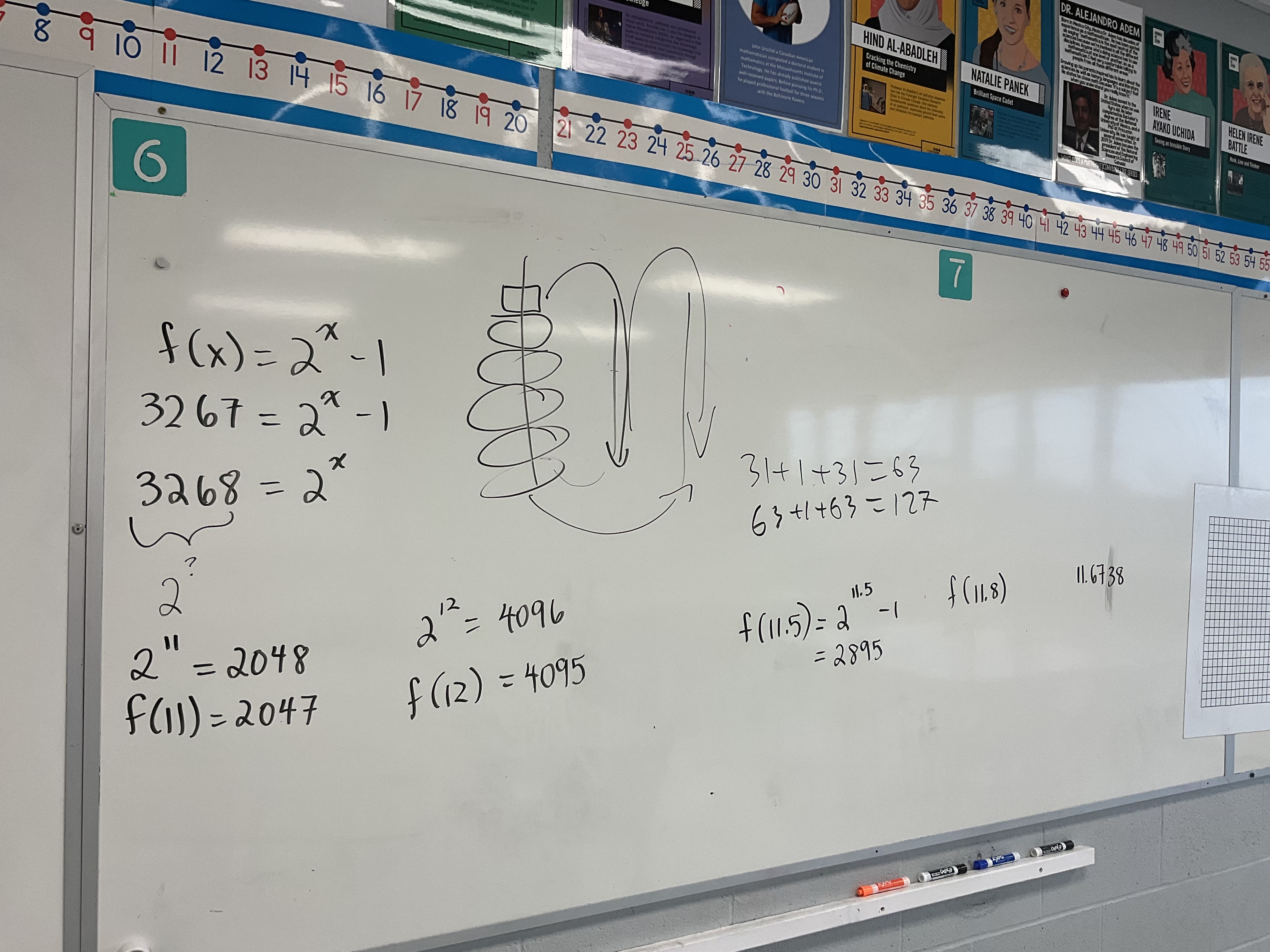
One neat justification for the hypothesis that it is exponential growth is that it took 15 moves to get one stack of 4 transferred to a new peg. If we are considering moving a stack of 5, we’d have to first move the stack of 4, then move the bottom one, so that’s 15+1, then we’d need to move the stack of 4 again to get it on top of the 5th disc, so that’d be 15+1+15, which is 31 moves. If we’re working on moving a stack of 6, we’d move the stack of 5, then move the 6th, then move the stack of 5 again. That’d be 31+1+31, which is 63. We can see that the growth is close to doubling each time.
It was a fun modelling task which led to a fruitful discussion about whether the claim of 3267 being a minimum number of moves, and about whether we should consider a fractional number of discs.

