Barbie Bungee
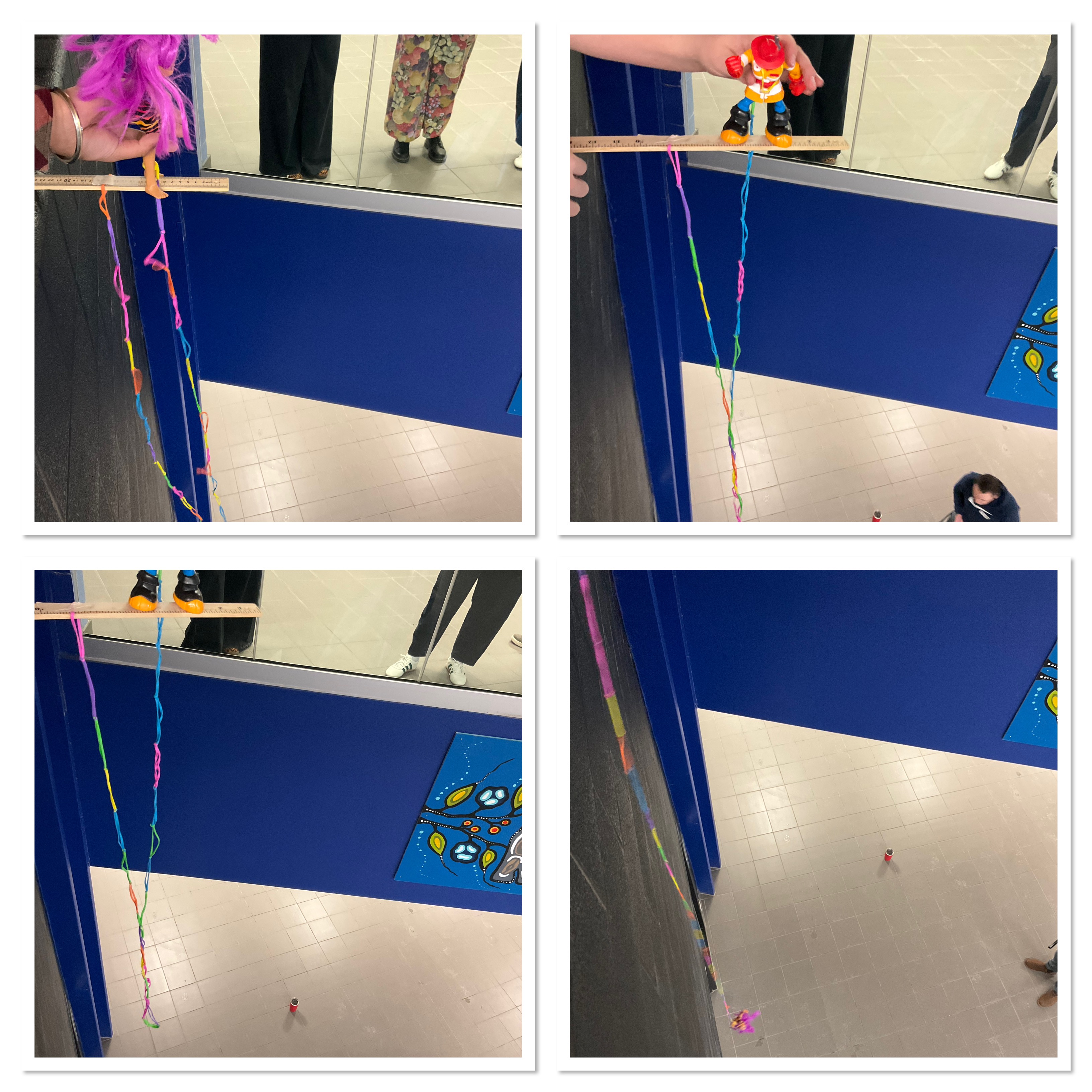
Today we bungeed Barbies! This is a task I’ve been wanting to do for ages, but never did. I went to the thrift store and dollar store and got a variety of characters to bungee.
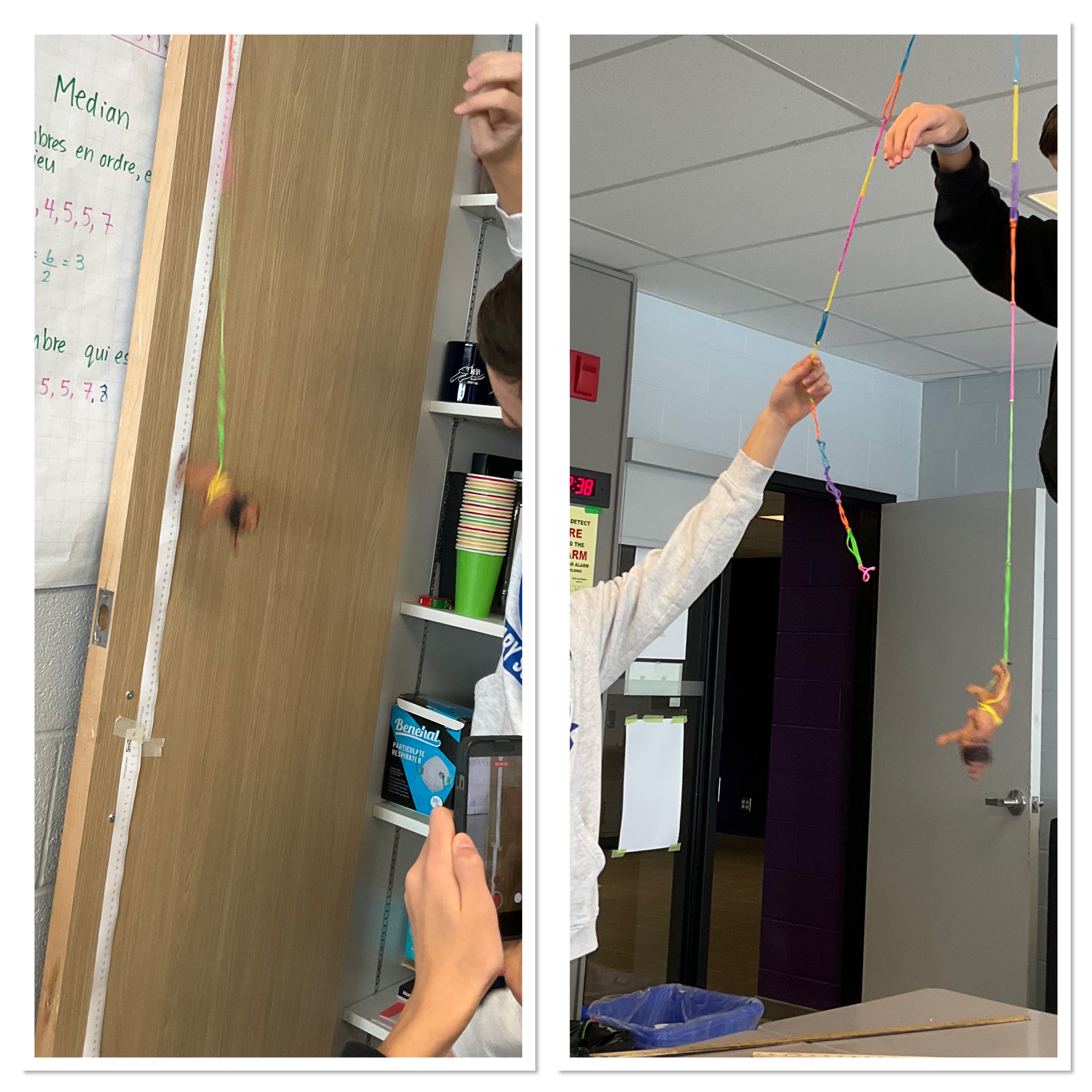
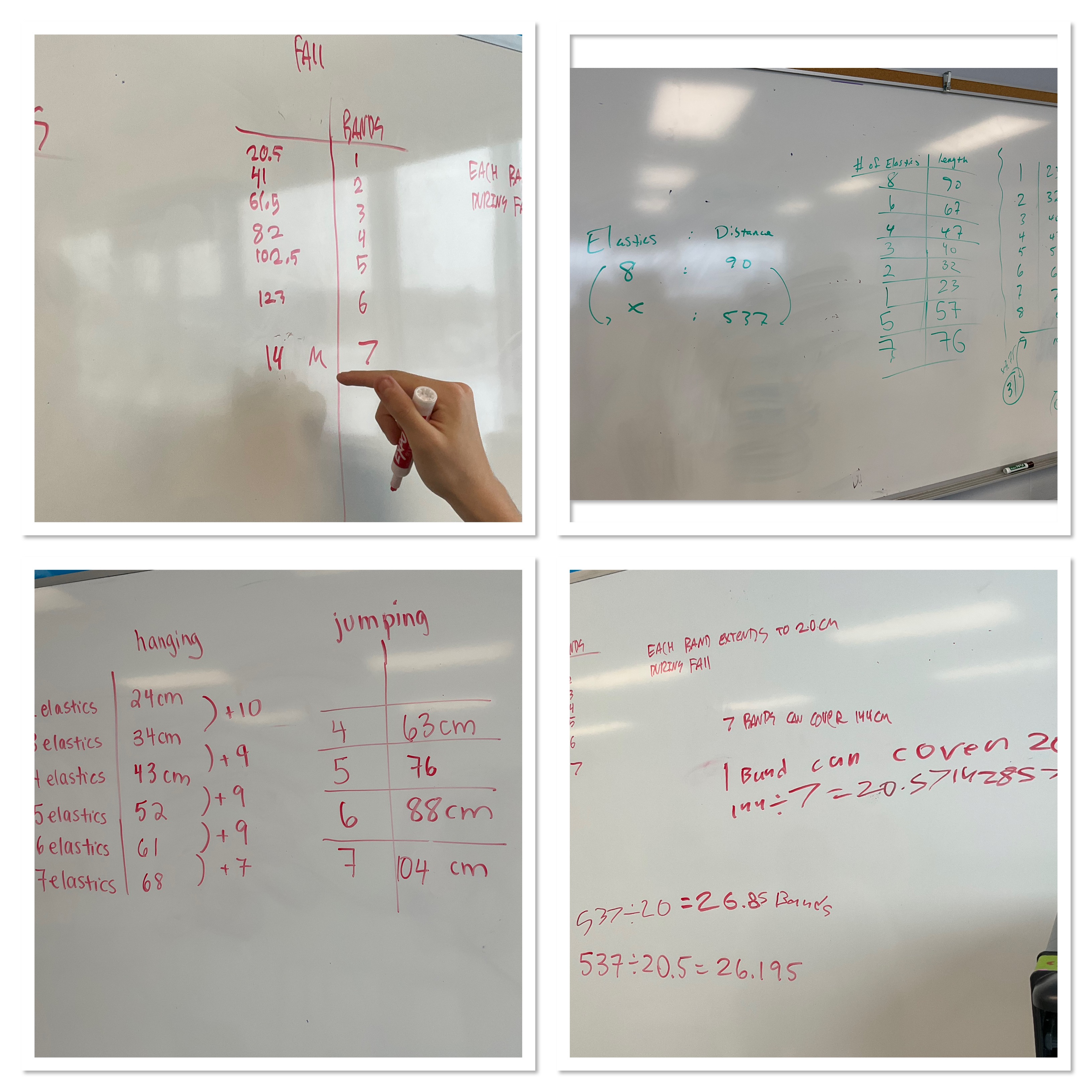
We started off with each team getting 7 elastics and then we started to test the stretch to figure out how many elastics would be needed to bungee down the 537cm from the top of the atrium stairs down to the floor. The goal was to give the character a thrilling and death defying ride.
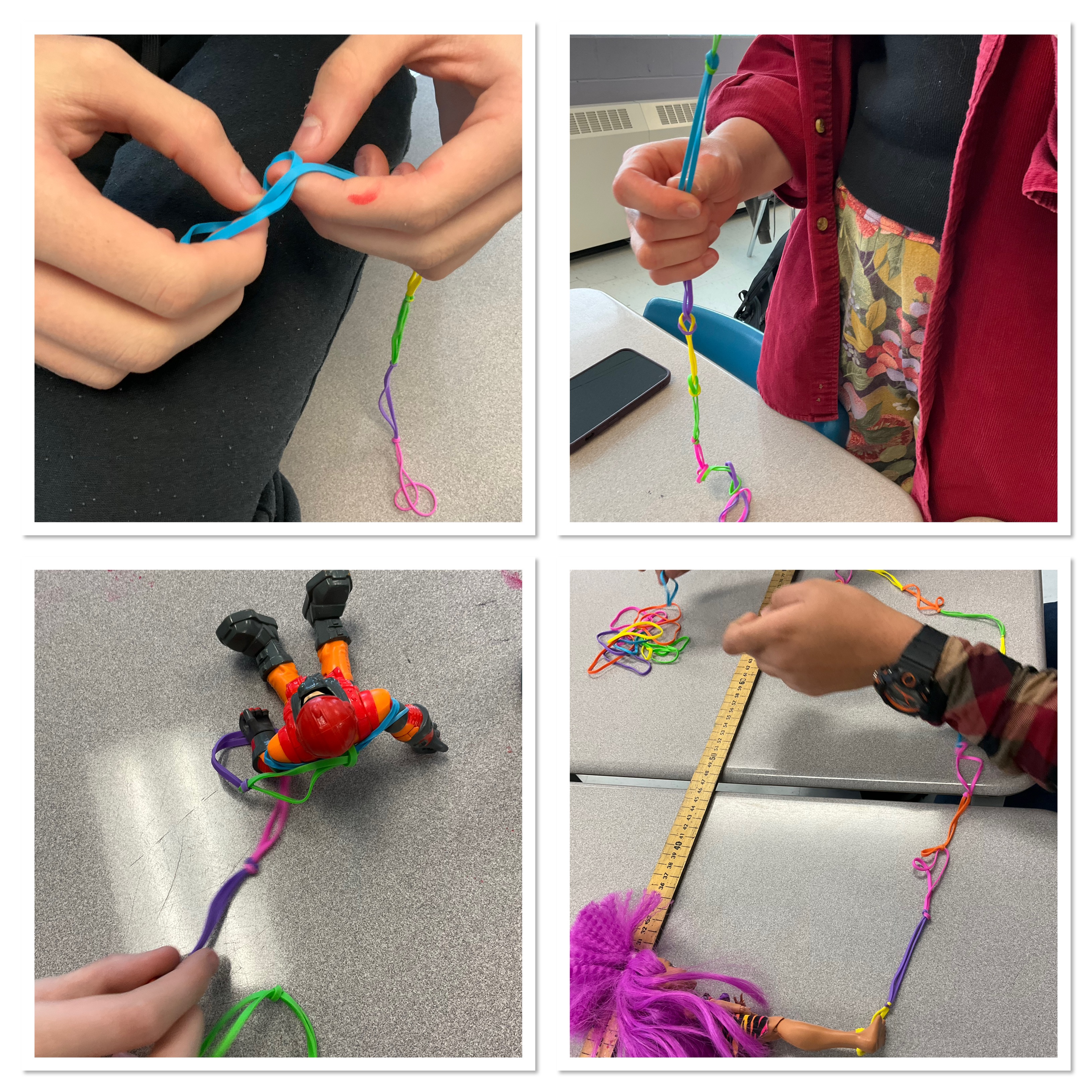
We had groups try different strategies. Many did trial and error with different number of elastics, checking how far the bungee would go.
groups put data in tables and used proportionality to find their answers.
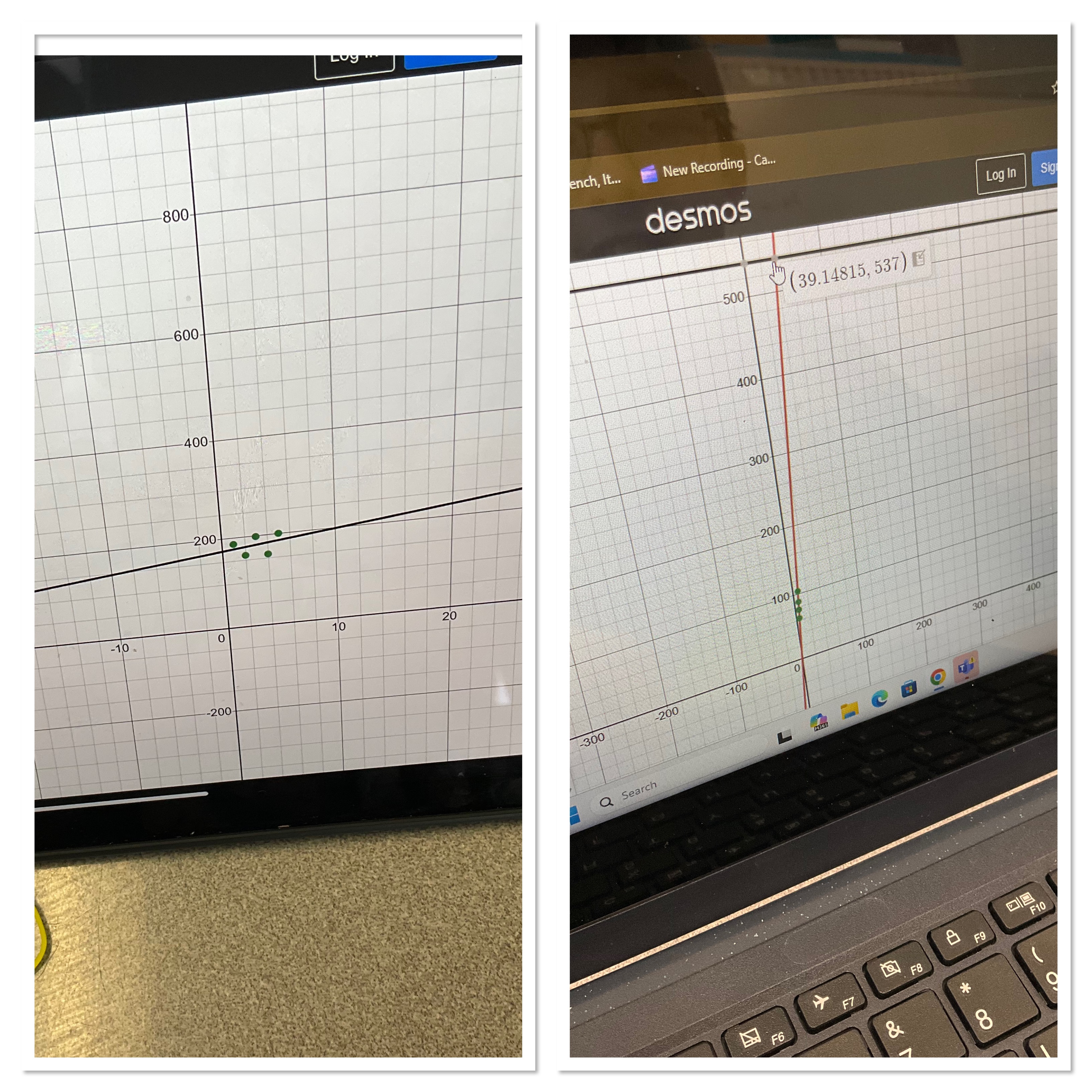
Groups used desmos to find averages, and also to solve the problem of how many elastics are needed.
Finally we bungeed the Barbies!
We had quite the audience for some of the plunges. It was a great success, with only one ending up on the floor.
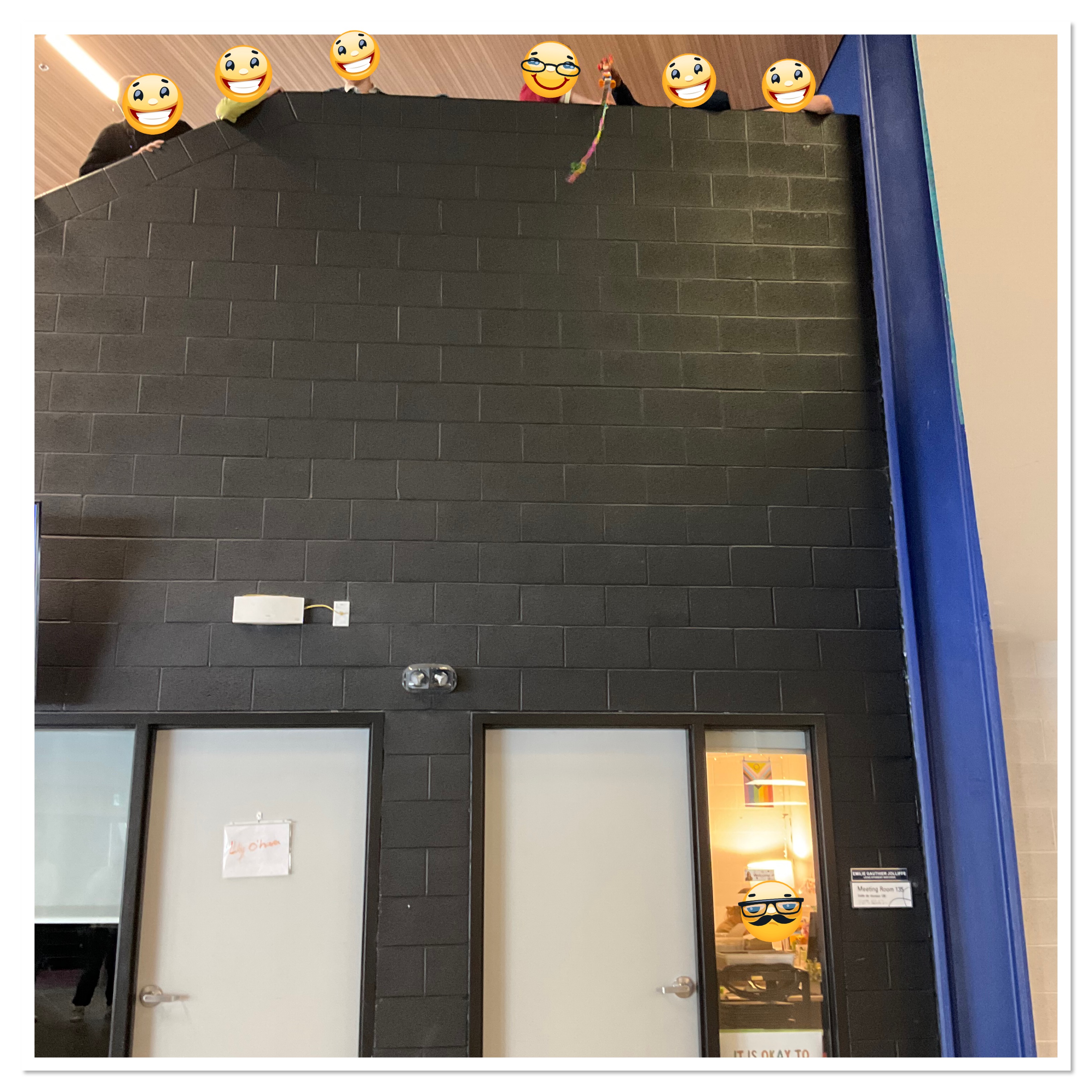
We had a lot of fun on the snow day and working through some math!
Substitution
Today in grade 10 we worked on solving a system of equations by substitution. We started off with a tug of war puzzle.
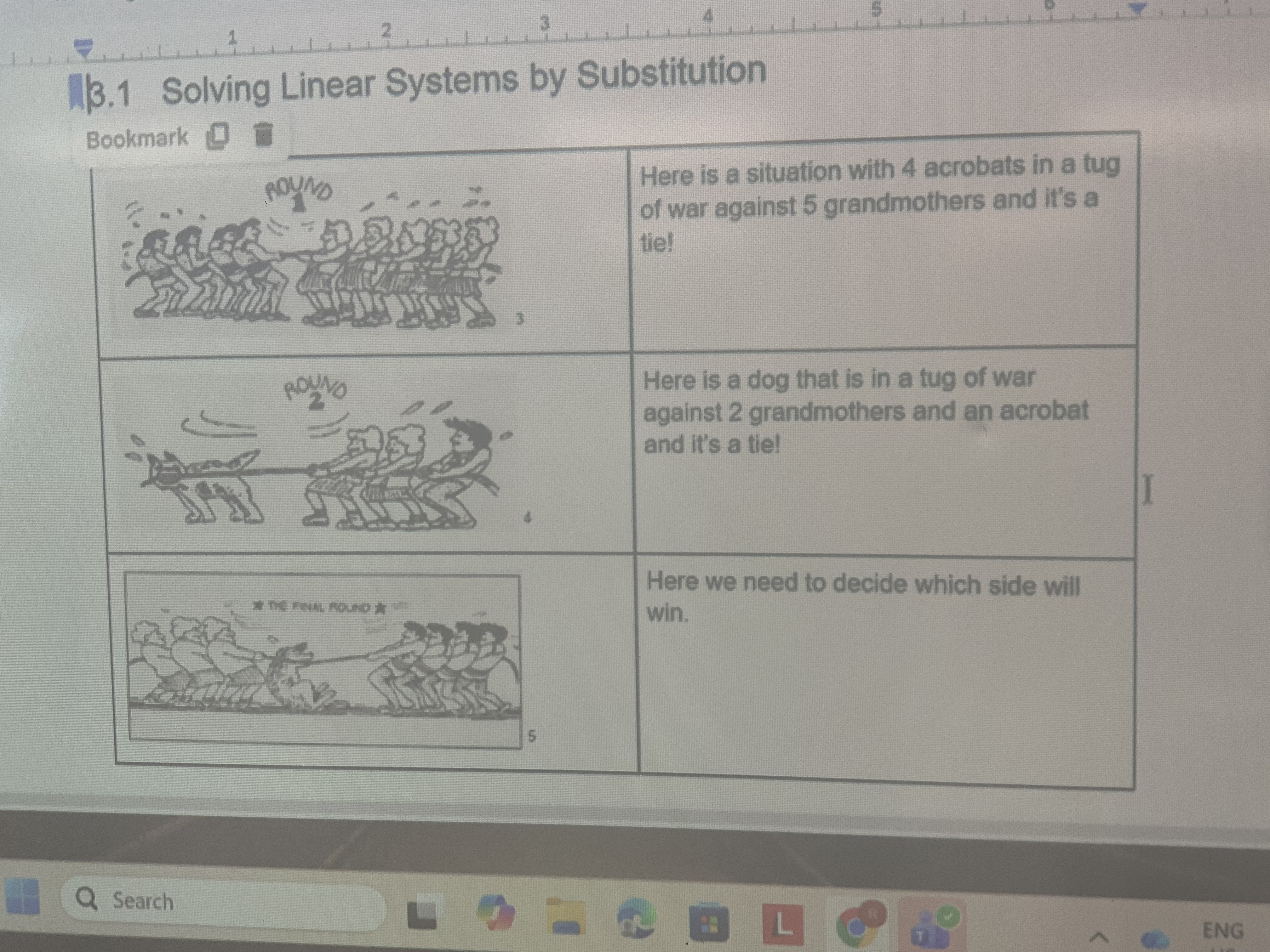
4 acrobats vs 5 grandmas are a tie
1 dog vs 2 grandmas and an acrobat is a tie
we need to figure out who will win with 3 grandmas and a dog vs 4 acrobats.
Students worked out a few ways to solve the problem. I wish I had photographed them!
One method had them assign a value for the strength of each grandma and each acrobat. They decided that if a grandma had a strength of 20, then 5 grandmas have a strength of 100, and if they are tied with the 4 acrobats, each acrobat would have a strength of 25. They figured out the strength of the dog by substituting in the values into an equation: dog=2(grandma)+acrobat to calculate that a dog has the strength of 65. Then they could calculate the final situation to see that the side with the grandmas and the dog will win.
Another method was to make equations. The idea of the tie means that both sides are equal, so:
5G=4A
1D=2G+1A
when we get to the final step:
3G+1D, we can replace the dog with (2G+A)
3G+(2G+A)
5G+A
but we know before that 5G=4A so we can replace that too
4A+A
which is 5A, so now we have a final show down with the equivalent of 5A on one side, vs 4A on the other side, so we know that the 5A side (the one that originally had the dog) wins!
We then did some substitution without a context, to practice.
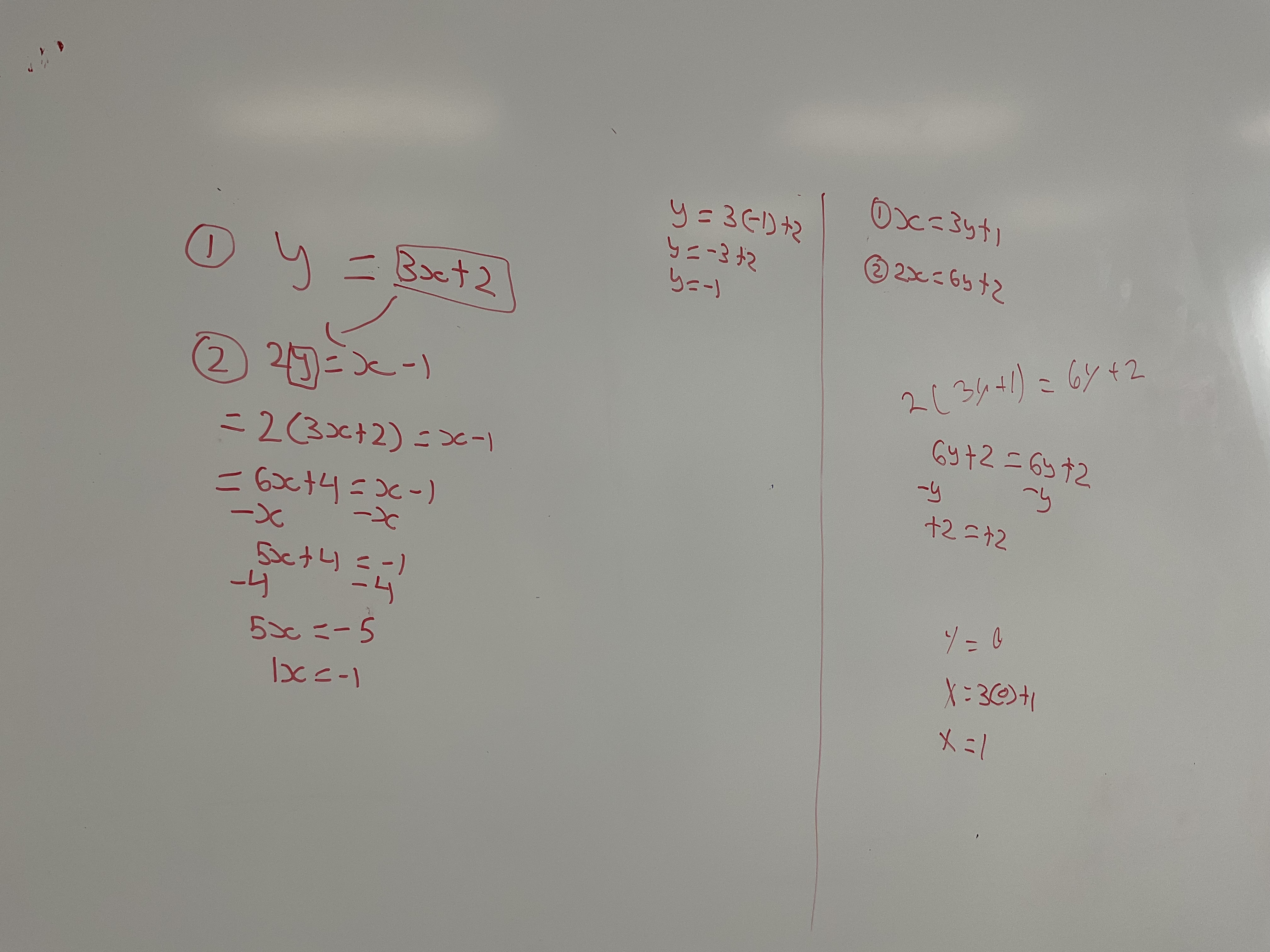
We made the connection to x=-1 and y=-1 being the intersection of the 2 lines using desmos.
Next we tried an interesting case:
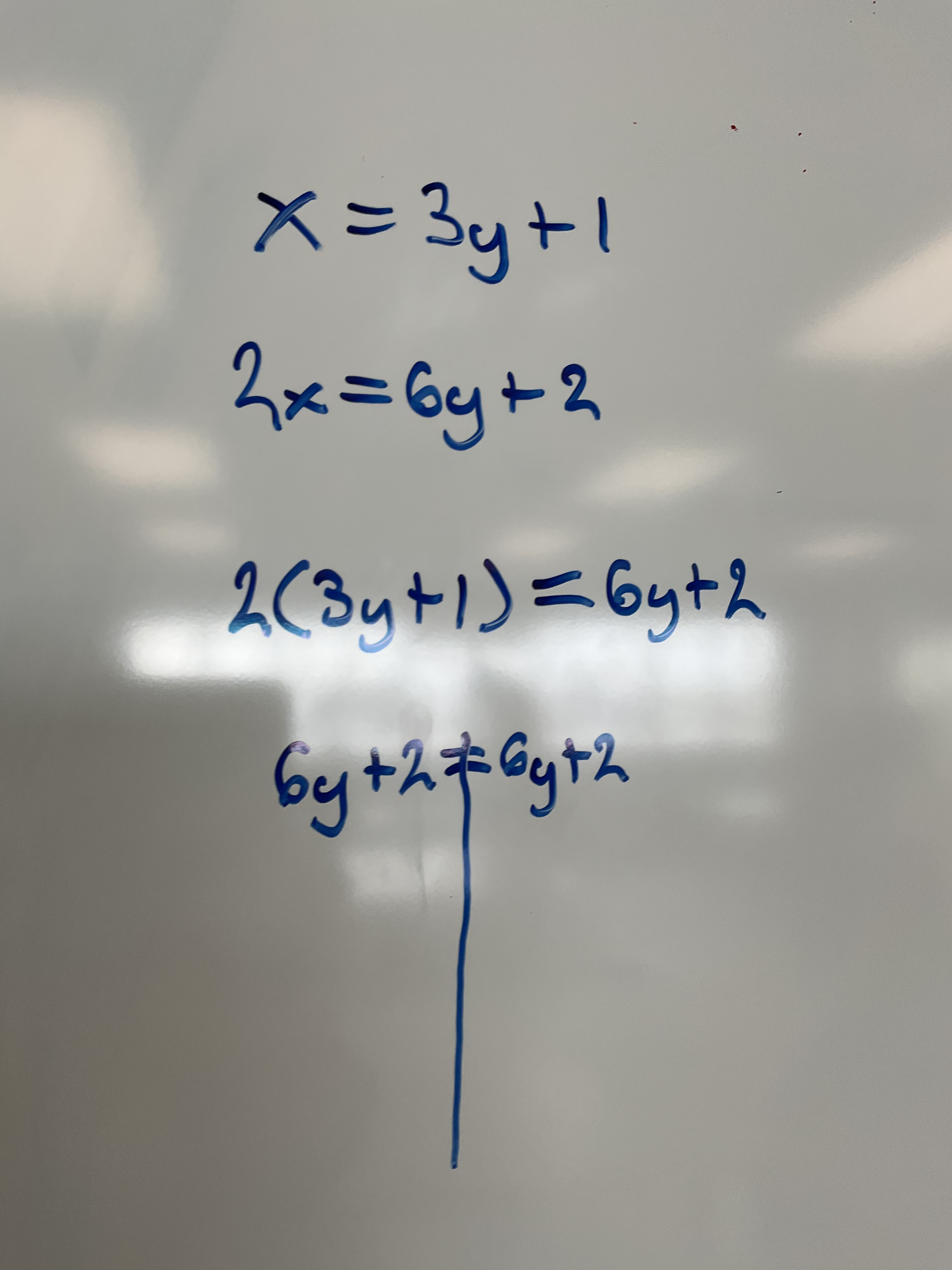
this case led to a discussion of what happens when the final line is 2=2 and what does that mean? It means “yes” because it’s true. We are looking for the intersection of 2 lines and math says yes.
these two lines are identical and intersect at all points, so all points on one line are on the other!
We did a lot, and had a fire drill too!
Heat Loss House Day 1
We are so lucky to have a group from St. Lawrence College to come and run a project with our grade 12 college math class. Day 1 involved making some choices about how to insulate a house on a budget. We also did calculations about mortgages for the land and construction loans.
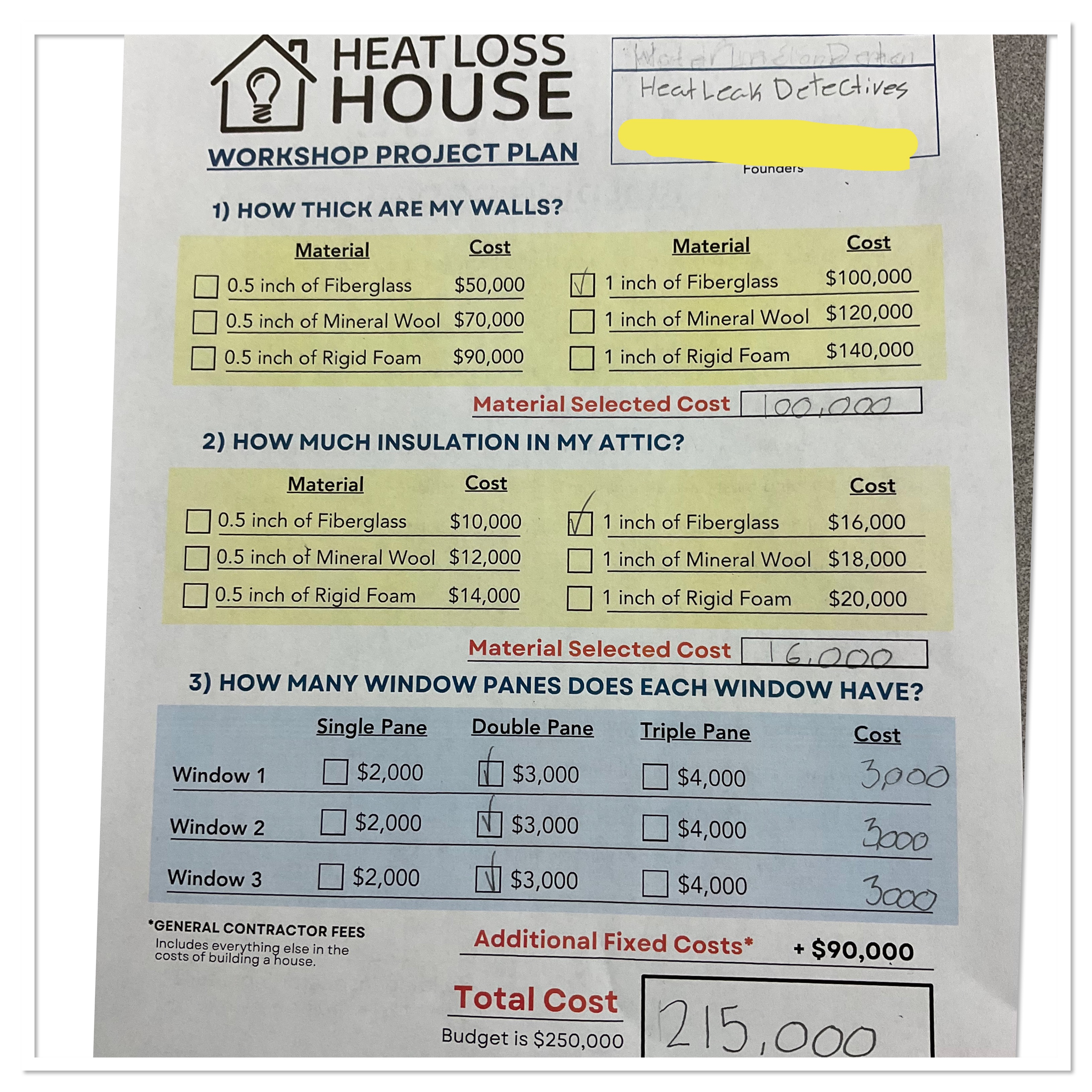
Later we will build the houses to the specifications chosen and test them overnight to see which ones lose the least heat.
Fraction Brainstorming
I worked with a colleague today to look at various approaches to conceptualizing fractions, and adding & subtracting, multiplying and dividing them.
We talked about area model and how to visually represent adding and multiplying fractions, but then we decided to dig a bit deeper and look at using concrete tools like cuisinaire rods to help us.
The plan we came up with is to start with a concept circle with the rods in place and students need to determine how to write down the value of each rod/combo. Using 12/12 as 1 is helpful for this task.
Next we’d do a concept circle with fractions written down, using quarters, thirds, halves and sixths, and the central 12/12 as 1 and have students build the fractions with the rods.
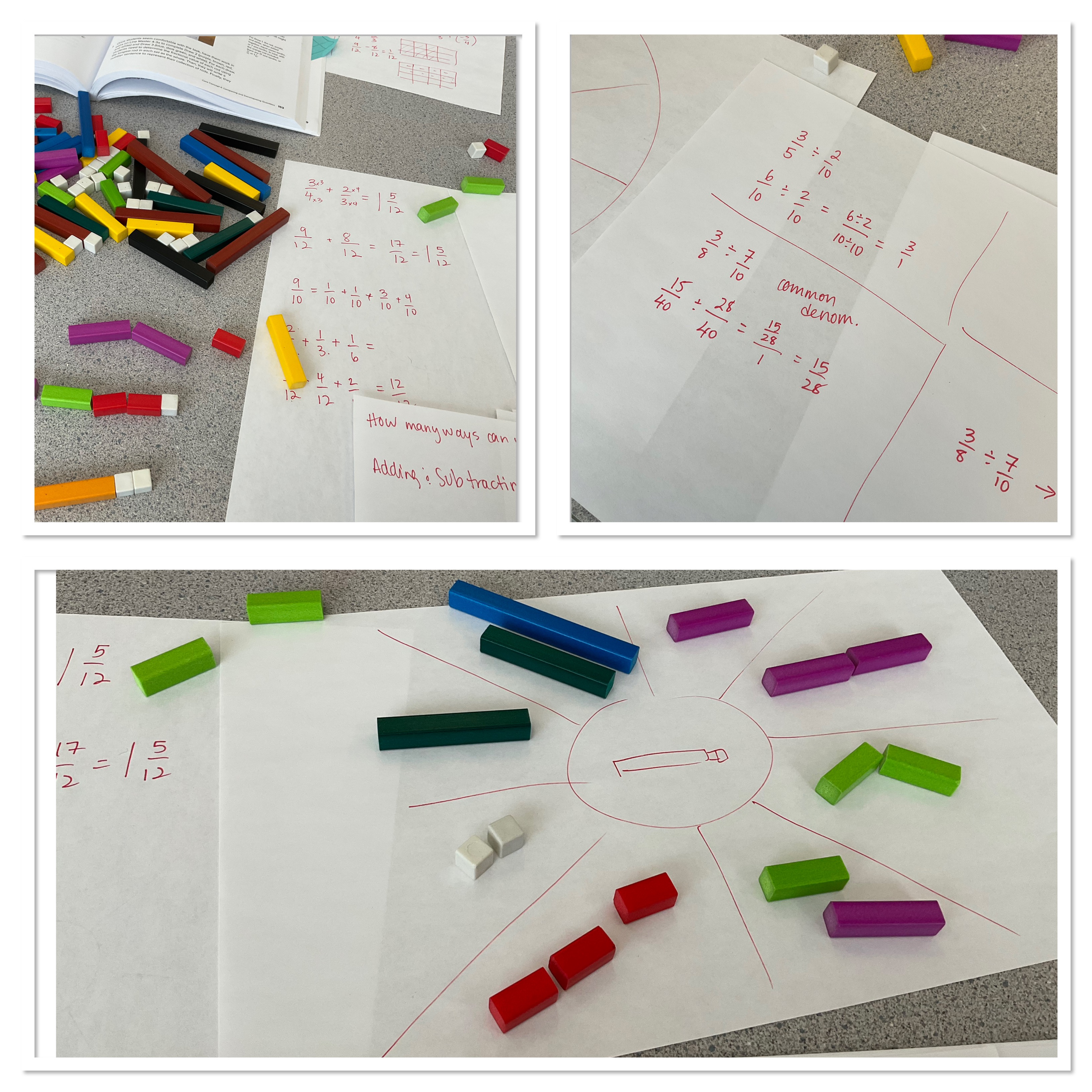
Next we thought that we could build equivalences with the rods, making combos that are the same length, and then writing them down in math. We know that if they are the same length they are equal, and if it’s a combo you can add up the various blocks. You could get at subtracting with an overshoot and return strategy using the rods as well.
After that we started talking about how to best show fraction division. I shared my recent new learning that fraction division can be done straight across just like multiplication can, and if we get a common denominator first then it simplifies beautifully.
e.g. 3/4 divided by 5/7
is the same as
21/28 divided by 20/28
dividing the numerators gets us 21/20 which would be over the quotient of 28/28 (which is 1) so the answer is 21/20. Now this isn’t a way to use visuals or manipulatives, but it sure is cool.
I was recalling the mini feud between Howie Hua and Mr G (videos are on tiktok and instagram, not sure how to link them here) about various fraction division methods.
This is something fun to dive into as a team. So glad colleagues are keen to ask and try and push me and my thinking in new directions!
I’m glad to have spent some quality time with the book rethinking fractions this summer. It has been very helpful.
EQAO practice
It was a snow day today and grade 9s were busy trying practice tests for EQAO
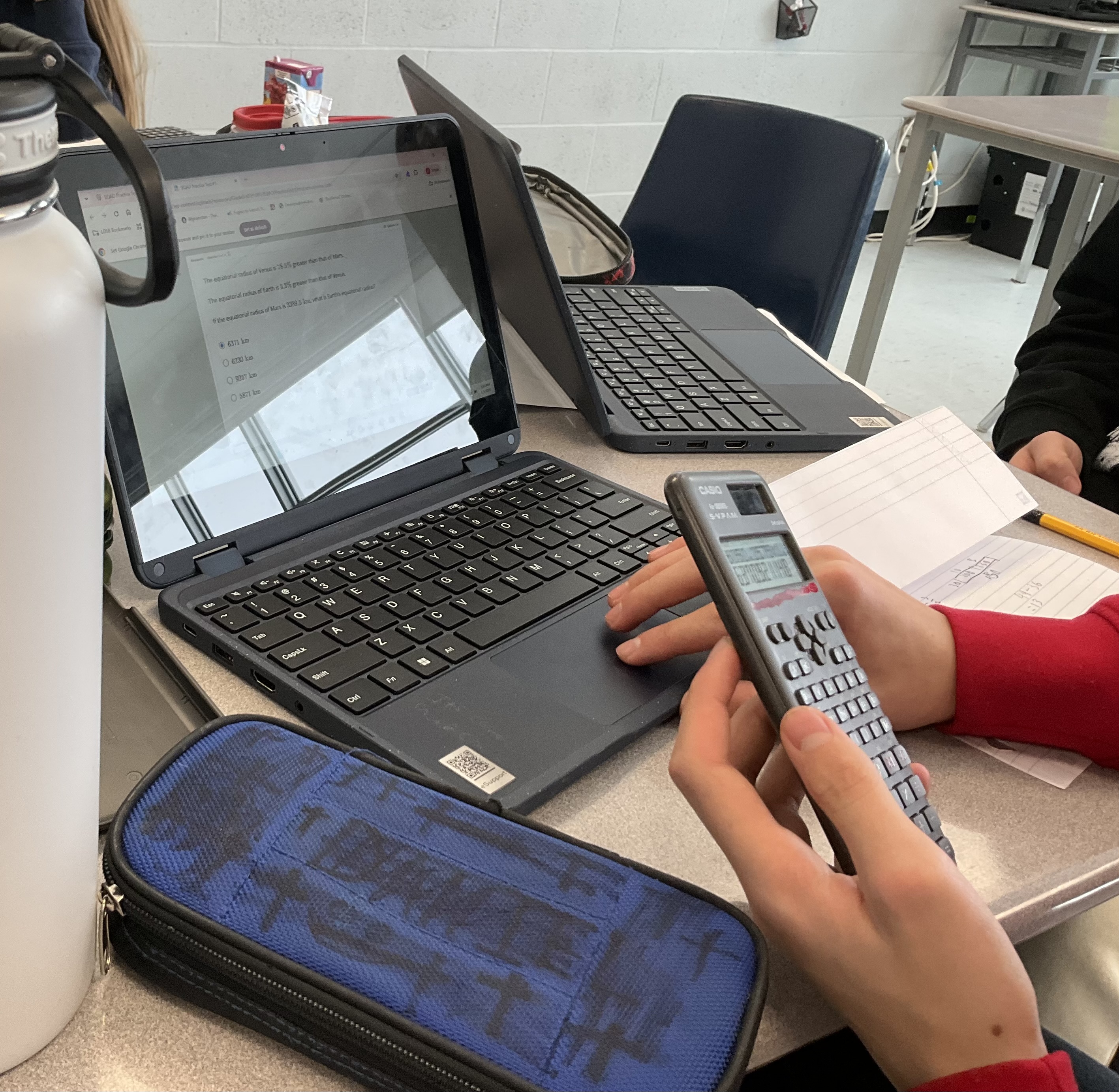
We worked through test 1 of practice questions. We’ll have to do a bit more practice and a bit more learning before we take the test for real later in the month.
Snow Day Math
Today there’s a storm and busses are cancelled so we had fewer than normal students. In grade 10 we worked on a task about rectangles. Each group needed to choose a number between 30 and 70 and that would be the perimeter of each rectangle made. They needed to make a list of all the possible rectangles, and then make the rectangles and calculate the area.
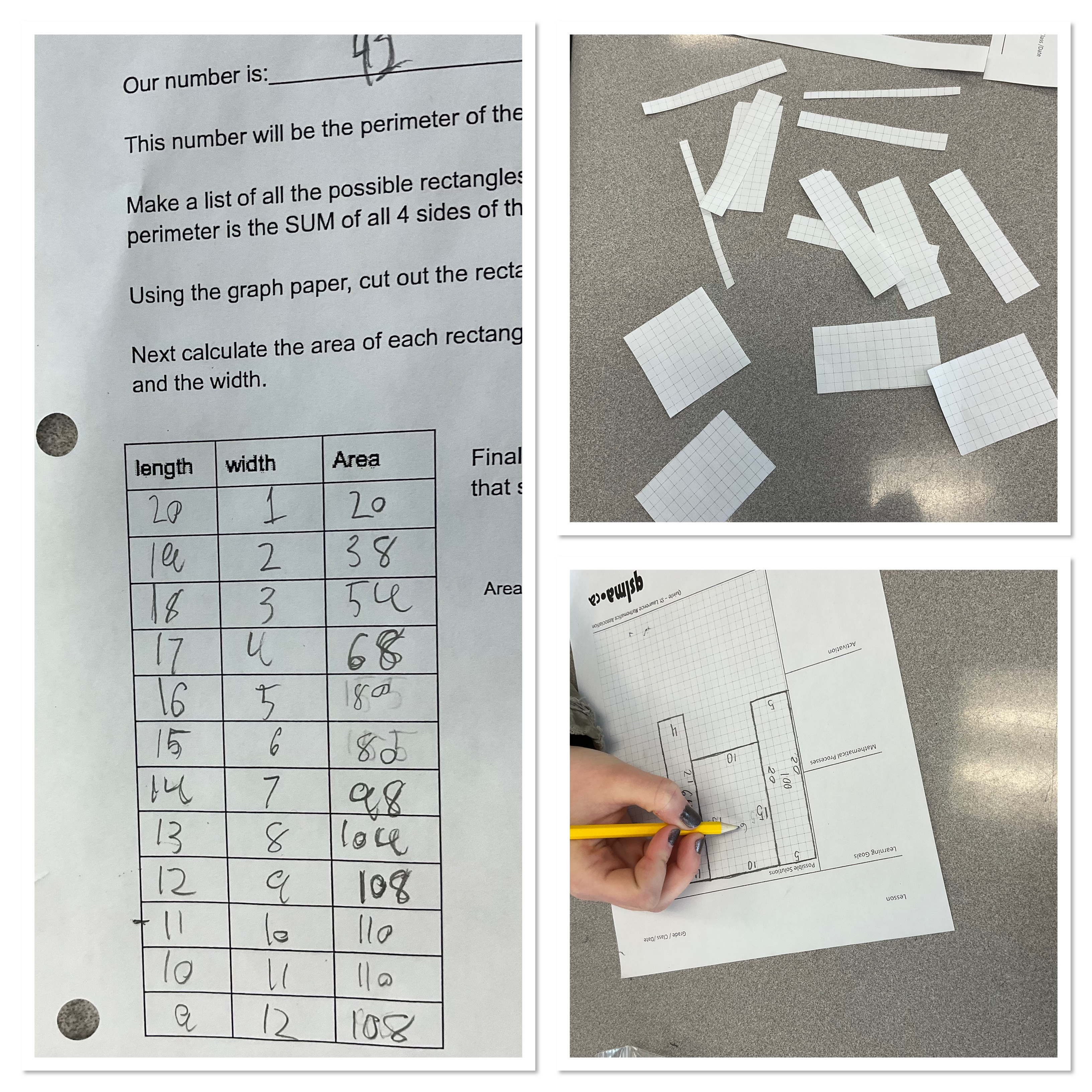
Next we cut out the rectangles and used them to graph the relationship between side length and area.
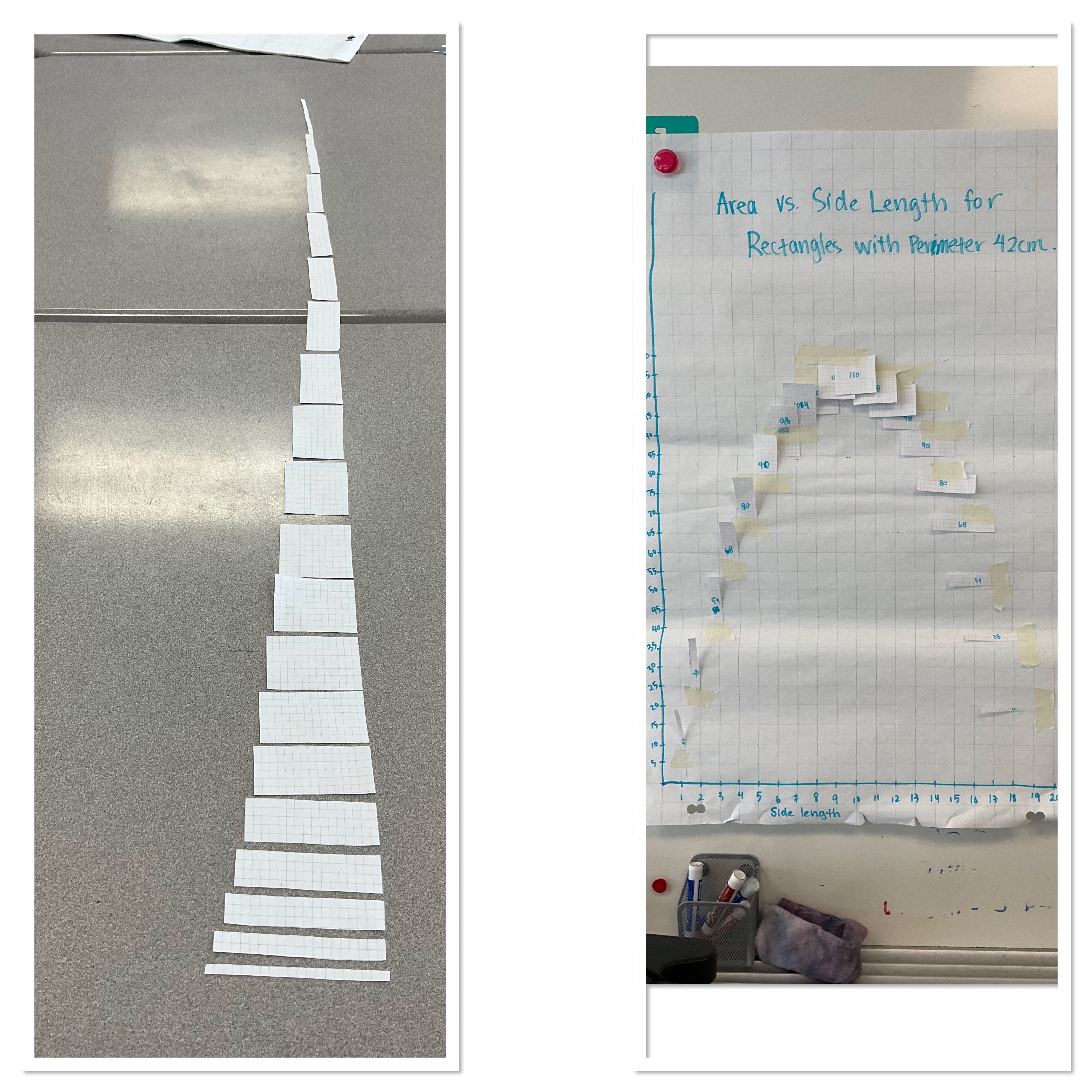
It was neat to see the quadratic relationship show up, and how the optimal area would be the square, which for a perimeter of 42 would have side length 10.5
It was a pretty fun task to do on a snow day, first day back from holiday.
Group Graphing
This lesson was inspired by reading this post on Al Overwijk’s blog.
We have been working on some quadratics on this spiral of grade 10 applied math. We have used algebra tiles and expanded and factored, and talked about the area model, and then explored the graphs on desmos. In our earlier spiral we talked about linear and non linear data and tables of values and trends that we see in the tables and graphs.
This task was a lot to take on for a Friday in December, but we did our best! I was thankful to have another adult in the room to support and keep the groups on task and moving forward. With a big busy class (24 students with a lot of needs) it would be a challenge to do solo.
As students entered the class and got situated into their random groups, each student was given a card with a decimal number from -3 to +3 and we started out by ordering ourselves in a row, in order. Next each student got tape and we made a well spaced out number line on our board. We talked about using integers as our ruler, and that the 0.5 is in the middle of 0 and 1, and the 0.25 is between 0 and 0.5. We are good at spacing out halves, quarters and 3 quarters which is what was needed for the functions I chose to graph.
We next got split up into 7 groups. Each group got assigned an x value to plug into each of the following equations. We used x values of -3, -2, -1, 0, 1, 2, 3
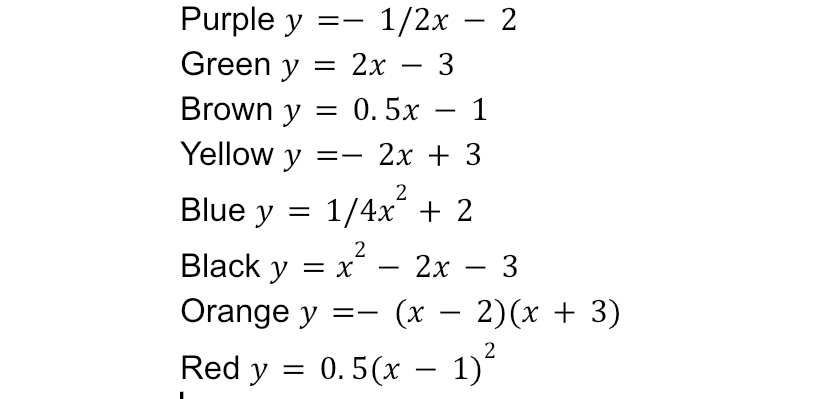
It took groups several tries to substitute and simplify using order of operations. The biggest challenge for some groups was correctly copying down the equation (many minus signs went missing), and then the issue of squaring negative numbers, or adding before multiplying caused challenges as well. It was very helpful for me and my colleague to have an answer key to help make checking work go quickly.

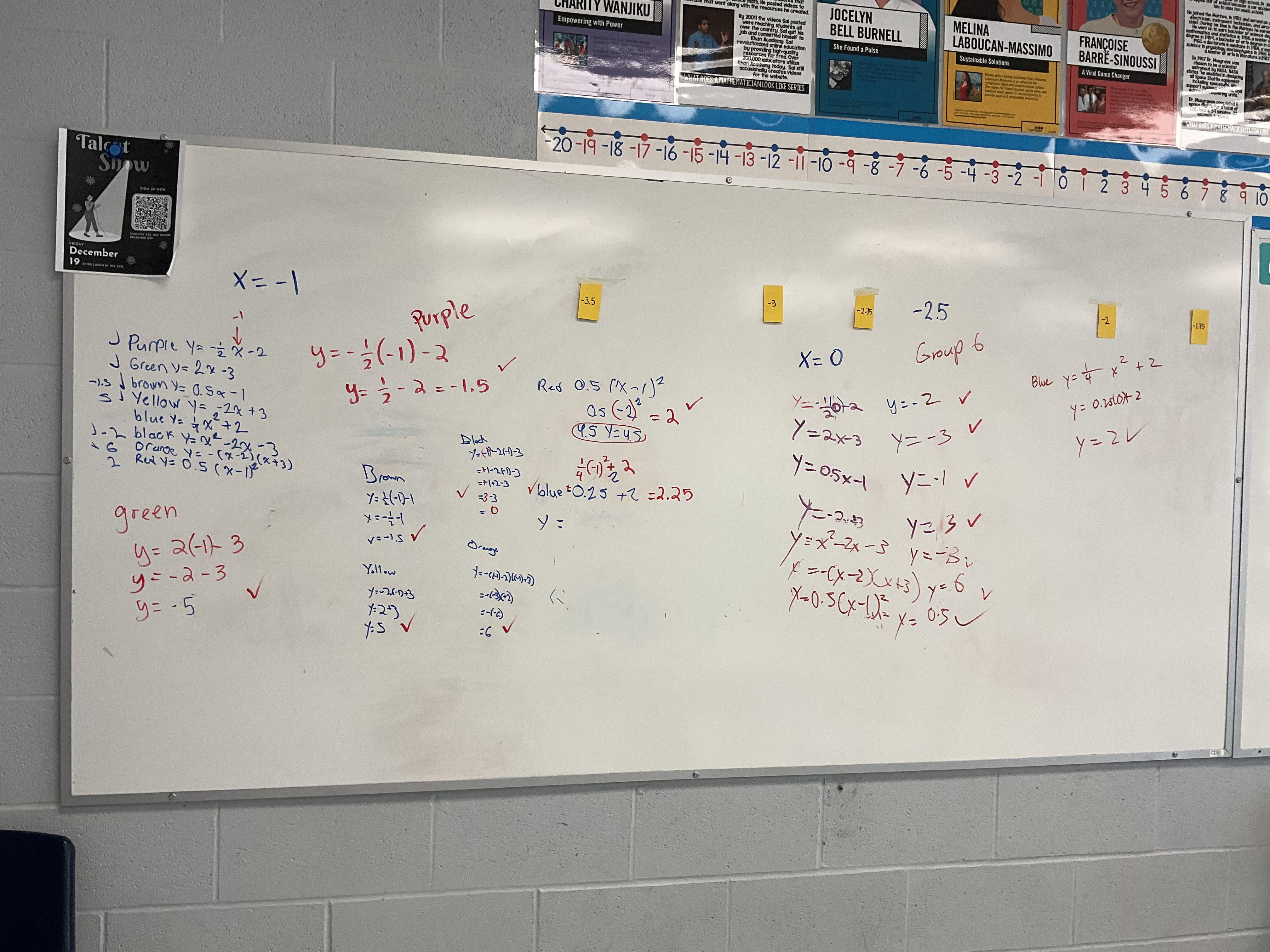
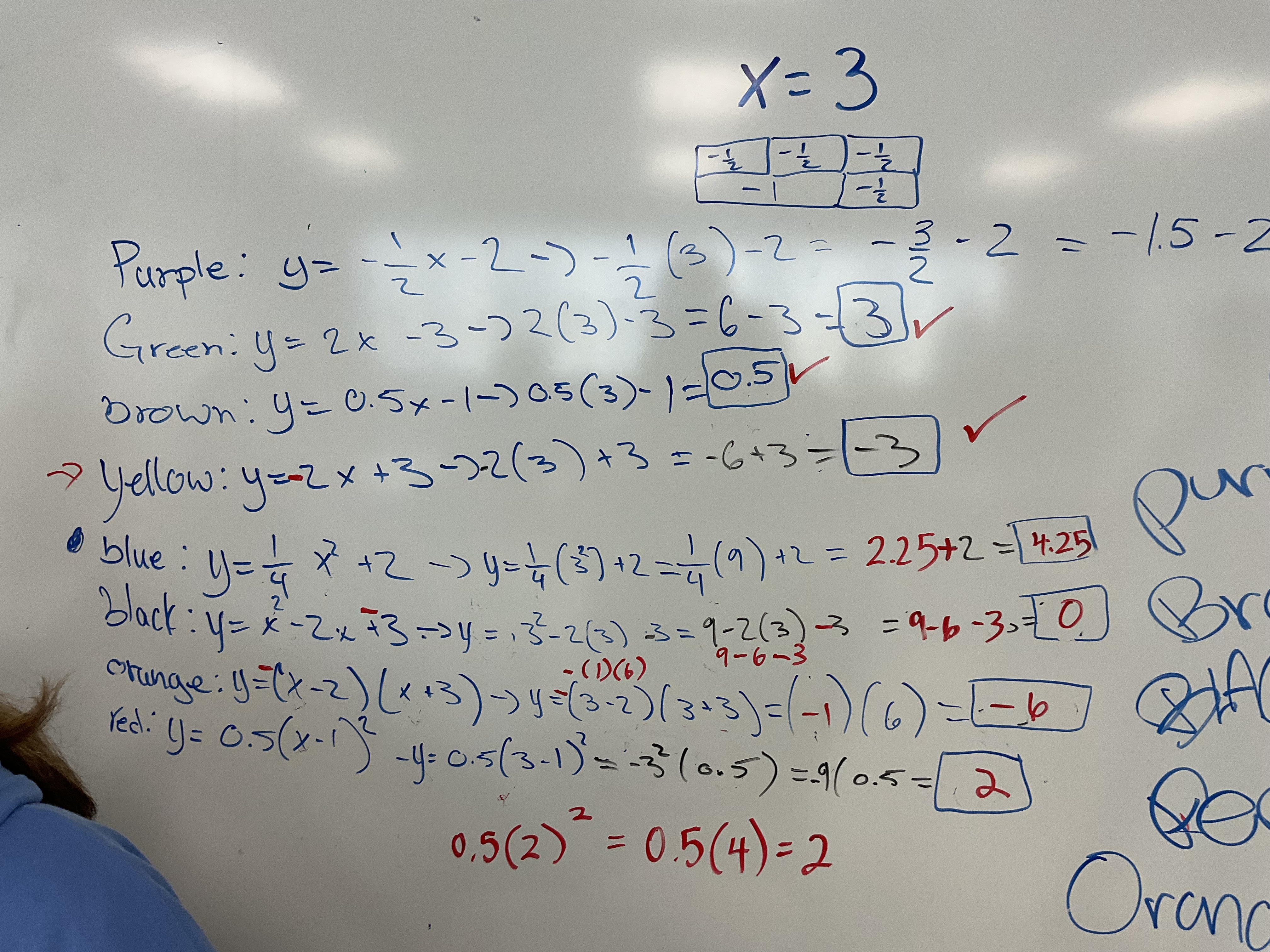

We’re working on showing steps and communicating our thinking. It was helpful for me to see the misconceptions so I know where to go from here next week when we consolidate the task.
Part 2 involved number lines. Each group got a number line with zero marked out. I cut strips from grid chart paper to make the number lines. They marked their points, then got the right colour marker and drew coloured dots on their number line.

The next step was to assemble the strips together. I taped them back onto a sheet of grid chart paper to help with spacing. I’m rethinking the scale of this, as it will be tricky to consolidate from as it is kind of small. Perhaps I’ll work from a projection of the image of the group graph to consolidate.

It looks a bit messy at first glance, but if you look carefully at one colour dot at a time, you can see the lines and curves take shape. If I were doing it again I’d have the students count each grid line as 0.5 to help us spread out the graph a bit more.
We will next explore the graphs, and use the tables of values and equations to identify key points of each equation, and features of the graph (slope, direction of opening etc).
We were mostly all engaged for most of the period, and even had some visitors in the room (grade 8s on tour, 2 v.ps and a colleague who popped by because it looked interesting). Many thanks to Al for writing his initial lesson study. I’m going to try this task with grade 9s and linear equations in various forms next!
Math Club For Grown Ups
We had our 3rd meeting of our math club for grown ups. Many thanks to all who attended and enthusiastically solved (or attempted) problems together.
We looked at 3 problems. The first was sourced by one of our students who needed a good challenge after their work was complete one day. We were led by a colleague who prompted us to think about our feelings as we were faced with this challenge.

We worked at it in small random groups for quite a while. I know that my group struggled with where to start, and if to work forwards or backwards, and we kept getting confused because we were instructed to NOT use BEDMAS which is hard.

We took a pause after about 30 minutes of struggle, and during that moment where we were considering our feelings, one of our groups solved it! (Spoilers ahead)

We next tackled the pirate question from Peter Liljedahl’s site.

We took time to explore the problem, and figure out how to keep track of our data and how to extend the patterns that we saw. Some groups didn’t want to start with 10 pirates, they started with a smaller case of 4 or 5 or 6, which in this case doesn’t clarify the situation as much as might be hoped. One group started off with a general case of n pirates which is quite an overwhelming task.
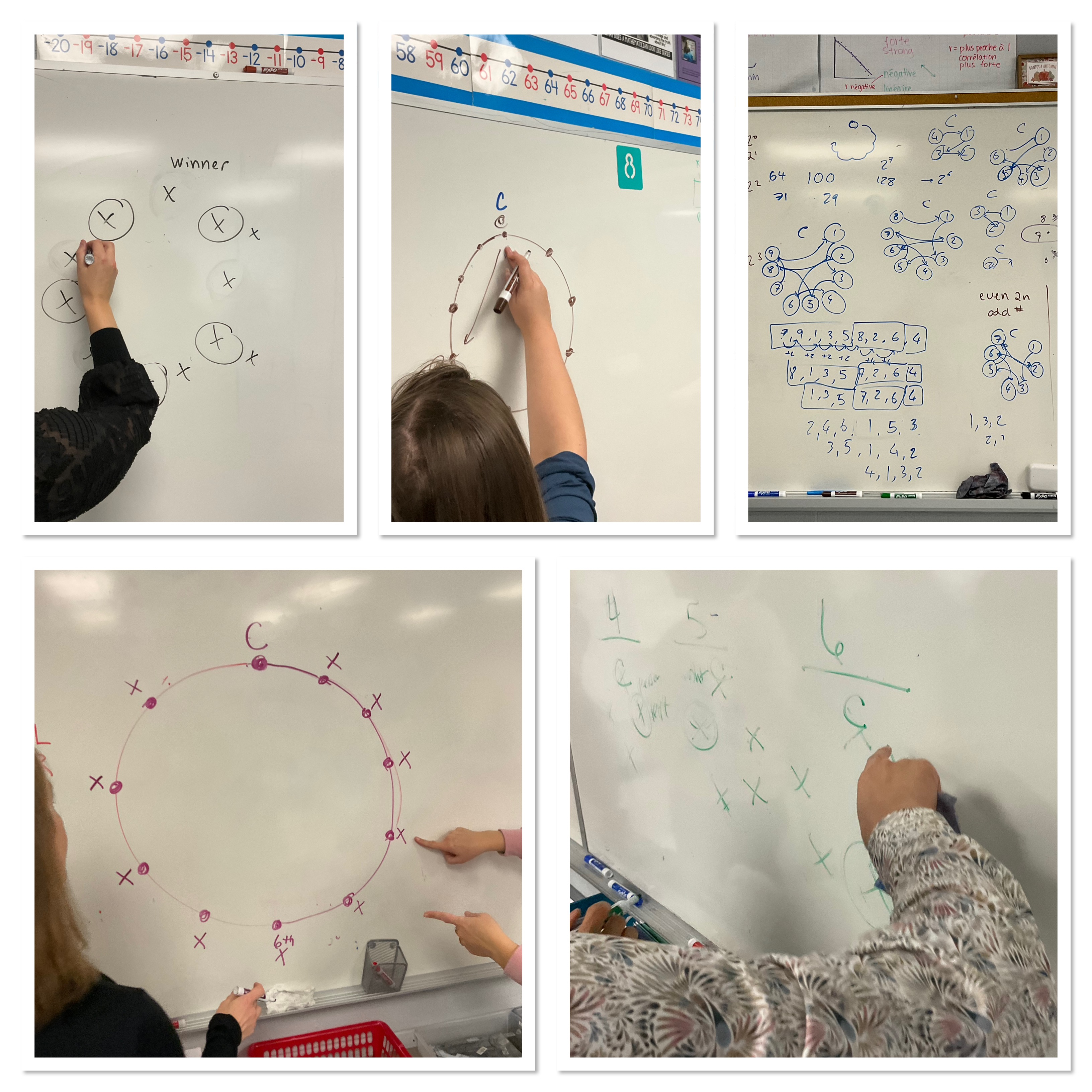
We made good progress, and left with people who were worried they’d wake in the night with new solution ideas!
The final task we looked at is how to use cup stacking in grade 9, 10, and 11/12 math as a way to explore and model linear, quadratic and cubic patterns.
Cups stacked in a single tower are a great linear model. Cups can be stacked from a desk to get a “b” value. If the cups are stacked in a nested fashion from the desk, and an upright/inverted fashion from the floor, you get a linear system that could be solved.
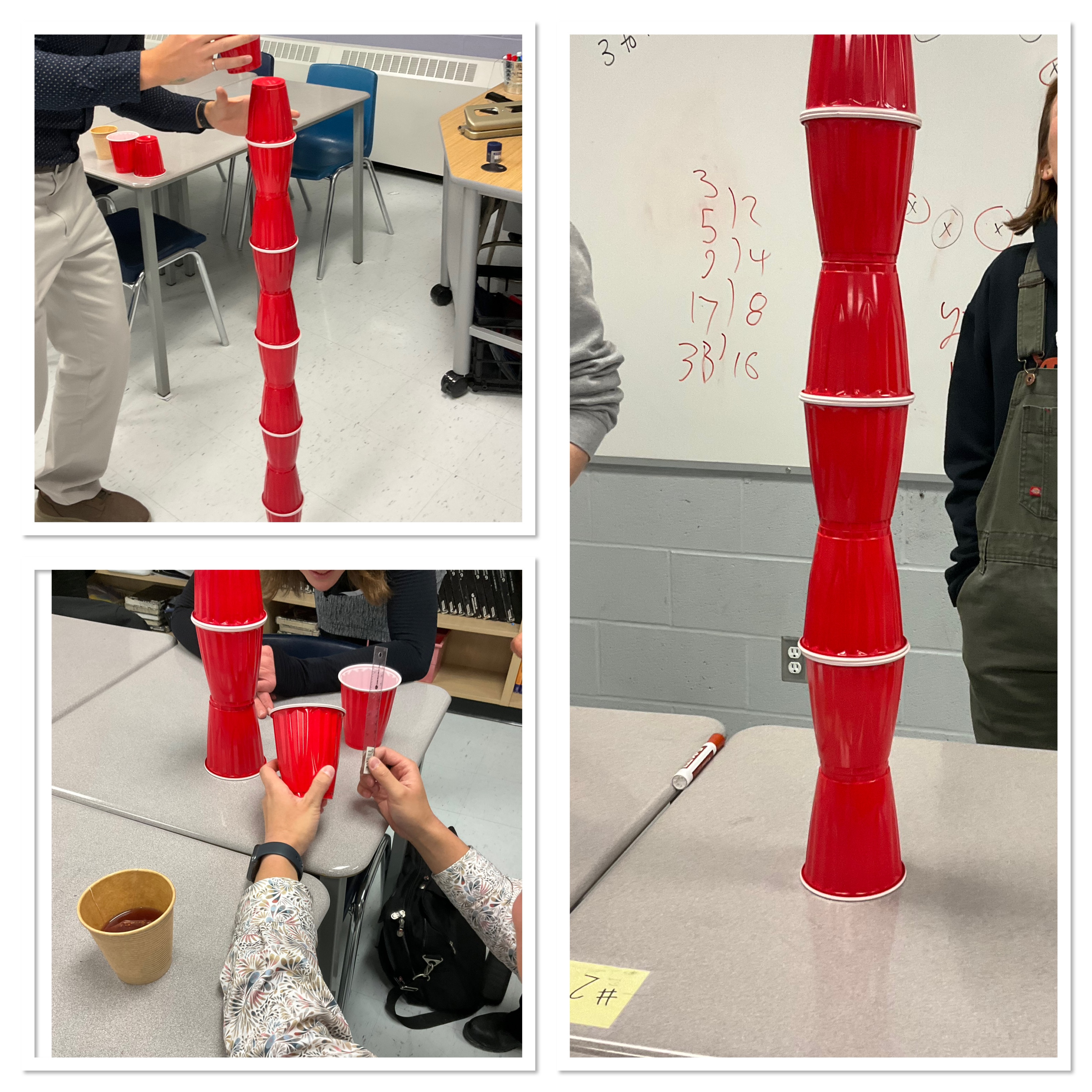
If cups are stacked in a triangle, it’s a quadratic model. Some good prompts would be: “How many cups are needed to make a triangle stack that’s a meter tall?” or “as tall as me?” or “how tall of a triangle stack could you make with 300 cups?”
The modelling could be done by hand for a 2D class or with desmos (there’s a nice regression button available now) for a 2P class.
If the stack is a pyramid (either square or triangle based) the model is cubic. This would be a good question for grade 11/12 functions or advanced functions to explore by hand and confirm with desmos.
It’s fun to be able to see and feel the model that you are making. There’s more sense making when you can see that there are so many more cups needed to make an additional row in quadratics compared to linear, and even more when using a cubic model.
I can see extensions where a cubic, quadratic, and linear model are all explored, looking for intersections. Different types of stacks could be built starting on desks or shelves or the floor to include different vertical translations.
I also brought in paper cups which are exactly half of the red cups (total fluke), but it brings about a nice conversation about the vertical transformation that occurs. The graph has a vertical compression, because each cup is half, so the entire stack would be half the height of the stack made with the red cups. I look forward to the chance to try this with my next sr. math class.
Desmos makes noise!
Desmos makes noise. I let my class know that I remember making graphs tat could be heard, to help people with visual impairments understand what graphs “look like” but with sound. I had forgotten how to do it, but sure enough my grade 10s figured it out within 5 minutes and were exploring what parabolas sounded like. At this point I knew we could either stick to my lesson plan (and have it be derailed every 30 seconds by a “noisy parabola”) or to just go with it, and explore graphs in a very different way than I had ever done with a class.
We used the graph y=(x+2)(x-5) as our starting point and listened to the graph.

It makes a static noise as it traces part of the graph. We had to replay it a few times to figure out when the sounds changed (static is when the graph is below the x axis, negative y values). It make a brighter sound for part of the graph, we figured out when that happens (positive x values). We then figure out how to make the static sound longer or shorter by changing what’s in the brackets. Students made connections to how the factors control where the parabola crosses the x axis (the goal of my lesson) but achieved in a different way than anticipated.
We looked at how there could be a whole family of parabolas that crossed the x axis at the same spots (we added an “a” value and then used a slider to show how the graph changes as the “a” is positive and negative, big and small, and of course we ended up animating it).
We made connections between factored form and standard form, and looked at what information from each equation is shown on the graphs.
There were some connections made between how factored and standard form are different ways of describing the same relationship, similar to how we can describe area or dimensions of an algebra tile rectangle.
Pirate Math
Today was a snow day for us, and when the school buses don’t run there are far fewer students who come to class. Today I wanted to explore a problem that I hadn’t led before, it’s one of Peter Liljedahl’s good questions.
10 pirates are disbanding, and although they could easily split their gold, they cannot split a very precious diamond. The pirate captain wants to rig a “fair” way to decide who gets the diamond. They all stand in a circle and the pirate captain points to someone in the circle who is out of the running (they take their gold and leave). The person to their left is in the running, but the next in the circle to the left is out. Every alternate person to the left will leave the circle until only one person remains. Who should the pirate captain point to so that he himself ends up with the diamond.
The extensions are: what if there are 12 pirates, or 11 pirates, or 18 pirates, or 5 pirates, or 6 or 7 pirates.
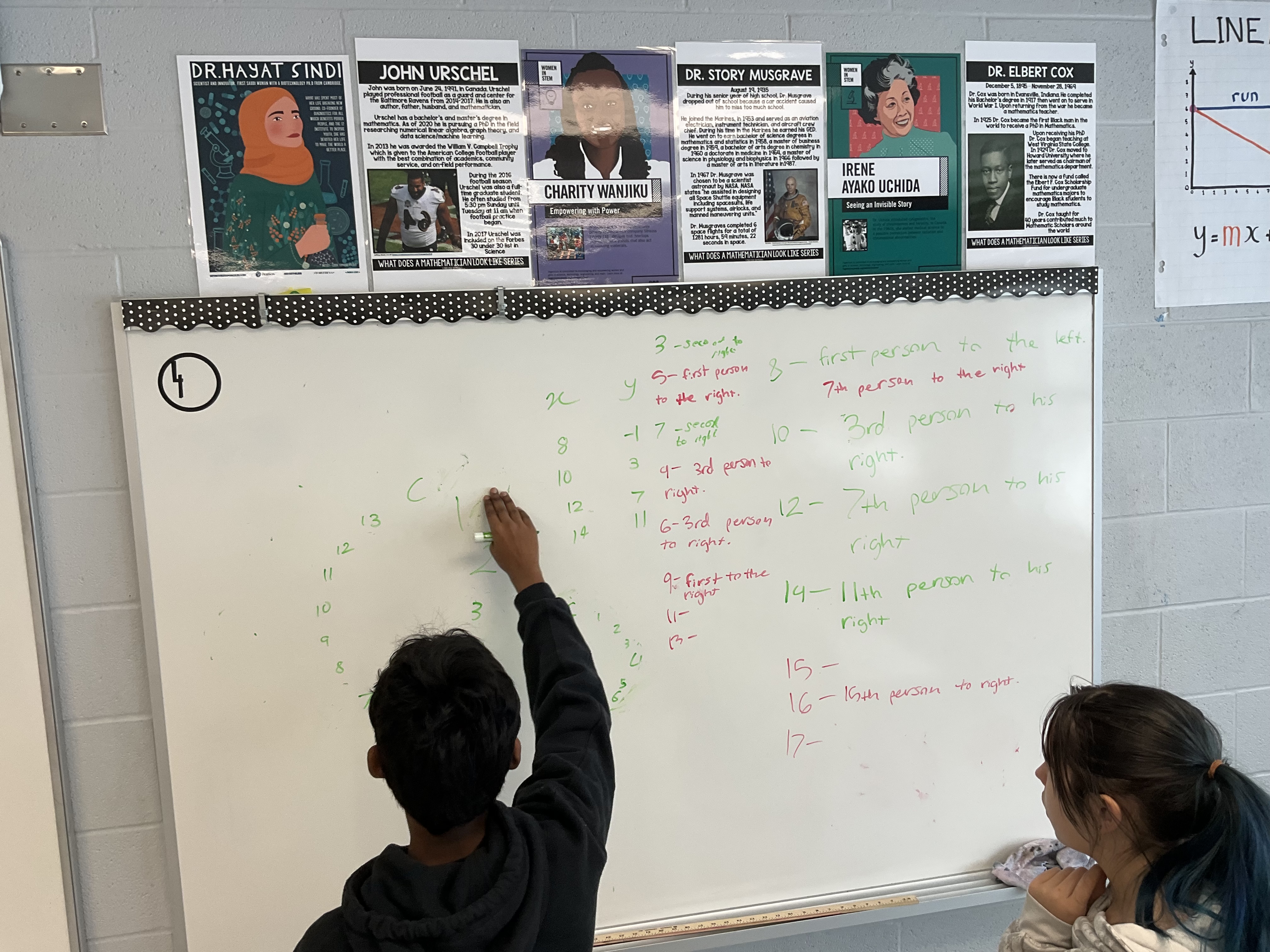
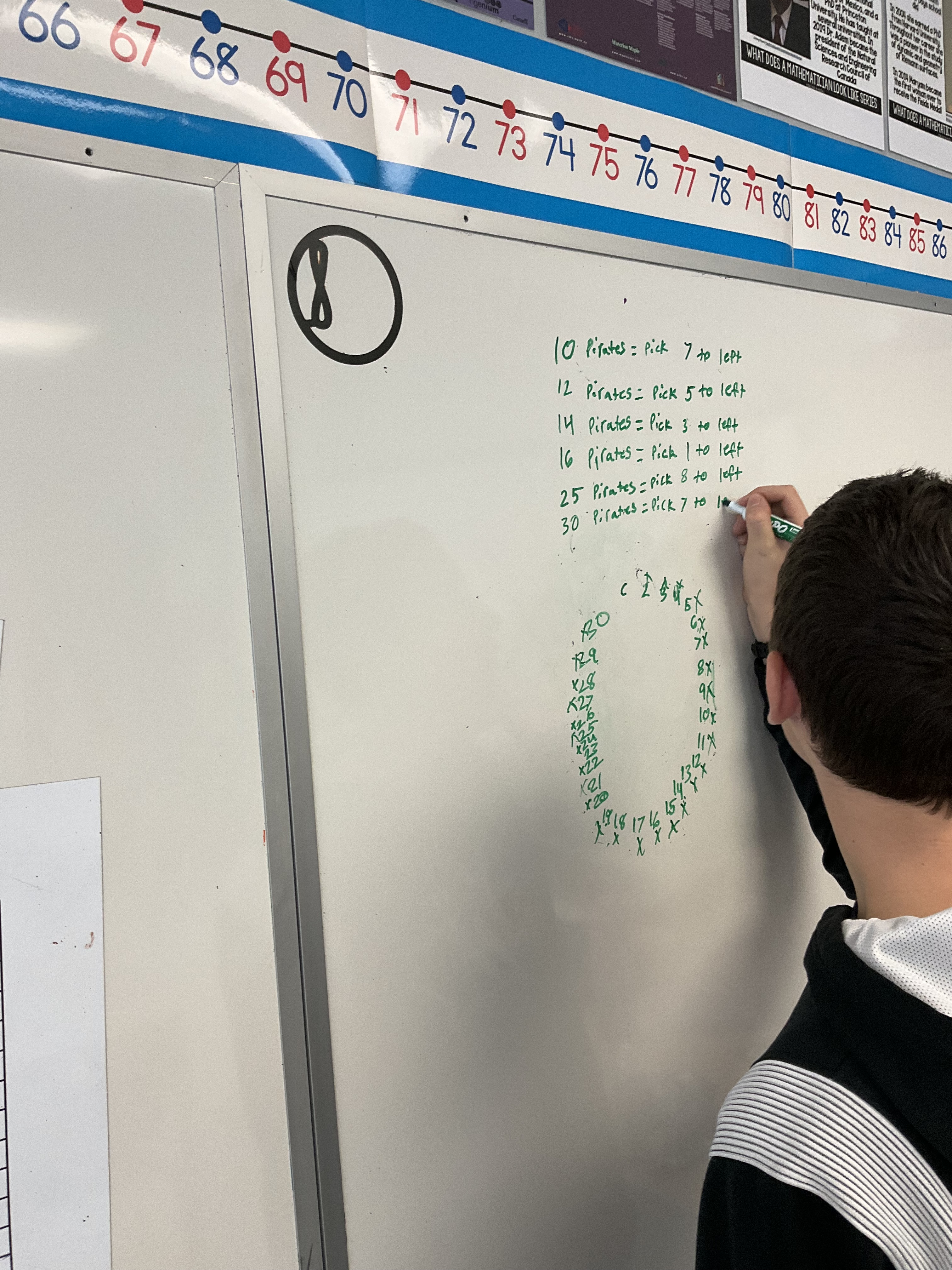
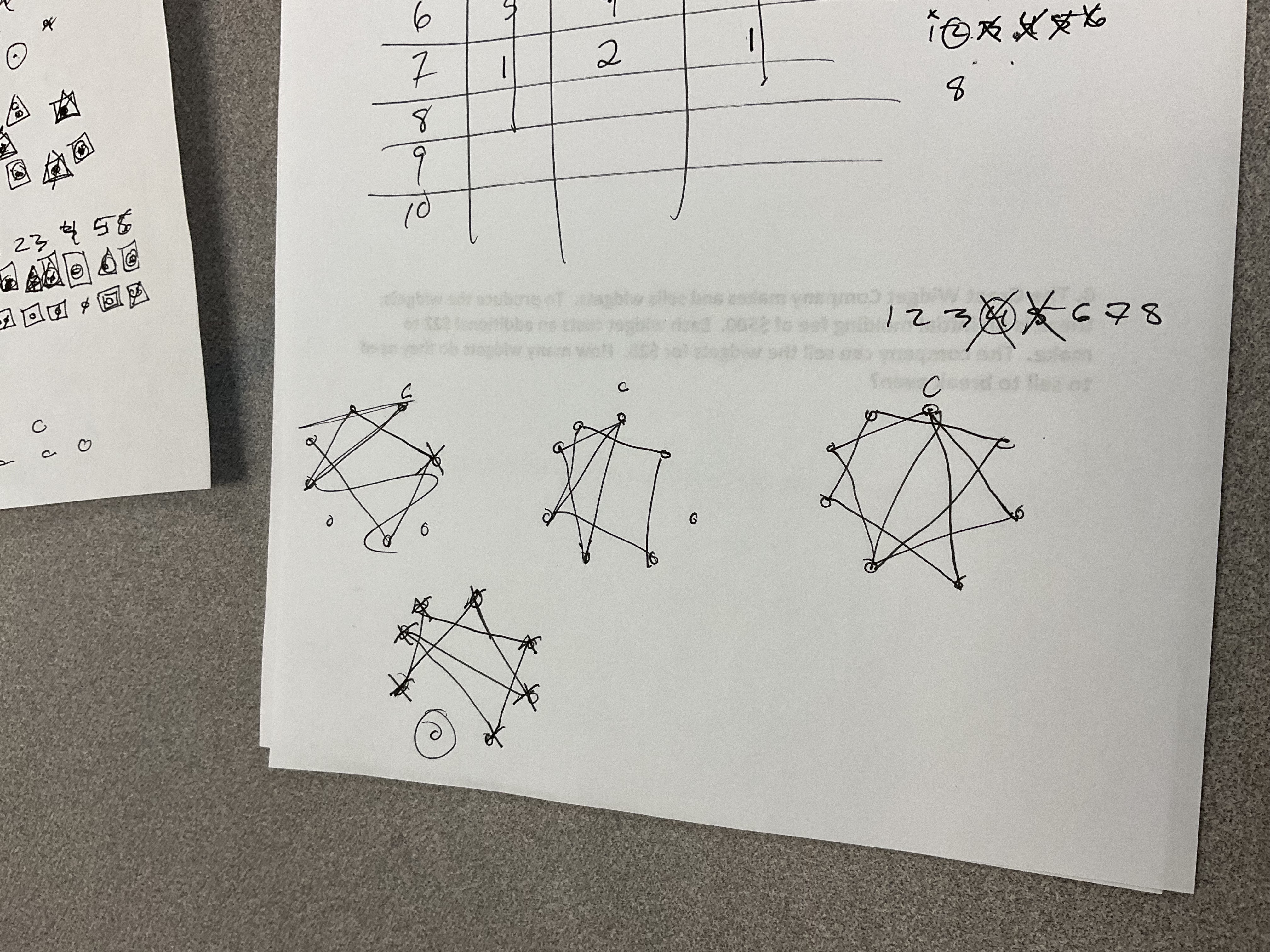
We needed to decide on a common way to discuss the issue, and came up with tracking how many spots to the right or left of the captain that he should point to start the eliminations. We worked on ways of drawing and tracking information, and then looked for patterns.
Without too much prompting students (grade 9 and 10s and 12s) dug in and modelled the problem, then made some connections. Some tried to make equations and graphs and extend their thinking and test predictions. We ran into some challenges, but persevered! Some teachers even came to try out the pirate math.
Pretty good for a snow day!

