Intro to Patterning
We started looking at patterning today and how to determine pattern rules and make graphs and tables of values from visual patterns.
we can extend a pattern in both directions to find figure 4 and also figure 0
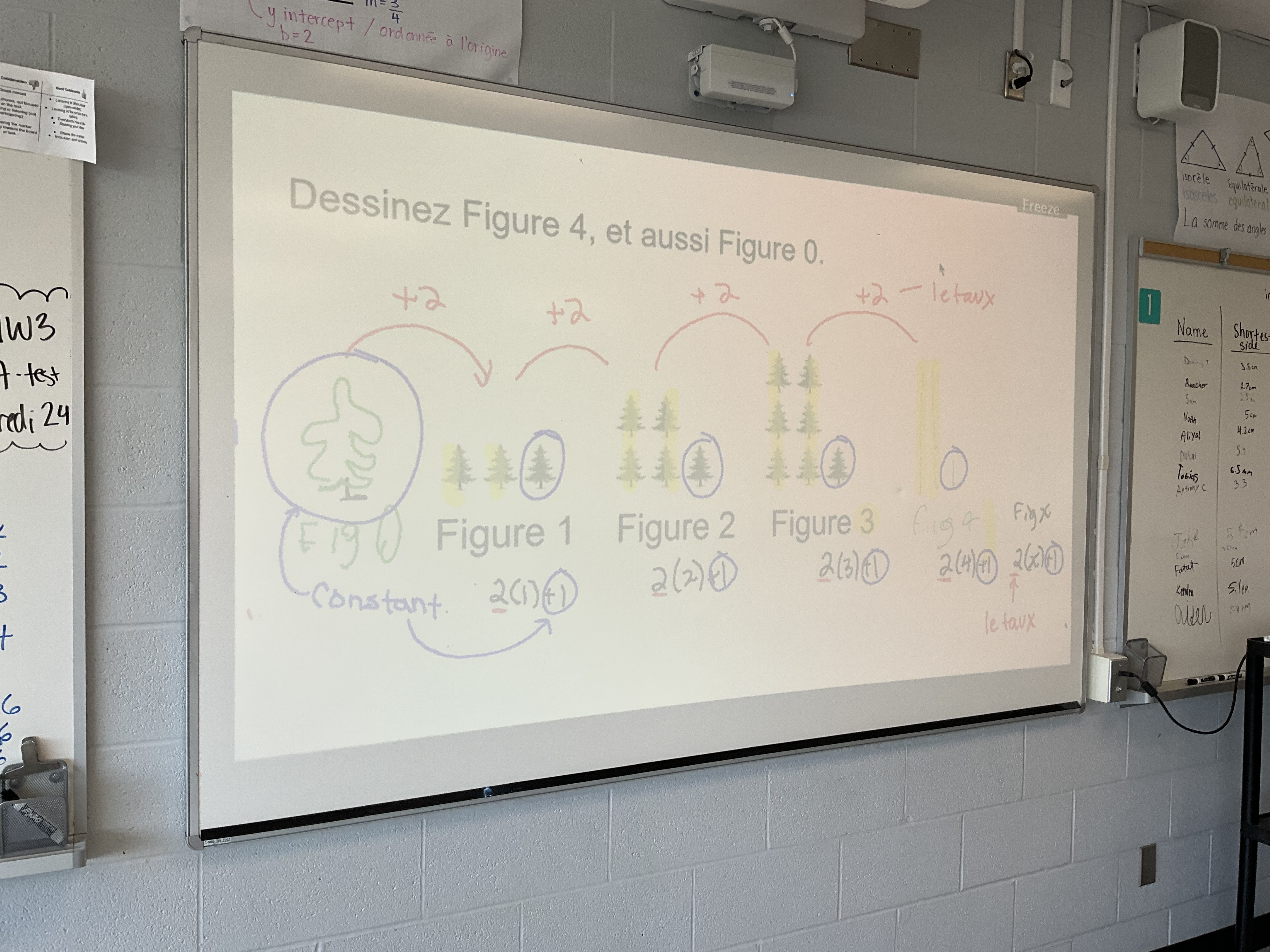
We noticed that the pattern increase is +2 each time. That can also be seen as 2 groups of the figure number in this pattern (the vertical columns of trees). We noticed that figure 0 is 1 tree. That’s the solitary tree that is alone on the left of each (circled in blue).
We thought about how to figure out how many trees are in figure 10. We know that we’d add 2 10 times, or that we’d have 2 columns of 10 trees, and then we’d have the 1 extra tree on the side. We could do that for figure 100 as well…
figure 100=2(100)+1
we can go from here to make the equation for figure x (this would be a neat time to introduce function notation…I didn’t think of it at the time though)
figure x=2(x)+1
we just replace the 100 with x and get the equation!

We put the data in a table and noticed the rate/slope and the constant (figure 0) in the table. We then put the points on the graph and noticed the slope (rise and run) and the constant (y intercept) on the graph.
We next had a challenge to build a pattern around the “figure 2” that was given
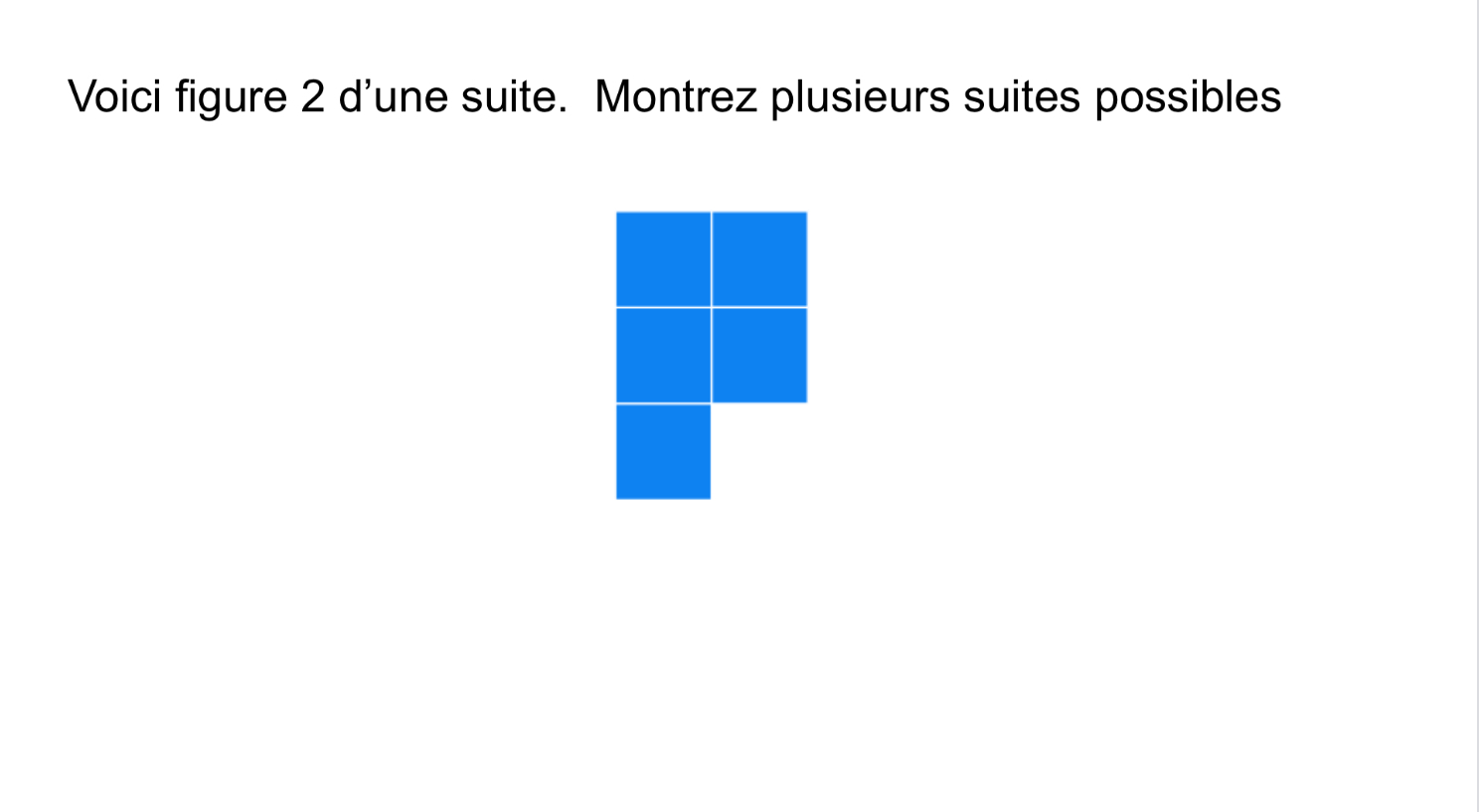
Here are some of the patterns and the analysis we did. We made the pattern rules for our classmates work. This one is y=3x-1
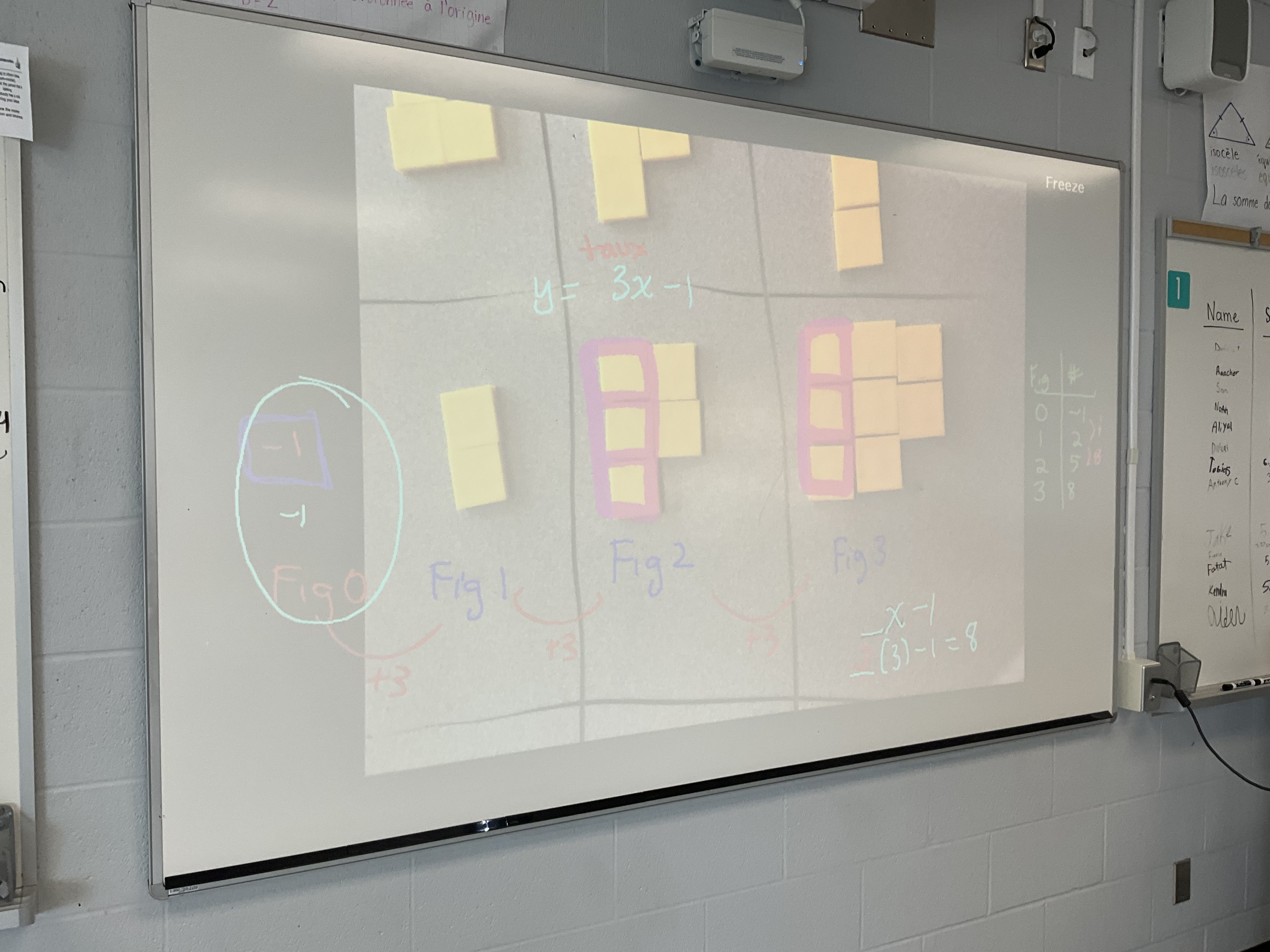
This one had an oopsie in figure -1, which we corrected, but for this one we see that the rule is y=2(x)+1

It was great to see the creativity that the class had in creating different patterns.
We had some time to try to analyse patterns on our own, and we made good progress with our new skills. We’ll keep practicing tomorrow and maybe see some non-linear patterns too.
Similar Triangles
Today in MFM2P we started learning about triangles. We reviewed how to use protractors and rulers, and the students were tasked with creating a right angle triangle that had a 30 degree angle in it.
we needed quite a refresher about how to use a protractor to design our triangle, and how to measure angles.
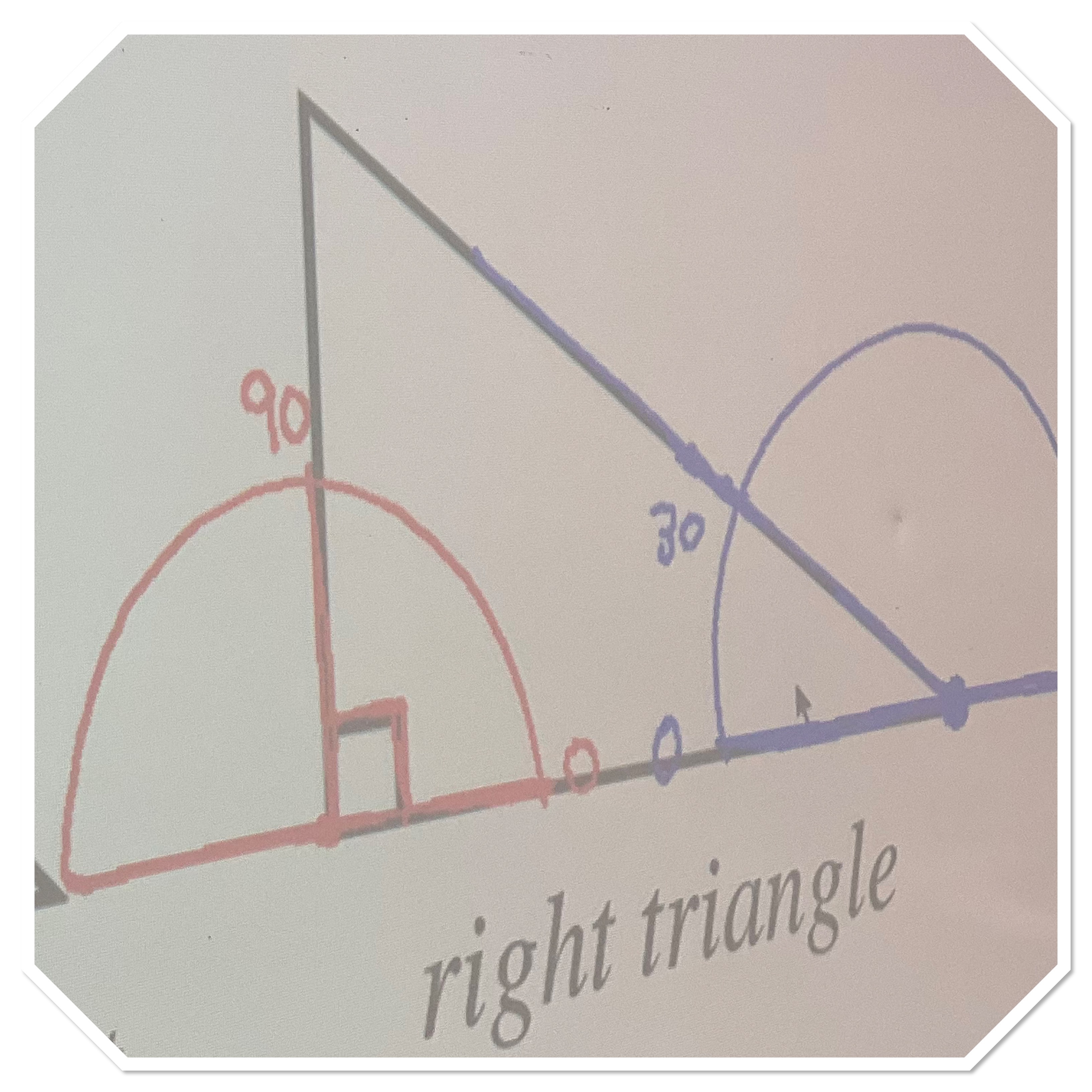
The next challenge was to use a ruler and carefully measure the length of each side to the nearest tenth of a centimeter.

We talked about triangle vocabulary. We know that angles can be acute obtuse or right, and that these triangles that we made were all scalene. They are also all similar since they have the same angles. Since they have the same angles their sides will be proportionate.
We checked that theory by calculating the ratio of sides. We noticed that the small side divided by the long side was always about 0.5, the middle side divided by the long side was about 0.87 and the small side divided by the middle side was about 0.57. It didn’t matter what size our triangles were, the sides were all scaled up (or down) proportionally.
We’ll keep working on ratios and proportions and use that to solve problems moving forward in triangles and other contexts.
Catching up
Grade 9s have been working hard, and busy with lots of activities outside of class, and during class time. We took today as a day to catch up and complete some of our unfinished tasks.
Some worked hard to get their beading completed. We are almost fully off the looms, which is good because another class will soon be using them.

We also had time to finish up questions and graphs from our bottle task, and from our 5 minute frenzy multiplications earlier this term.

We wrote our 6th email update home, and also did a quiz to see how much algebra we remember.
Tomorrow we continue on with new learning, but sometimes it feels good to work hard and catch up all the loose ends.
Expanding and Common Factoring
Today in my 2P math class we were working on expanding and common factoring using the area model. We did a warm-up where we needed to fill in the blanks to understand how we can multiply with the area model.

We then connected the idea to multiplying with algebra and the area model. We looked at how to fill in the blanks inside the box, or outside the box.
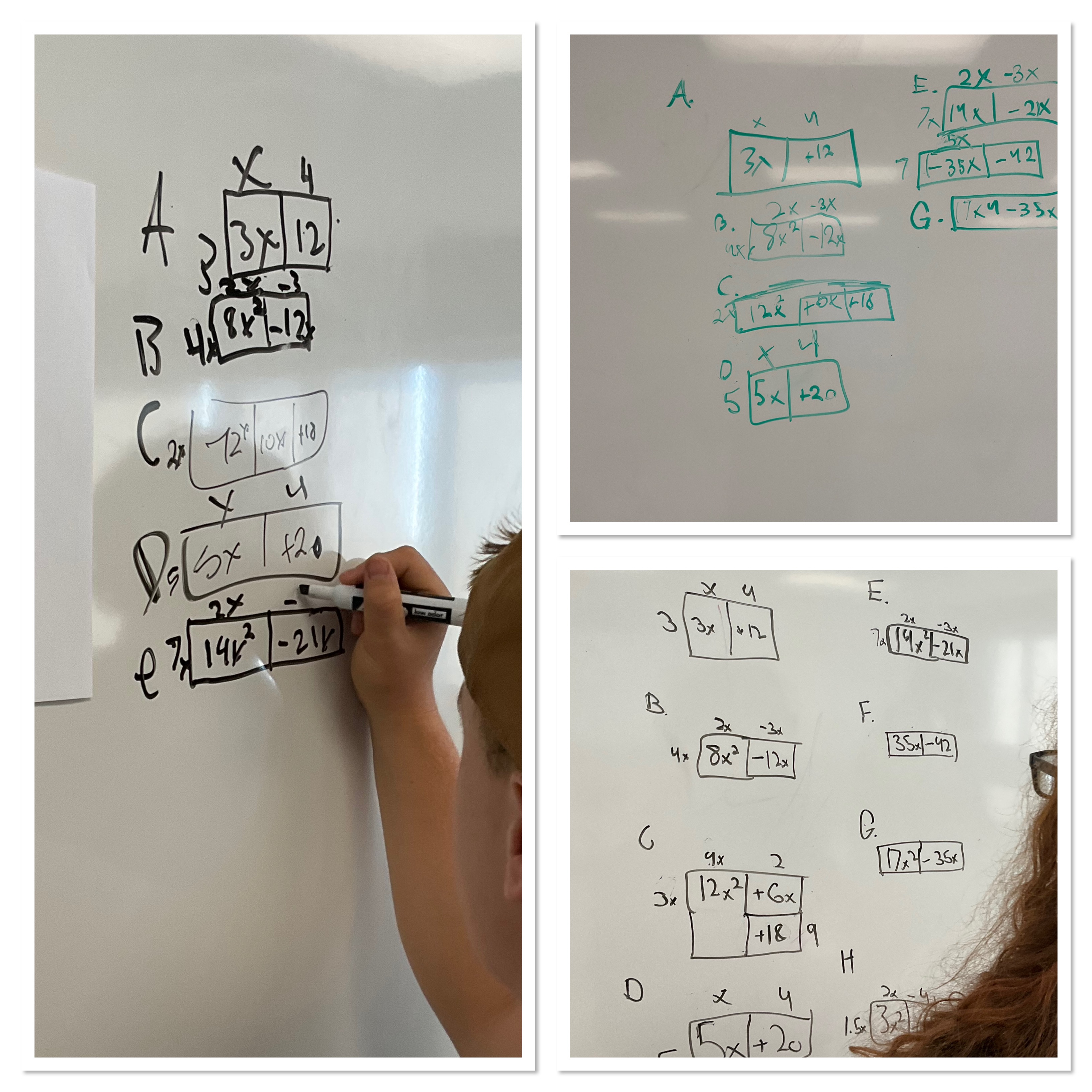
Class was cut short due to a pep rally, but we’ll keep working on this tomorrow as well.
What’s My Rule?
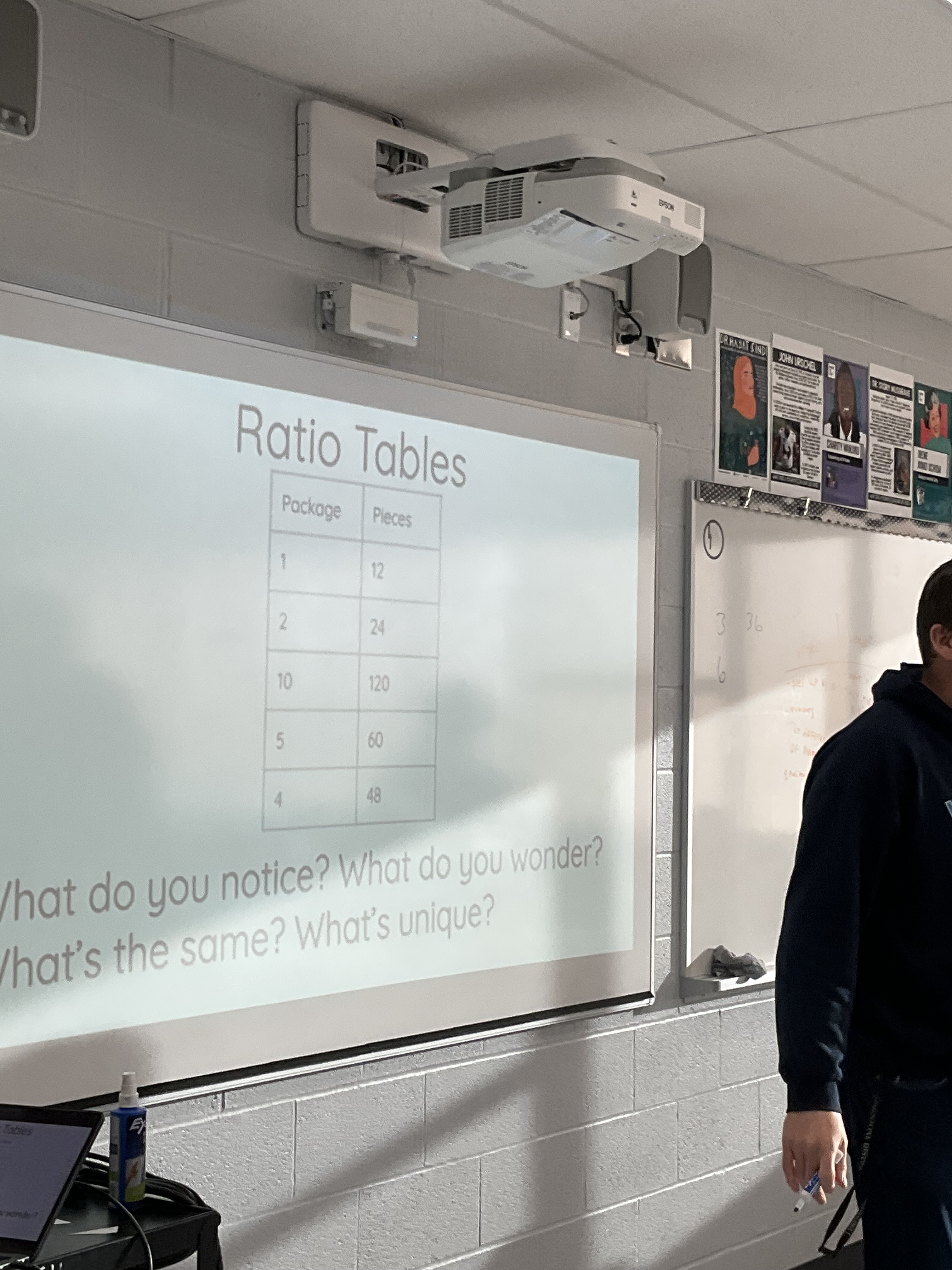
Today I was in a MTH1W class that was working on ratio tables and understanding the pattern rule being shown.
Starting with a fully complete ratio table, the class looked for patterns: some noted that the right side has even numbers, others noted that one package was 12 pieces and 2 packages had 24 pieces, you’d double one to get two, and double 12 to get 24. The “double double” became a refrain for lots of observations. We can double the 2 to get 4, and double the 24 to get 48. We can double the 5 to get 10 and double the 60 to get 120.
The class then tackled a partly filled in ratio table, completing it and looking for patterns.
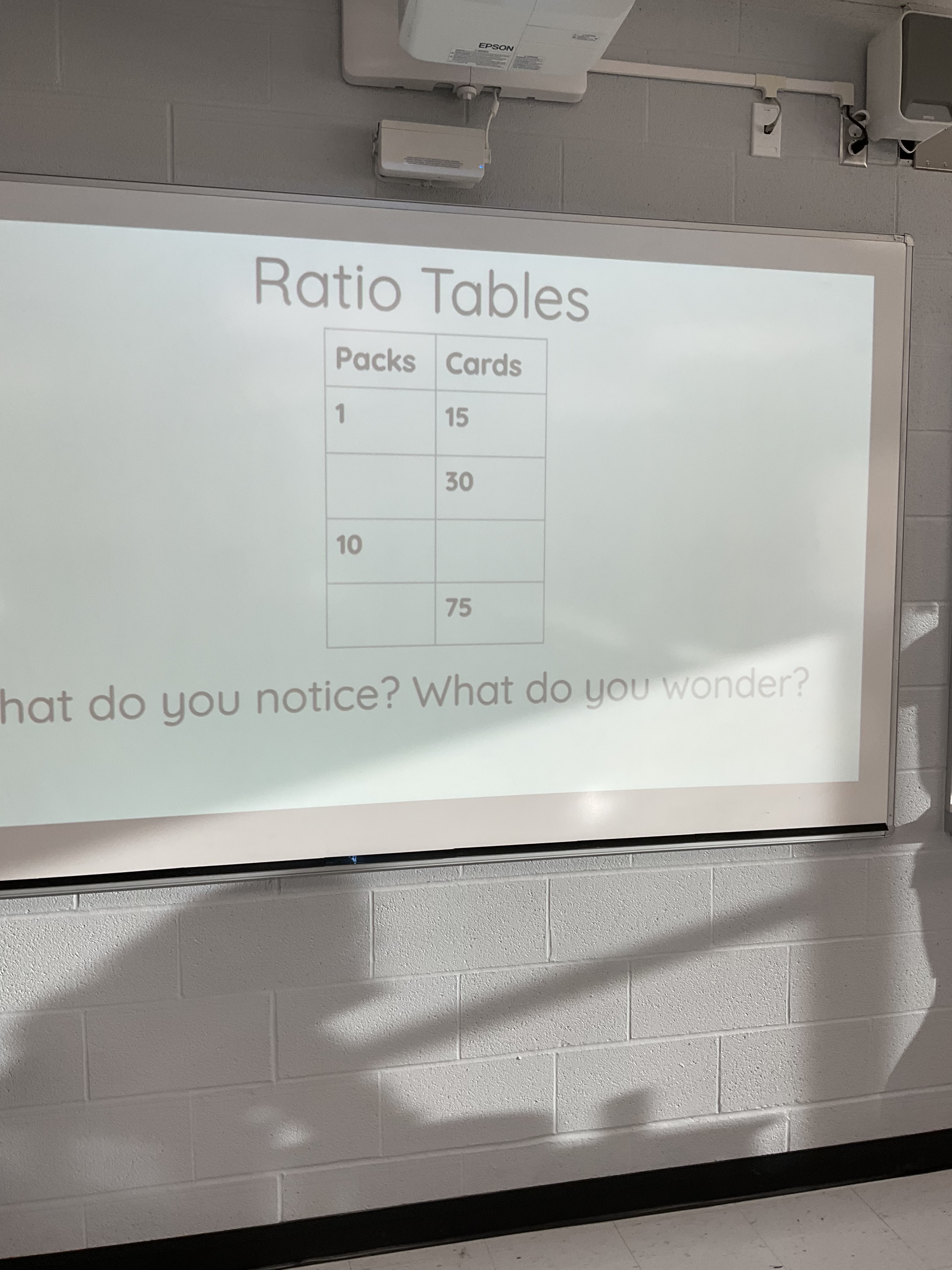
Students filled in the charts and even continued them farther using their patterning skills.

Next students were walked through an input-output table and were guessing the rule. The rule was that the input was tripled to get to the output. I didn’t get any photos of that process. The students then were tasked with building step 1,2,3 of a pattern where the figure number is multiplied by 5.
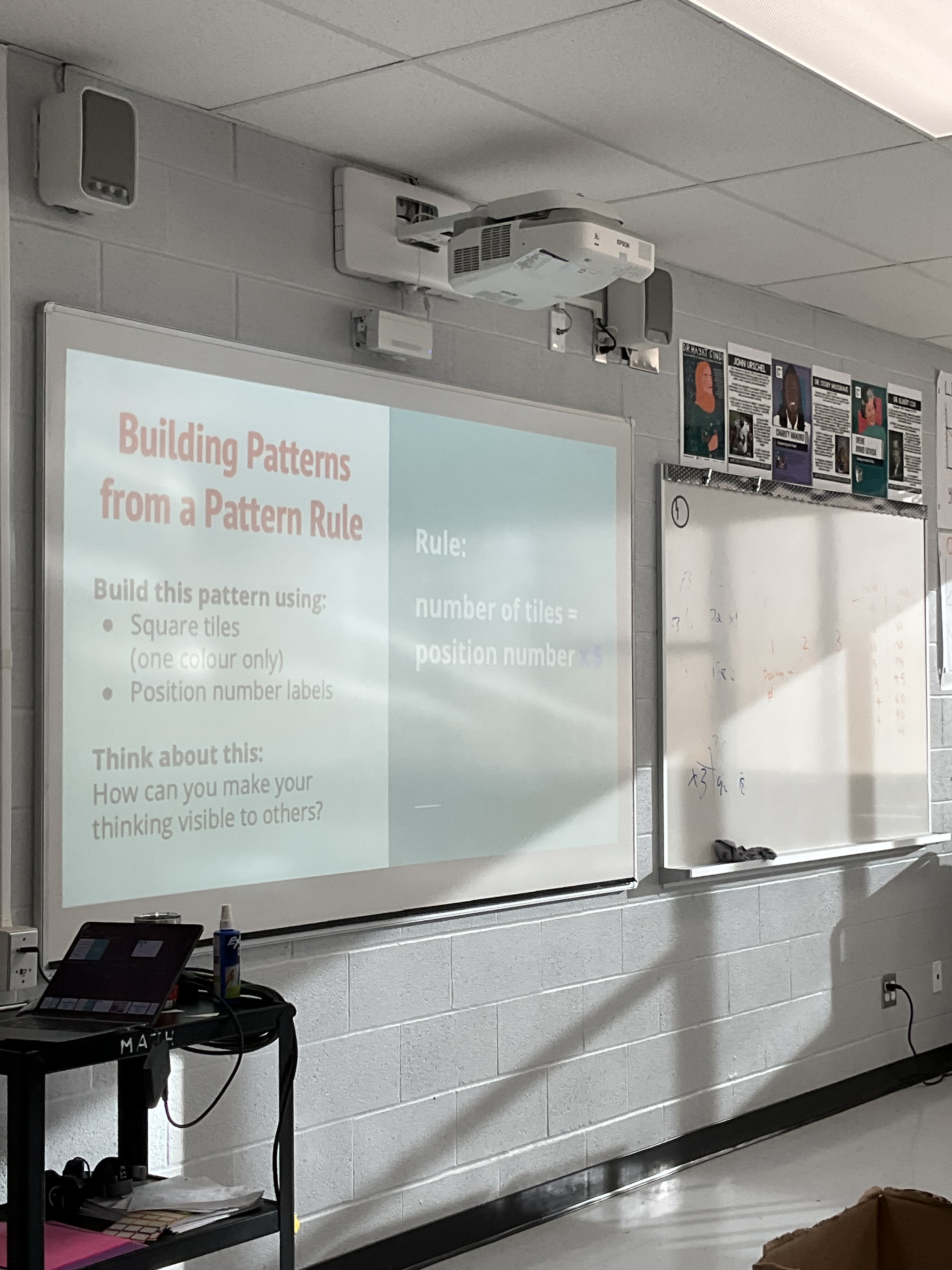
Students used the square tiles ro build each figure number. Some showed the thinking in an array, others made piles.
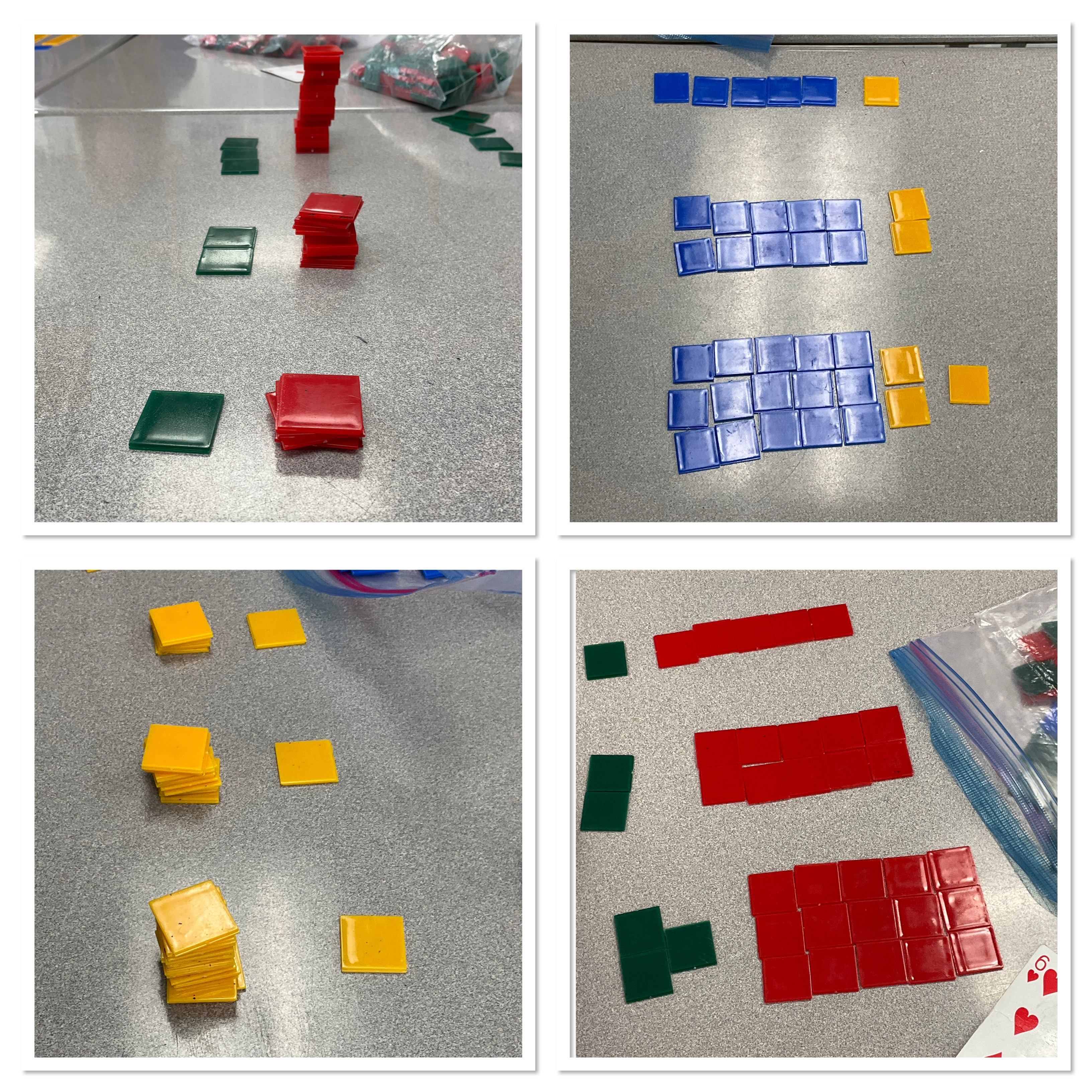
The next step in the sequence was to do another input-output table, to guess the rule.

Students guessed that we’d be multiplying by 5.5 to get from 4 to 22. There was a conversation about how to do distributive property, and how we’d multiply 4 by 5.5 by multiplying 4 by 5, and then 4 by 0.5 then adding them up.

The next reveal showed us we needed some rethinking.

We needed a bit more…we needed to multiply and add this time. Students were able to figure it out after seeing a few inputs and outputs.

The next challenge was to create their own input output tables to see if others could guess the rules. Some of the rules were pretty creative, using multiple operations, and some even used exponents. One was extra tricky because one of the tables had a calculation mistake! (Ooopsie).

The class went around trying to guess the other groups rules. Some of them were pretty tricky!

It was great to see the participation, first thing in the morning. Students are engaged, and working hard, and sharing their thinking with the class. They are taking challenges and running with them, often pushing the learning into new and unexpected areas.
Fraction Fluency
Today in Grade 10 applied math we went back in time to around grade 5, when these students had the covid shut downs and online classes. This meant that their learning and understanding of fractions was limited.
We spent some time using strips of paper to fold equal parts, and explore what the fractions are.

The first few were easy, but there were challenges folding fifths and tenths. We drew and identified each unit fraction as we went.

We noticed that as the number of pieces got bigger the denominator got bigger, and the pieces got smaller.

We looked at vocabulary related to fractions and remembered words like numerator and denominator. We remembered that fractions are like division. We also learned a new word that the line between numerator and denominator is called a vinculum. A vinculum is also the little line used over a repeating decimal.
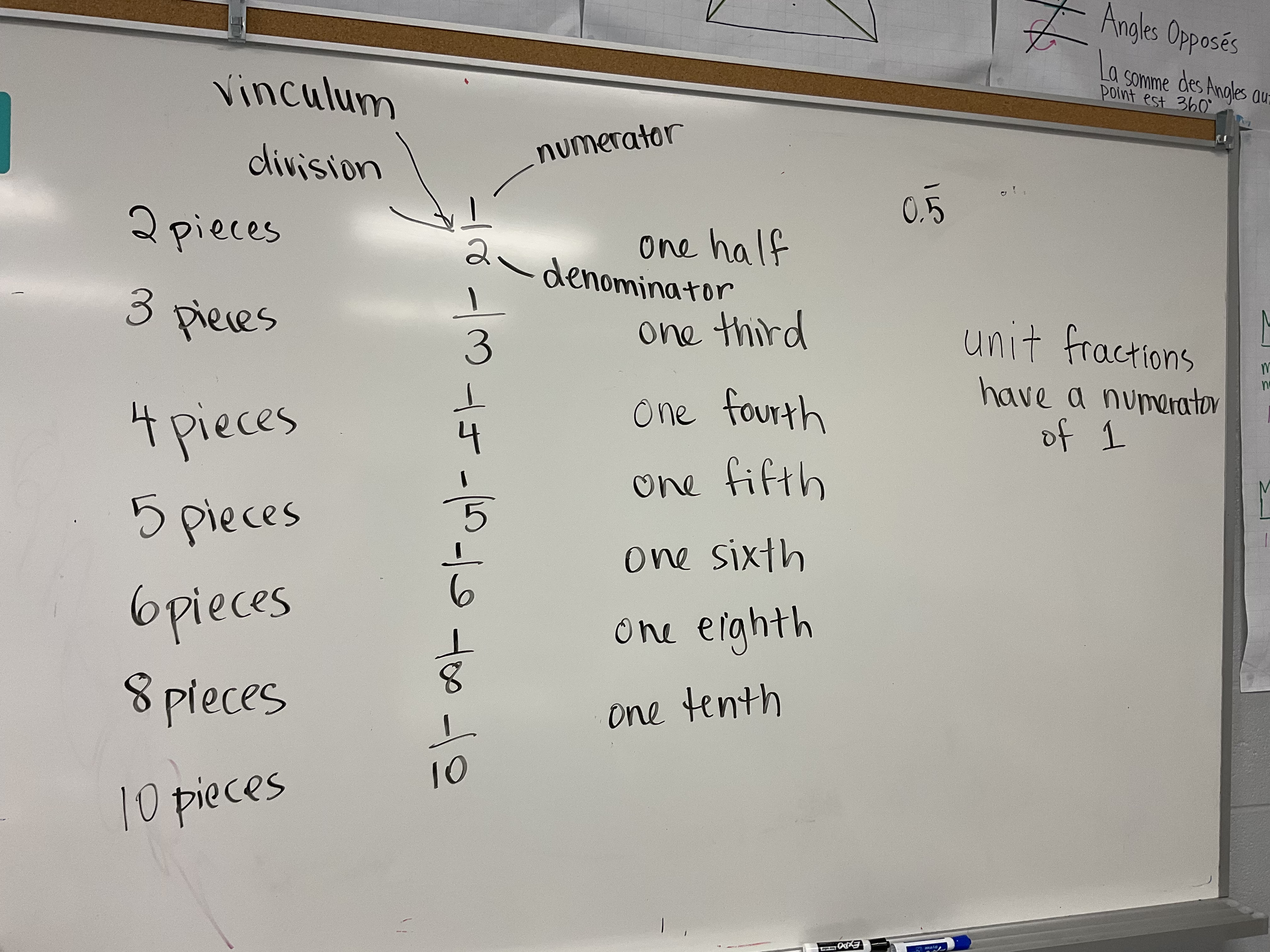
We looked at how we could make equivalent fractions. We noticed that even numbered denominators work nicely to make equivalents to one half.

we noticed that these fractions that are equivalent to one half have numerators that are half of the denominator, or denominators that are double the numerator. We even made some equivalent fractions that used really big numbers like 500/1000=1/2.

Guest Post
This is a post about an activity that I didn’t get to witness, but I heard about in the planning stages, and saw pictures of the fun. The grade 10 class was introducing the equation of a circle.
They started by building right angle triangles with a hypotenuse of 20cm, and a uniquely specified side length. Some worked in red, others pink, others blue, and others purple.
The triangles were all put up into one big picture on the board. One acute angle was on the origin, and one of the legs of the triangle was on the x axis. Blue and purple went into the negatives, and red and pink were positive values.
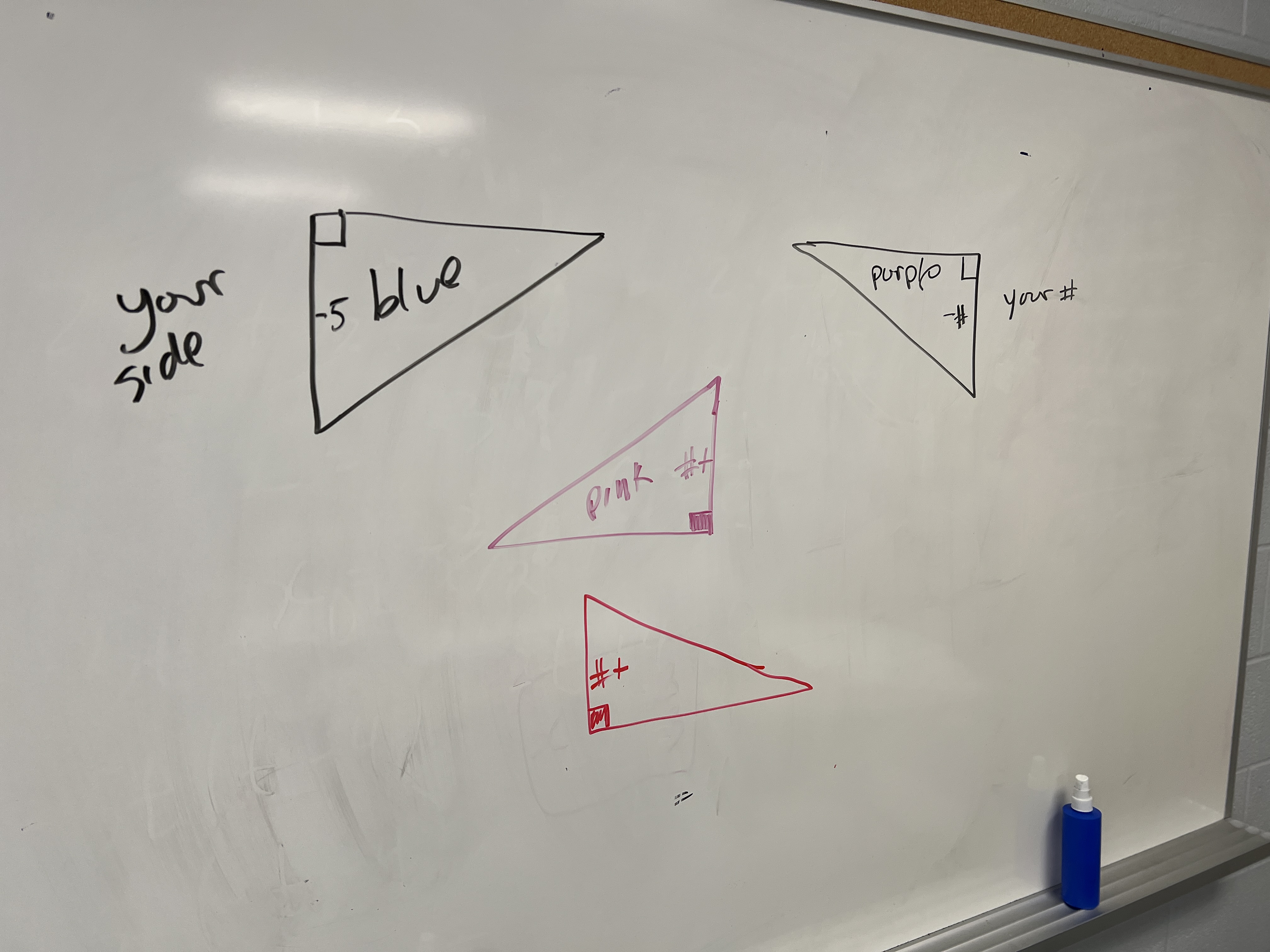
When placed, together there began to be some patterns emerging.
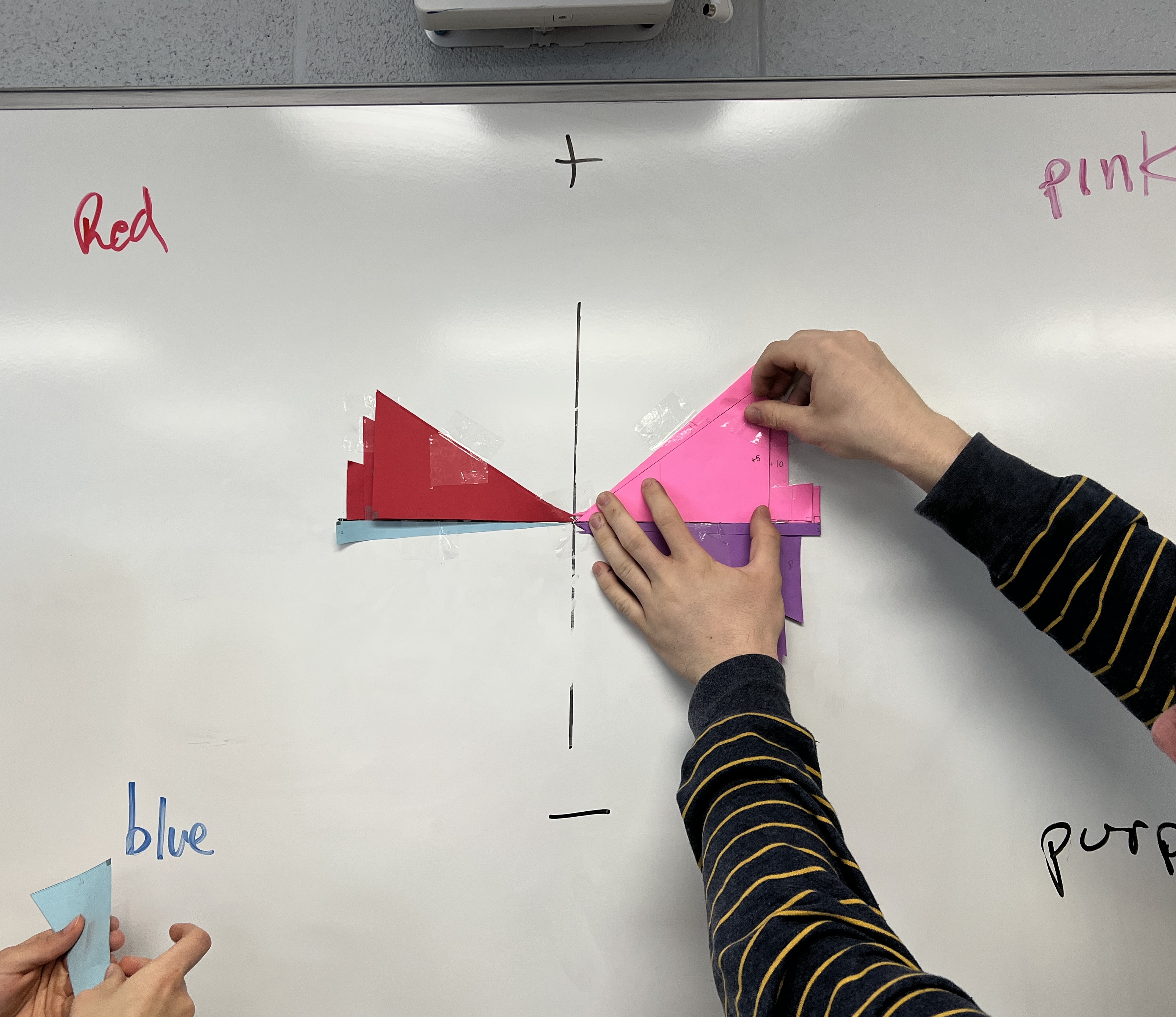
Not only did they see that each of the quadrants had triangles, they noticed that some were longer, and some were taller. More triangles were made to fill in the gaps, and to see the shape that emerged.

There’s a circle that forms. The coordinates of the point on the circle come from the side lengths (x and y) of the perpendicular sides of the right triangle. The radius is the hypotenuse of the right triangle.
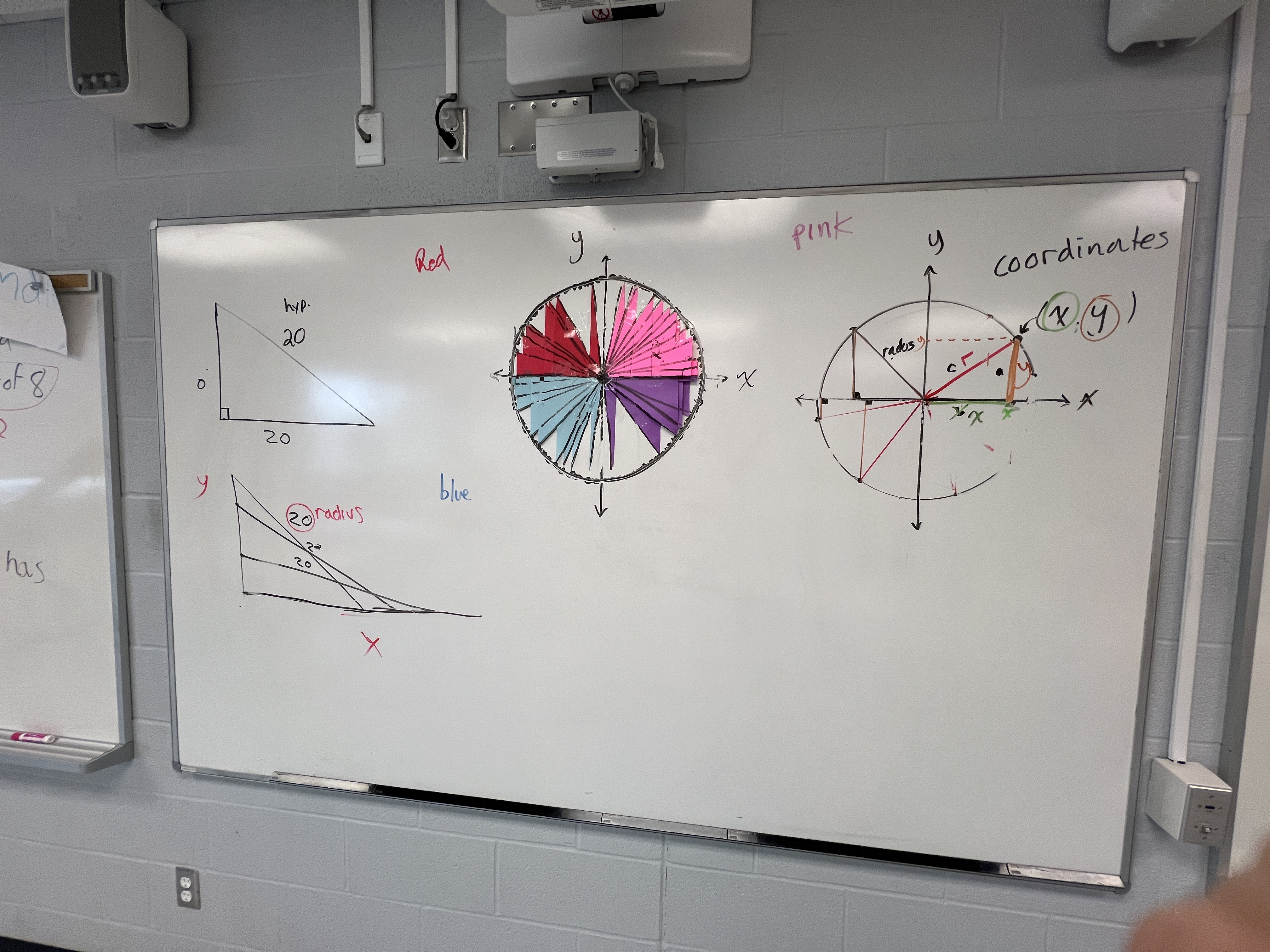
This was a neat way to connect ideas about right triangles and access some of that prior knowledge, and connect it to new learning about circles. By working hands-on everyone was participating and contributing to building the over-all picture.
I’m looking forward to trying this when I teach 2D again.
Exploring Exponents
Today grade 9s had a chance to build exponent models. We looked at representing x squared and x cubed using toothpicks and plasticine.

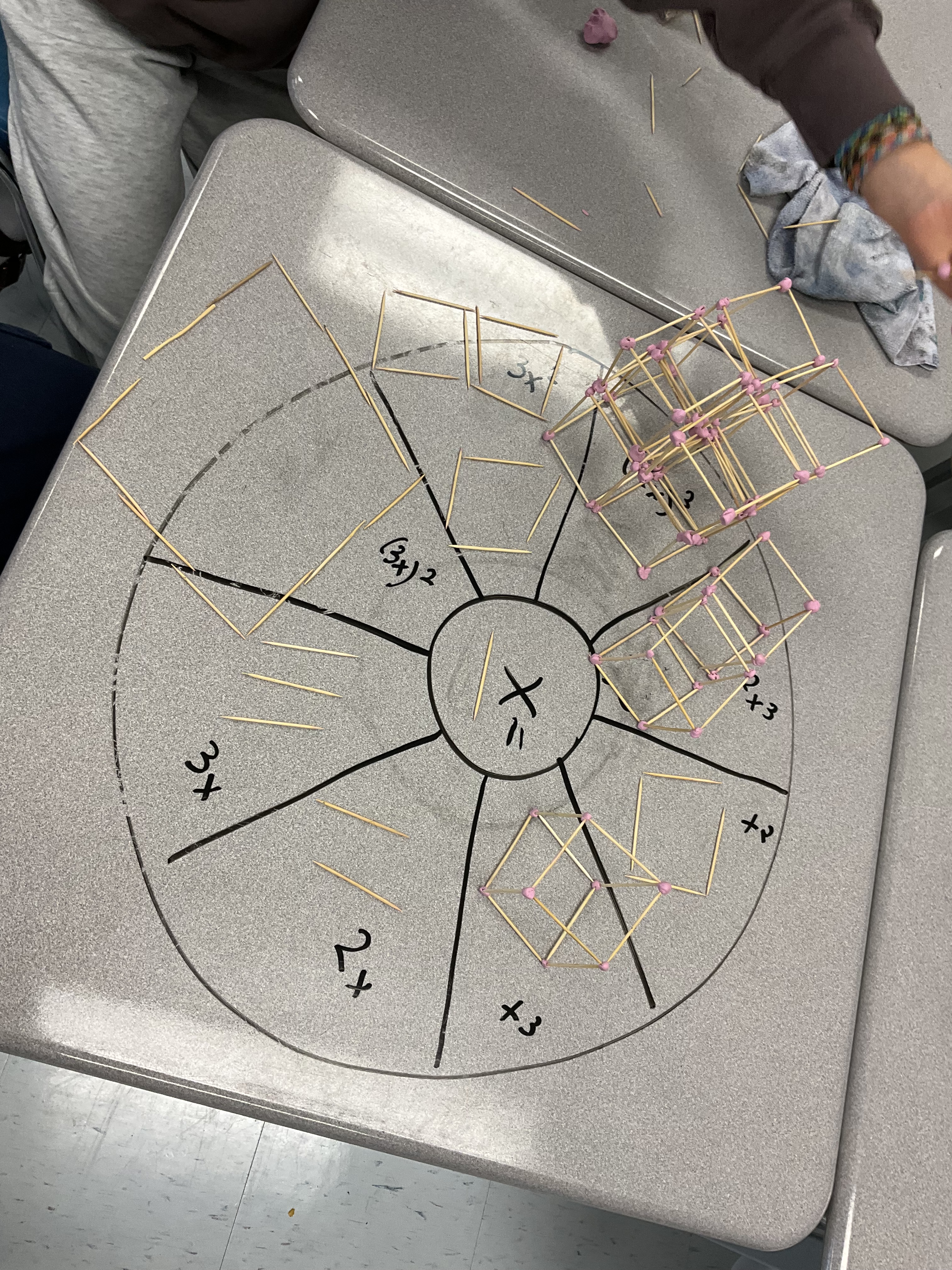
We noticed that anything with an exponent 2 is a square, and anything with an exponent 3 is a cube. We also noticed that the base of the exponent is representing the side length of the cube or square we make.
Since we were ready for a bigger challenge, I made up a spicy concept circle to try.
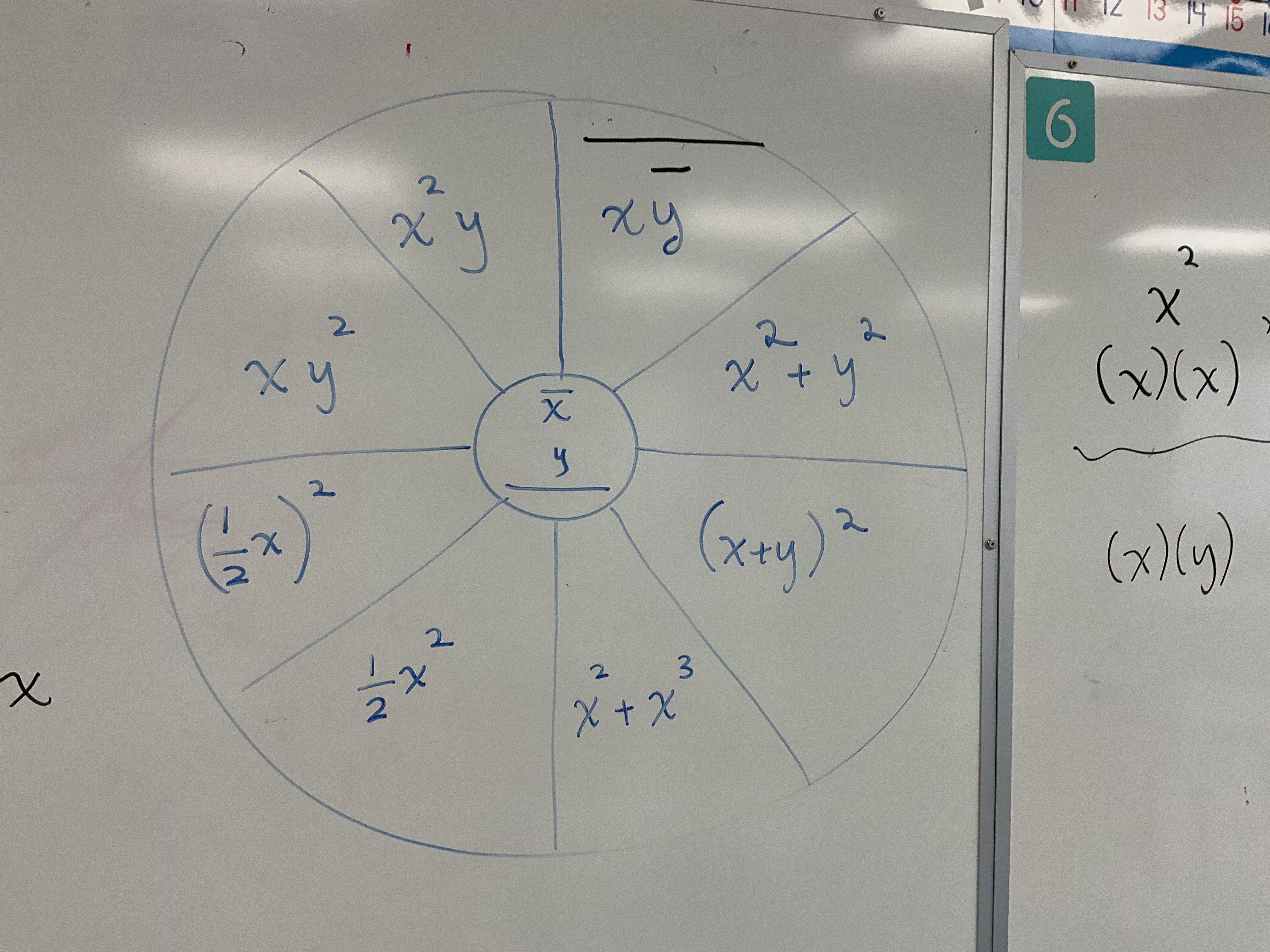
This one needed a bit more explaining. We looked at how x squared is a square, but also how it’s (x) times (x), how the length is x and width is x. This helped us look at (x)(y) as a rectangle with length x and width y. We introduced skewers as the y values.

We needed to talk about what an (x^2)(y) and an (x)(y^2) would be. We understood that they’d be 3 dimensional, but it took a while to realize that they’d be square based prisms, one with a toothpick square, and one with a skewer square.
We looked also at building (x+y)^2 which is something that challenges students in grade 10.
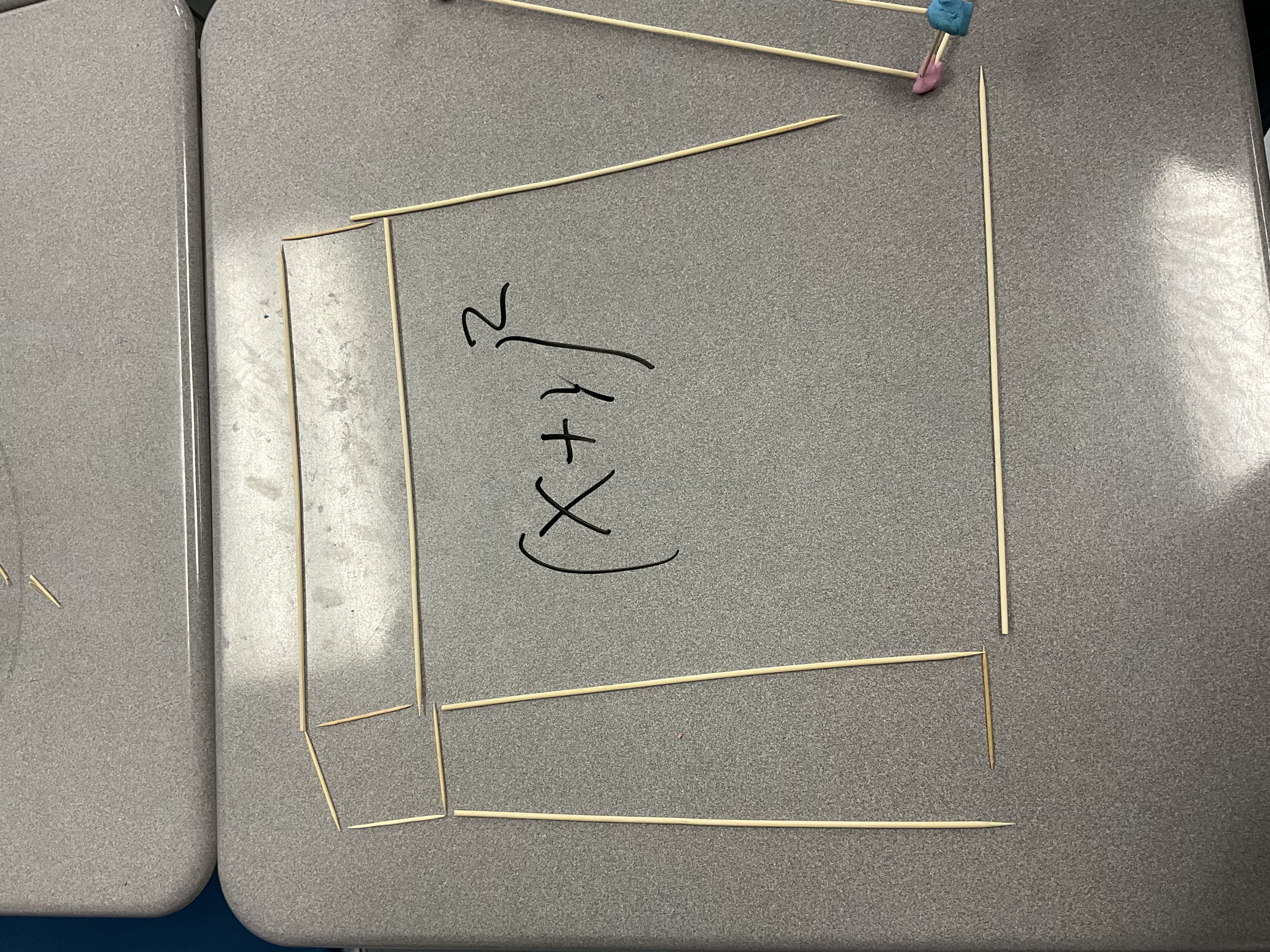
inside the (x+y)^2 we see an x^2 and a y^2 and also 2 rectangles that are both (xy). We can equate (x+y)^2=x^2+y^2+2xy.
Hopefully as we move forward with exponents and exponent laws we will have a sense of like terms, and simplifying, but also what happens if we multiply (x)(x)(x), and how we get x cubed. We’ll move from the concrete to the visual and abstract as the week progresses.
Exploring the Math of Sound
This morning I was invited to share an experiment with a grade 9 math class. It was inspired by the resonance that you get when blowing over the mouth of a bottle, and how that can change with more or less liquid (and thus air) in the bottle.
Each group needed the “sonic tools” app (free!) a bottle full of water and a ruler. They empty the bottle until they can blow over the neck and make it resonate. They record the frequency produced, and measure the height of the water in the bottle.


Then they empty a bit of water, and try again. We kept our data in a table, and then used it to make a graph.
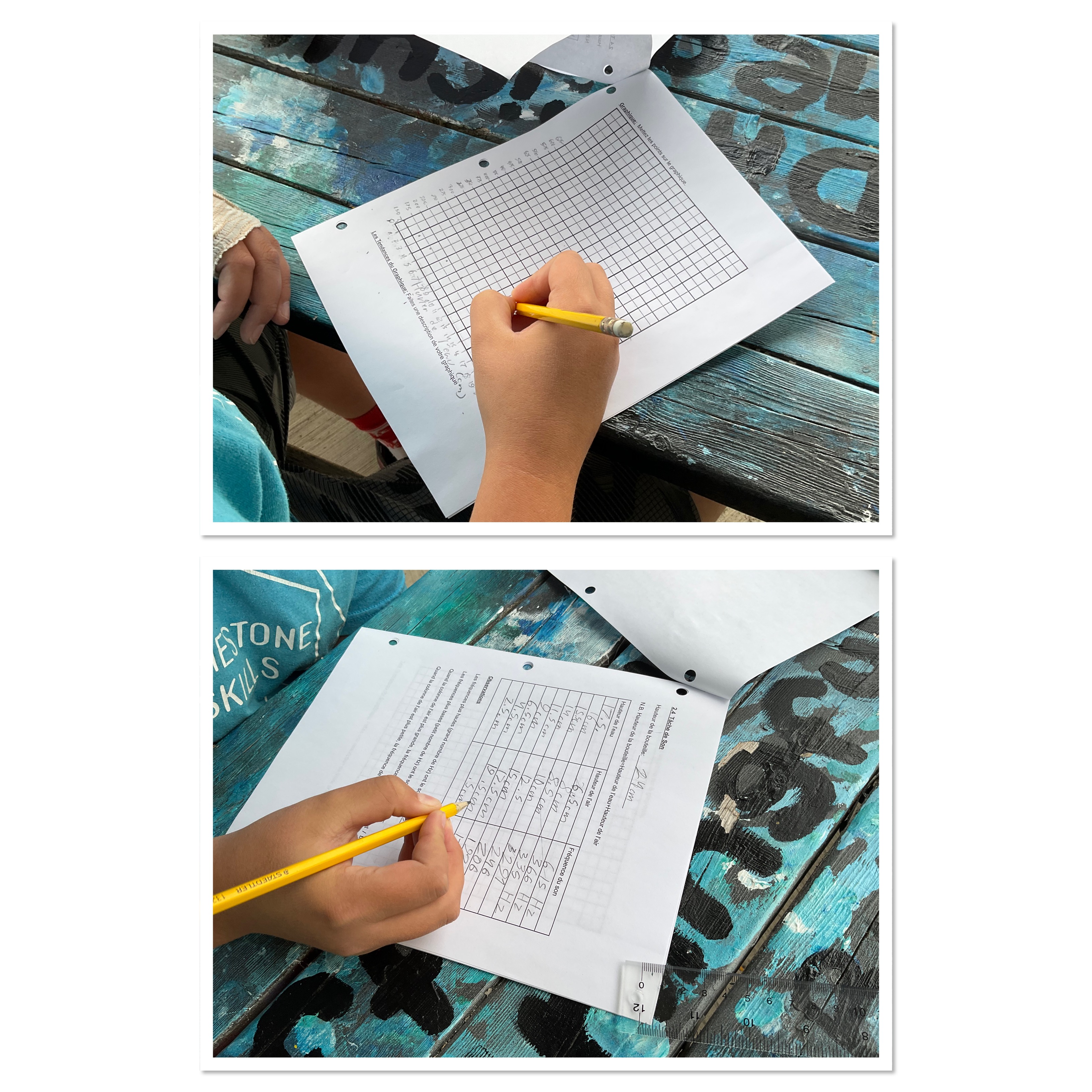
We worked outside because it was nice out, and we could spread the groups apart a bit and we could empty the bottles on the flowers. When the class came back inside we put the data together into a big table, and graphed it on desmos. We graphed water height and frequency, and found a pretty strong positive non-linear correlation.
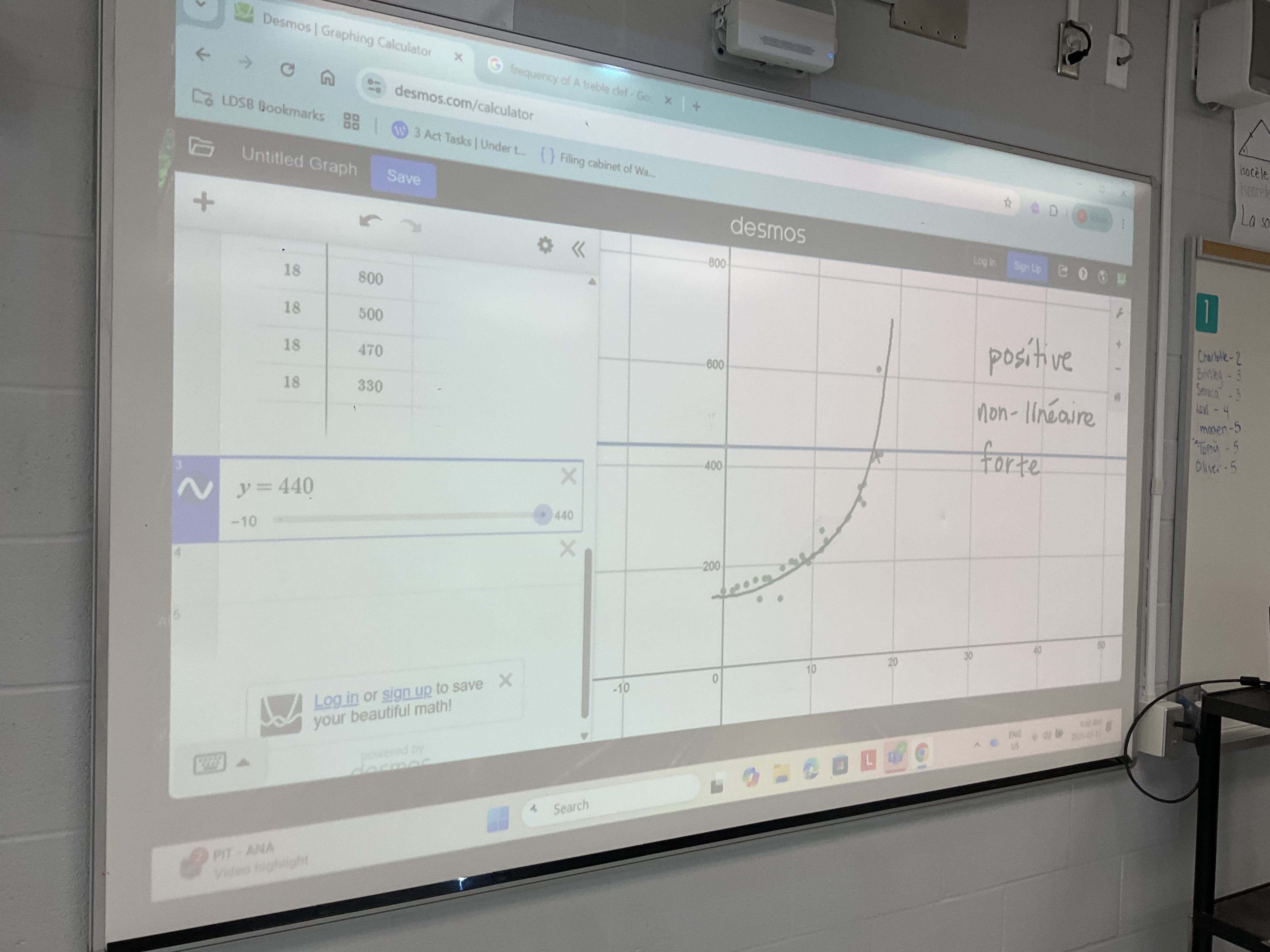
We looked at tuning our bottle instrument to a specific frequency, for example an A is 440 Hz, so we’d need a water height of about 17cm to make an “A” sound from our bottles.
The physics behind this is as follows: Air resonating in an air column that is closed at one end will resonate so a node is formed at the water, and an antinode at the mouth of the bottle. This will allow one quarter wavelength in the air column. The height of the air column will then be used to identify the wavelength of sound, often given the variable lambda.
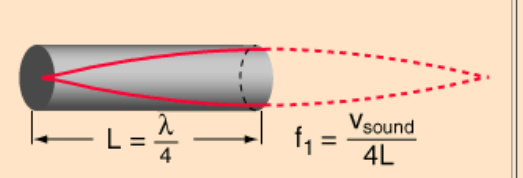
We know that the speed of sound is determined by the temperature of the air it travels through, which is not changing for the experiment. The relationship between frequency and speed of sound is v=(f)(lambda). If we isolate frequency, f=v/(lambda). If the wavelength gets bigger (this happens when there’s a taller air column) the frequency will go down. This is an equation of the type y=1/x which we explore more in grade 11 math and also physics.
Converting Square and Cube Units
Our goal in MFM2P is that we will be able to convert square and cube units. We are slowly working on making sense of squares and cubes. We did a day of making squares and cubes on Thursday, and we revisited that today and made the transition from the concrete to the visual and then to the abstract.
We know that when the exponent is 2 we have a square, and when the exponent is 3 we have a cube. We know that what the exponent touches, either the x or the brackets, indicates the side length of the cube or square.
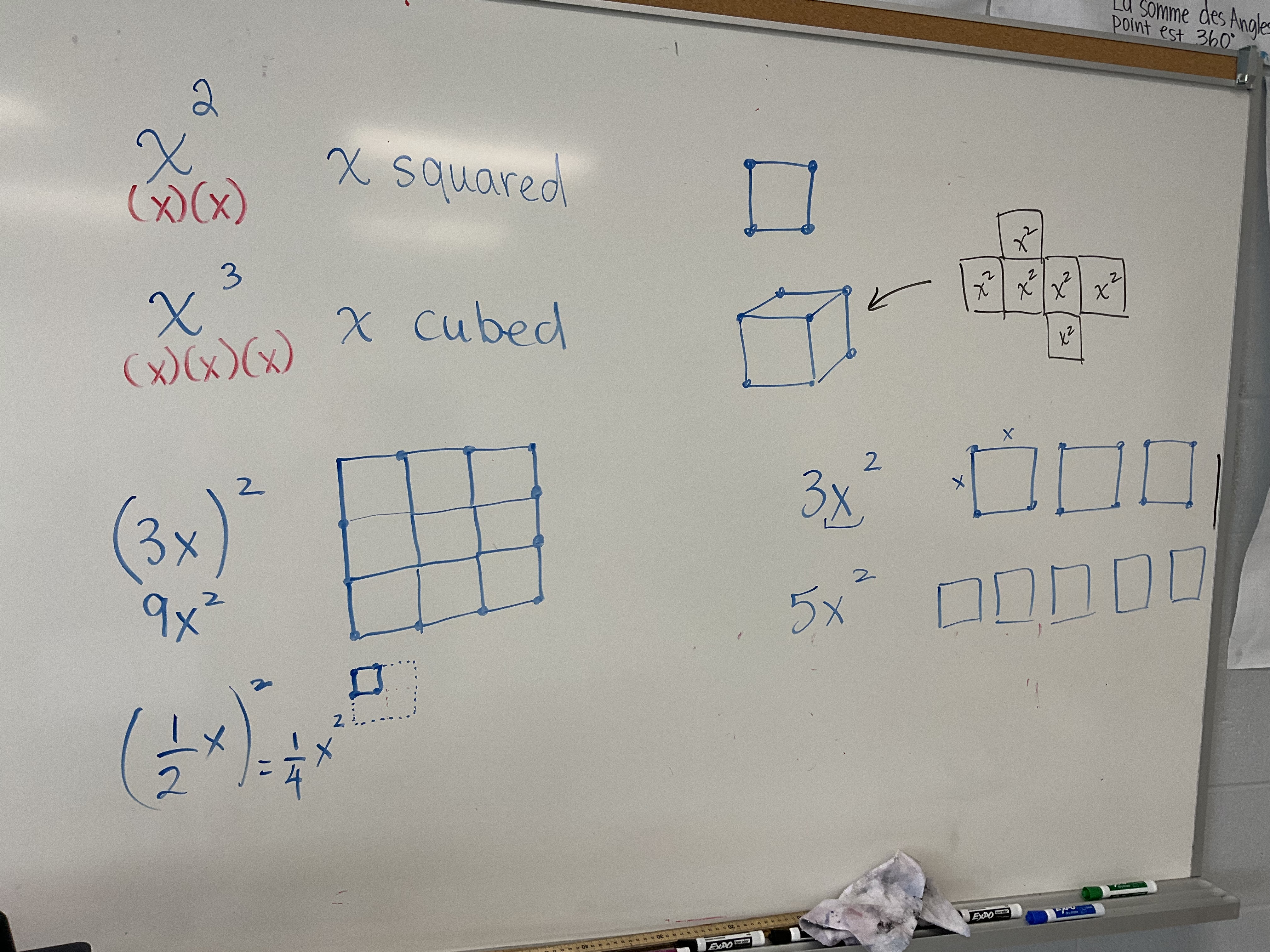
We next looked at a progression of questions involving drawing and reasoning about various cubes and squares.
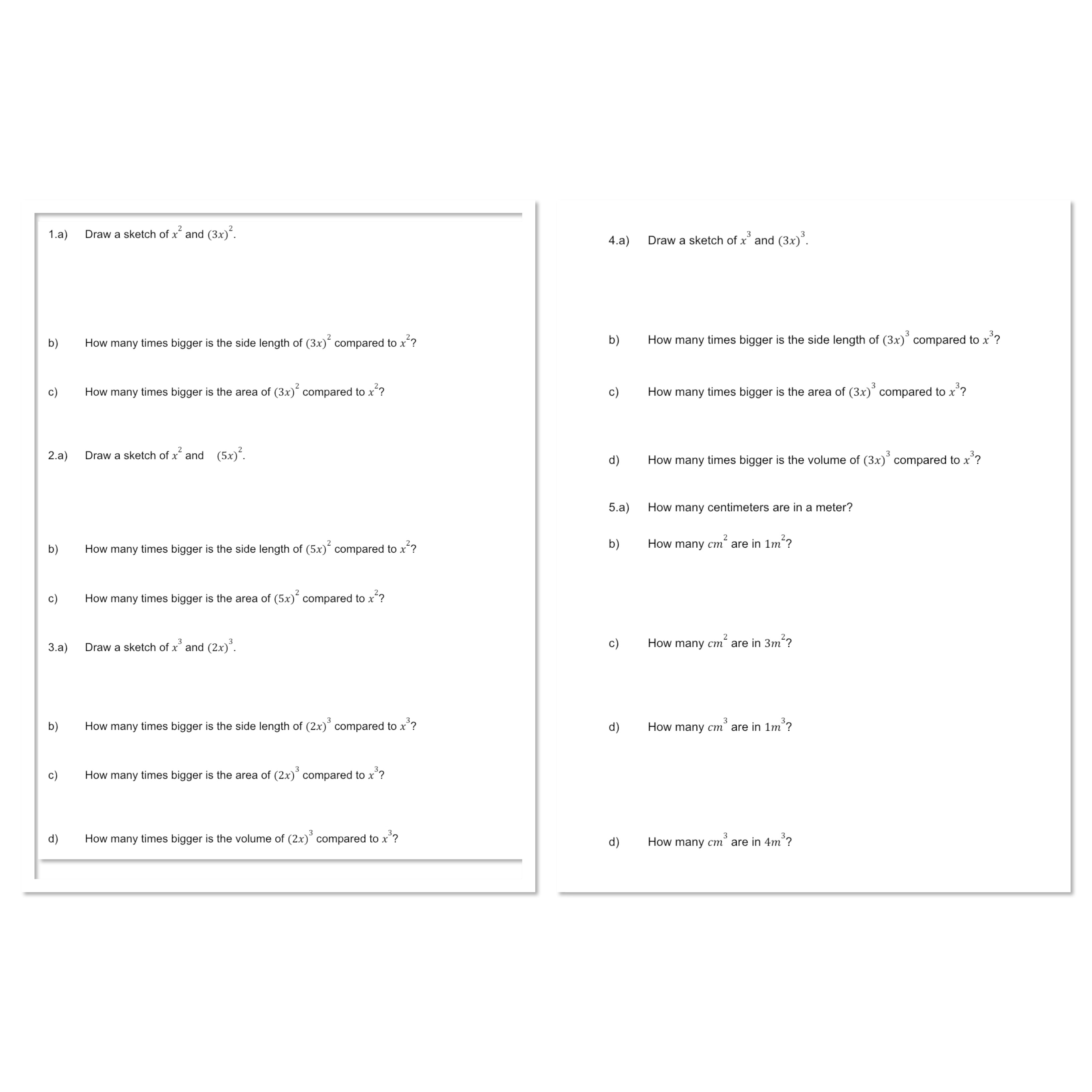
We drew diagrams and looked at areas and volumes

We needed to remember prior knowledge of nets, and add to it ideas from when we built our models out of toothpicks.
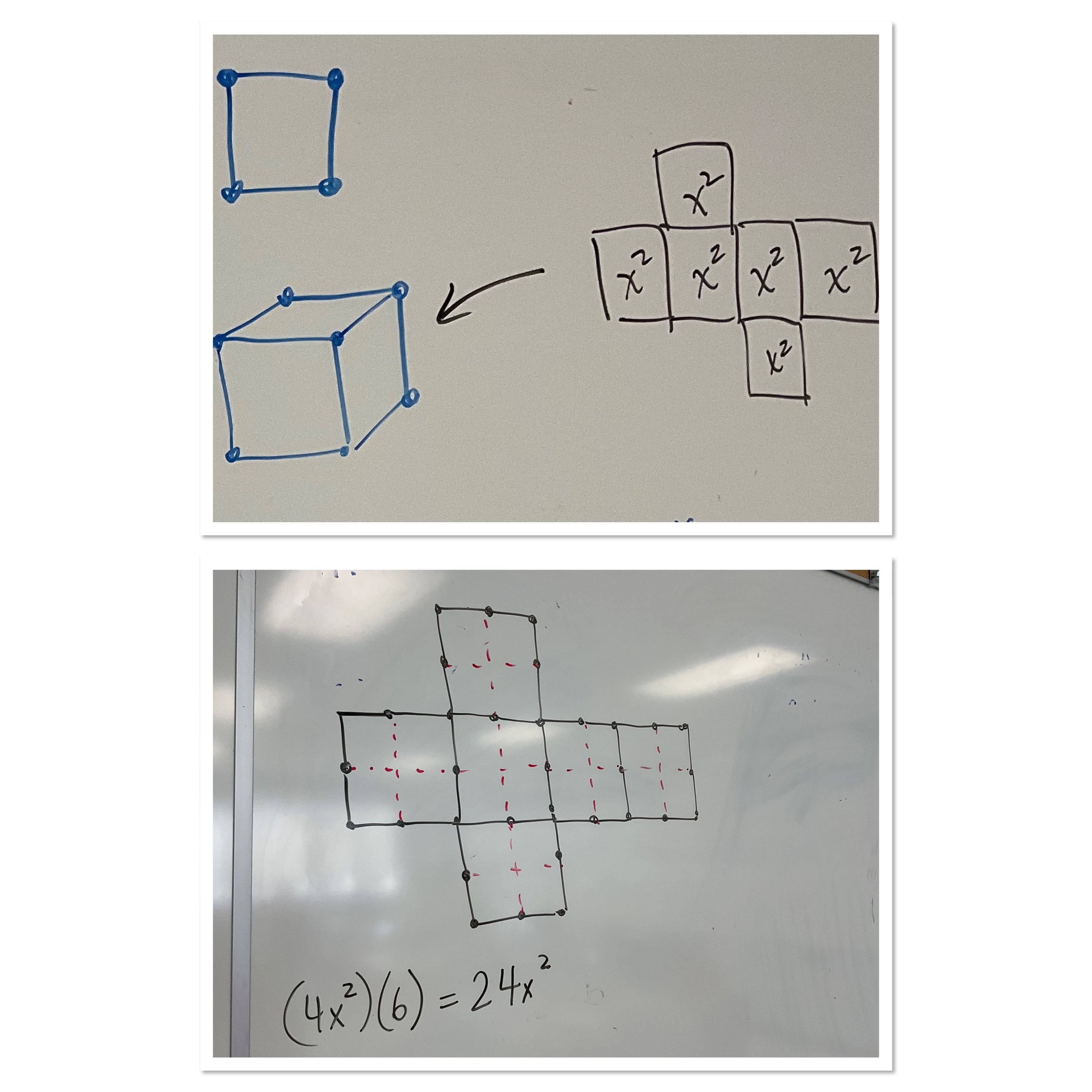
This led us to talking about how many square centimetres are in a square metre, which we can think of as (100cm)^2 since a meter has 100cm. We need to now understand that it’s 100cm by 100cm so the area is 10000cm^2.
We’ll do some more examples over the coming days during “algebra” and reconnect back to this again when we do volume and surface area calculations later on for “measurement and geometry”. Spiralling through a course allows for many chances to touch on the same material and review or solidify understanding.
 Ms. Bearse's Site