Introduction to Primary Trig Ratios
Today in grade 10 we looked at right angle trigonometry. The initial prompt was to use a ruler and protractor and draw a right angle triangle that has an angle of 30 degrees.

The next prompt was to measure each side, and record the values in the chart on the wall. The headings were “small side” “middle side” and “long side”.

Next I used my magical skills to tell everyone which triangles were perfectly drawn and measured.
My students know I’m not magic, so they were trying to figure out the trick or pattern I was using.
Pretty quickly they concluded that the small side was half the length of the longest side.
This is how we started the discussion about trig ratios. I showed them a trig table book from 1965 that was used at KCVI before the age of calculators.
We explored how we can use calculators to solve for missing sides and angles. It’ll take more practice, but we’re well on our way to solving right triangles now!
Fraction Fun
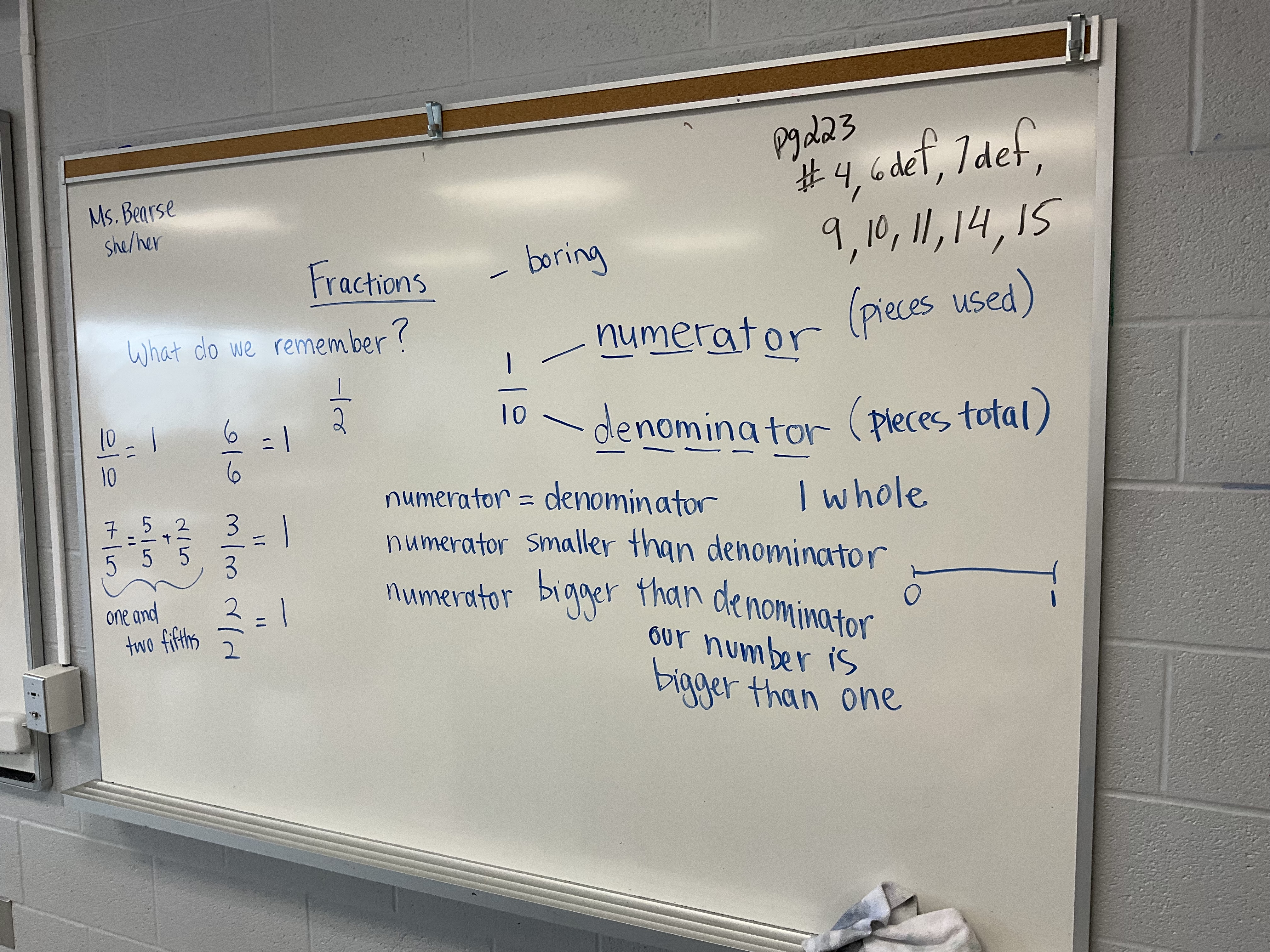
today we worked on fractions in MAT1L. Our focus was on using relational rods (Cuisinaire rods) to represent and compare fractions. Before we got started we reviewed the vocabulary of numerator and denominator, and practiced saying the words out loud together. We talked about if the numerator and denominator are the same how that equals 1. It was great to see some prior knowledge bubbling up.
We used a concept circle with 1 being represented by a rod of length 12. We built equivalent fractions to the central “1” using different blocks. Here it shows that it takes 6 red blocks to build the 1, so we know that each red blocks is 1/6th.
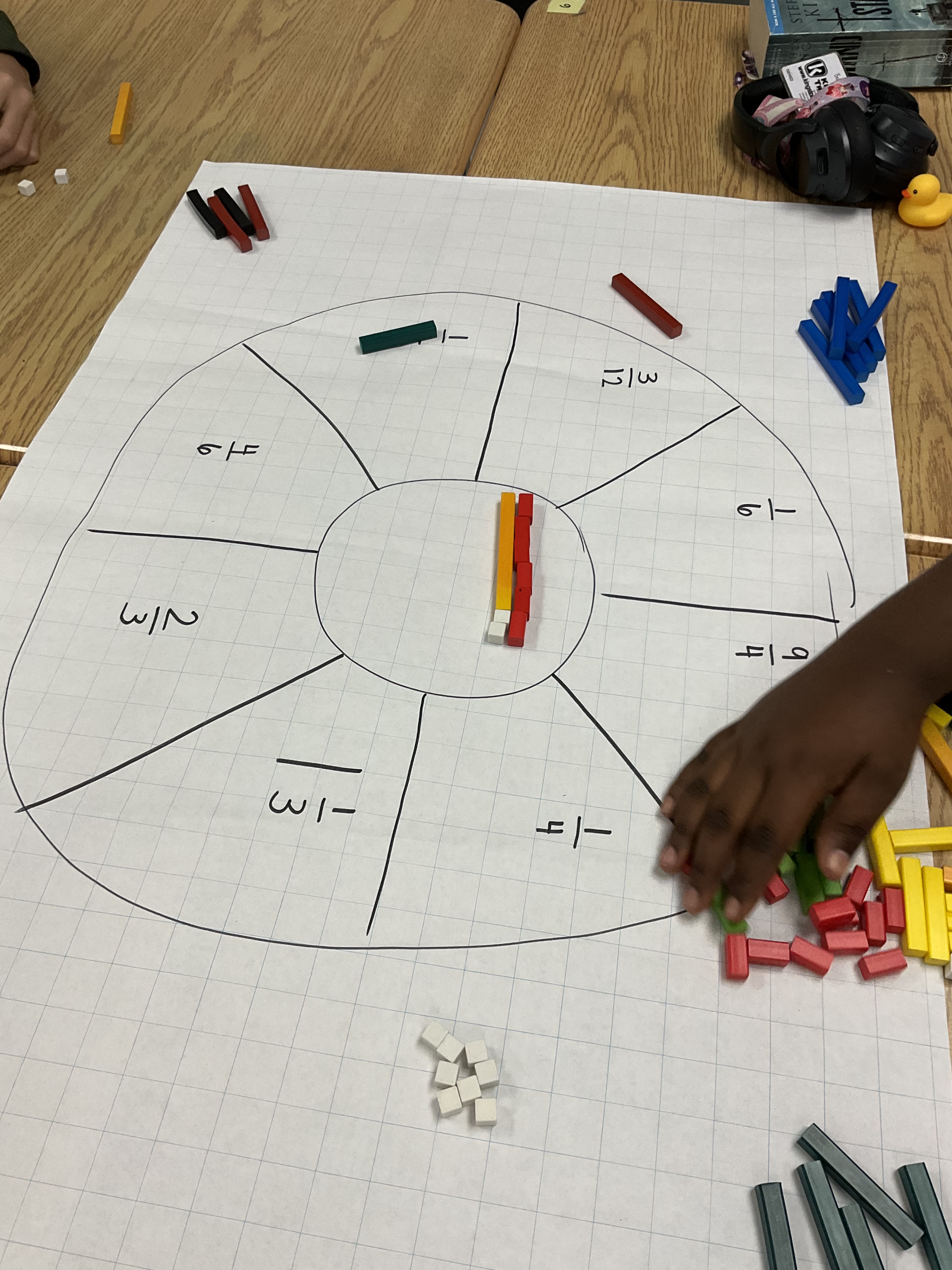
We worked hard to represent each fraction
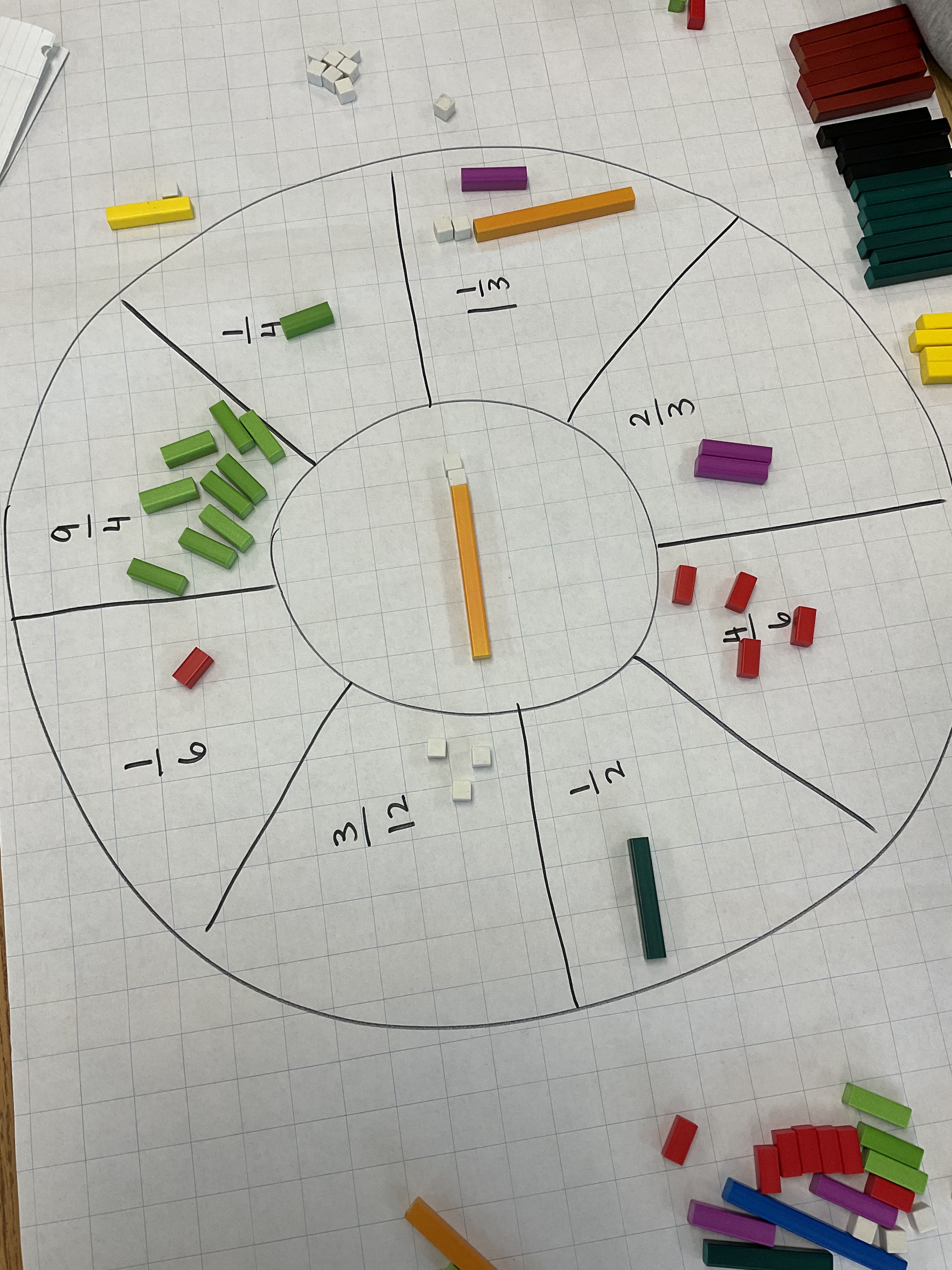
Next we looked for equivalent fractions by comparing lengths. We noticed that our magical multiplier is the same as the ratio between the blocks. Each 1/4 is split into 3, and each smaller portion is 1/12. It takes 3/12 to make 1/4.
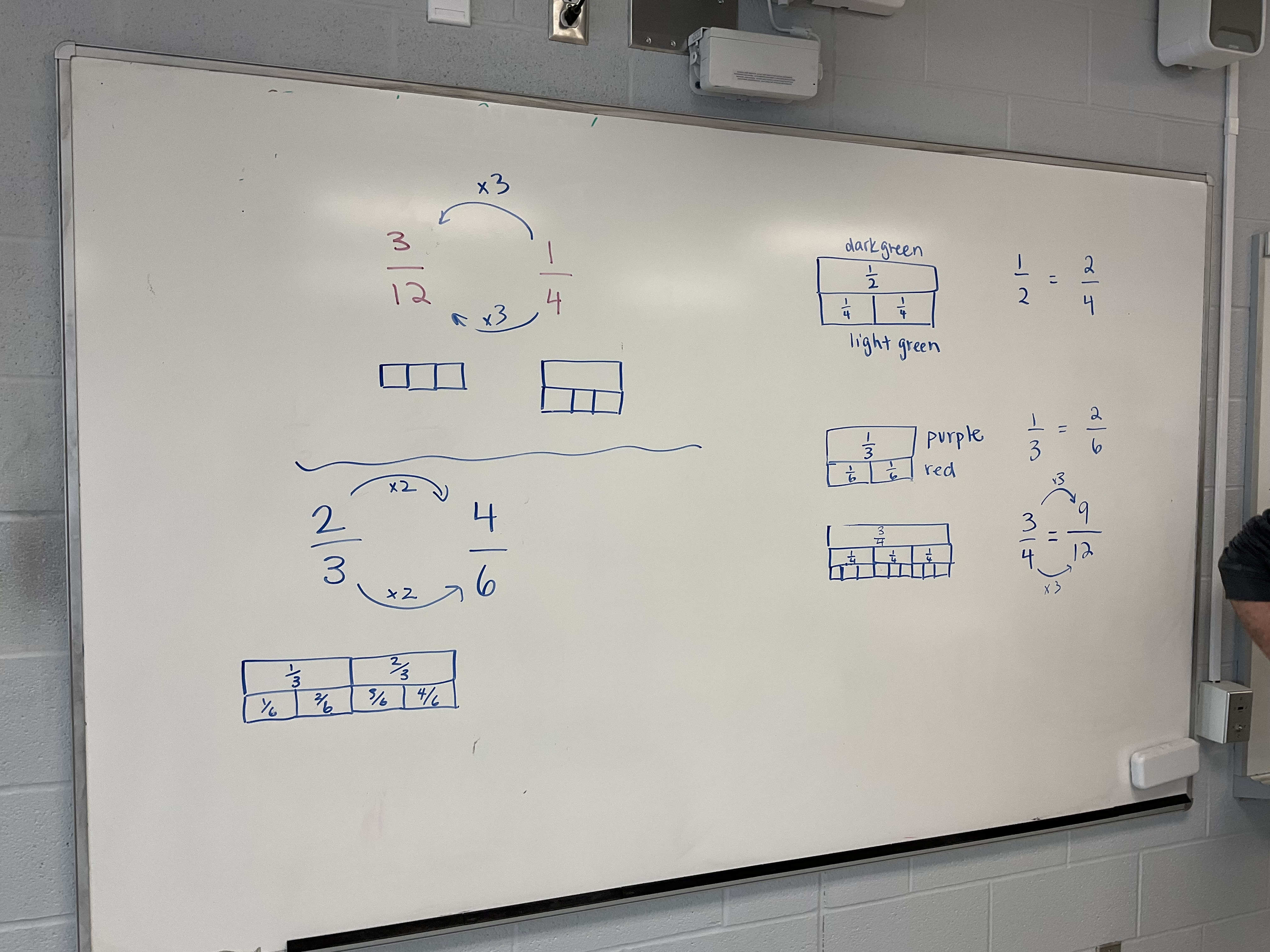
we made some equivalents: 9/12=3/4. The blue rod is 3/4.
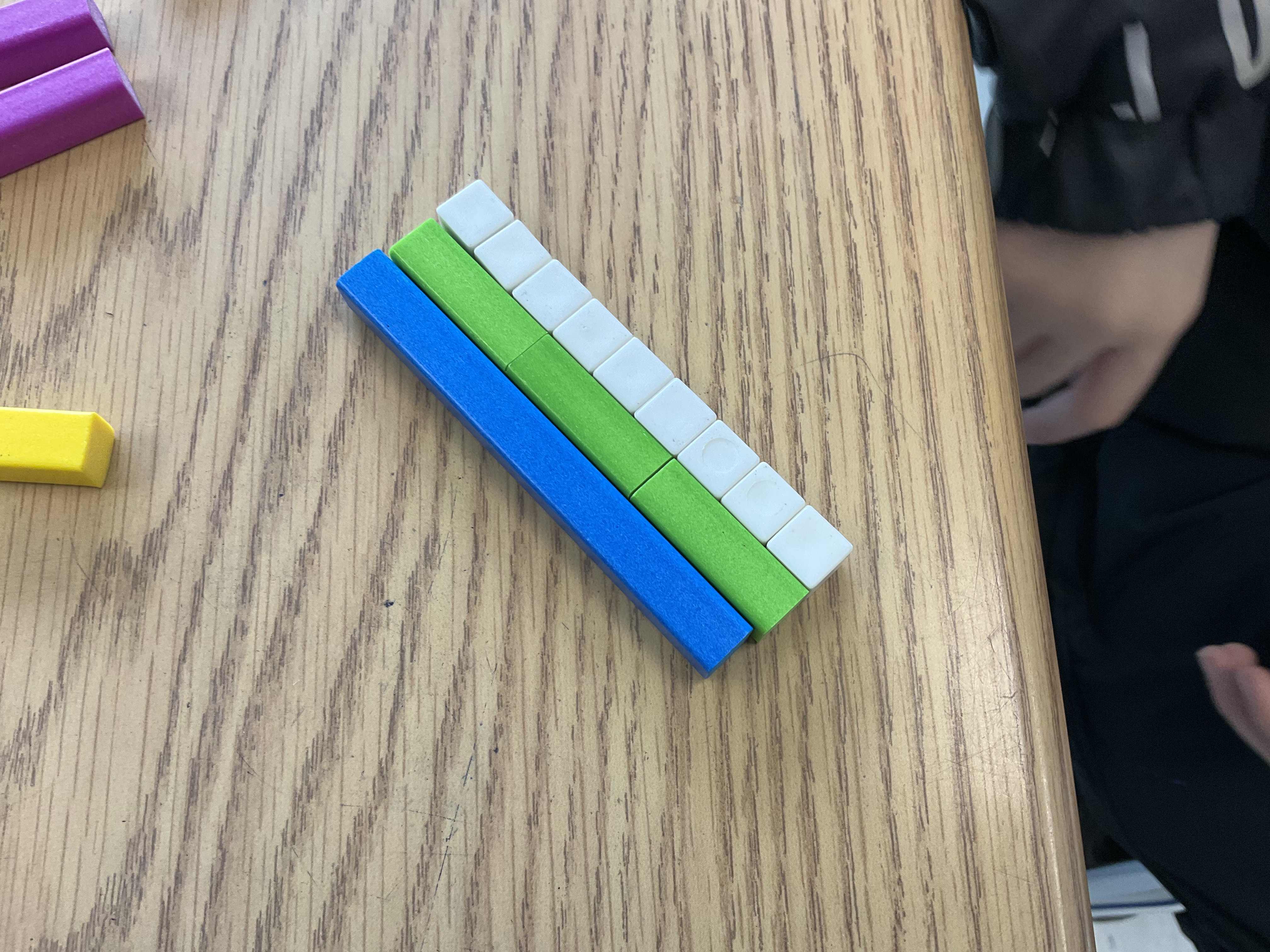
here’s another equivalence: 6/12=2/4=3/6 shown with the red, green and white.
we also noticed we could build rods of the same length. We have the blue which we already determined was 3/4 or 9/12 and to that we add a white which is 1/12, we know that 9/12+1/12=5/12+5/12. Each yellow is 5/12.
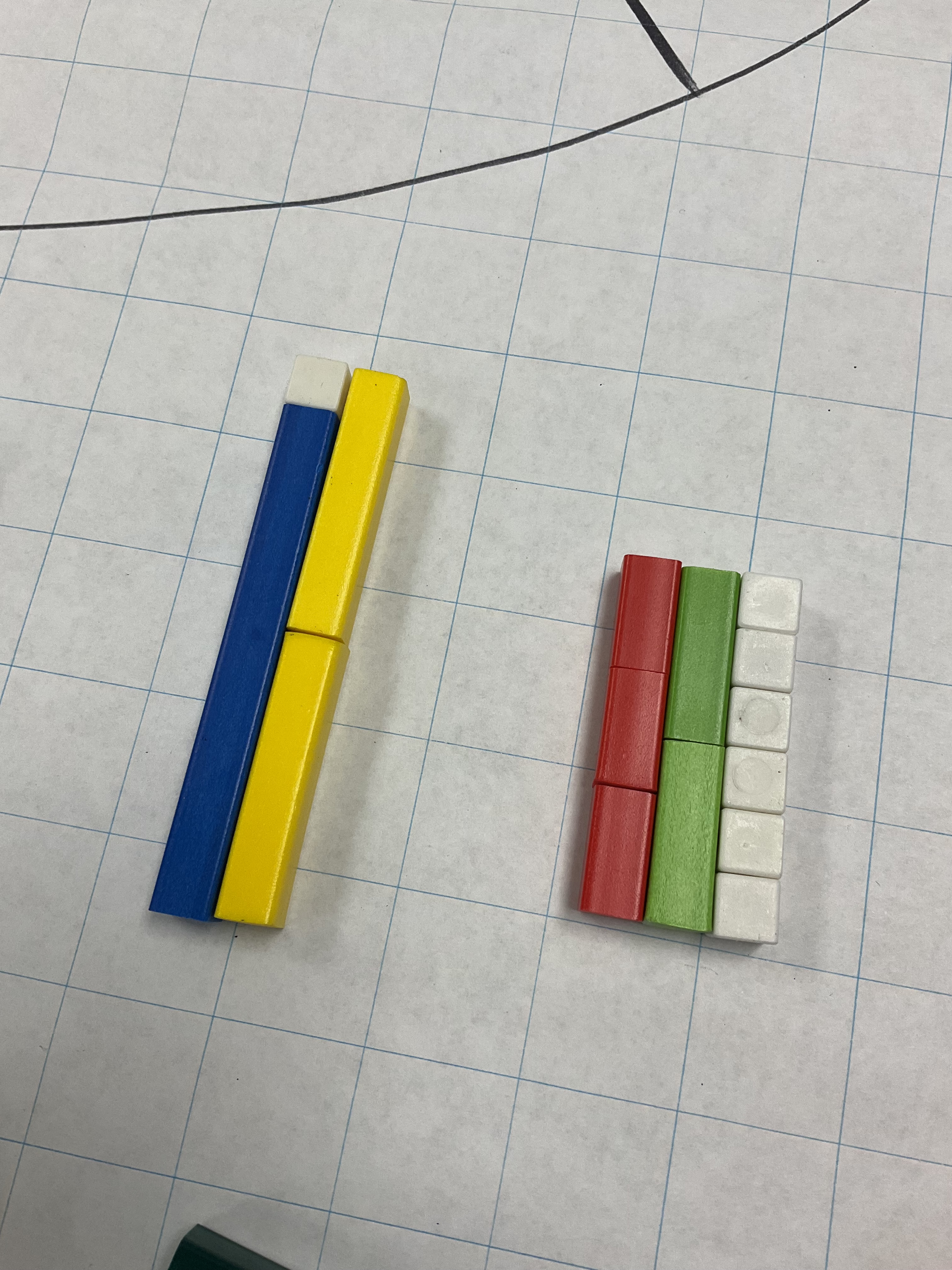
we had some success making fractions fun today. There were some thumbs up at the end of the class!
Algebra tiles for equation solving
Today I was invited to work with a grade 9 class to introduce equation solving with algebra tiles. We looked at what the tiles were, reviewed some of their understanding about combining like terms and making zero pairs, and then set off to solve.
We started with simple equations like x+3=-7 where students could likely solve by inspection, but we were introducing how to build the expressions with tiles and use the tiles and zero pairs to solve.

We worked through a sequence of problems adding more complexity as we went. After doing several similar questions with x on one side, we made a coefficient for x, e.g, 2x+5=1

Then after a few of those types of problems we introduced a question that would result in a fractional result e.g. 3x+1=5

The final step caused some discussion. We can split the x term into 3 groups, but we can’t split the 4 into 3 equal groups without cutting up a tile. Some students showed the answer as x=1 and 1/3, some said the answer is x=4/3 since it’s 4 tiles split into 3 groups. Pretty neat!
Next we did some questions with x on both sides like 2x+1=4x-3. We needed a strategy of using zero pairs to get x on one side only to start with, and then we used zero pairs to get the constant terms on the opposite side. Finally we made enough groups for each x to have a group.

finally we levelled up to doing problems with distributive property and x on both sides. The class had recently worked with distributive property with algebra tiles so this was a bit of a challenge, but not something completely new to them.
We did questions like 2(-x+3)=3(2x-1)

By doing questions in this sequence students became confident with what becomes the final steps of solving, so in each subsequent level of challenge they will review those final steps over and over again building up their understanding and confidence.
It was a really interesting visit with the class. The tiles unlocked understanding for several students who had not always participated with confidence, and they told me that math class was great that day, and that they were feeling good about their skills for a change. I was glad to see a strong reception by some. Other students seemed a bit more hesitant to buy in and try.
Paper Folding Fractions
I was working this morning with an MAT1L class who started a unit on fractions. The goal I set was to do a lot of work with unit fractions. We started by doing paper folding, which was quite challenging for some to get equal pieces.
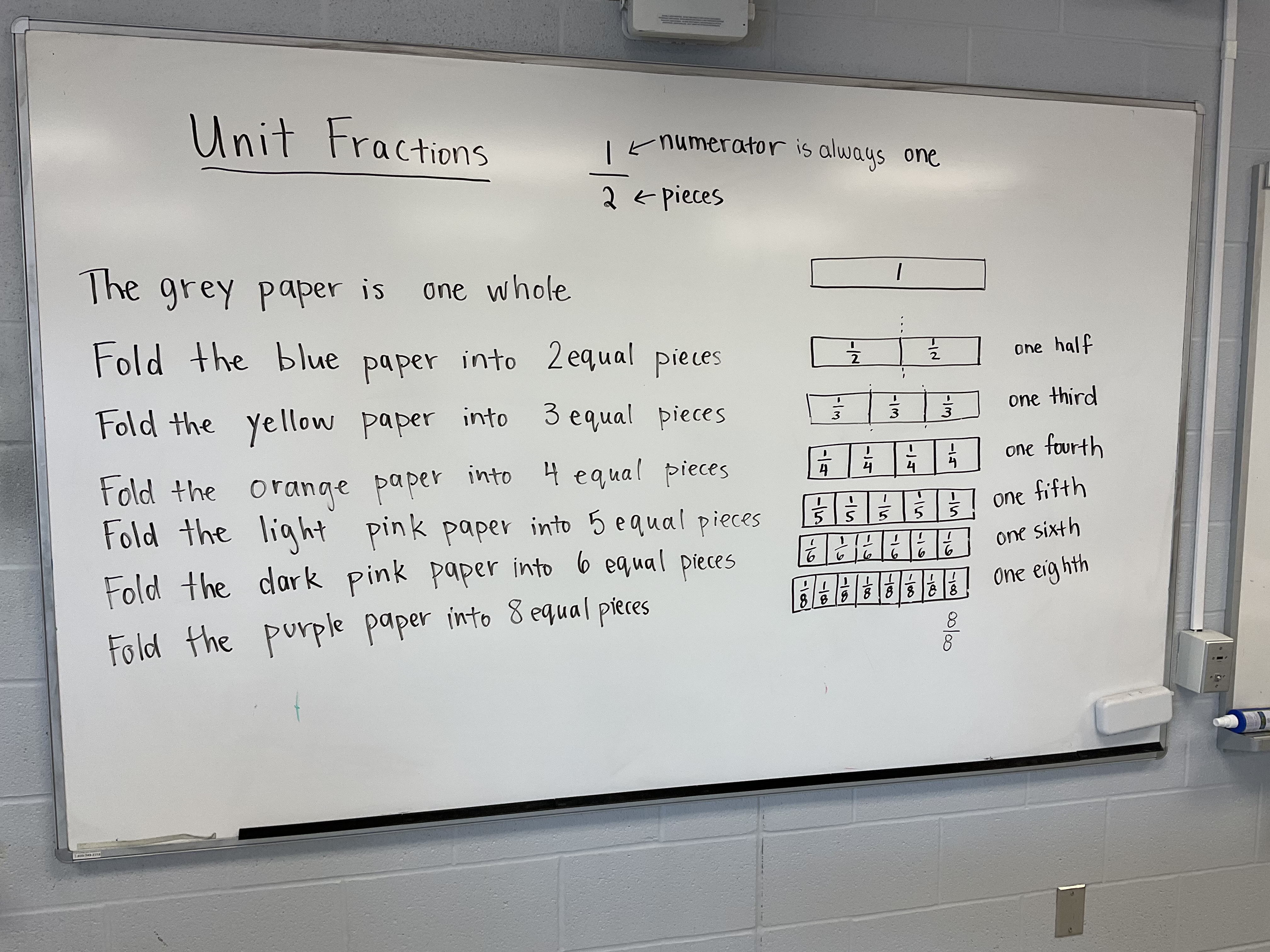
We made connections that the more pieces we make, the smaller the size of the pieces, so the bigger the denominator the smaller the unit fraction.
We put the unit fractions on a number line.
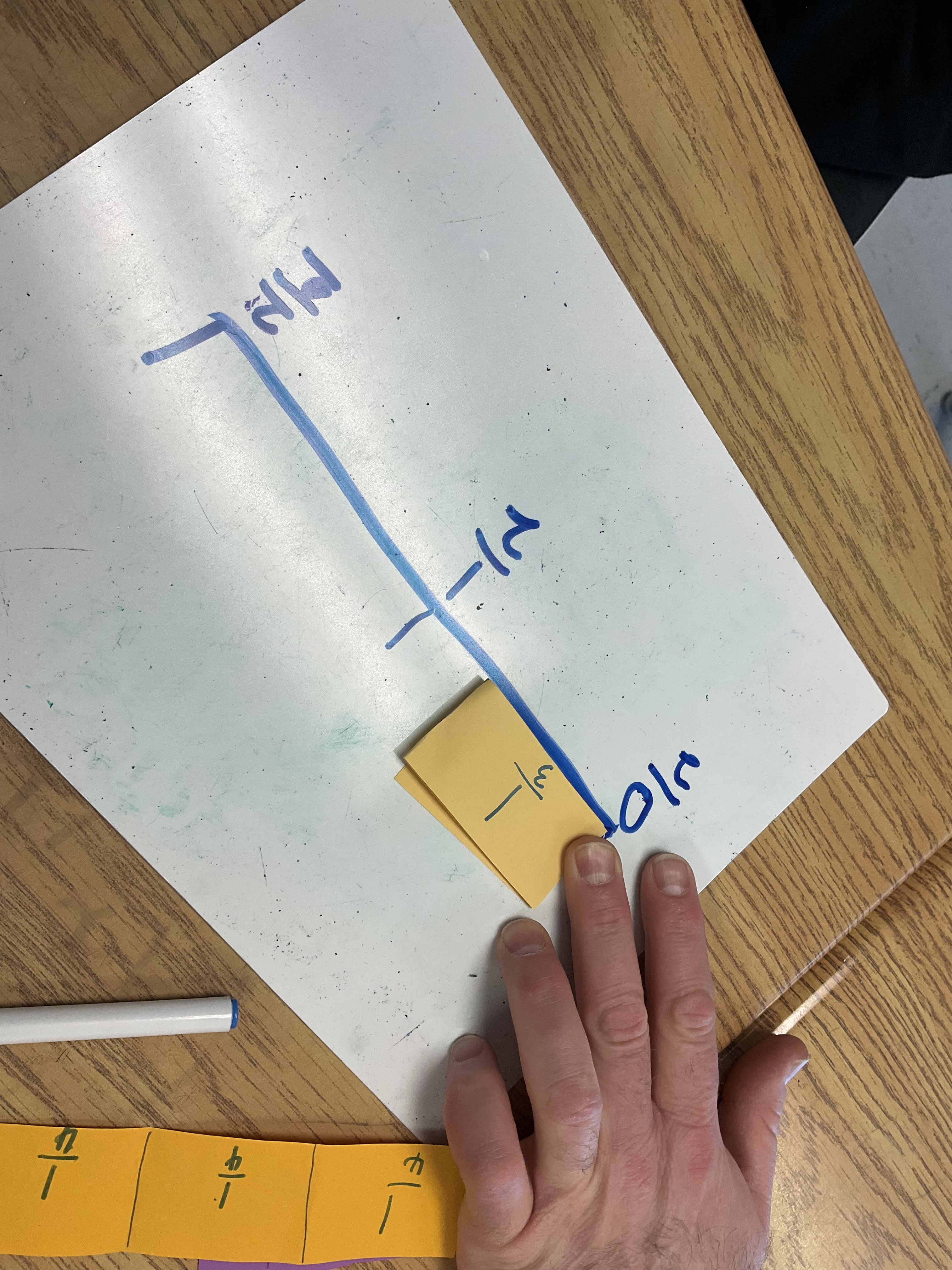
Some students put a lot of fractions on their number line. Once they have well folded unit fractions they can really get a sense of comparison between fractions.
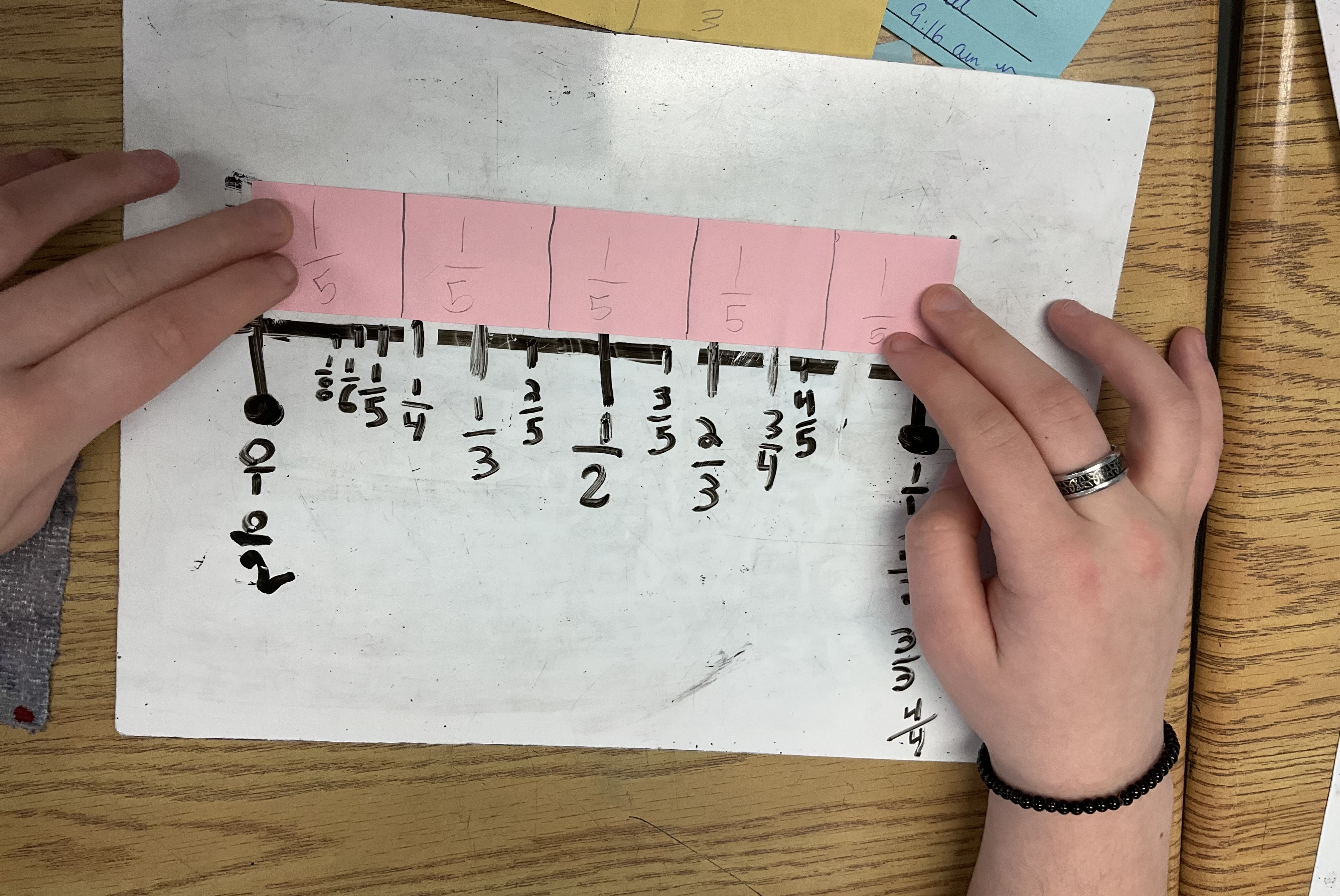
We looked at adding up unit fractions including what happens if we make improper fractions. There was some hesitation from the students to deal with anything larger than five one fifths. We had spent so much time living in the zone between 0 and 1 so this is understandable. We were able to show that 5 one fifths add up to 1, and then we’d have 2/5 left over so we have a mixed number 1 and 2/5.
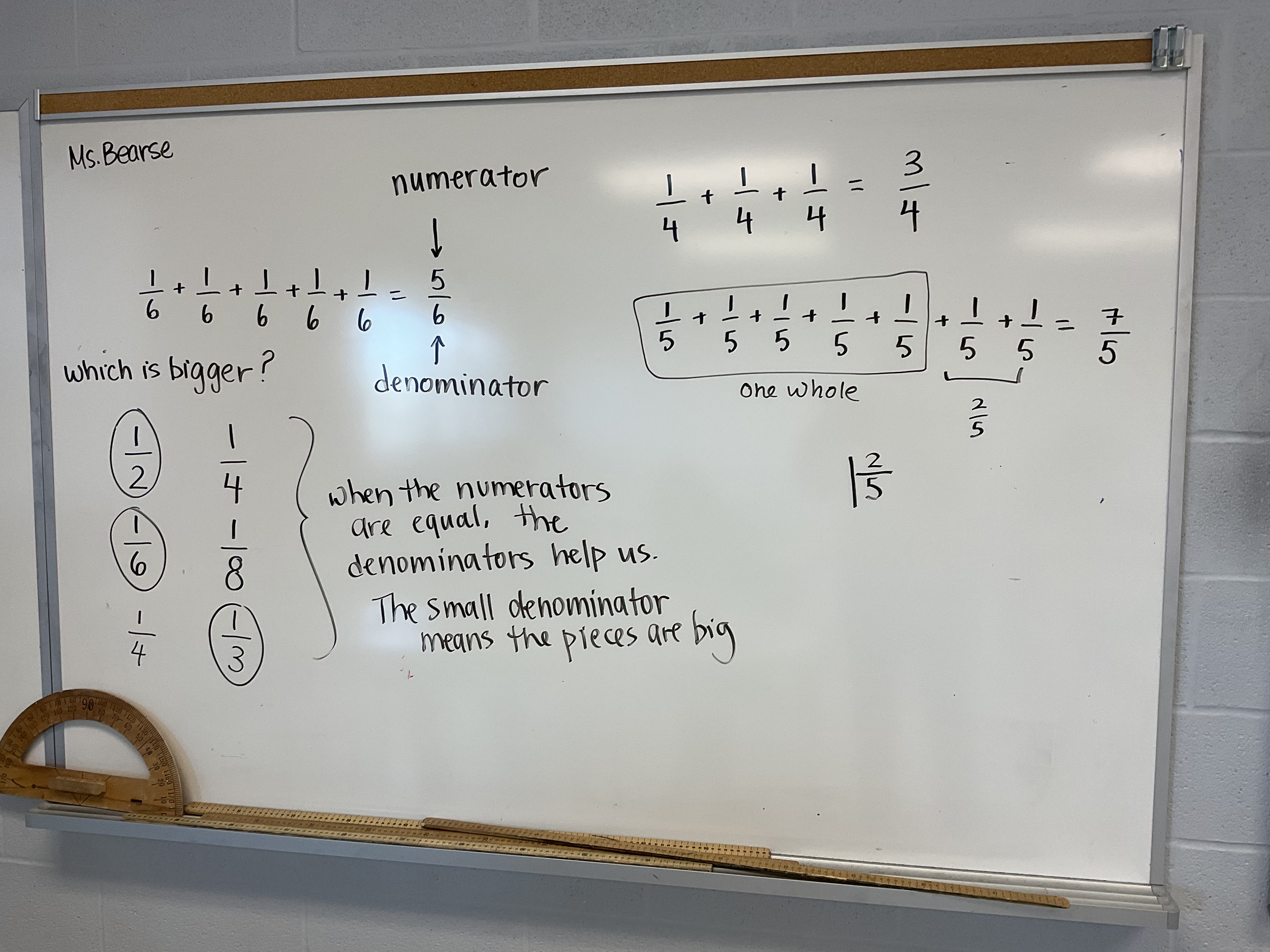
I look forward to coming back later this week to explore more fraction fun with this class.
Concept Circles for Fractions
Today in MAT1L I got to help with concept circles to explore fractions.
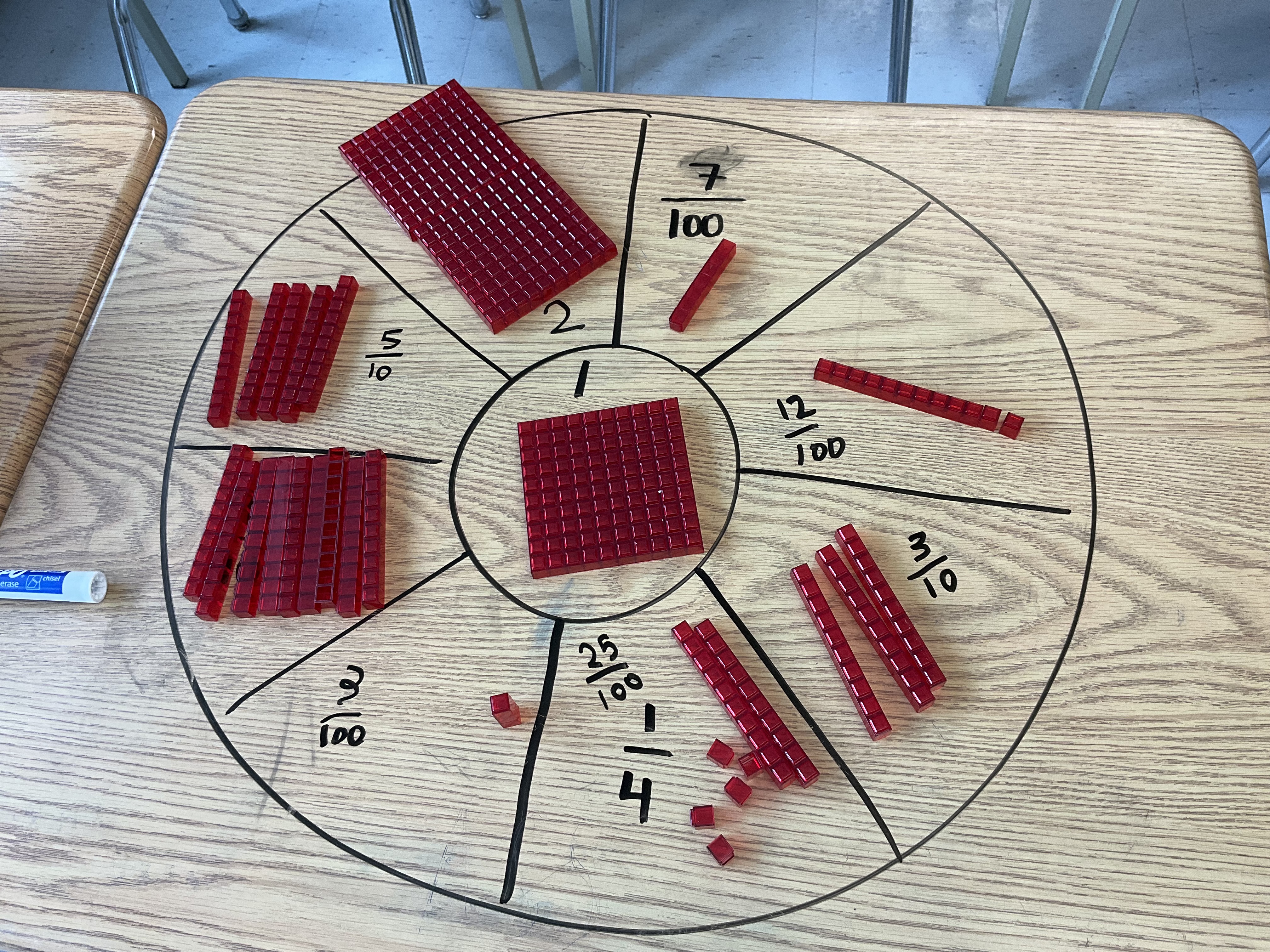
We used the 100 as our unit, and then had some segments of the concept circles had fractions, and some had handfuls of tiles. Students were working on writing the fraction, or building the fraction with the blocks.
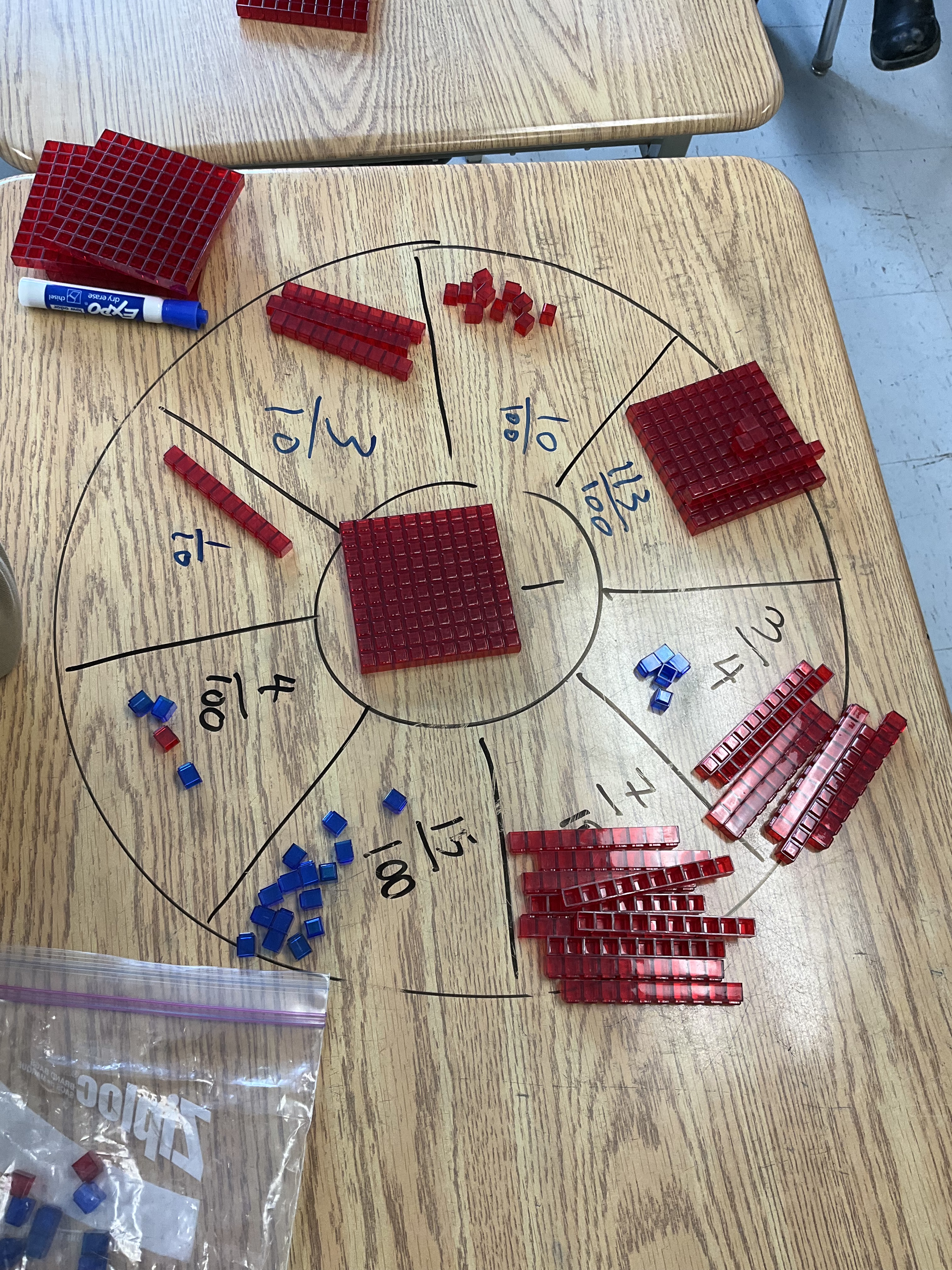
We were working on counting by hundredths and also by tenths. We have some work to do, but it was a good start.
Graphing Parabolas
We graphed parabolas today for the first time. I gave an equation in factored form, y=(x-1)(x-3) and then we set out to make tables of values to see what it looked like.
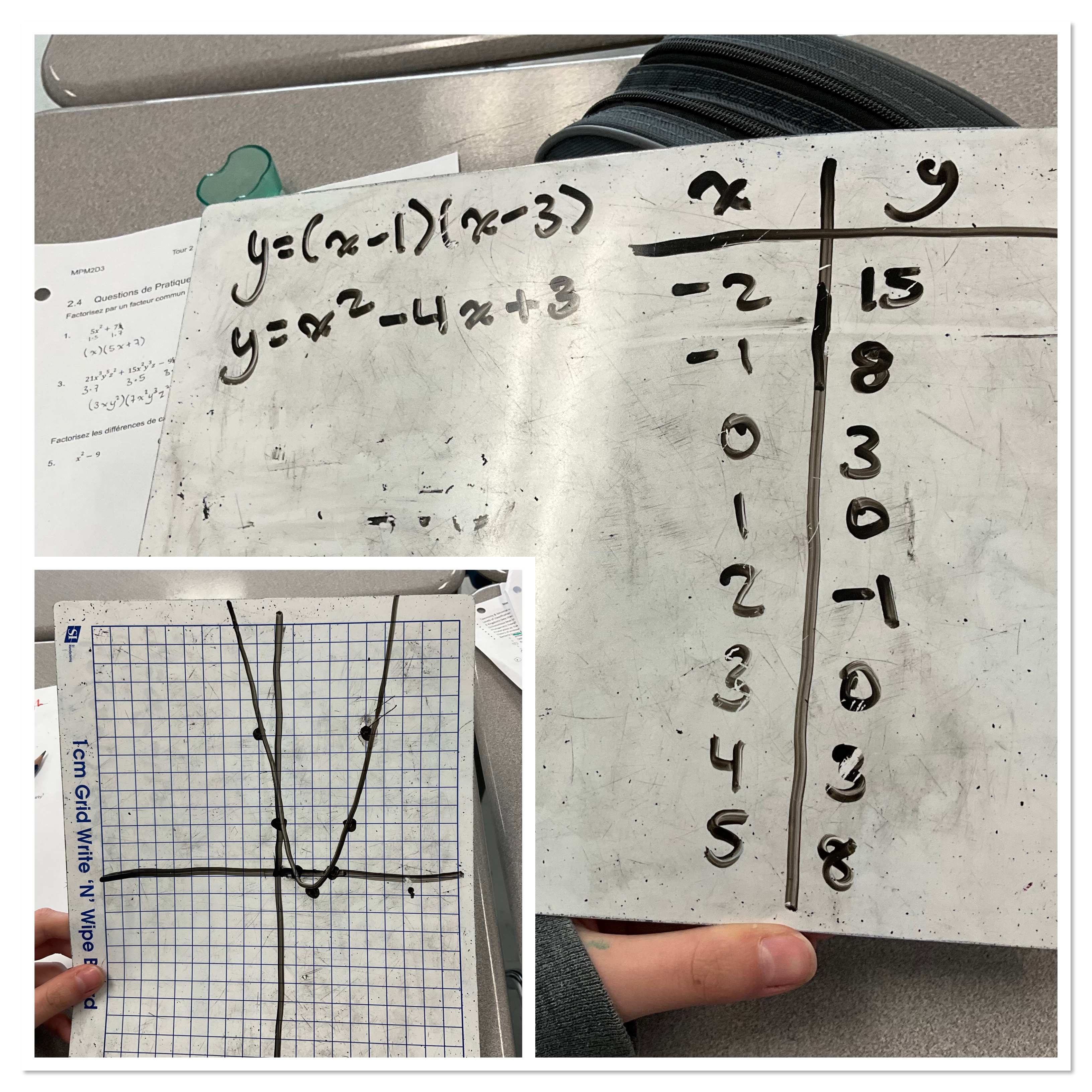
Some students worked from the factored form as given, and others decided to expand first and use the trinomial.
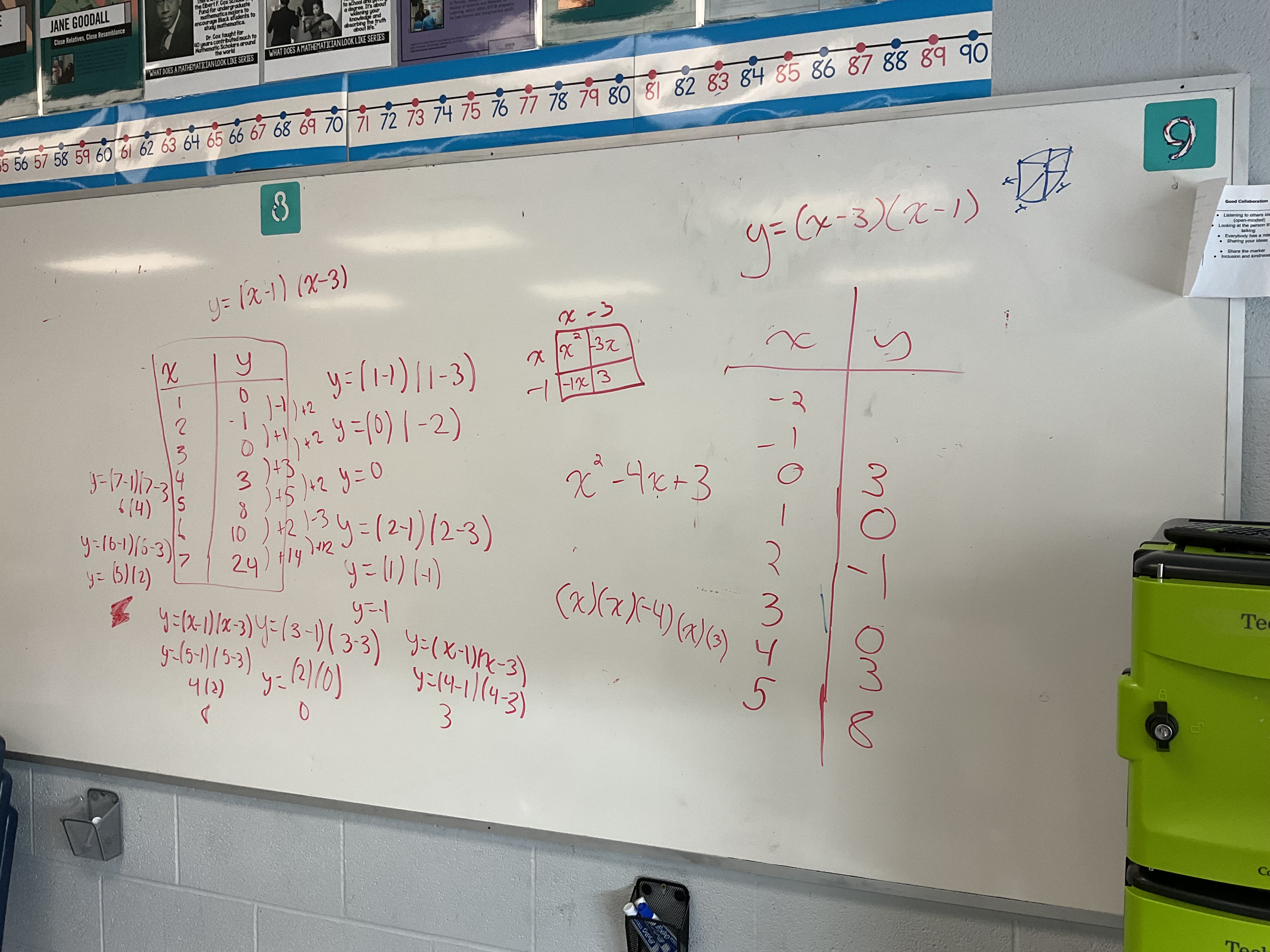
We looked for patterns in the tables of values, noticing that the 2nd differences are the same, and also that there is symmetry in the y values.
We graphed another one: y=(x+2)(x+4) and noticed some interesting trends when we looked at both equations and graphs.
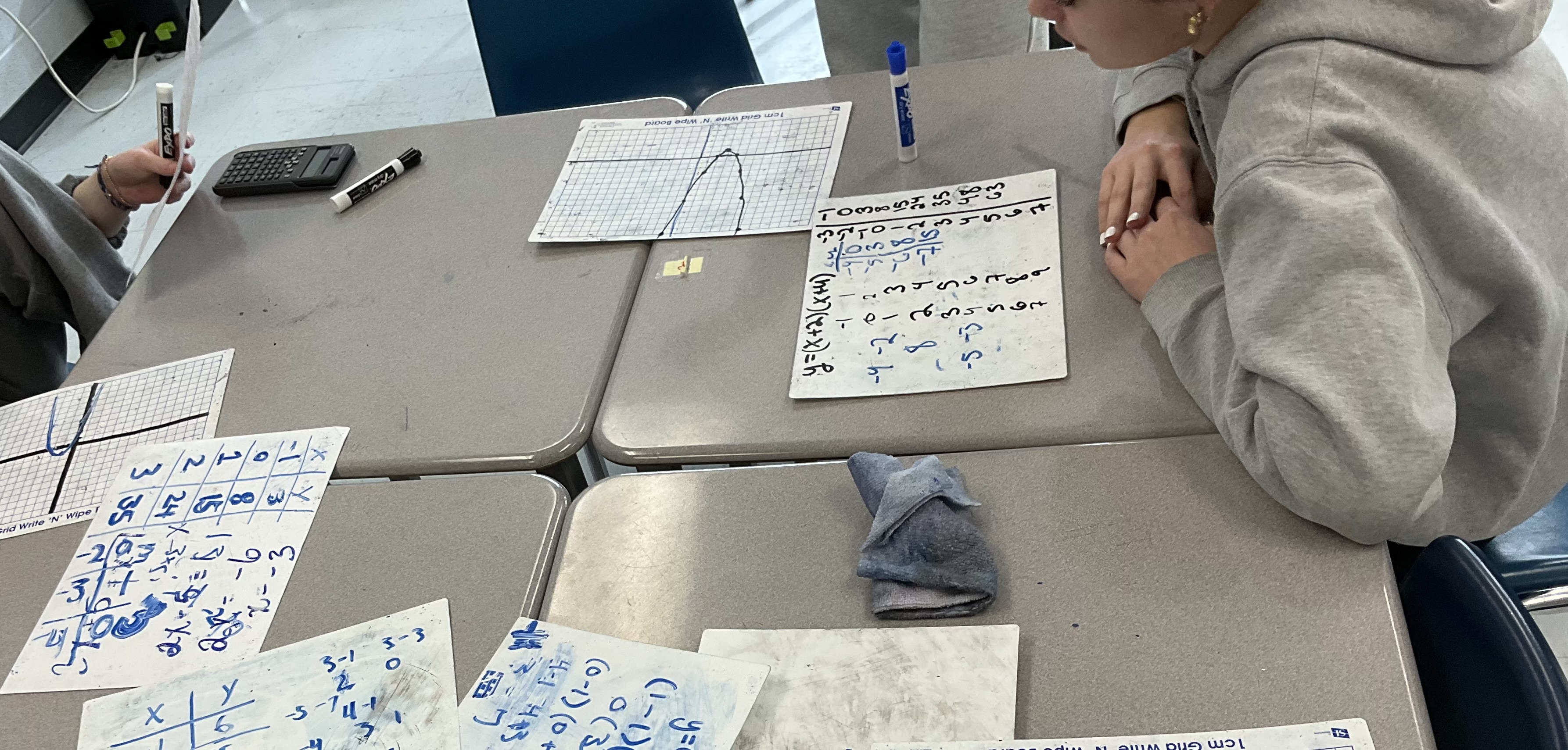
We made the connection that the numbers in the brackets are related to the x intercepts, and that the low point is always in between the x intercepts, exactly in the middle.
We looked at how the x intercept values make zero pairs with the expressions in brackets. We saw how the midpoint calculations from earlier in the course will come in handy to find the middle, between the x intercepts, and how we can substitute that value into the equation to find out where the vertex will be.

We noticed that there’s only one “u turn” in these graphs. We look forward to doing more practice with this tomorrow, and connecting our factoring skills to helping us graph parabolas.
Fraction Boot Camp Day 3
Today in our fraction boot camp we looked at visual representations of fractions
We started with a number talk looking at what fraction is shaded. There is lots to talk about in this one image. There were 3 different shaded regions that we looked at.

Next we looked at the unusual baker’s cakes problem, with this image. We stated that the cakes are all sold for 60 dollars, and our task is to determine what each piece should be sold for.

There was a lot of good discussion among groups, and good representations shown on the boards. We’ve realized that there’s lots of ways to draw fourths and halves, as triangles or rectangles.

The next task was a circuit of concept circles where fractions were represented by money, lego, pattern blocks, and base 10 blocks.


After 3 days of fractions we’re feeling kind of fractionned out, but hopefully also we’re a bit more confident with using manipulatives to represent fractions to solve problems.
Thinking about Factoring
In grade 10 today we were looking at what value of “k” would make expressions factorable.
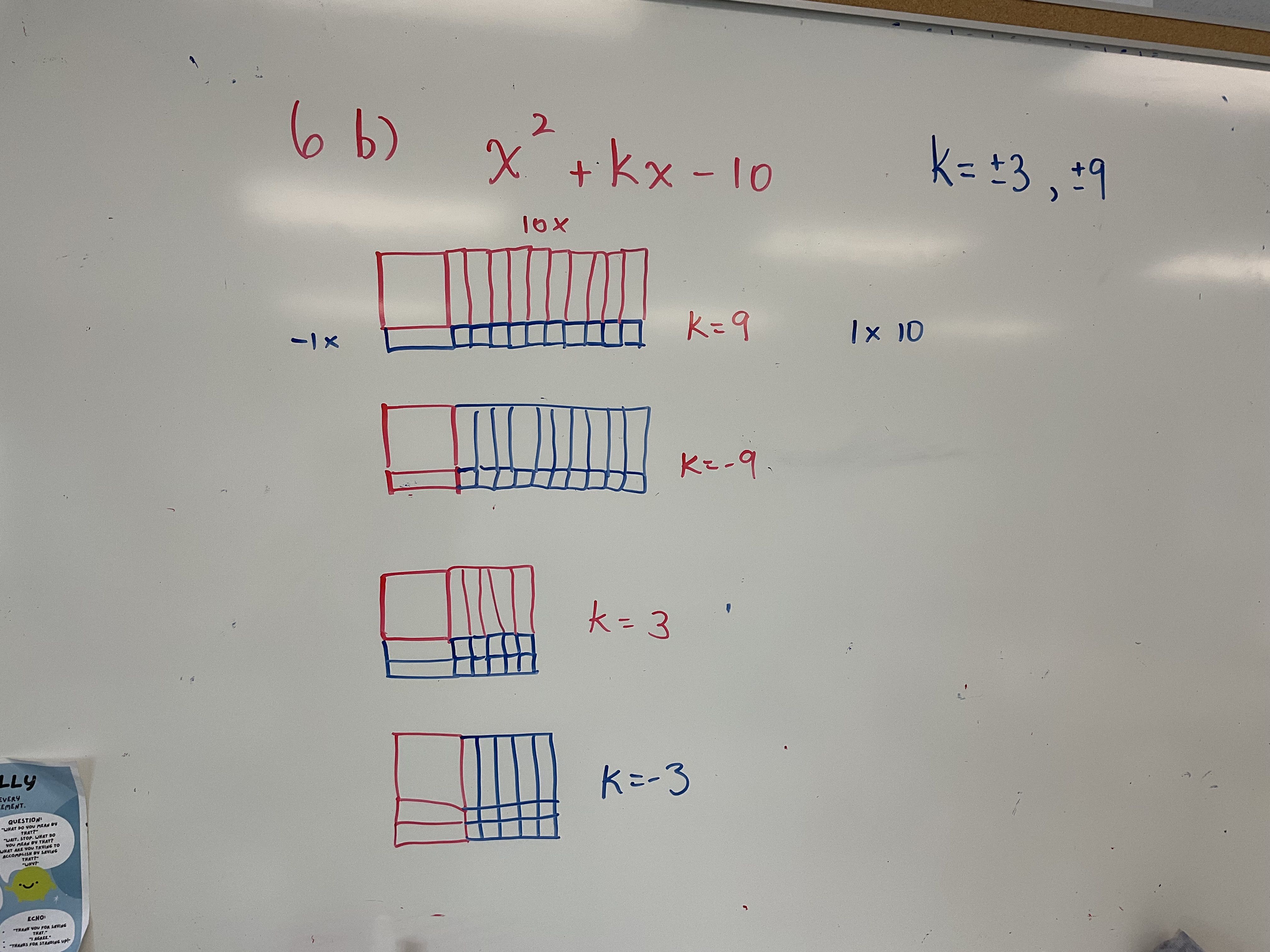
We used our logic and understanding of algebra tiles to build all the rectangles we could. We can change the number of x tiles we have, that’s all.
After working through several examples, we looked at a mix of factoring questions.
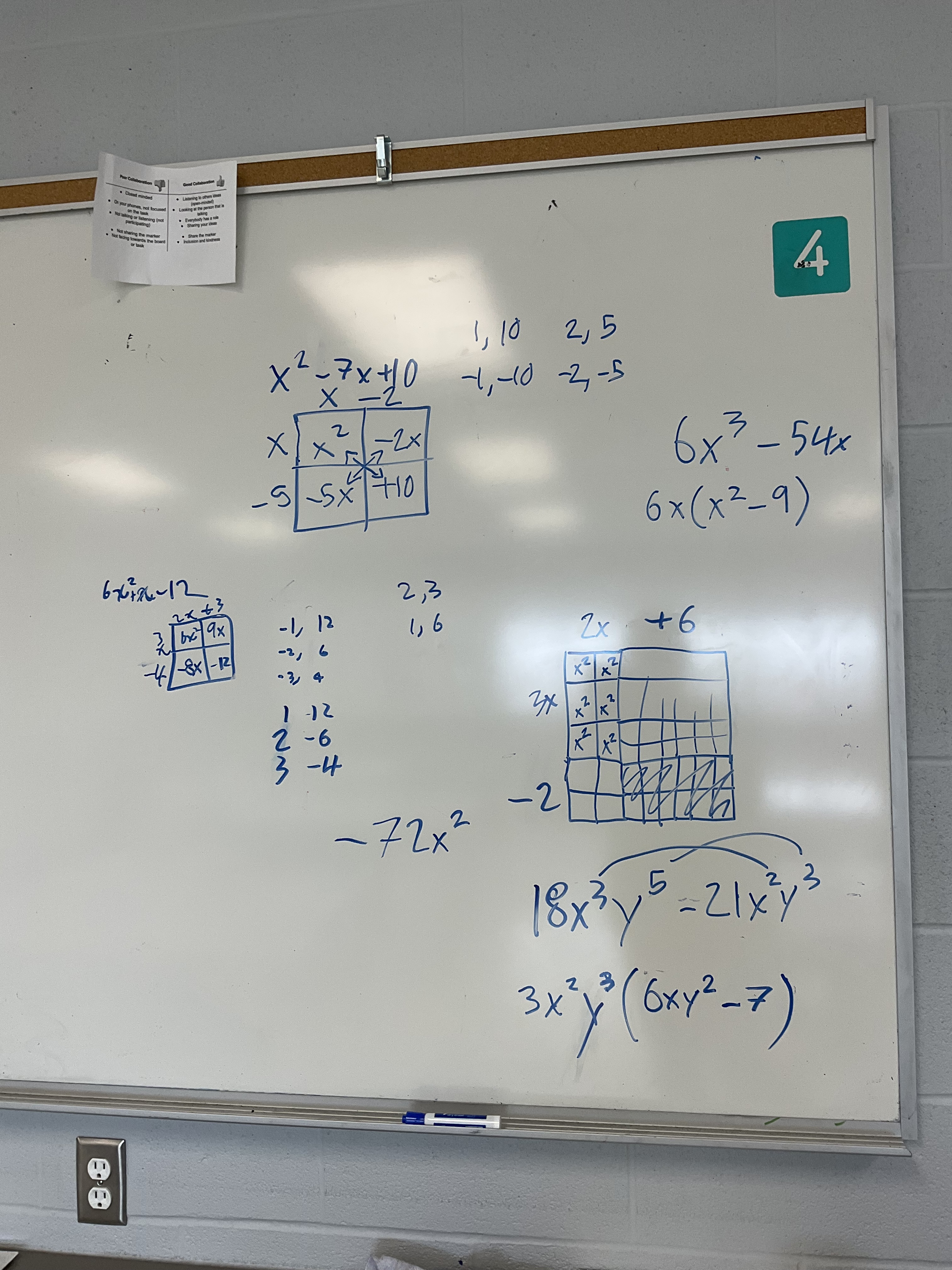
We’re getting much better with practice! We need to work on identifying cases where we need to factor, then factor again.
Fractions Boot Camp Day 2
Today was a short class, but we worked on representing and comparing fractions using relational rods. We had a concept diagram, with a 1 being defined as 12 units long (a 10 rod and 2 1 rods). Students worked to represent each fraction in the wheel by comparing the lengths to the central fraction as a help.

We recognized that the numerator was the number of pieces we needed, and the denominator was the number of pieces that equalled the “1”.

We noticed that some of the fractions were equivalent lengths!

we had some groups wanting to try to do something similar with the pattern blocks, so we tried a different concept circle with that group.

At the end of class we looked a little bit at adding fractions together using the fraction strips.
we looked at writing fraction equivalents 2/3=4/6, and 7/3=14/6 etc.
we looked at questions like 1/3+5/6 and realized we needed to make the pieces all the same size before we could count them up. If we wrote 1/3 as 2/6 then we could add up 2/6 and 5/6 and get 7/6.
more concept circles to come tomorrow!
Intro to Factoring (box method)

We know that when we multiply binomials using the area model we will have like terms appear on the diagonal. We notice that these two terms add up to give us the central term in the trinomial. We noticed today that the diagonals in both directions have the same product. We can use these discoveries to help us work backwards.
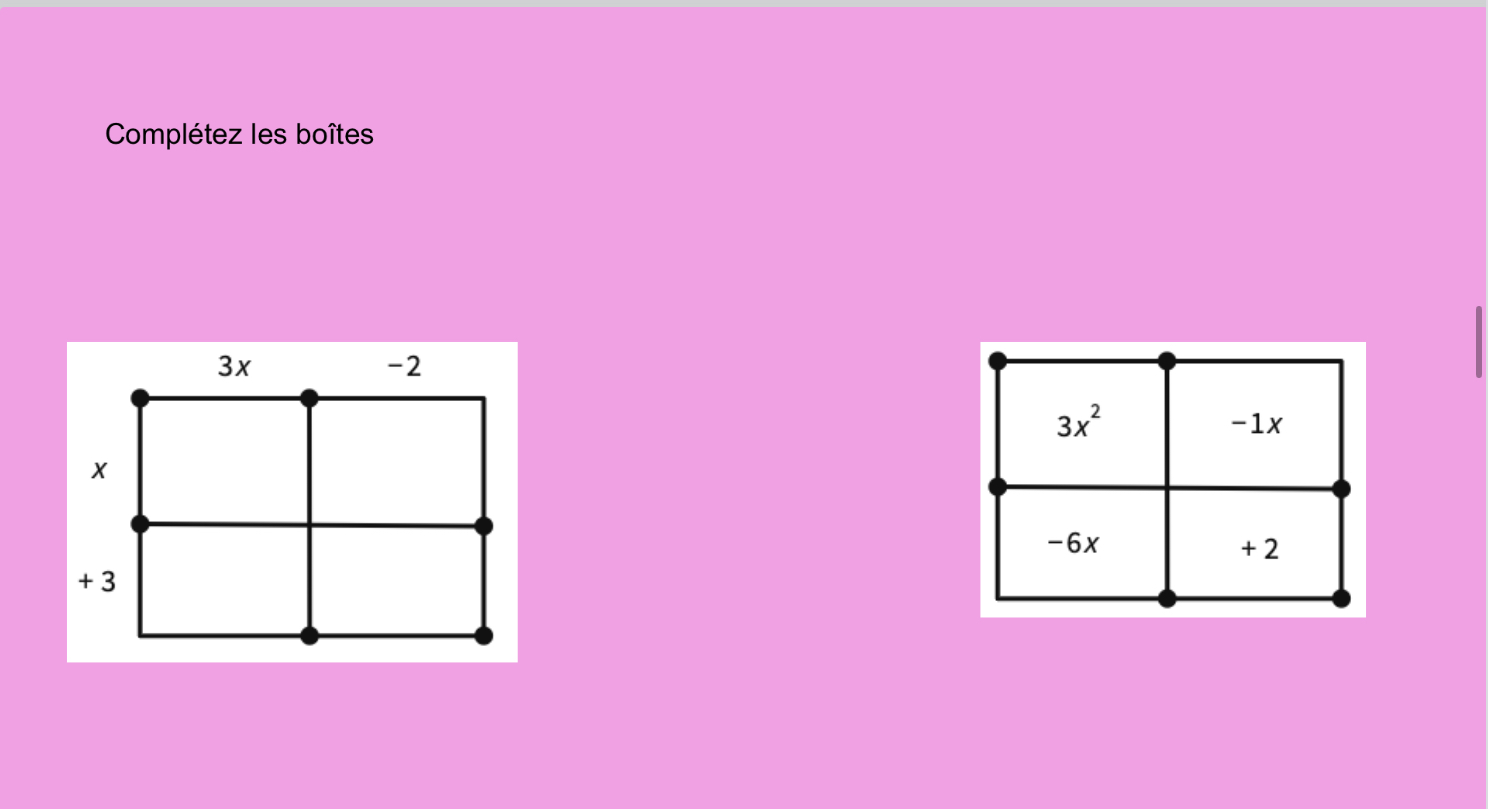
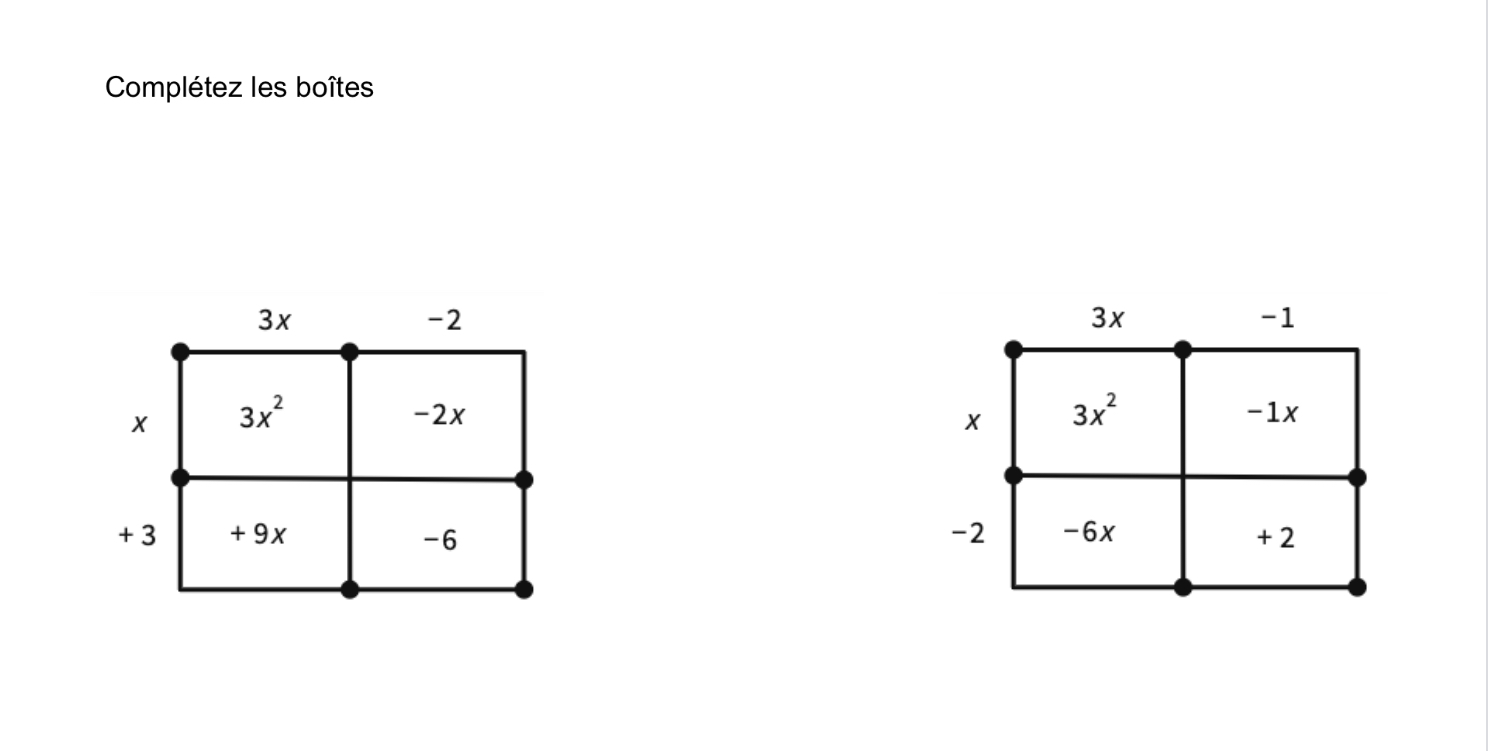
when we fill in the boxes we multiply. When we are looking for the dimensions on the outside of the box we need to common factor. For example, the bottom row has -6x and +2 we can common factor a -2 from both terms. We place the -2 on the outside of the box, and then can fill in the dimensions at the top of the box, 3x and -1, and then the other dimension missing on the vertical side would be x. The dimensions are in total (3x-1)(x-2). The solutions are below.
We worked hard at the walls in groups to use the area model to expand and also to factor. We are going to keep working on these skills moving forward.

 Ms. Bearse's Site