Fractions and Area in Grade 9
Today we are shifting from calculating with fractions to calculating area and perimeter. We worked on the “Unusual Baker” problem.

we are trying to put a price on each piece of cake, if the entire cake is $60.

It was neat to see all of the ways the students approached the task, and made use of their understanding of fractions to determine the price of each piece.
Equation Solving in Grade 10
Today in 2P students were solving equations.
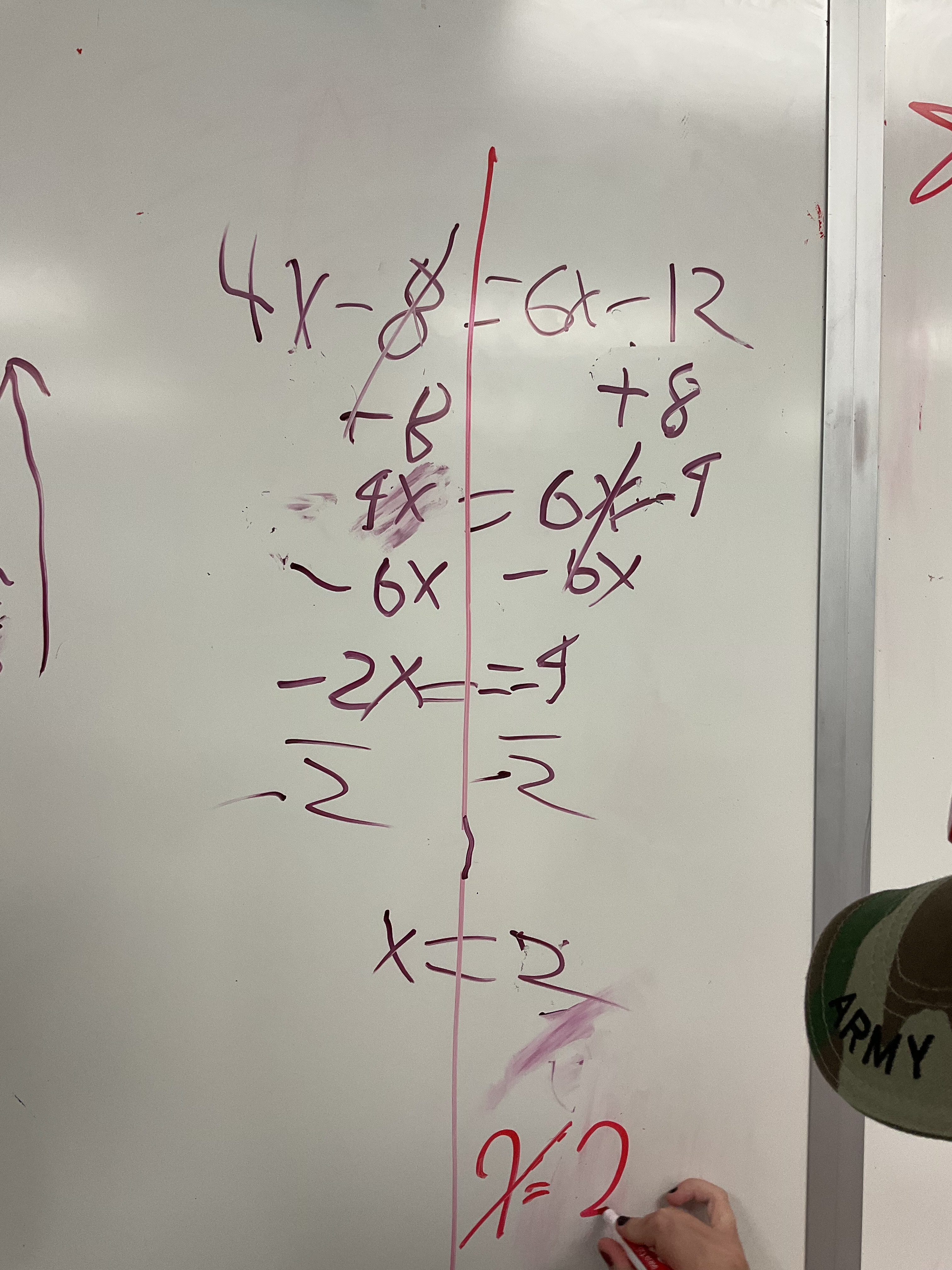
It was great to see how much they remembered from grade 9, and how well they worked together at the whiteboards.
Some questions led to interesting discussions about distributive property.
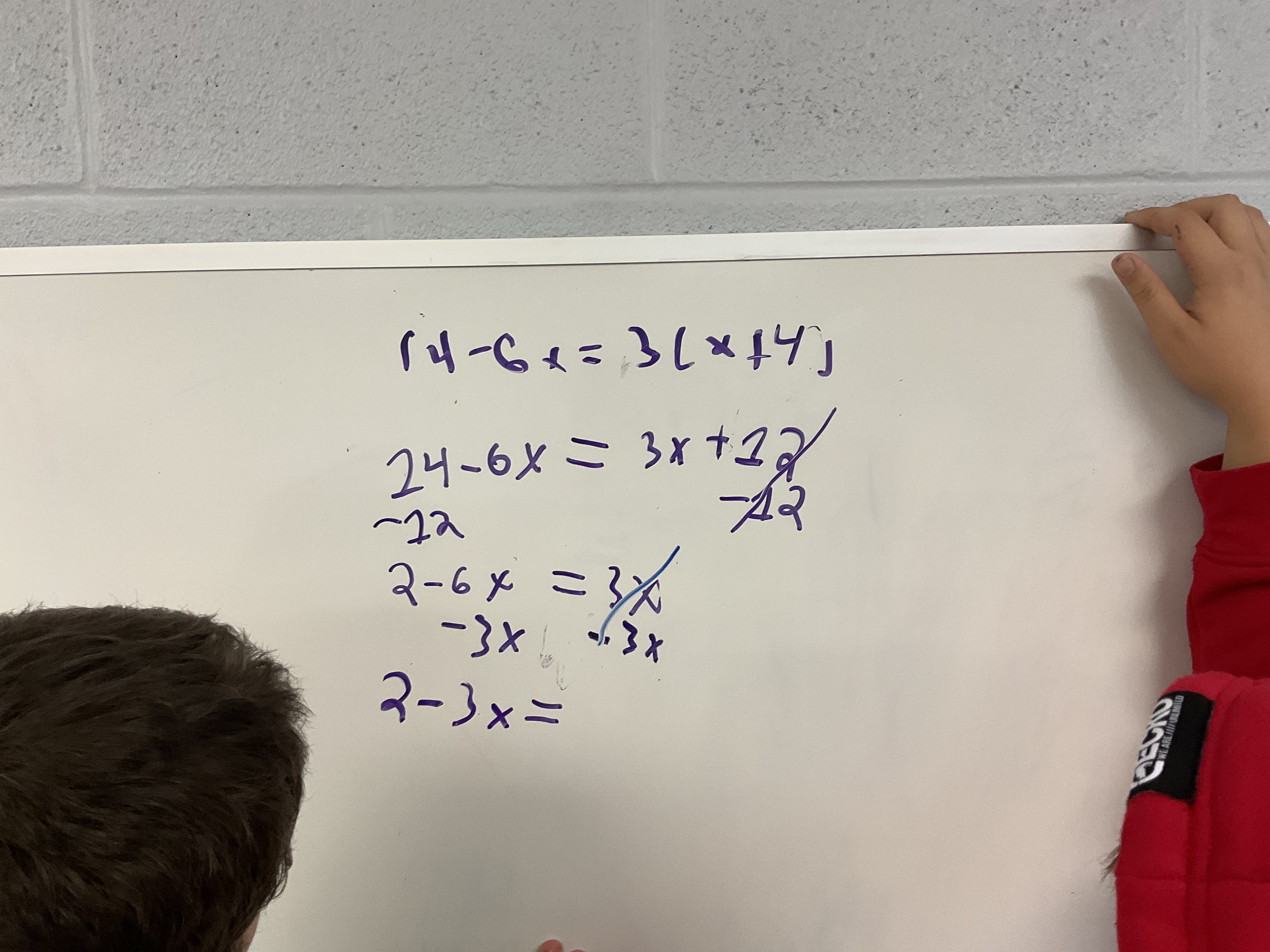
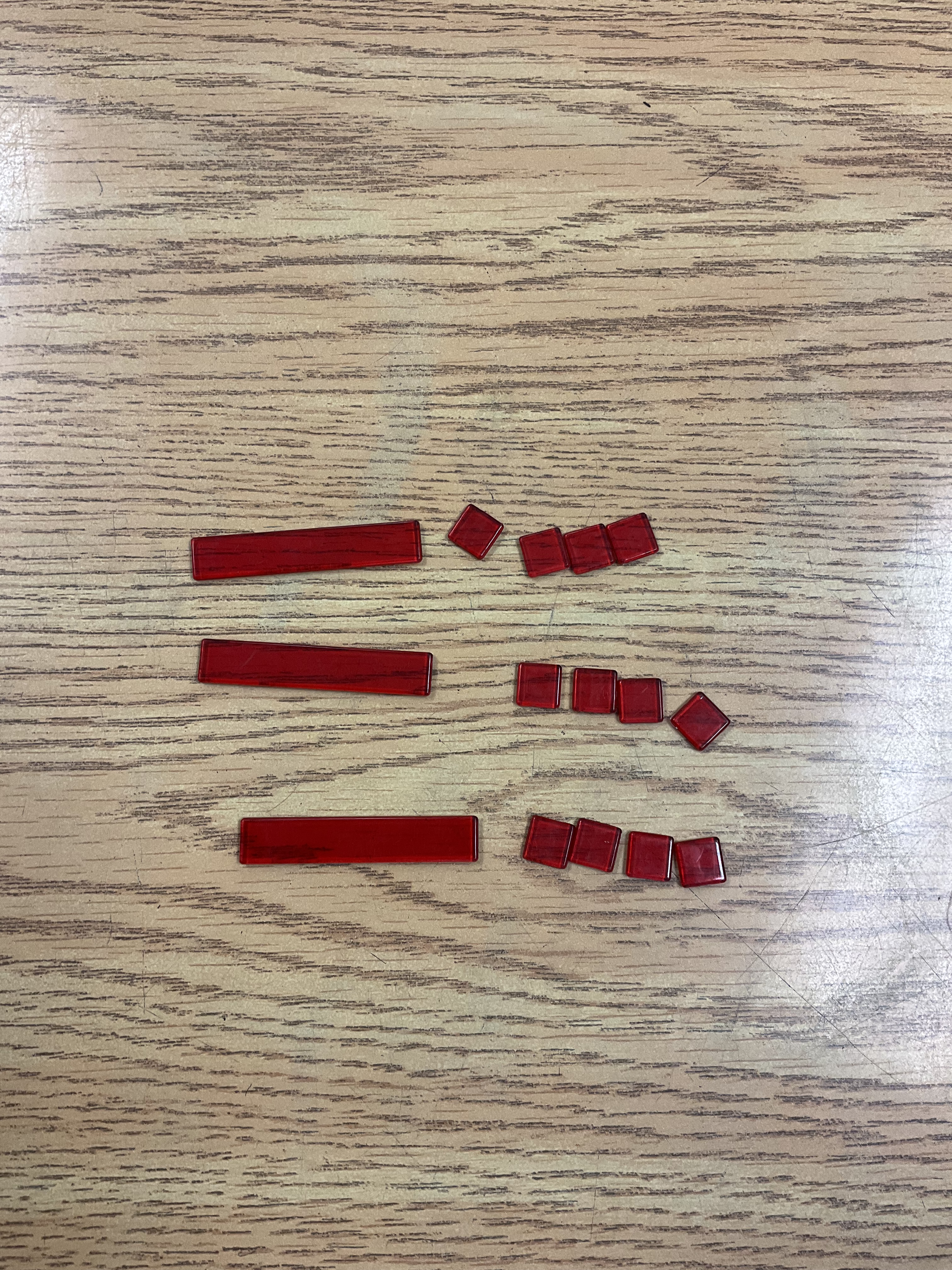
we used tiles to help understand what 3(x+4) means.
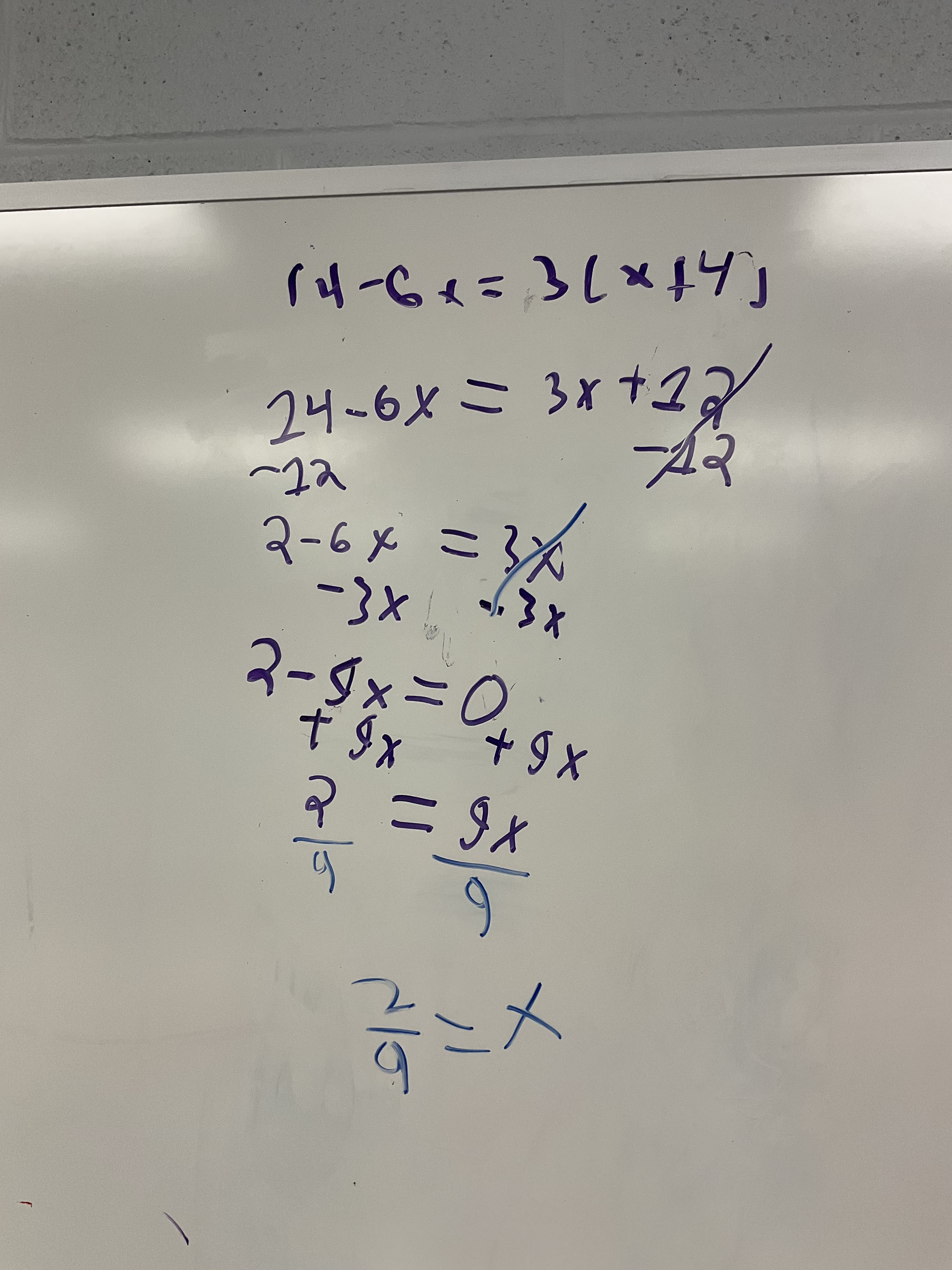
It was impressive what they could do by the end!
Visual representations of Fractions
Grade 9s are working on operations with fractions. Today we worked on multiplying.
We started by representing multiplication with an area model, using whole numbers.

Next we spent time exploring what it means if we multiply fractions with an area model. This question represents 2/3 times 1/2. We started by using vertical lines to divide the rectangle into thirds, and we coloured 2 of the thirds. Next we divide the rectangle horizontally into 2 pieces and we colour one of the halves.

the result of the multiplication will be a fraction. The numerator is the pieces that were coloured twice. In this case, 2 pieces. The total number of pieces will be the denominator. There are 6 total pieces. The result is 2/6 which simplifies to 1/3.
We did a few more examples at the walls, and then tried a new model for taking meaningful notes. The first quadrant has an example that involves filling in a few blanks, but the format is highly scaffolded. The second example leaves room for students to use their knowledge. The third quadrant is where they can write down an example we’ve done, or make up their own. The final quadrant is where they write some pointers for themselves for next week when we look at this again.

This note taking practice will be something we will be working on this term as a way to document our learning.
Collecting Data in Grade 9
We’ve started collecting some data in grade 9, and we’ll be collecting more data each school day, for a total of 10 days.
Each student is going to be doing a “five minute frenzy” multiplication challenge.
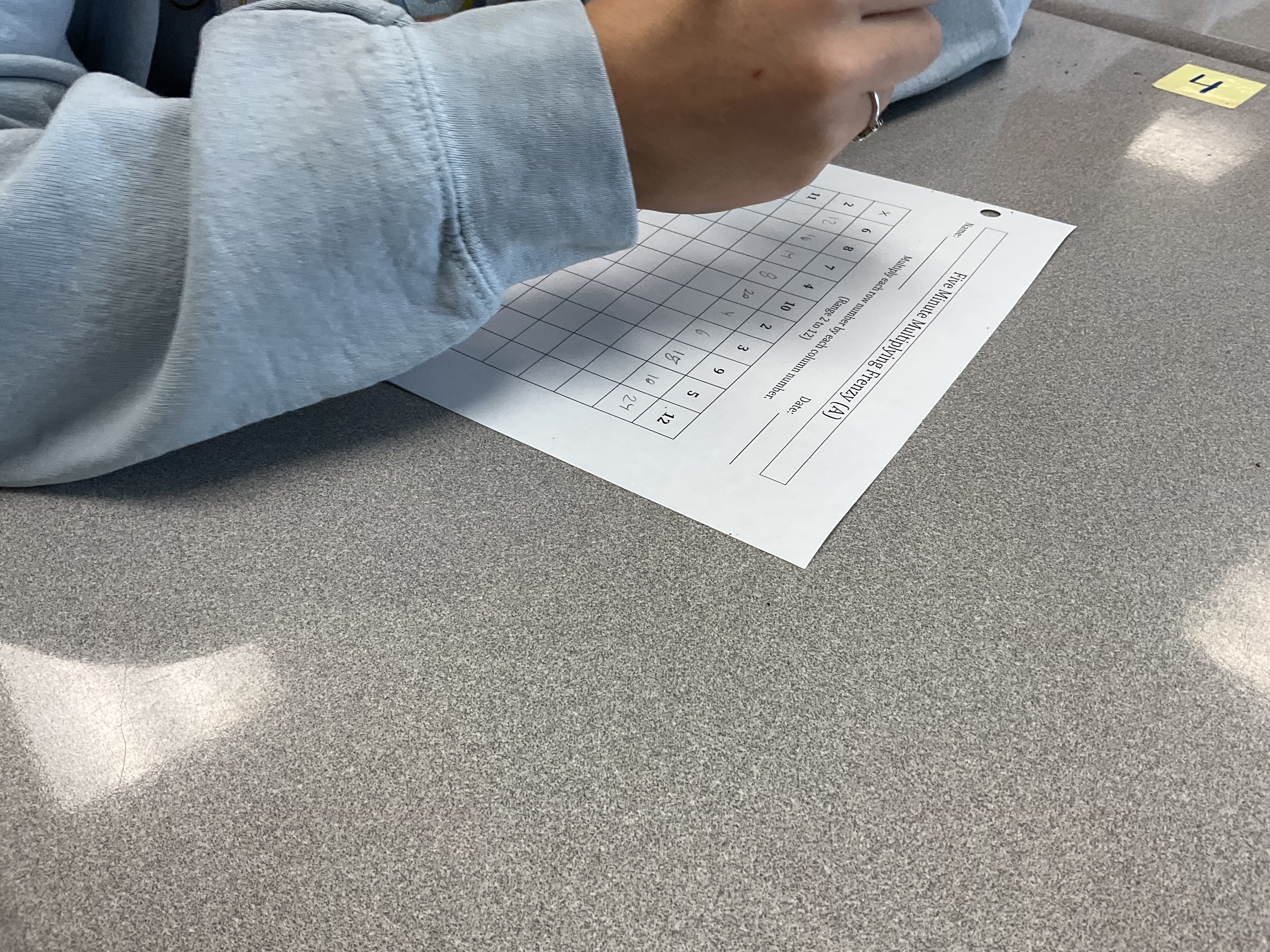
After the challenge is done, we tally up how many we got right, and how many errors we made, and how many we left blank, and how long it took. These are our dependent variables. We will be exploring how they correlate with the date that the challenge was completed.

Each student will then get to select data that tells a story. They will graph the data, interpolate and extrapolate with a line/curve of best fit, and discuss the trends of the graph.
Along the way, it is an excellent springboard to discussing multiplication strategies, and to try them out the next day.
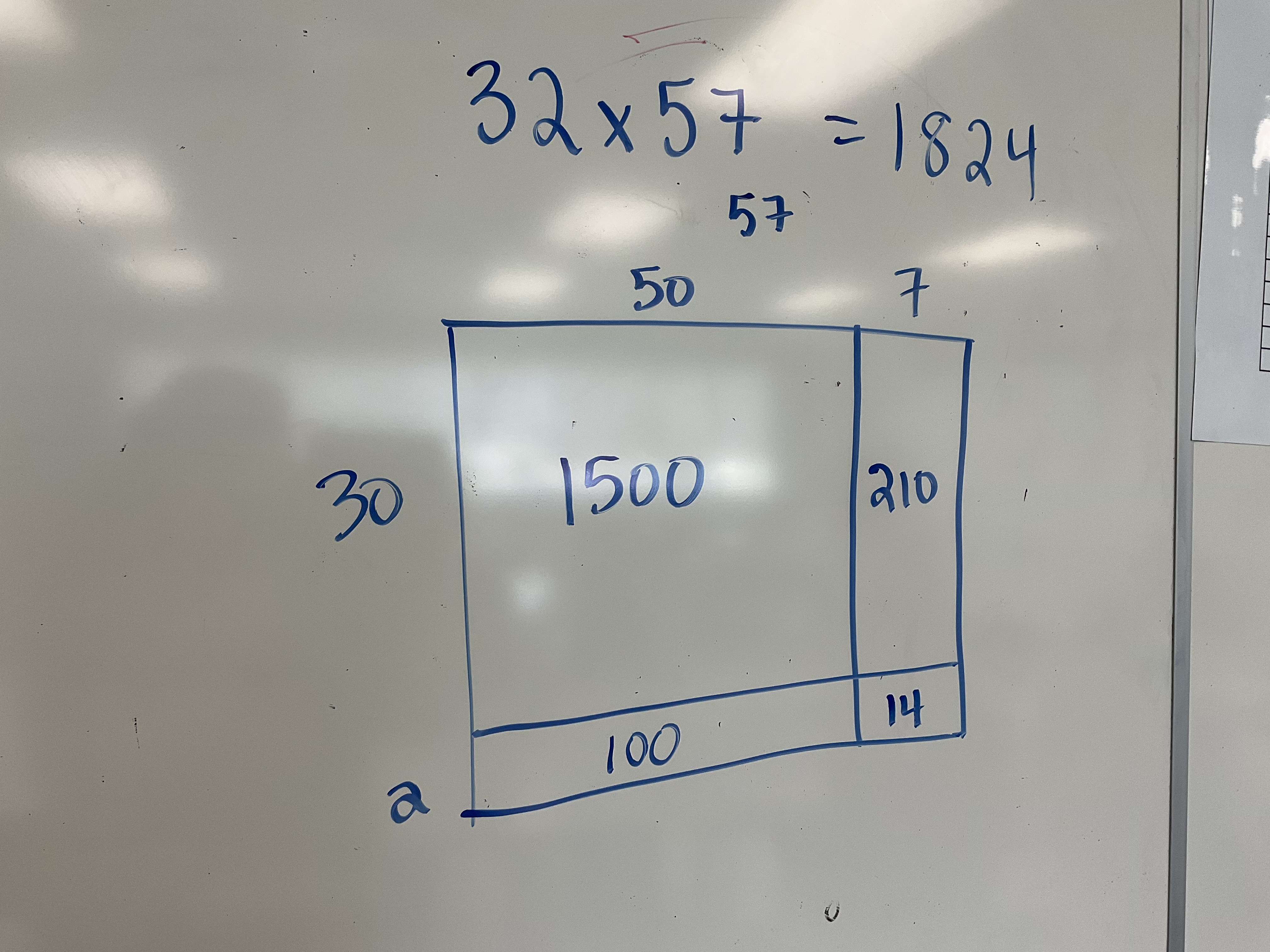
Today, we looked at using the distributive property to split up big numbers like 12 into friendlier numbers like 10 and 2, and using that to help us multiply by 12.

We also explored how this can help us multiply big numbers together.
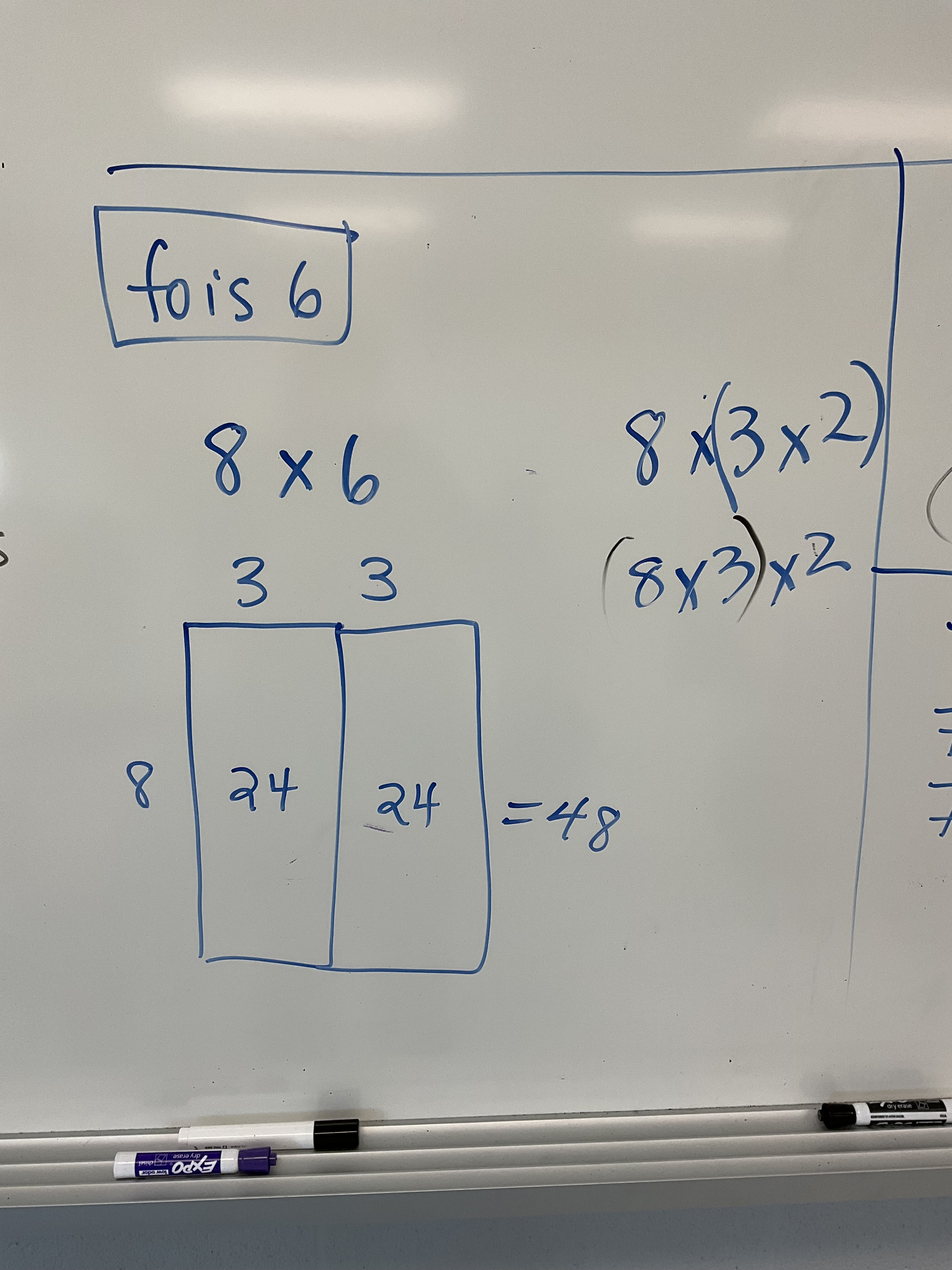
We looked at multiplying by 6 as well, and how it relates to doubling the result of multiplying by 3. Here we used the distributive property and the associative property to illustrate this multiplication.
We looked at multiplying by 4 and by 8 using the associative property as well.

Students are keeping track of their data each day, and some are already noticing some big changes as we practice and learn new strategies.
Bucket of Zeros
Today in grade 9 I was in a class where students were working on integers and using the bucket of zeros to show that a negative times a negative will be a positive number. Many times we have been told the rule, but it is important to be able to show why it makes sense.
Students started out by making a bucket of zeros with many zero pairs on their desk.
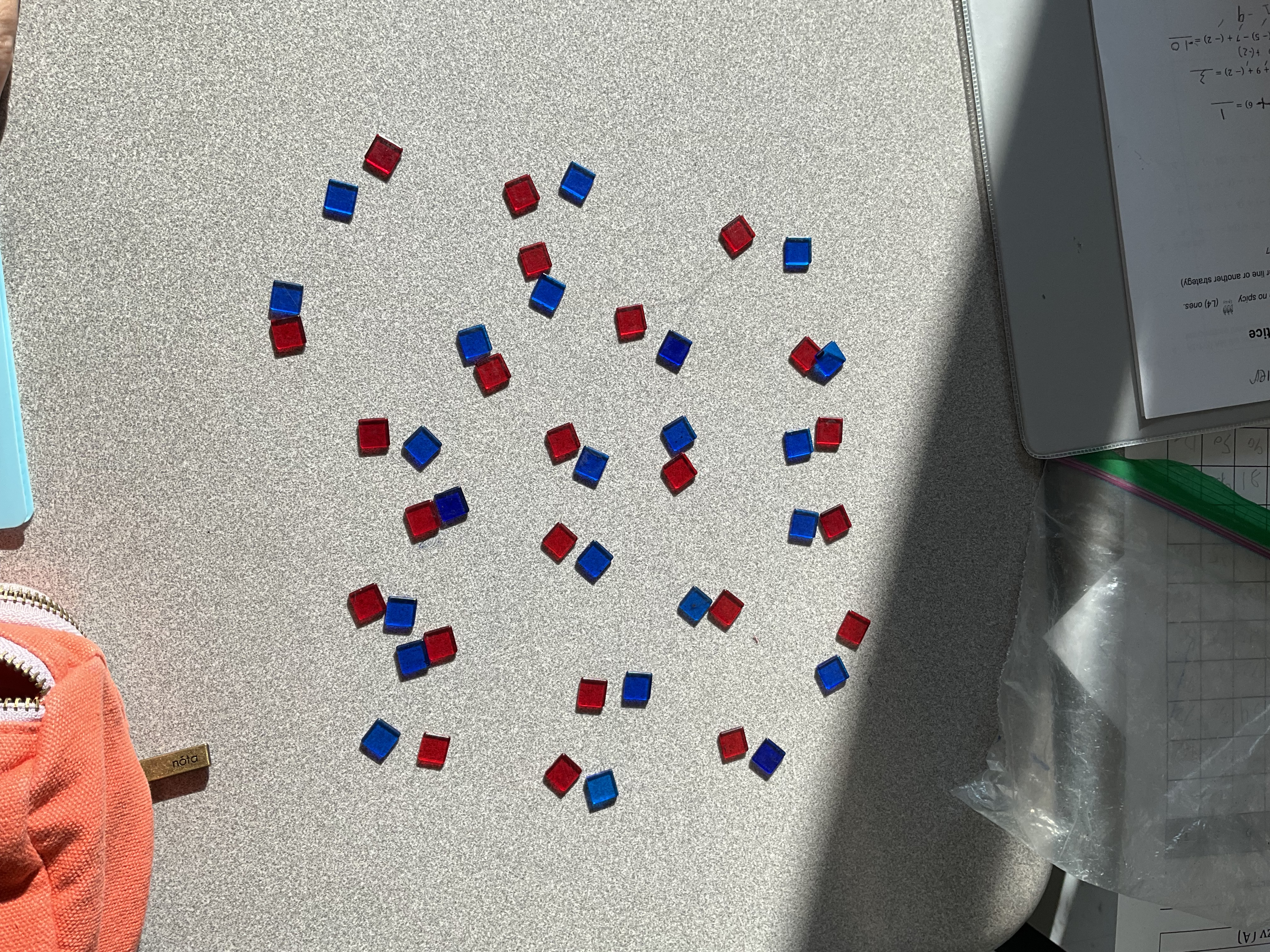
The next step is to decode the question. This question was -7(-4), which we can be viewed as removing 7 groups of (-4).
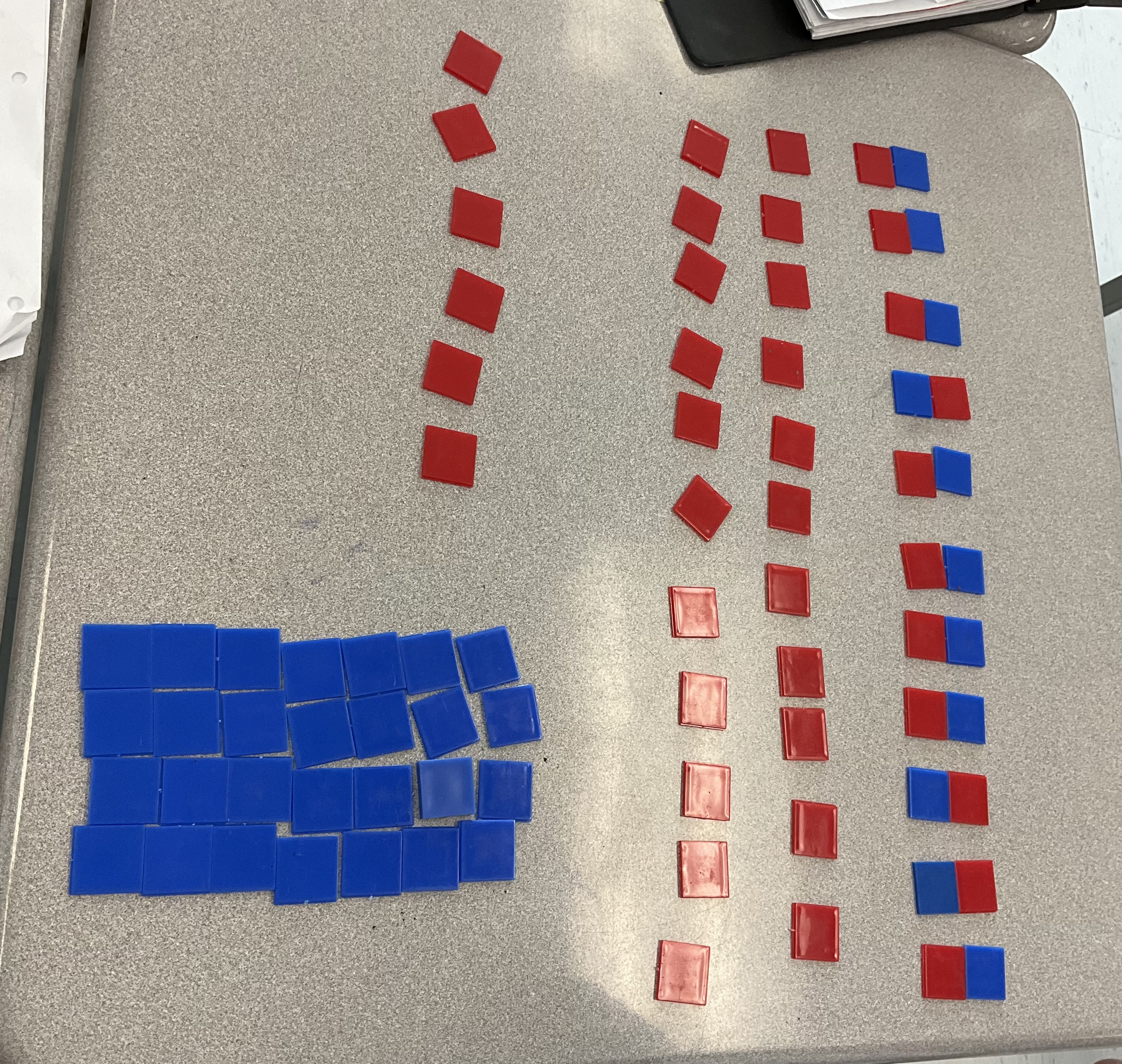
Once the 7 groups of (-4) are removed, we look at what’s left.

We have some zero pairs, and also 28 red tiles. So we have proven that -7(-4)=28.
To consolidate, students were doing questions on the board, showing their work with the bucket of zeros.
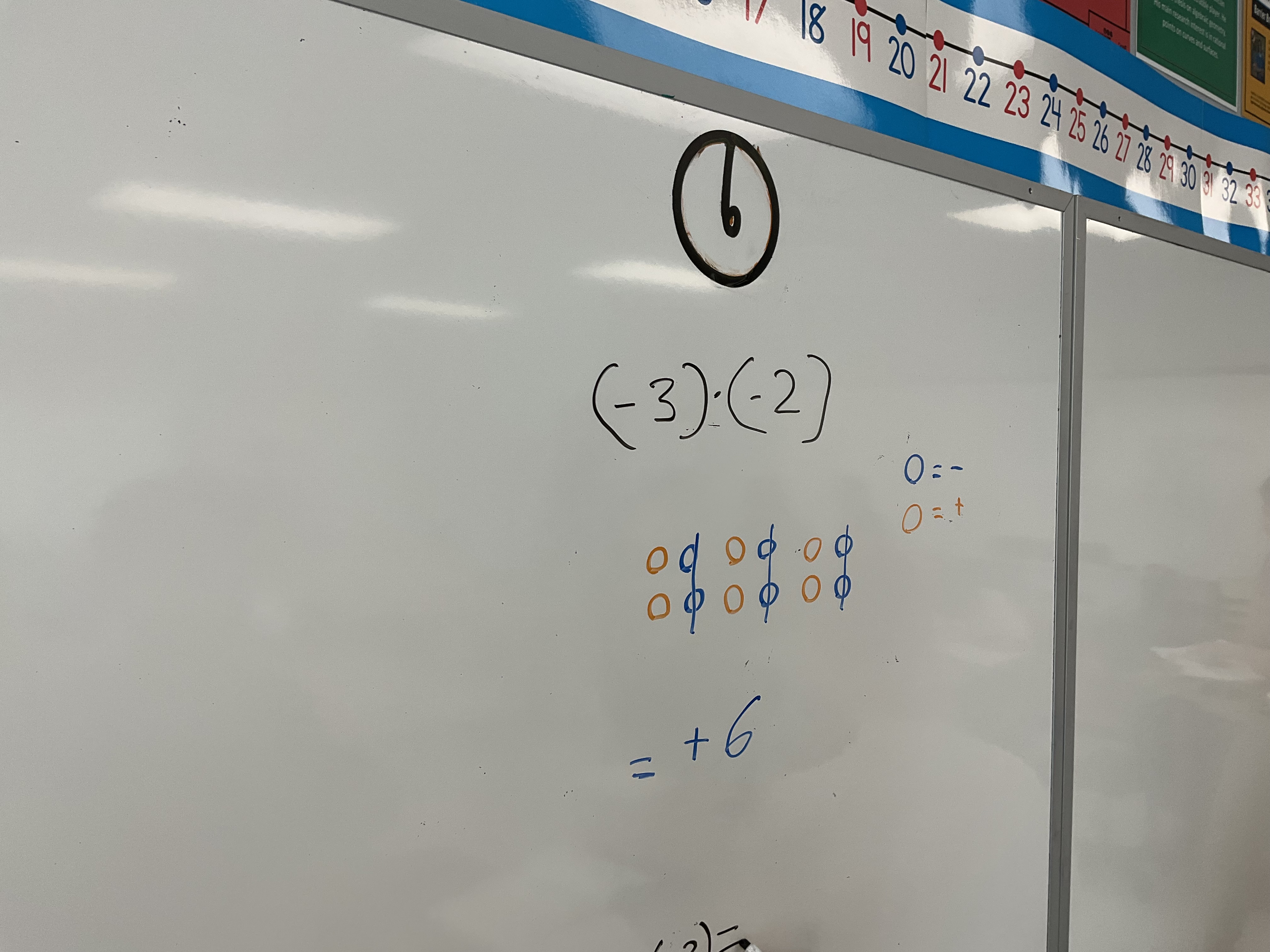
They then consolidated with a 4 quadrant meaningful note.

Volume of Pyramids and Cones
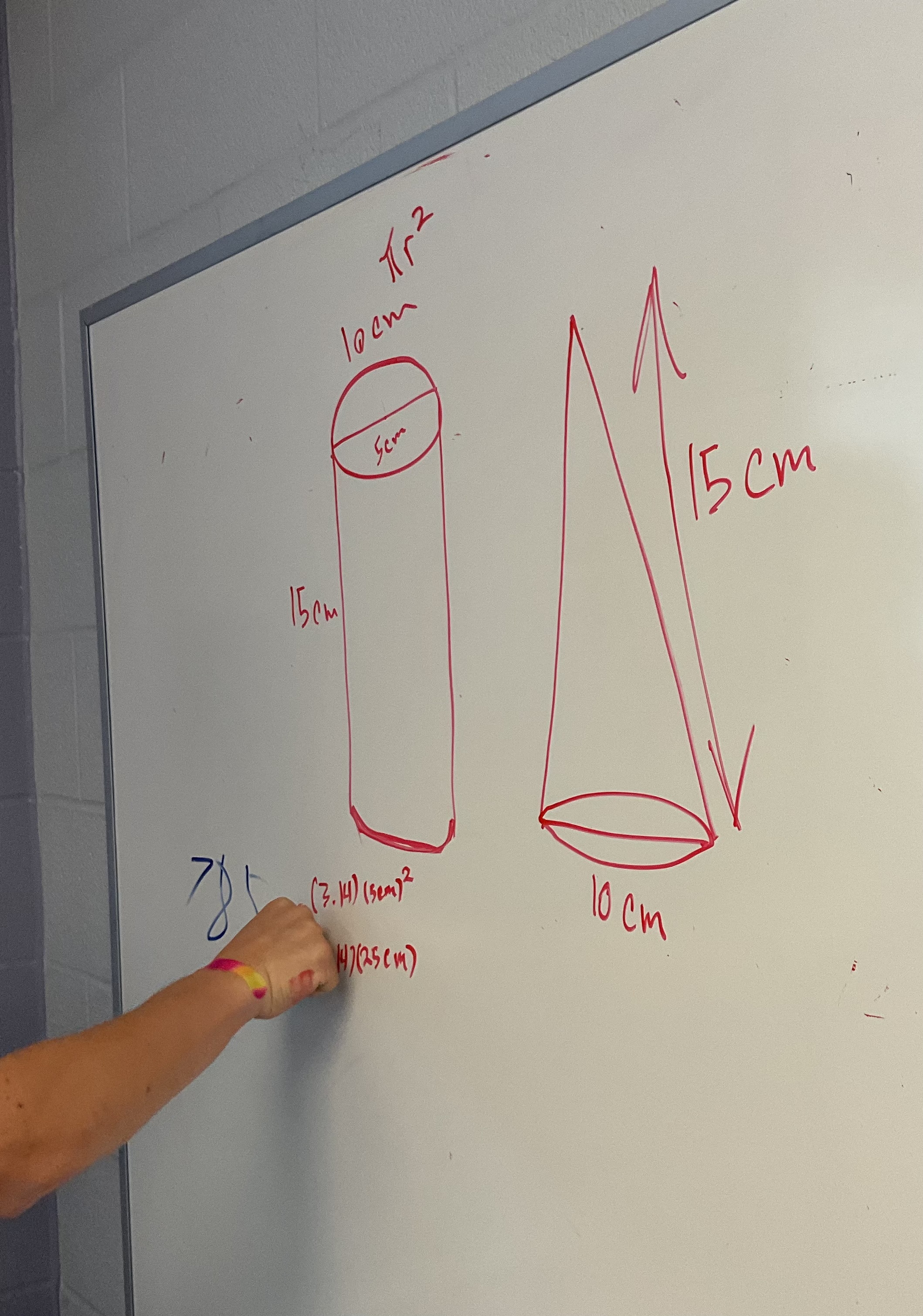
Today we looked at the volume of pyramids and cones, and developed the formulae using water.
By using the geometric solids we discussed the properties of prisms and pyramids, and then guessed how many cones it would take to fill a cylinder with the same base and height. Many students guessed 2, 2.5, 3, 4 as possibilities. After the cone was filled once, and dumped into the cylinder, students were prompted to look at it and refine their guess if needed. Most converged on an idea of 2.5 or 3ish.
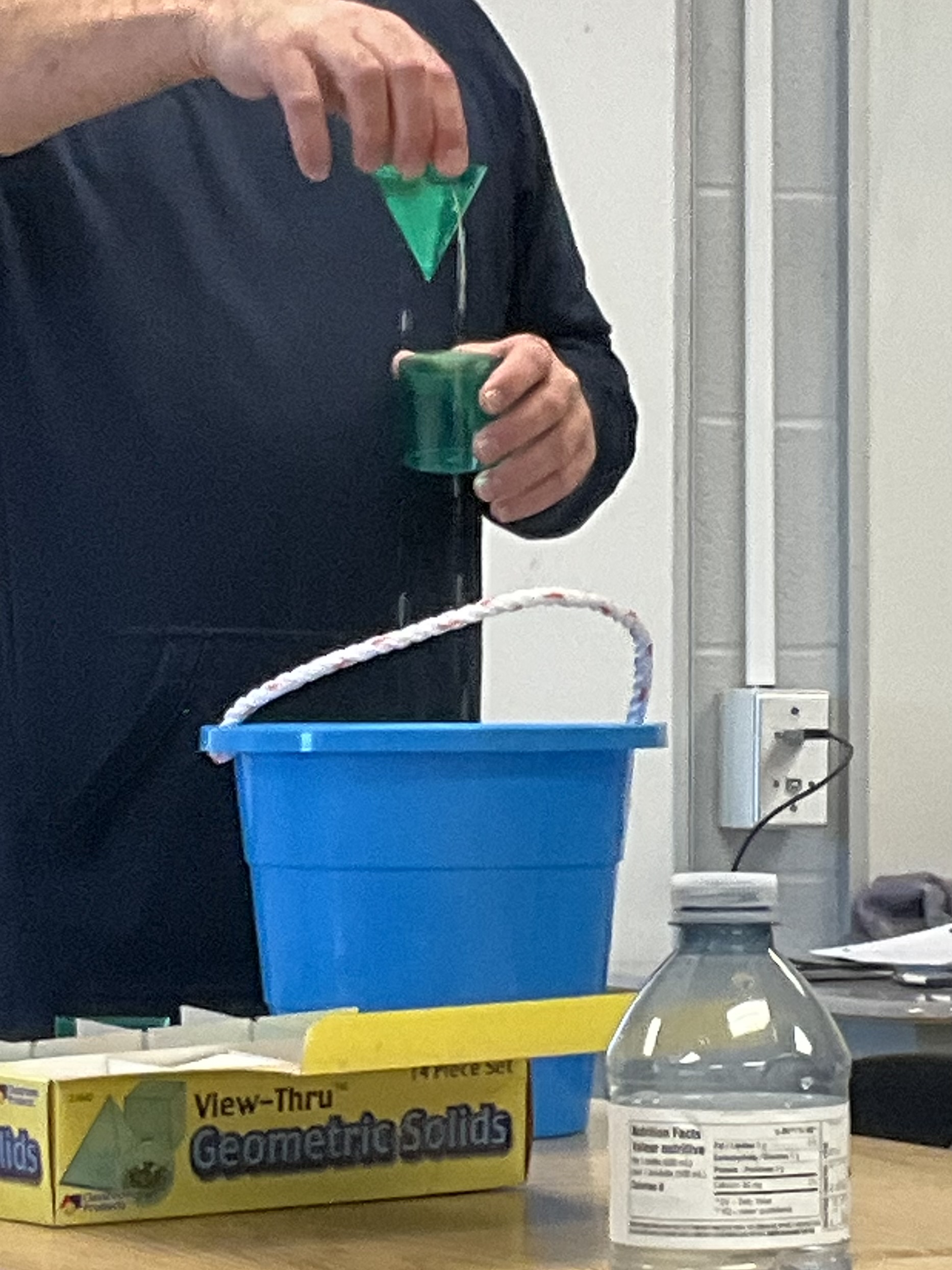
Finally, everyone could see that it took 3 cones to exactly fill the cylinder to the top. The same process was repeated for square based pyramids and a square based prism, and then again for a triangle based prism and triangle based pyramid.
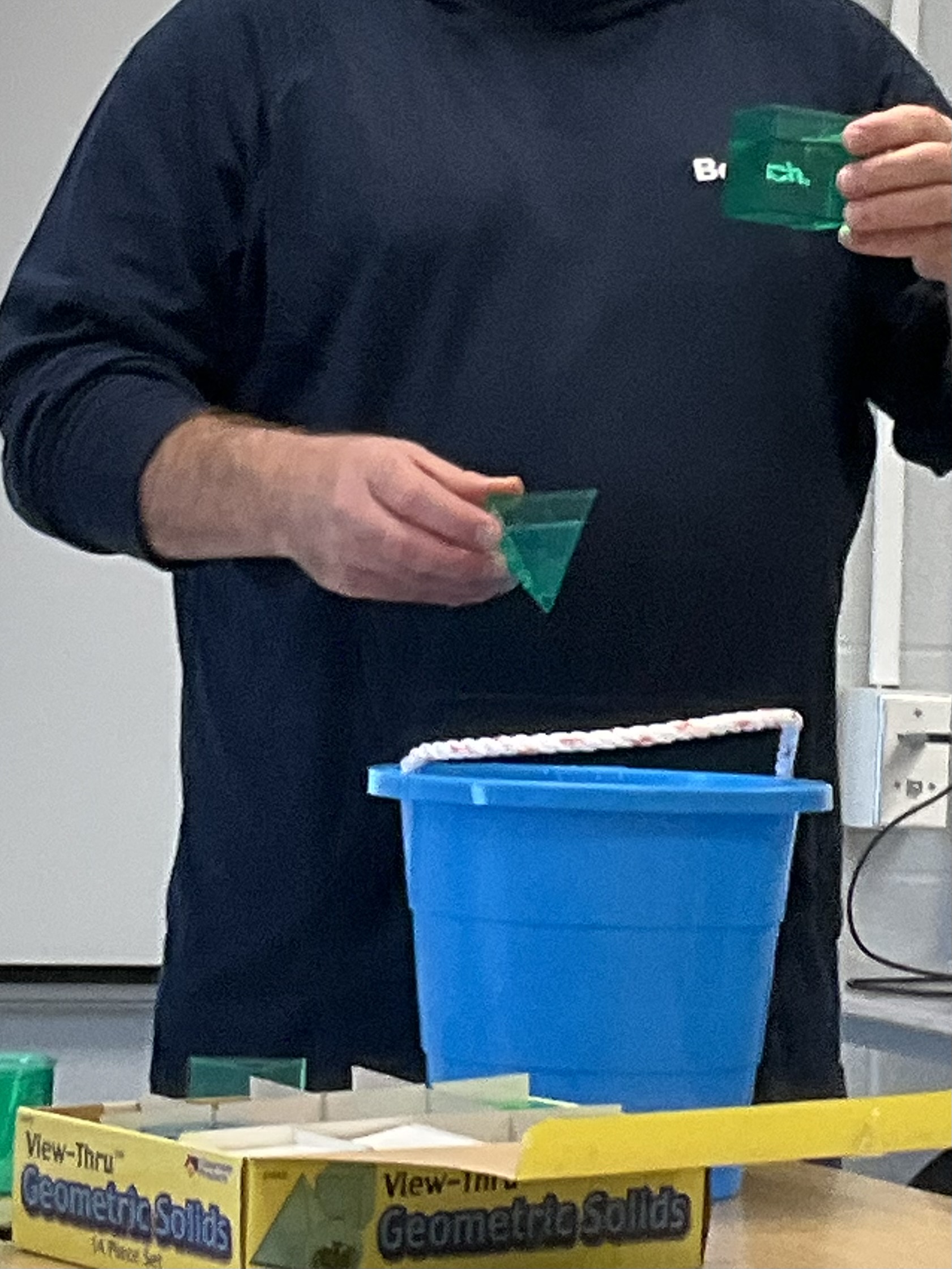
In the end, students saw that it took exactly 3 pyramids to fill a prism with the same base and height. (Note: if you are doing this activity be very careful not to overfill the pyramids since a meniscus would affect the volume).
Next, the idea of working backwards from cylinder to cone means that we multiply by 1/3. A cone contains 1/3 of the water that the cylinder did.

From there, students were up at the boards in small groups working on calculating the volume of pyramids and cones, and cylinders and prisms.
Building Prisms in Grade 10
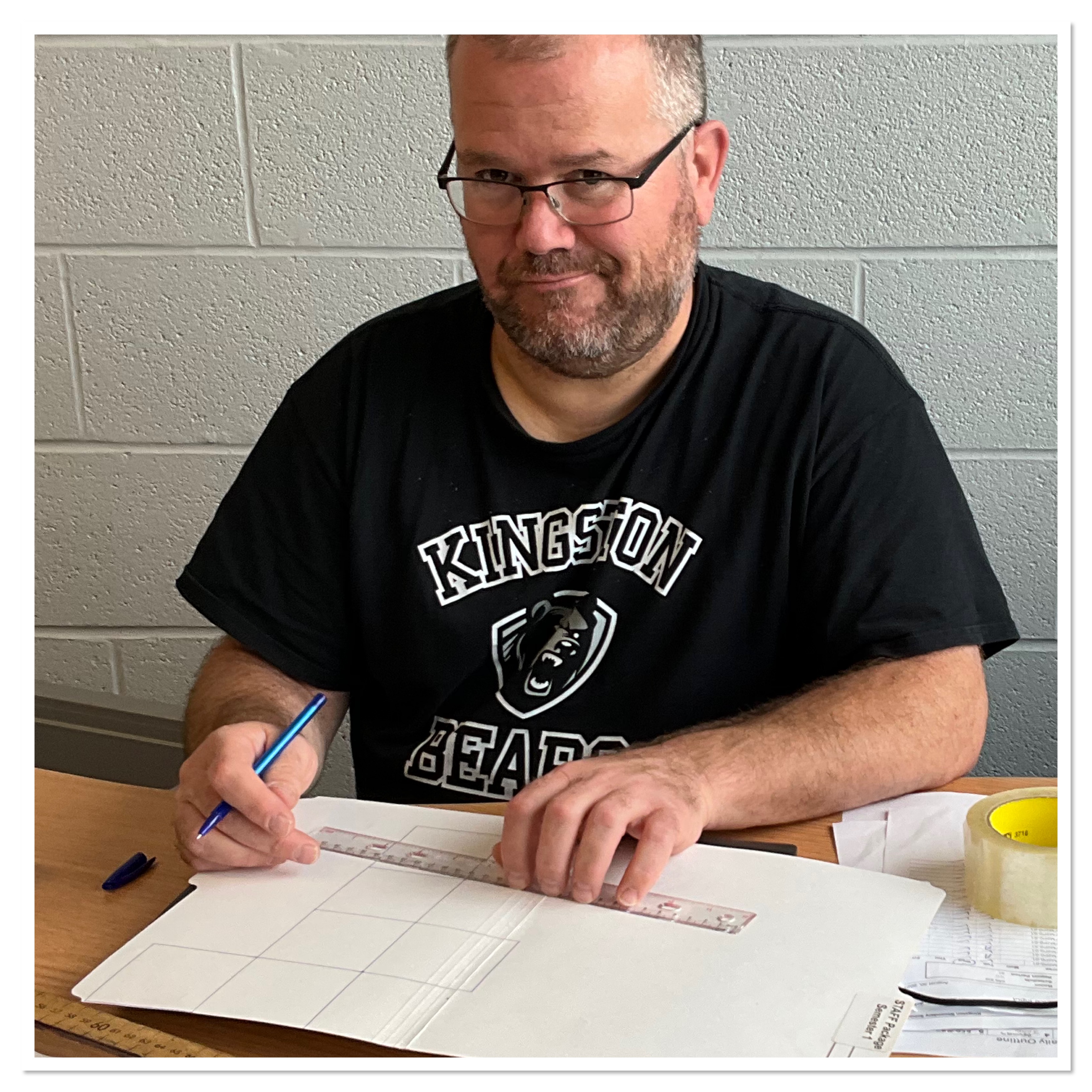
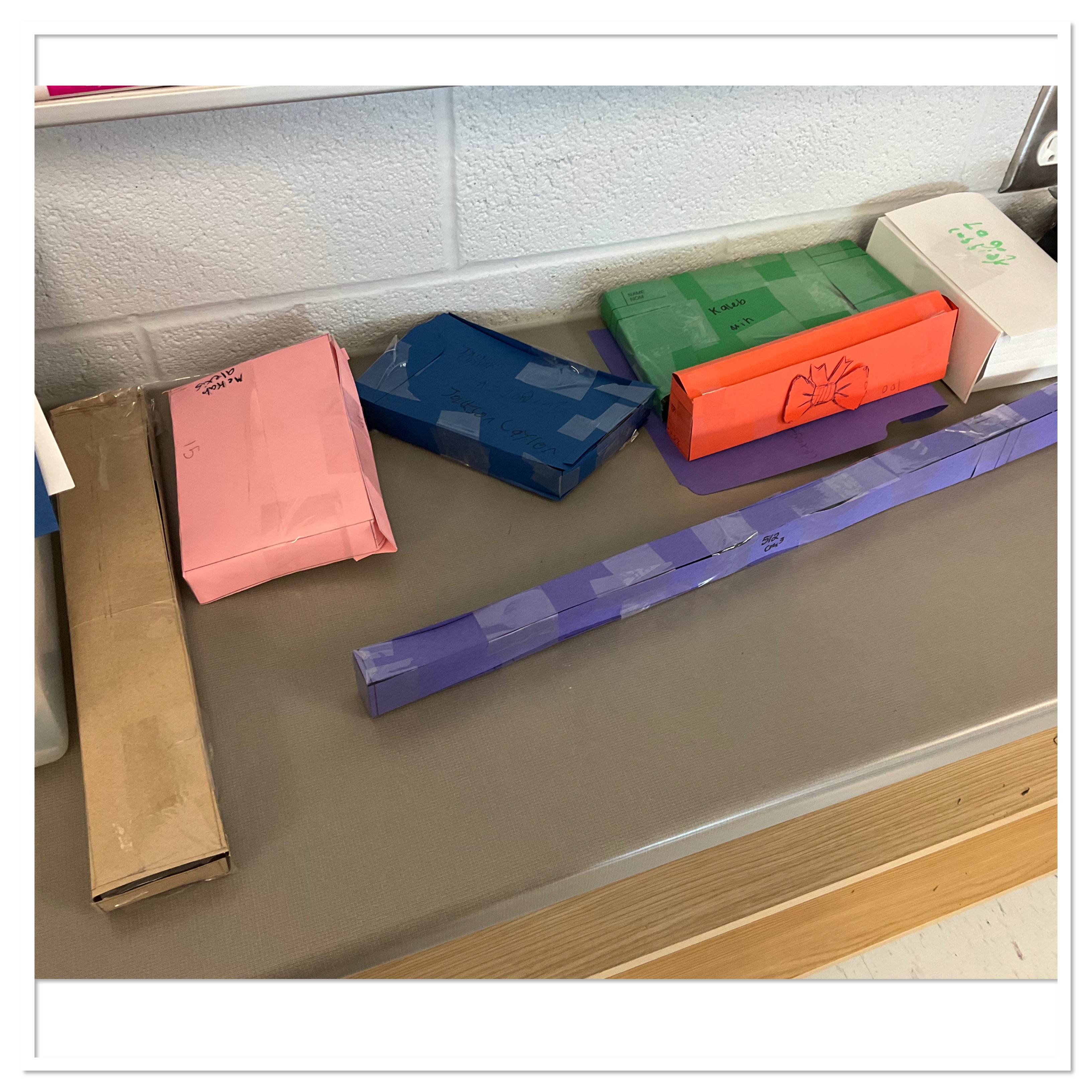
This morning in MFM2P we were building rectangular prisms with a volume of 300cm^2. It was an interesting challenge for the class, to find dimensions that would work, and then to actually construct the prism.
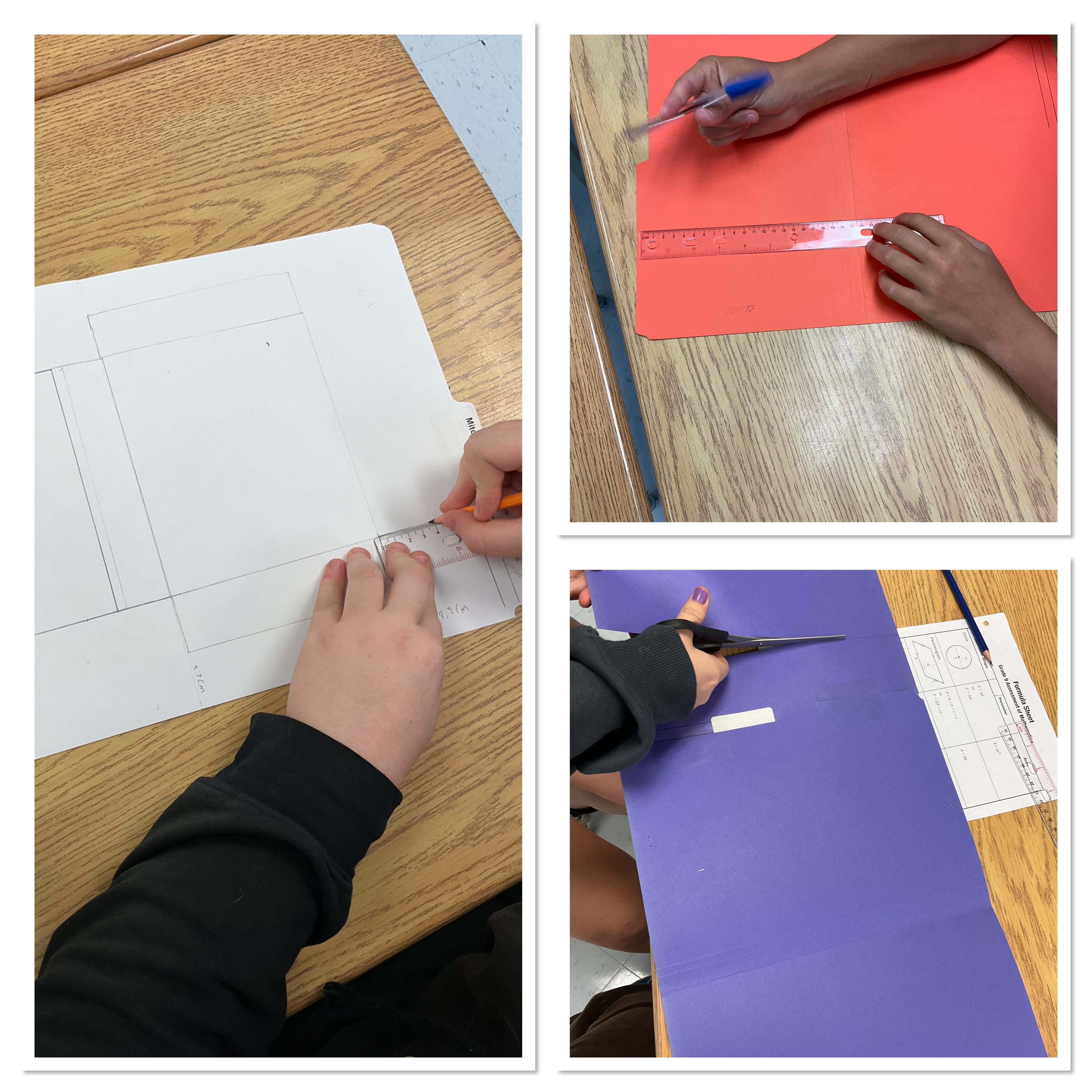
We used old file folders donated from our main office, and we needed rulers, tape and scissors. Students were in groups of 2 or 3.
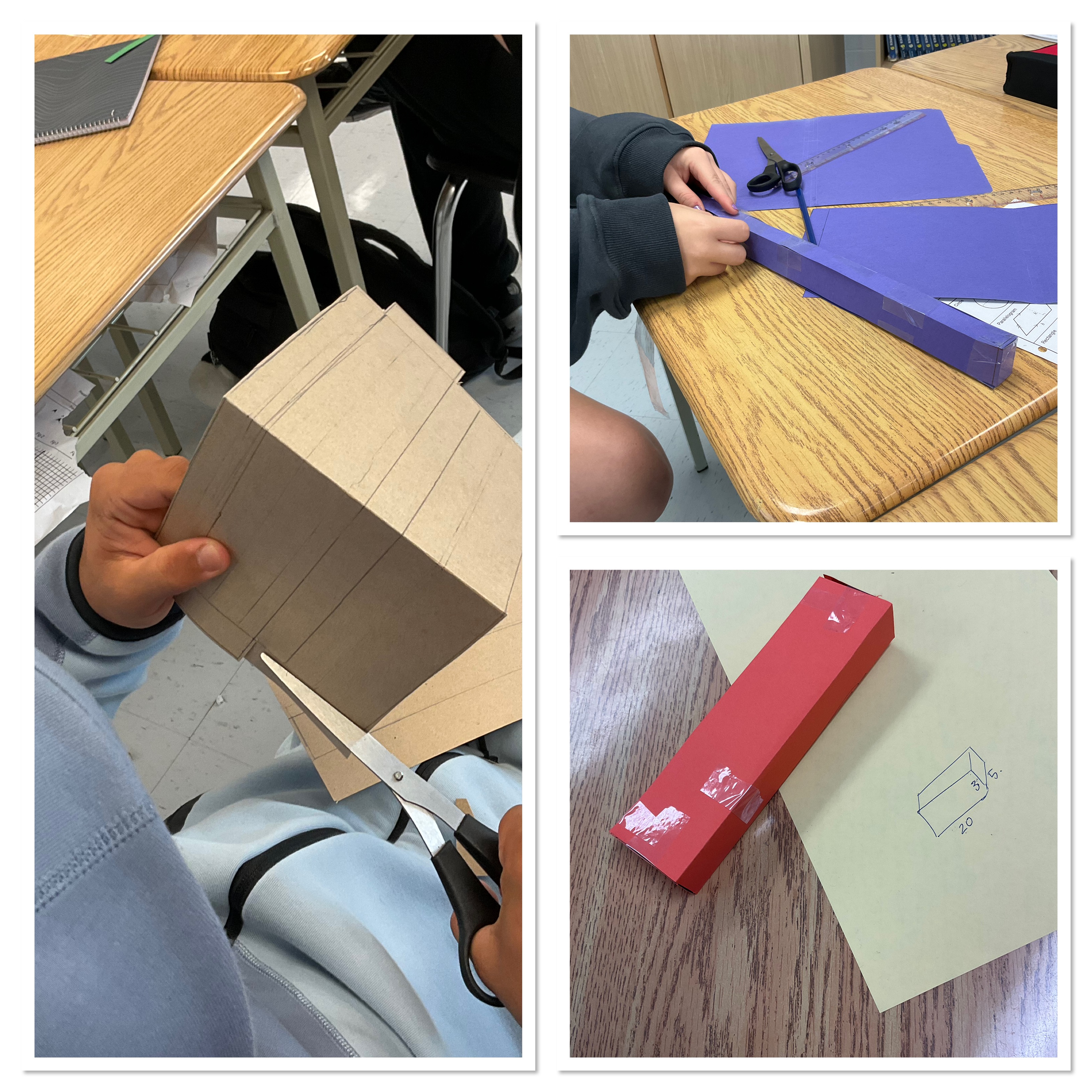
some groups made a net, and then had a much easier time assembling the prisms. The groups that cut out 6 individual faces had some frustration putting it all together.
There was some great learning that happened when assembling the boxes. Some people learned that if sides fold to join, they should be the same length. Something that you realize pretty quickly when your prism has a hole in it! Others realized part way through that they had chosen numbers that would not actually multiply to 300. I recommend not choosing a side length of 17 if you are working without a calculator!
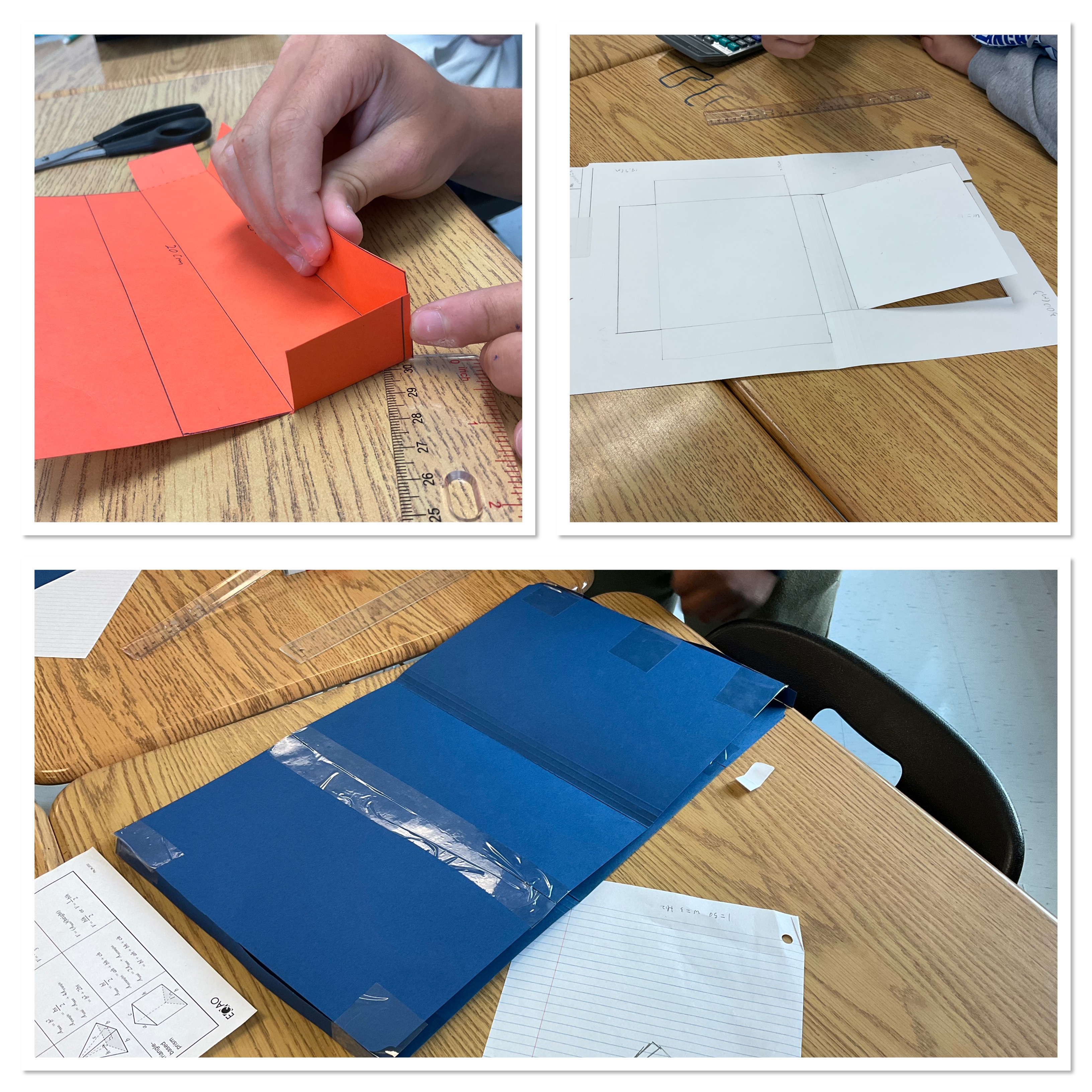
Another group made a side 30cm instead of 3cm, so they have a much larger volume than everyone else!
We have a cube that was made by our fearless leader. There was some discussion about if that counts as a rectangular prism. Some students are still not convinced!
At the end we calculated the surface area of the prisms, and we will look at them again tomorrow and put them in order from smallest surface area to biggest, and notice any patterns. It is a neat way to experience how prisms may have the same volume, but that doesn’t mean they have the same surface area.
Great work everyone!
Day 2: we organized the prisms from biggest to smallest surface area, to look for trends.
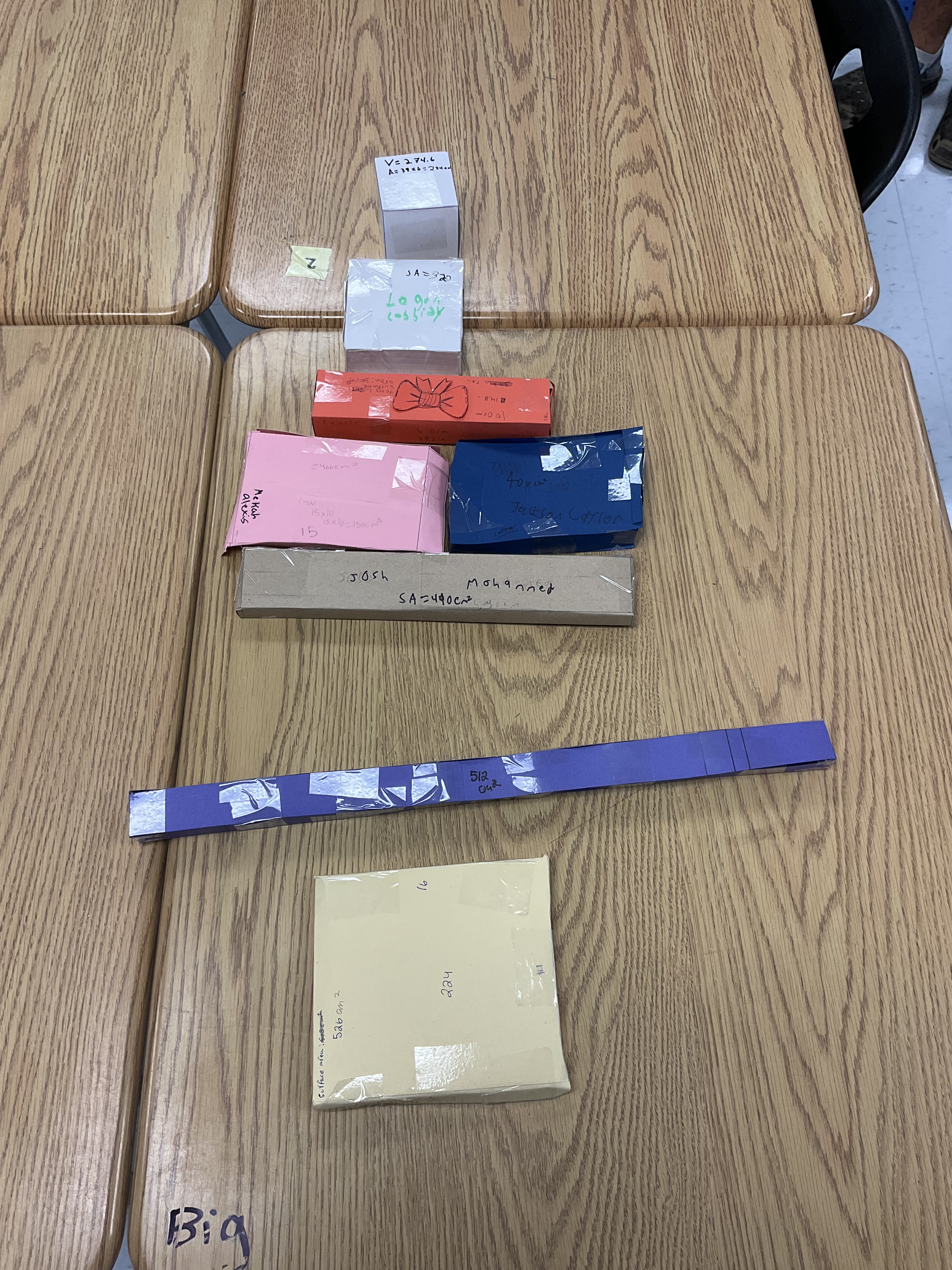
we noticed the cube is the one with the smallest surface, and the ones that are longer or flatter have bigger surface areas.
we talked about surface area in terms of doing drywall, or flooring, and we noticed the floor tiles are a square foot. We talked about packaging items, and why choices are made to minimize packaging, or not. We talked about how surface area and volume are important to biology, with cells dividing to maintain an optimal surface area to volume ratio, or how worms can breathe through their skin, and how our lungs by design, increase the surface area for gas exchange.
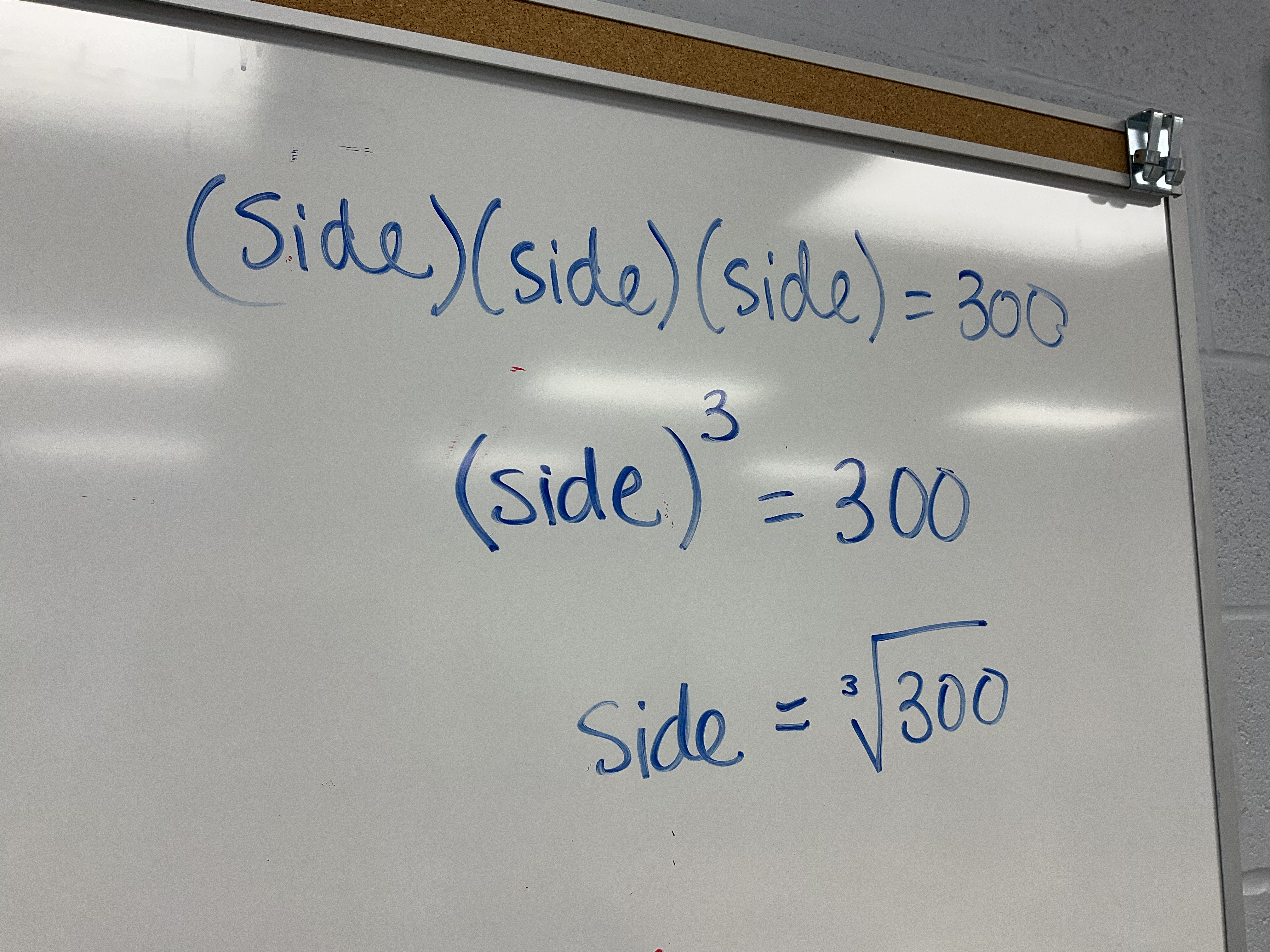
we talked about how many groups had integer dimensions, and these values are all factors of 300. Some groups had side lengths that were decimals, so they needed to use division or trial and error to get the correct side lengths. The cube led to an interesting discussion about how to get the sides correct. We need to take the cube root to undo the effect of cubing a number. The cube root of 300 will give us the side lengths of a cube with volume 300.
Friday Photos
I was in several classes on Friday and took some photos of the neat tasks and activities that were going on.
One class was working on adding and subtracting positive and negative numbers, with an emphasis on zero pairs.

They also had a neat quiz, based on the max/min dice game

To start the quiz a dice is rolled 4 times, and students place the 4 numbers into the boxes, then evaluate each expression.
Another class was doing this slow reveal data talk. A series of images are shown, and students notice and wonder more and more as more information is revealed.

Another was consolidating the R2D2 3 act task, looking at 2 different ways to solve the task, by a ratio of areas, or by converting the dimension in inches into a dimension in “post it notes”. Consolidation ideas included making sure the number sentences were all written in a way for others to follow clearly.

Finally, in my class we were working on order of operations. We were working on the 4 4s task where we use four 4s to create a math expression that equals 0,1,2,3,4,5,6,7,8,9,10.
e.g. 4+4-4-4=0

It was impressive to see the different approaches. We practiced using brackets, and exponents, and found out that since square and square root are opposite operations, they have the same level in BEDMAS. Groups looked to other groups for inspiration, and students were working hard to check and double check their work.
It’s been a fun week in the math department!
Dot Talks
Today several classes were working on dot talks as a way to encourage students to express themselves and explain how they perceive different patterns of dots.
An image is projected for several seconds, and students are asked how many dots there were on the screen. Students then take turns explaining how they know how many dots there are.

As they explain, the teacher groups the dots and shows the different ways that the students suggest. It’s always impressive to see how many different ways we can see things to get to an answer. It’s a great activity to encourage participation, and to celebrate different approaches and viewpoints.
some sources of dot talks are: numbertalkimages, and youcubed.
Working at the Walls
Today in grade 10 we did some review in groups of 3 at the walls. We worked on simplifying algebraic expressions, and solving equations including ones with fractions.
It was great to see the students working so well with each other and collaborating on day 2. Having lots of practice in grade 9 has been very helpful in building the expectations of collaboration and the ability for groups to ask for help within and amongst the groups. Our class has 32 students, so I am not able to be the sole source of information, nor the sole checker of “is it right?”. I was impressed by the different strategies students used to solve equations with fractions, and how they communicated their work.
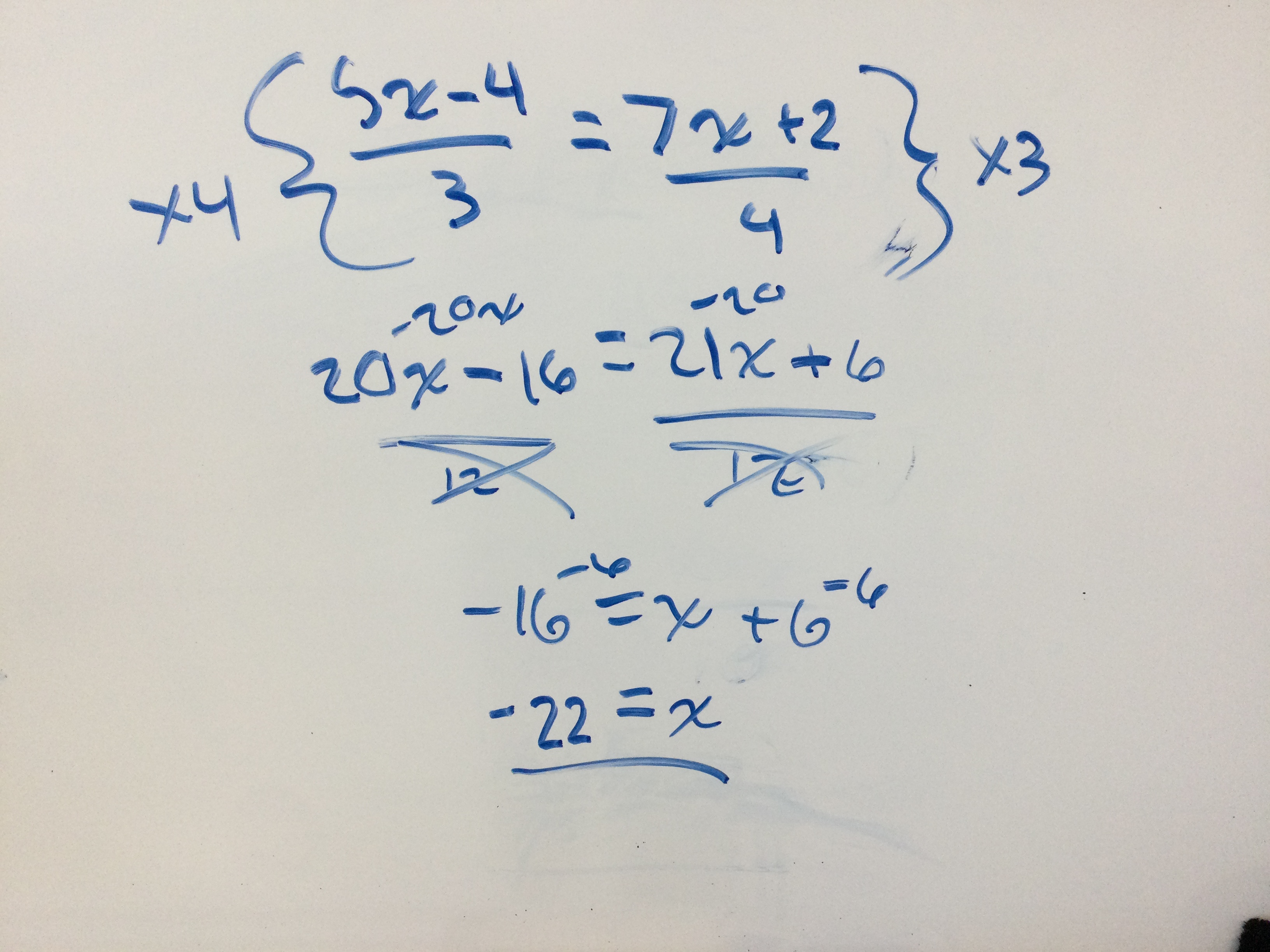


We have some work to do with fractions and integers coming up tomorrow, which will hopefully work to increase accuracy of solutions. Many groups worked through questions a few times, finding out where they made errors, and checked their work with each other. I was so lost in the moment with them that I didn’t take any action shots, just photos at the end of class while I cleaned up the room. It was an impressive whirlwind of activity last period, working right to the bell!
 Ms. Bearse's Site