Circles
We learned some new words today in 1L. We know that the circumference is all the way around the circle. We know the diameter goes across the middle of the circle from one edge to the other, and the radius goes from the center to the outside.
We traced many round containers and objects, and measured the diameters and circumferences.

A good strategy for measuring around an object is to use a measuring tape, or a piece of string.

We put all of our information into a chart, and then made a graph from our data. We noticed that our graph had all of the points in a straight line. We can use the trends that we see to help us estimate the circumference of a circle if we know the radius.

Perimeter
In 1L we’re working on making rectangles with a perimeter of 24. That means that if we count up the edges, we get 24 as an answer.

There are a few different ways to make a rectangle with a perimeter of 24. Here’s a rectangle that is 1 by 11. If we add up 1+11+1+11 it makes 24.

we saw some patterns when we organized all of our rectangles by size. When the length increases the width decreases. We also noticed that length plus width is always 12 in this case. Which is half of the perimeter.
So another way to calculate perimeter is to add length and width and then double the answer.

Area of a Sphere
Grade 9s are working on understanding how to calculate surface are and volume these days. Today’s activity shows how to calculate the surface area of a sphere.
We measured an orange, and drew 5 or 6 circles with the same diameter.
We then peeled the orange and filled the circles, like a jigsaw puzzle.

We can always fill 4 circles with the peels. We know already how to calculate the surface area of a circle, A=(pi)(r)^2, so the surface area of a sphere is A=4(pi)(r)^2.
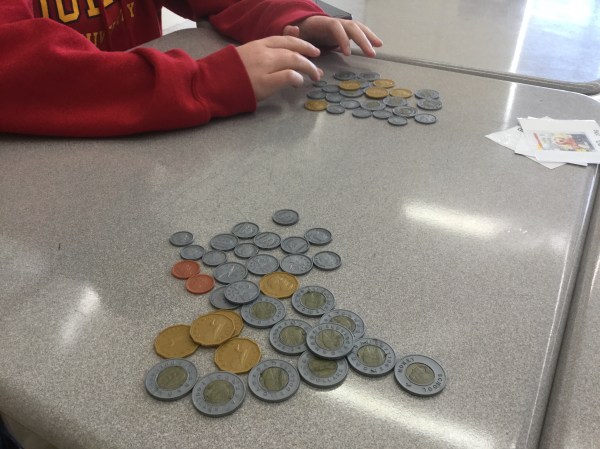
Counting coins
In 1L today we practiced counting coins, and making change for purchases.
Representing complex expressions
Grade 9s are working hard to represent expressions with exponents using toothpicks and skewers. We call the toothpicks x and the skewers y. We can build shapes with volumes like (x)(y)^2 and (y)(x)^2 now and we know how they are different. We can represent the surface areas also, since we know that each side is a rectangle, and the area of each rectangle is length times width.
 We are working on our understanding of how the parentheses will affect the finished model. The important thing is to understand what the exponent touches will be the dimensions of the object.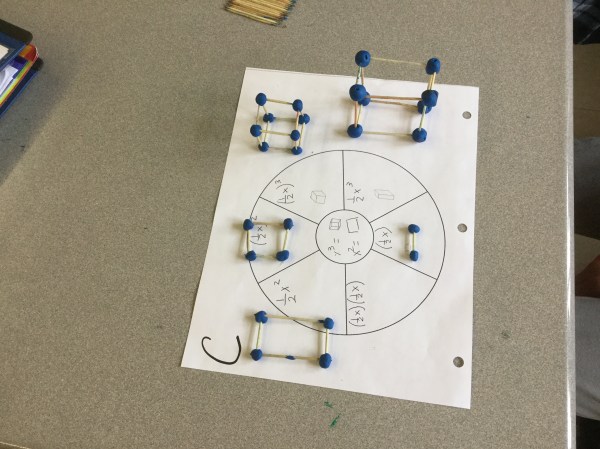
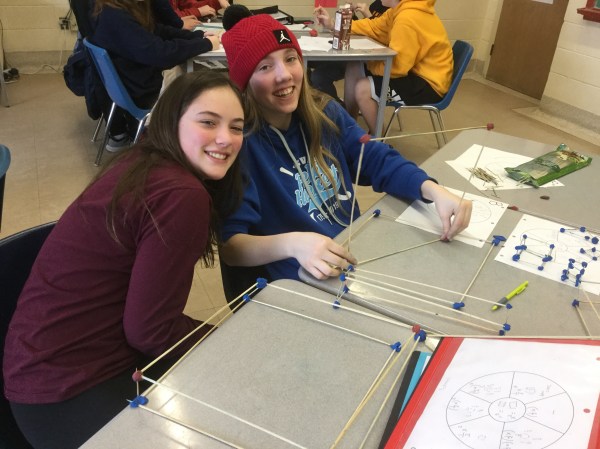 We’re getting the hang of it!
Fractions bingo
In 1L we worked on fractions, and learned how there can be many representations for the same thing. We can have a visual, a numeric, and also a worded description.
We built fraction models using cards at the board. Here is an example of 4/9 or four ninths. We have nine cards total, and 4 are pink.
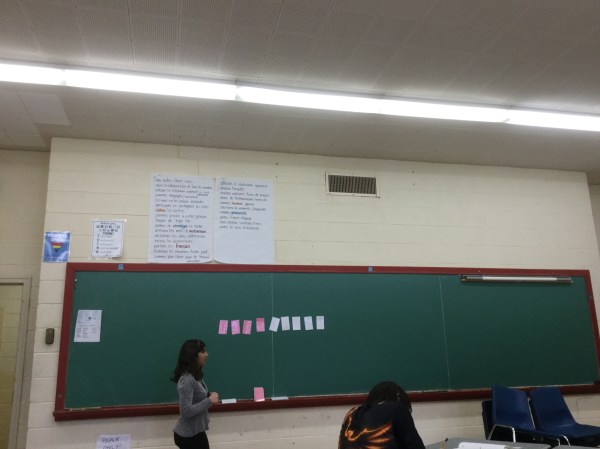 Fractions bingo is a game where a fraction gets called out, and then we get to decide which representation to colour in. The goal is to fill in a complete line.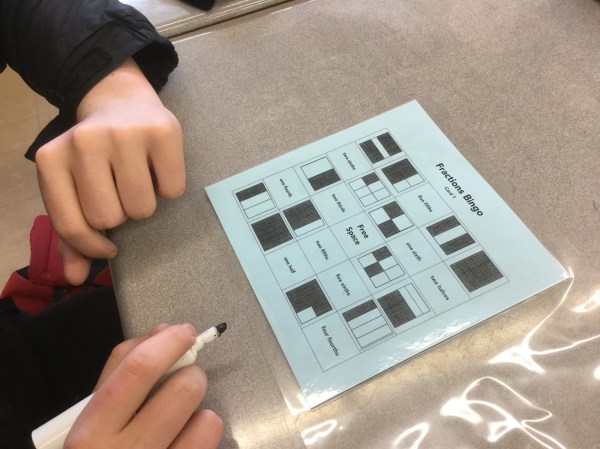

Geometric representation of exponents
We are working on a new understanding of exponents. Today we are building them with toothpicks and plasticine. First: X^2
 an X^2 is actually going to be a square, with side lengths of x, just like a square meter is a square with side lengths of one meter.
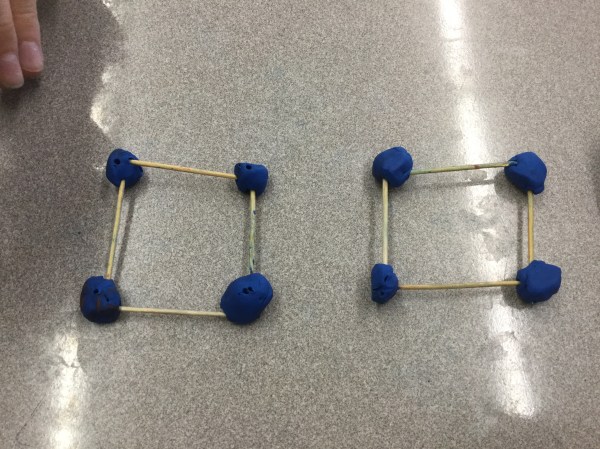
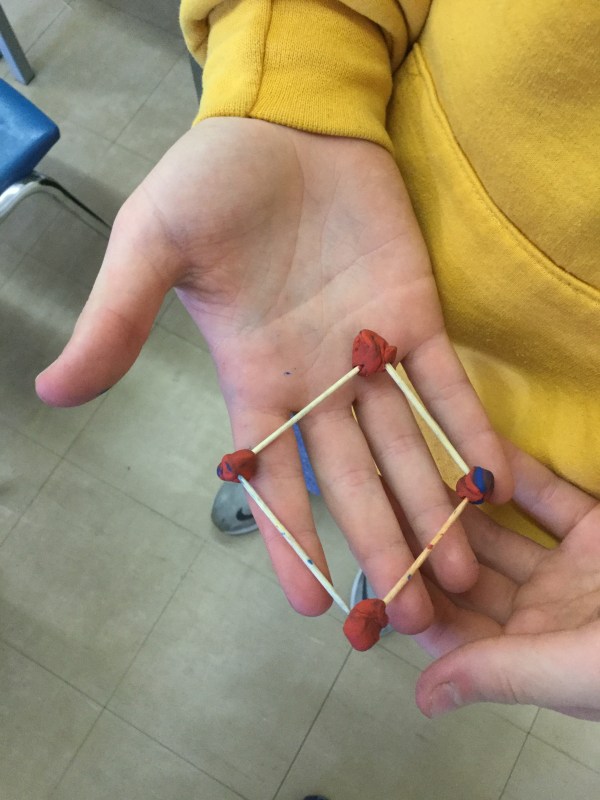 Here are 2 squares, and each one has dimensions of x, so this is 2(x)^2
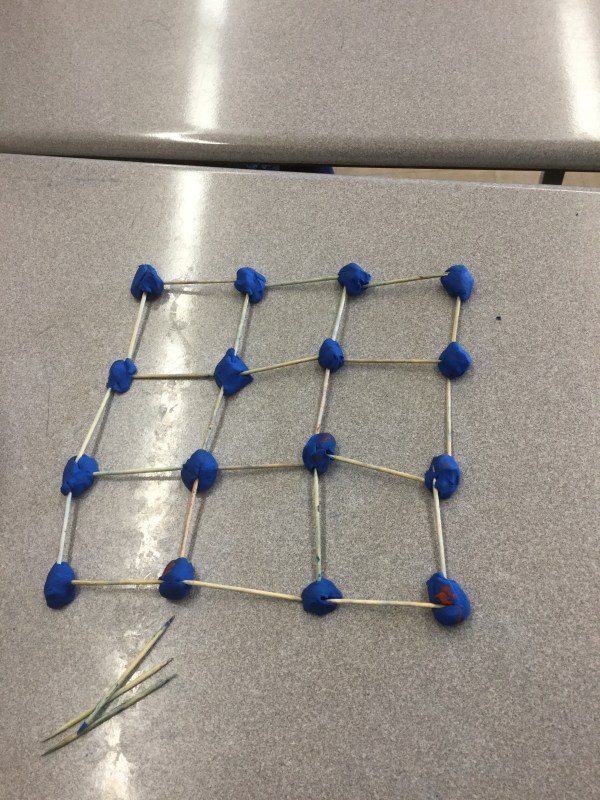
 Here is a bigger square. The dimensions are 3x, so we call this (3x)^2.
Another way to look at this is to notice that it can be subdivided into pieces of x^2 and that there are 9 of them. We also know that (3x)^2 is the same as (3x)(3x) which is the same as (3)(x)(3)(x) which is the same as (3)(3)(x)(x) which is the same as 9x^2.
This one is in 3 dimensions, a cube with side length x, so it is x^3.
For many of us, this is a new way to explore and express exponents.
Fractions
In 1L we looked at fractions, and how to draw them. We are working at comparing fractions and understanding that 3/6 and 2/4 and 1/2 are all the same.
 After our fractions work we played the game of totality. We took turns moving the marker, and adding the value to the the previous total. The goal was to be the person to land on the number that brings the total to exactly 50.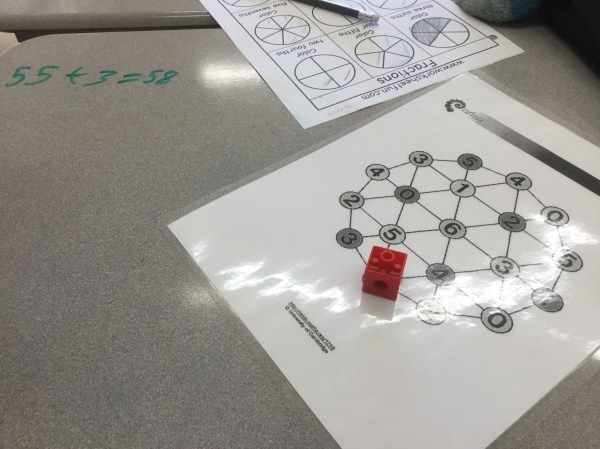
Rounding
Today we looked at a number line strategy for rounding. Here we are rounding to the nearest 100. We count by 100s until we find the 2 “100s” that sandwich the number we’ve got. Here we have the number 573. We count up and sandwich 573 between 500 and 600. We make a number line, and mark the center of the interval (550), and then we place our fraction, and look at which end it’s closest to. We would round 573 to 600 since it is the closest 100.

Pyramids
We are building pyramids with a volume of 300cm^3. We saw that each of the pyramids can be poured 3 times into the prism with the same base and height.
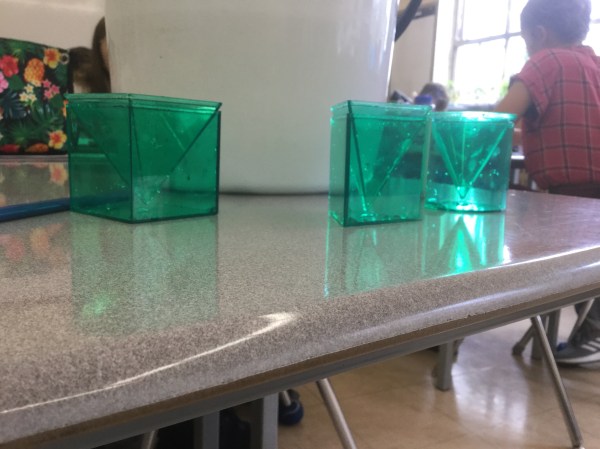
We made plans, decided dimensions, and then we drew out the pieces and cut them and taped them together.
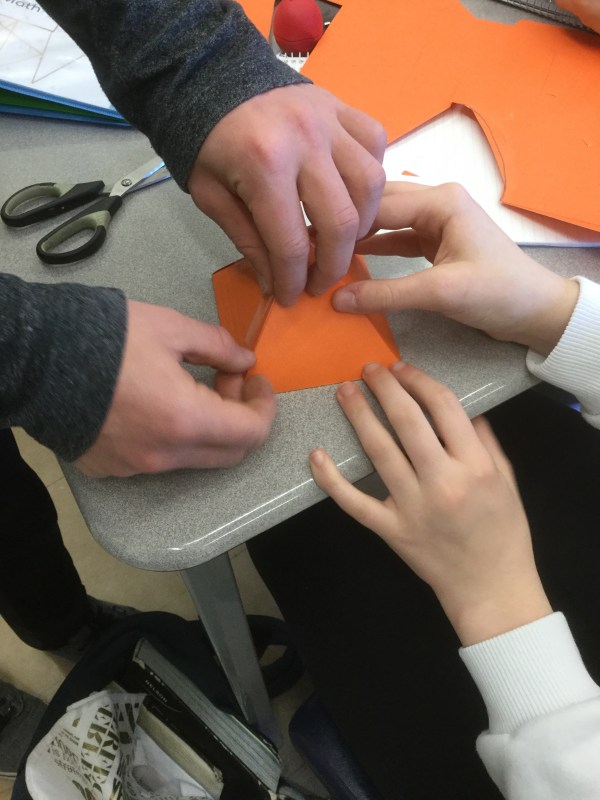 We ended up with pyramids that were often incorrect! This one for example, was supposed to be 10cm by 10cm by 9cm tall. But the height was just over 7cm tall.
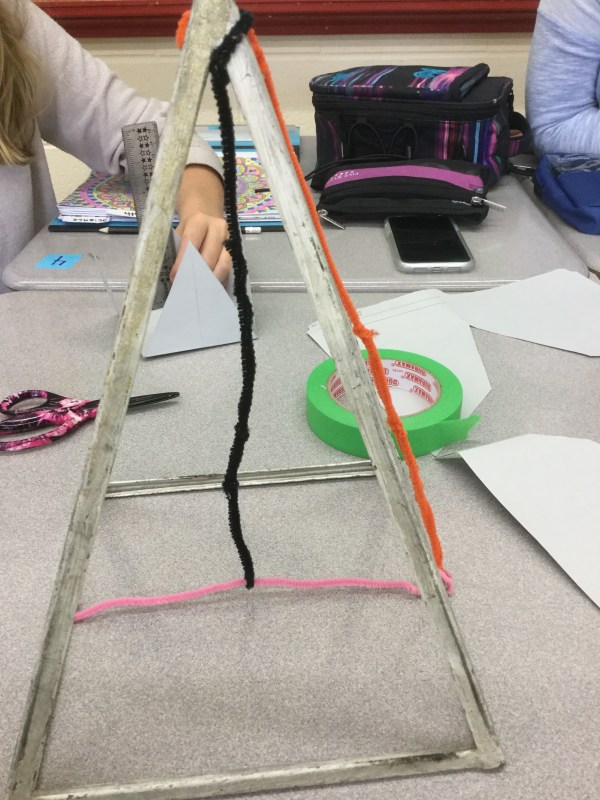
To understand what went wrong, we need to look at a few things. Here’s a pyramid. The height of the pyramid is the black pipe cleaner. The base of the pyramid is the pink pipe cleaner. The slant height (génératrice) is the orange pipe cleaner. Together these dimensions create a right angle triangle, and we need to use Pythagorean theorem to calculate the slant height, and use that dimension as the height of each of the triangle sides. Many of us used the pyramid height as the height of each side triangle, which results in a pyramid that is too short.
 Ms. Bearse's Site