Sky Scrapers problem
Grade 9s started today with a problem to solve.

On the cards is a grid, a city plan. Each row and column can have one building of each height (1 floor, 2 floors, 3 floors, 4 floors). On each side of the plan is a number which tells how many buildings are visible from that position.
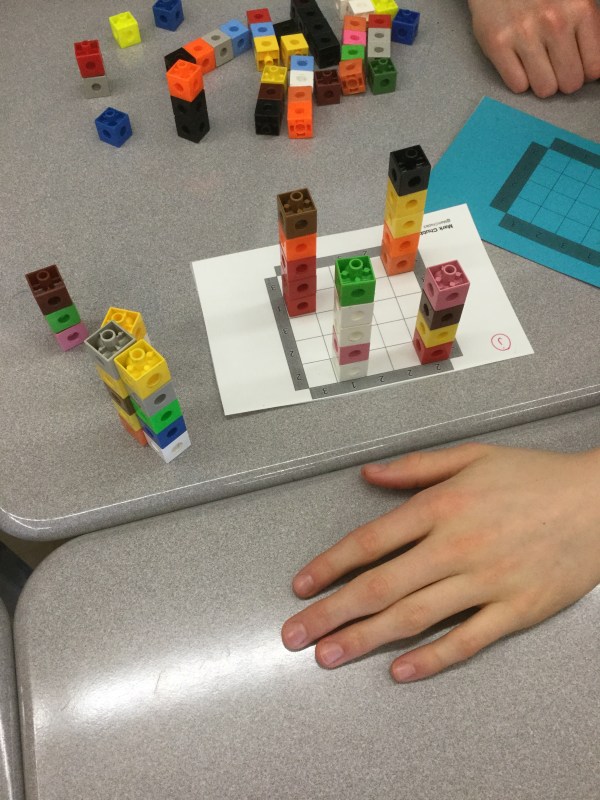
We developed good strategies to solve the logic problem, and worked on our group collaboration and speaking in French.

Sometimes it seemed really tough to get started. There are many perspectives to consider!
We worked together and found that each of the different puzzle boards could be solved using a similar method. Some perseverance was definitely required!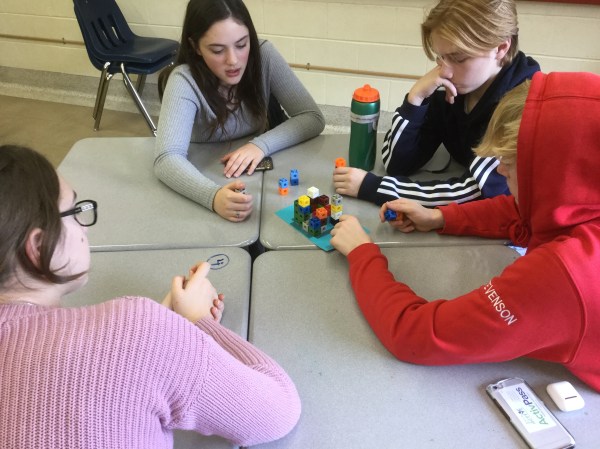
Welcome back!
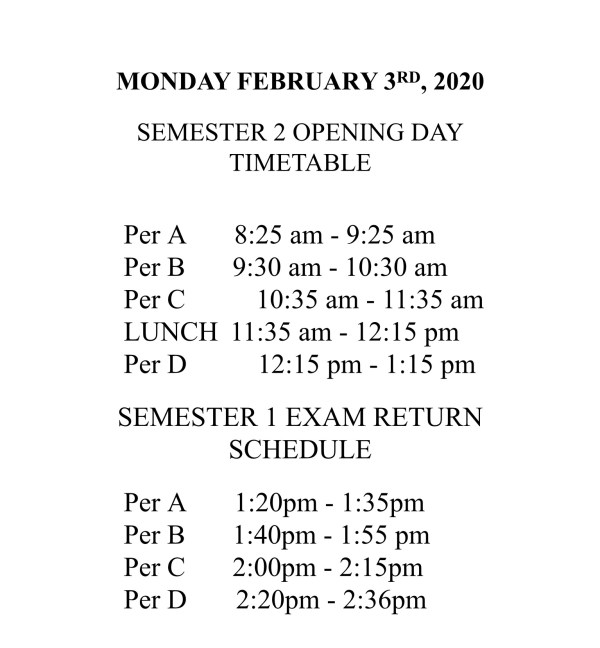
Exams!
Grade 10s are writing their exam today. It’s been a good semester! Best of luck to everyone.

Portfolio interview preparation
Today we worked on our interview skills. We did an inside circle/outside circle activity where we practiced answering questions like “what was the biggest challenge you faced this year”, “what are you proud of”, “what learning skill improved the most over the course”.

We had inside or outside circle move and then we answered more questions.

Then we practiced speaking for 5 minutes in partners for an interview carousel.

One partner spoke about their experience this term, for 5 minutes, as they will during our interview. Their partner listened, took notes, and prompted as needed.  They switched roles after giving feedback. We used team shake to make different groups and practiced several times. We are getting more confident with practice!
Distance time graphs
We worked on distance time graphs today, relating speed with the slope. We used this graph game.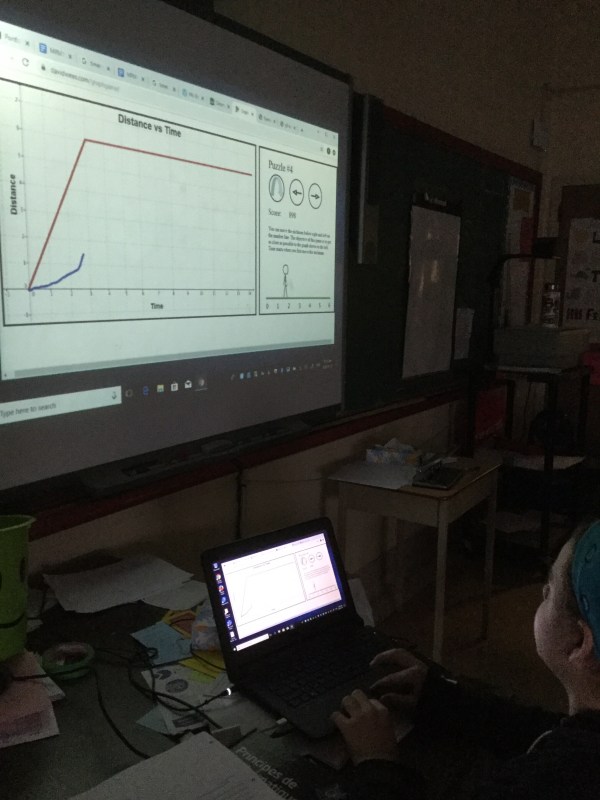
We noticed that we need to move the stick man at different speeds, forward and backwards to match the graph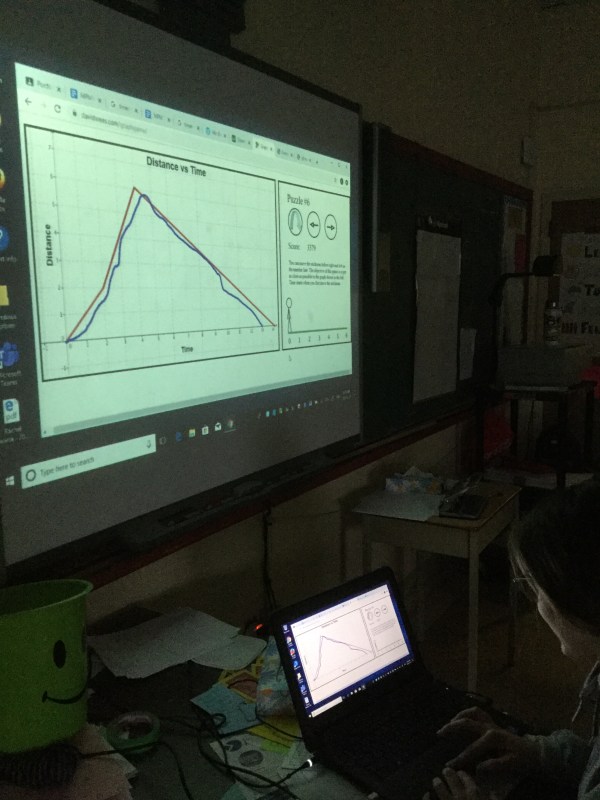
If the graph shows a flat horizontal section, it is because the guy is not moving.
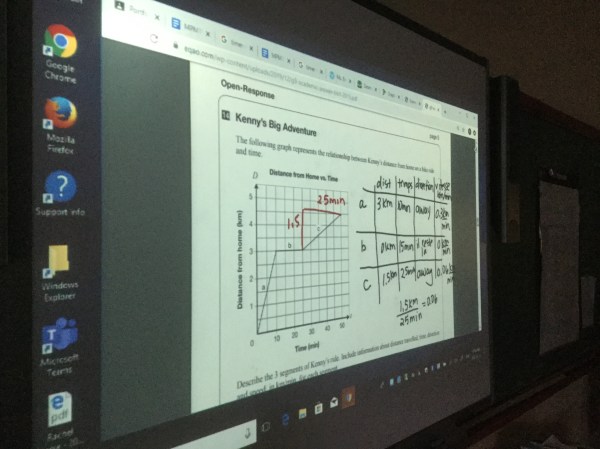
We applied our new knowledge to look at EQAO questions like Kenny’s big adventure
All about angles
Grade 9s worked on figuring out all of the angles presented in our box of blocks, without measuring!

Some groups compared shapes, and used their knowledge of the interior angles of a regular hexagon as a basis for comparison. We also can have a nice conversation about fractions here!

Knowing that a square has angles of 90, and this trapezoid has an acute angle of 60 (see above) we can figure out that the light rhombus has an angle of 30 since 90+60+30=180 and as you can see they add up to a straight angle above!

Some groups had good comparison methods…3 acute angles added to make 90 so each angle must be 30.

Some added 6 acute angles together to make 180 so each of the acute angles must be 30. (180/6=30)
 some took it even farther! It takes 12 to go around a full circle, so 360/12 gives us the value for each acute angle of the rhombus. We went on to discuss the value of an exterior angle for this 12 sided shape, and what each interior angle would be, and what the sum of interior angles would be, and the sum of exterior angles too.
 we can build interesting patterns and see that there are parallel lines and transversals shown here. We can see the z,f,and x patterns. We can see supplementary angles. We can also calculate the angles of empty space shown. Around each junction, we can also add angles to make 360.
We are working on our final portfolio task: solving for unknown angles using many strategies.
Grade 10 patterns
Since our projector was not cooperating today I couldn’t say as much as I wanted about these patterns. We were looking at what questions might be interesting to ask, and how we could represent the patterns with algebra. Questions are referring to the patterns ABOVE them. (Patterns are from visualpatterns.org)
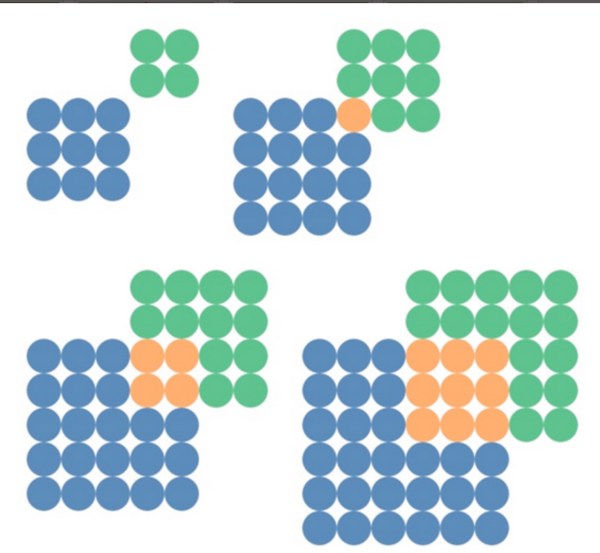
Figures 0,1,2,3,4 are shown. We looked at representing each colour with an equation, or modelling the growth of the entire set of circles.

There’s another one to look at. What do the colours represent?
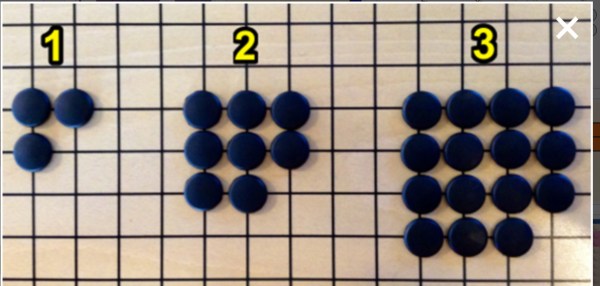
What form of equation would be the most logical for expressing this relationship?
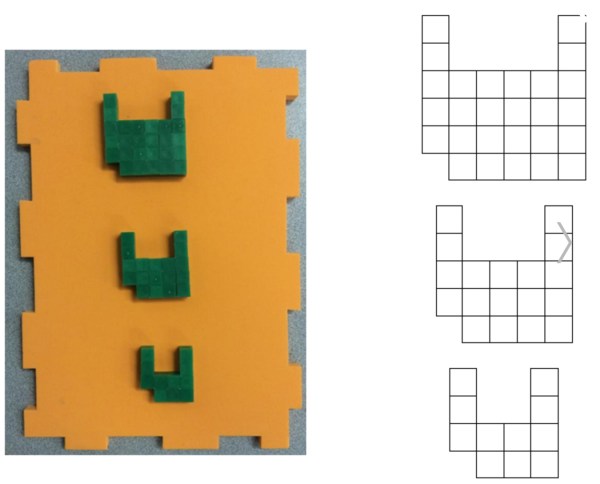
We could look at area and perimeter here. Would they ever be equal? Would the perimeter ever be double the area? Would the area ever be double the perimeter?
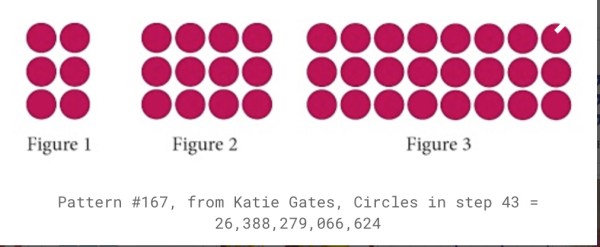
What do you notice about this pattern? What do you see in a table of values?
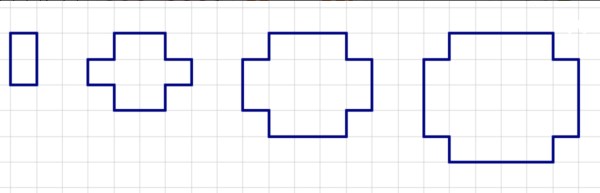
We can look at the area and perimeter here too. 2 different equations. Are they both quadratic? How do you know?
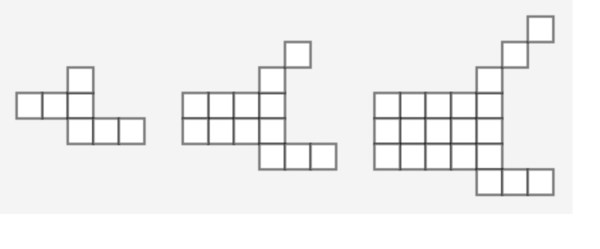
How can you show the growth of the area? Simplify your equation to standard form. Is there a way to visually modify the pattern to match your simplified equation? Can you show this in factored form? Can you modify the pattern to match your factored form equation?
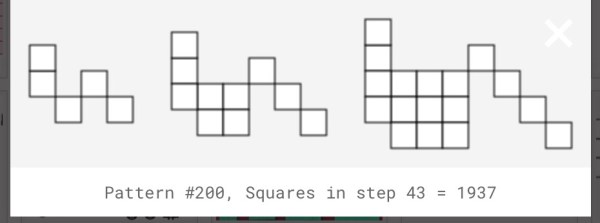
Same questions as above…this looks complex! Is there a way that we can visually simplify things? Rearrange blocks? Does that help us with the creation of an equation?
Today we math carolled

We have been learning math carols recently, and today we took our show on the road, and sang to several high school classes, office staff, and each of the grade 7/8 classes.
Here are the songs, if you’re interested. We didn’t write them.

Frogs
Grade 10s explored a leapfrog problem.
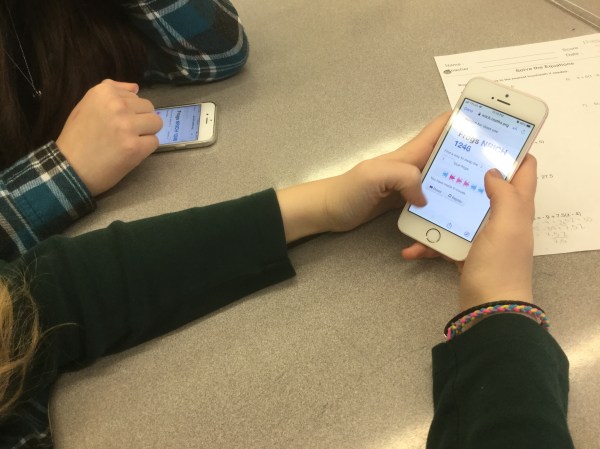
Using either this site, or a game board and frogs, we looked at the number of moves it takes to have the frogs swap sides. The frogs can slide one space or hop over another frog and each counts as one move.

We aimed to minimize the number of moves to have the frogs switch sides. We can vary the number of frogs, and then look for patterns. The goal was to be able to say how many moves it would take for any given number of frogs.

We saw a few ways to model the problem. Here’s a neat visual model.
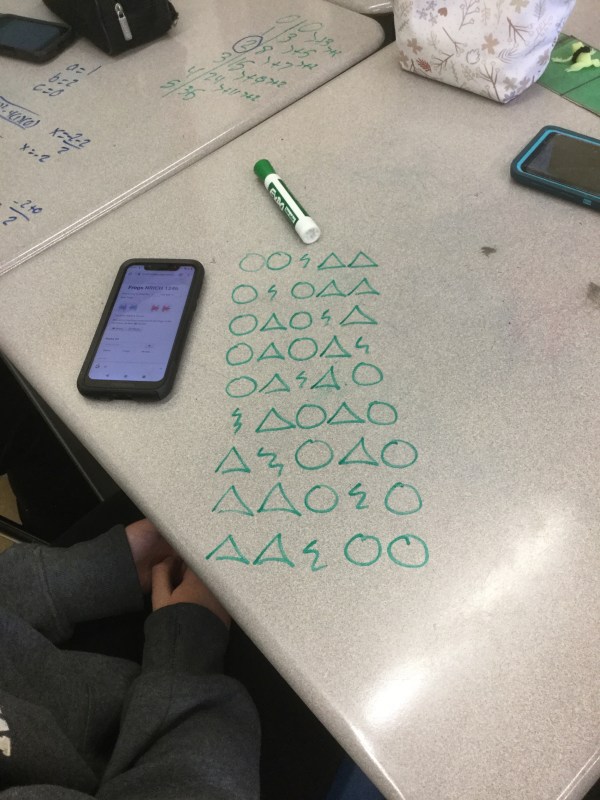
Some used tables and used the equation with desmos to show that the equation was a good fit.

Once we figured out the equation for this situation, we were ready for a new challenge. What happens if there were 2 spaces between frogs at the start? What happens if there are different numbers of frogs on each side? How will this affect our equations?


Word problems
Grade 9s are working at solving word problems.
 we’re looking at the words and seeing what information we can get from the question, and then we are making equations out of the information.

We’re working on communicating clearly with words and symbols. we want our work to be able to be easily understood by others.
We’ve got a test on Tuesday, so we’re working hard to prepare.
 Ms. Bearse's Site