Pumpkins!
We spent Hallowe’en with grade 9s exploding pumpkins.
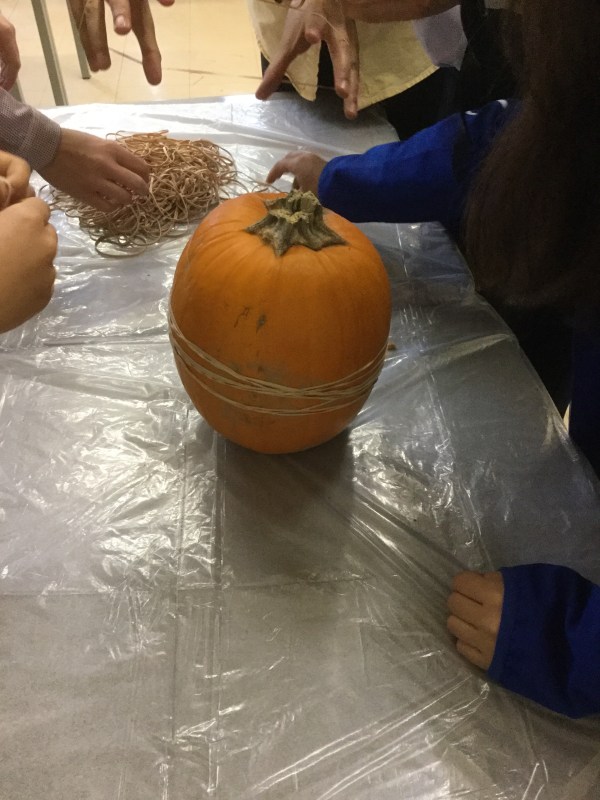
We measured heights, circumferences, and then made a prediction about how many elastics it’d take to pop the pumpkin open.
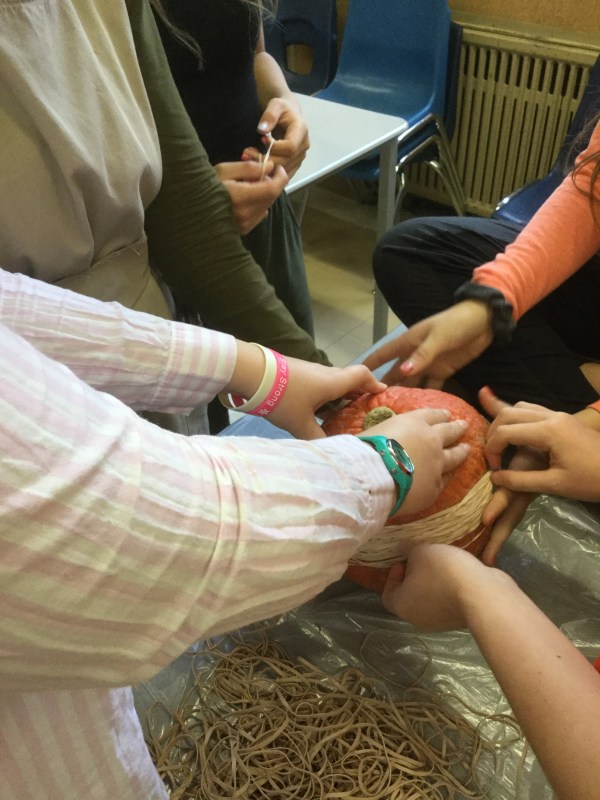
We needed to work together, often adding several elastics at once.

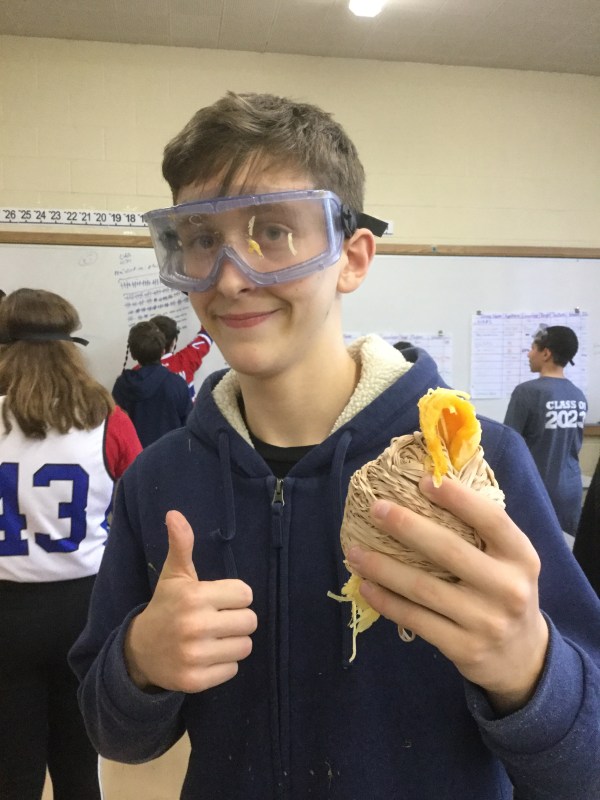
Some pumpkins started to show signs of weakness…cracking, or bubbling, or leaking…so we knew they were getting close…and we began filming.
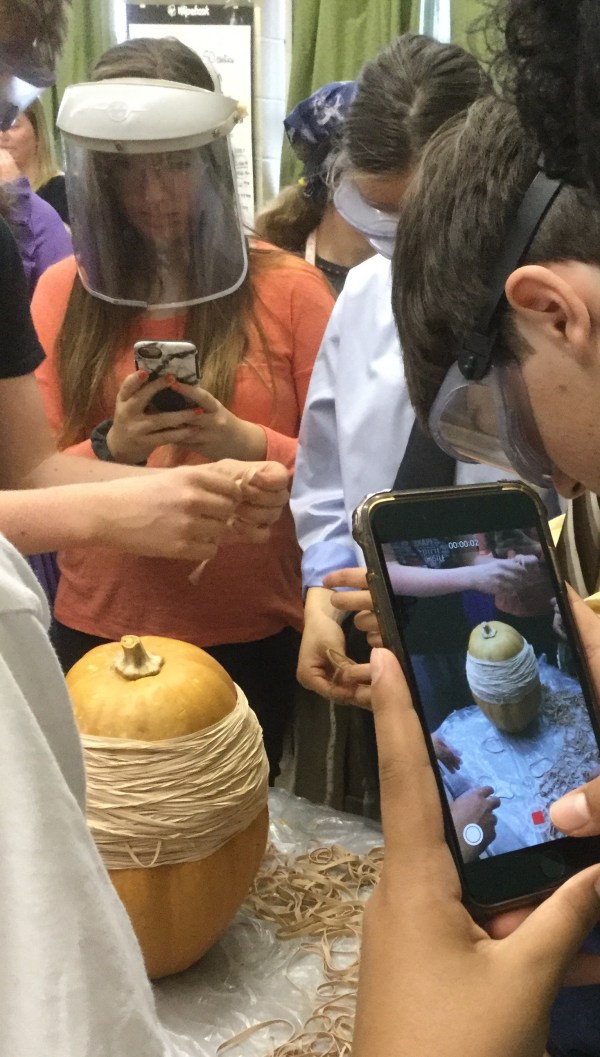
We wanted to catch the moment on film.
Some groups took a lot more elastics than others. Some groups had 300 elastics, while others needed more than 1000. We’ll be making scatter plots to see if we can determine the factors that correlate to an increased number of elastics.
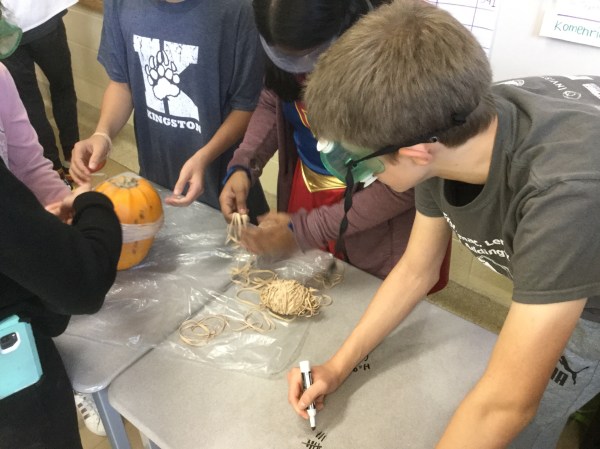
We had lots of fun!
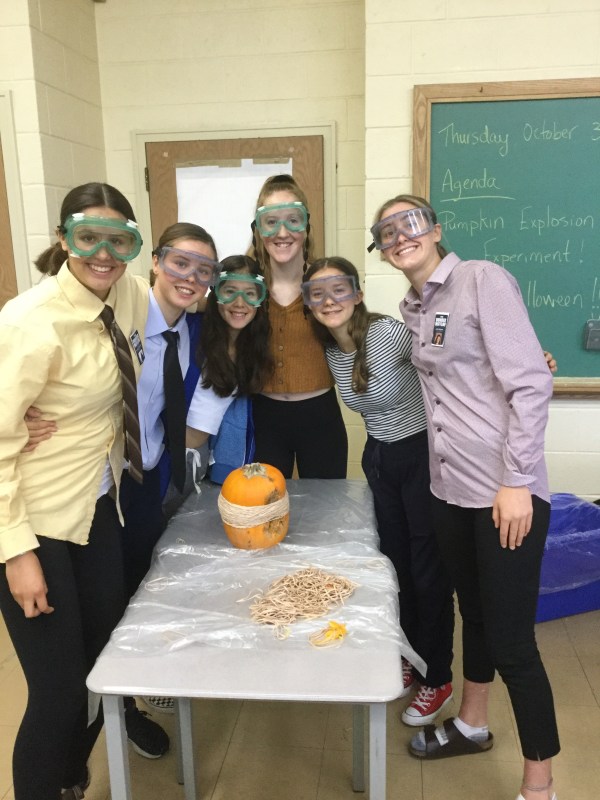
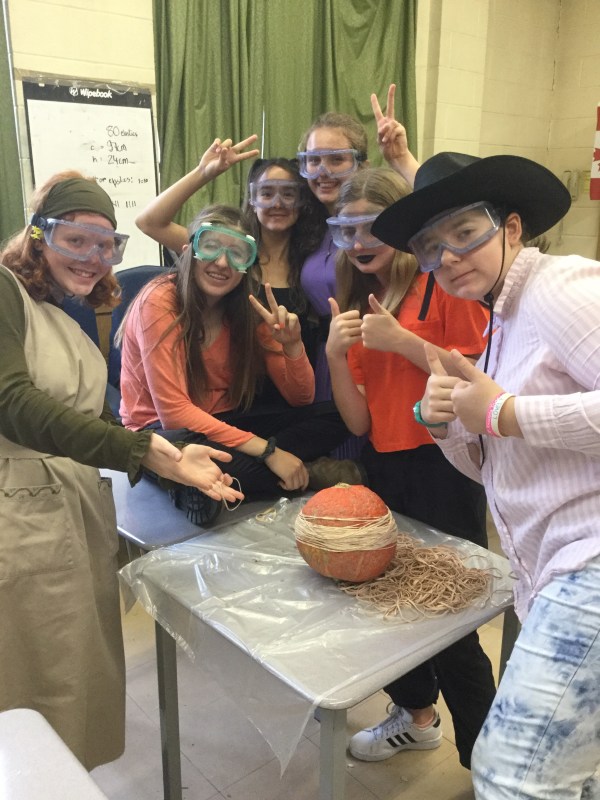
If you do this at home. Be sure to protect your eyes.
Solving quadratics problems
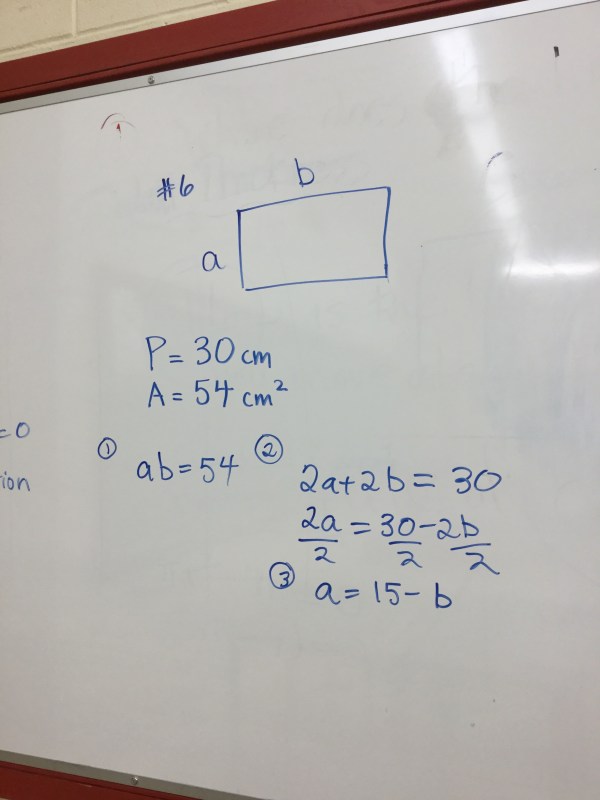
For this problem, we know the area and the perimeter of a rectangle. We make equations, and substitute so that everything is in terms of one variable.
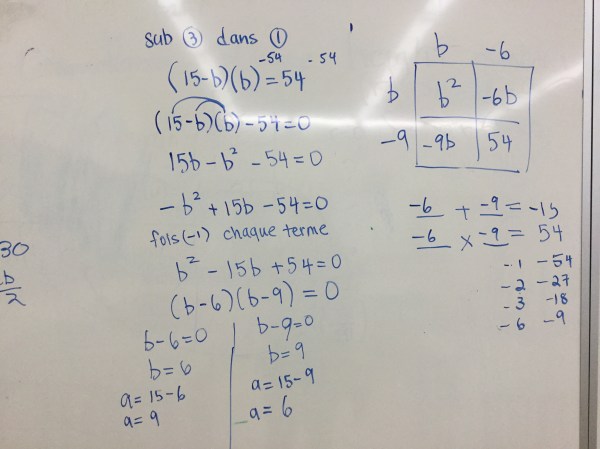
We then multiply the brackets, and work towards having 0 on one side, and an algebraic expression on the other. That expression is factored (using the area model in the box) and the factors are written with the product=0.
We then find the roots by setting each bracket equal to 0.
Once we get the 2 values for “b”, we use each one to calculate a value for “a”.
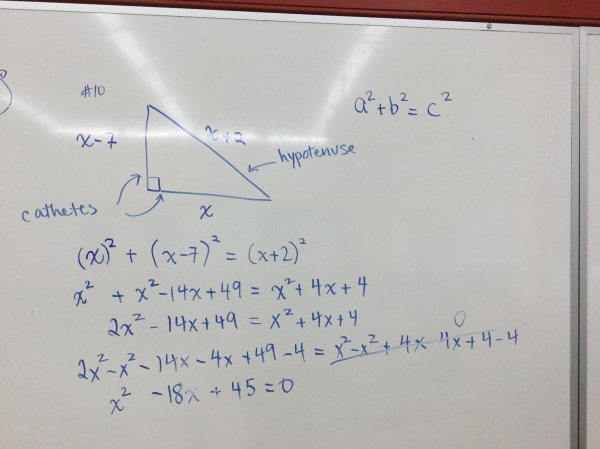
This question relates the legs of the triangle to the hypotenuse using algebra. One leg is 7cm longer than the other, and the hypotenuse is 2 cm more than the shortest leg.
We use the pythagorean theorem to create our equation. We need to expand by multiplying the binomial by itself to create a trinomial. We simplify our equation to get 0 on one side.
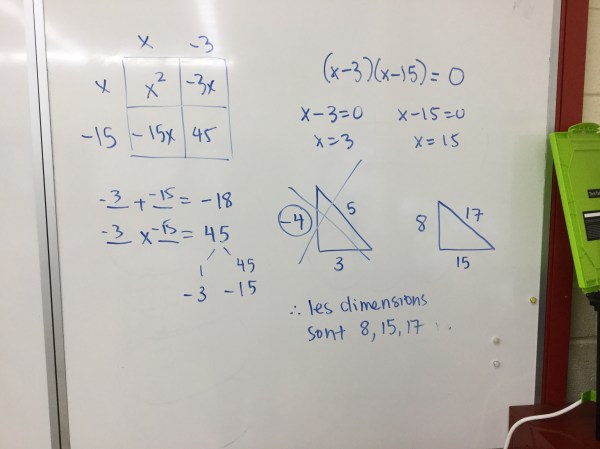
We then factor (using the box) and we write our factors in brackets equal to 0. We now find the roots by setting each bracket equal to 0 and solving for x.
We need to check at the end if the x value is acceptable. We know that side lengths must be positive, so x must be 15, and not 3.
Polynomials and algebra tiles
We are working on combining like terms and simplifying expressions.
Today we looked at representing expressions with algebra tiles

This is 3x+1 (and a lot of zero pairs!) we can simplify this a lot by removing the zero pairs.
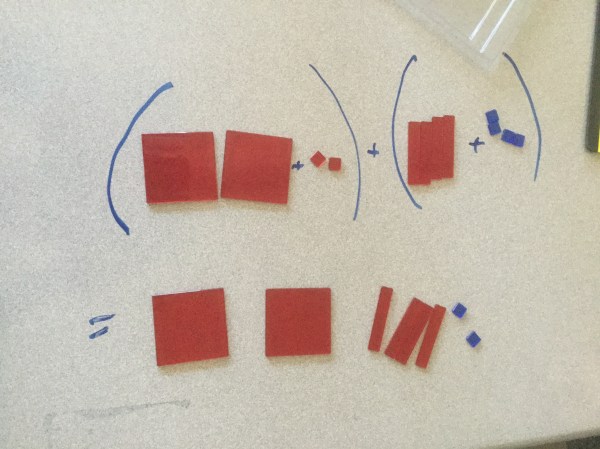 we also looked at how to add 2 binomials to get a trinomial as an answer.
The power of YET
Factoring trinomials using the area model
How can we determine the two binomials that multiply together to create the product 6x^2+17x+5?
We know that we can fill in the area model box, putting the squared term in the top left, and the constant in the bottom right spots. We need to now figure out what goes in the two empty spaces. We know that the sum of these two values is 17x and that the product is going to be 30x^2 (the product of “a”x”c”) in our trinomial ax^2+bx+c
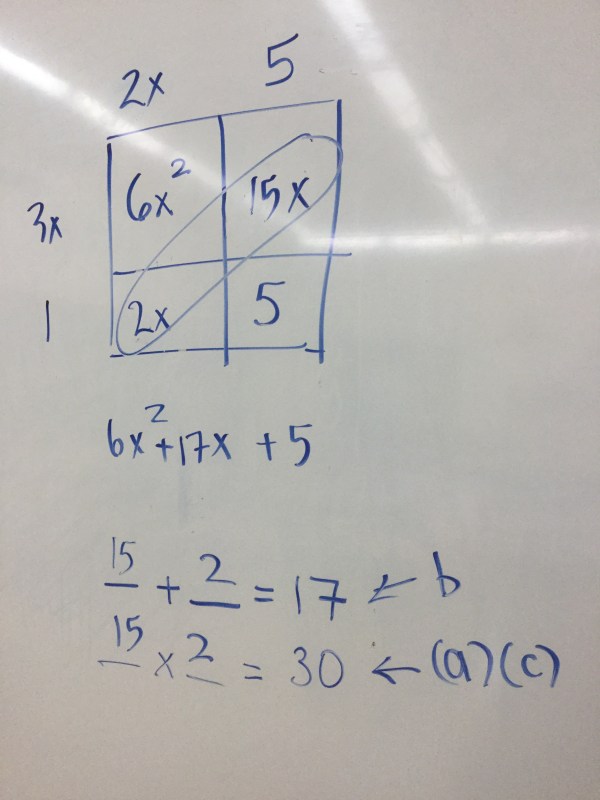
After a bit of thinking/list making, we determine that the values of 15x and 2x should go into the boxes. We then look for common factors vertically and horizontally, which will be the factors.
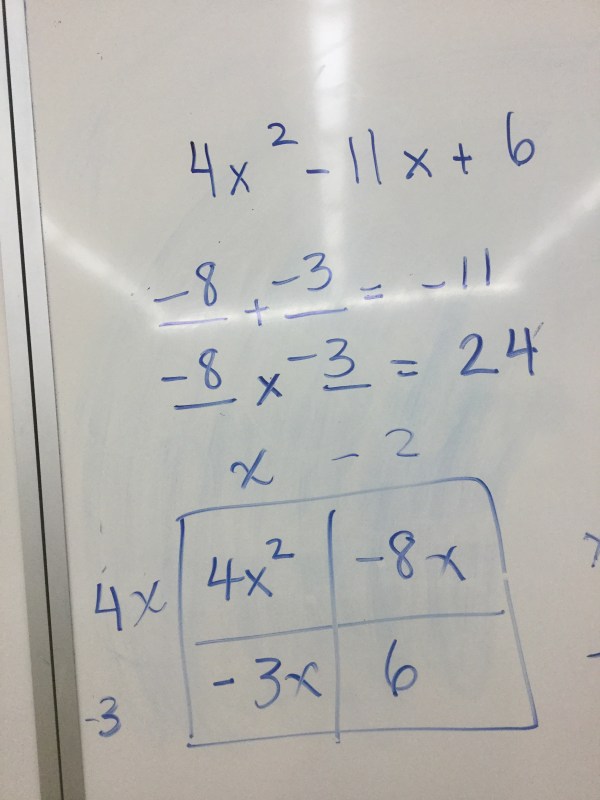
This is the visual method of factoring trinomials using the area model.
Power of visual representations

We are continuing to link algebraic and visual representations of exponents in grade 9. Today we branched out into (x+y)^2.

We used the skewers as y and the toothpicks as x. We built a square with dimensions (x+y) and then showed that the area contained is the same as x^2+2xy+y^2. We see the large and small squares, and the two xy rectangles on the sides.
Tests today
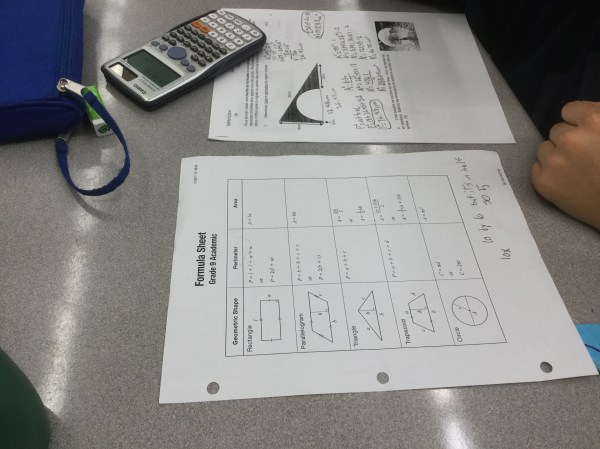
Grade 9s and 10s all had a summative assessment today.
Eqao practice
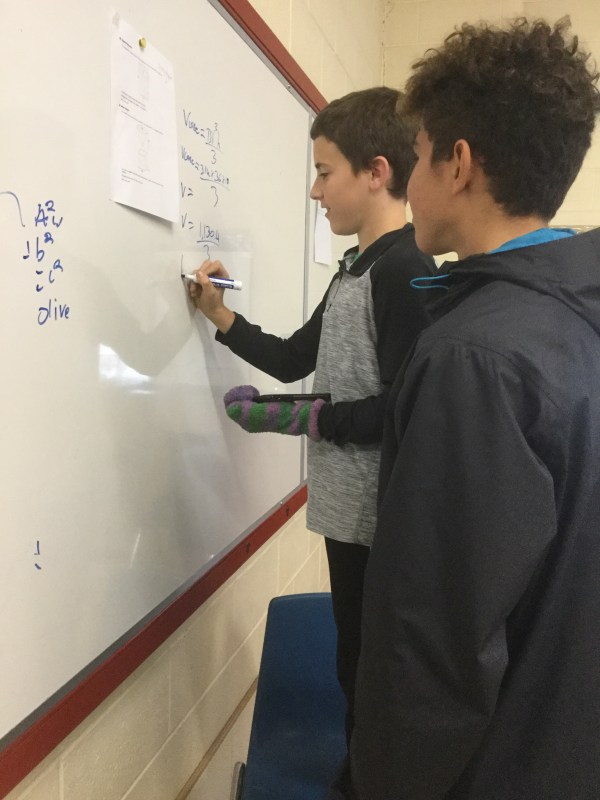
Grade 9s worked on EQAO practice questions related to surface area, volume, perimeter, pythagorean theorem, and scatter plots today.
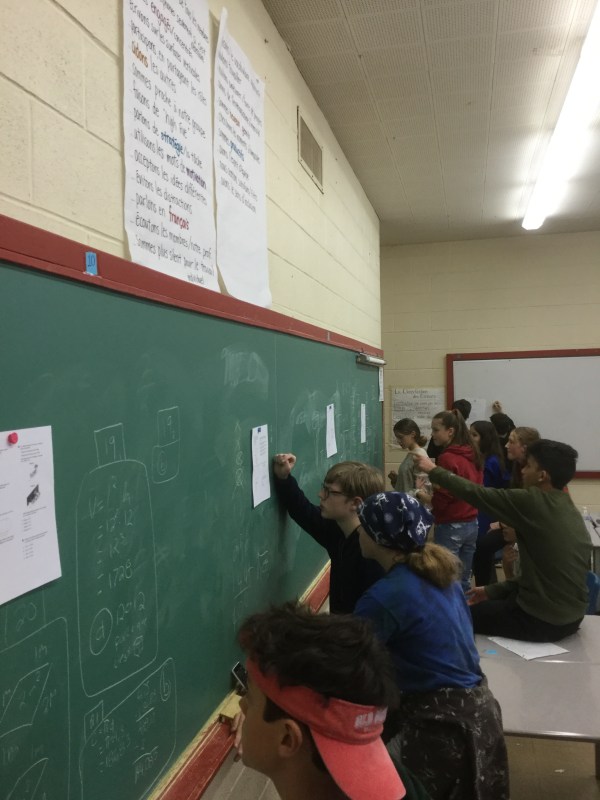
We are using some of these questions for our portfolio work, and some for our study notes assignment as we prepare for our first test on Monday.
Financial Literacy

Period D went to a presentation on Financial Literacy today, to learn about making investments.
Quadratics Introduction

Grade 10s are exploring algebra tiles and how they help us visualize some abstract concepts.
We looked at how the expressions we use can be created with tiles, and also how we can show the expressions on a graph.

We learned about roots(x intercepts/zeros) of the parabola, and also about the vertex (le sommet).
We can use Desmos to help us see the graph of the equation
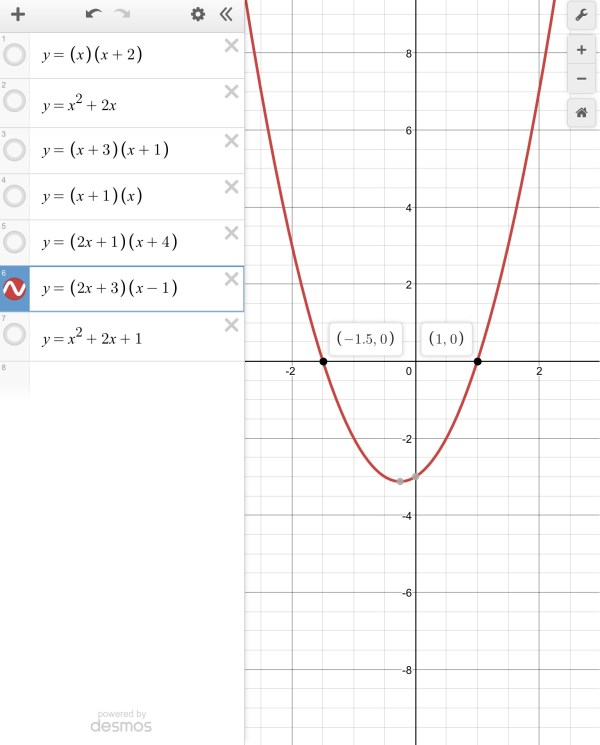
We can calculate the exact points where the graph crosses the x axis by setting each of the parentheses to 0.

 Ms. Bearse's Site