We’re back!
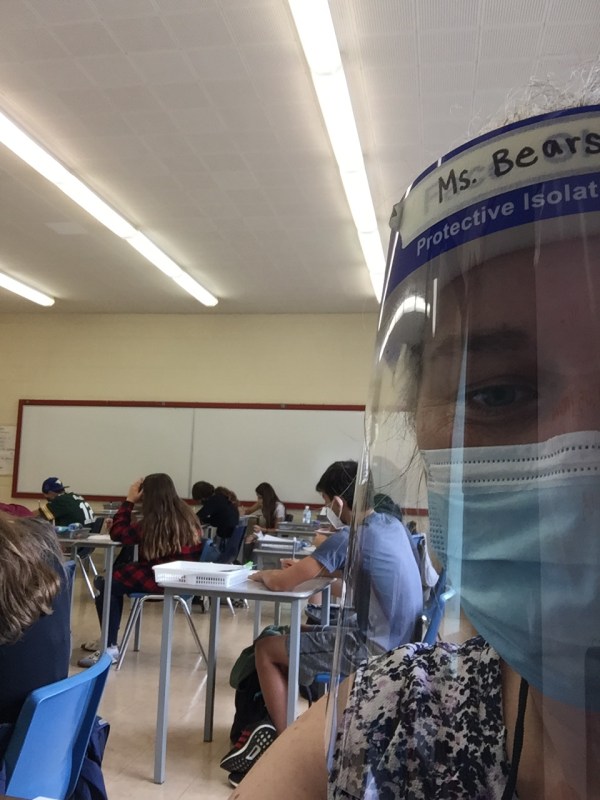
School’s back on, and we’re working hard.
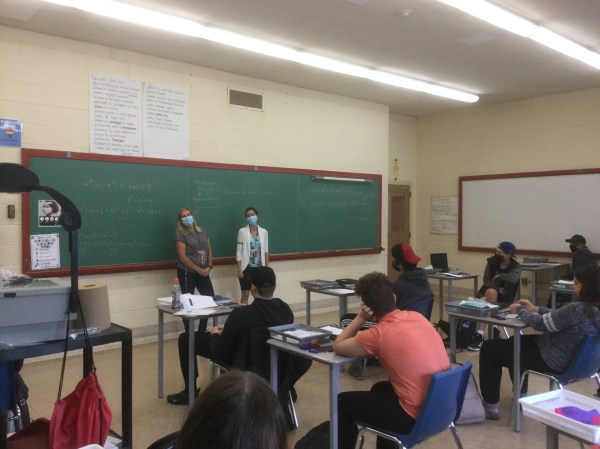
We’ve got our adolescent care workers in talking to us about the supports that are available for everyone this term.
Getting back in the building

We’re in teacher training for the 2020/2021 school year, and all the challenges that it brings.
Looking Forward
Hello everyone, happy summer! Congratulations on finishing up a very unusual term.
We are not sure yet what we will be doing in the fall, but I’m sure it will be different from what we’ve done before. In the mean time, be safe, wear a mask, stay away from people.
For those of you who would like to do some extra practice/review I suggest knowledgehook (grade 9s you can use class code gum4578 and have access to lots of missions and review questions)
khanacademy has lots of videos and questions and can help you fill some gaps in your understanding.
For those of you wanting to work on your multiplication skills. Here are the Five Minute Frenzy sheets that we got pretty good at last year.
You could also play around with desmos and see if you can create some amazing art!
Have a good summer and keep in touch.
Mme Bearse
Gathering Information
Angles
It seems like ages ago, but we worked with blocks to show lots of things about angles before schools were closed. Here are my pictures, for use in our learning portfolios.


We also learned that the interior angles of a triangle add up to 180 degrees, and the interior angles of a quadrilateral add up to 360 degrees. Both of these can be proven by creating a triangle (or quadrilateral, as shown), labelling and identifying the angles, and the ripping the shapes up to separate the angles.
 The angles then ca be reassembled together, and in this case we see that they go all the way around a circle or 360 degrees. In the case of a triangle, they all come together to make a straight line, or 180 degrees.
We next had a look at desmos geometry, and we investigated how joining the midpoints of any quadrilateral will create a parallelogram in the middle.

We can prove it’s a parallelogram by measuring angles. Opposite angles are congruent. Also parallel sides will be the same length. With desmos geometry we can drag and drop any of the corners to shift the shape, and see that the resulting interior quadrilateral is always a parallelogram!
Which one is bigger?
In 1L we are now looking at triangles, and other shapes. We wondered which was bigger, the rectangle or the triangle….
 or which was bigger, the rectangle or the parallelogram….
We had a good discussion, and compared the two. Each of the shapes has the same area, as they were made by cutting the rectangle along the diagonal, and then rearranging the pieces. The perimeter is not the same for the shapes though!
We determined that the area of a triangle is half of the area of the rectangle that it came from.
First math test
First grade 9 math test today! We prepared well, and are ready to show what we can do. We know that the first test is often a learning experience!

Working on Perimeter and Area
We’re working on calculating perimeter and area in our 1L math class now.

Today we modelled a rectangle on the floor, and made use of the tiles to help us determine the perimeter and area.
We know that to determine the perimeter, we add up all the sides, or we can add the length and width and then double the result, or we can double the side lengths and then add the results.
To determine the area we we are working on multiplying. We know we can count the squares, or we can multiply length by width by skip counting, or by making groups.

We followed up with another area game!
Test Review
We’ve got last minute test preparations happening today. We worked in pairs at the boards, and solved questions at stations around the room.
 We are now able to do many skills. We can calculate the surface area and volume of spheres, cones and square based pyramids, we can optimize the surface area and volume of rectangular prisms, we can calculate the perimeter and area of composite shapes, and we can represent exponents in 3D models (using toothpicks and skewers and clay).
We’re ready for tomorrow’s test!
Area of rectangles
We played a game in 1L today to help us practice the area of rectangles. We played in pairs. Each person took a turn to roll 2 dice, and then colour in a rectangle with the dimensions of the numbers on the dice. Each person needed to then state the area of their rectangle. There was some strategy about where to place the rectangles, to mess up the future plans of your opponent.
In the end, to determine who won, we needed to determine who had the most area coloured in. We divided up the regions into smaller rectangles and calculated those areas and added them up.

