Grade 10 homework


Motor building
In Physics we are starting electricity and magnetism, and as a part of that we are building motors.

Some groups got right to work today at lunch.
Reviewing for our test
Tomorrow is a test day for grade 9s. Today we spent time working in groups to review material and get ready.
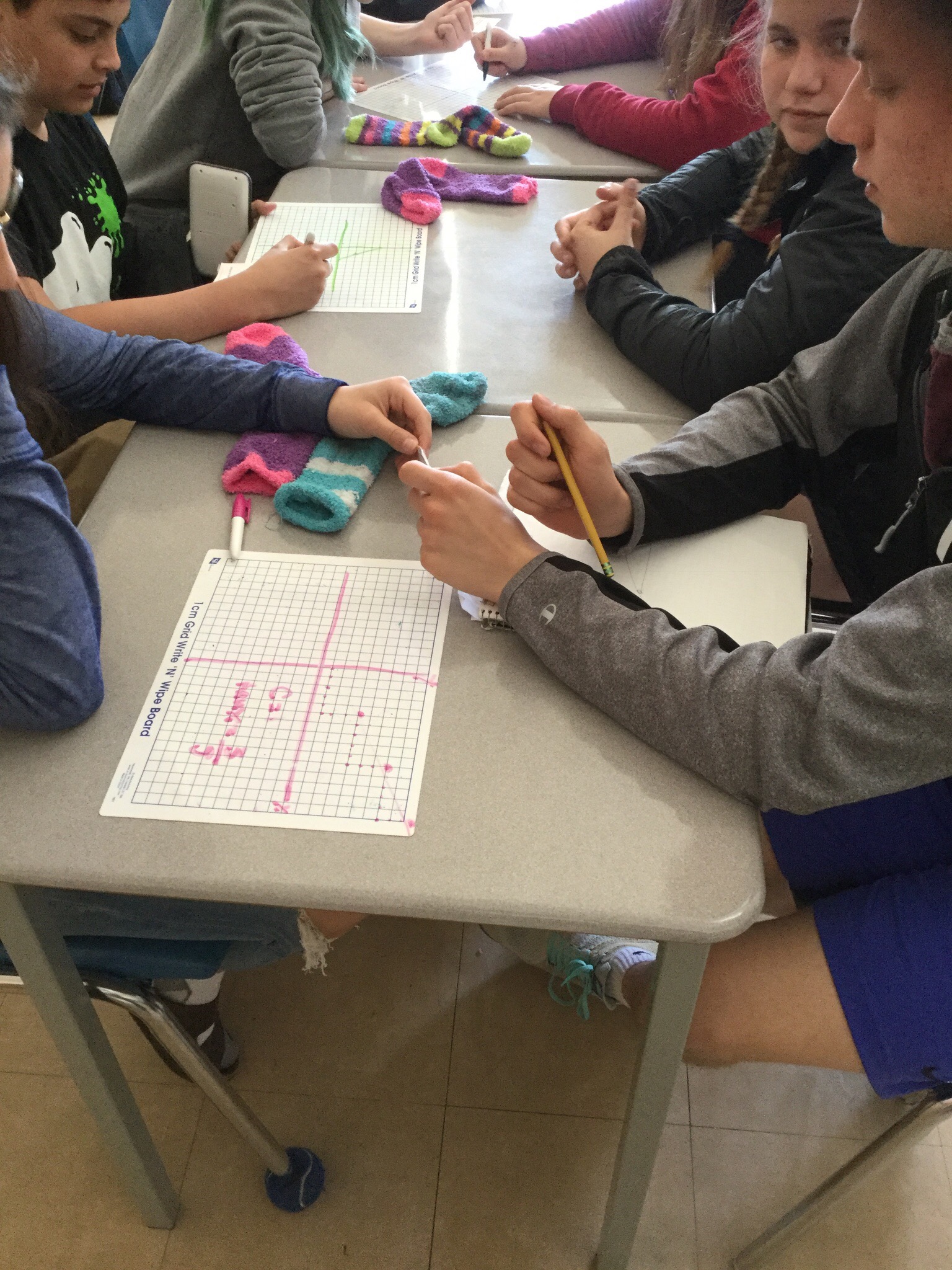
We did some “speed dating” style review for graphing lines and calculating slopes.
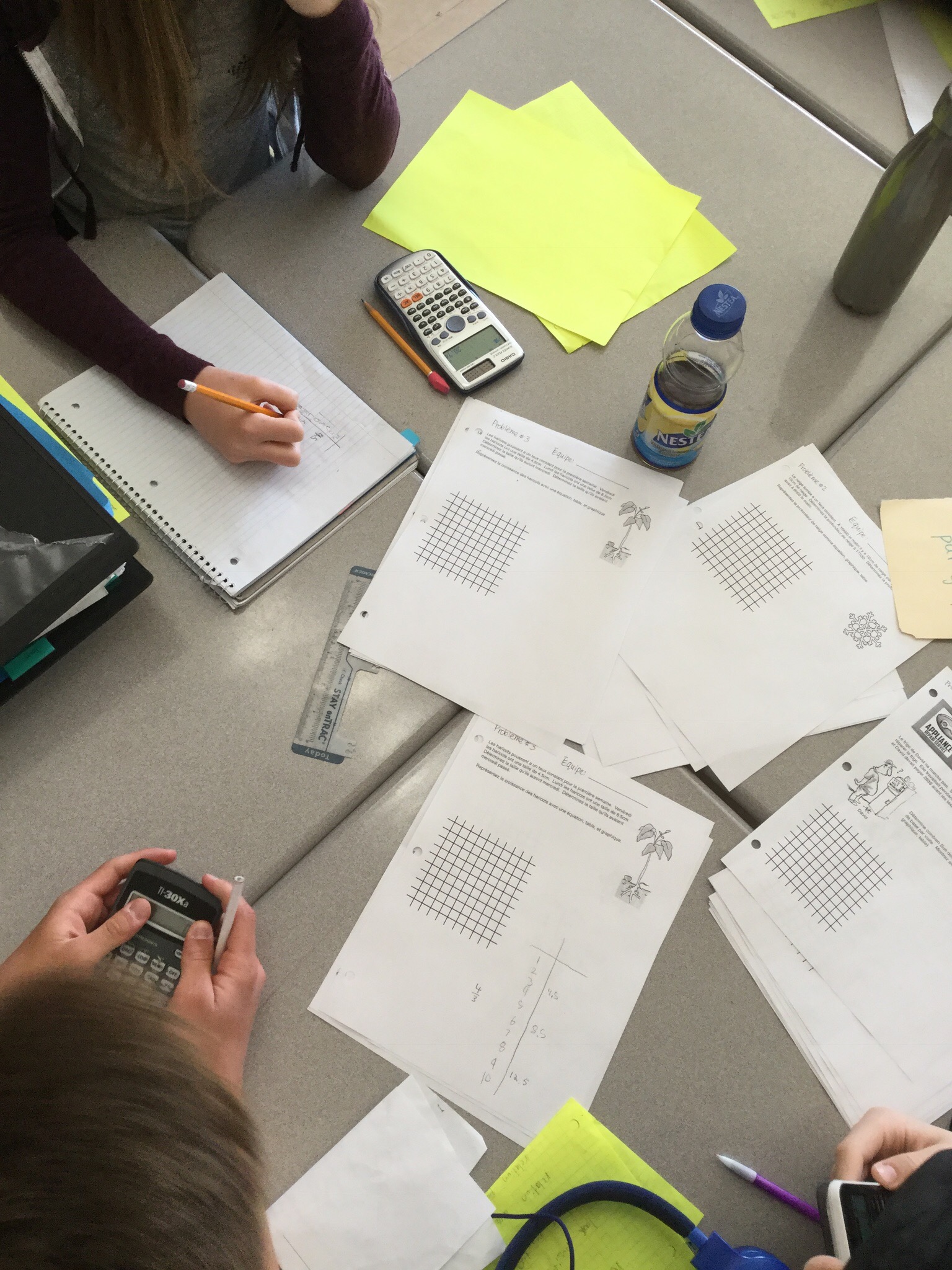
We worked on solving some word problems using multiple strategies.

And represented growing patterns using tables and graphs and equations.
We also had 3 teachers from Molly Brant Elemetary school with us, and a school board consultant, the math department head and student success teacher in the room. We shared with everyone how we are using our strategies to solve problems. Good job today!
desmos with angry birds
click on each image to open a desmos graph. You will notice that the slingshot is located on the x axis at -6, so all your graphs must go through that point. You need to create an equation for a parabola that will get the bird successfully to each of the pigs.

Here’s another to try: This time try to determine the equation of the bird in flight, and decide if it will hit any of the monkeys. Create parabolas that will land the bird at each of the monkeys.

Gr.10 homework
We explored a desmos activity today called parabola slalom. Try it here if you like

We experienced some frustration as we explored what the various values do in a formula.
Y=ax^2+bx+c Y=a(x-h)^2+k Y=a(x-r)(x-s)
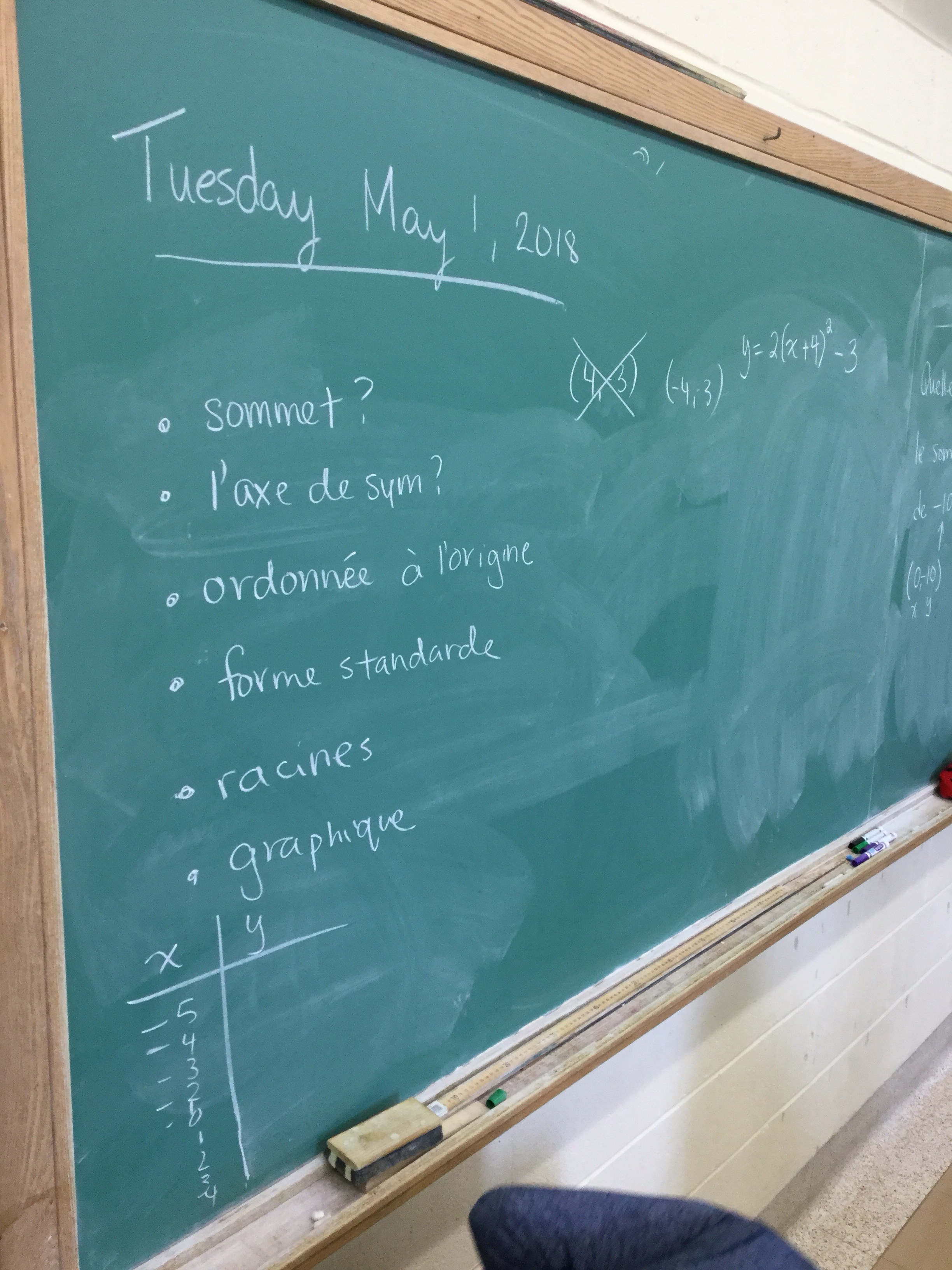
The struggle paid off as we got more experience. We were able to better predict what formula would pass through the slalom gates. For homework we are looking at what we can find out about the equation y=2(x+4)^2-3
Gallery Walk
Today we followed up with what we started yesterday. We finished our graphs and put them up to show everyone. Then we consolidated our learning and added some new vocabulary.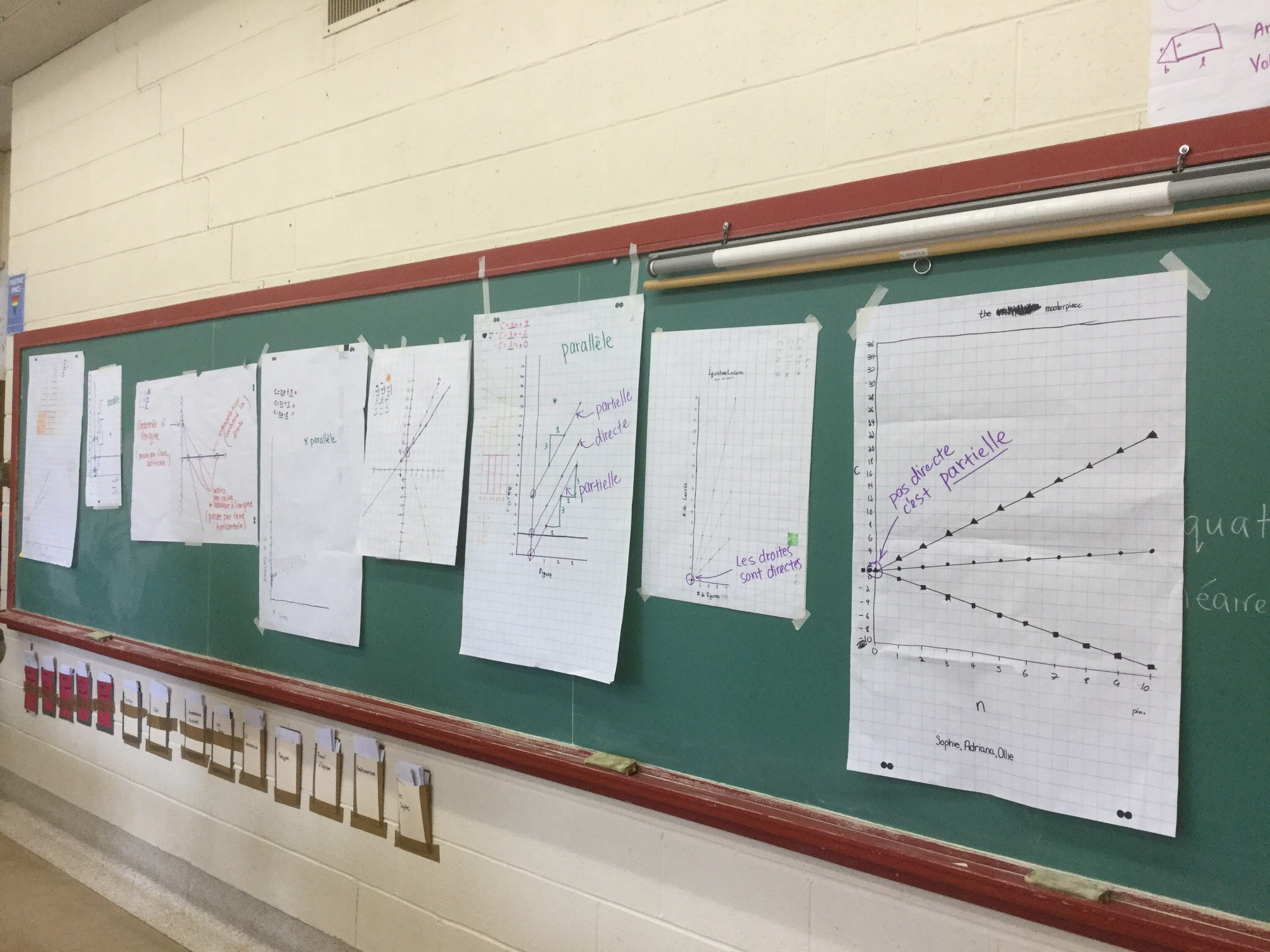
We learned that direct relations go through (0,0) and partial ones do not go through (0,0). We learned the names for the x intercept (abscisse à l’origine) and y intercept (ordonnée à l’origine), we looked at the rate of change (taux de variation) and also introduced the word slope (pente). We noticed that the rate of change /slope is given by the coefficient in the equation and the y intercept is the same as the constant (initial value). If the lines are parallel, they have the same slope.
We noticed some of the lines have positive slopes (upward to the right) and some have negative slopes (downward to the right).
Here is how one group visualized the relation with a negative slope.
Red is positive, blue is negative. They started with the initial term of 5, and for each subsequent term they placed n groups of -2 beside the original 5.

Knowing what we know about zero pairs (from algebra and algetiles) we know that a positive 1 and negative 1 will cancel each other out. (Seen below)

Interpreting tables of values
In grade 10 we are investigating tables of values, and how to determine the equation of a parabola given the table.
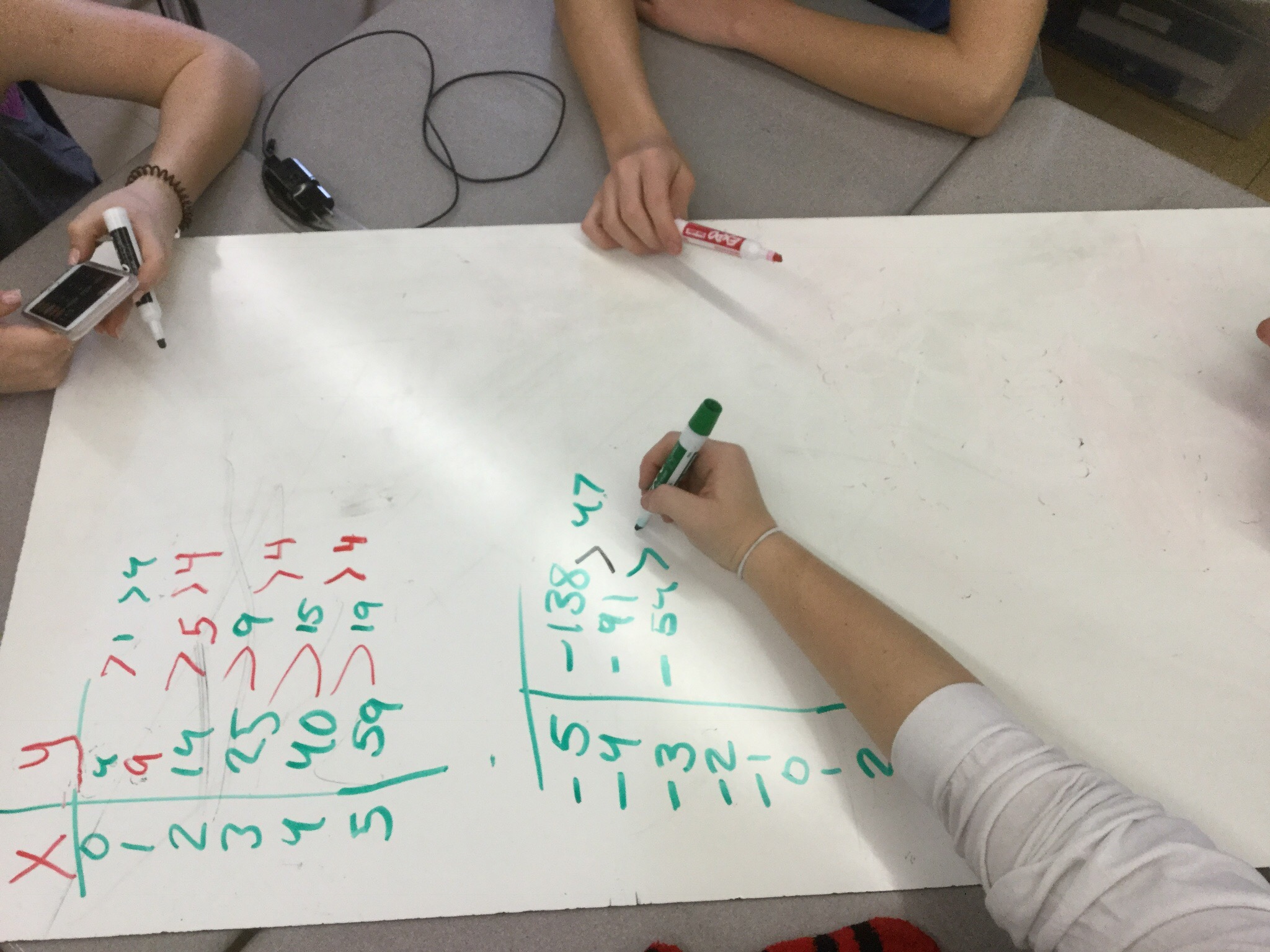
We are getting much better at calculating first and second differences. Parabolas have constant second differences.
We know that the “a” value is always half of the second difference, the “c” value is always the 6 value corresponding to an x value of 0, and then by substituting a different point for “x” and “y” along with “a” and “c” we can calculate the “b” value for y=ax^2+bx+c
Wih practice we are getting a lot better!
From patterns to Graphs
We have been building patterns recently using square tiles. Today we branched into graphing these patterns.
Each group was given 3 equations (pattern rules) to build and graph.
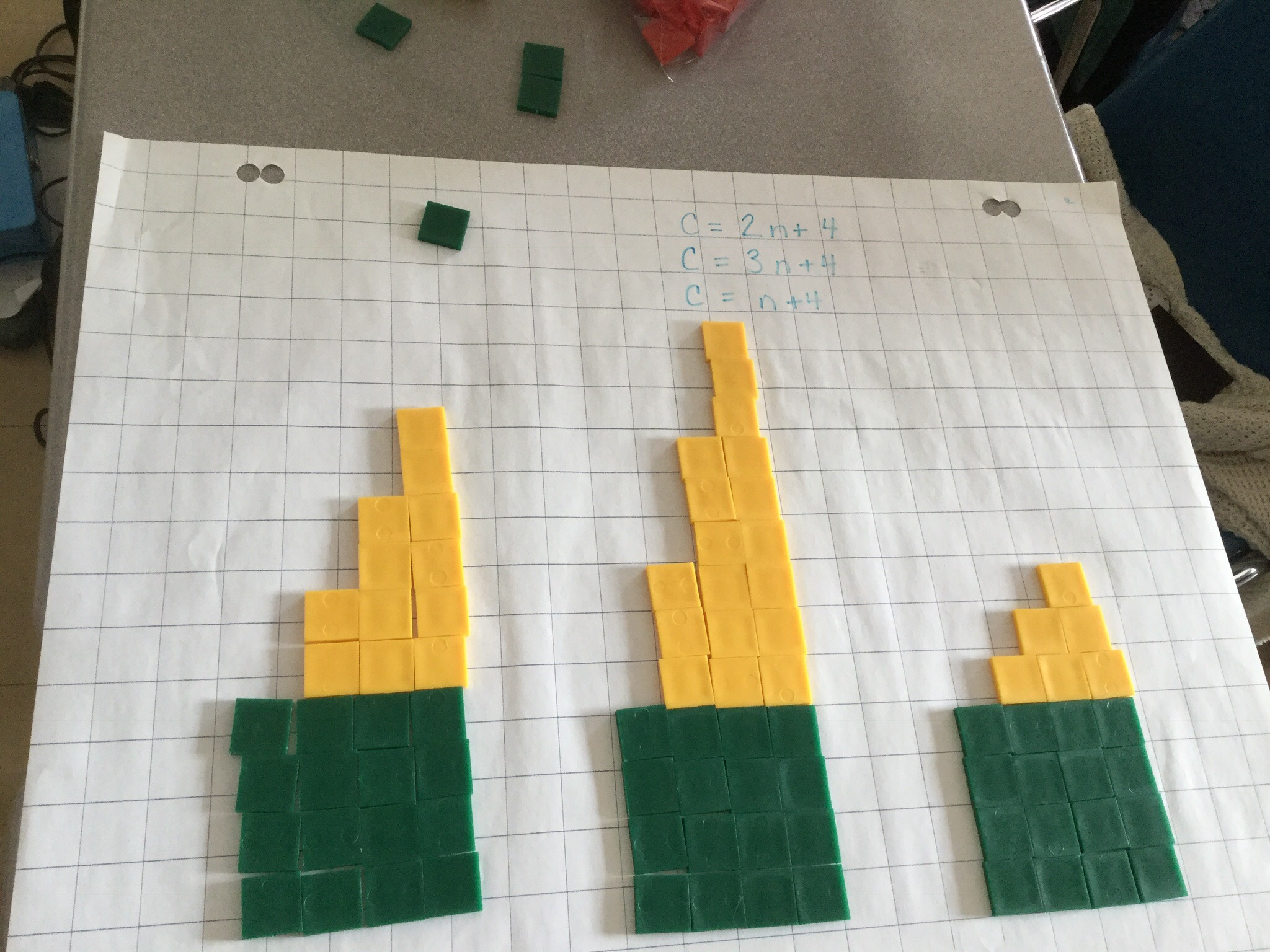
Each of the patterns had something in common. Here you can see figure 0,1,2,3 of each pattern with the constant in green and the growing pattern in yellow. We’ve noticed how the coefficient in the pattern shows us the “stairs”. The bigger the number the steeper the stairs.
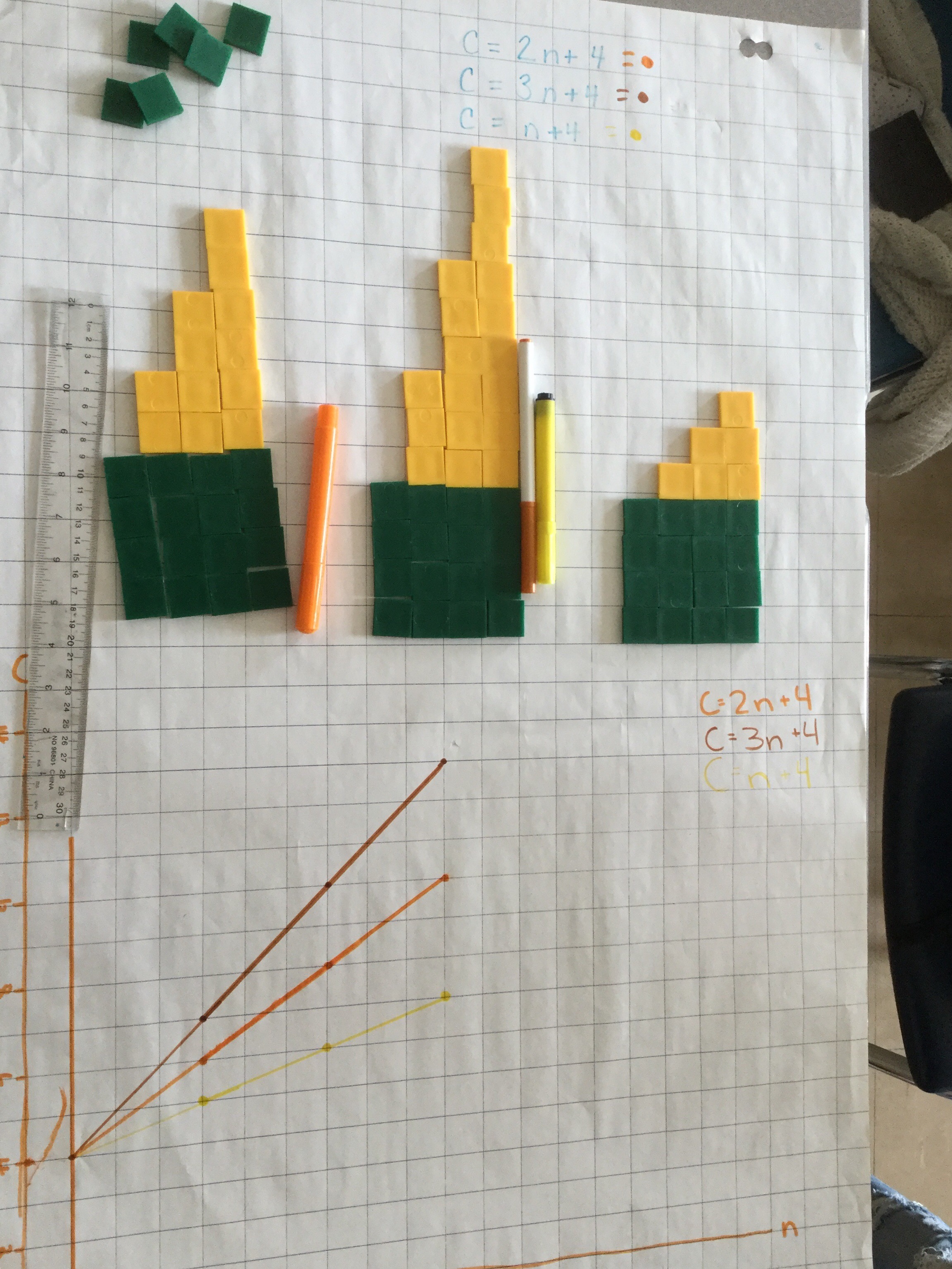
We graphed figure number on the horizontal axis and the number of squares vertically.

We would have done more, but we had a lockdown drill. We will continue this inquiry tomorrow.
The Mu of a Shoe
These are spring scales. They are used to measure the weight of things, and the forces on things.

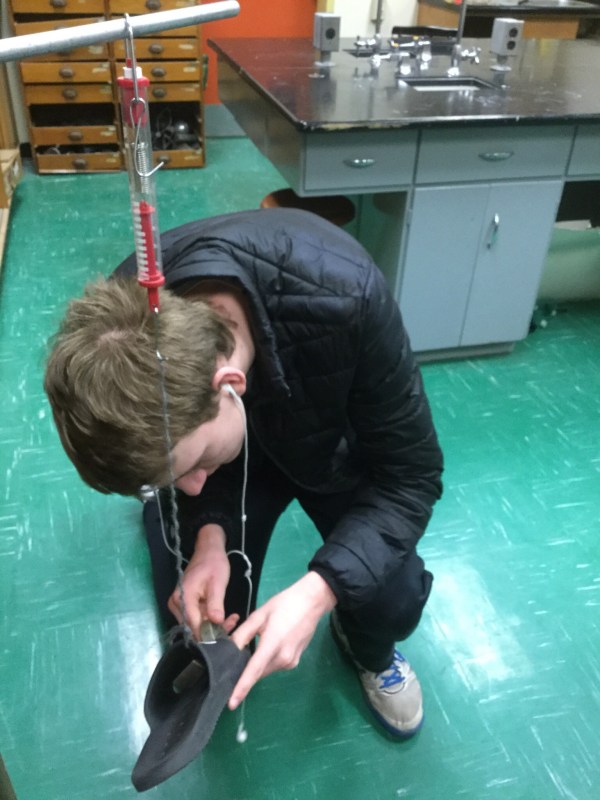
We measured the weight of the shoe, and then we pulled he shoe to determine the force of friction on the shoe. We added mass and repeated the procedure.

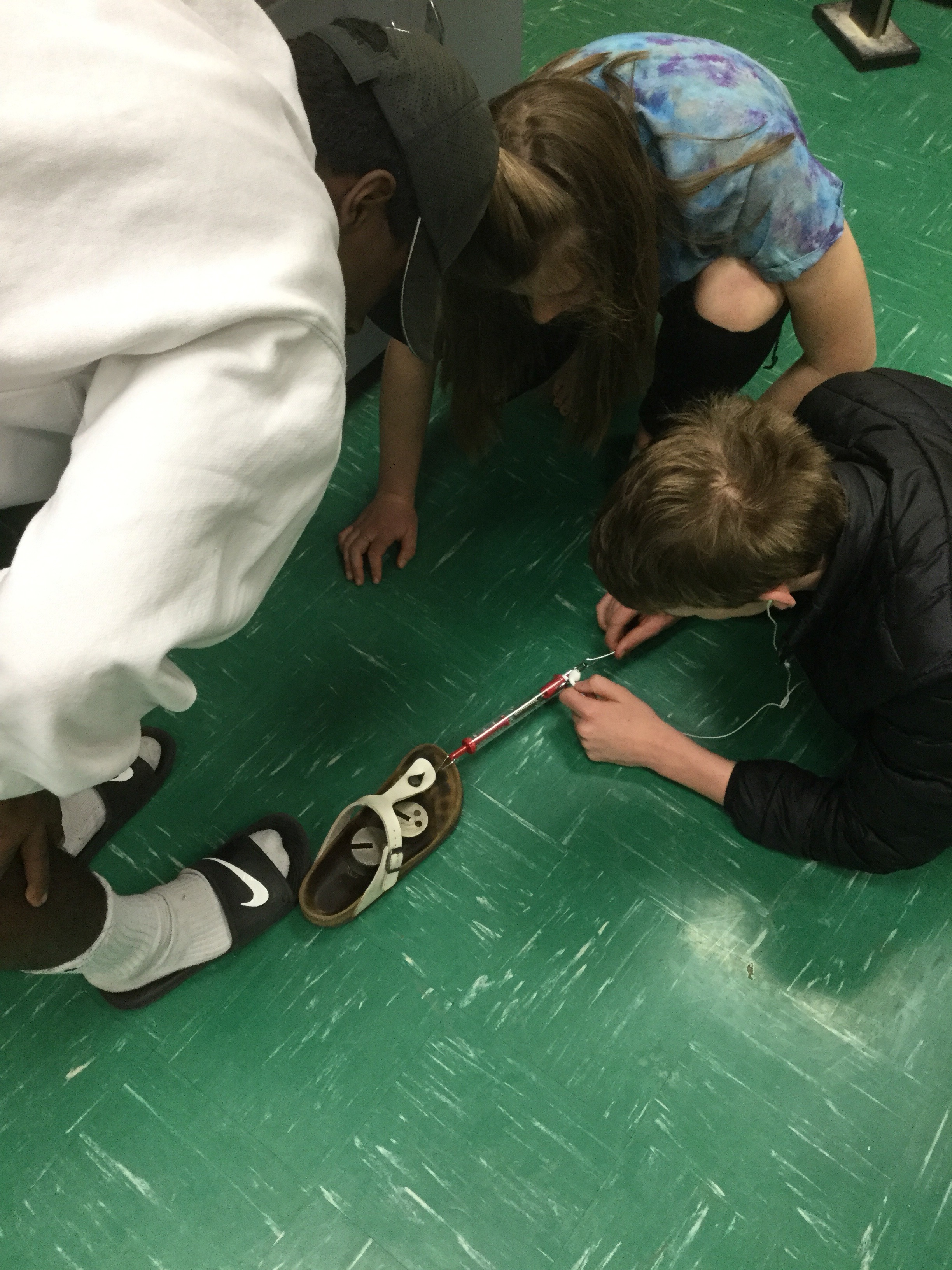
We noticed the force to get the shoe moving is bigger than the force to keep the shoe moving.
All of these forces are bigger when the mass of the shoe is bigger.
We tried all of this experiment again but on a wet floor. The goal is to determine the coefficient of friction between the show and dry floor and the shoe and wet floor.
Solve Me Mobiles
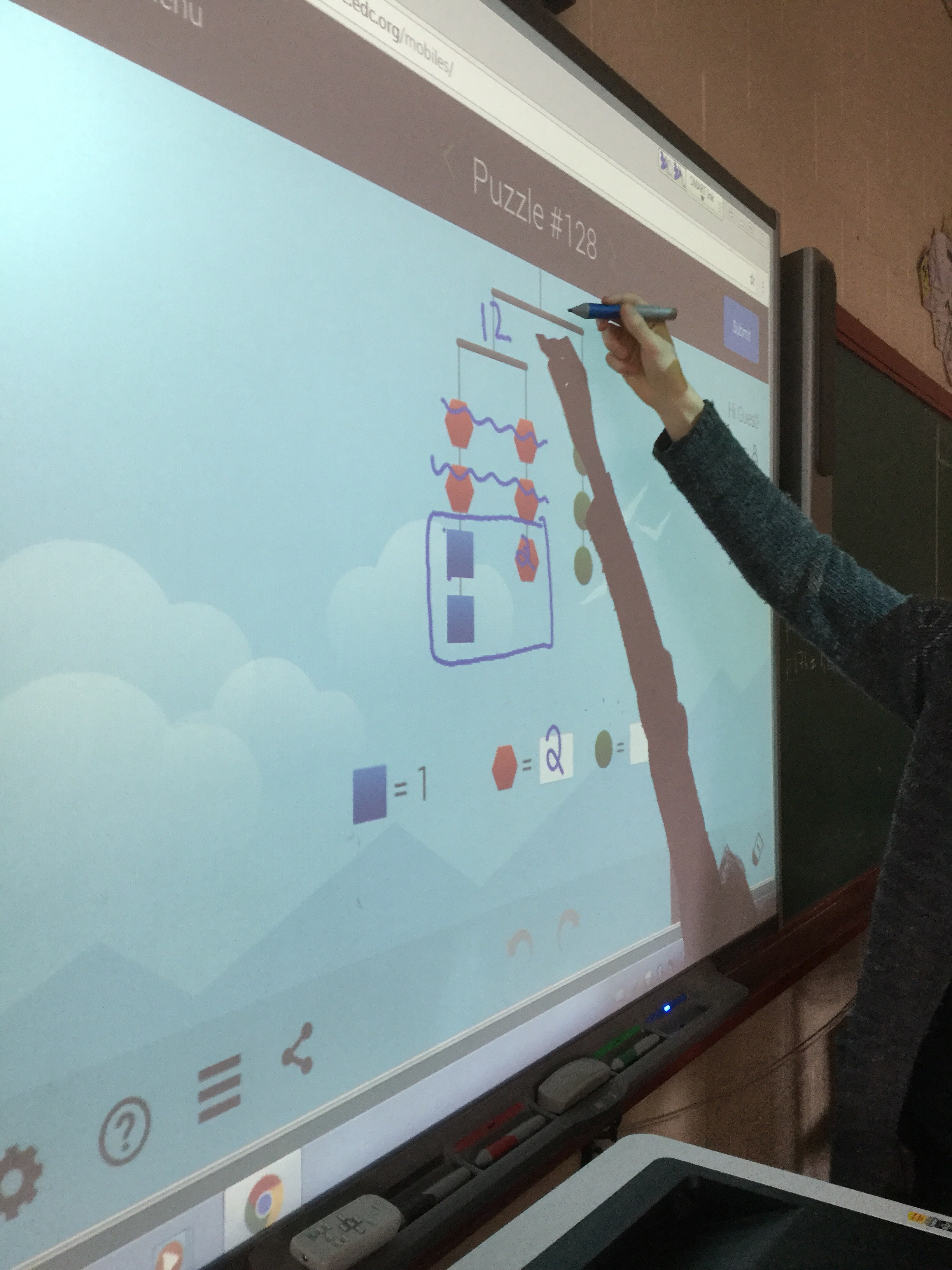
Today we worked on a fun puzzle game available online. It’s called “solve me mobiles”. Using logic and algebraic reasoning the goal is to determine the value of each coloured block. We are building equation solving skills and intuition through this game. They are pretty fun! Give it a try here.
 Ms. Bearse's Site
