Modelling quadratics
Grade 10s are working on solving problems involving quadratics. This example shows how we can determine dimensions of a rectangle given the area and perimeter. We can create equations, substitute, expand to make a trinomial, use algebra to get a trinomial that equals zero, and then use the quadratic formula to solve for the roots (if they exist).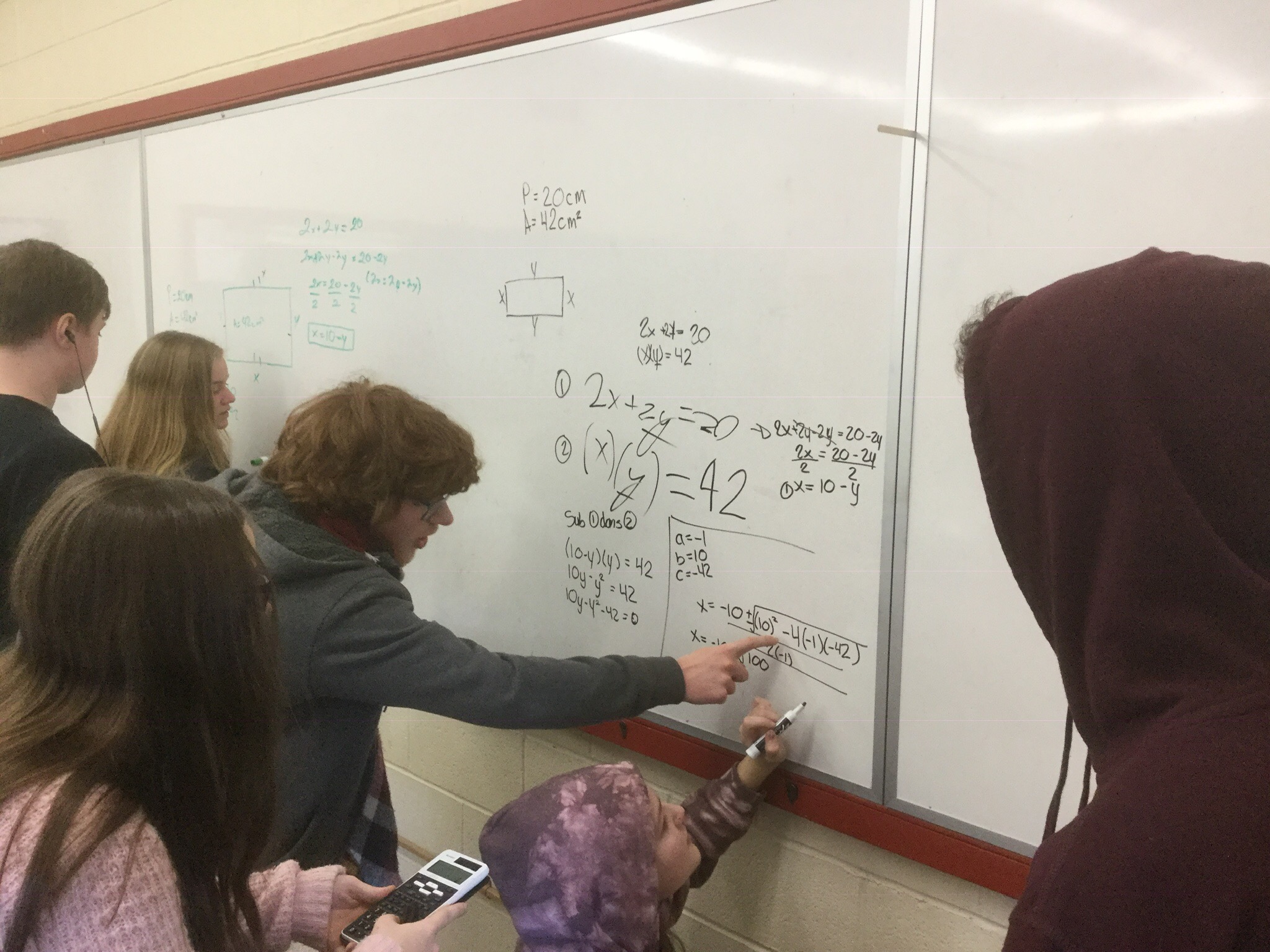
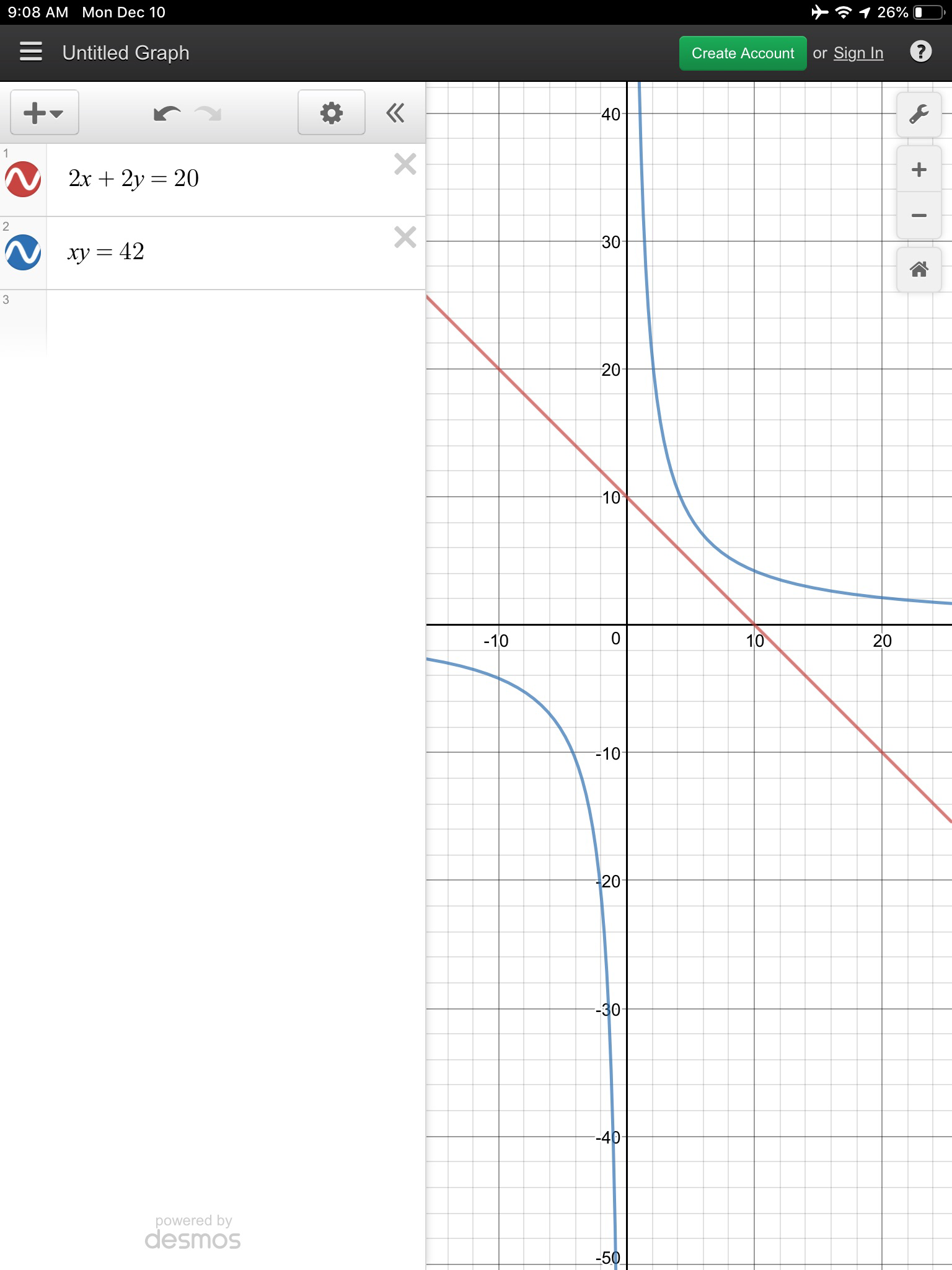
We also saw that sometimes there are no roots. In this case on desmos we can see that there are no intersection points between our two equations, so we have no possible dimensions that will work. It corresponds to the fact that the discriminant found is a negative number.
Our work this week is mostly based on modelling (creating equations) and using them to solve problems.
Grade 9 Review
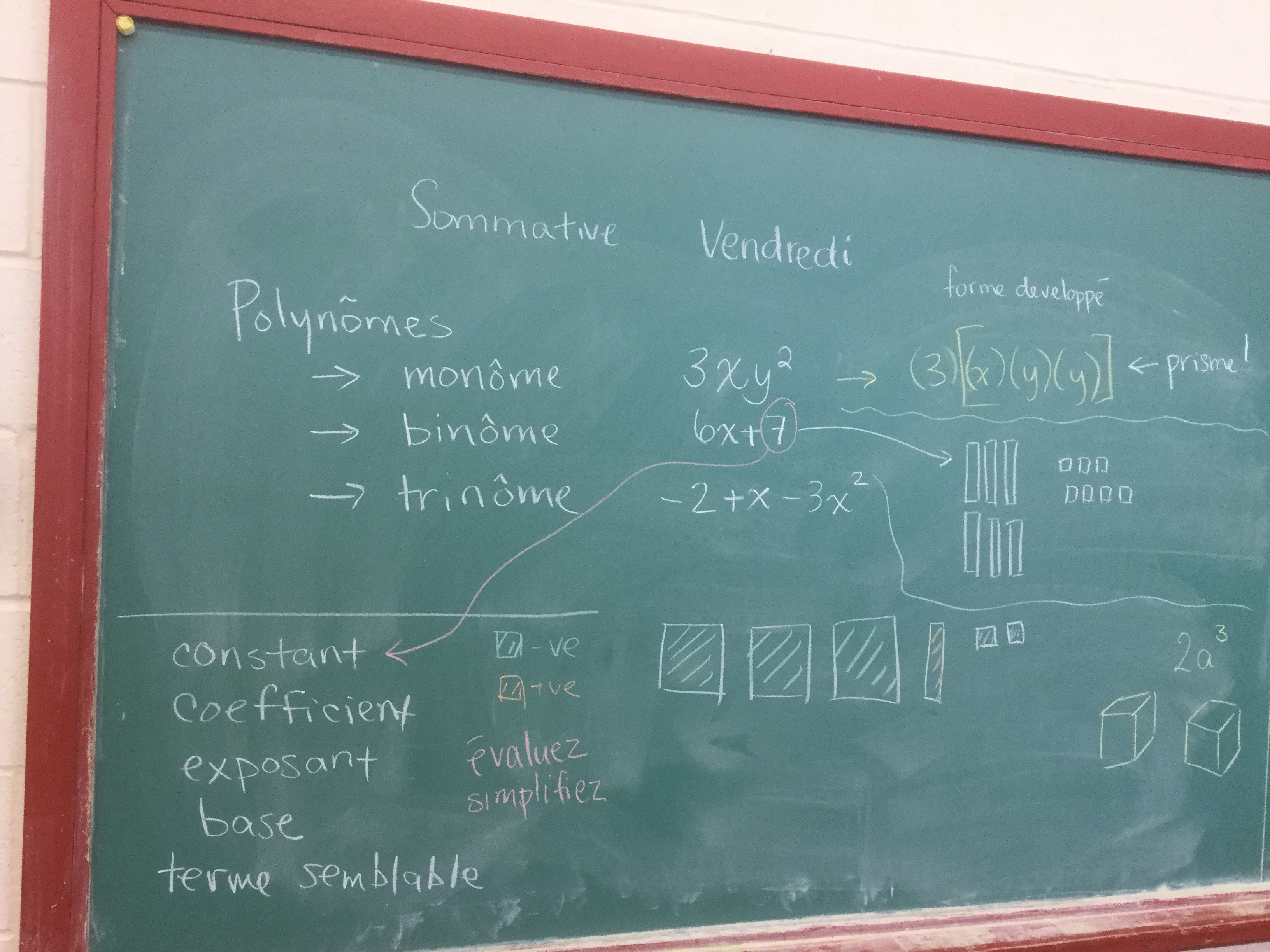
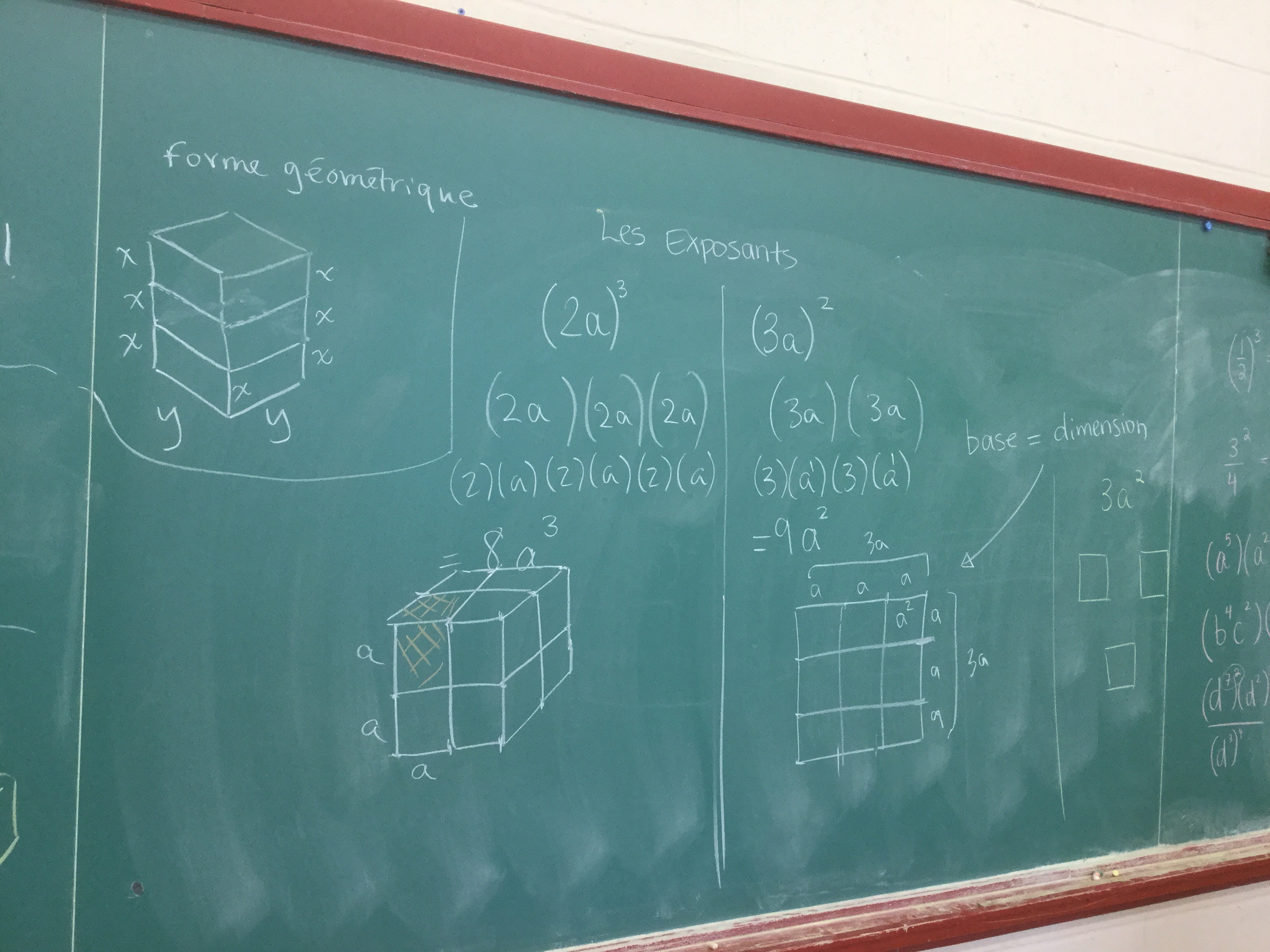
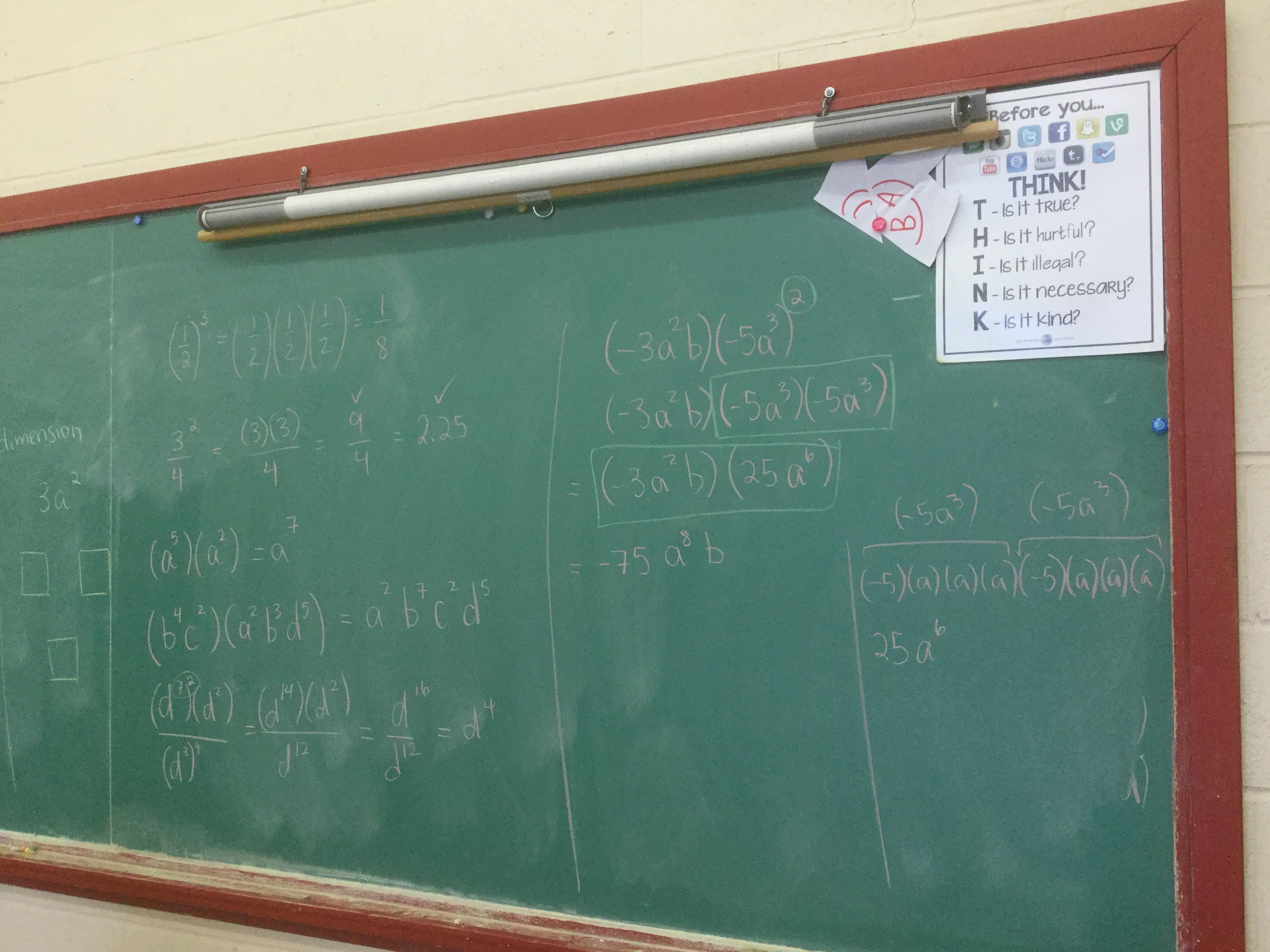
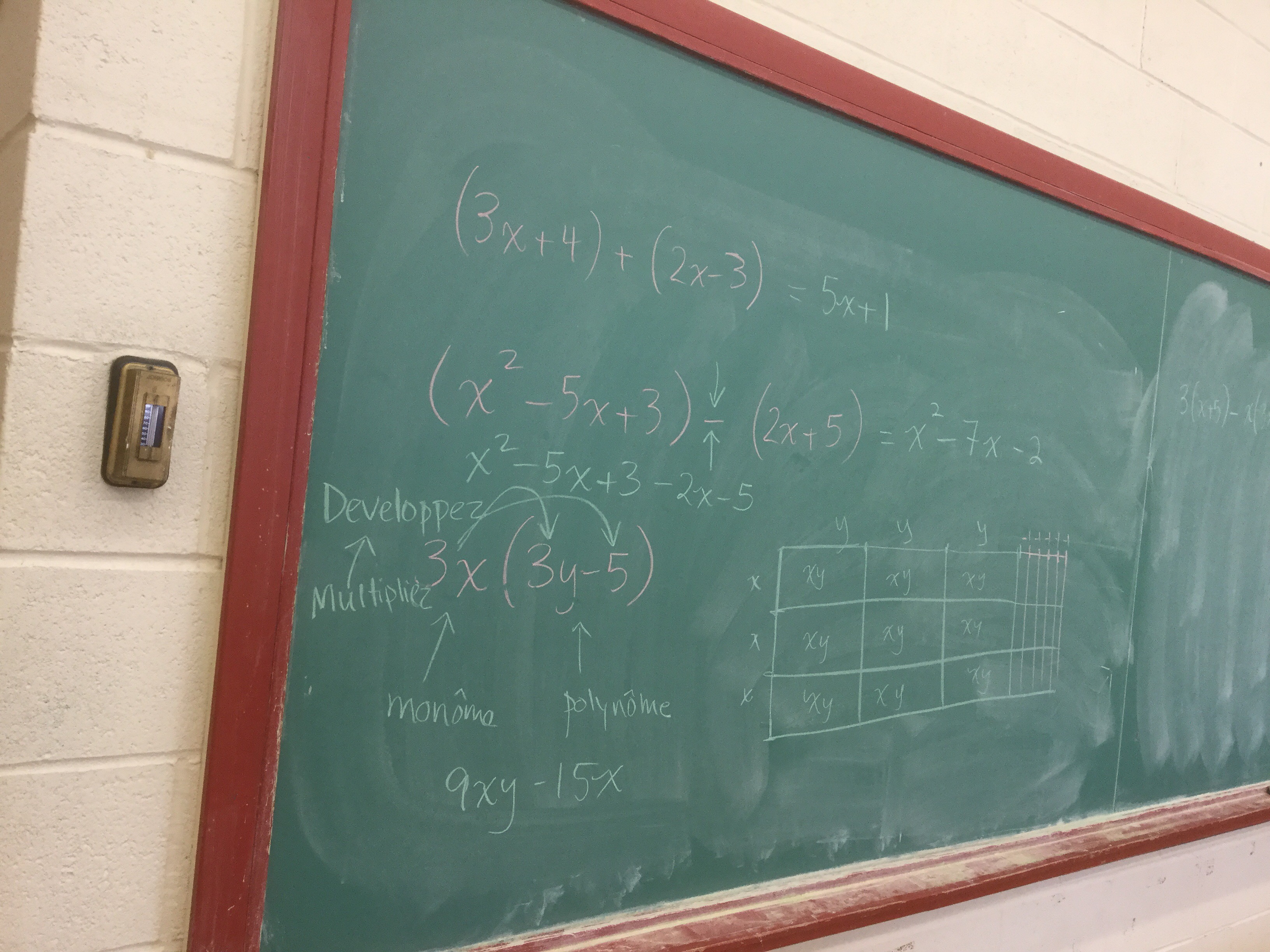
Some good review questions
Discriminant
In Grade 10 today we learned all about the power of the discriminant (b^2-4ac) that is under the square root of the quadratic formula.
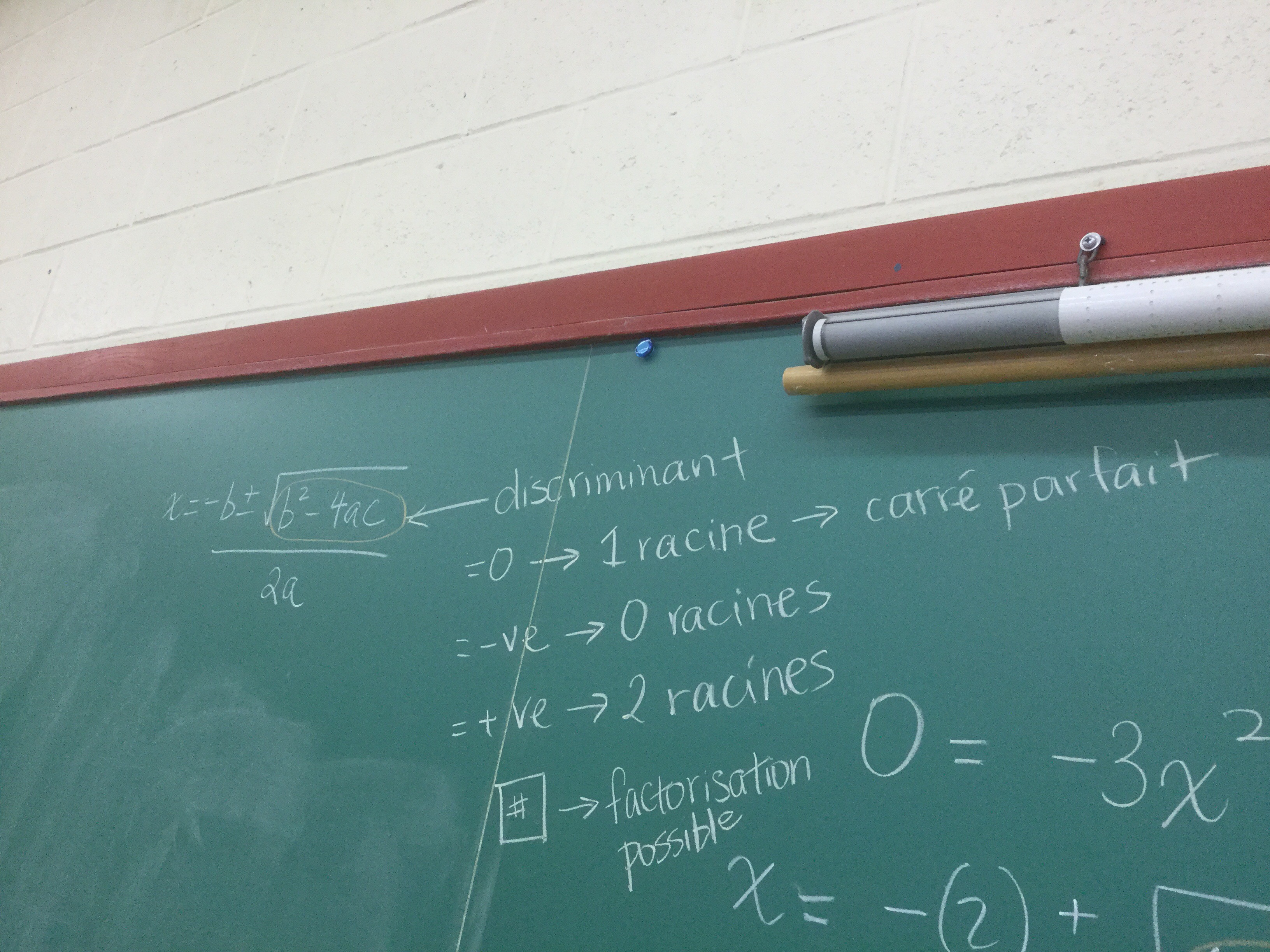
We looked at multiple examples and practiced solving for the value of x from factored form, vertex form and standard form equations. We can now find the intersection between 2 parabolas using substitution.
Multiplying and the Area Model
Today grade 9s learned how to represent multiplying in a few different ways.
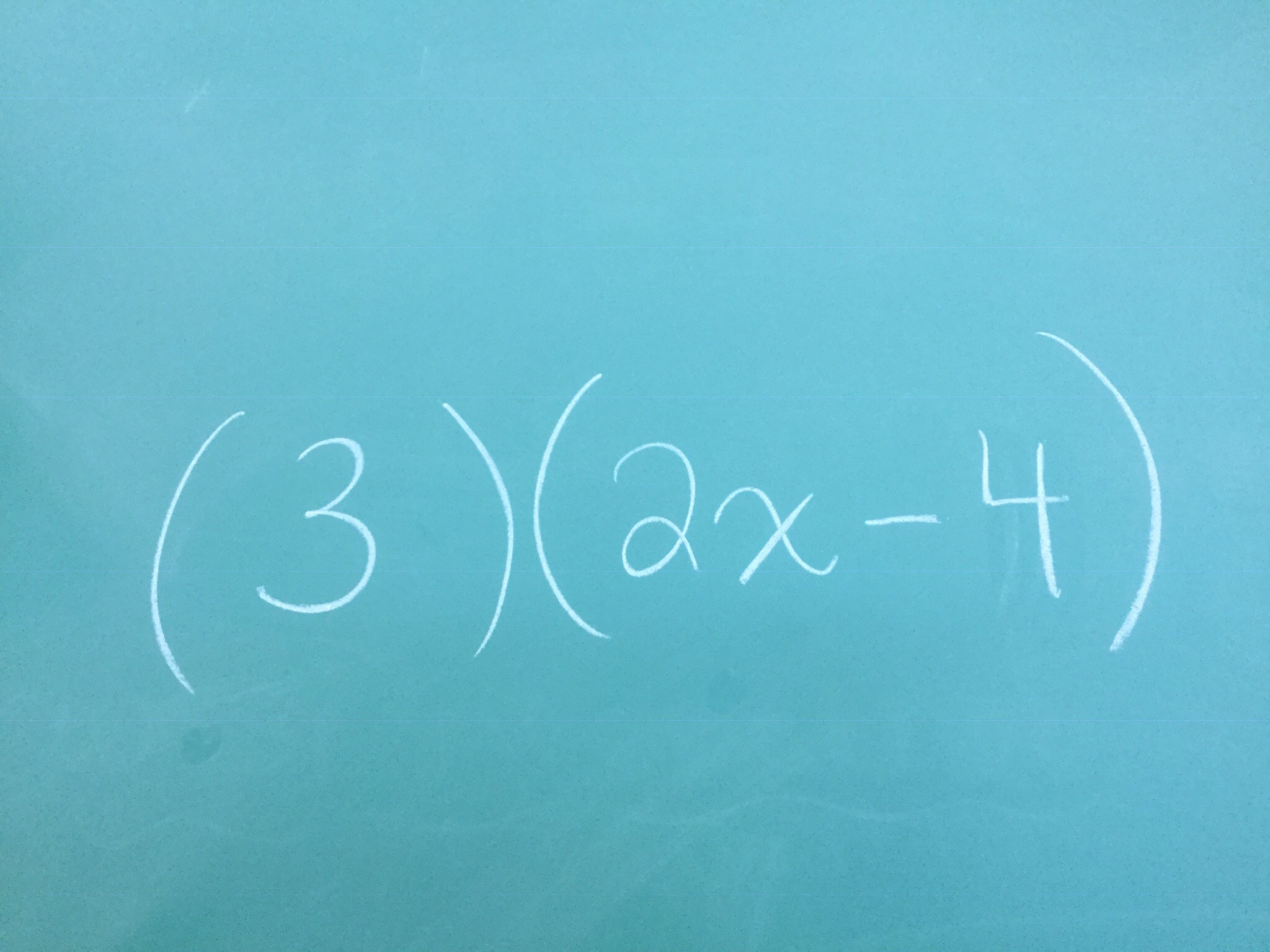
Some saw this as 3 groups of 2x-4

Others saw it as 3 groups of 2x and 3 groups of -4, which is 6x-12
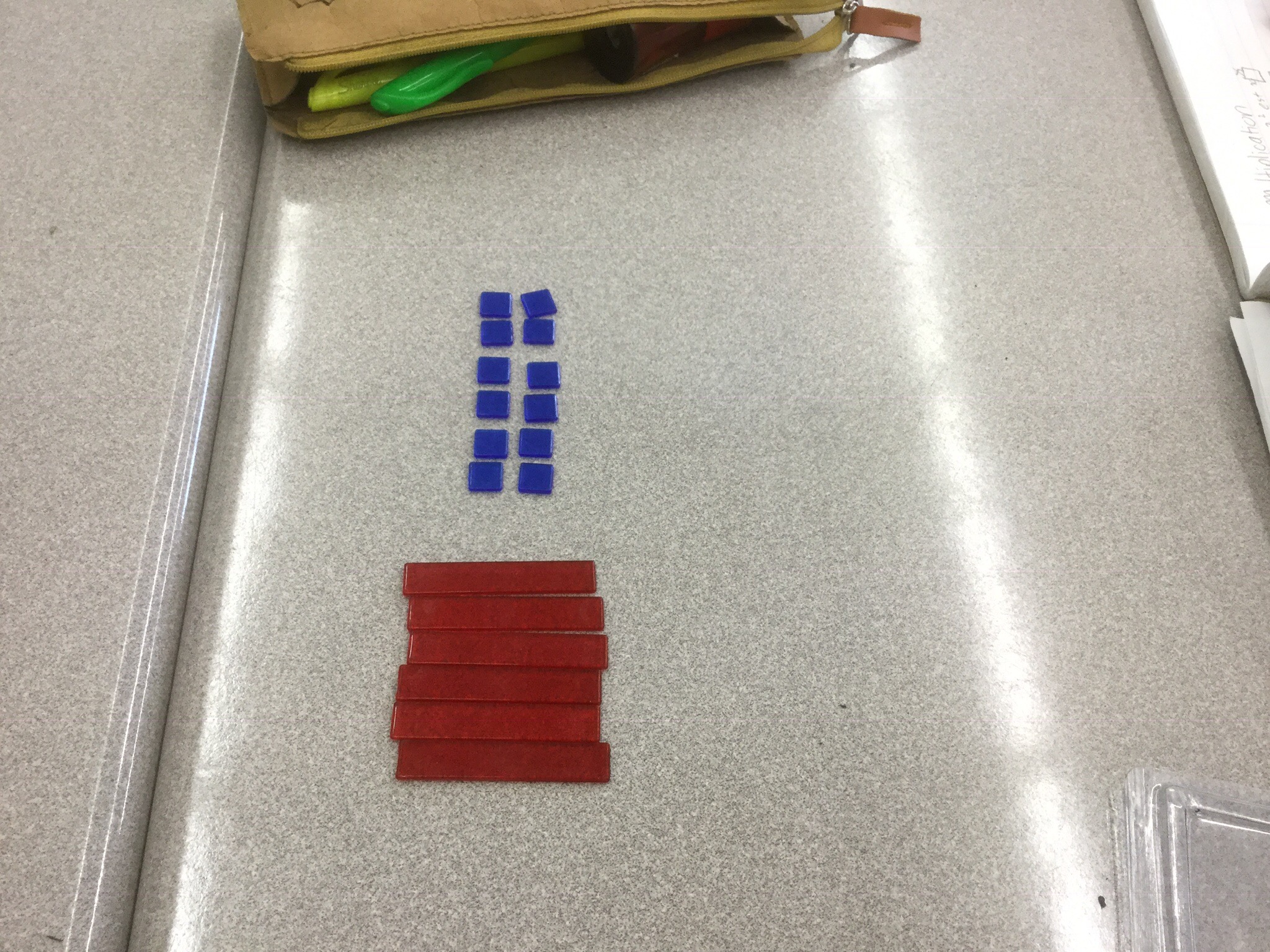
Some could see it as a rectangle, with the area representing the multiplication of length and width.
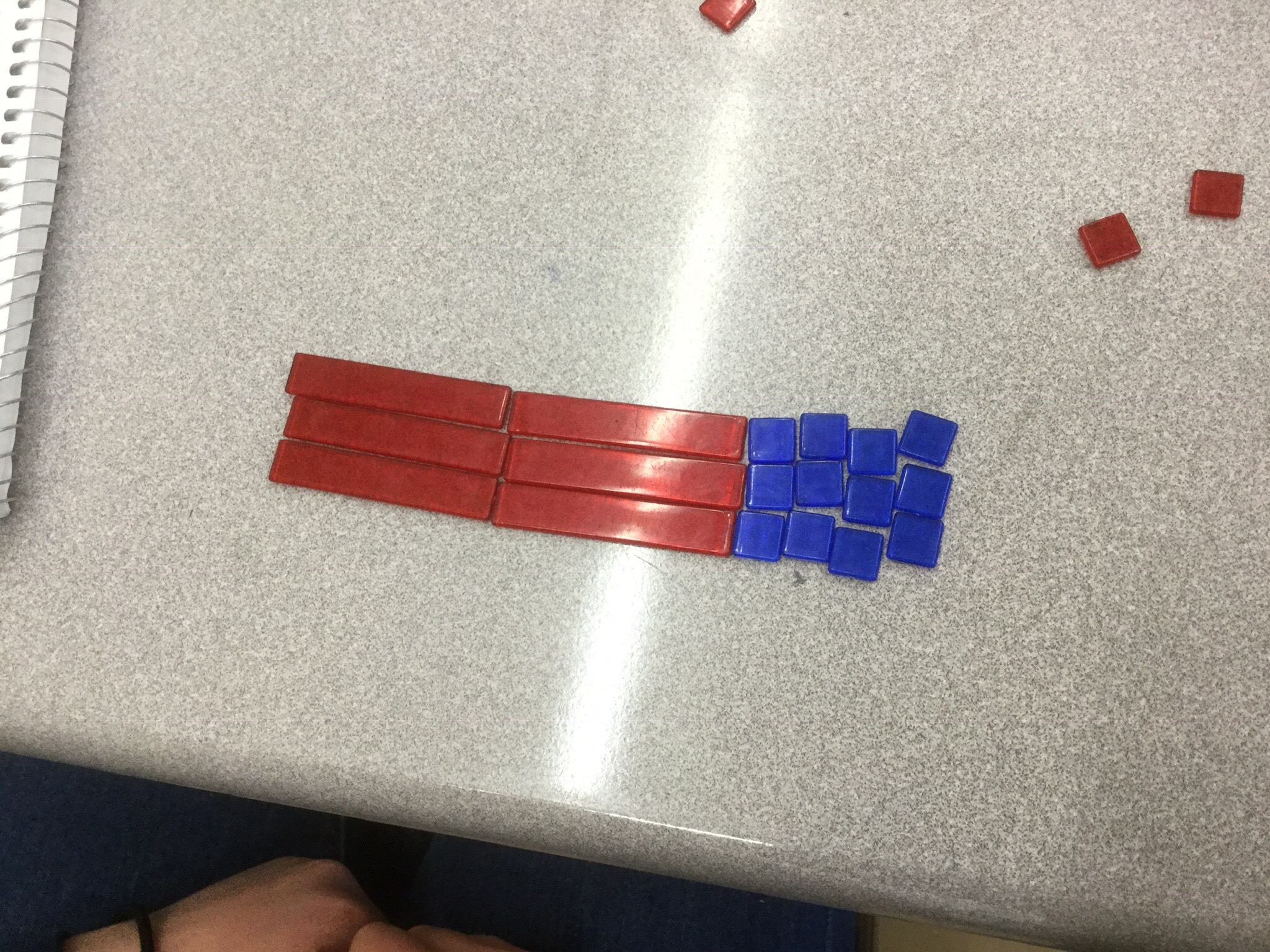
In each case, it is the same answer, just represented in a slightly different configuration. This might not seem to be a big deal, but when we make the question a little more challenging….

We no longer can group things as easily, since we don’t know the value of x. The area model continues to be useful though, and we can build a rectangle with the dimensions of x and 3x+1

Here’s a representation of 2x(x-4) the rectangle dimensions are placed up on the ledge and the rectangle itself is on the lower level. The results of the multiplication are 2x^2-4x.
Exponent review
Look at these hard working grade 9s! They are collaborating and checking their understanding with some very complex exponent law simplification questions.
We’re using all sorts of surfaces to work on. Many are choosing the boards, some are writing on desks, others on small whiteboards, and some on paper.
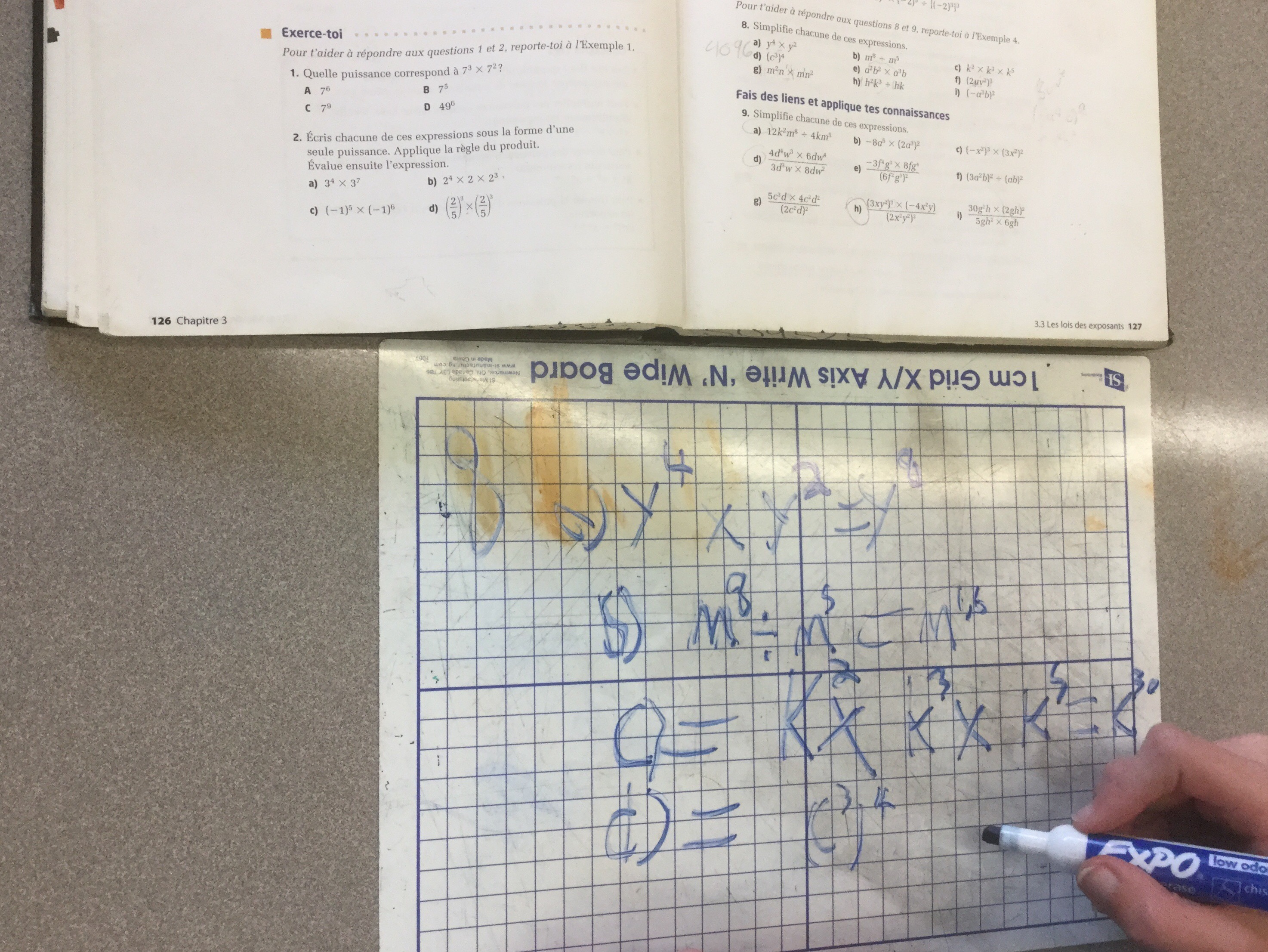
We’re learning about using our textbooks and how to check the answers in the back.

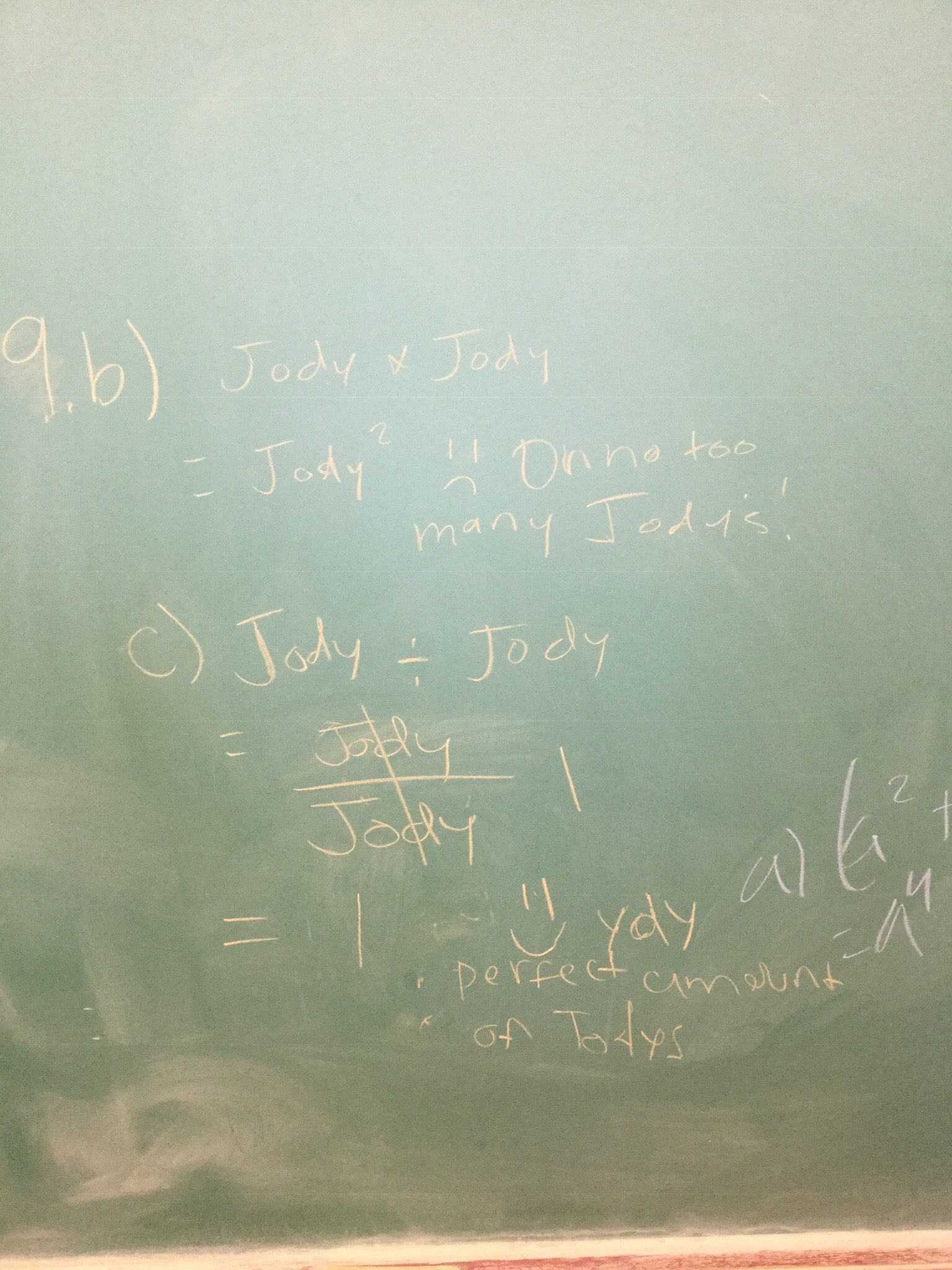
Some of us are expressing our exponents in interesting ways, such as making up our own questions….here’s one that is particularly creative.
Grade 10s patterning continues
We worked on this pattern today
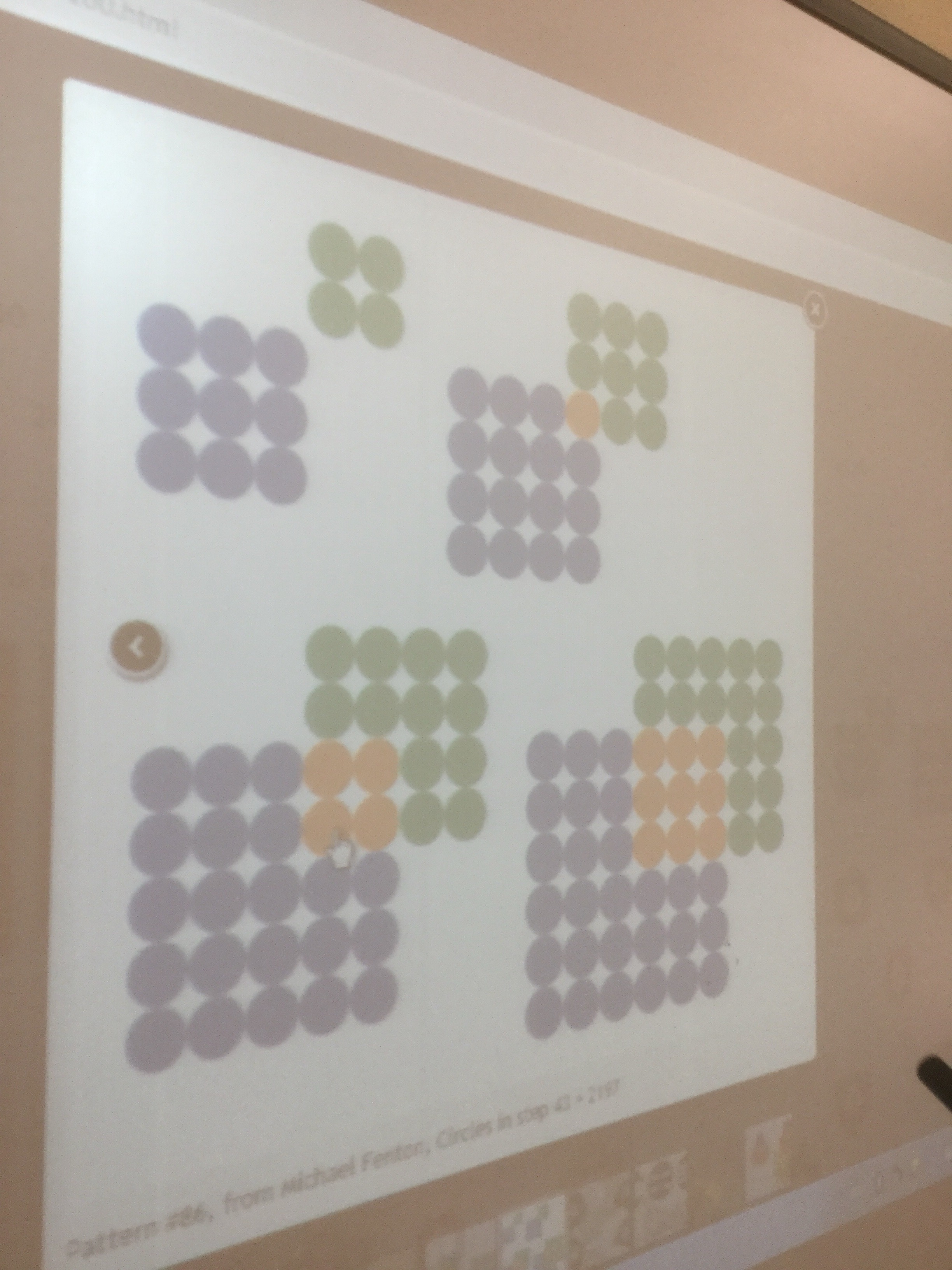
We saw things in so many ways!
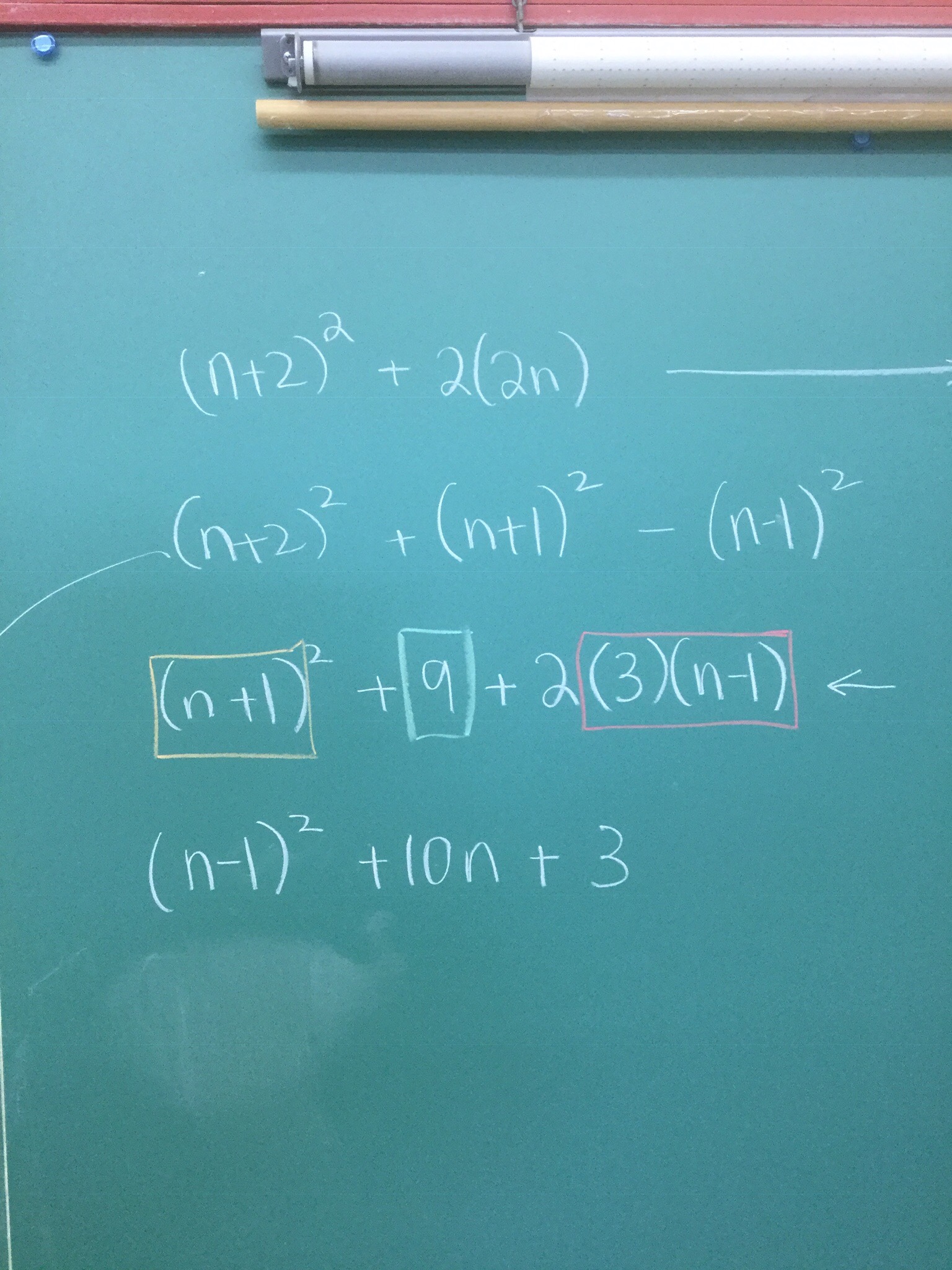
We made a lot of equations which all simplified to the same thing.
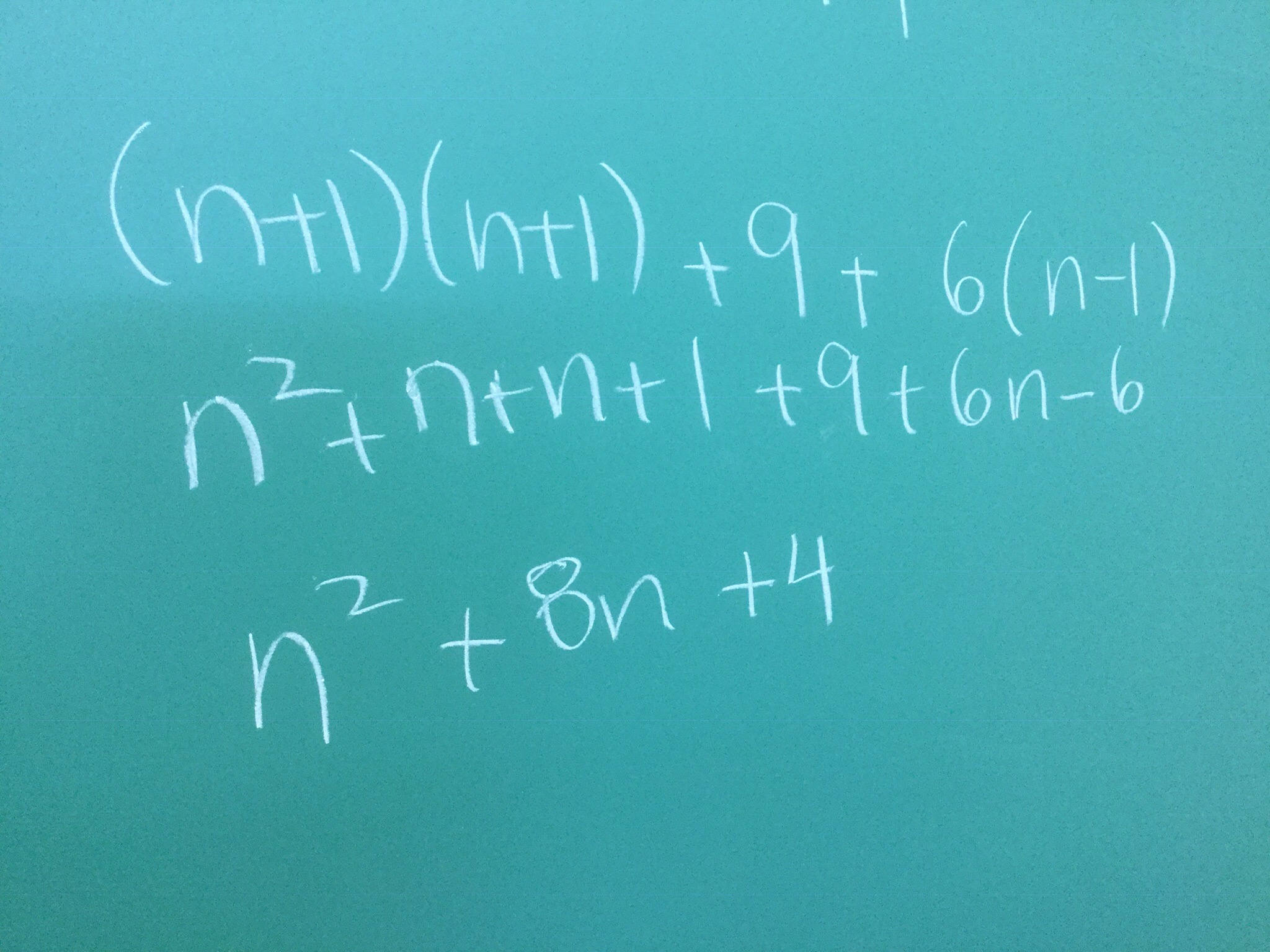
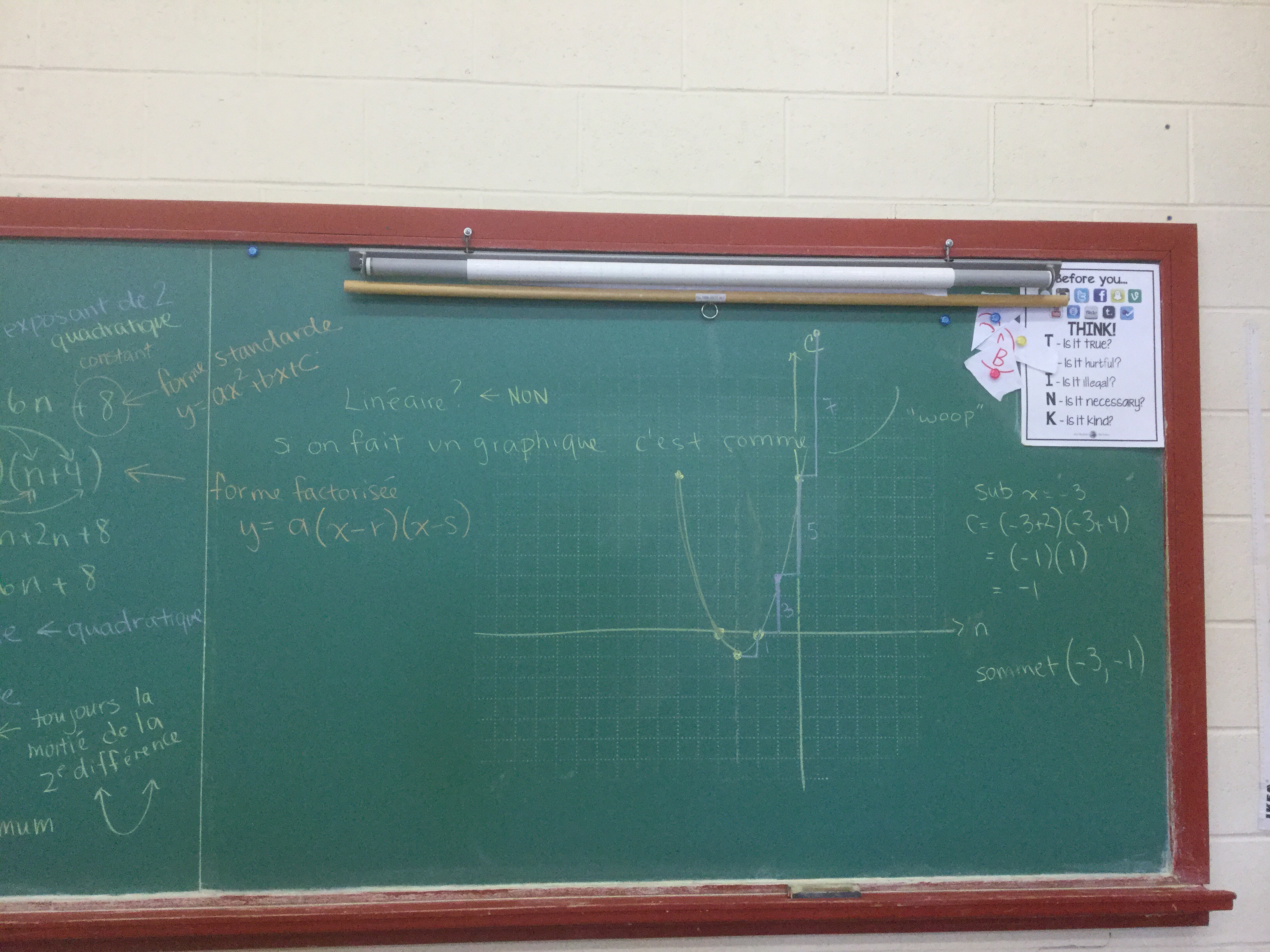
The next step was to make a graph. The trick was it’s not a factorable equation. We needed a new step to find the vertex (le sommet).
We looked at some perfect squares (we’ve done lots of practice with these). We know they have one root (racine) and it is also the vertex (sommet). What happens if there is a constant at the end, after the perfect square. It turns out that if the bracket turns to zero, the final number will be the minimum value of the parabola (part of the vertex).
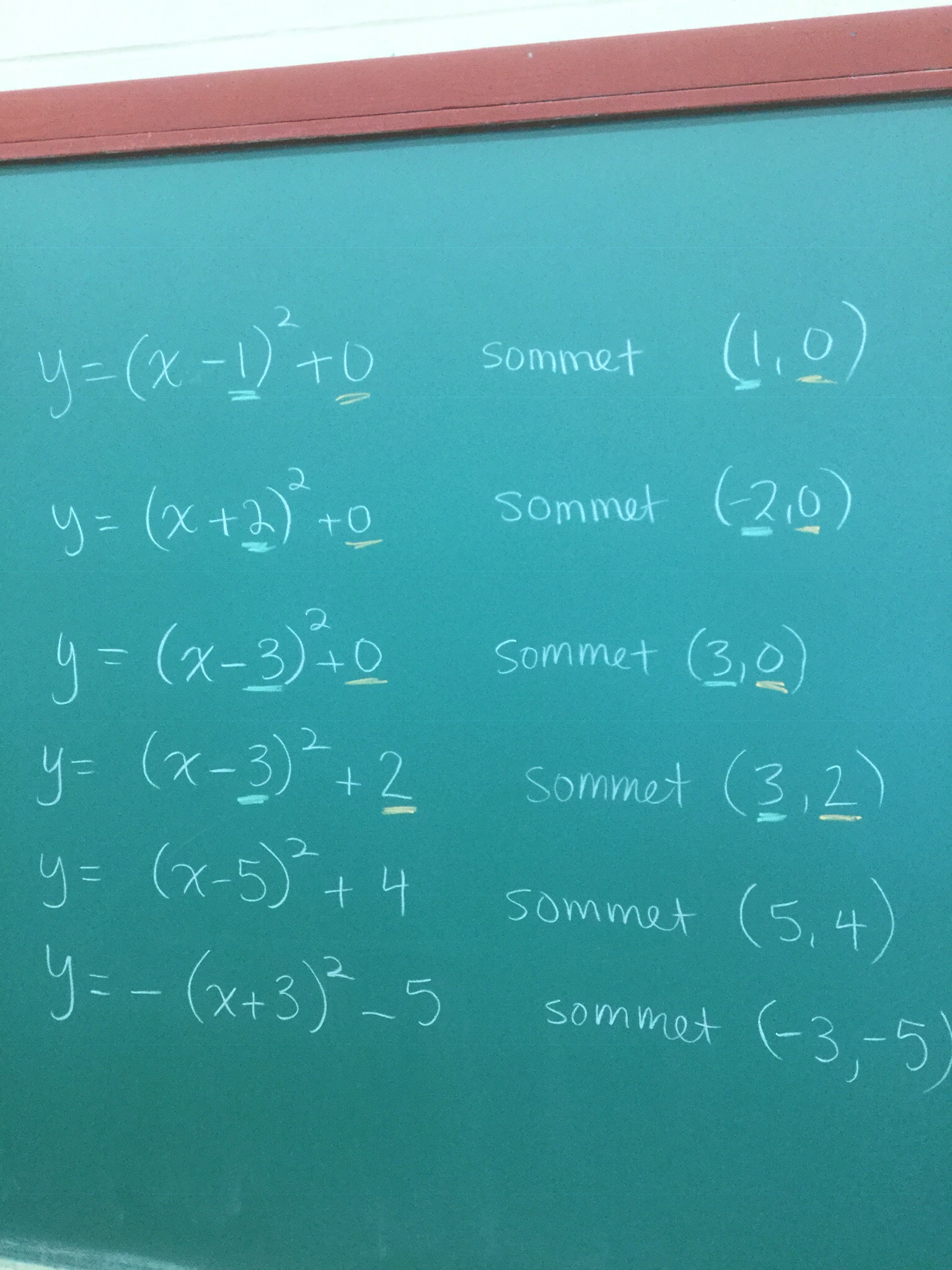
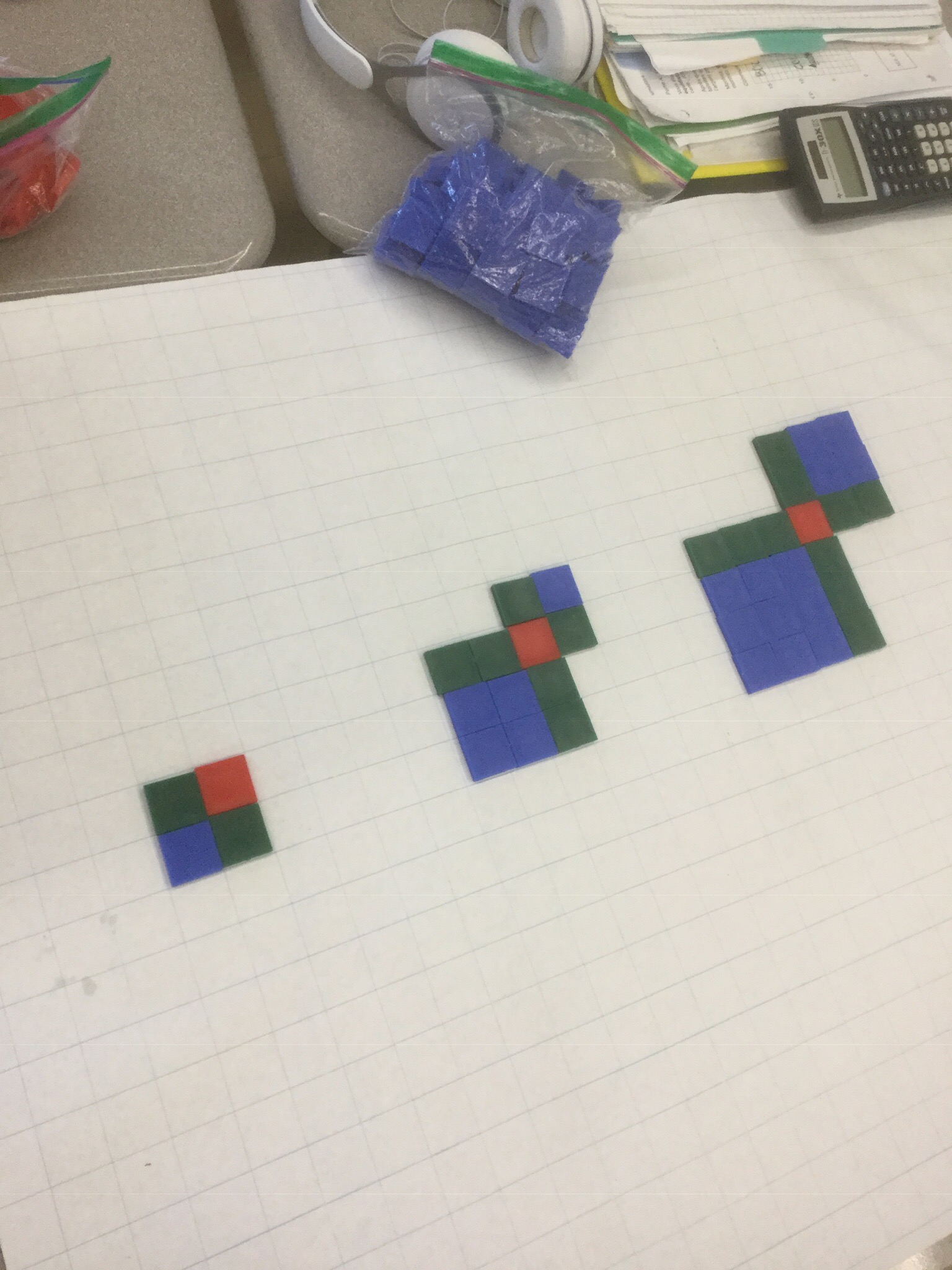
We got good at that, so we tried to make a perfect square out of our expression
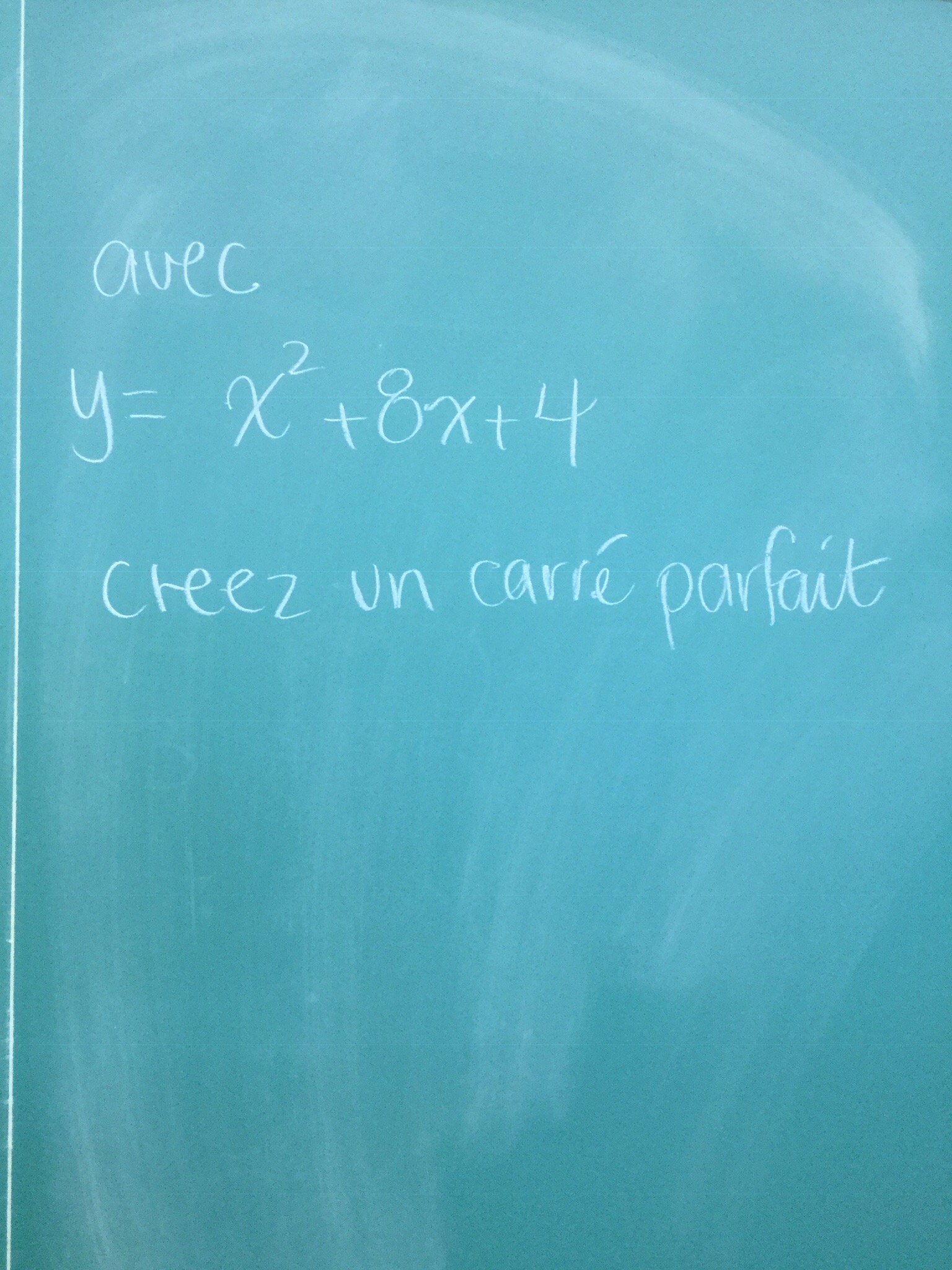
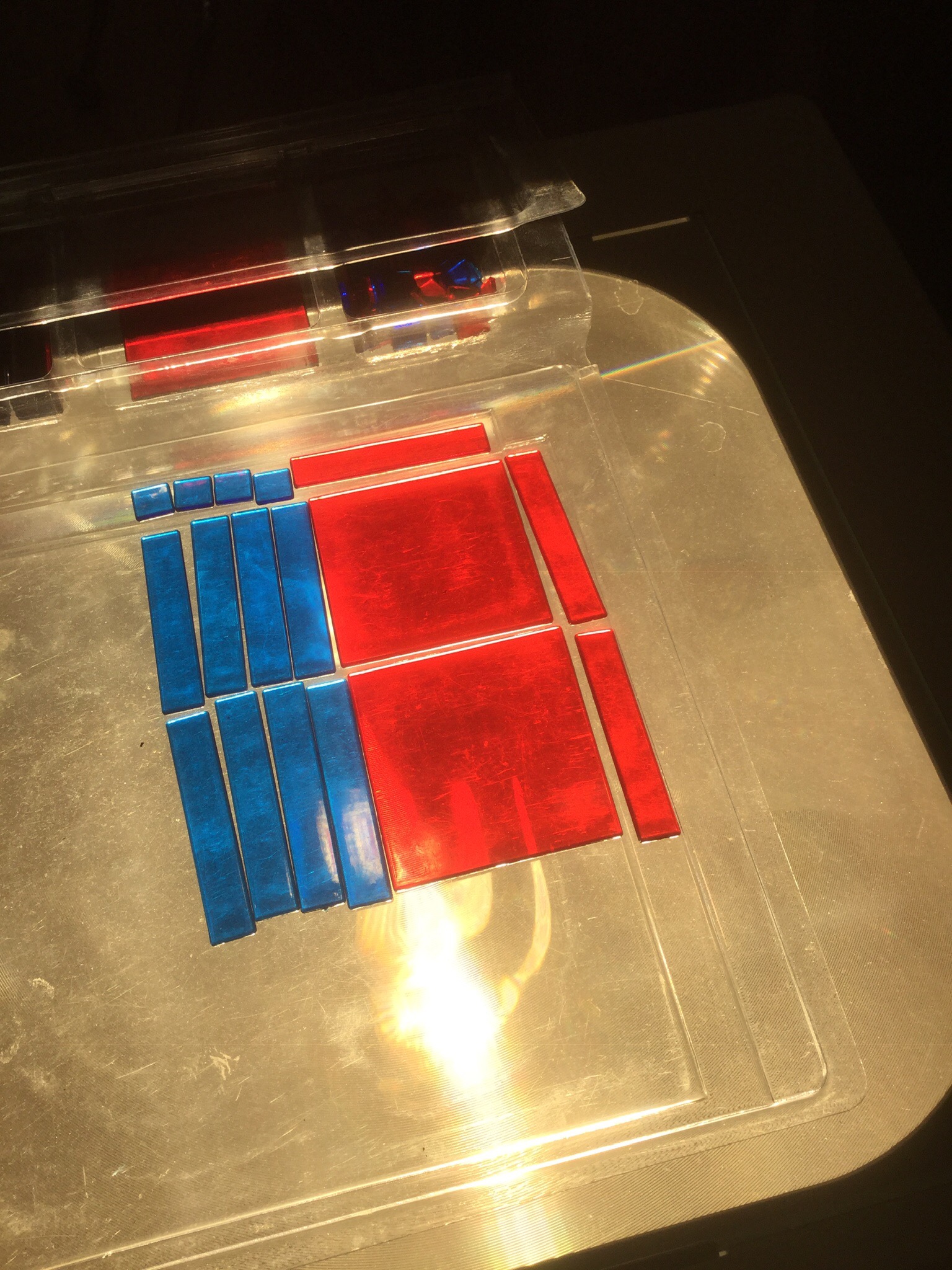
We used algebra tiles, splitting the 8x up into 2 groups of 4x and then we needed 16 squares to complete the square. We already had 4, but we needed 12 more. We added 12 zero pairs (blue and red squares together) so now we have a full square, and 12 blue squares left over
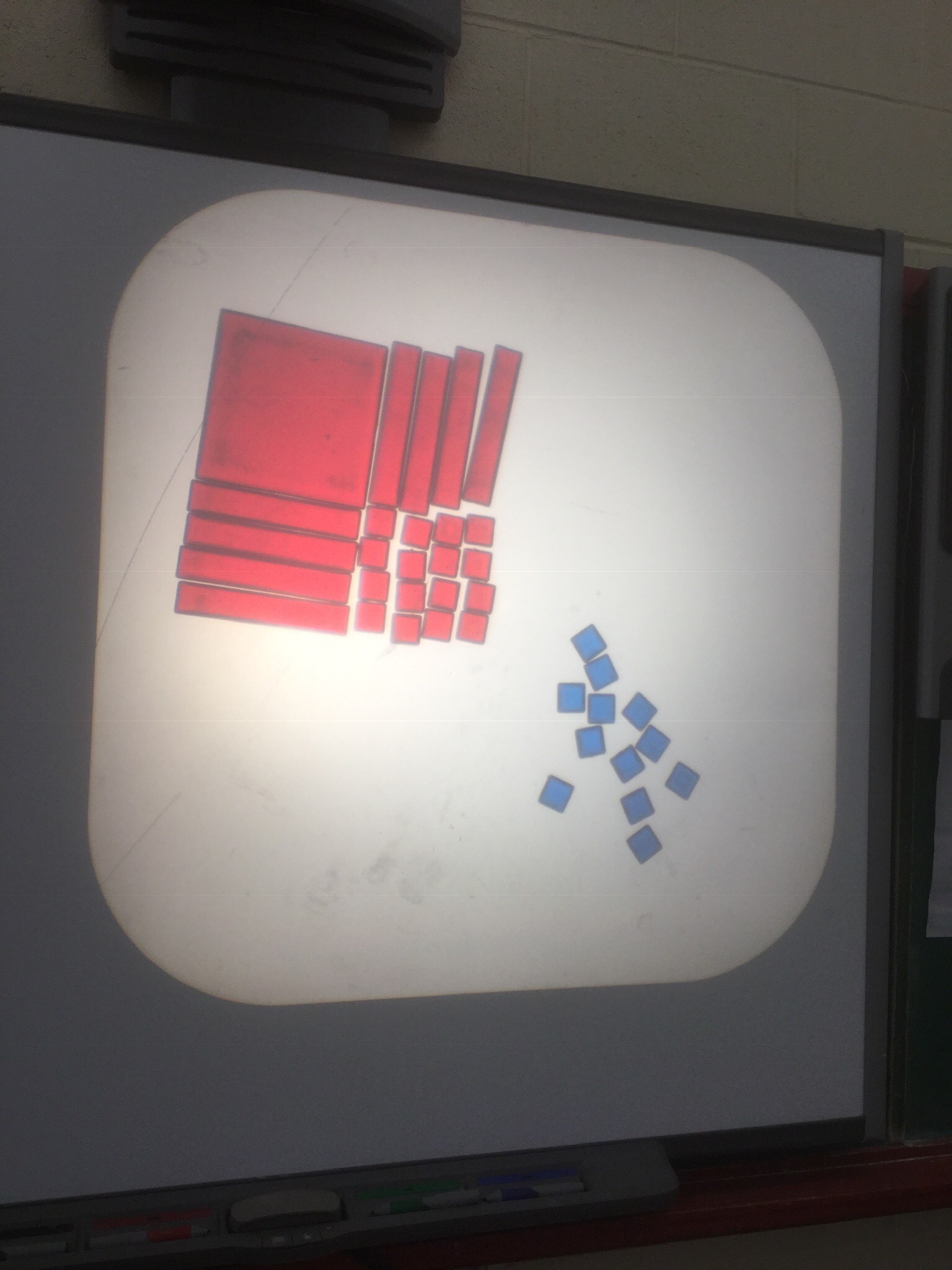
Our equation is y=(x+4)^2-12 and from this we know that the vertex (sommet) is (-4,-12).
We then looked at calculating the roots (racines) by setting y to 0 and then solving for x by using opposite operations. We’ll do more practice with this next week.
All about exponents
Grade 9s are working on evaluating expressions with exponents. Today we looked at bases that are integers, and fractions.
We look each time to see what the base is, and can show the repeated multiplication. In the following examples, if there are parentheses surrounding a negative number which is raised to an exponent, that negative number is what is repeatedly multiplied. If there are no parentheses, the exponent does not affect the negative. The base is the positive number the exponent touches. That number is then repeatedly multiplied, and the negative is applied after.

We noticed that if the base is negative, and the power is an even number, the answer will always be positive.
We looked also today at the pattern that we see when we have the same base (in this case 2) raised to many different powers. We made a table, and looked for the patterns. We made the exponents go all the way into the negative numbers.
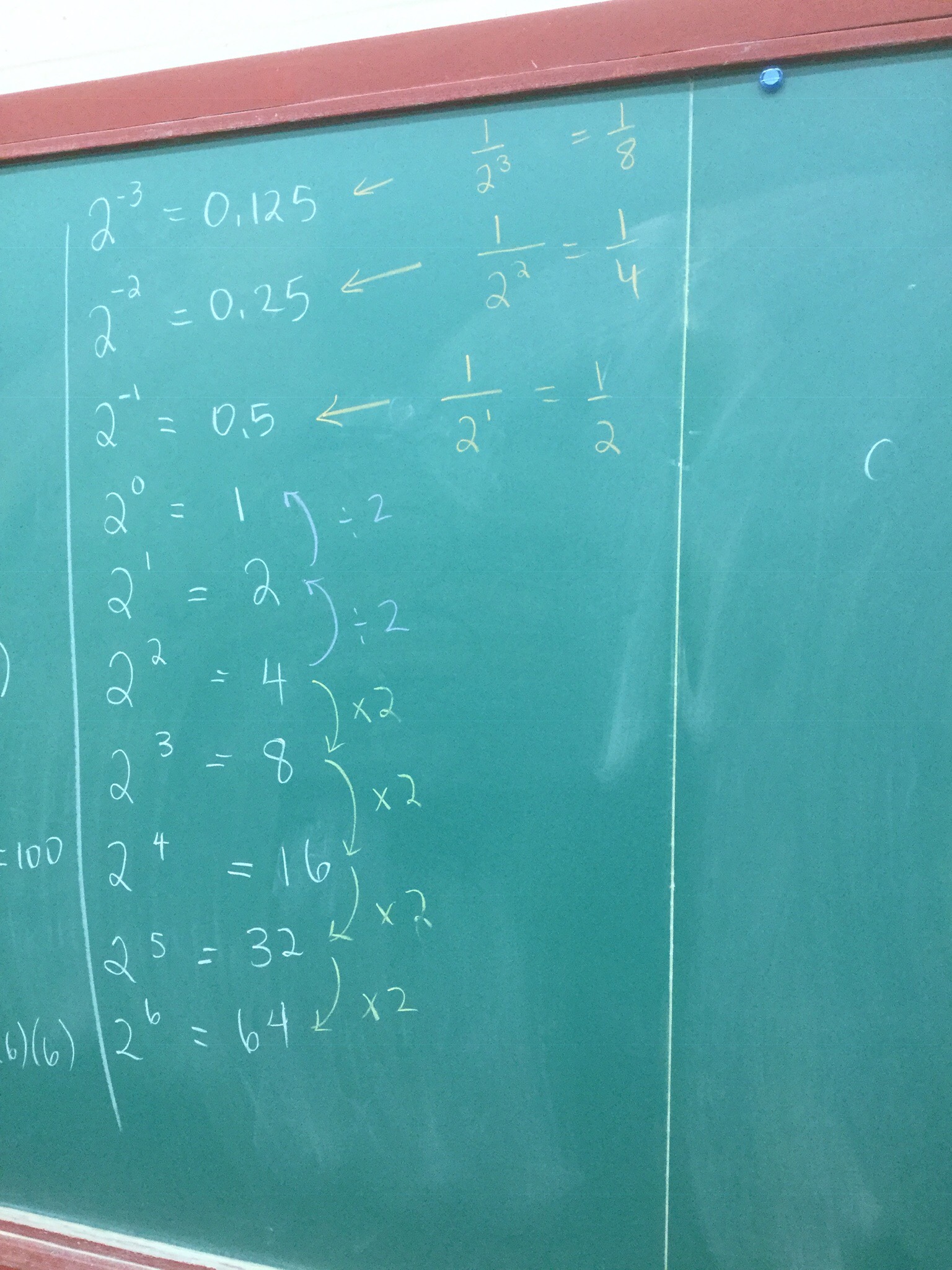
We explored to see if this is a linear or non-linear pattern, positive or negative, direct or partial. It turns out to be pretty interesting on a graph.

It is positive, non-linear, and partial. The y intercept (ordonnée à l’origine) is 1 and it will never cross the x axis. It gets super close to it, but will never reach it. That means there is an asymptote (something to learn more about in grade 11).
We looked a bit at what an exponent of 0 means. We arrive at it by creating a division with the same base and same power in numerator and denominator.
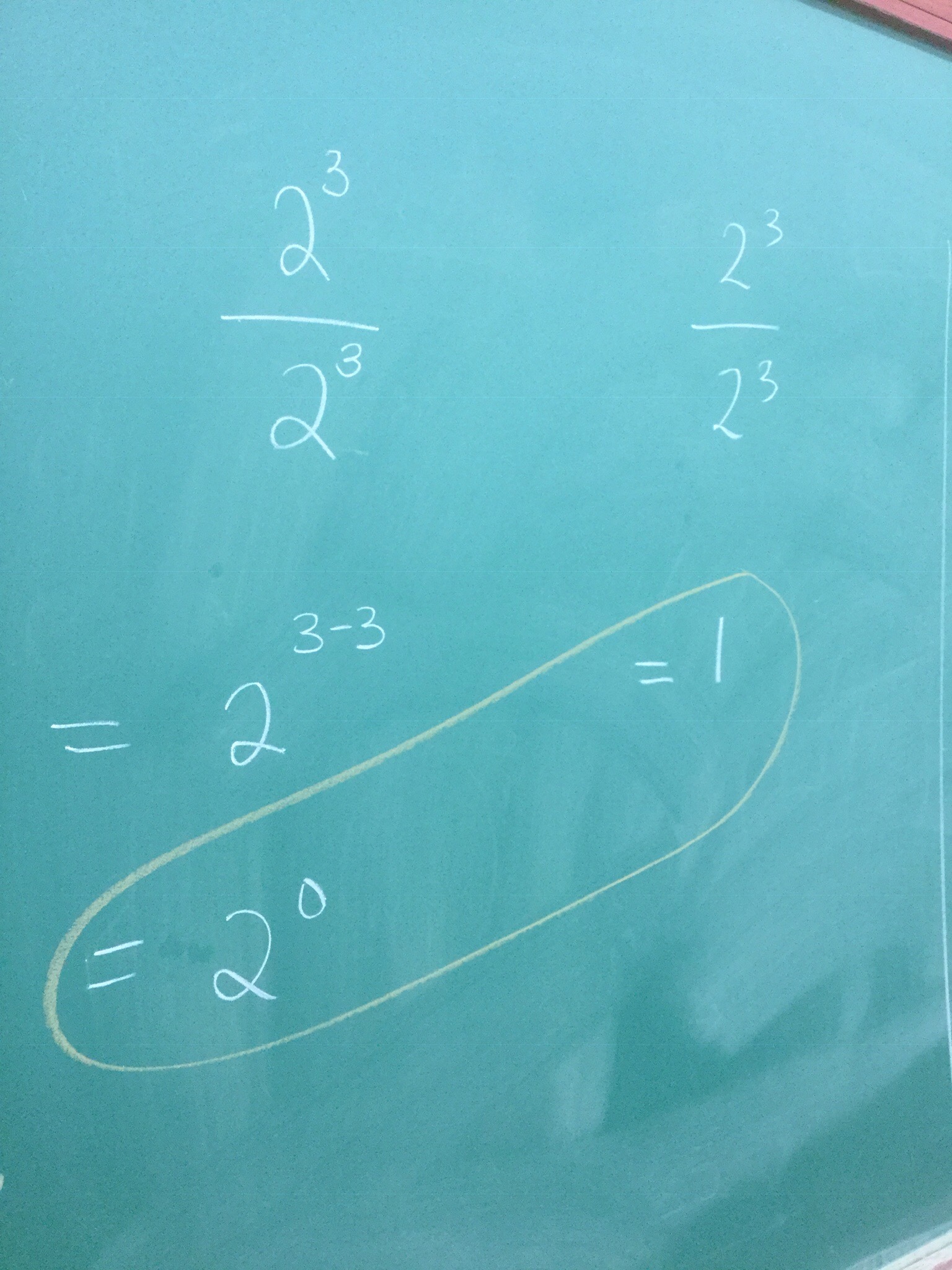
We know that anything that is the same on top and bottom will divide to make 1. We also know that with our exponent laws we can subtract the powers in a division question with the same bases. Using 2 perspectives we get 2 answers which are then equal.
We used similar logic to explain negative exponents.

Patterning to Graphing
Grade 10s continued to work on their patterning activity from a few days ago.
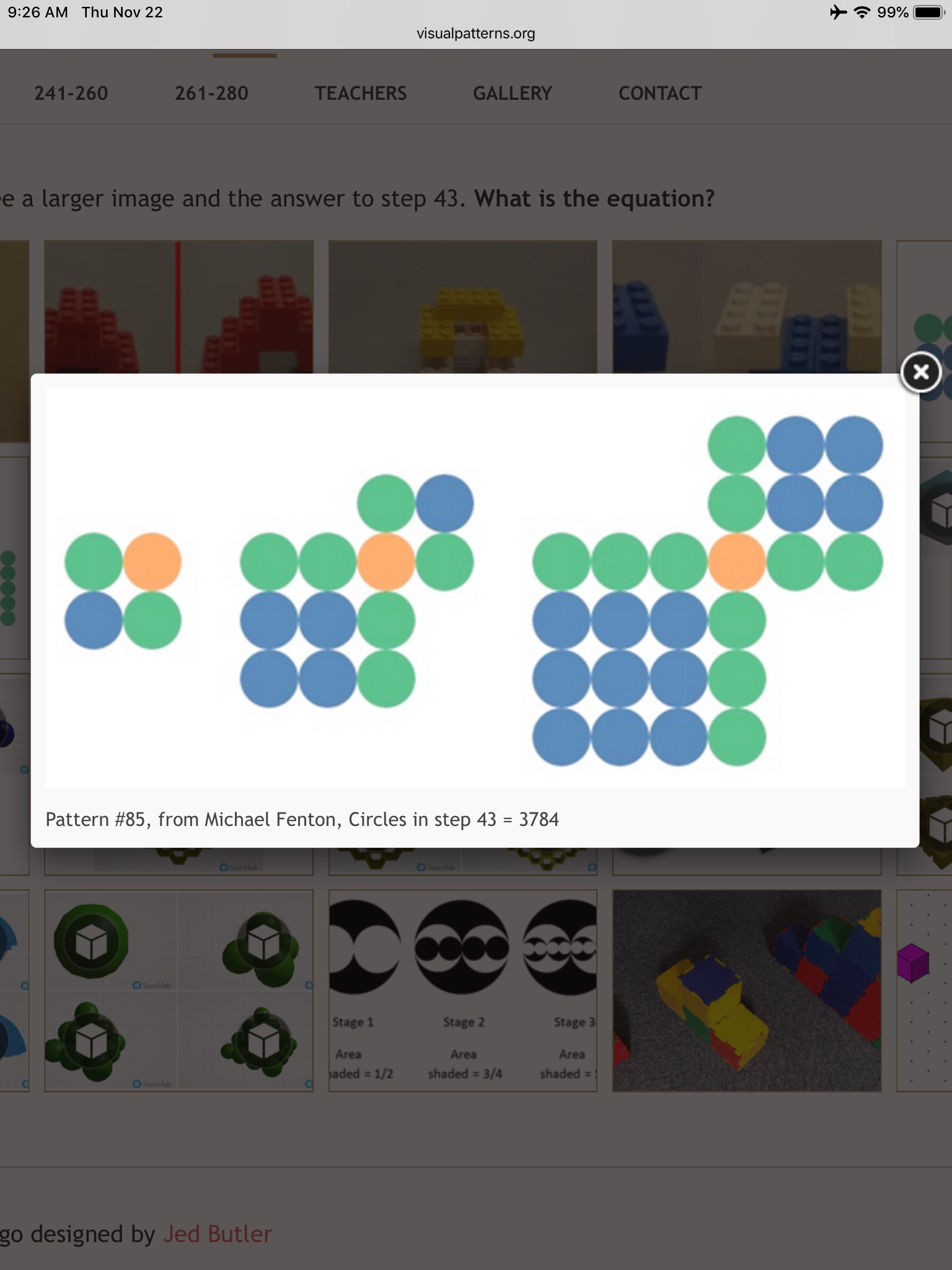
We had previously constructed and graphed the pattern.
But now we are working on figuring out an equation to model the situation.
We are working from the visual representation, and connecting what we know about the graph from the tables of values. We know the “a” value is half of the second differences, and we know that in this case figure 0 is 0, so our constant is 0.
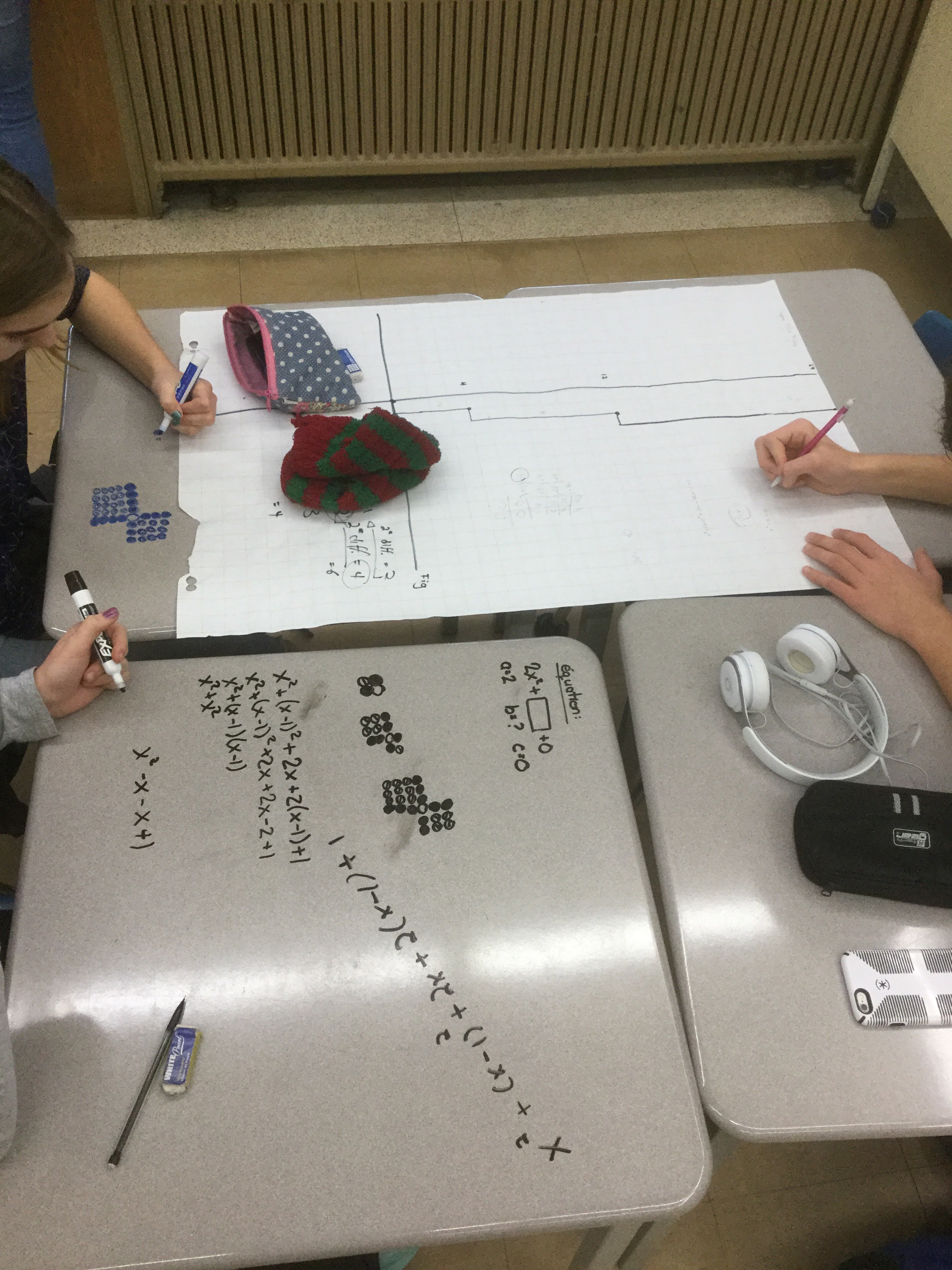
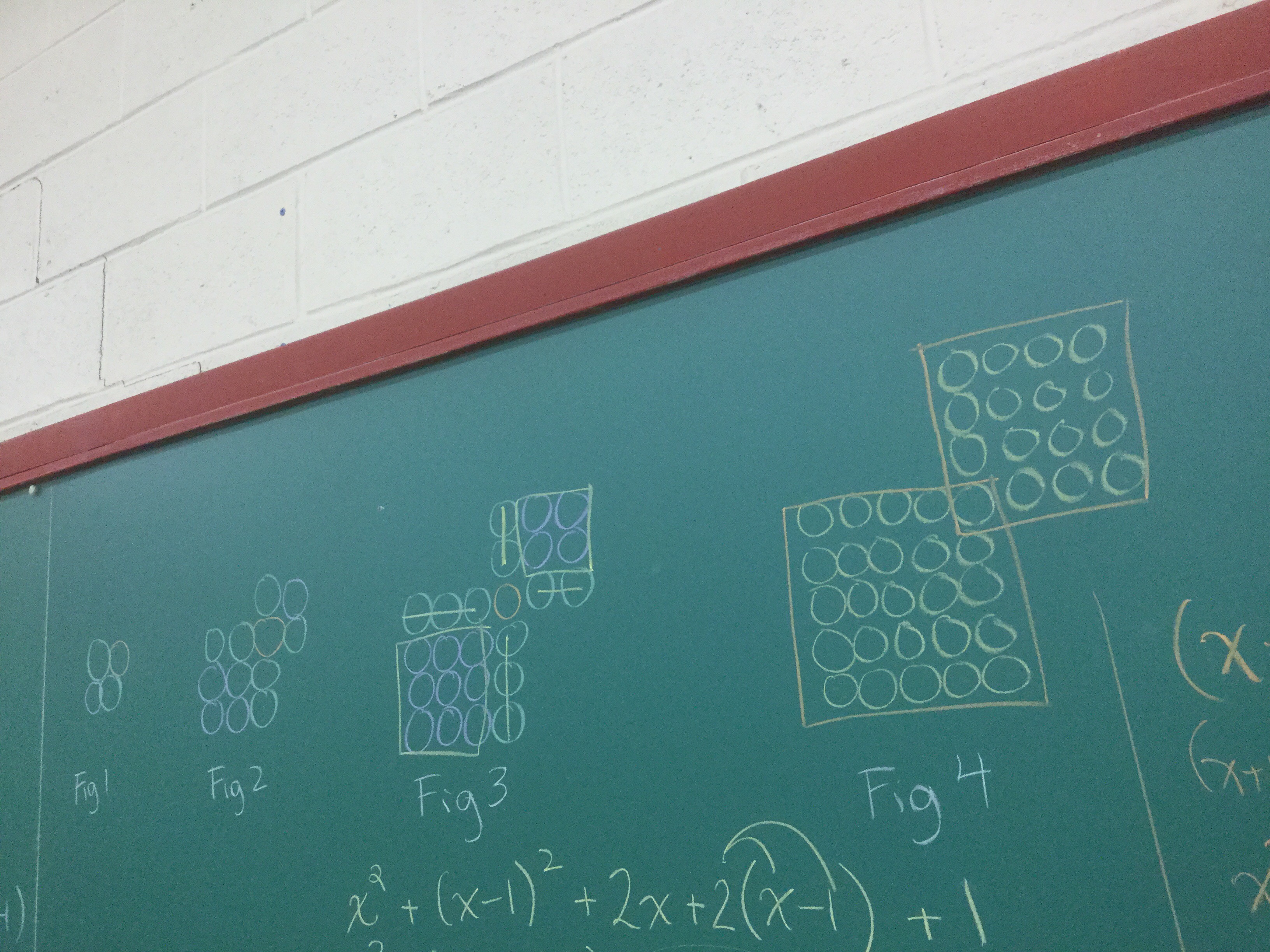
Some of us are working on simplifying complex equations…
If we use the colours as a way to group things….
We get a long equation!
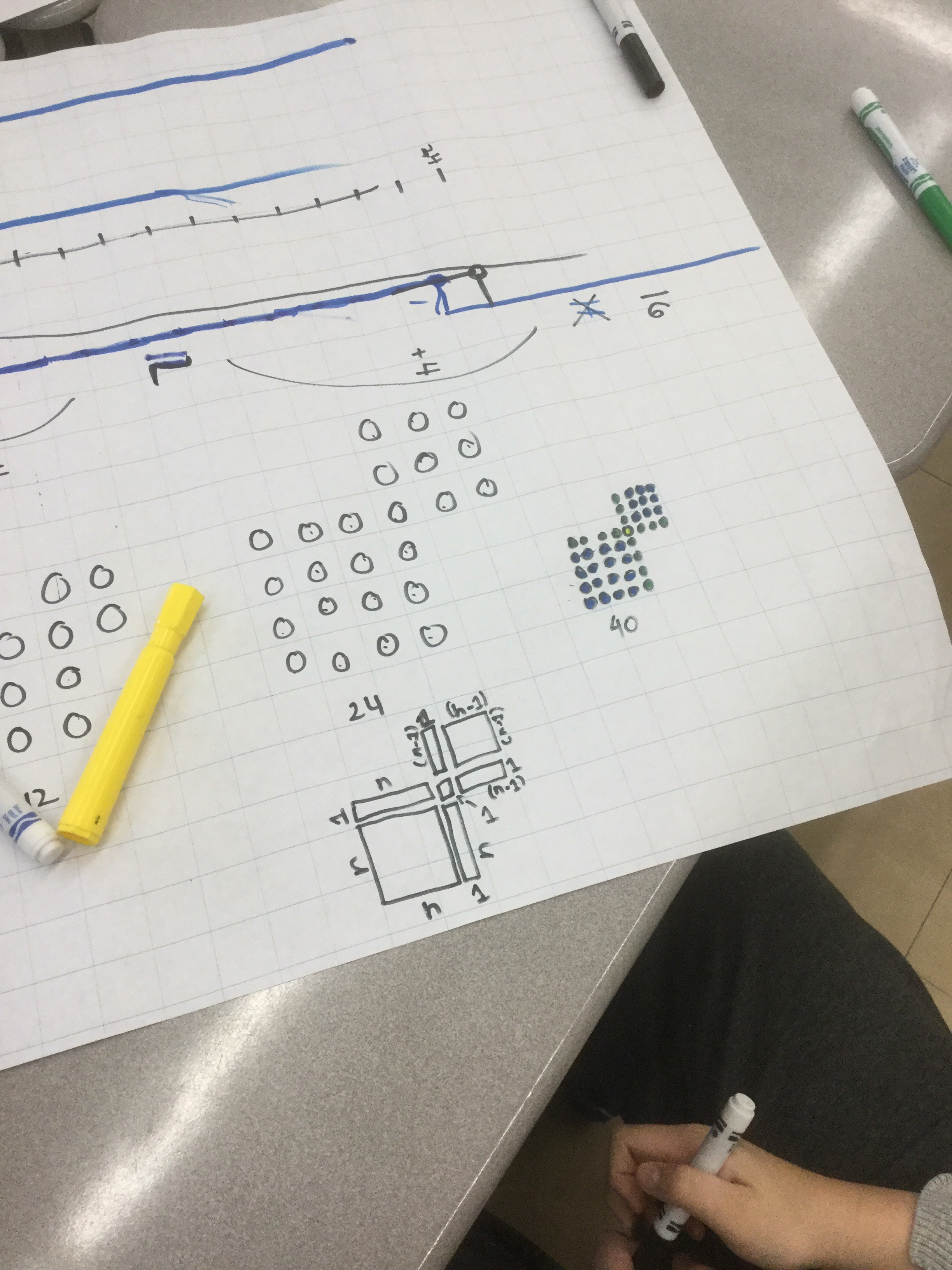
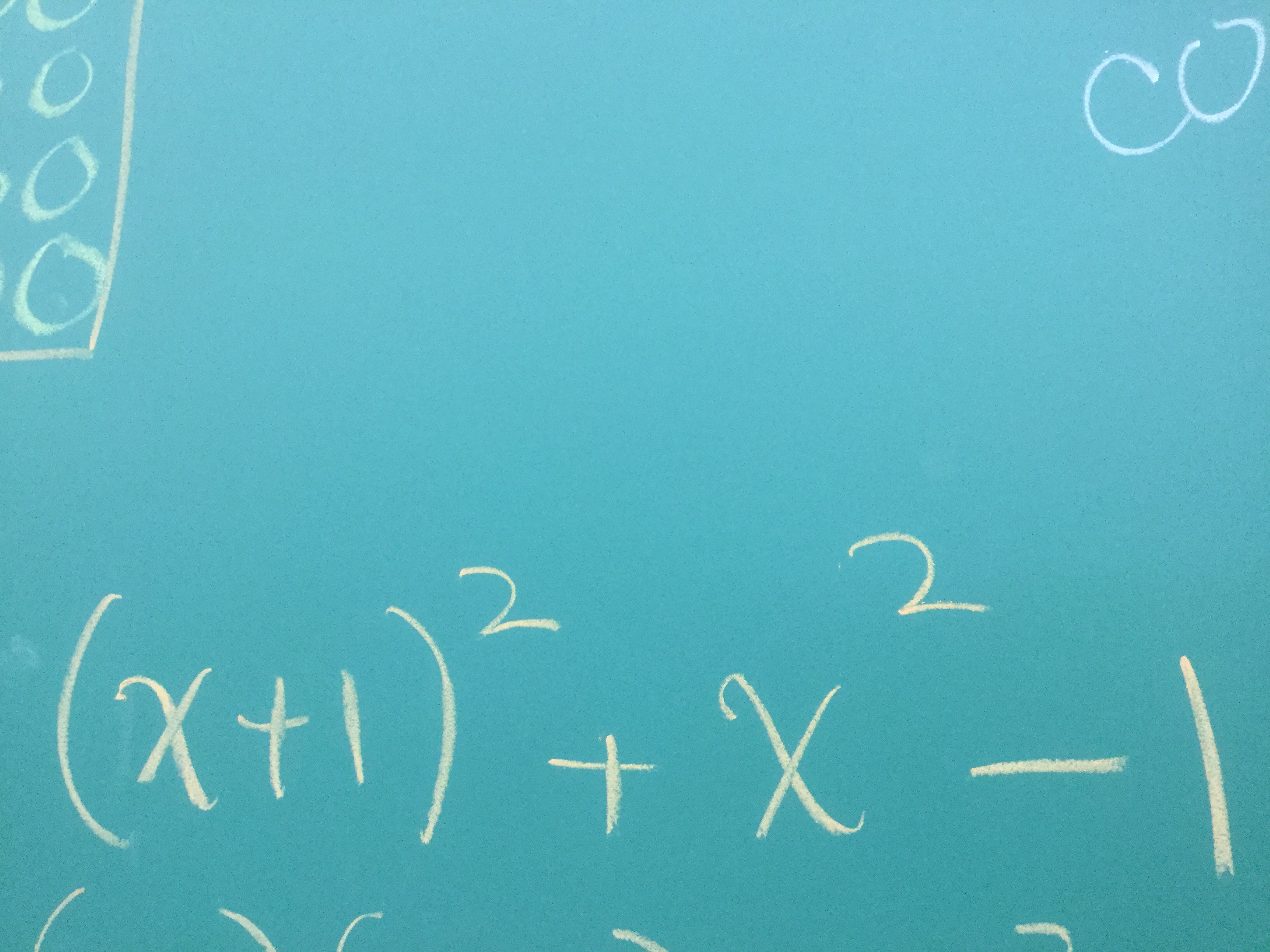
If we ignore the colour…

We get a simpler equation
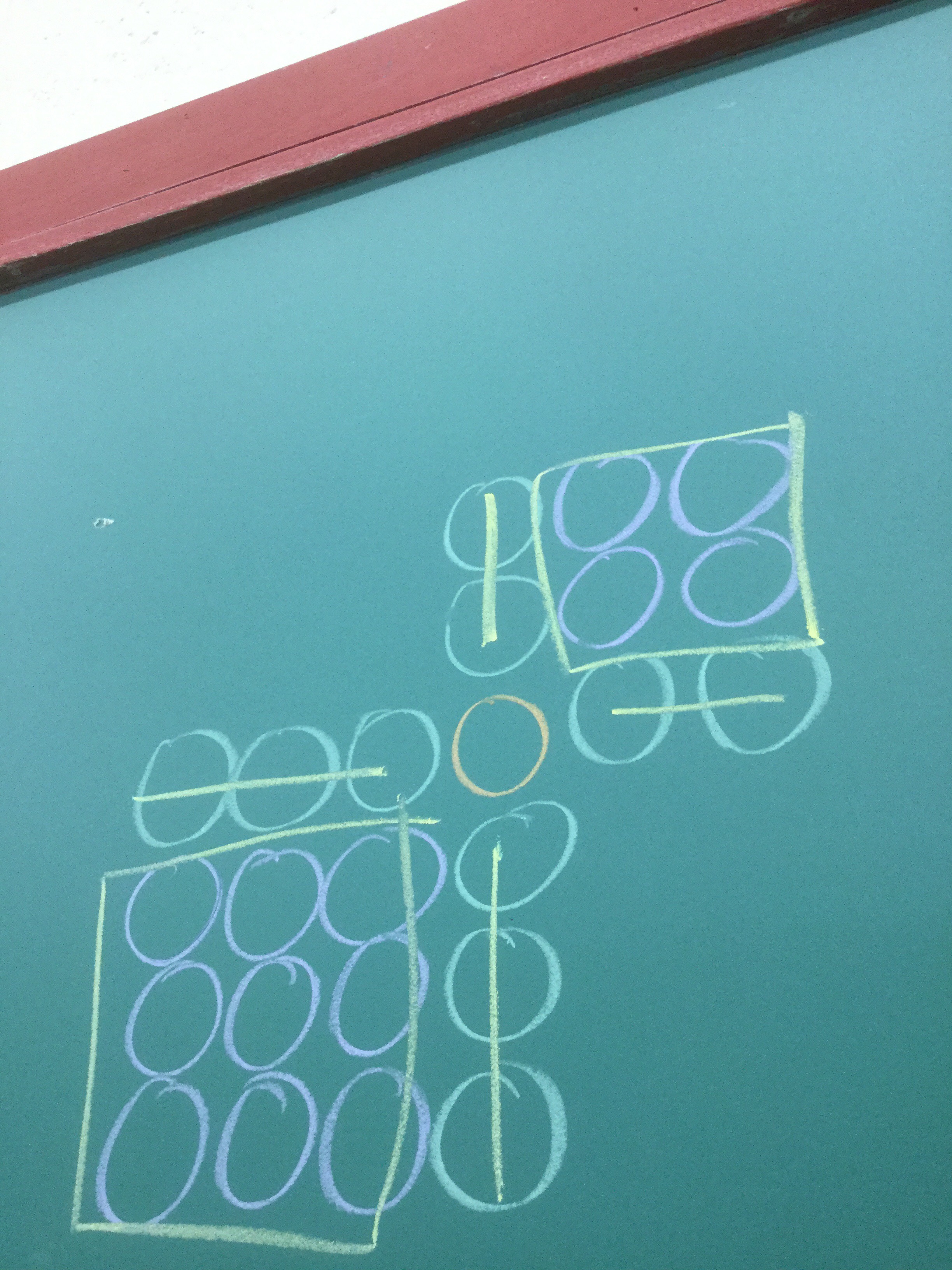
If we are creative and try to rearrange the circles…
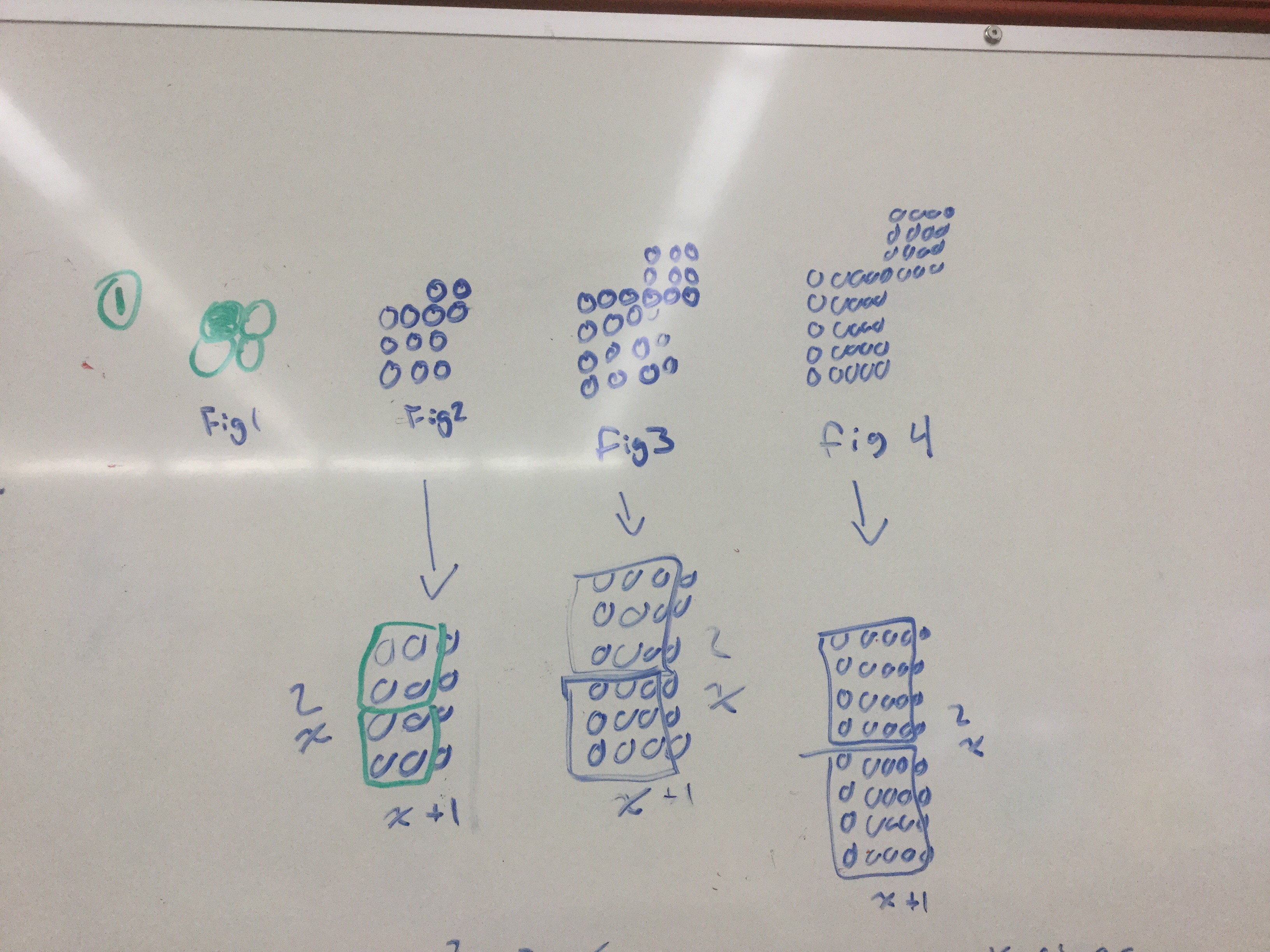
We can create rectangles that have dimensions 2x and (x+1) so that leads us to a simple equation! Y=(2x)(x+1)
Here’s another way to factor that expression
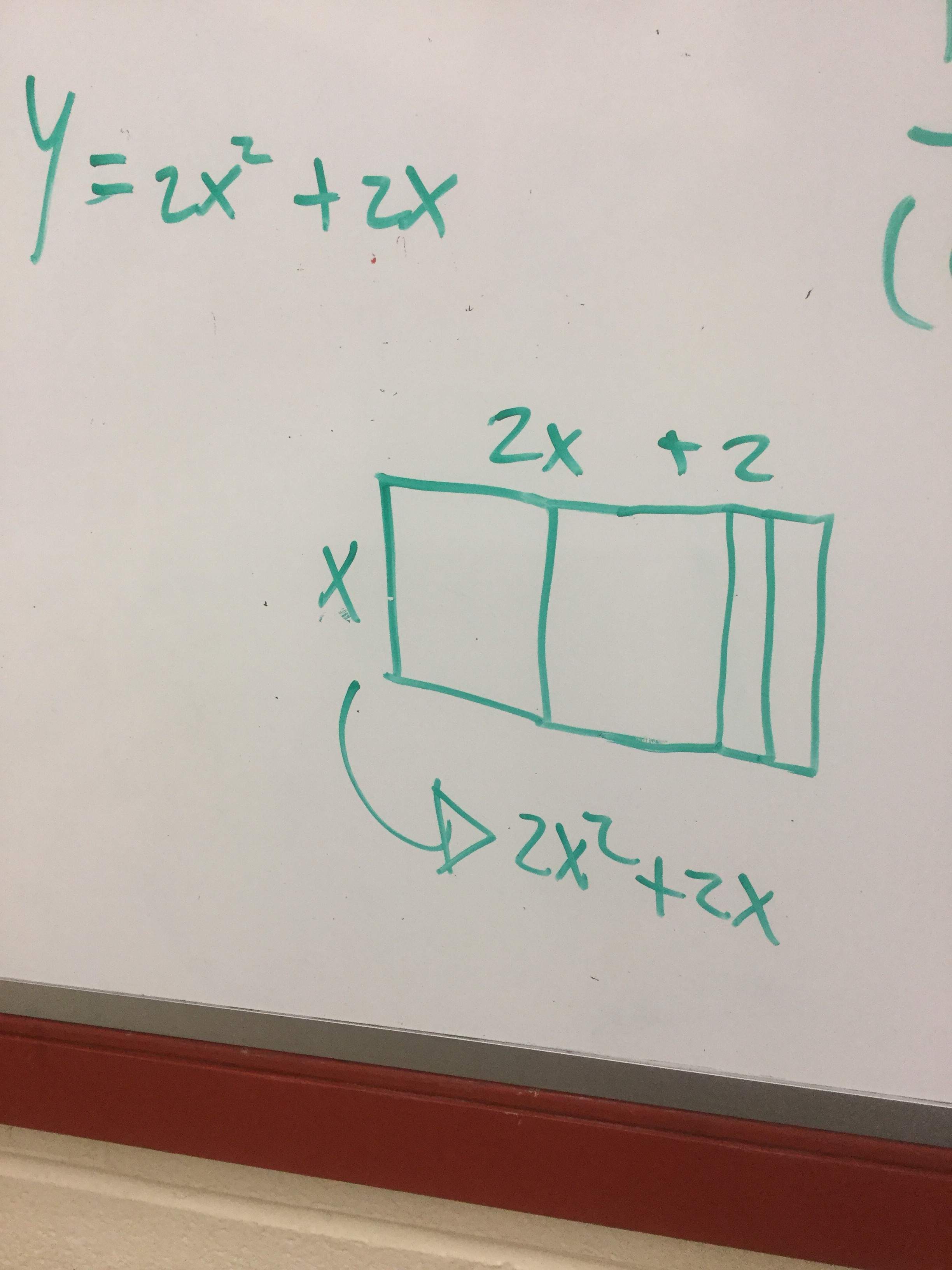
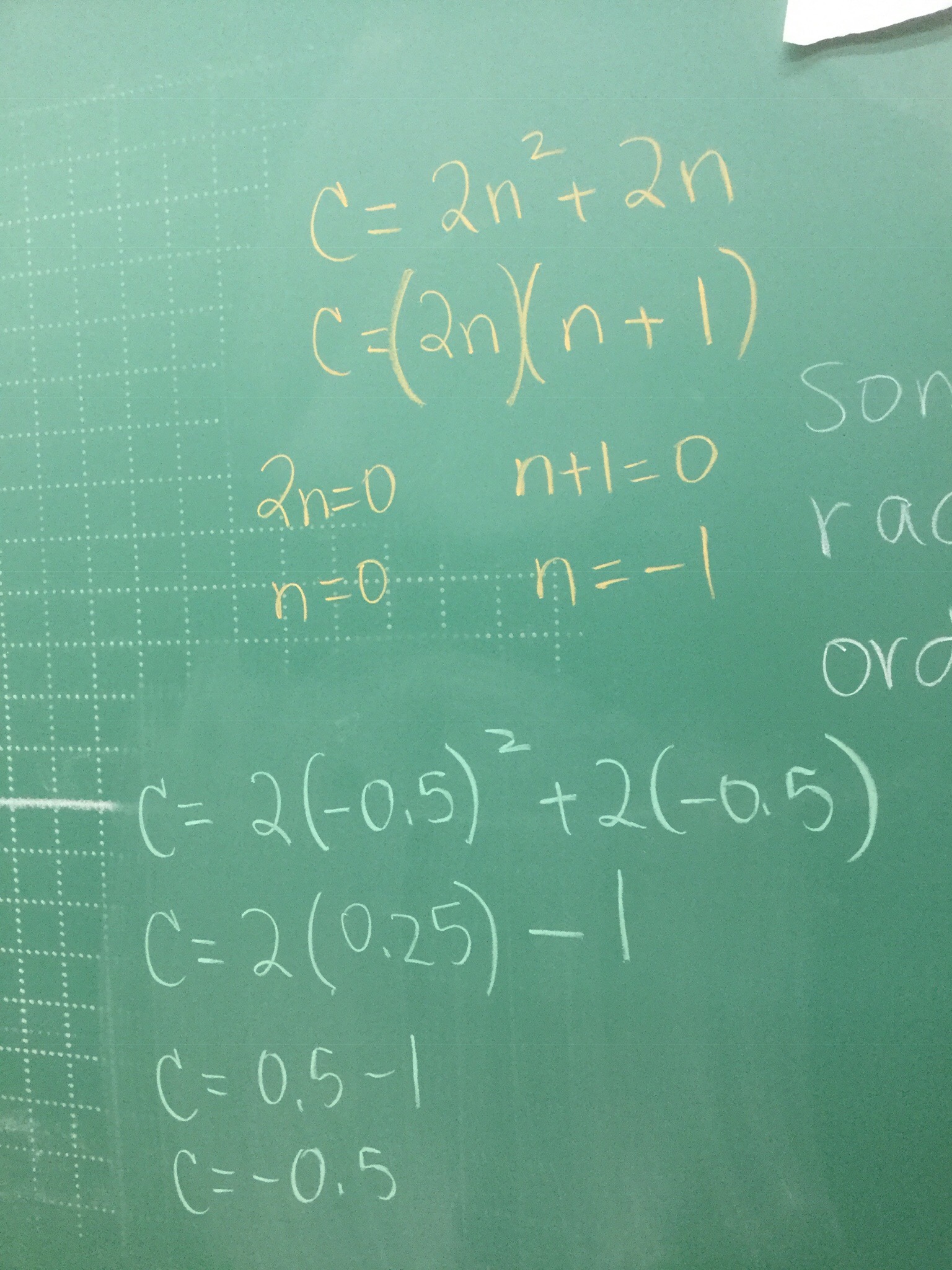
Working from our table of values we can determine the a and c values…


We can substitute any point as x and y and calculate b, and then we can factor, determine the roots, and then the vertex (sommet), and draw the graph.


This is the next one we are working on: here are figures 1-4

Taking up our work
Today grade 9s received their summative and formative from last week. We took up questions and worked on building our algebra skills.
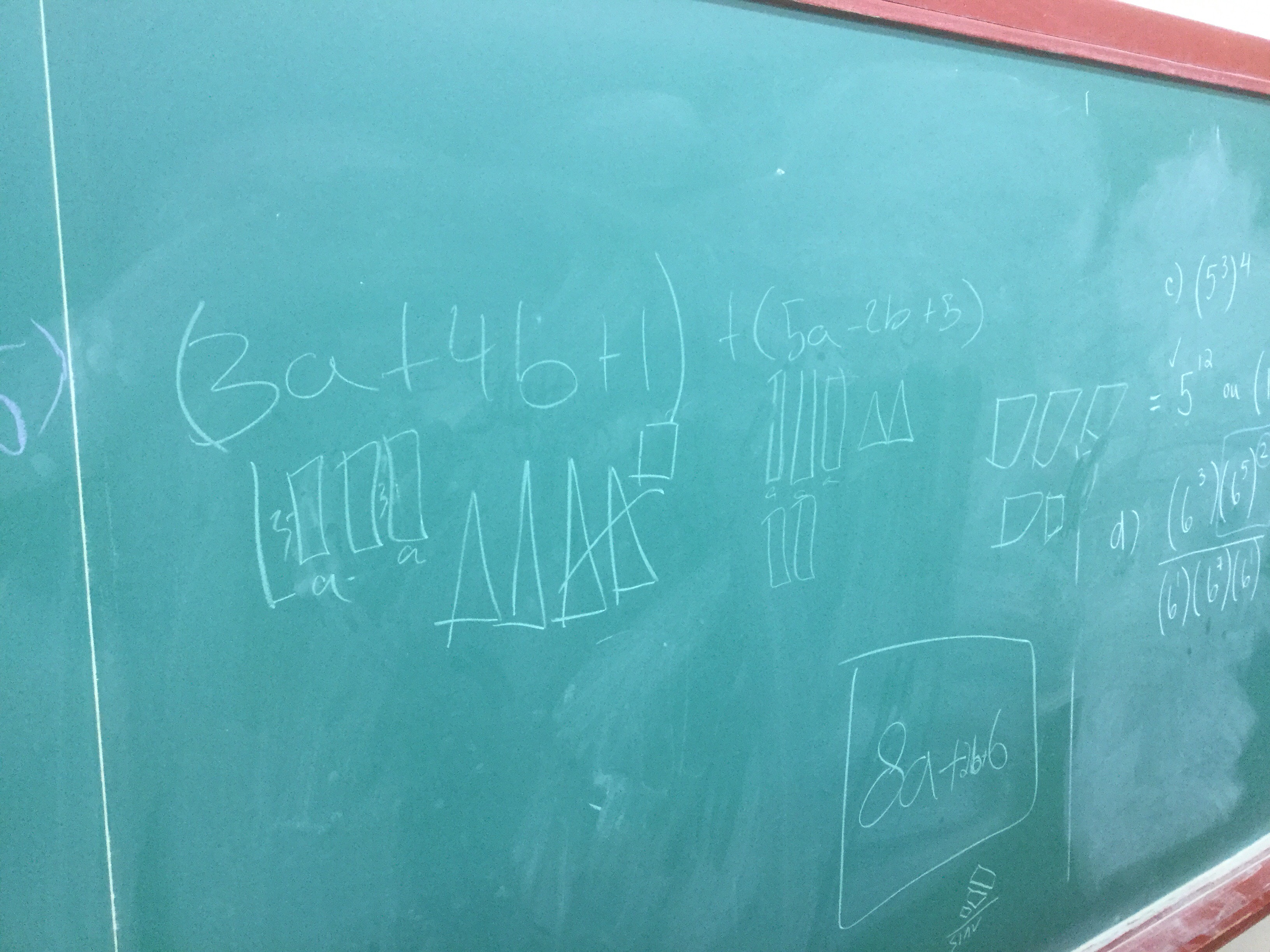
We are getting more used to working with variables and representing them visually.
Patterning to graphing
Grade 10s explored patterning and how the patterns connect to the quadratic functions we have been exploring. 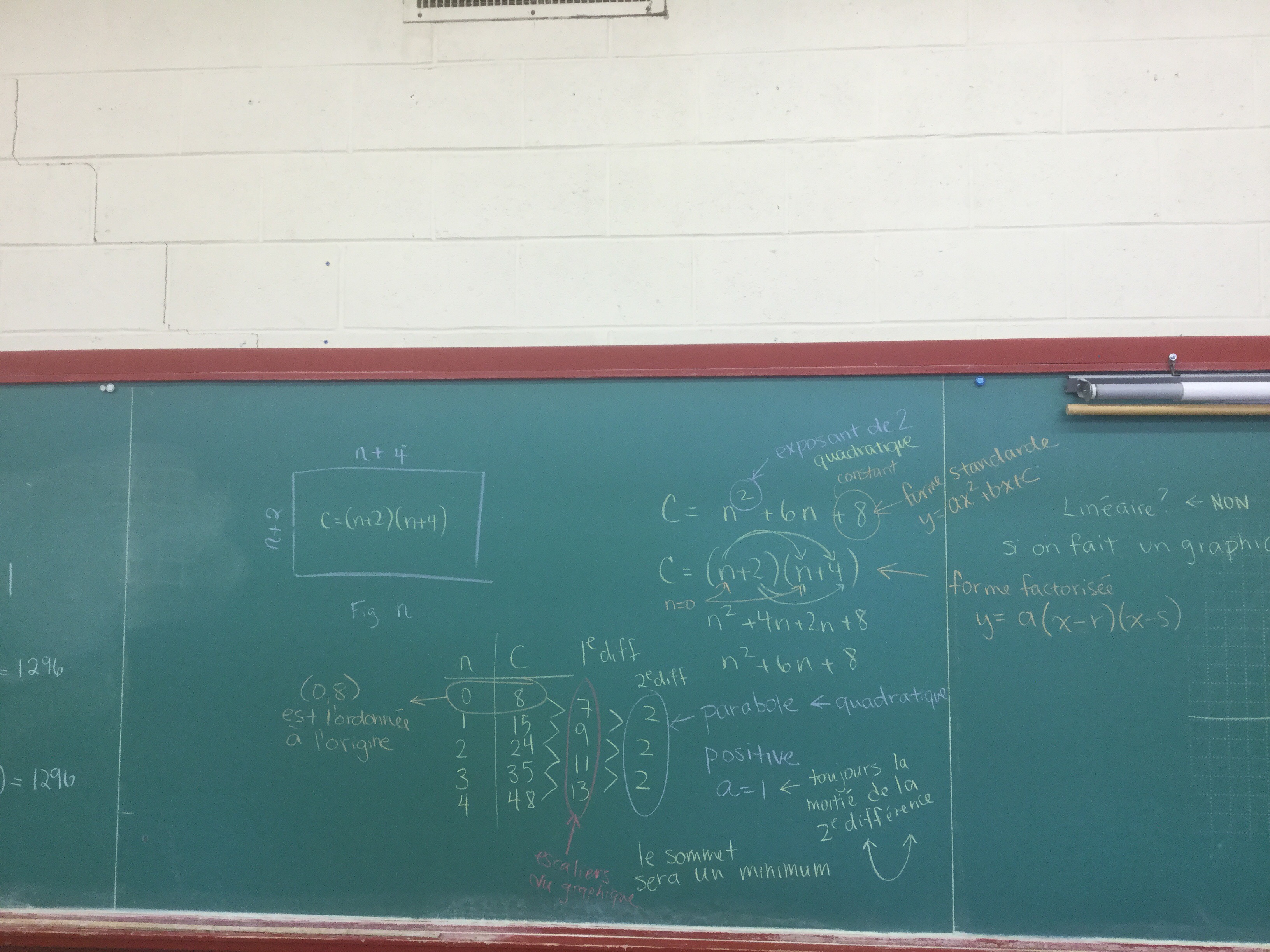
We graphed the pattern, and also represented it in an equation in 2 forms, made a table of values, and looked at the constant and 1st and 2nd differences.
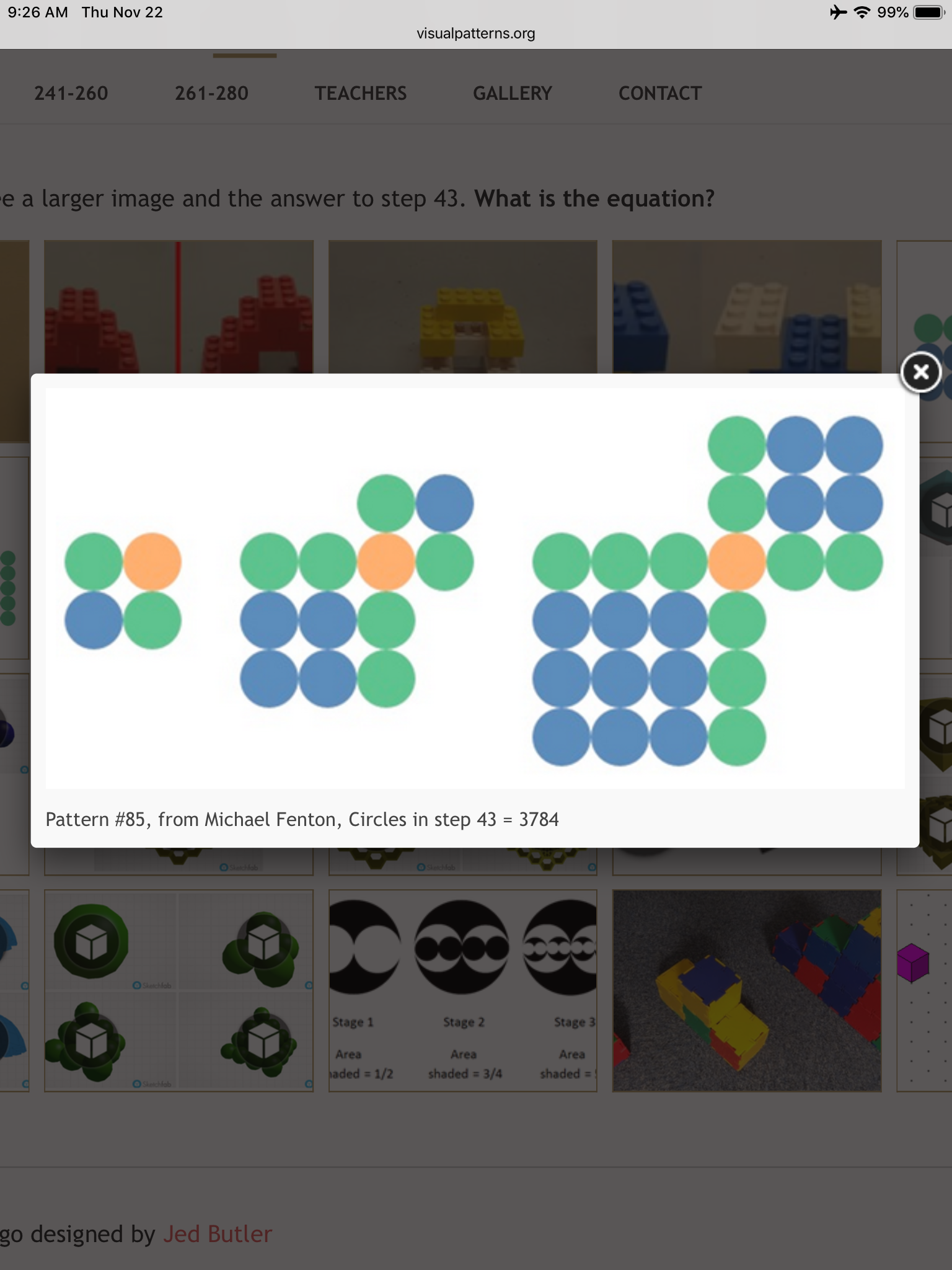
We looked at this visual pattern next and did our best to analyse it graphically.
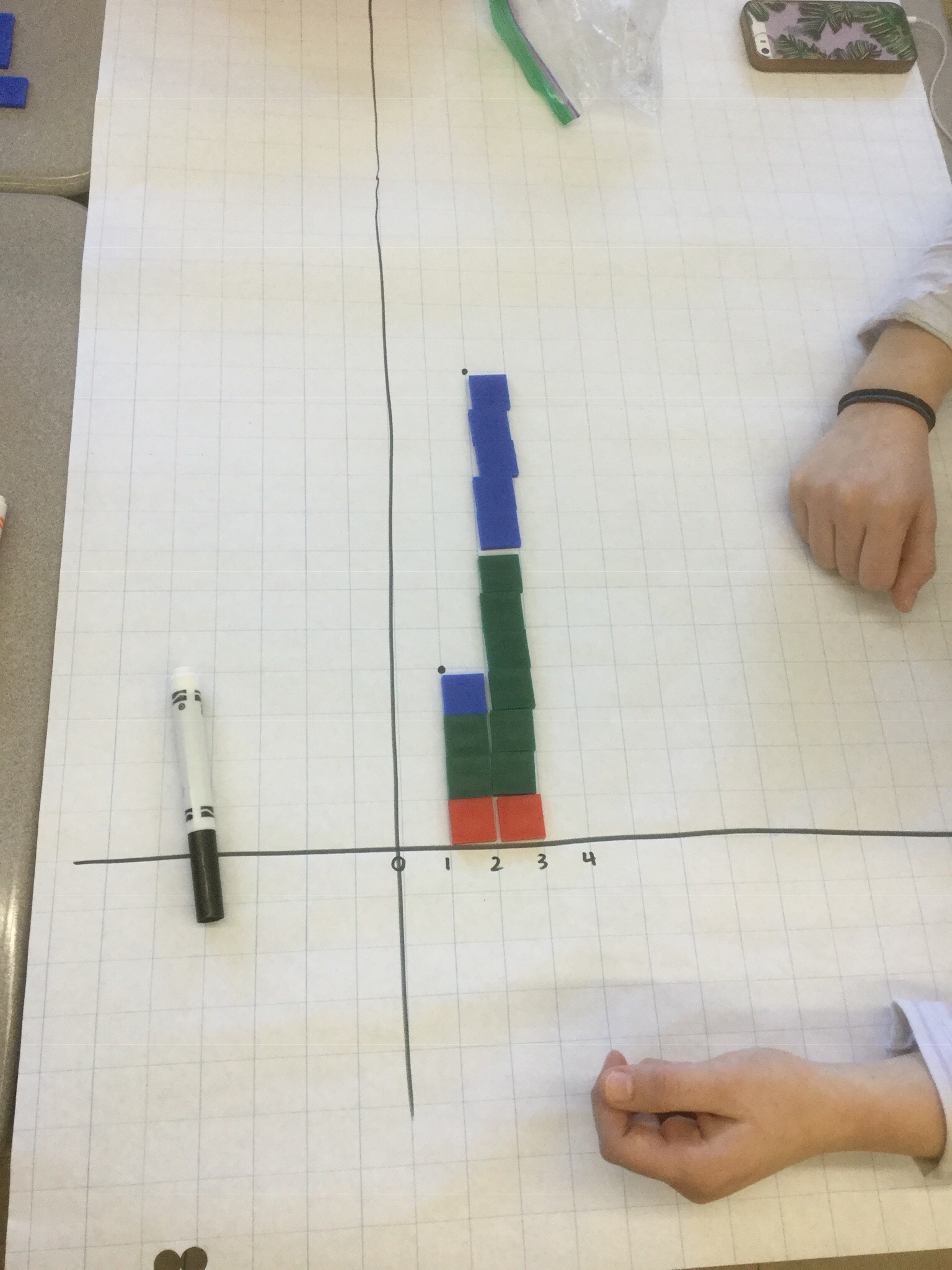
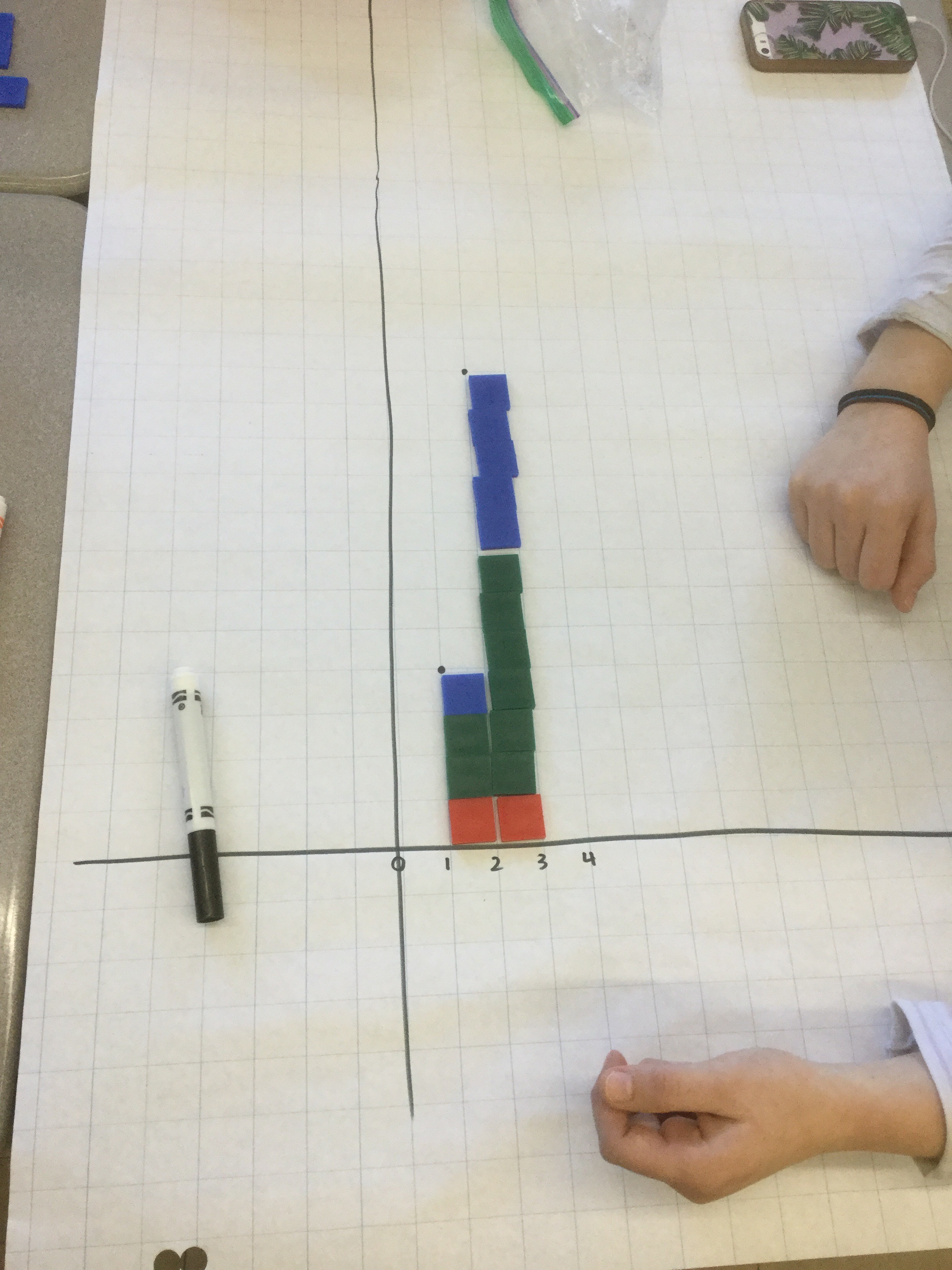
We built the figures

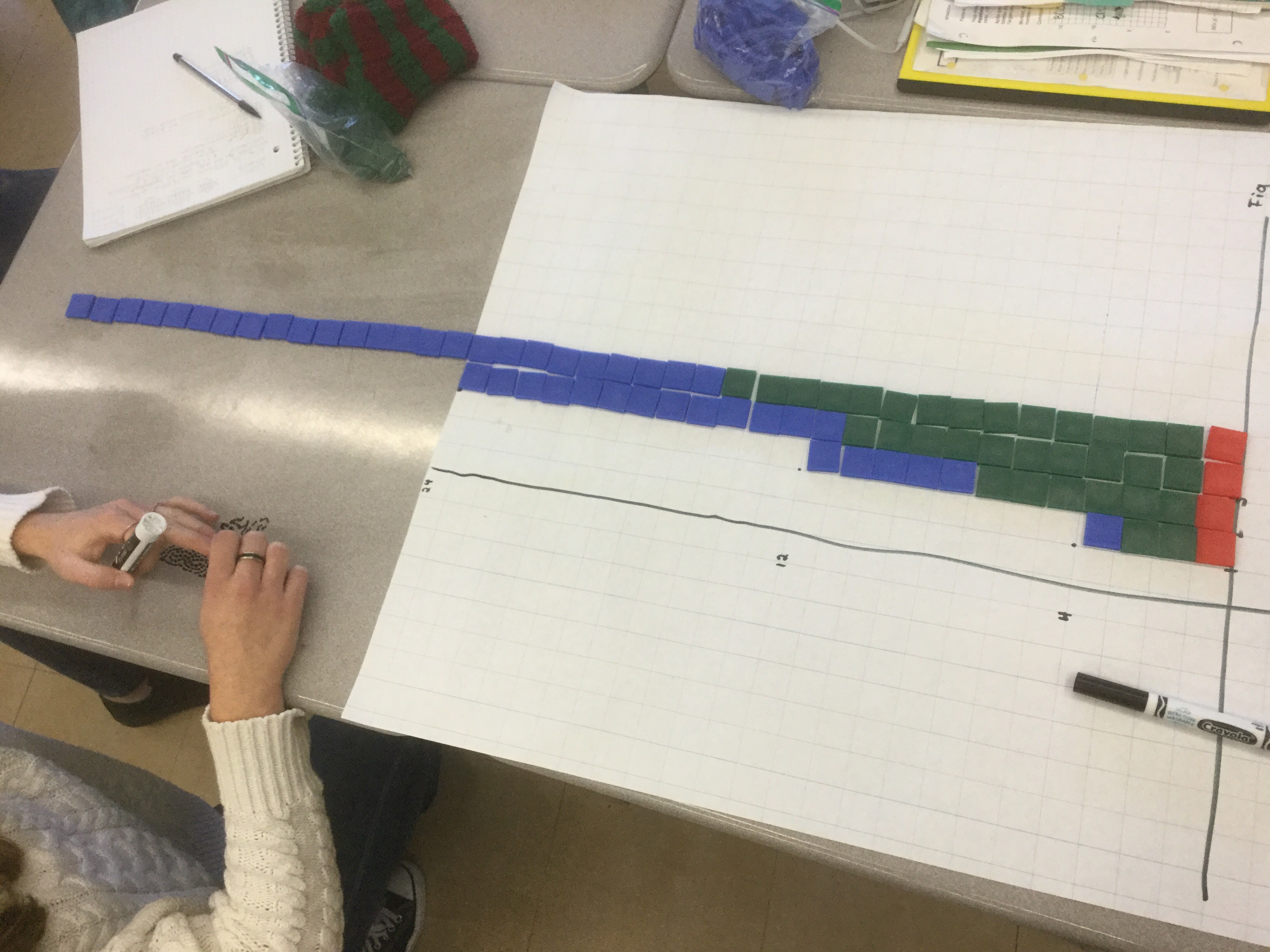
And reassembled each figure into a strip on our graph.
The graph was increasing rapidly, and soon was too big for our page.
We will continue to look at the equations that some of us created, and discuss if there is a constant in the relationship or not.
 Ms. Bearse's Site