First day schedule

Grade 9 practice investigation
Notice, Wonder….
Dans les groupes nous allons poser les bonnes questions de mathématiques, et nous allons demander pour de l’information necessaire pour les resoudre.
Nous allons poser les questions de chaque section de notre curriculum: la numération et algèbre, la géométrie, les relations, et la géométrie analytique.
Pour notre investigation, le deuxième jour, vous allez recevoir de l’information que vous voulez, et vous allez individuellement resoudre les problèmes que vous avez crées.

How tall’s the school?
 We are using mirrors to determine the height of the school. Using the law of reflection we can create 2 similar triangles. One between the heigt of the school, and the length of the ground between the school and the mirror.
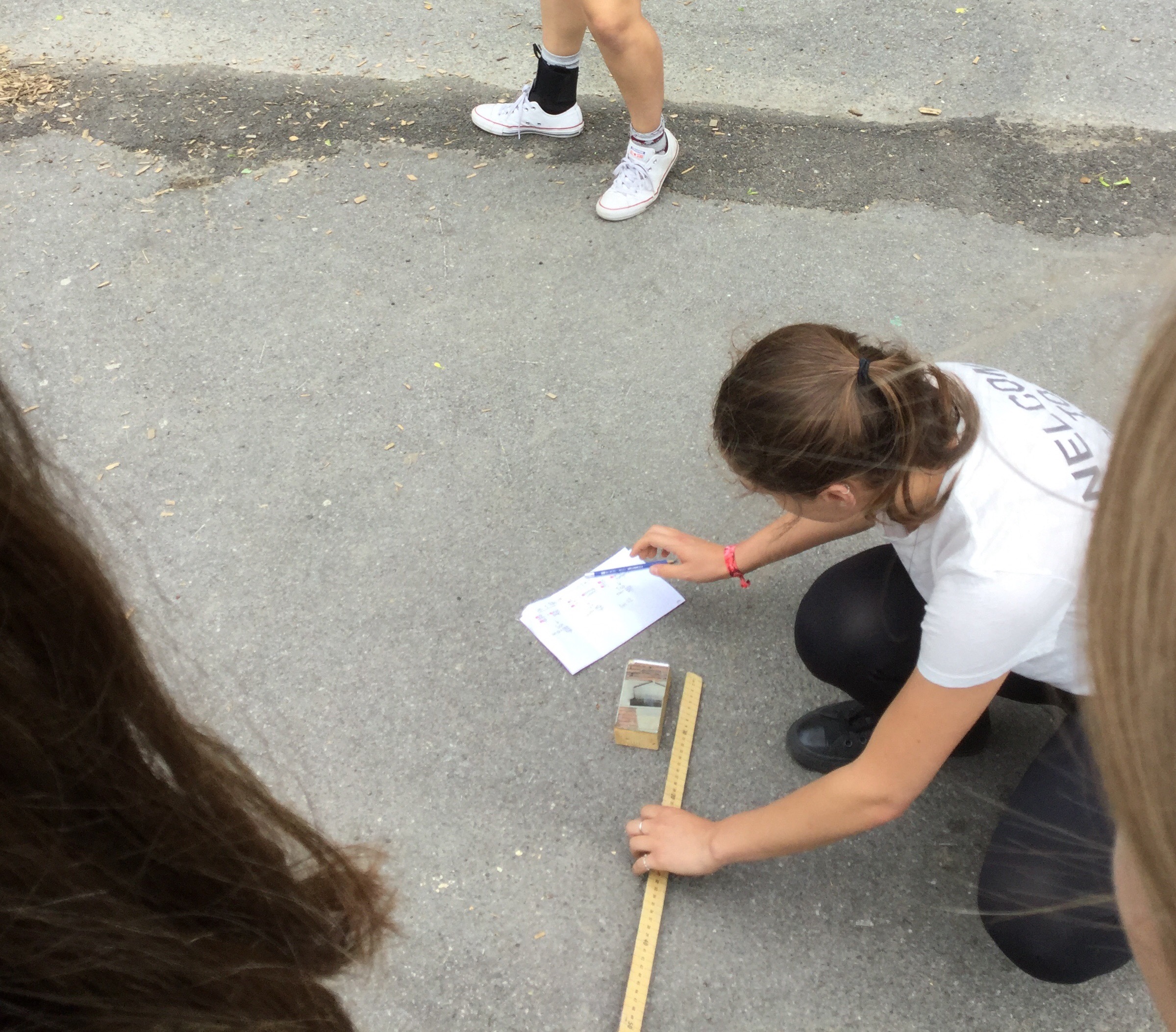
And one involving the height to the observer’s eyes, and the distance from the observer’s feet to the mirror.

We can determine the proportionality constant and calculate the height of the school!
Using shadows to determine heights
We used a meter stick as a reference, and measured the lenght of its shadow. 
We can now measure shadows and determine the heights of the tall objects.

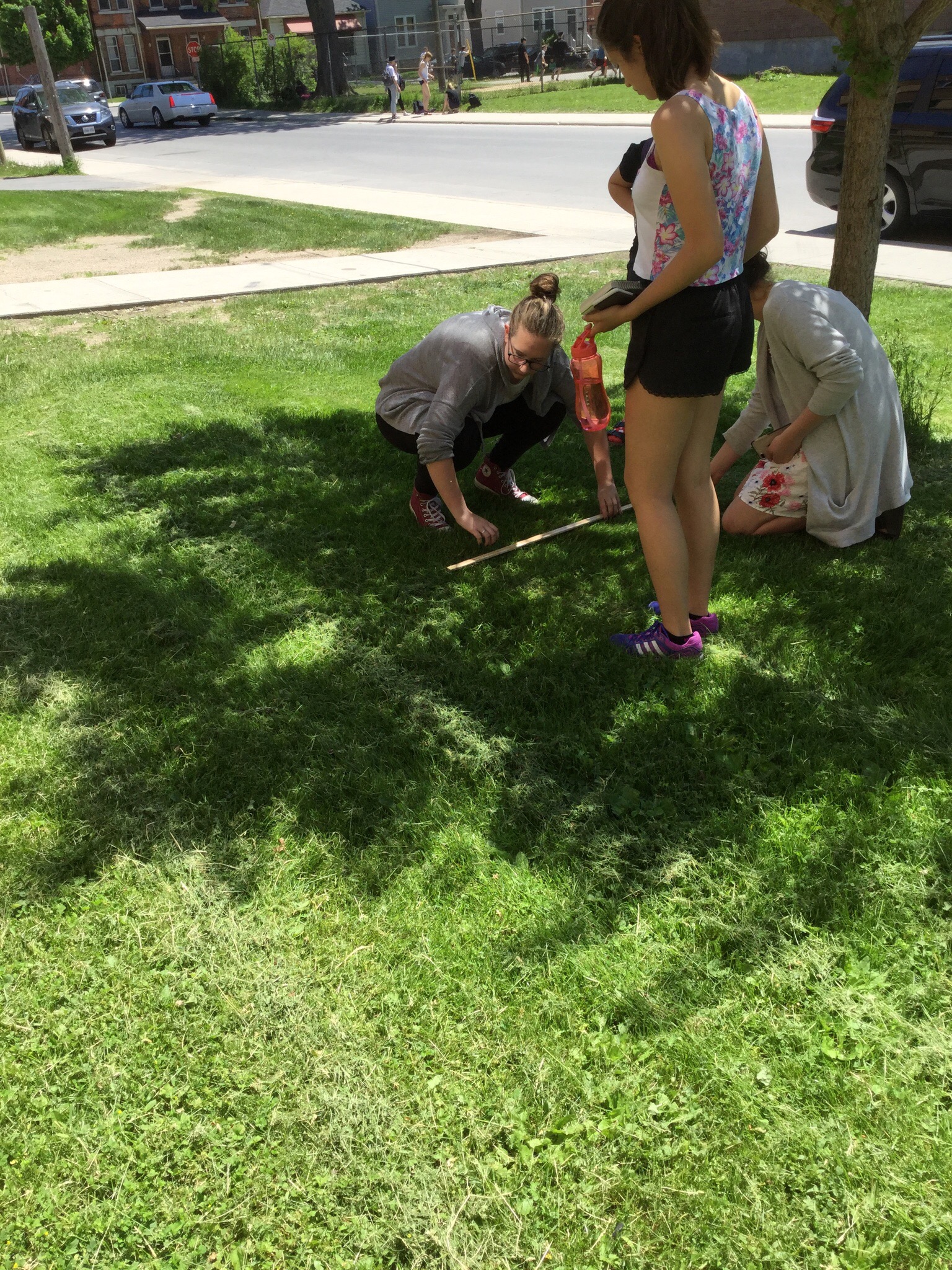
We can do this and make similar triangles because the sun is at the same spot in the sky when we take all these measurements.
Grade 10 homework


Motor building
In Physics we are starting electricity and magnetism, and as a part of that we are building motors.

Some groups got right to work today at lunch.
Reviewing for our test
Tomorrow is a test day for grade 9s. Today we spent time working in groups to review material and get ready.
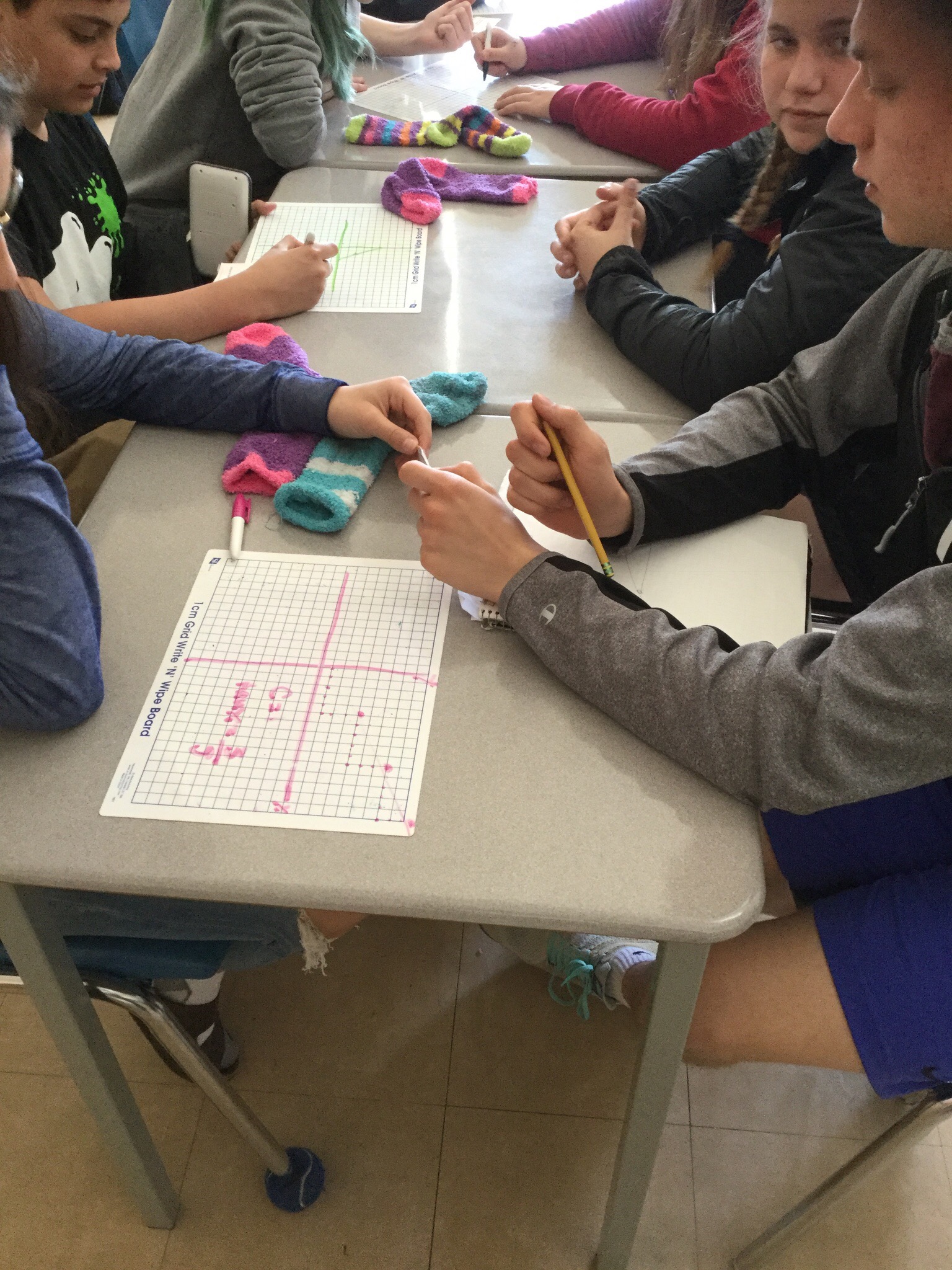
We did some “speed dating” style review for graphing lines and calculating slopes.
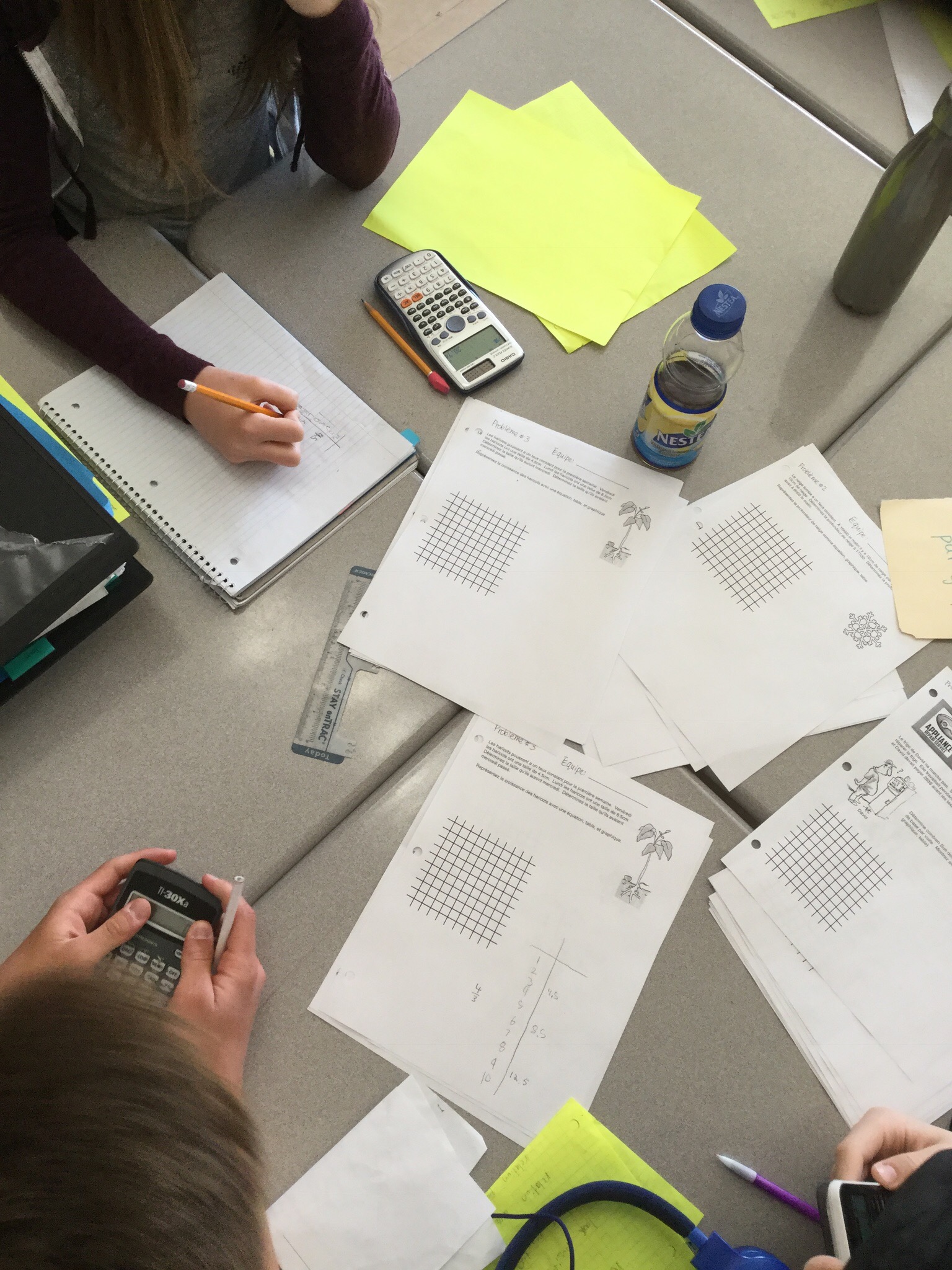
We worked on solving some word problems using multiple strategies.

And represented growing patterns using tables and graphs and equations.
We also had 3 teachers from Molly Brant Elemetary school with us, and a school board consultant, the math department head and student success teacher in the room. We shared with everyone how we are using our strategies to solve problems. Good job today!
desmos with angry birds
click on each image to open a desmos graph. You will notice that the slingshot is located on the x axis at -6, so all your graphs must go through that point. You need to create an equation for a parabola that will get the bird successfully to each of the pigs.

Here’s another to try: This time try to determine the equation of the bird in flight, and decide if it will hit any of the monkeys. Create parabolas that will land the bird at each of the monkeys.

Gr.10 homework
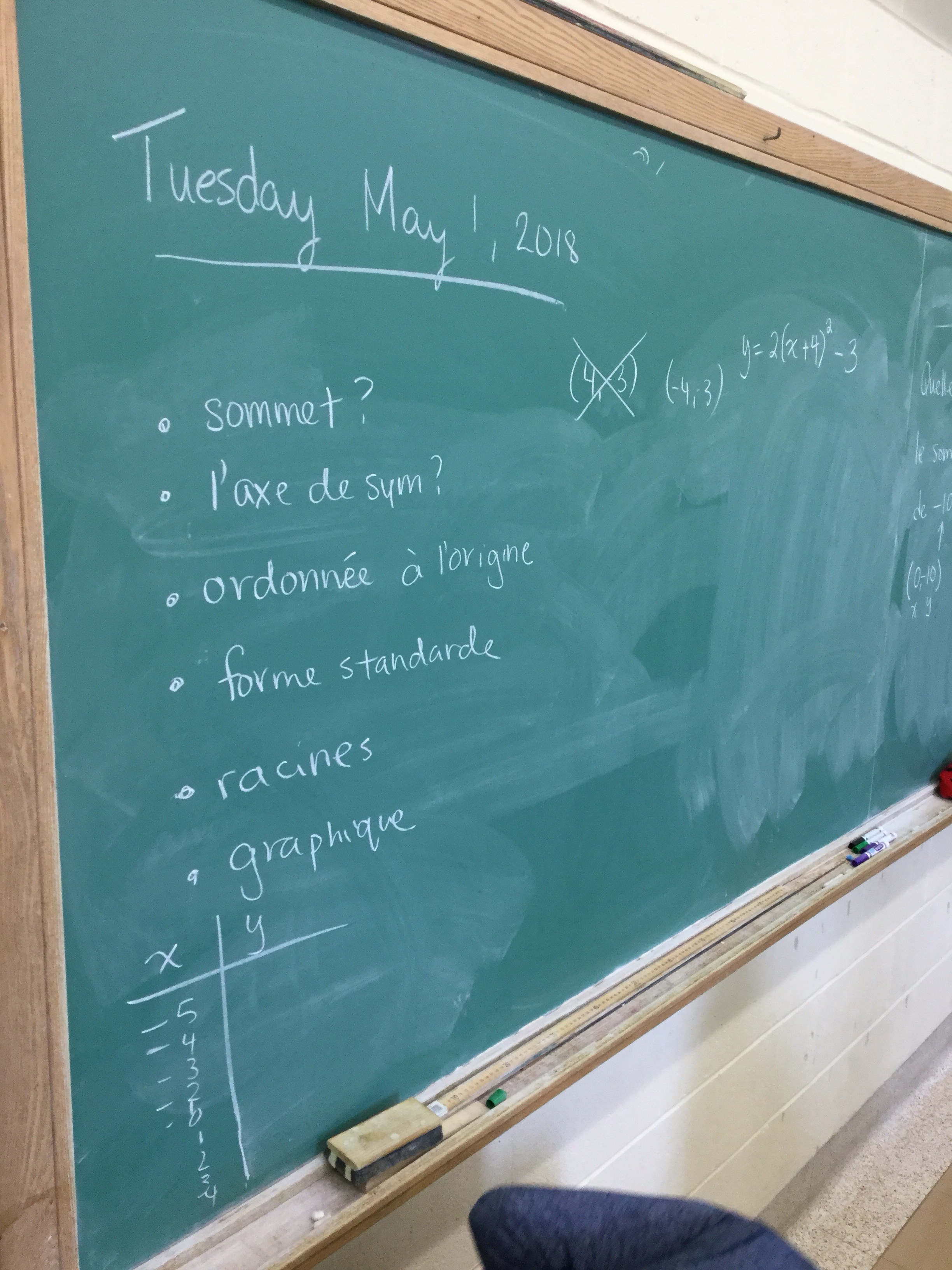
We explored a desmos activity today called parabola slalom. Try it here if you like

We experienced some frustration as we explored what the various values do in a formula.
Y=ax^2+bx+c Y=a(x-h)^2+k Y=a(x-r)(x-s)
The struggle paid off as we got more experience. We were able to better predict what formula would pass through the slalom gates. For homework we are looking at what we can find out about the equation y=2(x+4)^2-3
Gallery Walk
Today we followed up with what we started yesterday. We finished our graphs and put them up to show everyone. Then we consolidated our learning and added some new vocabulary.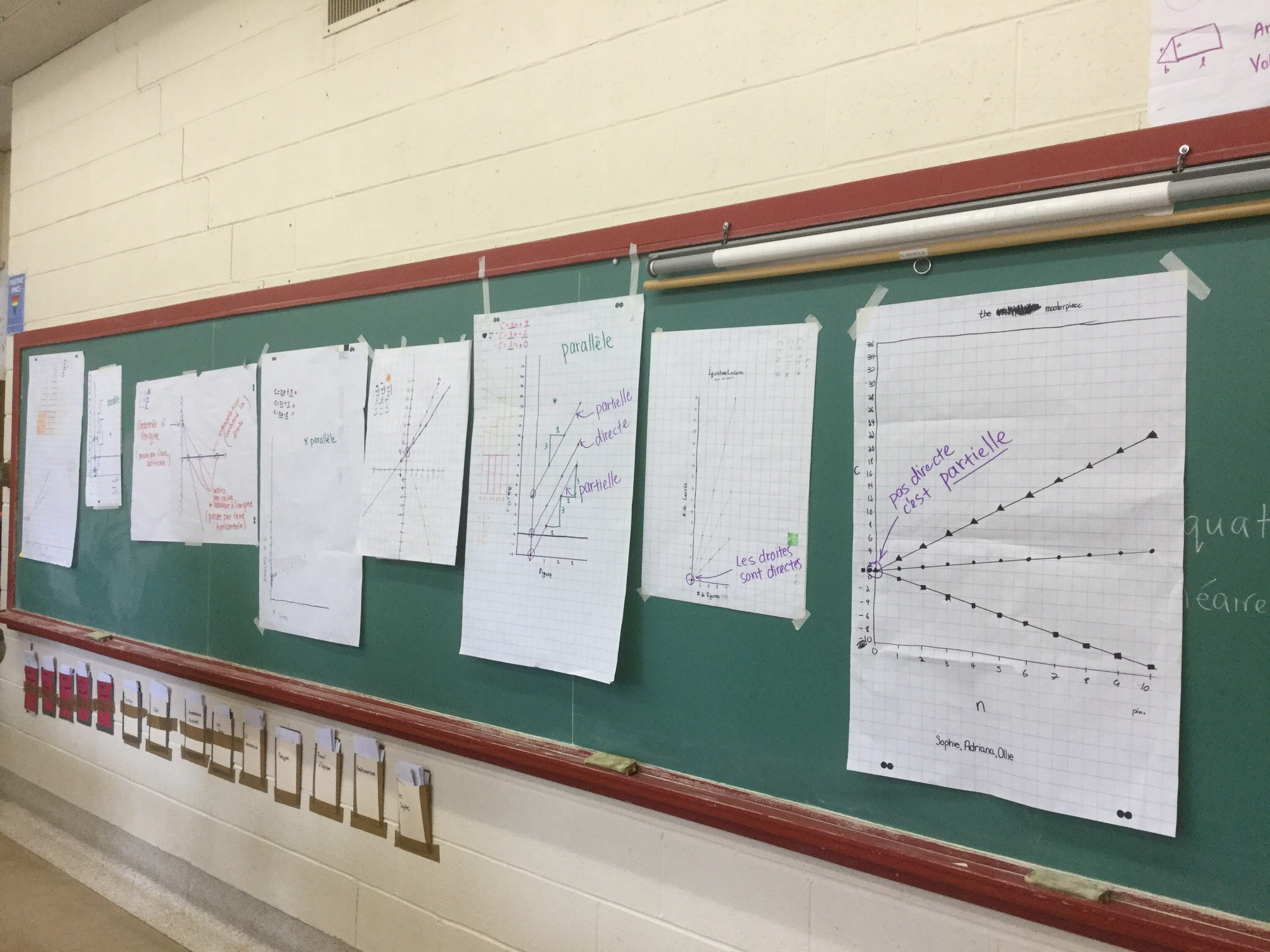
We learned that direct relations go through (0,0) and partial ones do not go through (0,0). We learned the names for the x intercept (abscisse à l’origine) and y intercept (ordonnée à l’origine), we looked at the rate of change (taux de variation) and also introduced the word slope (pente). We noticed that the rate of change /slope is given by the coefficient in the equation and the y intercept is the same as the constant (initial value). If the lines are parallel, they have the same slope.
We noticed some of the lines have positive slopes (upward to the right) and some have negative slopes (downward to the right).
Here is how one group visualized the relation with a negative slope.
Red is positive, blue is negative. They started with the initial term of 5, and for each subsequent term they placed n groups of -2 beside the original 5.

Knowing what we know about zero pairs (from algebra and algetiles) we know that a positive 1 and negative 1 will cancel each other out. (Seen below)


