Incredible Shrinking Dollar 3 Act Task
Today in grade 12 we explored exponential decay with the 3 act task of the incredible shrinking dollar by Dan Meyer. (Available here).
We watched the Act 1 video, noticed he was copying money but shrinking it on the copier. They immediately started to make models. Most were based on percent like this: A(n)=100(0.75)^n
We then started to wonder if the photocopier shrinks the area of the page to 75% of the original, or if it shrinks the length to 75% and the width to 75%. A quick google search confirmed that it is indeed a linear shrinking of length and width both.
we had a good conversation about whether this is linear decrease or exponential decrease. Some groups thought that you’d lose 25%, so after 4 decreases there’d be nothing left since 100-4(25)=0. Others claimed that it’d never disappear just get smaller and smaller and smaller since it would be losing 25% of the current length each time, so it’s losing less and less each time.
Finally someone asked what the dimensions of the original bill were, and we unlocked the “act 2” data where the dimensions are shared.
Groups worked on making tables, graphs and equations for the area decrease, and they looked at domain and range within context of the question.
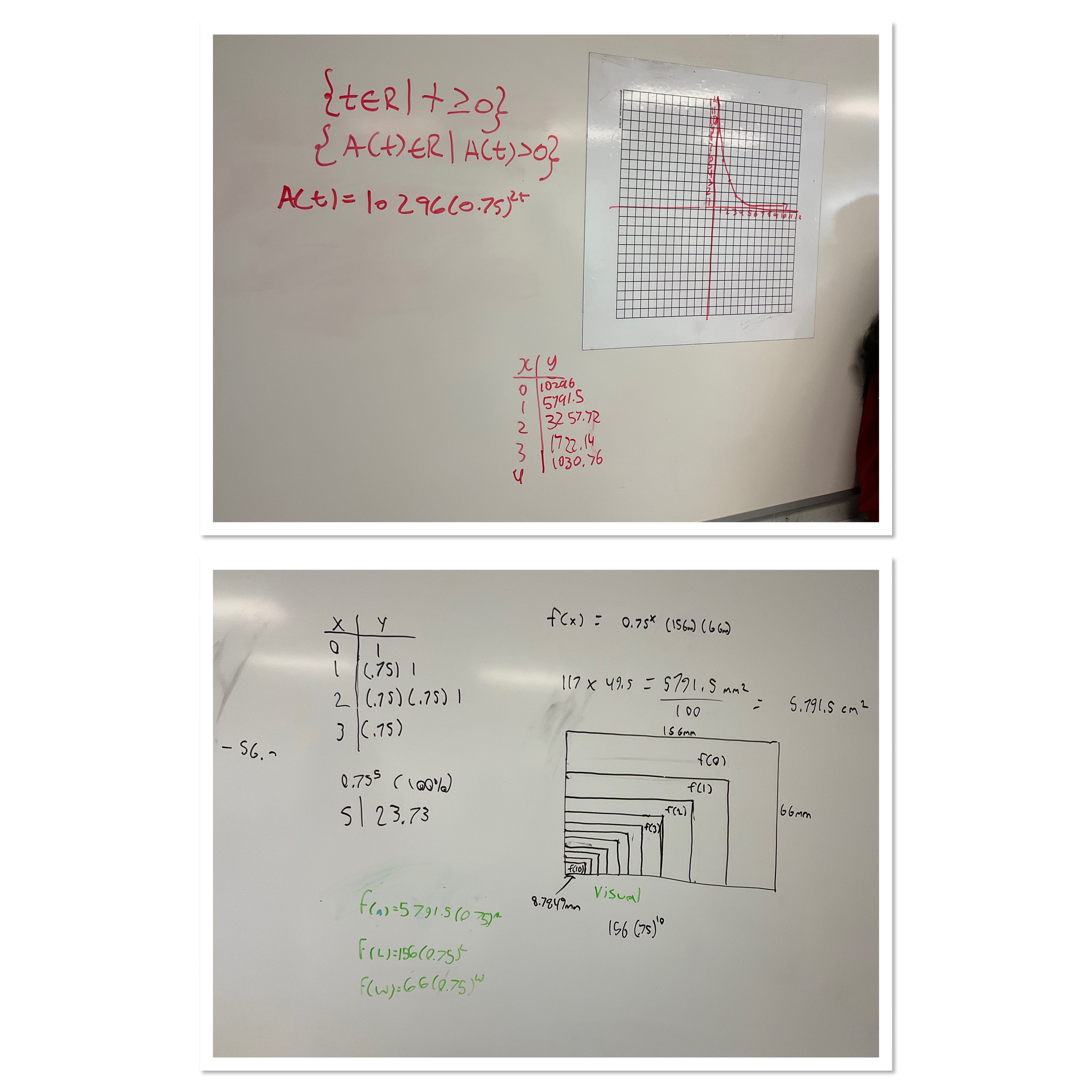
Others worked on modelling how the linear dimensions would change, and how the dollar would shrink by length and width each time.
Groups got a lot of practice with a skill that is challenging, sorting through information given, like they may see in a word problem, and making equations that make sense which can model the problems.
We’re heading towards our 3rd test soon, and we’re getting lots of practice in each day.
Numeracy Challenge
Today I worked with a grade 8 class. We’ve been working over the last few weeks on developing some confidence to start and persist while problem solving.
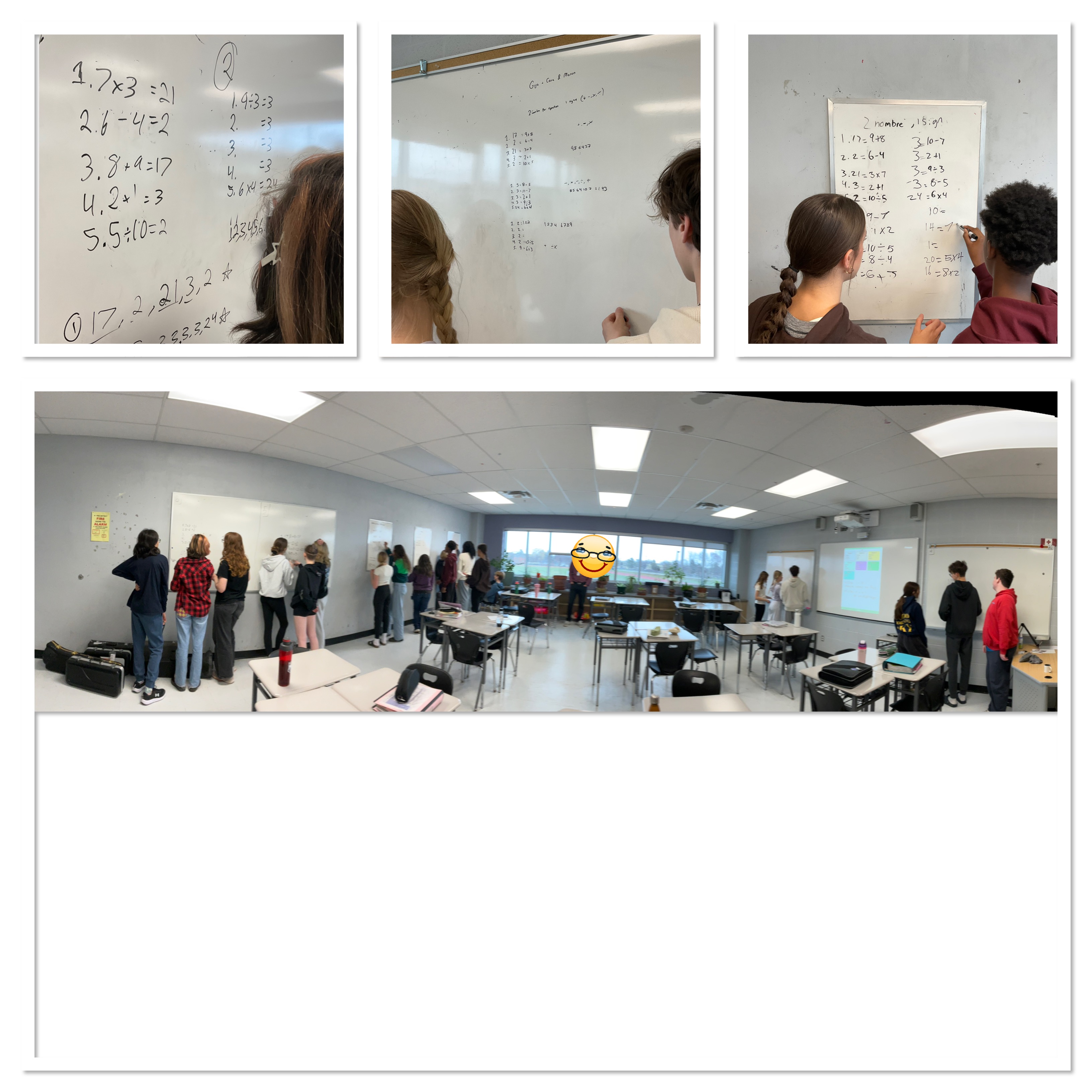
We had such intense focus and good spirits of competition and challenge today. There were high fives and cheers, and students told me that they liked the problems we did.
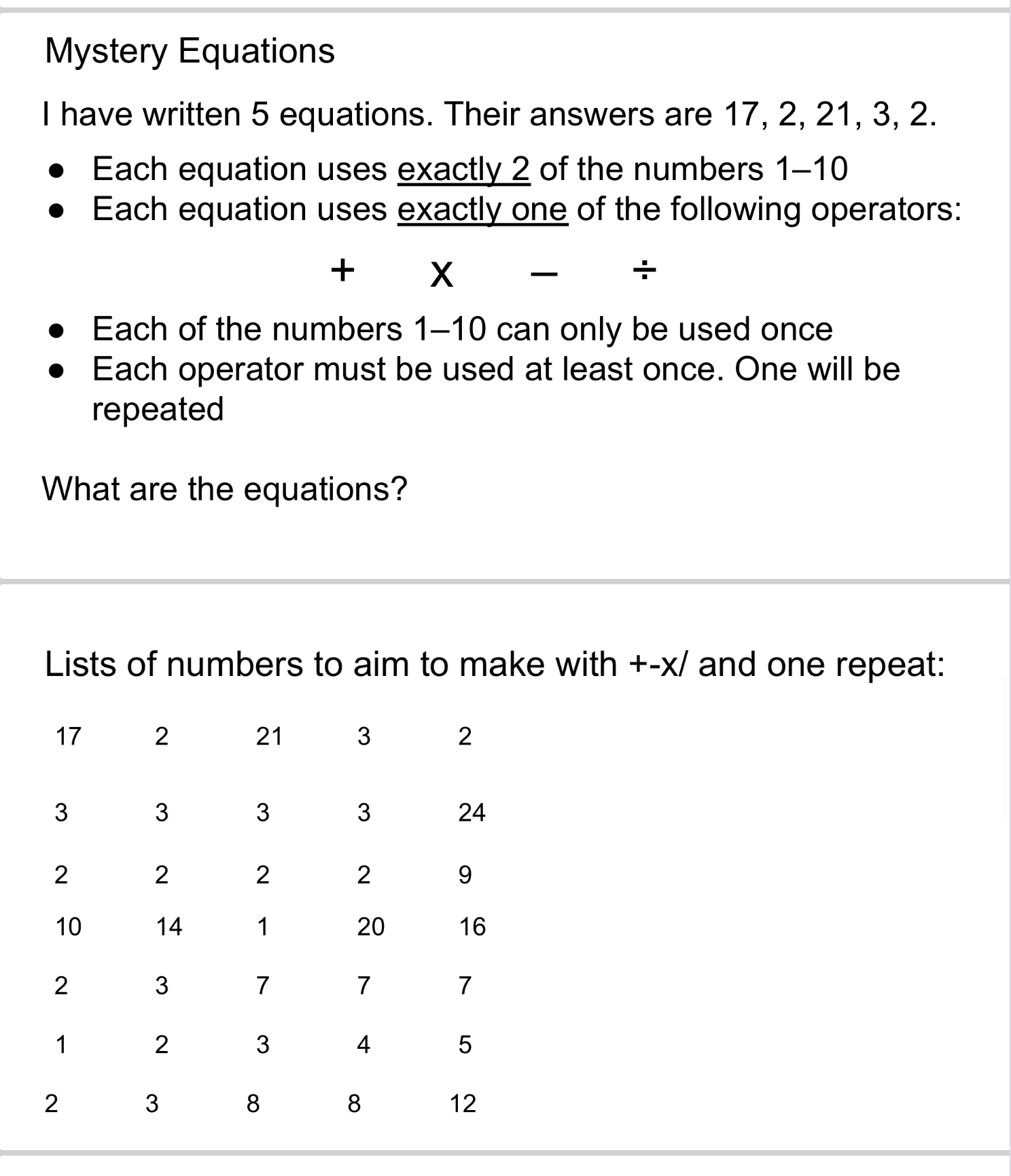
The lesson sequence is from Peter Liljedahl. I didn’t post anything, but said it all out loud. Groups are given the answers to 5 equations, and they need to make the equations to follow the rules. Once a group was done with one set of numbers, I came around to check, and then give them the next set to work on. (See below)
In 45 minutes we had some groups get through 6 of the 7 sets. Most groups got through 5 of them.
Groups not only practiced their operations, but they also needed to use logic to determine which number is made with the fewest possibilities, e.g. in that first number set, 21 can only be made by 3×7 so we know that 3 and 7 cannot be used in any other equation. Students also practiced checking their work for small details like how many repeated operations they used, and if they repeated any of the values 1-10 in their work.
Proud of them for their excellent attitude and effort!
Using Fractions
Today we built on the fraction skills we started learning/remembering yesterday. We started off with multiplying a fraction by a whole number like 2(1/3) is 2/3 and 4(3/4)=12/4=3, and 5(2/5)=10/5=2. We started noticing that sometimes we can predict when the result will be a whole number and when it will be a fraction.
We practiced a bit, in table groups on mini whiteboards, using our fraction manipulatives to help us.
By the end of class we were getting comfortable with combining some of our skills: area and perimeter calculations but now with fractions.
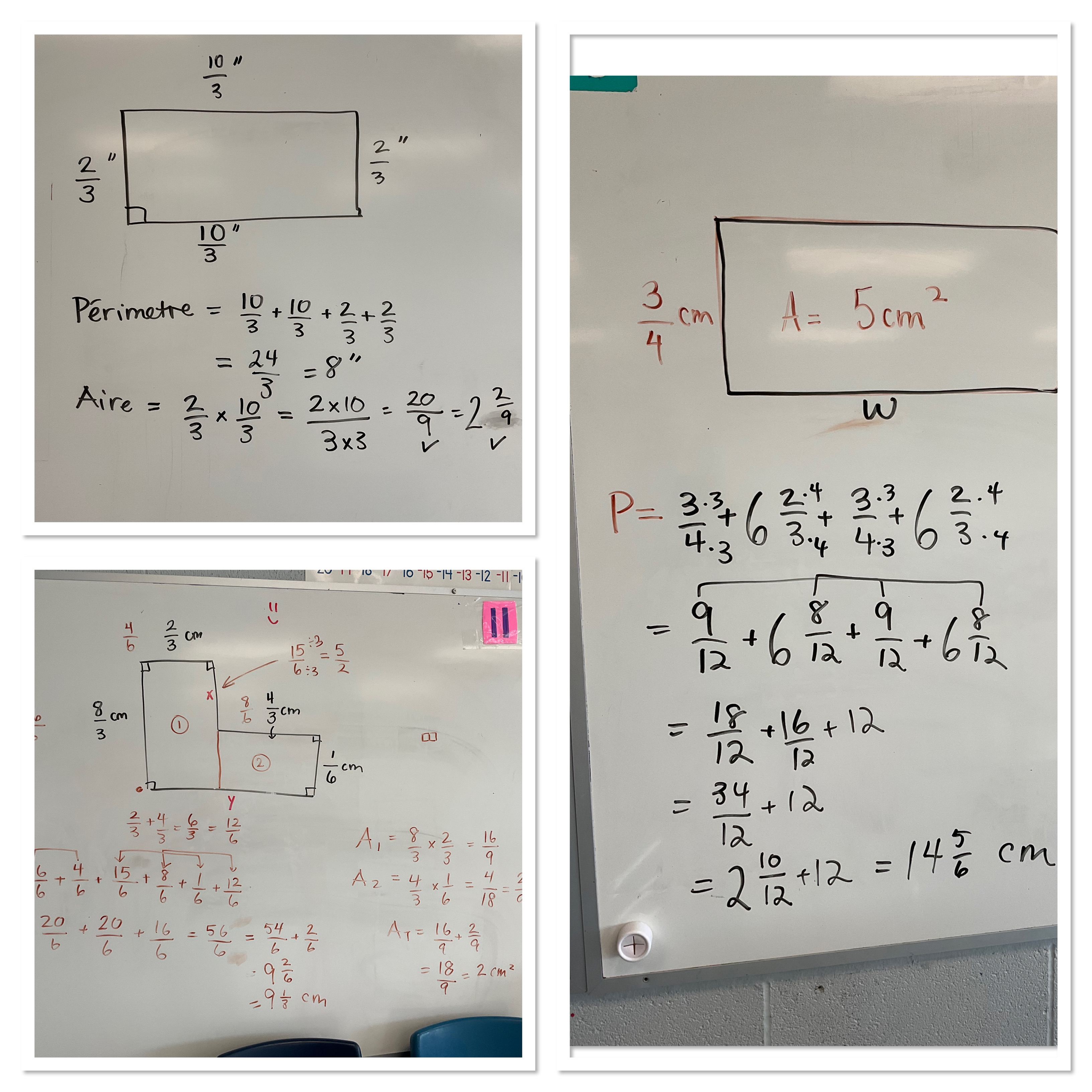
Groups collaborated to solve these problems together, and there were some celebratory high fives and cheers when they got them correct. Some students are confronting their past views of themselves as someone who can’t do fractions. We’ve worked on building the skills bit by bit, and we’ll keep practicing some fraction fluency moving forward, so hopefully they’ll be less surprised that they got it right! I’m so glad that we are building skills and confidence with fractions, as they are key for many skills coming up in grade 9 and beyond.
Stacking Tower Game
My grade 11s are working on problem solving, and today we started with a game.
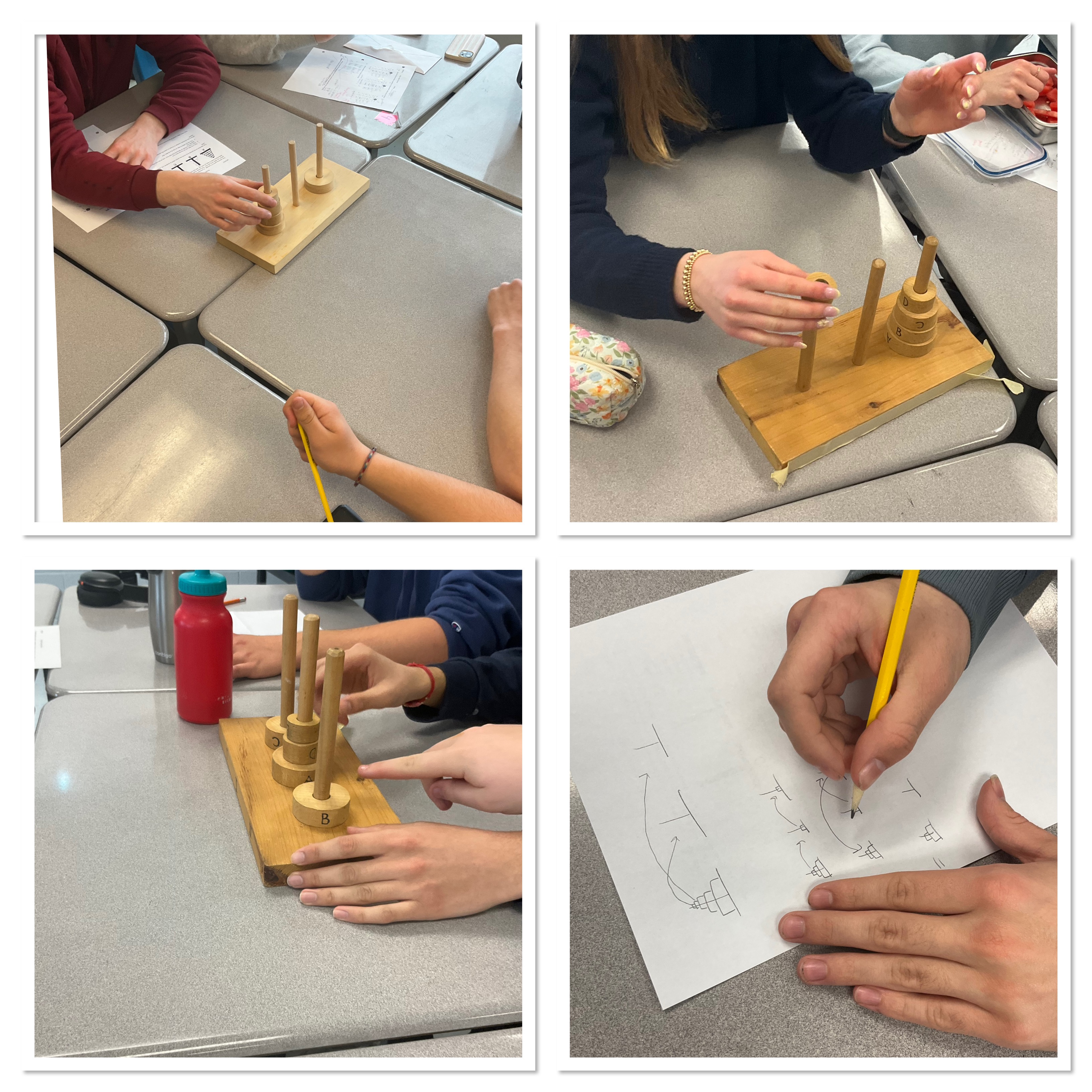
There are 5 discs of different sizes stacked on one peg. There are 2 empty pegs. Students need to find the minimum number of moves to get all discs to another peg. The rules are: one disc moved at a time. No disc can be put on top of a disc that is smaller.
The next challenge is to extend it to the number of moves needed to move 10 discs, and if a group says the minimum number of moves was 3267, how many discs did they use?
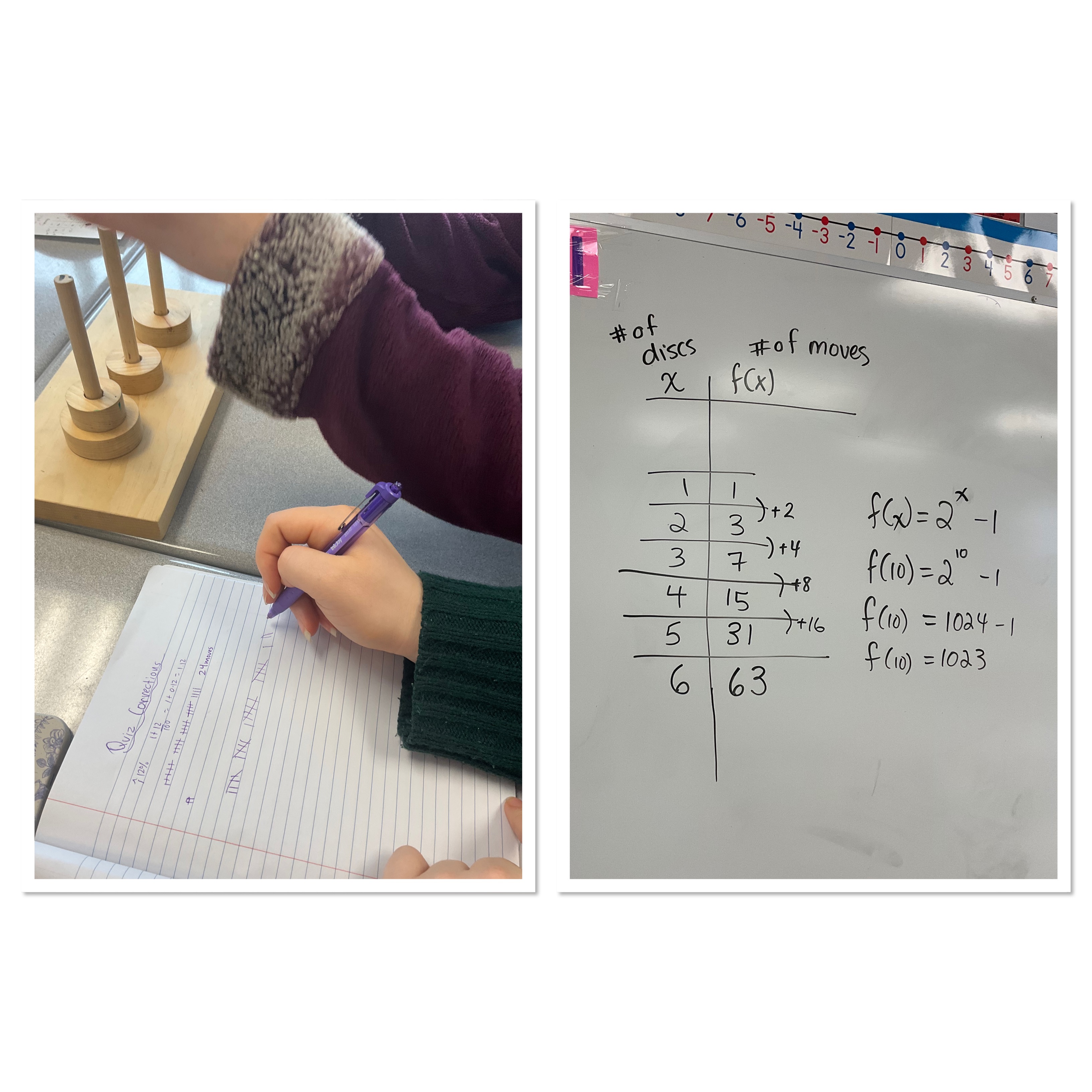
It was fun to watch students wrestle with the problem, and how they supported each other through the frustrations. Groups developed different ways to tracking moves, and modelling the situation.
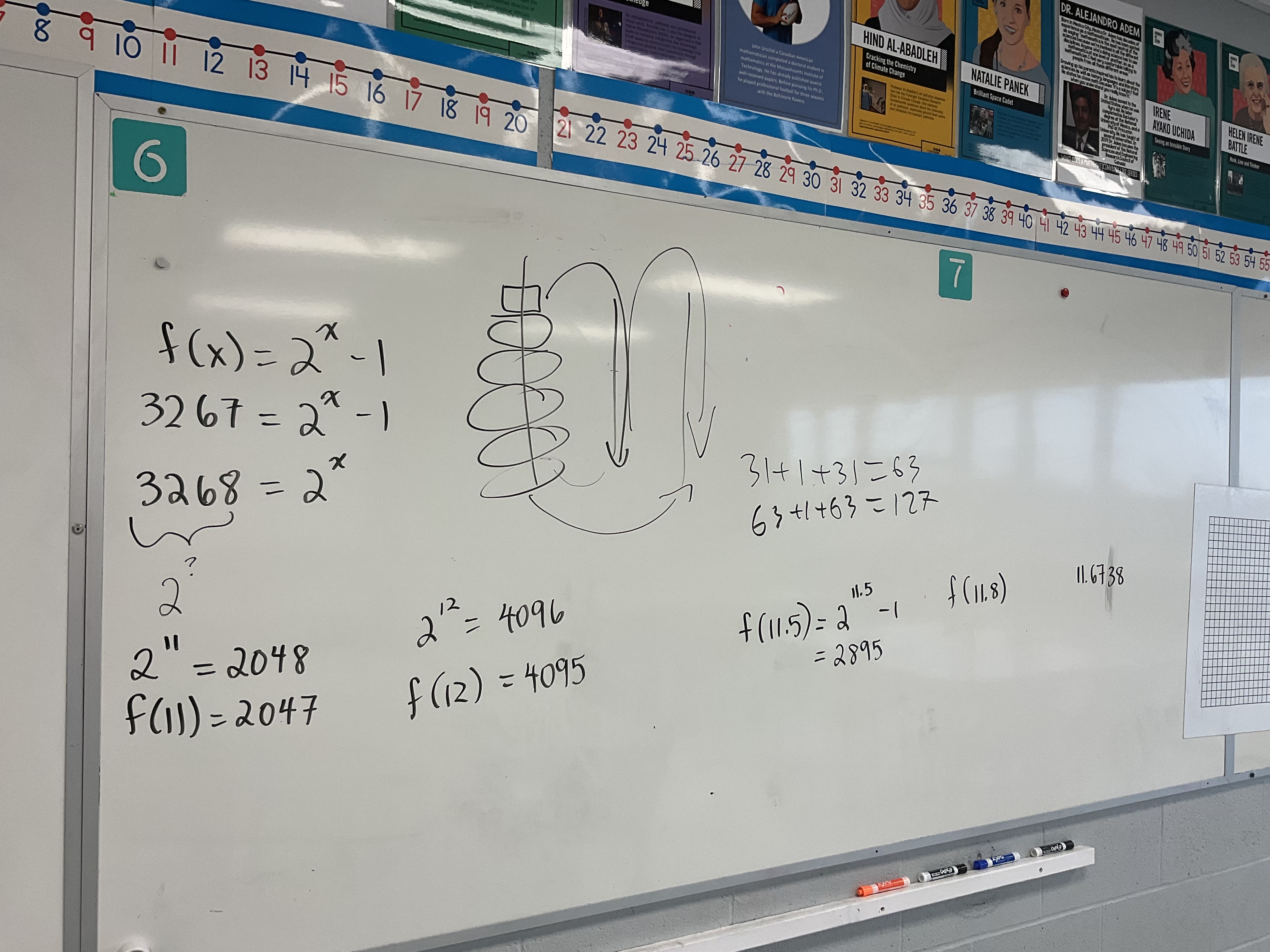
One neat justification for the hypothesis that it is exponential growth is that it took 15 moves to get one stack of 4 transferred to a new peg. If we are considering moving a stack of 5, we’d have to first move the stack of 4, then move the bottom one, so that’s 15+1, then we’d need to move the stack of 4 again to get it on top of the 5th disc, so that’d be 15+1+15, which is 31 moves. If we’re working on moving a stack of 6, we’d move the stack of 5, then move the 6th, then move the stack of 5 again. That’d be 31+1+31, which is 63. We can see that the growth is close to doubling each time.
It was a fun modelling task which led to a fruitful discussion about whether the claim of 3267 being a minimum number of moves, and about whether we should consider a fractional number of discs.
Fractions Introduction
Grade 9s are working on exploring, and enjoying fractions. We got out the unit fraction strips and played a bit. We organized them, and noticed that when the denominators get big, the pieces get small. We noticed that it takes 4 of the “one fourth” pieces to make 1, and 10 of the “one tenth” pieces to make 1 etc.
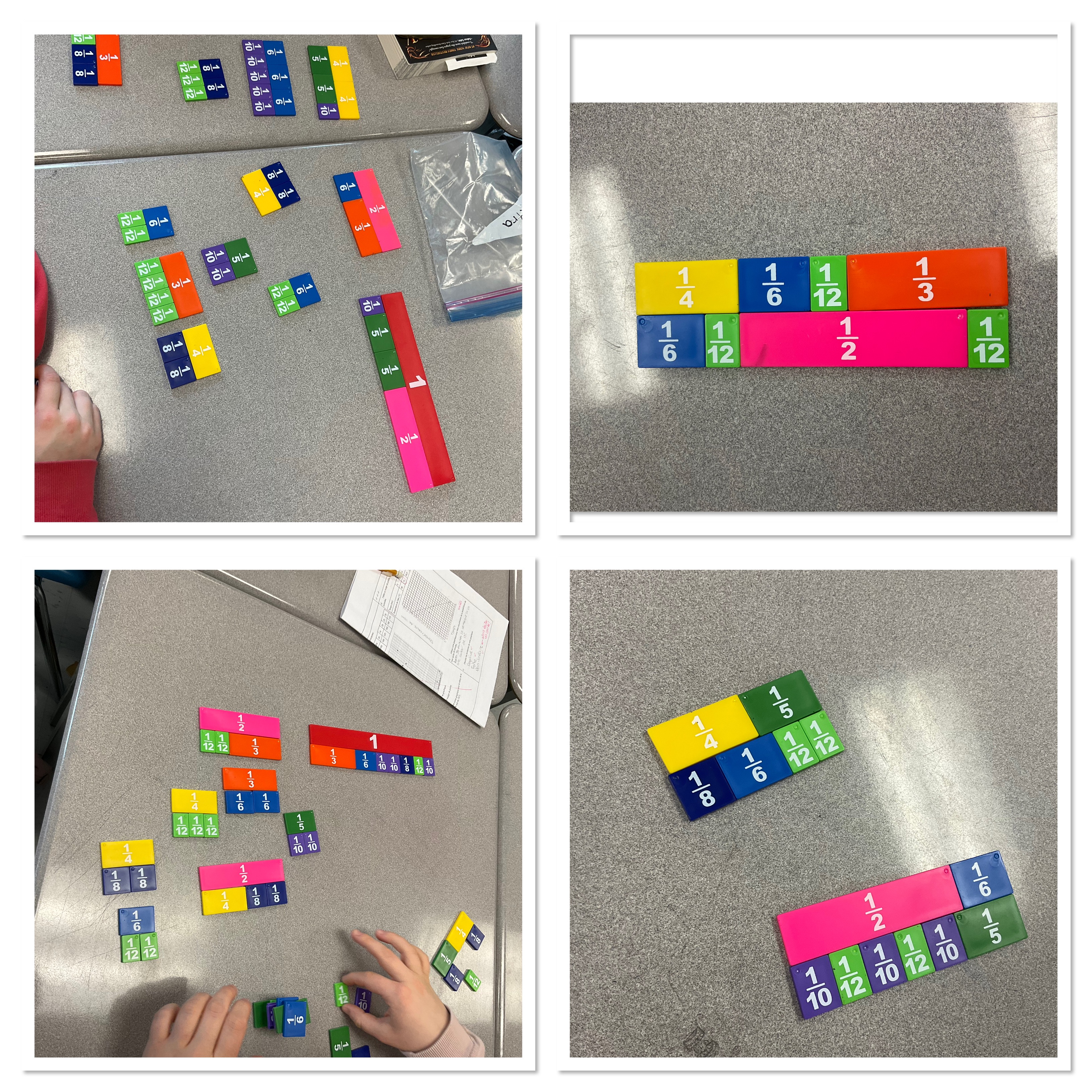
Next we started exploring other ways to make things that are equal. Some made equivalences like 1/4=1/8+1/8, and 1/3=1/12+1/12+1/12+1/12. We saw how we can quickly add unit fractions in a similar way that we add x terms in algebra. 1/4+1/4 is 2/4, just like 1x+1x=2x. When the denominators are the same, we are able to add those similar unit fractions together.
We had some interesting combinations where we needed to make common denominators before we could add unit fractions.
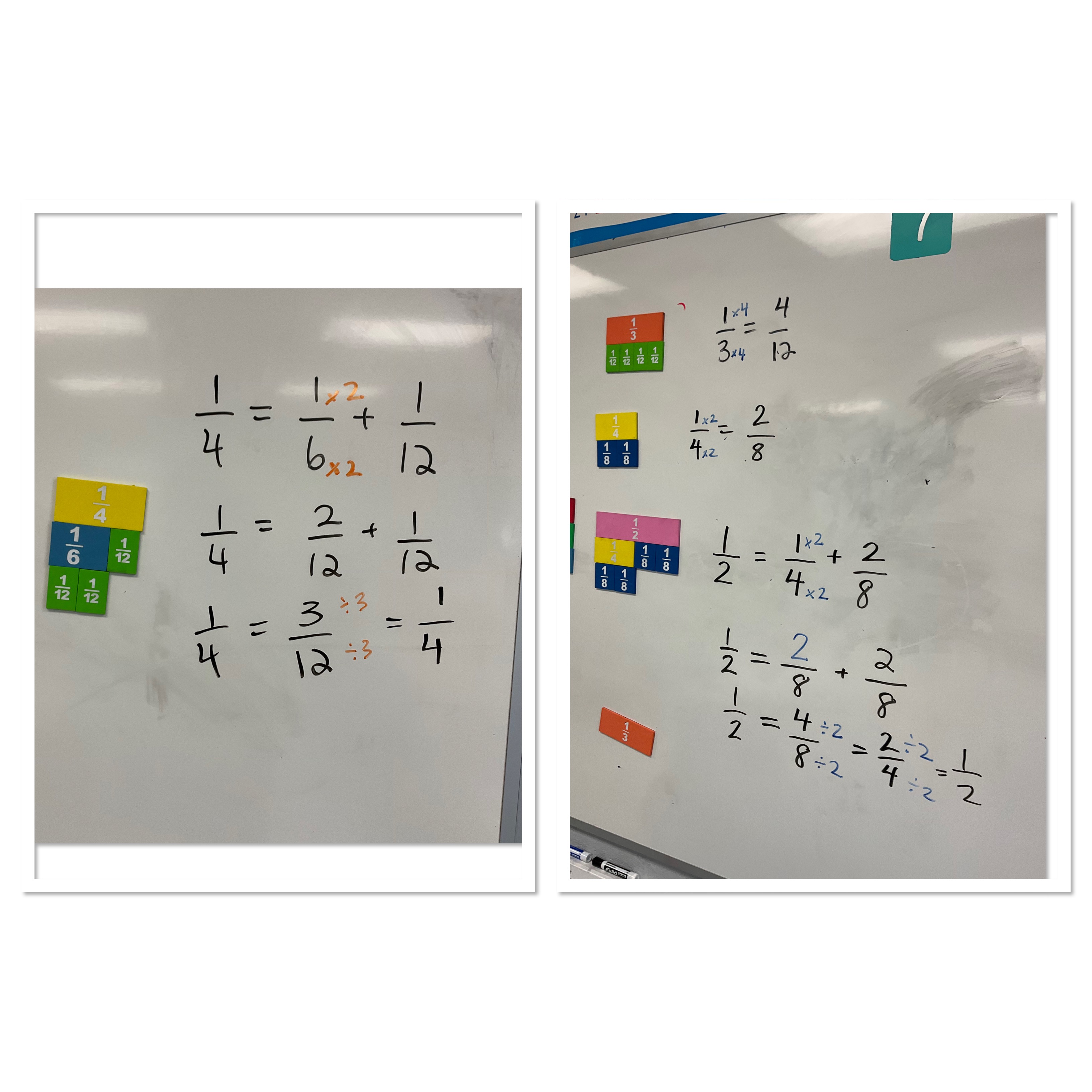
One neat example was given where it looked like there was equality, but we explored it further and saw that it wasn’t really equal.
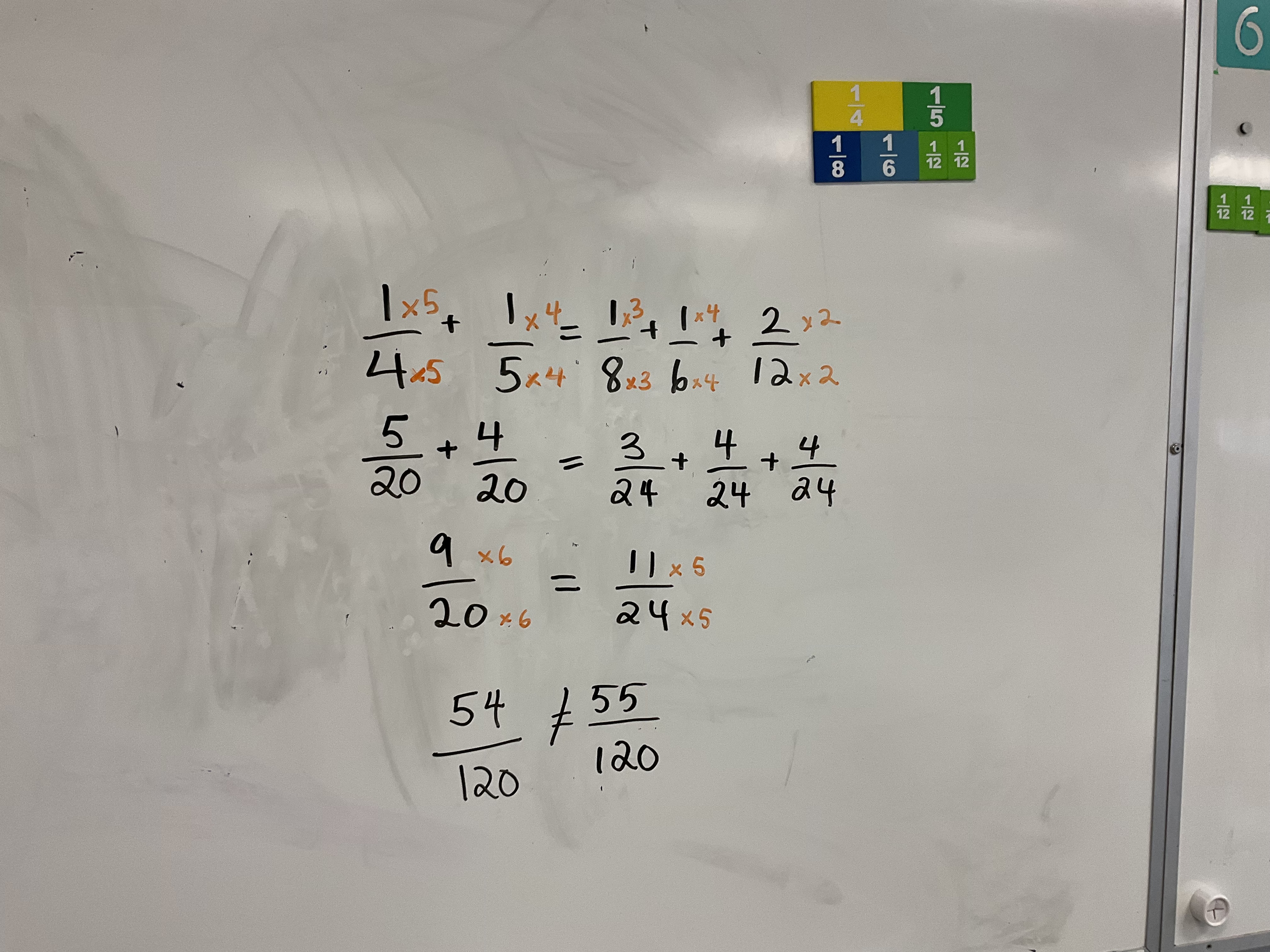
We made common denominators with each side separately, then simplified each side separately, and then eventually made common denominators with both sides so we can compare, and we saw that they were NOT equal, off by 1/120 which is tiny, but not insignificant.
Getting hands on experience with fractions and manipulatives can help us explore and communicate with fractions. It takes away some of the mystery about what fractions are, and lets us build to understand and connect to the operations.
From there we connected our understanding of area models for multiplication to multiplying fractions.
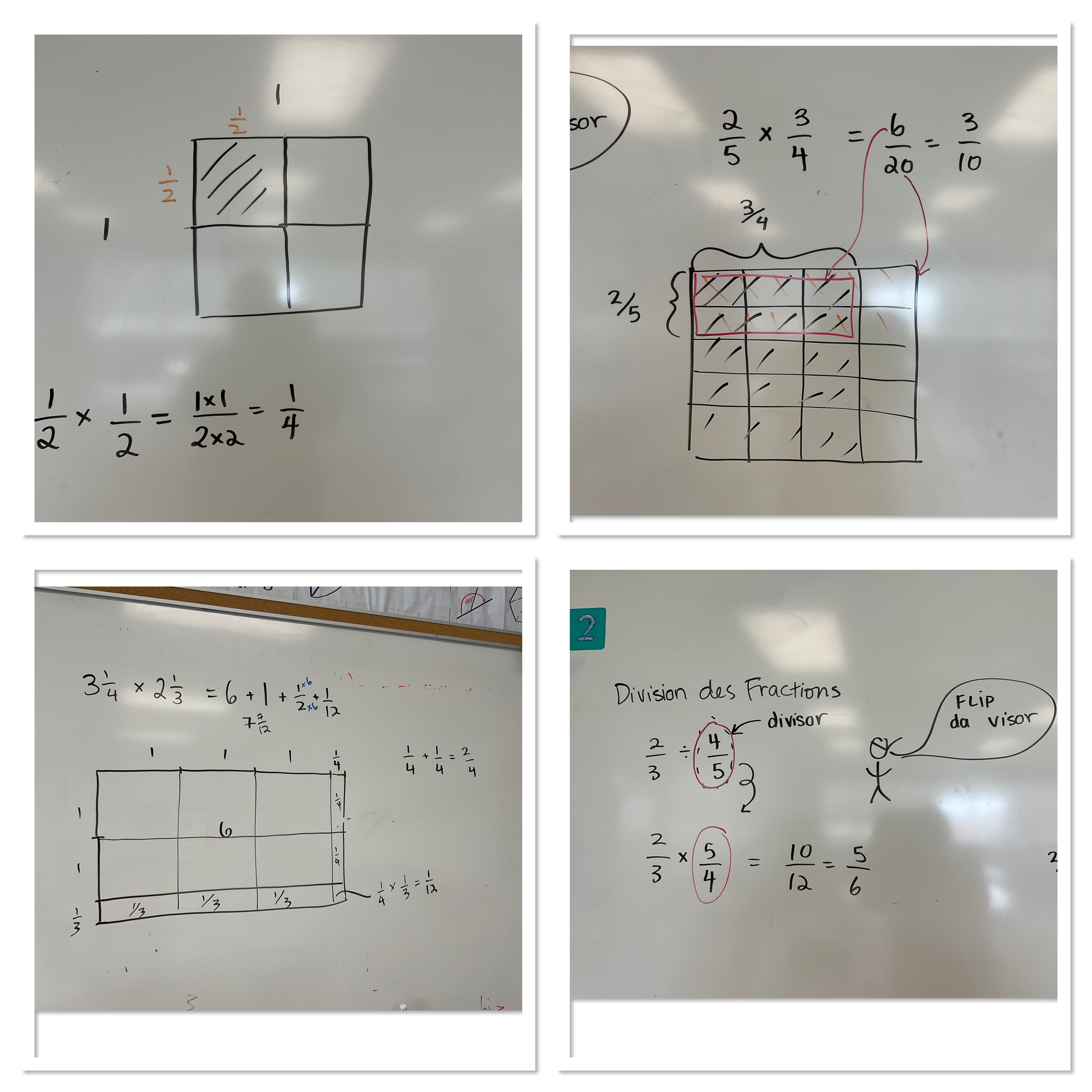
We looked at how to multiply unit fractions, non-unit fractions, mixed numbers, and then later how to divide fractions. We will keep practicing these skills and building our fluency and reasoning skills with fractions.
Math Club For Grown-Ups
We had another fun evening with Dr. Taylor and educators (and future educators) from our region. We looked at 3 rich problems, one involving quadratics, another involving exponent laws, and another involving exploring Napoleon’s Theorem and a neat demonstration of Desmos Geometry.
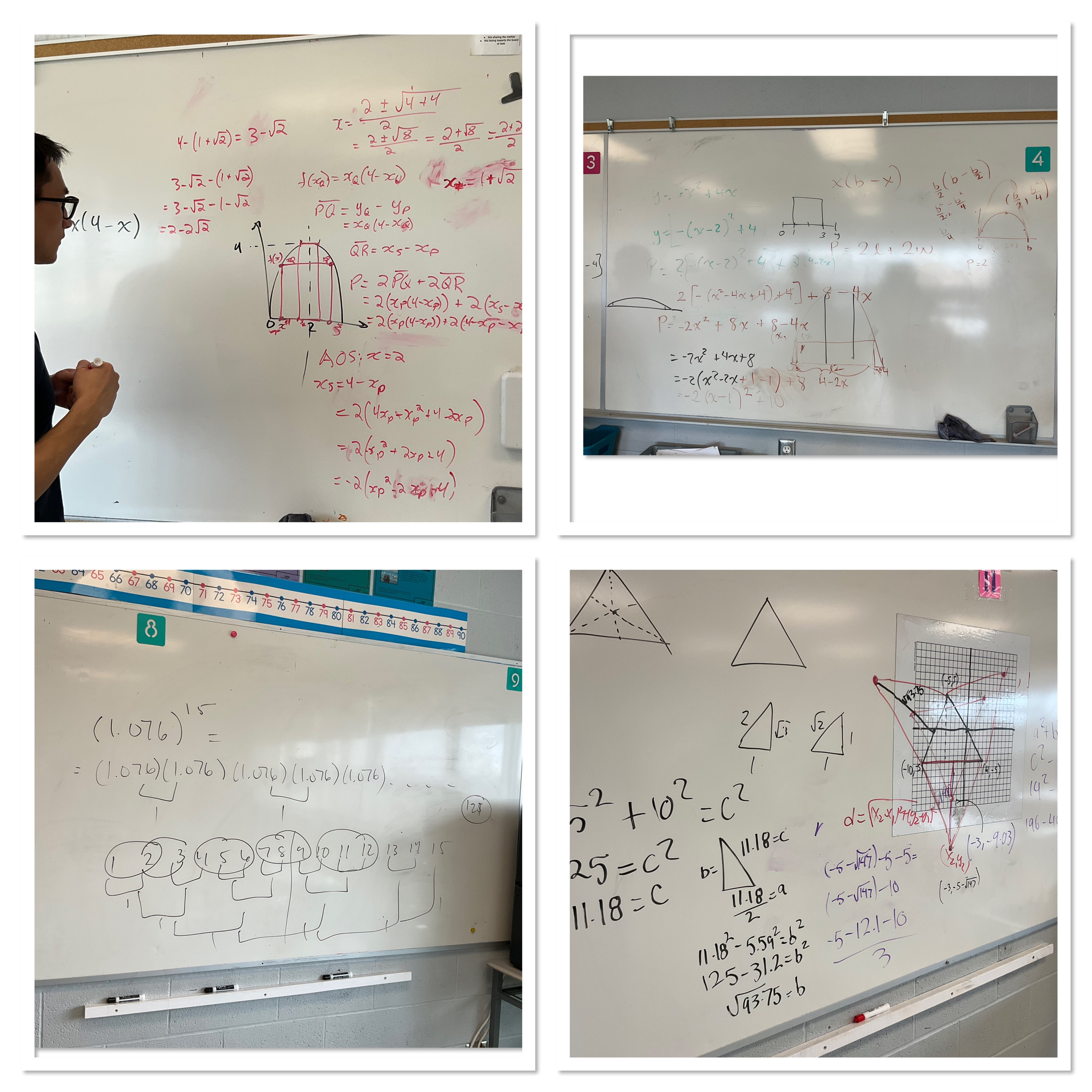
Many thanks to QSLMA for sponsoring our snacks! We looked forward to another meeting in June.
Word Problems
In grade 11 we are working on developing our critical thinking skills by tackling word problems where we don’t always have an equation. We are getting good at making tables and modelling, and also making equations and solving.
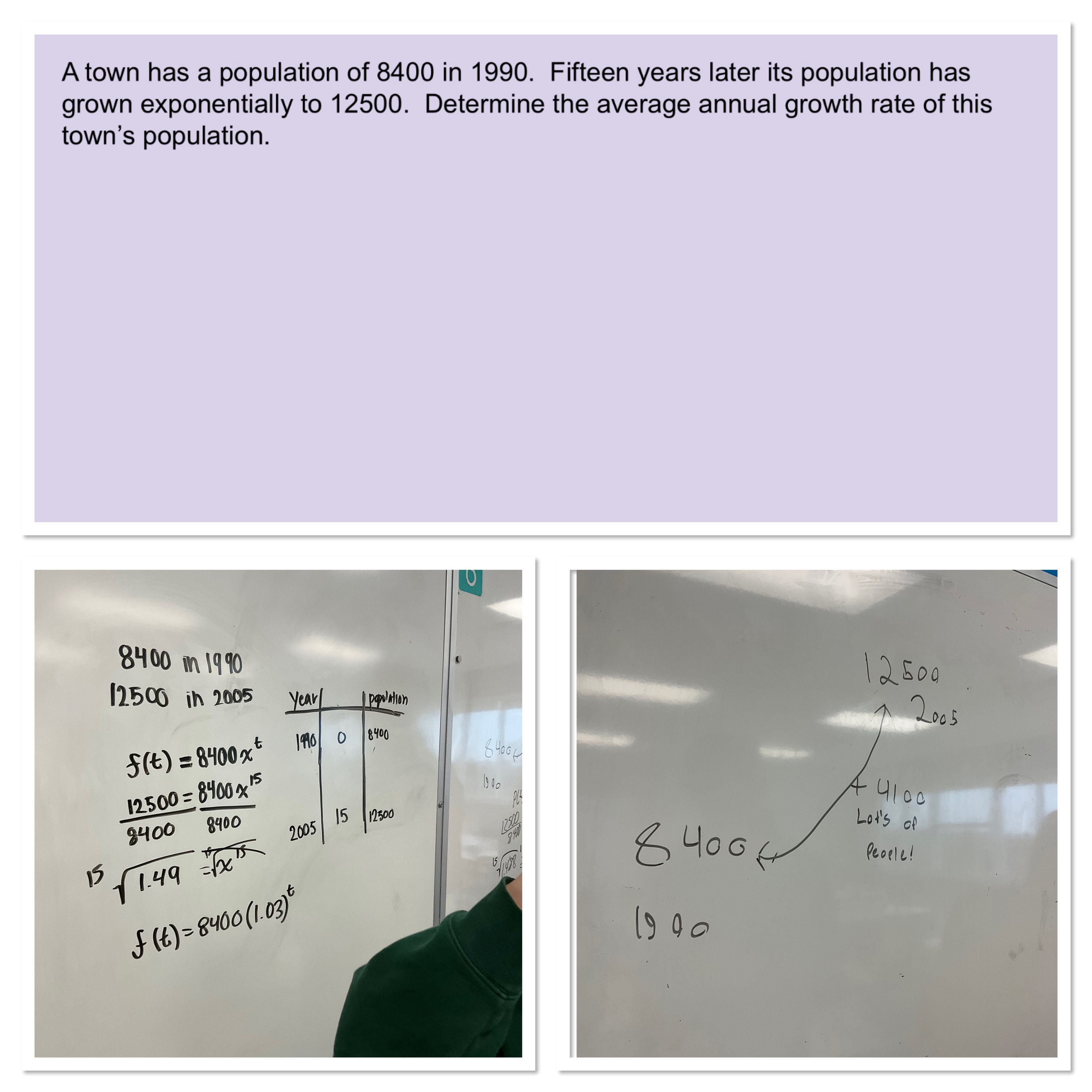
We are able to identify exponential growth or decay depending on if the base of the exponential is greater than or less than 1. We know that the rate of increase or decrease is related to what is added or subtracted from 1.
It takes time to build up our skills and confidence.
Beading Wrap-up
Today we finished our week of beading. We have gone through the steps of learning a new skills, struggling and figuring it out, making progress, helping each other, celebrating accomplishments, and reflecting on how far we’ve come in a week. These are all skills that apply to math class as well, along with all the emotional regulation skills we used to keep our mindset good while we were working as to not put any negative energy into our work. We learned how to notice our emotions, find a strategy to use to regulate, and then to return once we were calm and ready. We will be putting all of those skills to use as we move into the challenges of lap 3 of our course.
The final steps of the beading involve weaving threads to create a tab of fabric to glue the finishing leather to.
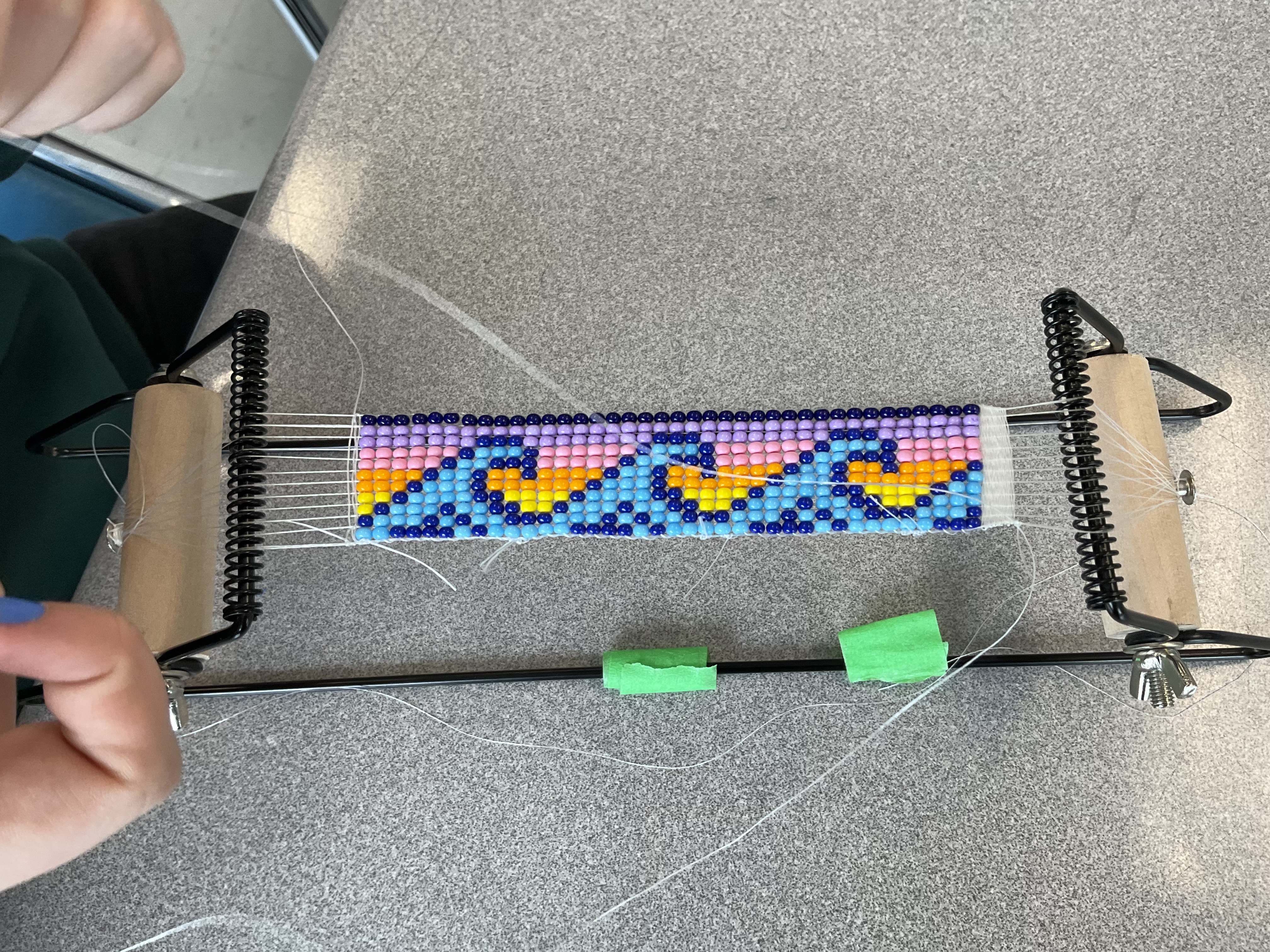
Next we applied glue to the strings so they would stay bonded together
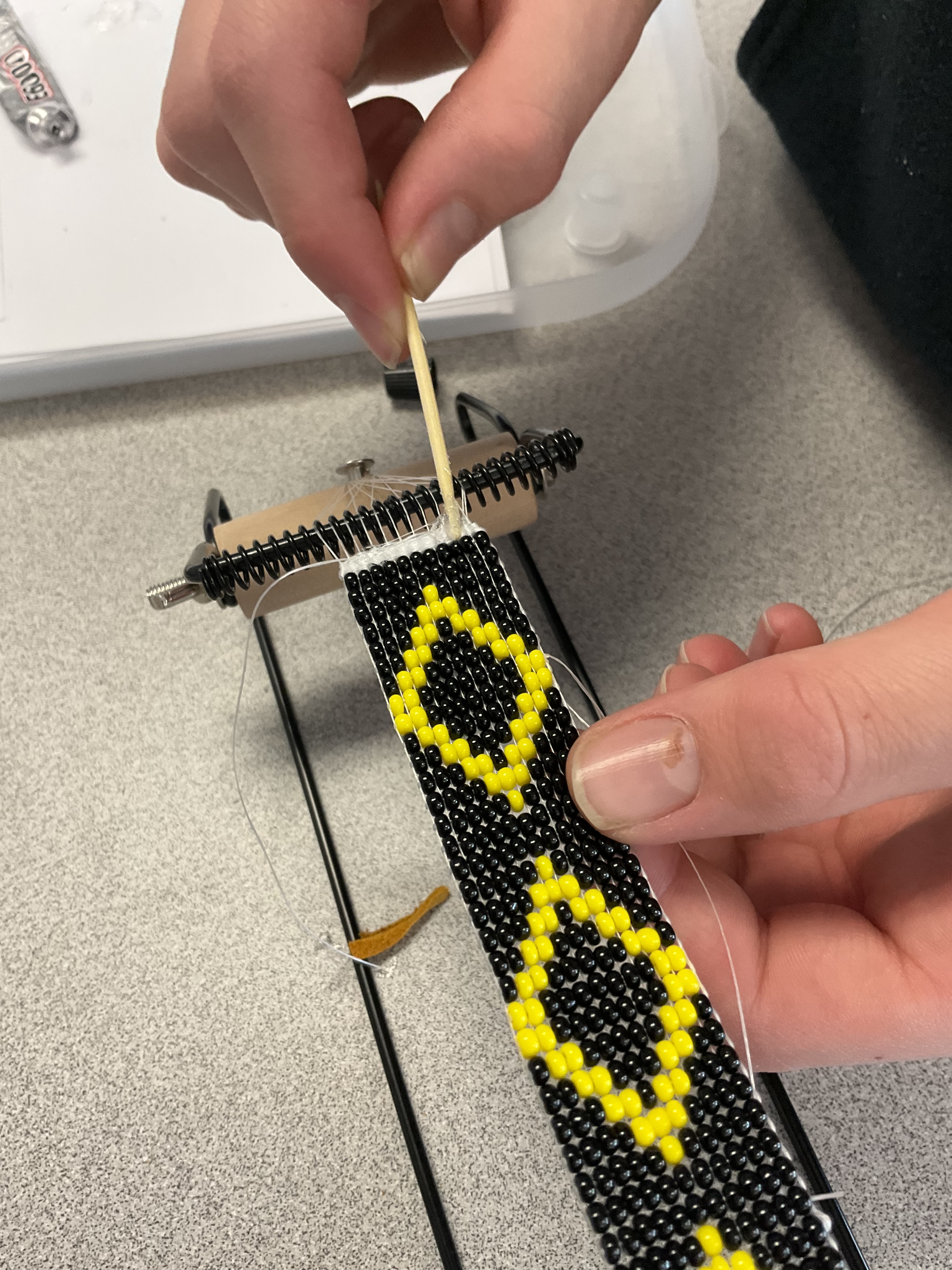
Then we cut the work from the loom and used leather glue to glue the hide to the ends to finish the keychain.
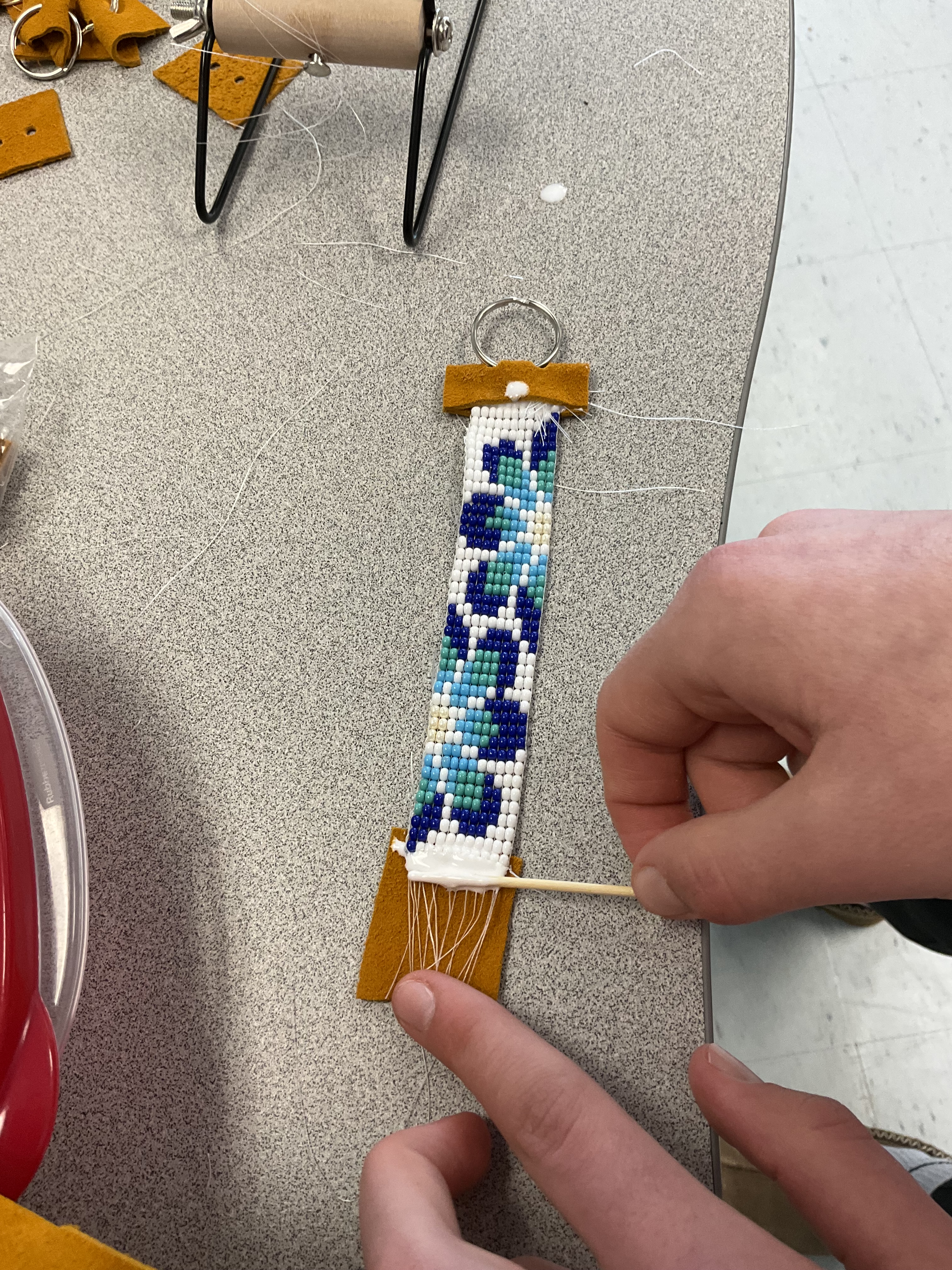
We’ve got many finished pieces resting on the windowsill, while we work on our writeup that explains all the math in our work.
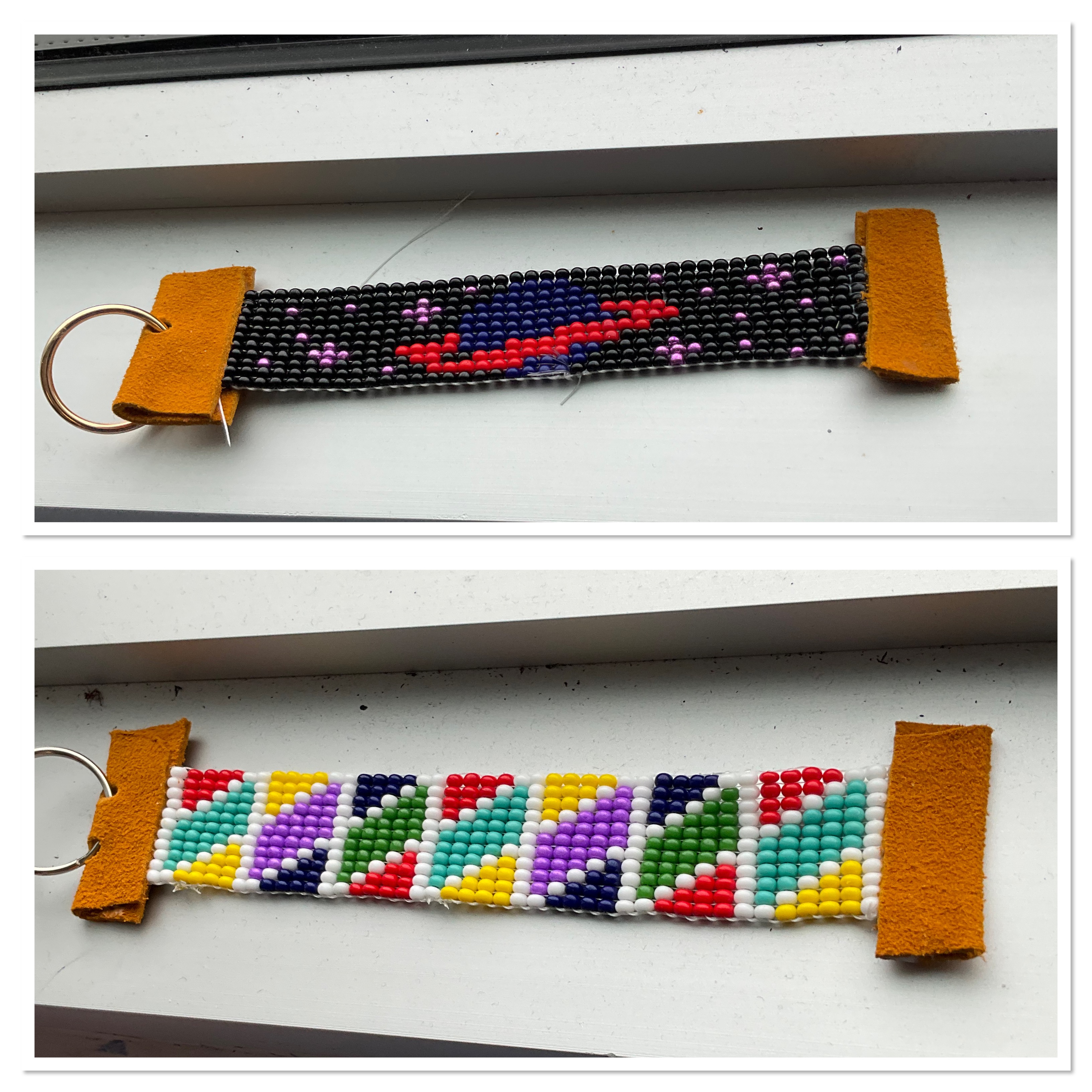
We can talk about the number of beads we used, and how we can calculate that with our strategies. We can determine the fraction of beads of a certain colour, or we could report that as a percentage. We can discuss symmetry, reflection, translation, rotation, various shapes or angles, areas and perimeters. We could talk about repeating patterns, or growing patterns and use proportional reasoning. If 1 motif takes 5 red beads, then 3 motifs would take 15 red beads. Some students thought of the math first and planned their beading accordingly, and others are starting with the art, and developing the math later.
We are also reflecting on the learning skills and emotional regulation skills we learned, as well as the teachings and connections to Indigenous ways of knowing and understanding pattern and math.
Beading update
Some students are almost done their masterpieces! We had several in working at lunch and making very good progress.
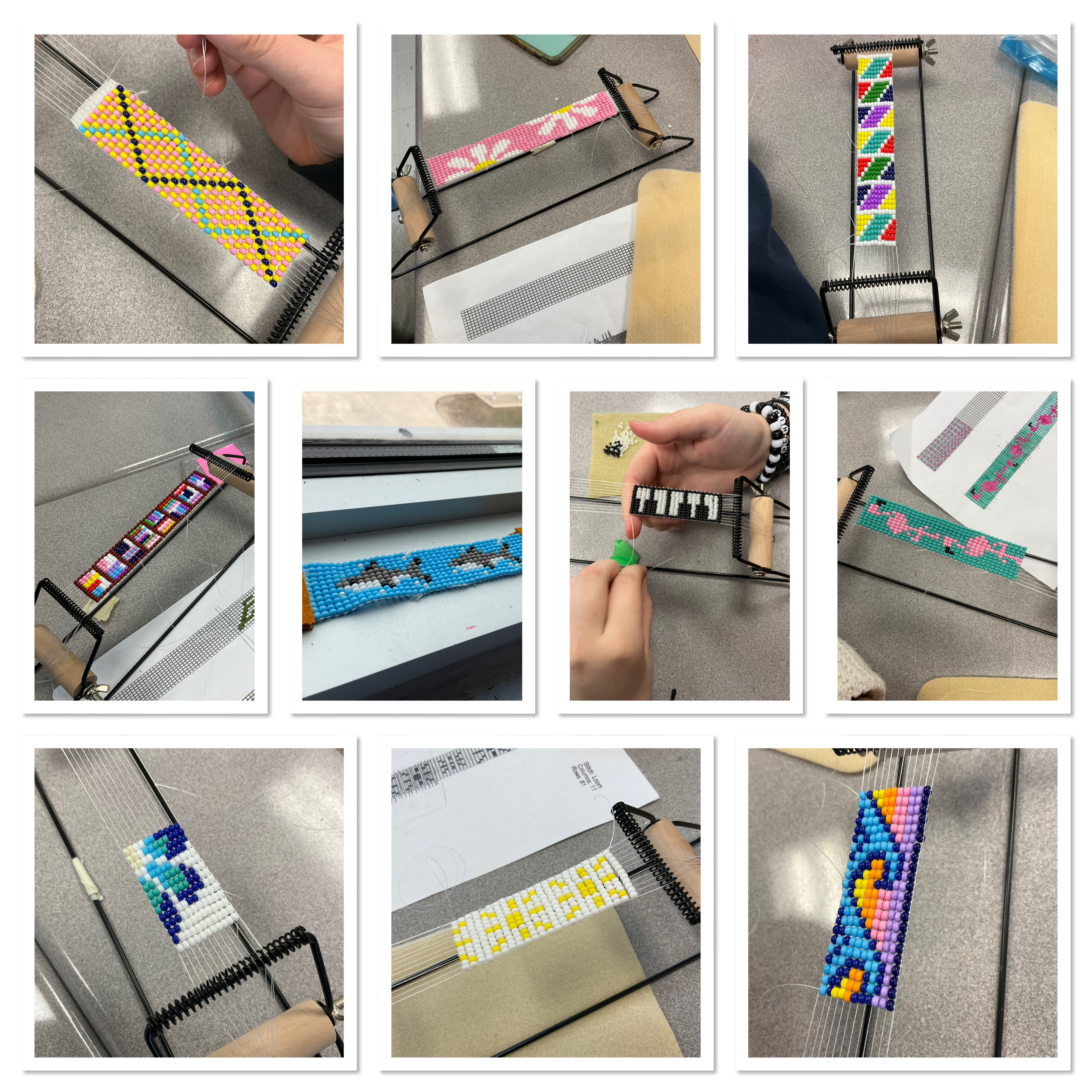
After the beading is done, we weave the thread across the loom threads to make a fabric tab to glue together and attach leather to. Once the threads are firmly fixed they can be cut from the loom, then leather added and then they are left to dry on the windowsill.
Tomorrow we will finish beading, and start out mathematical writeup and reflection on learning skills that we used.
How many times can you fold a piece of paper in half?
Today grade 11s were working on modelling exponential growth and decay. We folded paper in half repeatedly and modelled the number of sections that we get after more and more folds.
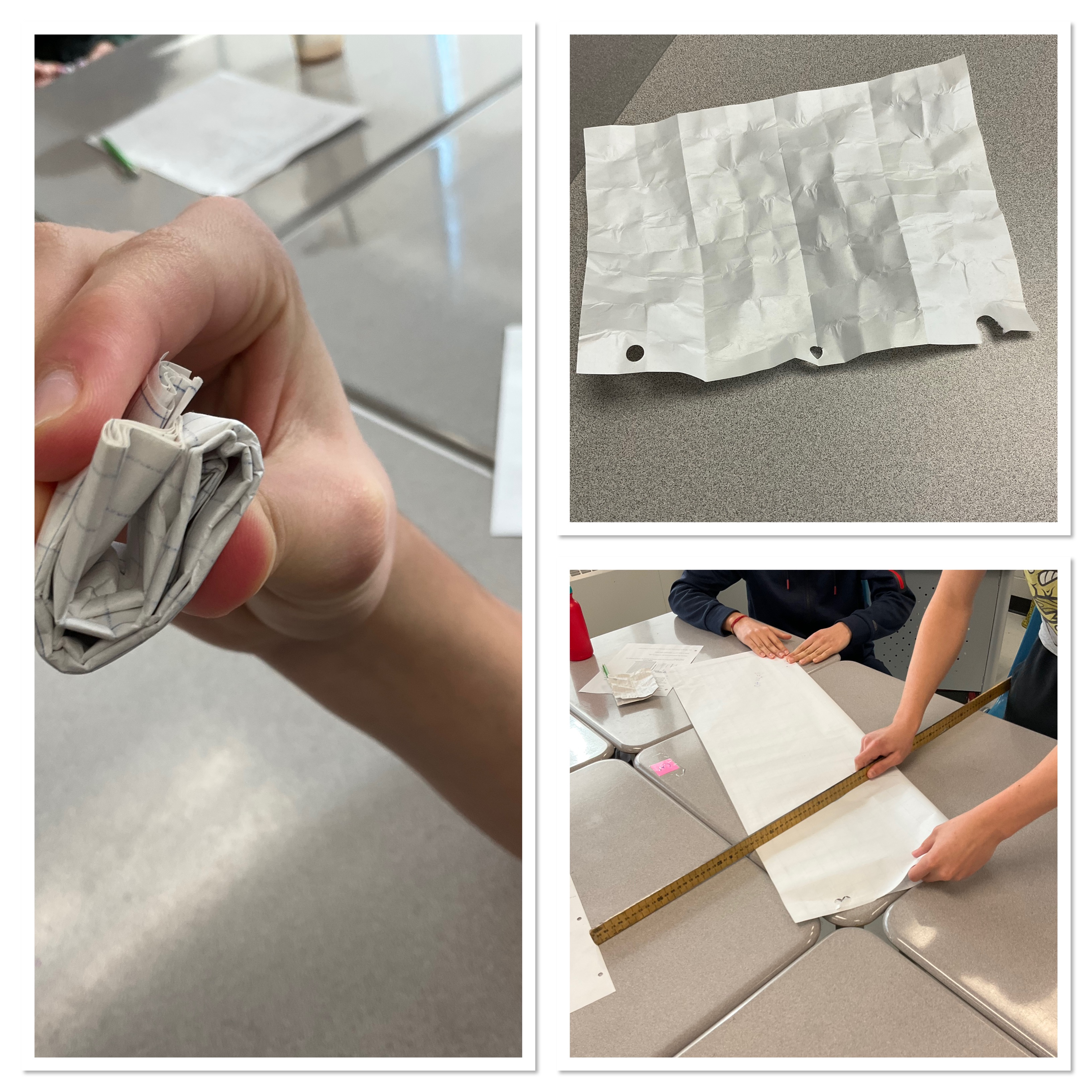
We decided this was exponential growth and the equation is y=2^x
We also looked at the page area, and how that changes as we folded more and more. Some called the initial page area 1 (measuring with a “page” as a non standard unit of measure), and then we saw that the area of each folded section decreased each time (the base is 1/2). The exponential decrease function is y=(1/2)^x. Others who measured the page and had the area in cm^2 then would have that as their “a” value for their equation.
Tomorrow we will be working on modelling word problems, so this is a good introduction to those skills.
PS. We had papers folded 7 or 8 times before it got to be too challenging to fold any further. We tried with larger pages too without any luck. Here’s a group that managed to use toilet paper and fold it 13 times.

