“Show me the math”
It’s amazing what math grade 9s can show with a bucket of polygon tiles and the instruction to “show me the math”
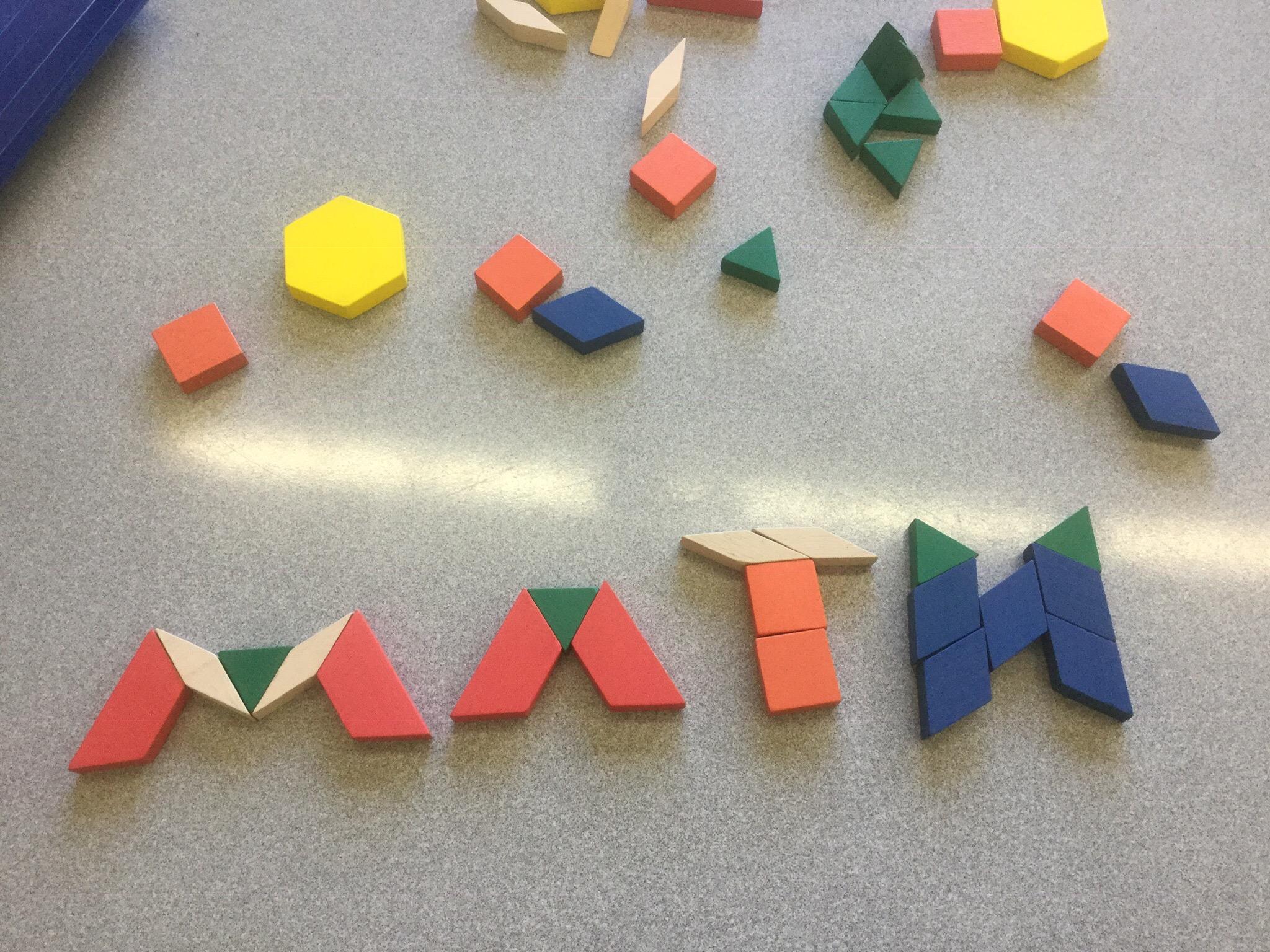
We saw rotational symmetry
Parallel lines, and symmetry about an axis.

We saw hexagonal based prisms…

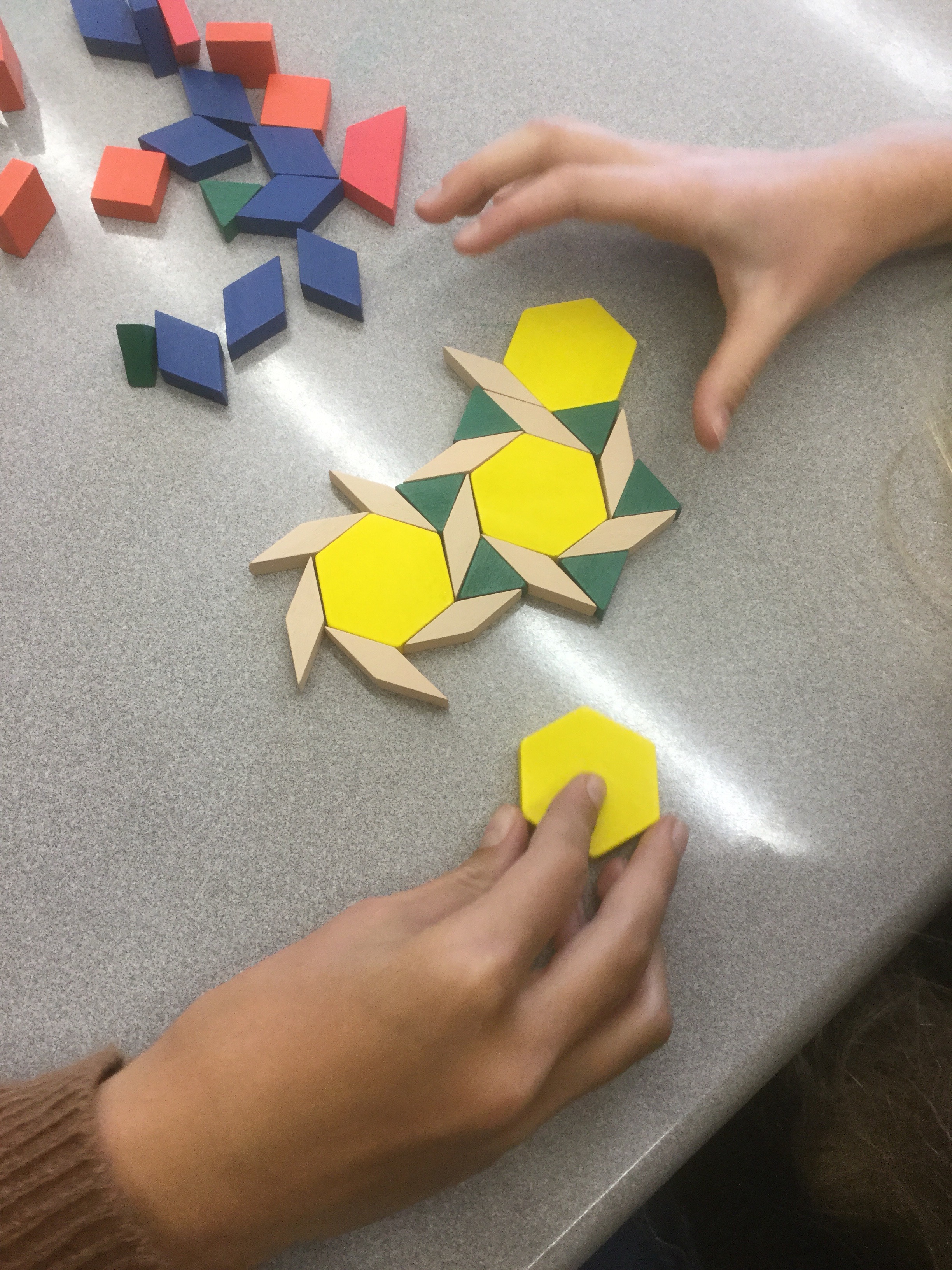
Proved that hexagons can be made up of trapezoids (red) rhombuses(blue) or equilateral triangles (green)

Some showed fractions….that 2 rhombuses are 2/3 of a hexagon….but so are a trapezoid and a triangle (which happen to represent 1/2 and 1/6 respectively) so we know that 1/2+1/6=2/3

We saw that honeycomb pattern made up of hexagons…and trapezoid combos

And when we ran out of those they were made of rhombuses and triangles too

Some made pictures…here’s a very symmetrical owl

Some patterns filled the space perfectly
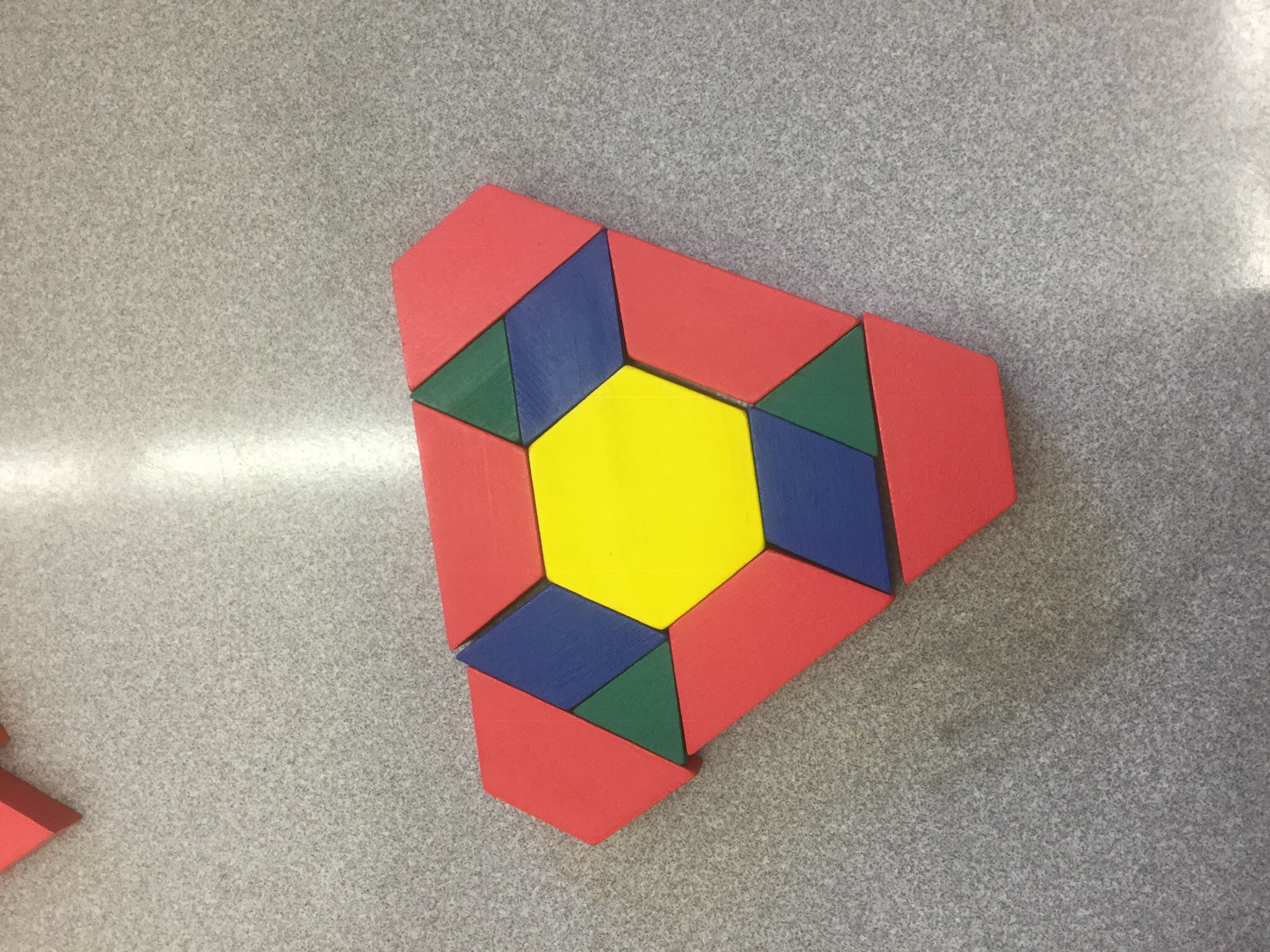
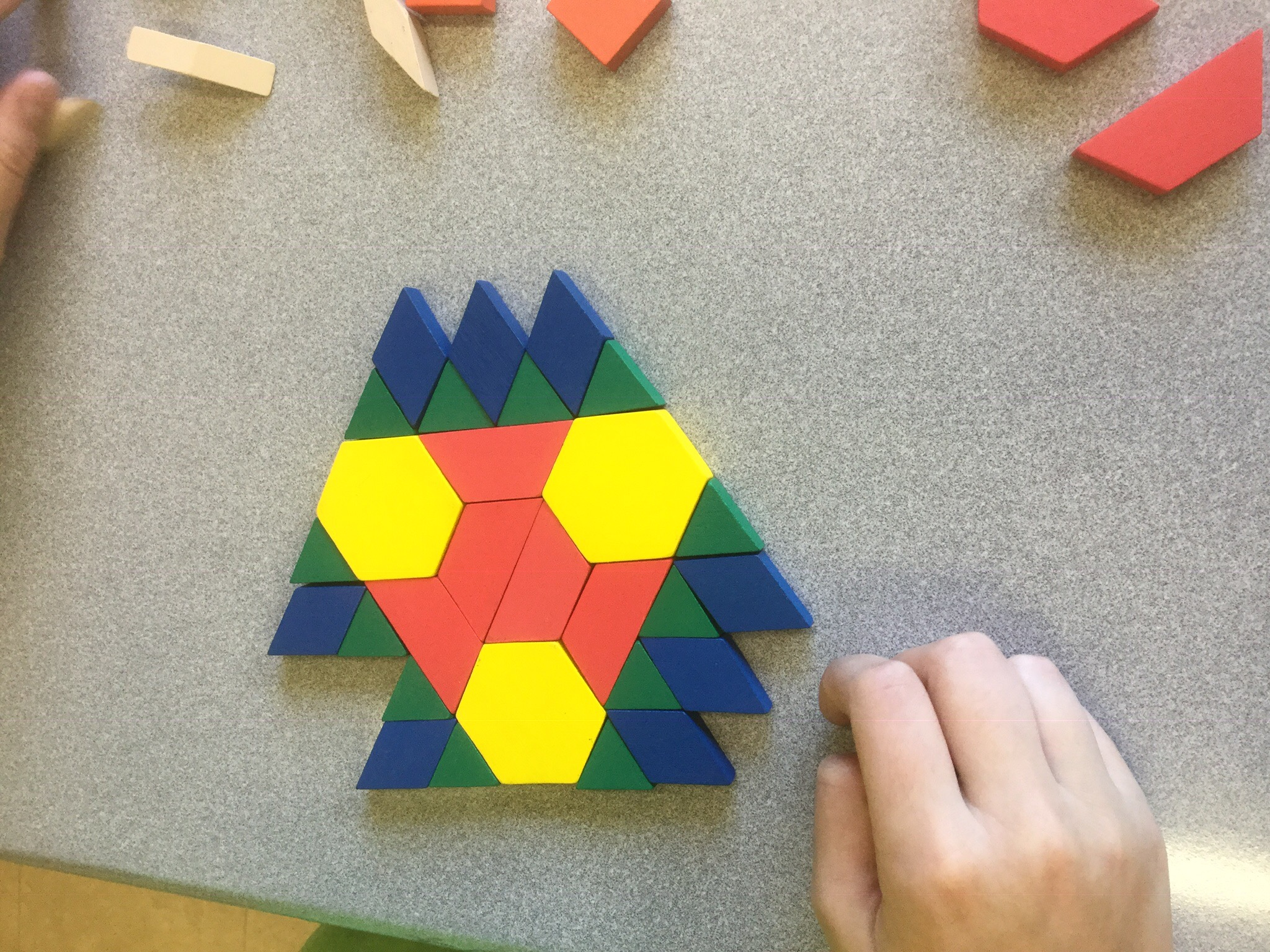
Others were showing patterns in rings.

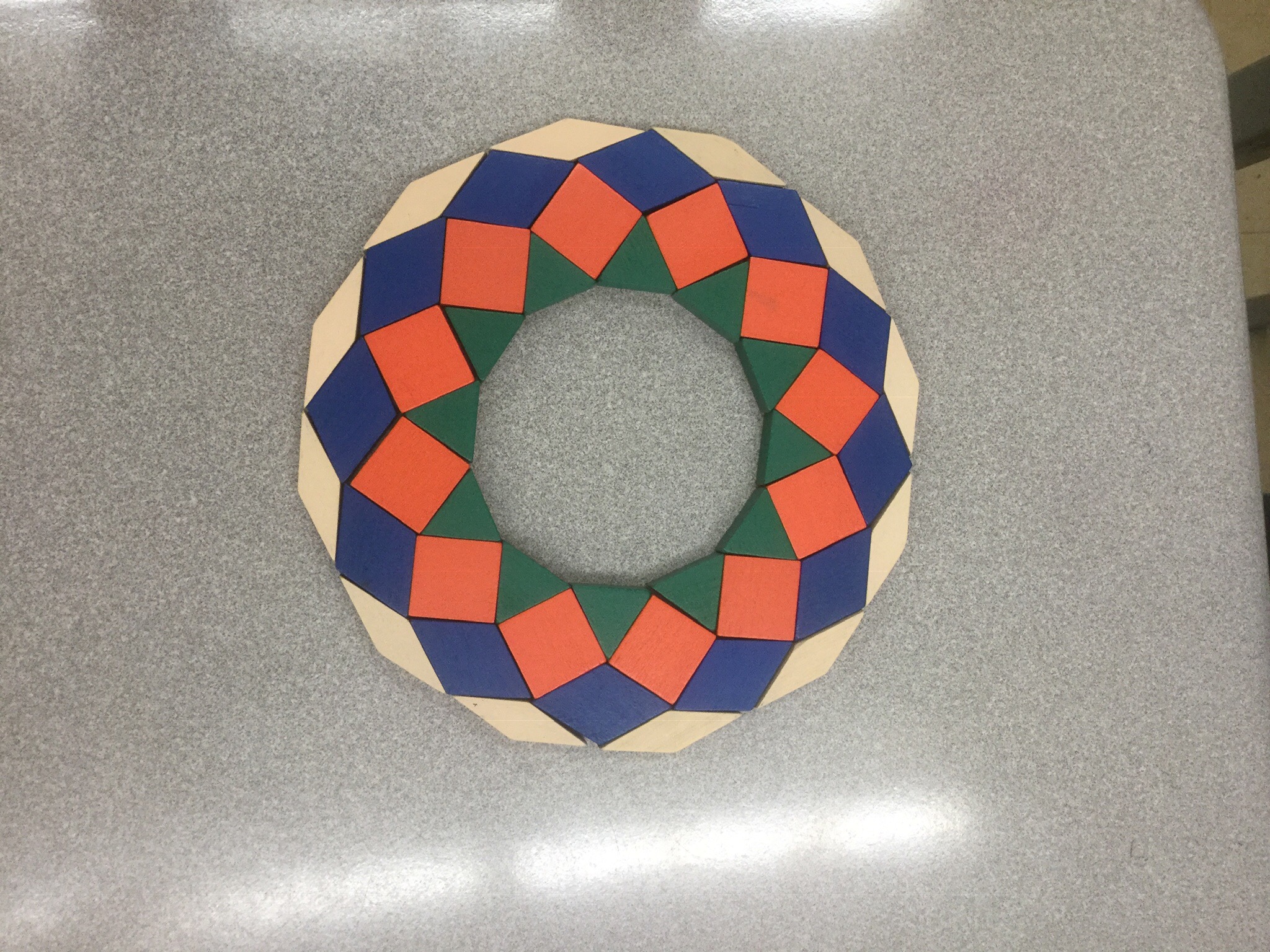
And some patterns looked like they were missing something. This one below caused some concern. Many people wanted to fill the gap beside the square. We wondered if a thin rhombus would fit.

We examined the rhombuses to see if we could figure out about the angles inside. We saw that 12 of them fill the whole way around the central point. We know that a full circle is 360 degrees, so each acute angle is 360/12 which is 30 degrees.

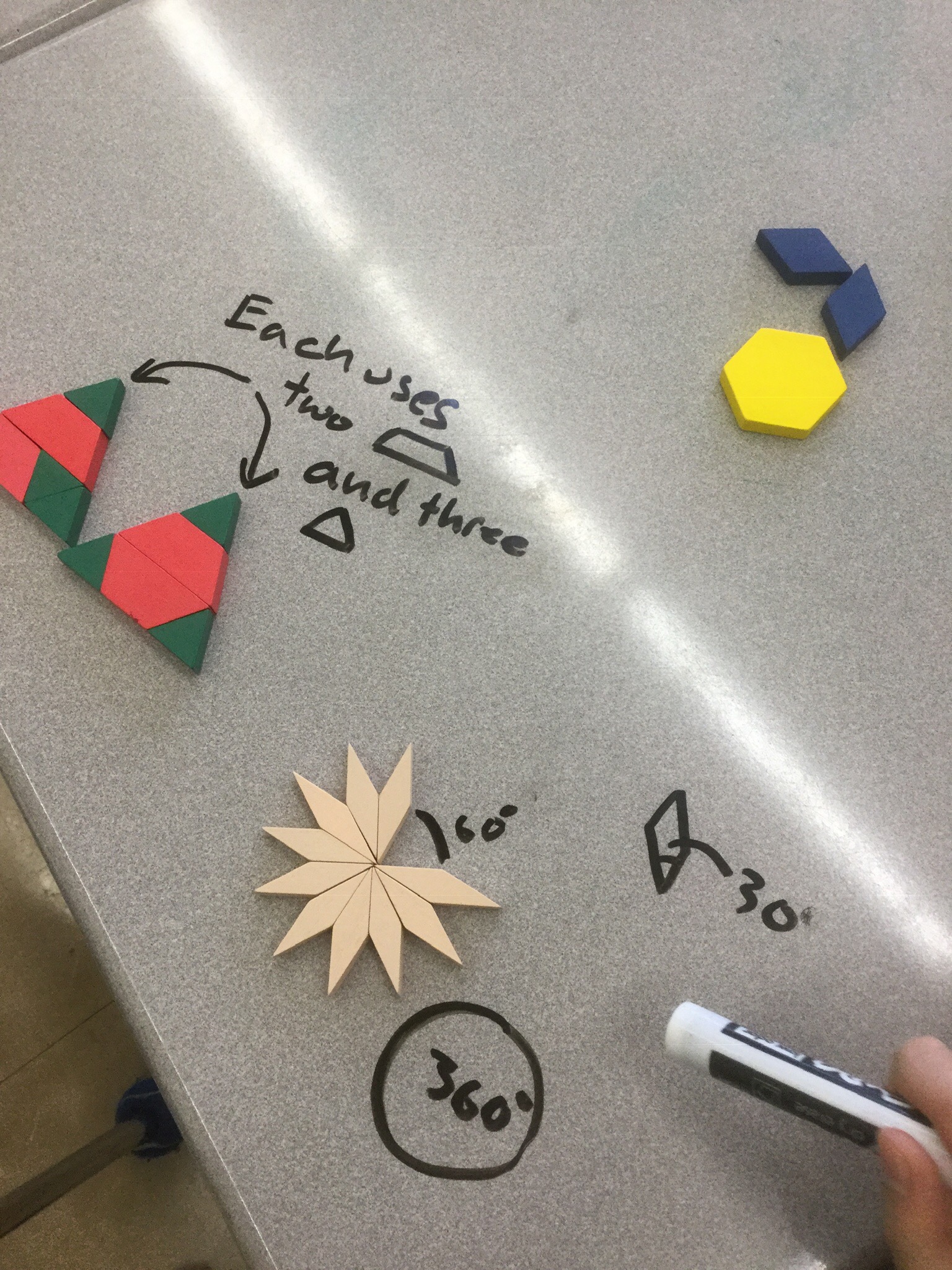
We know that a quadrilateral has 360 degrees, and if you remove two 30 degree angles, there are 300 degrees left for the other two congruent obtuse angles. Each obtuse angle must be 150 degrees.
We could go on and on about more angle discoveries…and we will be looking to do more this coming week.
Period B patterning
Period B got into patterning and polygons. We looked at how many degrees there are in a triangle. If we add up all the angles….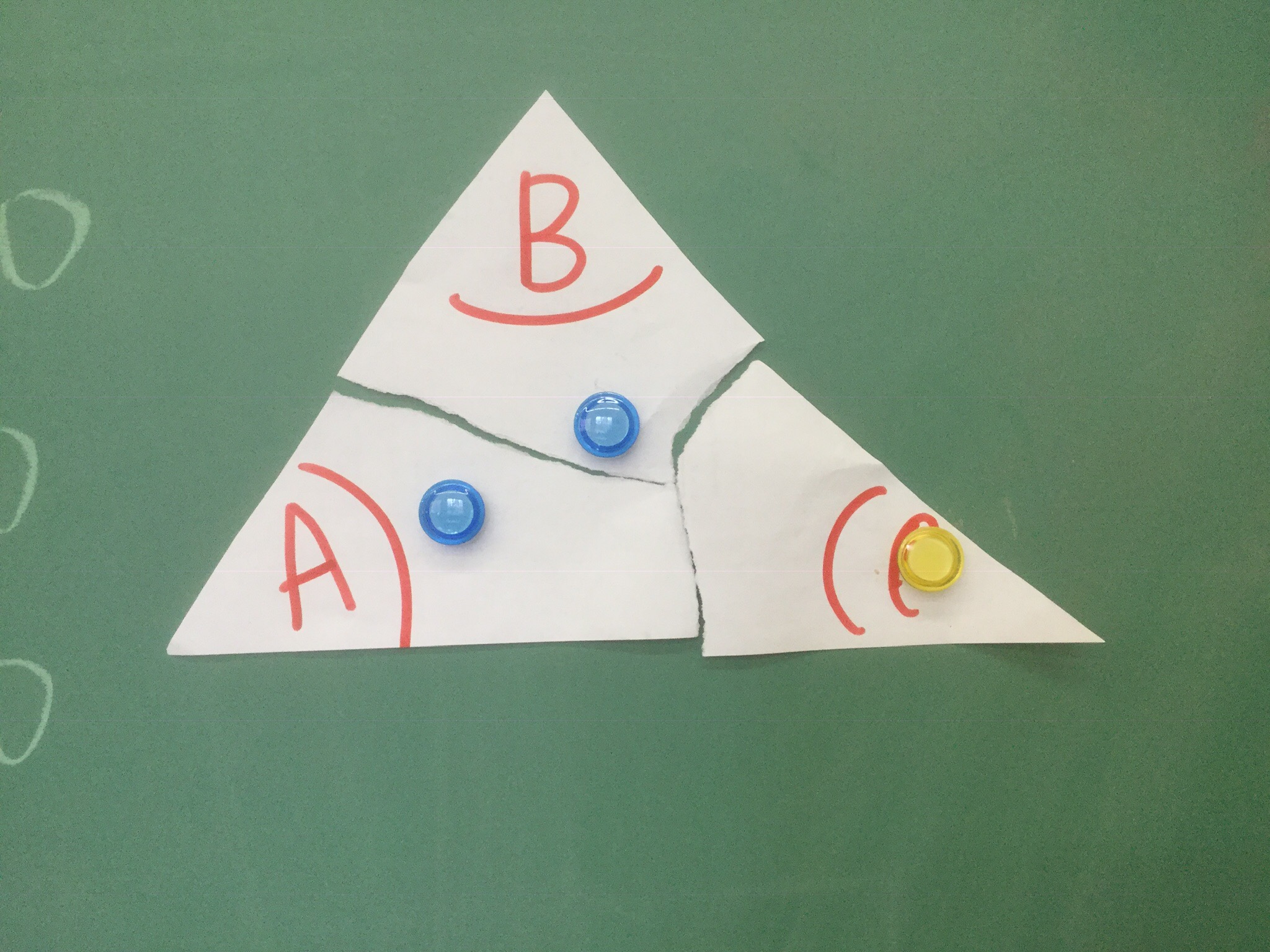
We get 180 degrees! The angles are supplementary, and make a straight line.

We looked at a lot of polygons. We drew diagonals from one point to the other corners.
We counted the number of triangles that we created too.
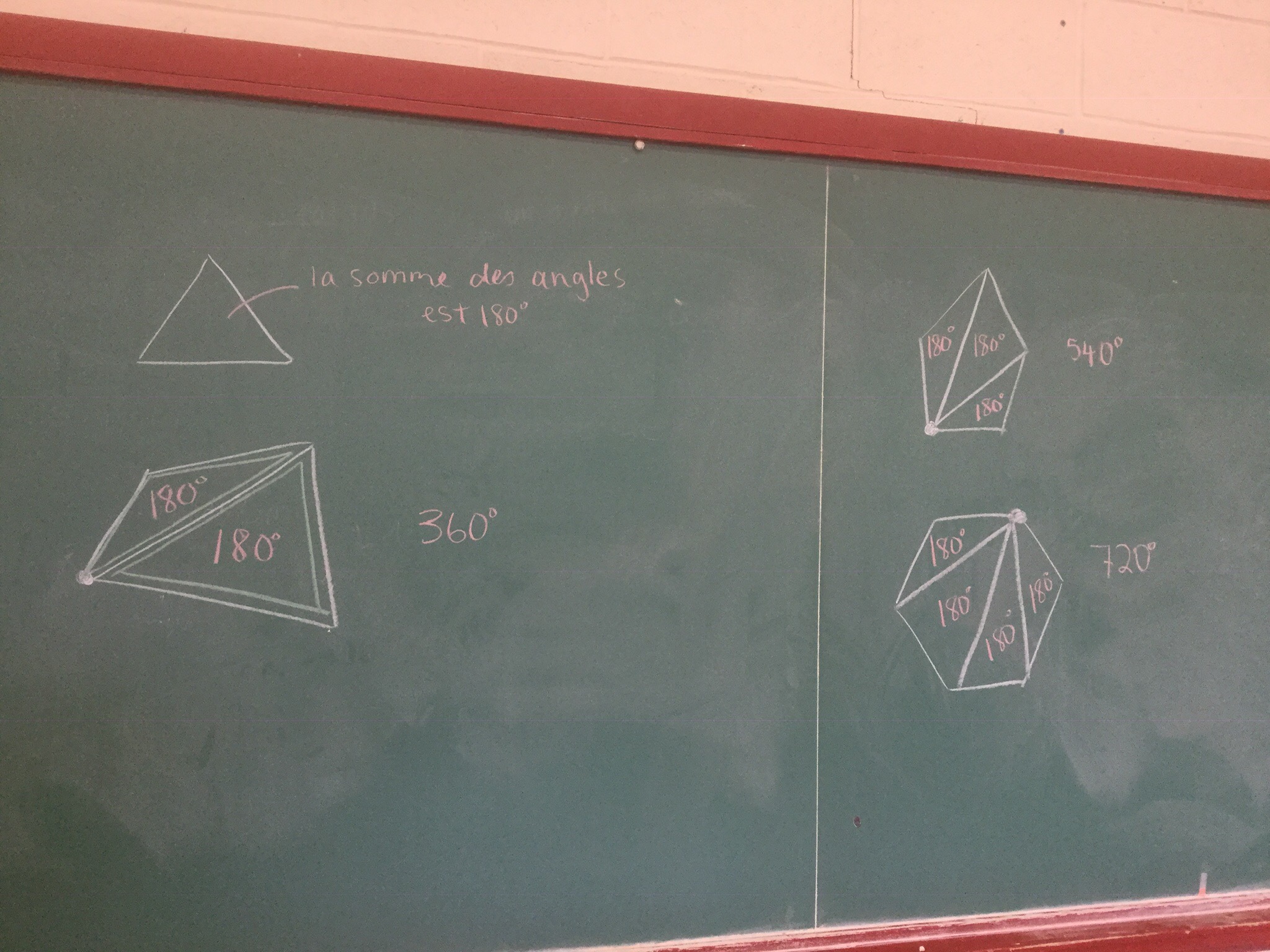
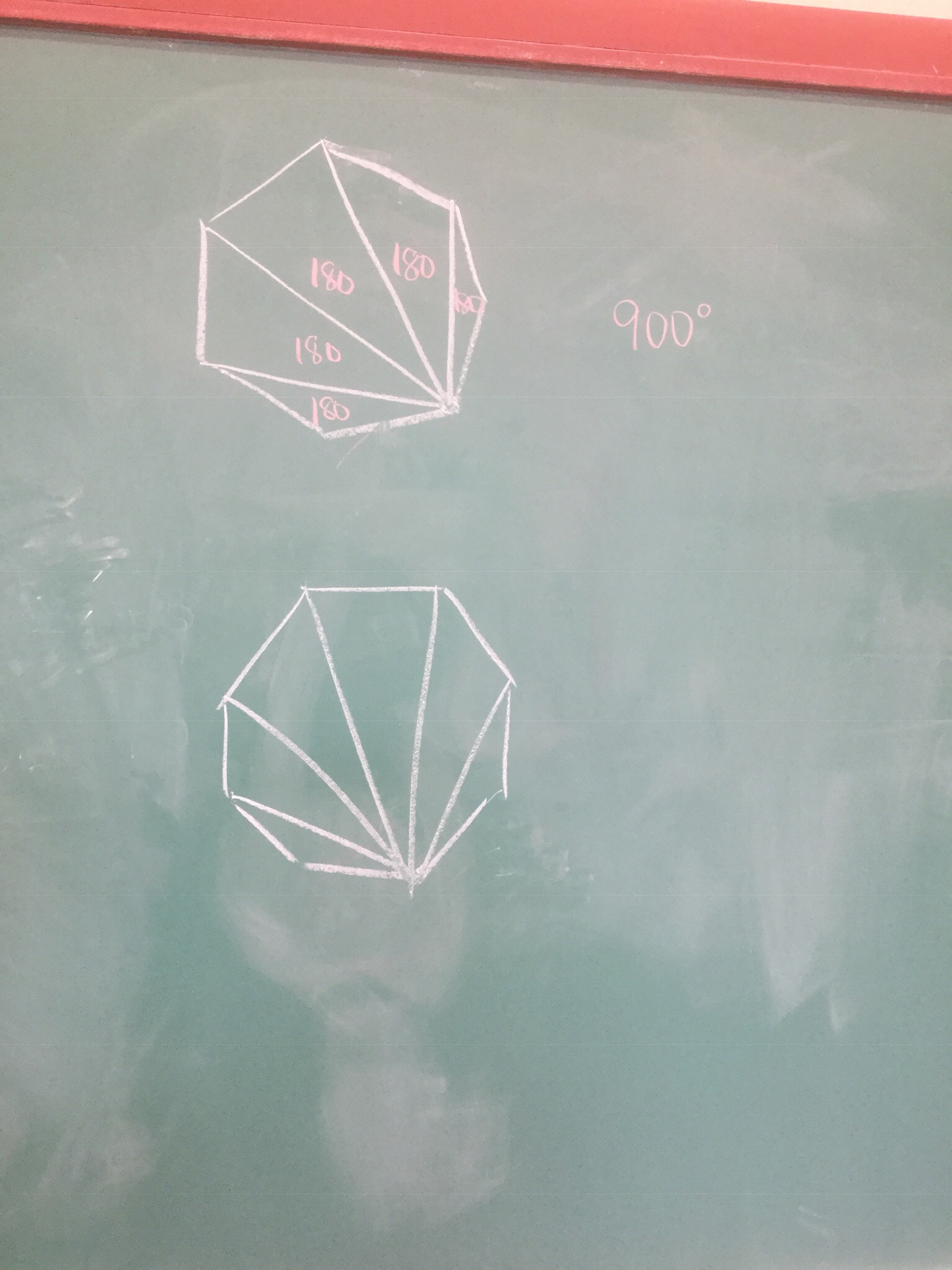
Here is the table for the number of diagonals, and the equation we made.

Here’s the table and equation for the number of triangles.

And then we did another table and equation for the number of degrees in the polygon.
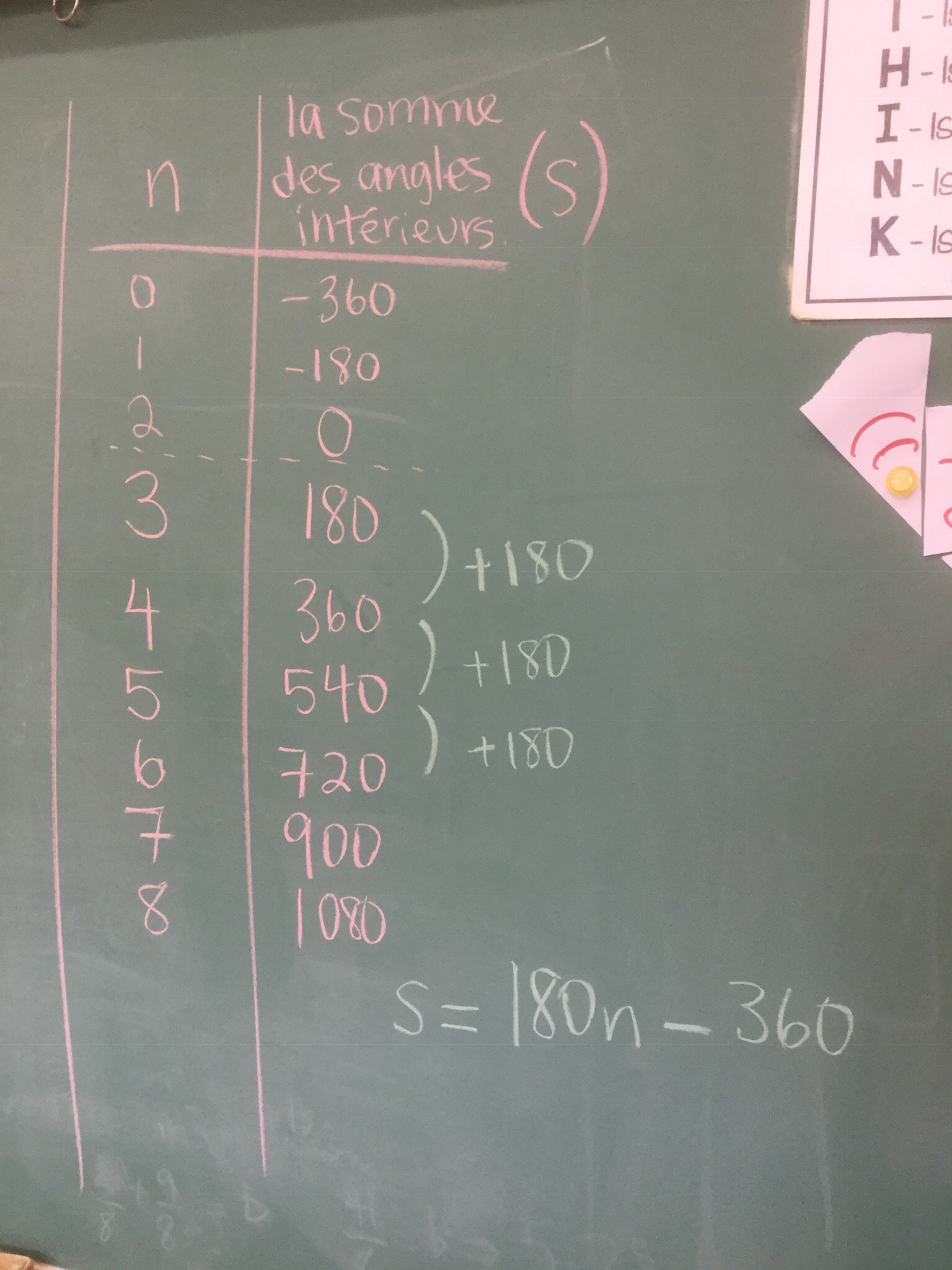
We then looked at if a shape had 100 sides, what the sum of the internal angles would be, and if it was regular (all congruent angles) what each angle would be.

We tried one with 1000 sides too!
As the shape gets more and more sides, the shape looks closer and closer to a circle. The internal angles get closer and closer to 180 degrees.
Practice EQAO
In grade 9 there is a provincial test at the end of the term. We are doing some practice today with multiple choice questions dealing with linear relationships.
We put the questions up on the wall, and had 4 minutes at each station to give them a try.


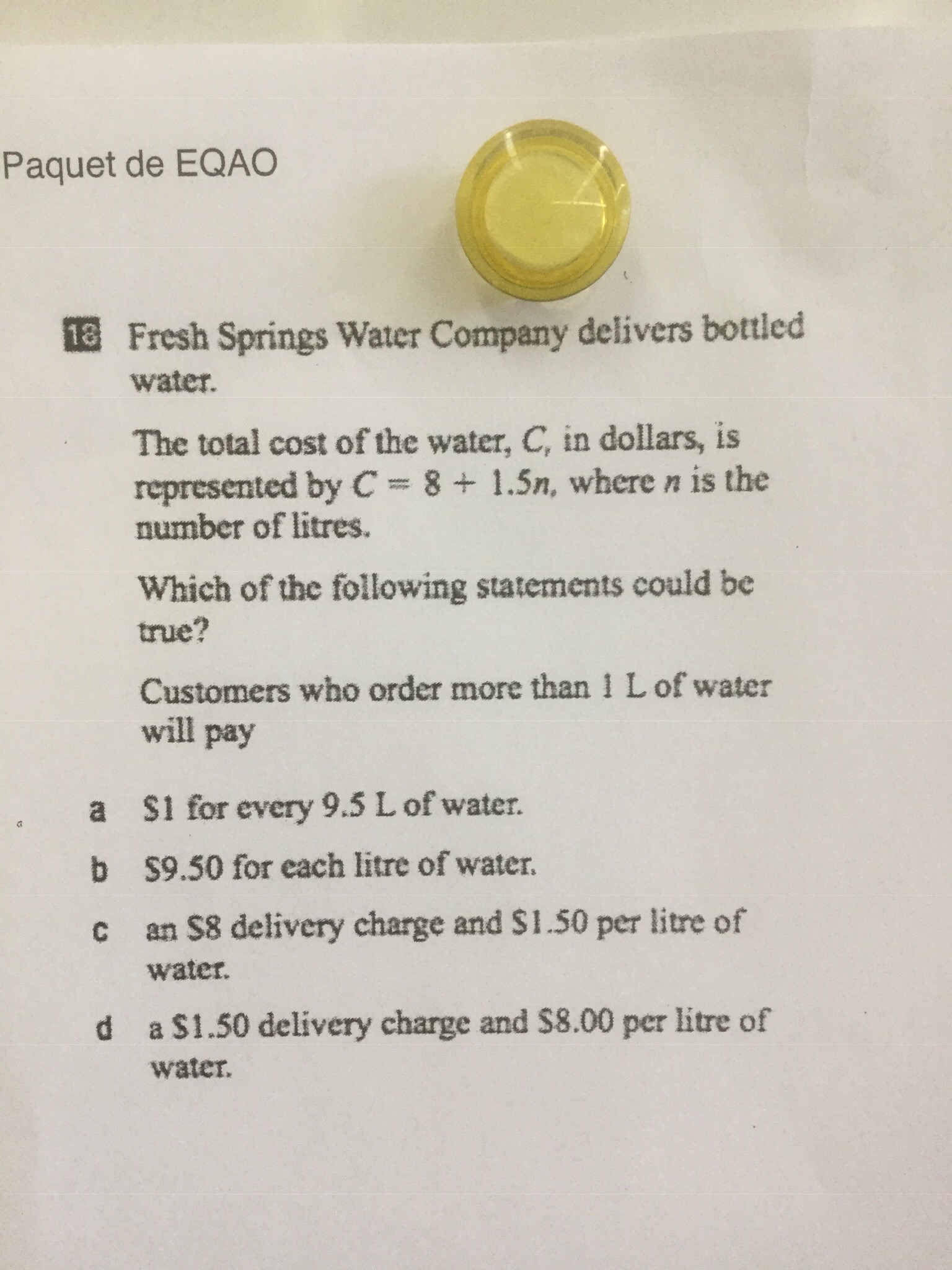


We are finding that sometimes we are missing key details when we read the questions. It’s important to read them a few times, and highlight key words.
With multiple choice questions we can work through them as we would normally approach a question, or we can also work backwards with the answers given. Sometimes we can eliminate ridiculous answers first and then think further.
Although we don’t HAVE to show our reasoning for multiple choice, it is often a really good way to verify our answer.

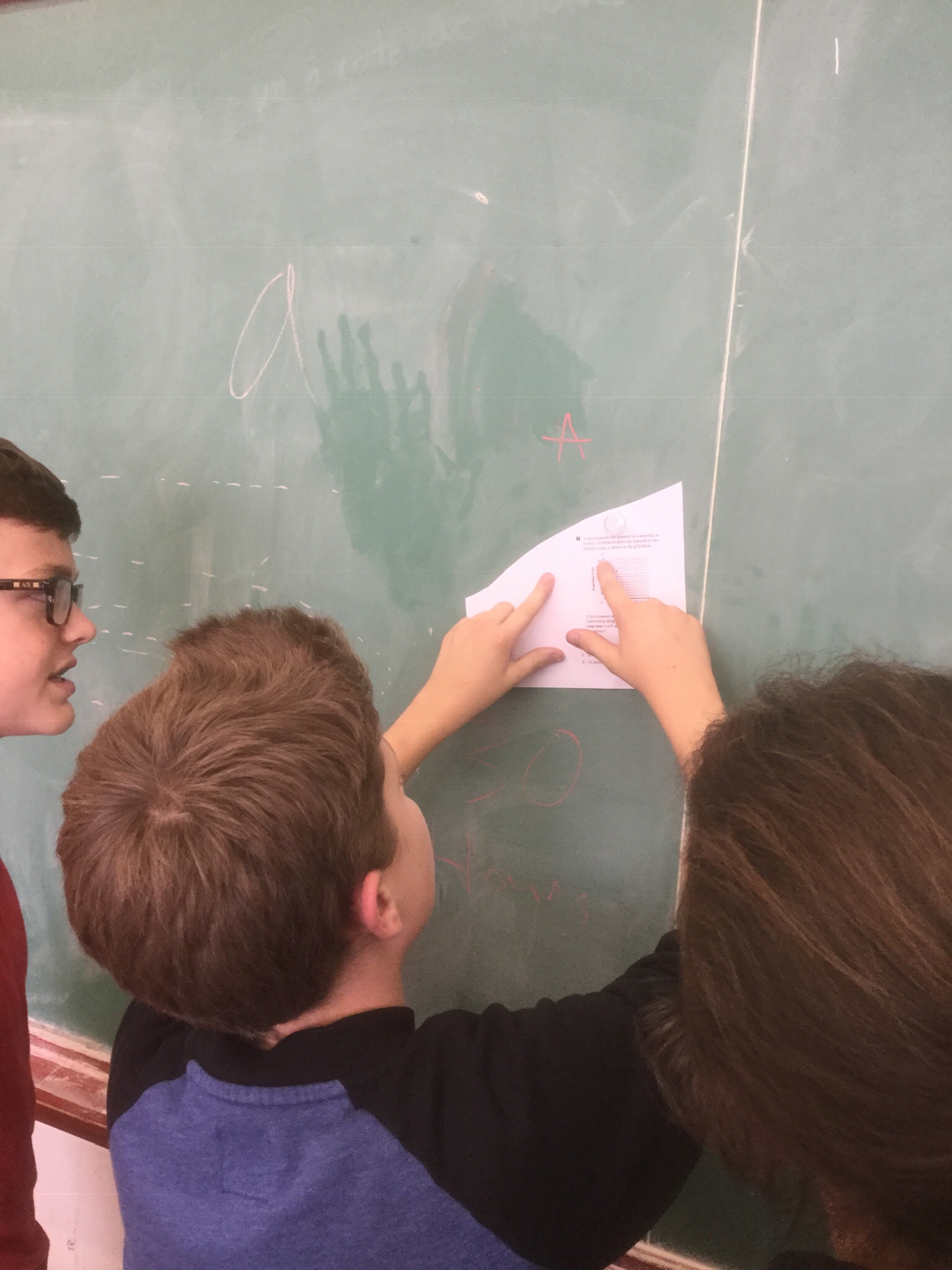
Sometimes it helps to draw on the question….to show where the line will go.
Past years of EQAO tests are available on their site. Note: we write the English version of EQAO.
Understanding all the words!
In grade 10 we are working on verifying and proving different scenarios using analytic geometry skills. We need to first understand what the question is asking. As we read through, we need to interact with the question. The question words will make us think of related things, and prior knowledge. Here’s an example of all the added things we can include for the following question.
In English the question asks to verify algebraically that if the midpoints of adjacent sides of a quadrilateral are joined a parallelogram is created.
We set out to draw quadrilaterals, and join up the midpoints, and then use our math skills to prove that the new shape is a parallelogram.

We are working well with graphical models, and are practicing a lot of our calculations.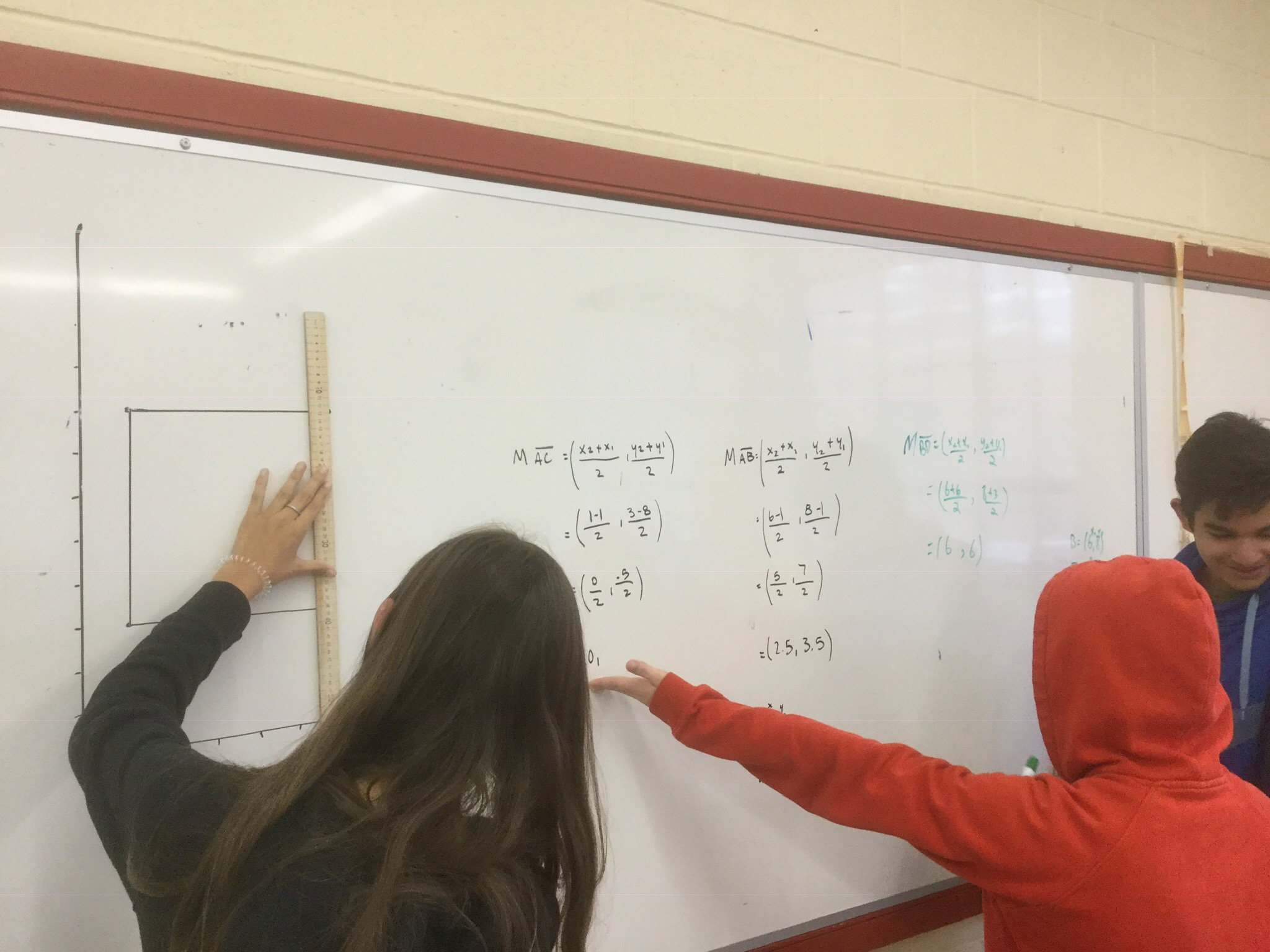
Desmos geometry was very helpful for a conceptual visual proof. We can construct a model on the screen, and drag points around and watch that the middle shape remains a parallelogram.
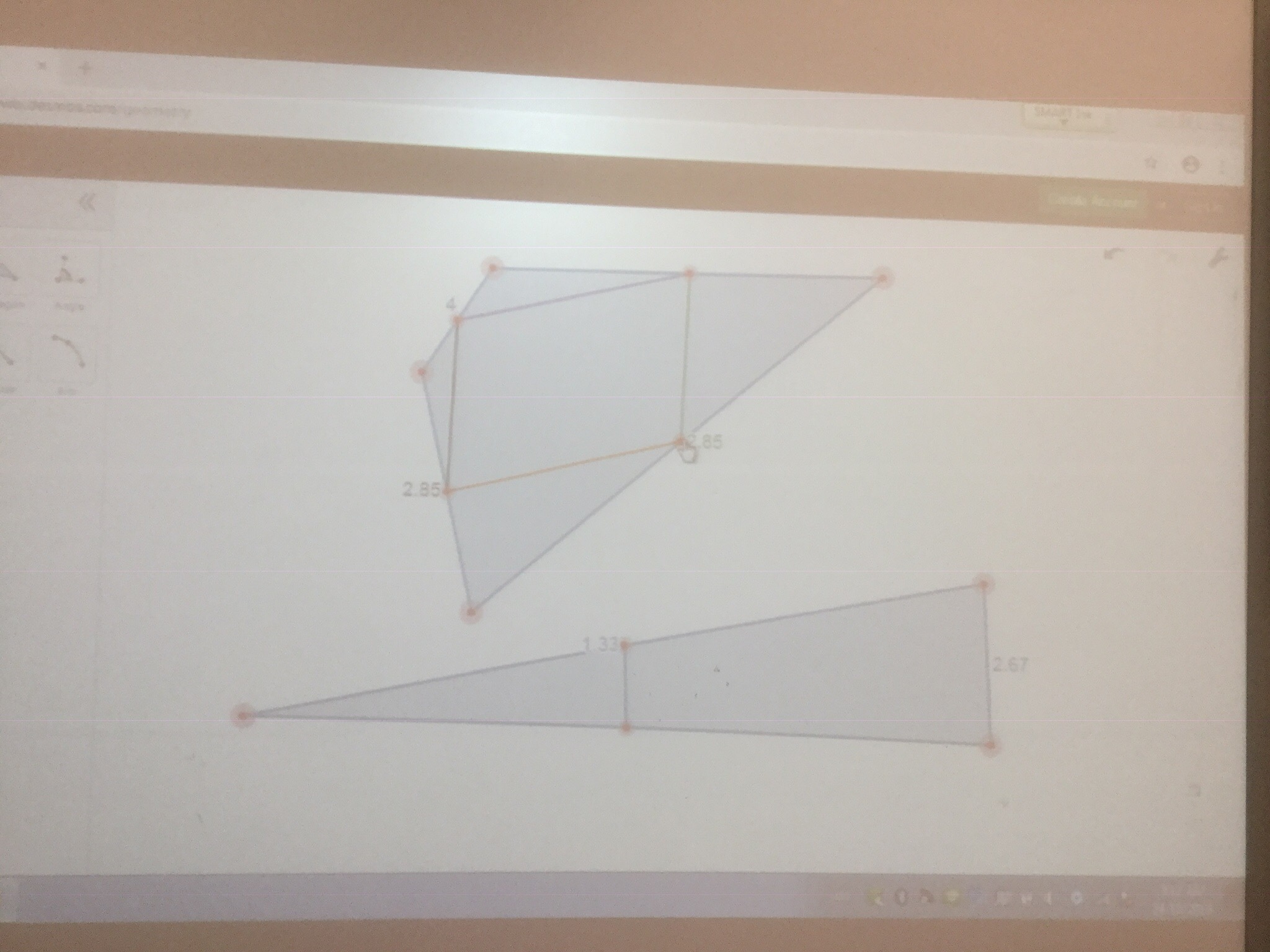
Our second proof involved joining midpoints of 2 sides of a triangle, and comparing the segment created with the 3rd triangle side. The segment is parallel and also half the length.
Making Connections
In grade 9 we used a graphic organizer today to consolidate our understanding of the multiple representations of linear relations. We colour coded the constant and the rate (taux) for each representation. 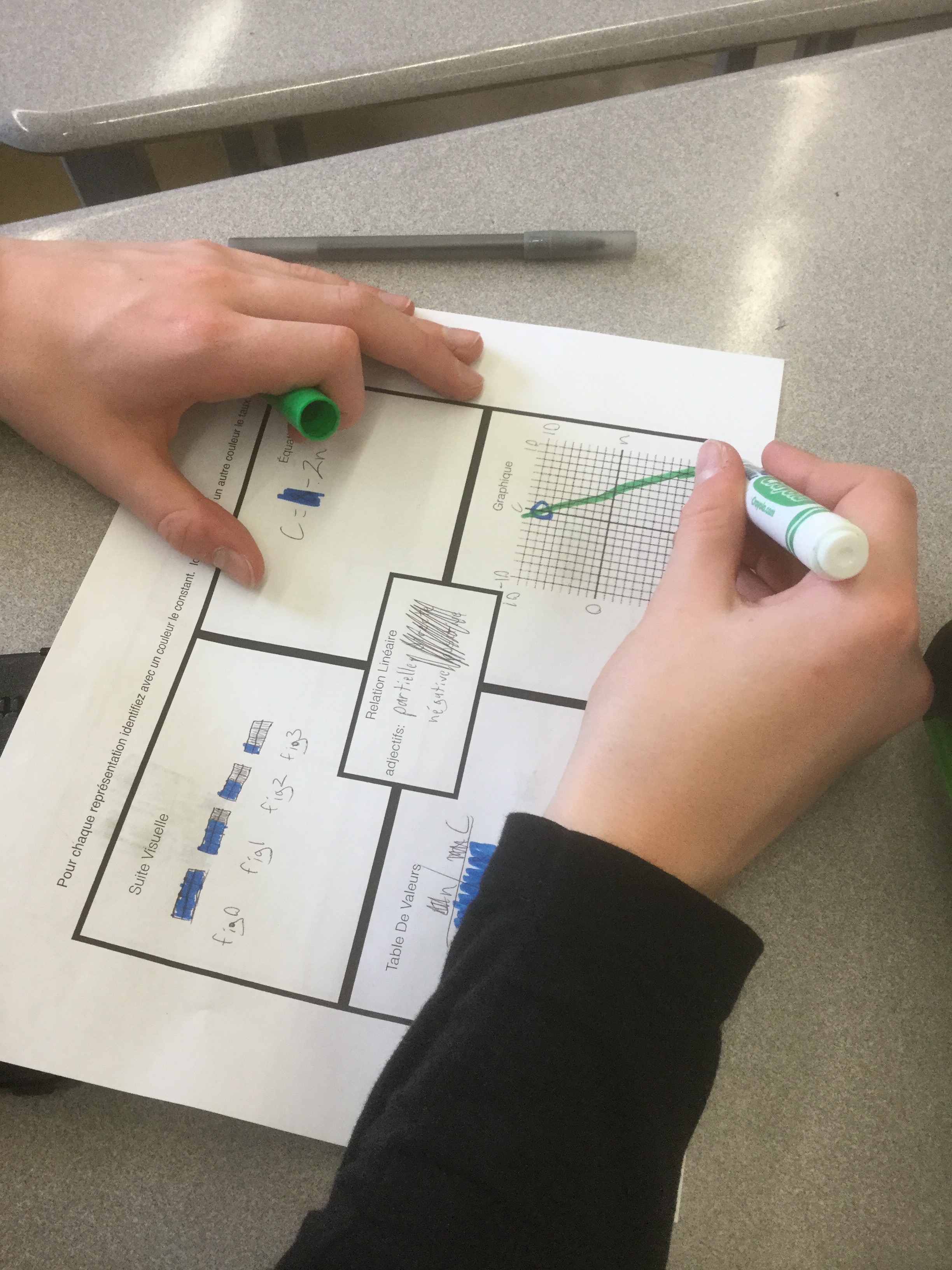
Here’s another example.

We next used our knowledge to try some past years’ EQAO questions. (For more check here)

We made graphs from tables, and made equations to go with them.
We made best fit lines (droite ajustée) for graphs, and then made equations for them.

With all of this practice we are getting better at solving problems with a context.
Good work grade 9s.
Quadrilaterals and their diagonals
We looked yesterday at how to classify quadrilaterals using their side lengths and slopes. Today we are looking at properties of their diagonals. We drew squares, rectangles, parallelograms, rhombuses (“losanges”), trapezoids both isosceles and not, and kites. We compared their 2 diagonals to see which ones have diagonals that are perpendicular, congruent, and have the same midpoints.
If we can make sense of this, we can cut our work in half! 2 diagonals are quicker to analyse than 4 sides.
It’s good to review all of these skills because we will need to do these on the summative.
Our summary:
Congruent diagonals: square, rectangle, isosceles trapezoid
Perpendicular diagonals: square, rhombus (losange), and kite
Diagonals with the same midpoint: square, rectangle, parallelogram, rhombus (losange).
Upcoming summative Grade 9
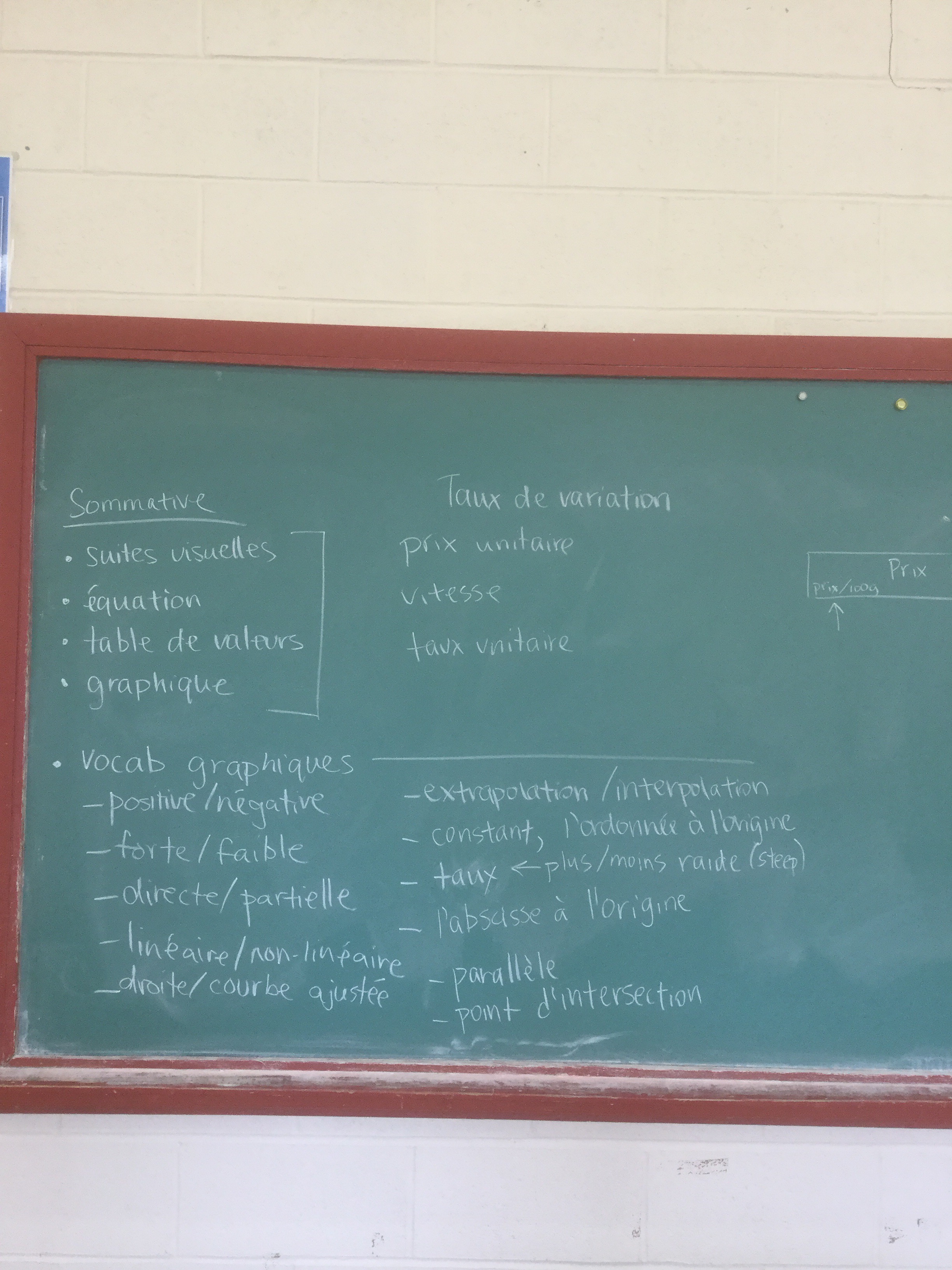
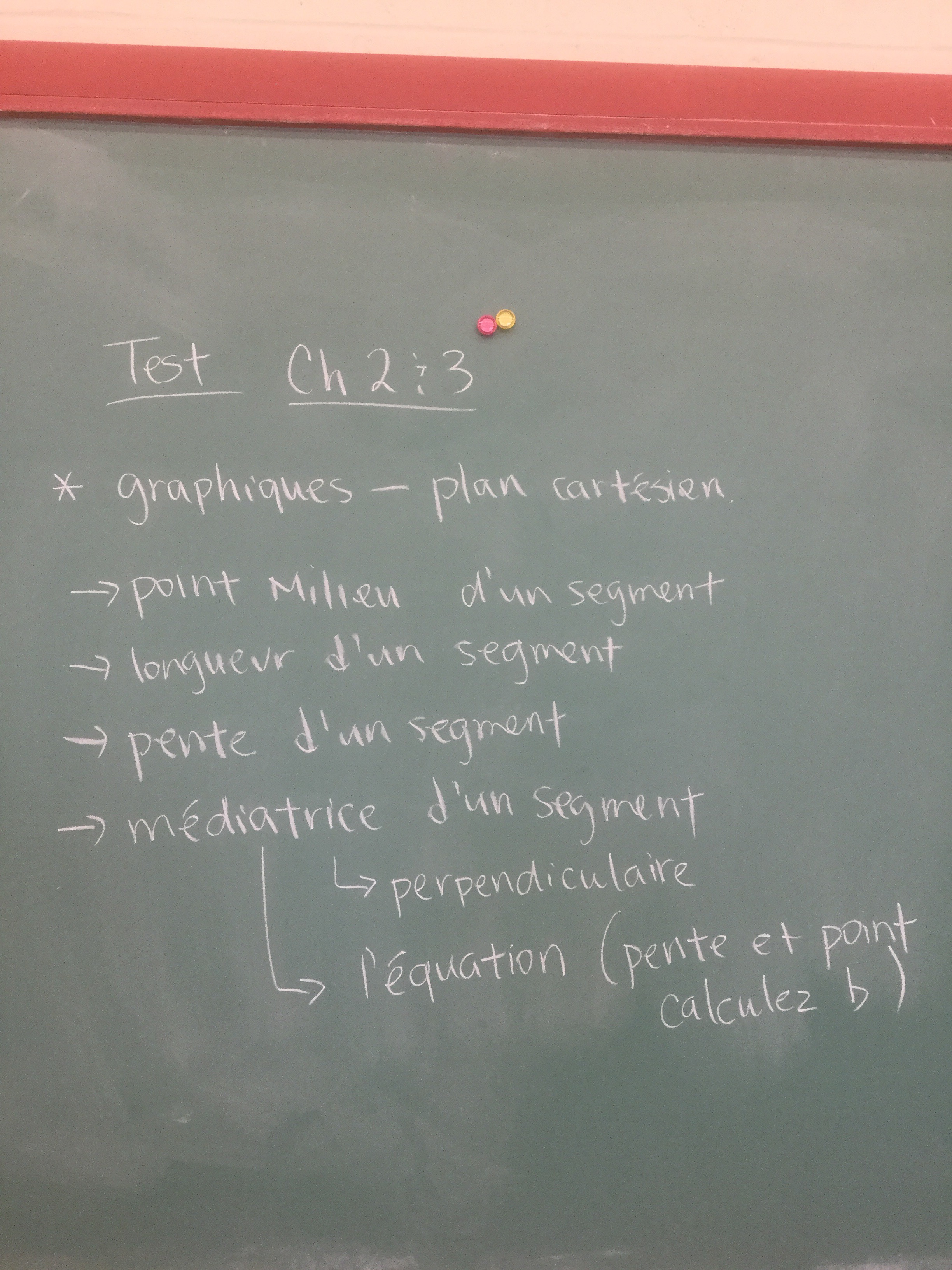
Grade 9s, your next summative is on October 30. Here are the things you will need to know. Review your notes. Ask for help if needed.
Upcoming Summative Grade 10
Grade 10s, your next summative is October 30. This next week is busy with leadership camp, cross country, and a PA day, so start your reviewing now. You are responsible for chapters 2 and 3 in our text. There are great chapter review questions and a model test for each chapter in the book.


Technology in Grade 9
Today’s technology in grade 9 is the spreadsheet. We used google sheets, but excel does similar things too.
We put data into the table on the spreadsheet, and learned how to make a scatter plot. We formatted the graph and added titles. We explored trend lines, and saw how a linear fit isn’t always the best model for real world data. For beans that did show linear growth we inserted a trendline “droite ajustée” and looked at the expression that the computer gave us. We recognized it has 2 parts, one is a constant, and one is the rate. In this case the blue line has a constant of 14.1 which makes us think the bean was initially 14.1cm when it was planted, and the rate is 0.262 cm/day of growth.

We are making graphs of our beans using google sheets and working on making good models to fit their growth to predict their height next week.

Technology in Grade 10
Today in grade 9 and 10 we were working with some new technology. Grade 10s were using the desmos geometry website to visualize some of our recent concepts like perpendicular bisector (médiatrice) and median (médiane). In French these words are so similar that they are often mixed up. We need a lot of practice and a good visual sense of what they are.
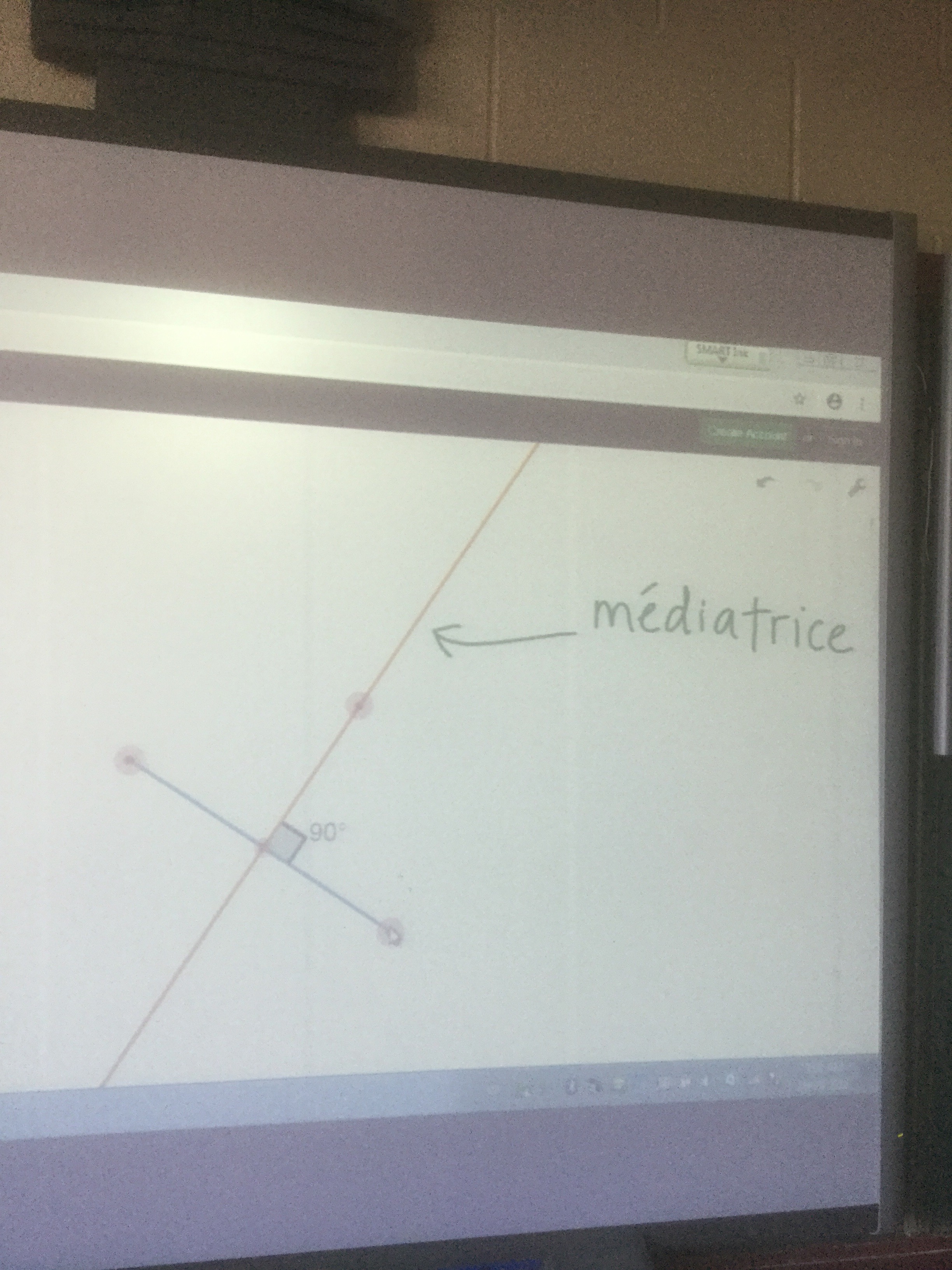
We could see that for isosceles triangles the “médiane” and “médiatrice” are the same for the non congruent side (it’s perpendicular to the side), and for an equilateral triangle all of the “médiane” and “médiatrice” are equal.

This program is great because you can construct something and then drag points around and see how the concepts are visually related.
Here’s a wordy question that we tried. “Show algebraically that the perpendicular bisectors of the legs of a right triangle intersect at the midpoint of the hypotenuse.”

We analysed what the words told us, and what pictures came to mind. We can show graphically that it is true.
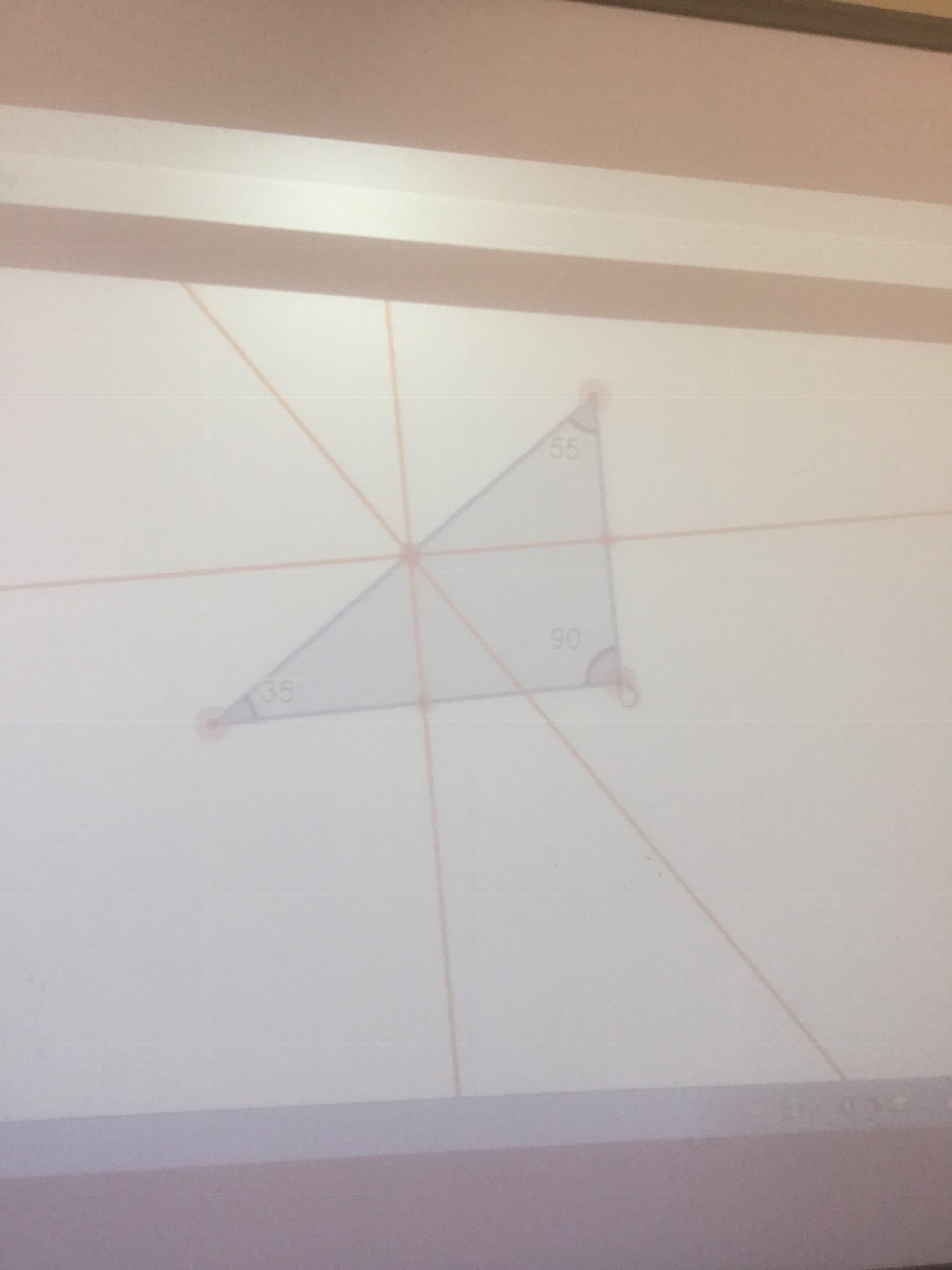
And with some strategic calculations we can also verify algebraically.

 Ms. Bearse's Site