Gr. 10 Quel côté gagnera?

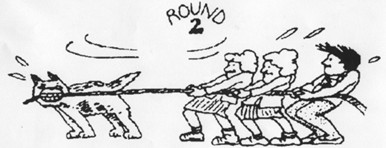
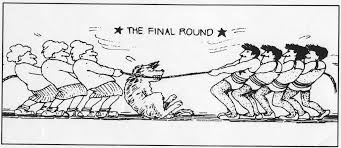
Grade 10s explored this problem today. In Round 1 and 2 the tug of war is a draw (nobody wins). The question is to determine who will win the final round, and to justify it sufficiently.
Many groups created equations and introduced variables, and solved the equations to determine which side would win.

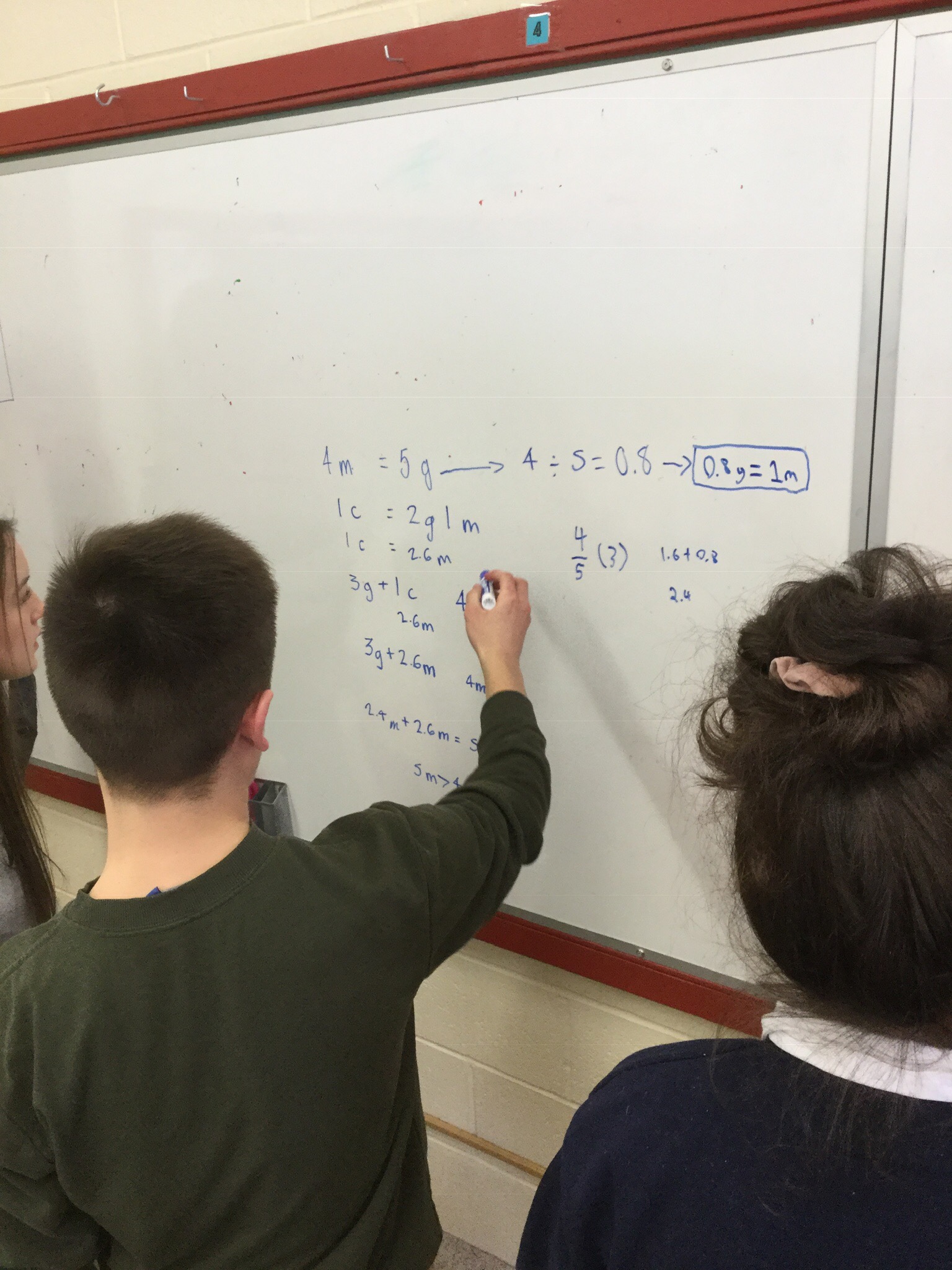
We are using ideas of ratios and fractions and decimals, and showing important information in boxes.
We’re working towards clear communication, and solid justification of our answers.
We ended up with a different question.
6 hamburgers and 5 drinks cost $30
10 hamburgers and 3 drinks cost $32
Determine the price of a hamburger.
Grade 9 Sky Scrapers
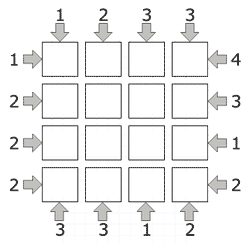
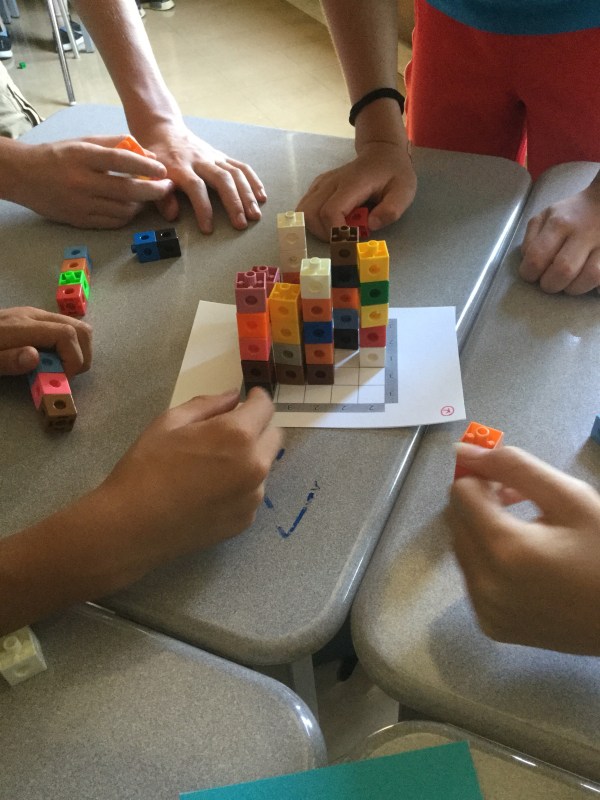
We tackled the sky scrapers puzzles today using our linking cubes to build our buildings. The rules are that each row and column can have only 1 building of each height. The heights are 1,2,3,4 for a 4×4 matrix. The grid has numbers on the sides which indicate how many buildings can be seen from that position.
We needed to work as a team to see all perspectives of this problem and verify our finished arrangement.
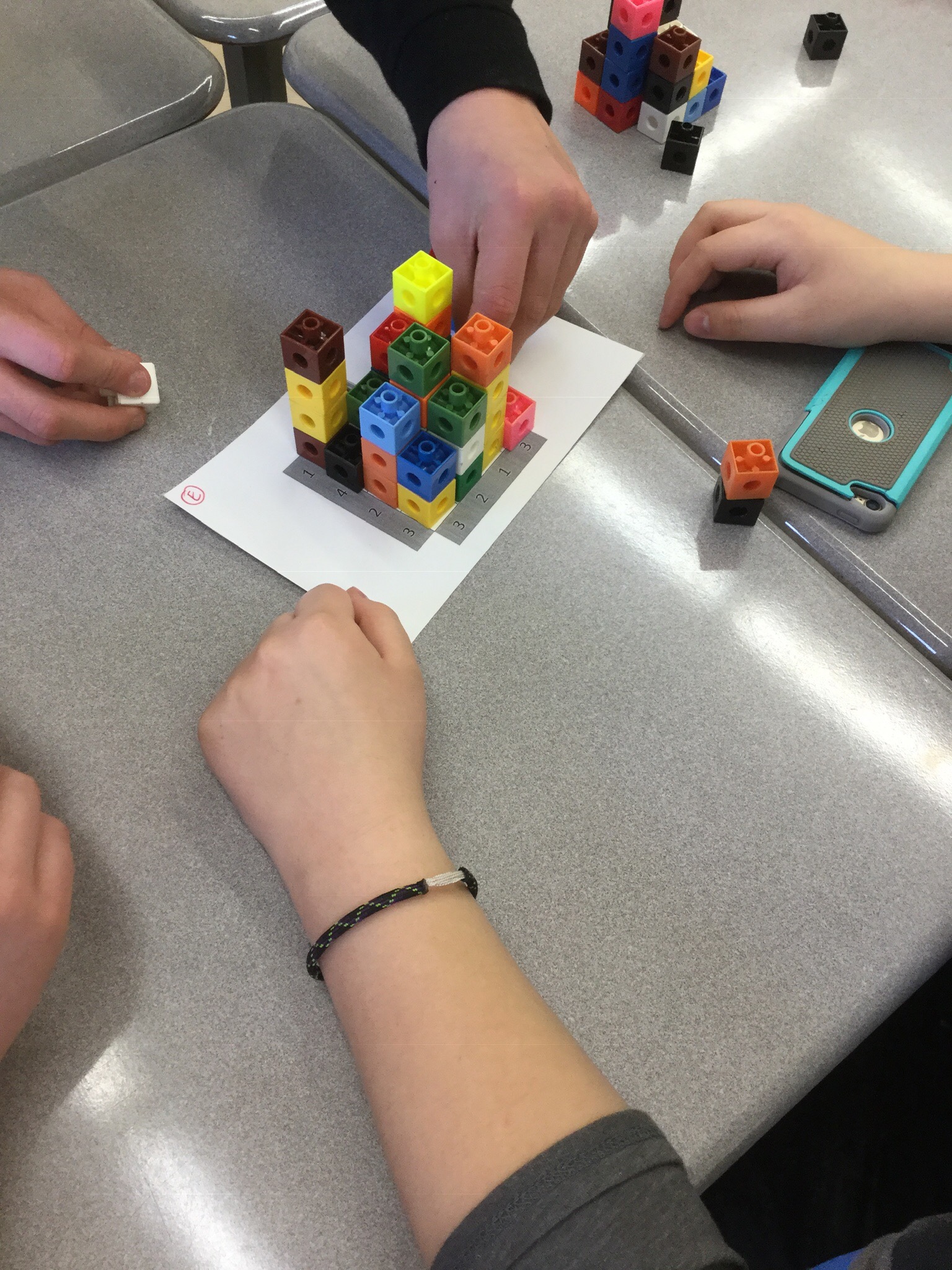
We tried a 5×5 puzzle when we mastered the smaller ones.
Good work today!
Skyscrapers en 9e
Voici un casse-tête: une grille avec les carreaux. Chaque carré représente un édifice. Chaque rangée/colonne peut avoir un édifice de grandeur 1, 2, 3, 4 étages. Les nombres représentent le nombre d’édifices visible de cette endroit.
Voici un exemple d’un groupe qui est en traine de résoudre le casse-tête.
Voici plusieurs casse-têtes de skyscrapers que vous pouvez essayer.
Final preparations
Grade 9s worked on interview skills today and practiced answering questions that we may discuss during portfolio interviews.
We made 2 circles, and spoke for 30 seconds to answer the prompt, then our partner had a turn to answer.

We answered questions like “what was your biggest challenge this term?” Or “what was your organizational strategy that helped you”, or “how did you use collaboration to help you” or “what was your biggest lightbulb moment”.

We worked on listening carefully and being able to give feedback like a sandwich (positive, area for improvement, and then positive again).

We will come in and do 5 min discussion of our learning and growth as problem solvers for our interview over the next 2 days.
We ended off with “oh the places you’ll go” a great book to read every year!

Thanks for the great semester everyone!
Well…this is wild!
So this is the 3rd day of bus cancellation. We have a plan. Class will run on Thursday, and the exam schedule will be bumped by a day.

Swimmers, our meeting is now rescheduled (again) to Thursday at lunch. Come with your forms and money for EOSSA. If you have not yet signed up for races, please do so now! Email me, or contact Brooke.
Grade 10s that means your test is thursday, exam is Friday morning at 8:30.
Grade 9s that means your interviews are on Friday afternoon and on Monday. Here’s the handout you’ll get tomorrow if you want to have a look now.


The school is open today. If you are coming, please be safe. If you are not coming, I’m available by email if there are any questions.
Tuesday January 22
 Triboard transportation has been cancelled yet again due to the cold temperatures. Schools are open (but a bit cold, so dress warmly if you are coming). I will be available by email to help out if you are staying home. Culminating assessments are going to be pushed to Wednesday.
Swimmers here is the OFSAA form that you need to bring signed to our meeting on Wednesday at lunch: release_of_liability_form
Grade 10s: I hope you are all working on review! mpm2d3 exam review 2019. Your test will be Wednesday.
Grade 9s: The final task has been cancelled, and we will spend our time preparing for excellent interviews, and completing our portfolios.
Monday January 21
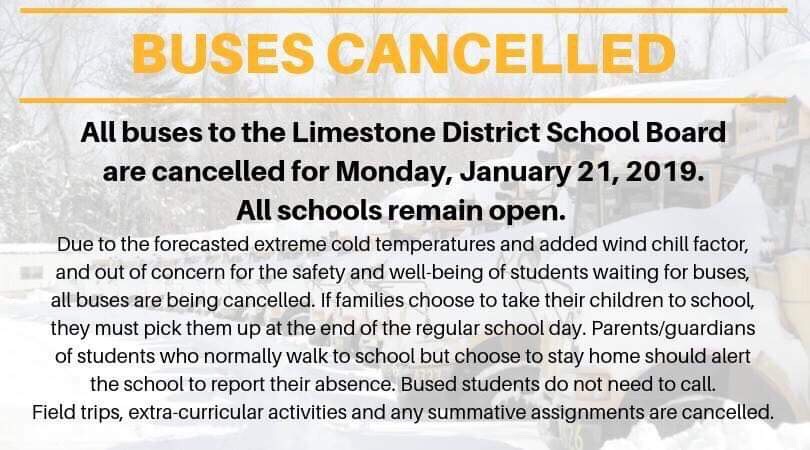 Grade 9s, your task is cancelled, and grade 10s your test will be Tuesday.
Stay warm everyone! If you can get to school safely and want to get caught up on work, or ask questions, please come find me in our classroom. It’ll be toasty warm in there (as always).
I will be reachable by email if you are working from home and have questions.
What a week!
Grade 9s have worked incredibly hard (and ate a lot of cake) this week. They have finished EQAO testing and should be proud of their accomplishments. Test scores look pretty high over all. Final EQAO results will be available at midterm in the fall, but for now we have good estimations, and reasons to celebrate.
I am proud of everyone for their excellent attitude, perseverence, and collaboration over the course of the term. We have done a lot of thinking about our learning, and reflecting on what helps us, and where we tend to make mistakes.
We are better at reading questions, picking out important information, asking good questions, communicating our reasoning in multiple formats, knowing that if we get stuck there’s more than one path to get to the answer, and being able to ask for help when we need it.
Today we prepared for our culminating task. We looked at the following photos.
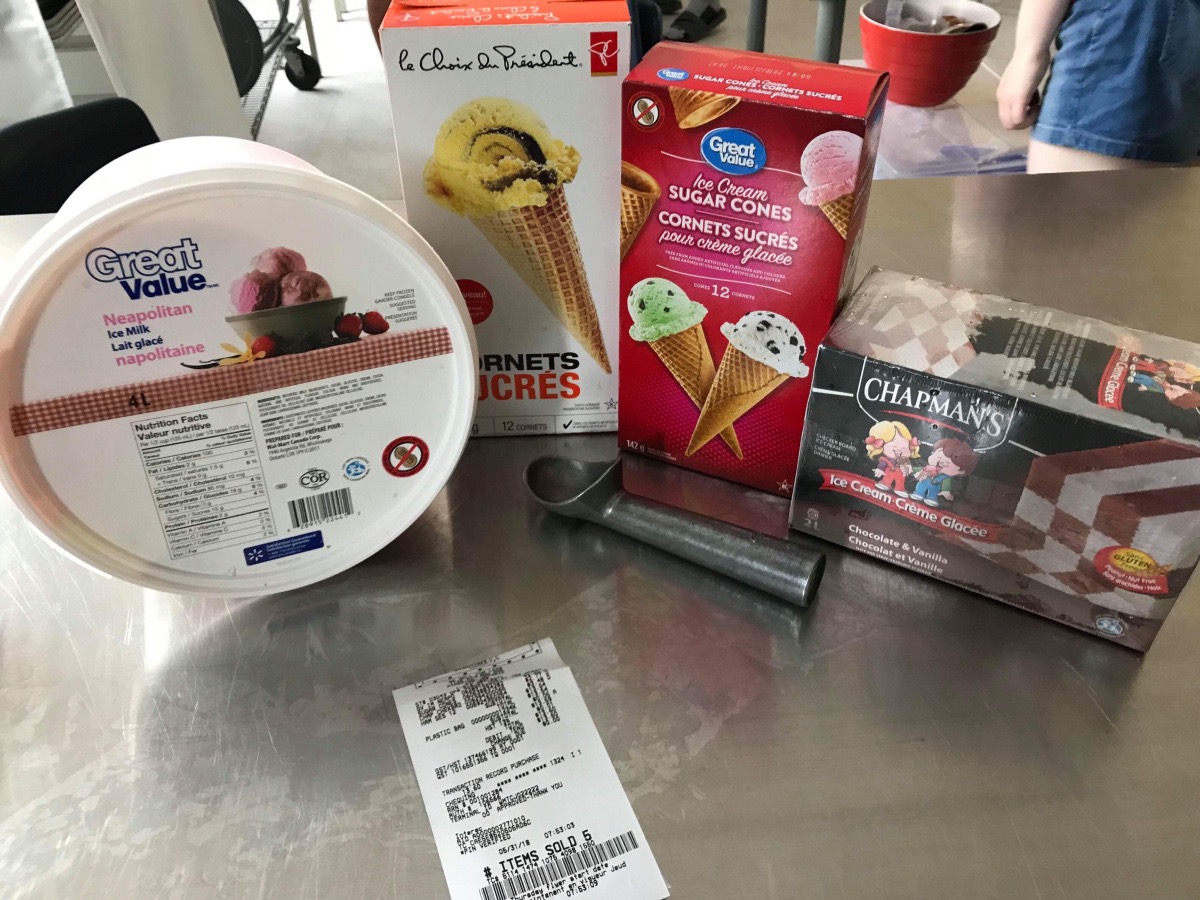

And we noticed a theme! We next brainstormed as many good quality thinking questions about the scenario. We categorized them according to the curriculum by “number sense and algebra”, “linear relations”, and “geometry and measurement”.

Some of us wanted to know how many people you could feed with all that. Some wondered how long you could sustain yourself with that number of calories. Some asked about how many cones you’d need if you scooped all the ice cream.
 Others got creative about packaging. Some talked about optimizing the surface area to volume ratio of the containers, or calculating empty space in the box of cones.

Some talked about prices, comparing prices of different brands, or of different package sizes. Some talked about going into business selling ice cream cones, and if you wanted to make enough money to afford new shoes, how many cones would you need to sell, and at what price, knowing that there are also costs involved in operating an ice cream truck!

Others talked about stacking cones in a tower, and how many cones you’d need to make a stack 10 feet tall.
It was impressive creative thinking!
On Monday we’ll have a new scenario presented and work similarly to brainstorm, and choose our 3 questions to answer. Tuesday we’ll work independently and answer them.
Eqao is almost done!
 We’re all feeling a little silly. Final day of EQAO is tomorrow. Work hard everyone, and do your best!
Practice EQAO today
Grade 9s are trying a practice EQAO test today to get the feel of things before the real test on Tuesday/Thursday next week.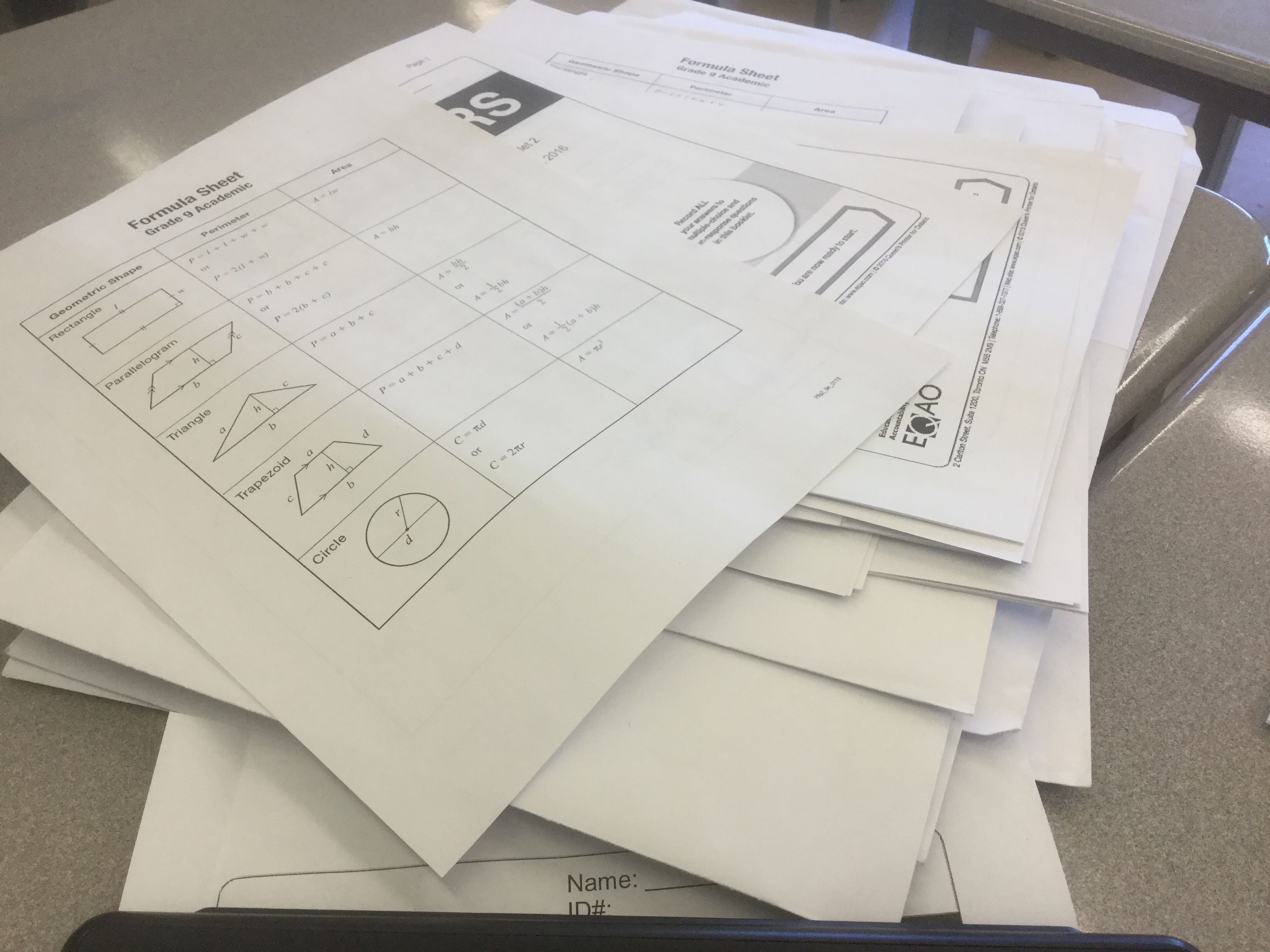
For Tues/Thurs bring a calculator and be sure to have eaten and gone to the bathroom first! Leave backpacks in lockers.
For more practice over the weekend check out 5 years of past tests on the eqao site in English and here in French. (Our test will be written in English).

