Geometric representation of exponents
We are working on a new understanding of exponents. Today we are building them with toothpicks and plasticine. First: X^2
 an X^2 is actually going to be a square, with side lengths of x, just like a square meter is a square with side lengths of one meter.
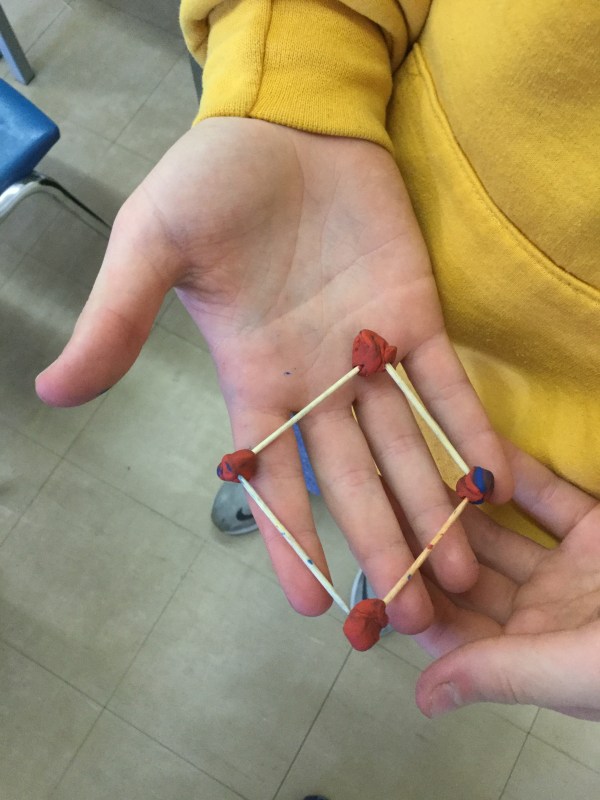 Here are 2 squares, and each one has dimensions of x, so this is 2(x)^2
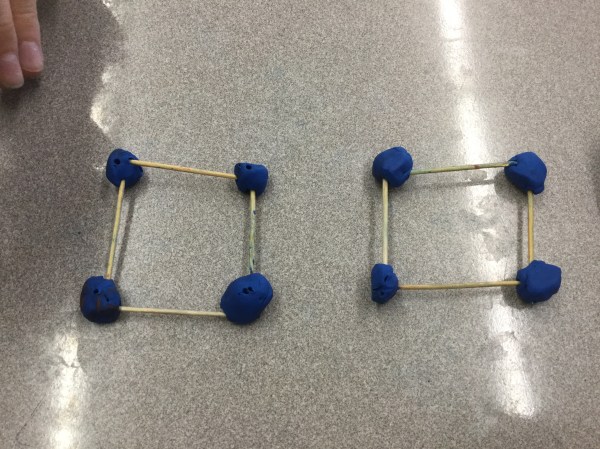 Here is a bigger square. The dimensions are 3x, so we call this (3x)^2.
Another way to look at this is to notice that it can be subdivided into pieces of x^2 and that there are 9 of them. We also know that (3x)^2 is the same as (3x)(3x) which is the same as (3)(x)(3)(x) which is the same as (3)(3)(x)(x) which is the same as 9x^2.
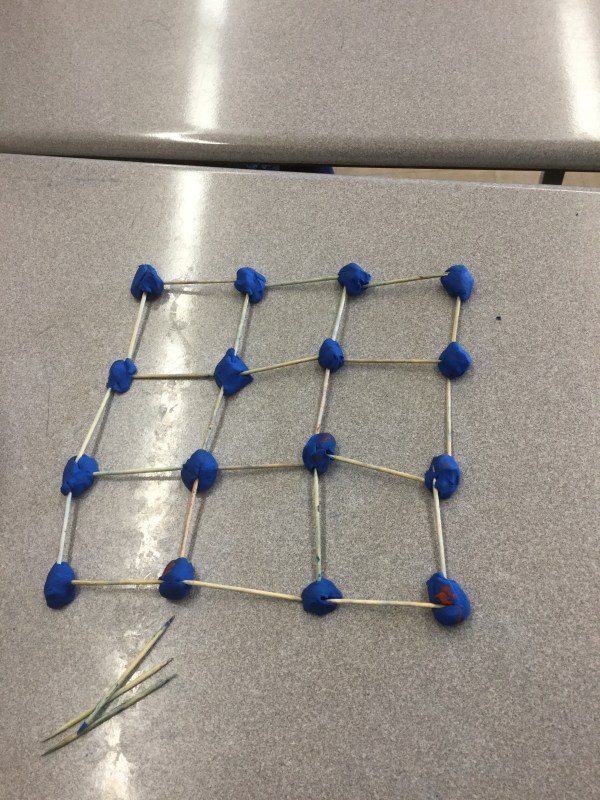
This one is in 3 dimensions, a cube with side length x, so it is x^3.
For many of us, this is a new way to explore and express exponents.
Fractions
In 1L we looked at fractions, and how to draw them. We are working at comparing fractions and understanding that 3/6 and 2/4 and 1/2 are all the same.
 After our fractions work we played the game of totality. We took turns moving the marker, and adding the value to the the previous total. The goal was to be the person to land on the number that brings the total to exactly 50.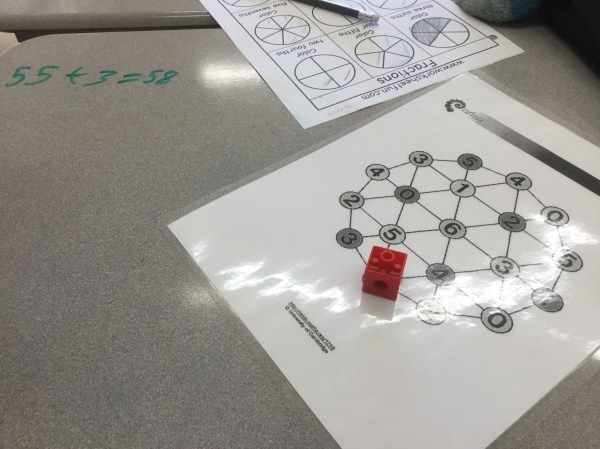
Rounding
Today we looked at a number line strategy for rounding. Here we are rounding to the nearest 100. We count by 100s until we find the 2 “100s” that sandwich the number we’ve got. Here we have the number 573. We count up and sandwich 573 between 500 and 600. We make a number line, and mark the center of the interval (550), and then we place our fraction, and look at which end it’s closest to. We would round 573 to 600 since it is the closest 100.

Pyramids
We are building pyramids with a volume of 300cm^3. We saw that each of the pyramids can be poured 3 times into the prism with the same base and height.
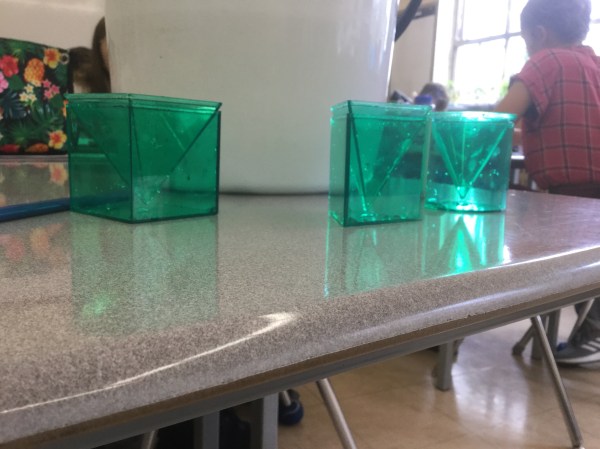
We made plans, decided dimensions, and then we drew out the pieces and cut them and taped them together.
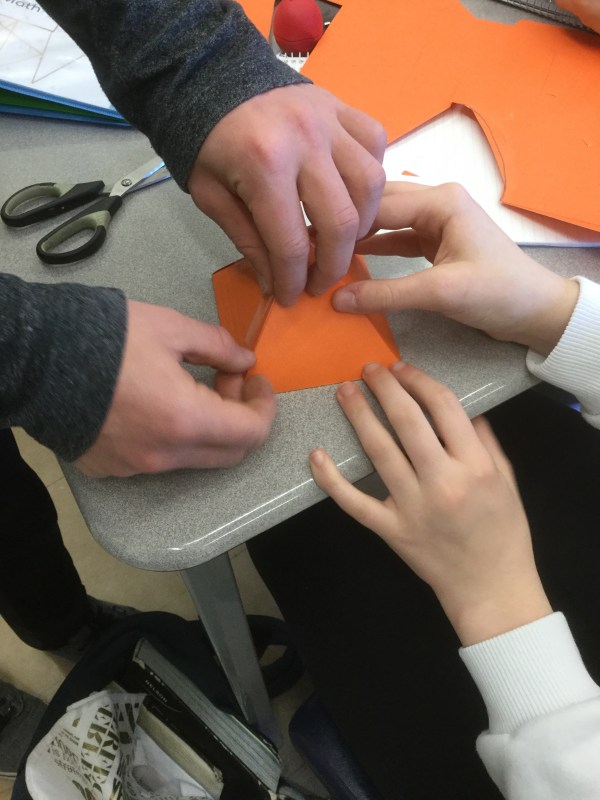 We ended up with pyramids that were often incorrect! This one for example, was supposed to be 10cm by 10cm by 9cm tall. But the height was just over 7cm tall.
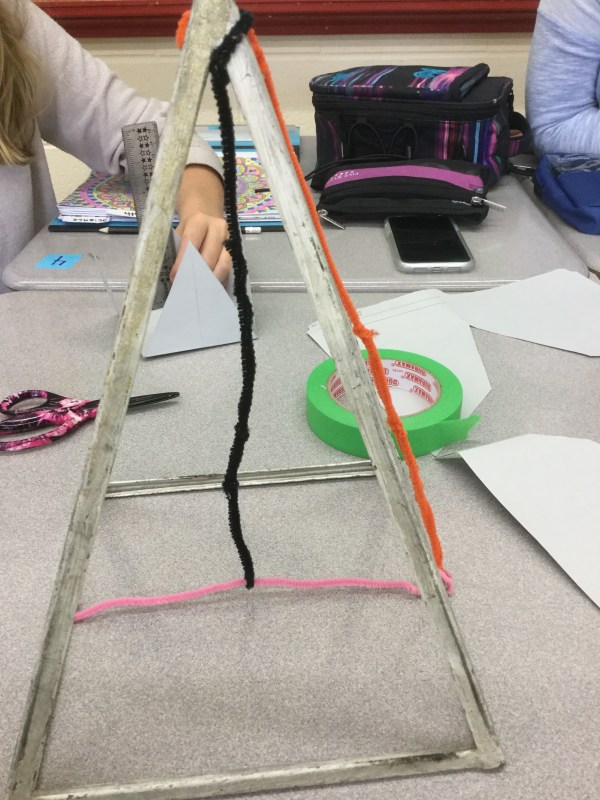
To understand what went wrong, we need to look at a few things. Here’s a pyramid. The height of the pyramid is the black pipe cleaner. The base of the pyramid is the pink pipe cleaner. The slant height (génératrice) is the orange pipe cleaner. Together these dimensions create a right angle triangle, and we need to use Pythagorean theorem to calculate the slant height, and use that dimension as the height of each of the triangle sides. Many of us used the pyramid height as the height of each side triangle, which results in a pyramid that is too short.
Decimal numbers
We built models to correspond to the values in our concept circle. This concept circle has a 100 block as equal to 1. That means that each single block is equal to 1/100 or 0.01
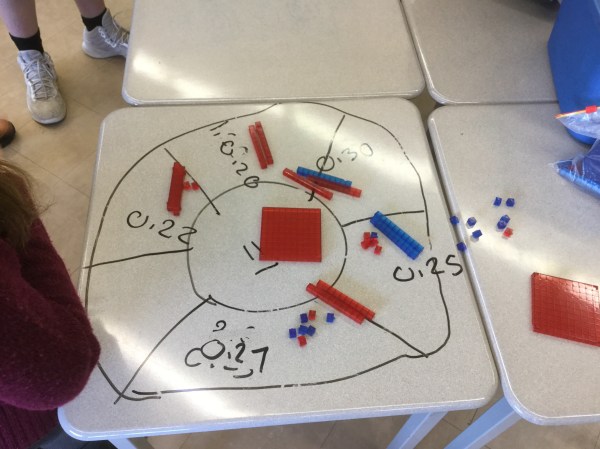 We know that 0.35 ad 0.53 are different, and we can see with our blocks, exactly why they are different.
 We are working on placing decimal numbers on a number line, including tenths and hundredths.
 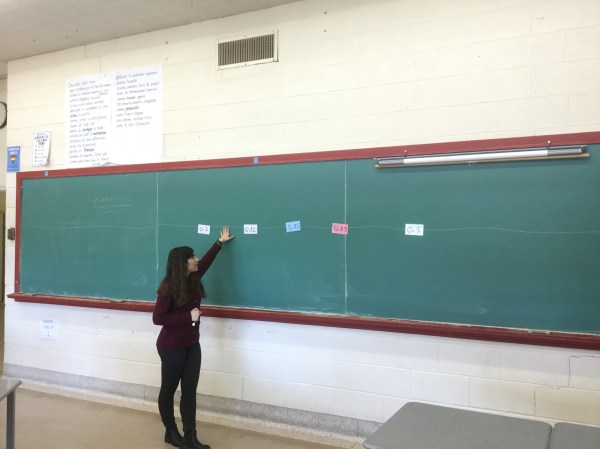 We played a new game where we each rolled 2 dice and then made the largest decimal number we could. The person who got the higher decimal number wins that round. We then ordered the numbers that we made.
Relaxing and building prisms in Math class
Today we had a visit from Emma Jane our adolescent care worker. She talked with us about how to keep calm, how to stretch, and how to breathe.

We learned a little bit about how our thoughts and behaviour are things we can change, and that their changes will influence our feelings.
We then worked on our challenge of the day: building rectangular prisms with a volume of 300cm^3.
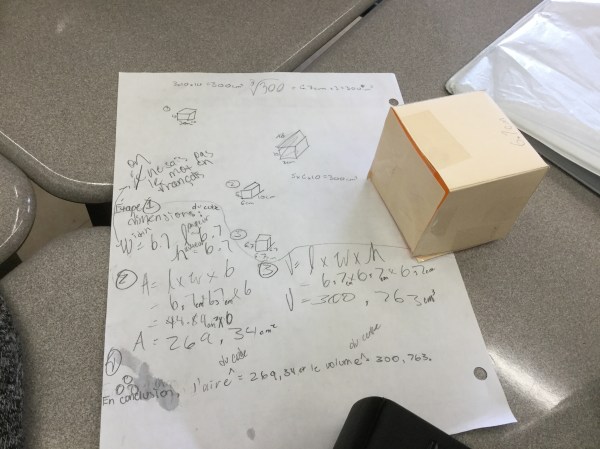

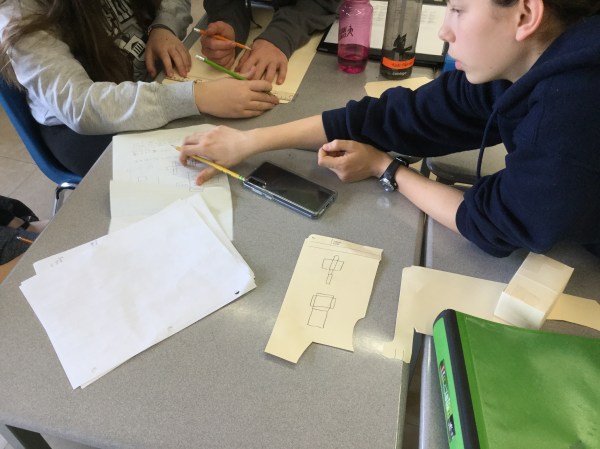
We calculated the surface areas of our prisms and will make more (different) prisms with same volume on Friday. We’ll look for patterns in the dimensions and areas of the various prisms which all have the same volume.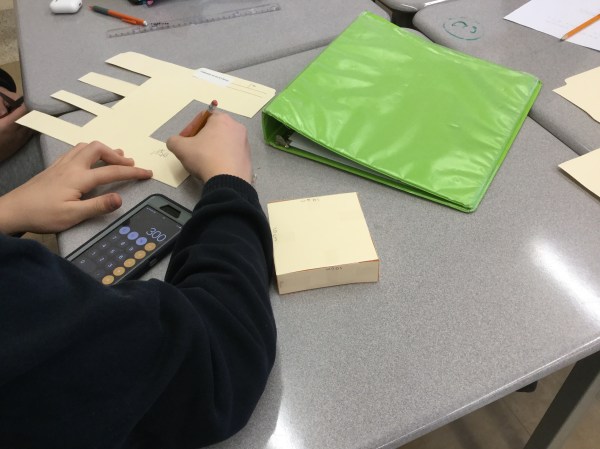
We looked at all of our prisms, and ordered them from greatest to least surface area.

We know that the cube has the smallest surface area of all of the prisms we made.
Fractions decimals and percents
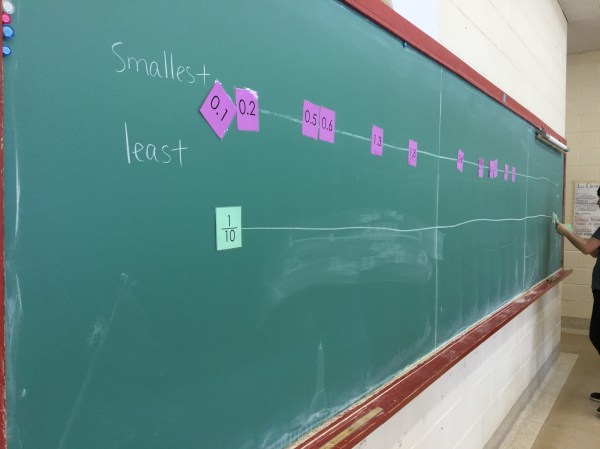
In 1L today we worked on ordering decimals, fractions and percents. We had good learning moments when we connected the number in front of the decimal with the whole number in the fraction, and when we examined the number in the denominator and connected it with the size of piece we’d have. 1/2 of a cookie is bigger than 1/10 of a cookie. When the denominator is big, the piece is smaller.
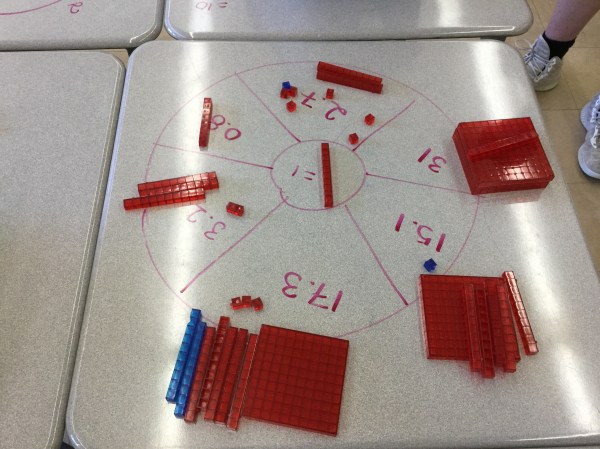
We represented decimals in a concept circle today also. Today our “one” in the center was a 10 block, and then we built the other values accordingly. We are getting more comfortable with these materials and this skill.

Problem solving day!
Grade 9s started off by collecting data on their multiplication skills.  We are multiplying daily, and discussing strategies to multiply more easily. Eventually we will graph our progress.
After that, we looked at the pythagorean theorem, and how to use it to calculate one of the perpendicular sides, when the hypotenuse is known.
This video really helps us visualize the pythagorean theorem, and why sometimes we add the squares together, and why sometimes we subtract.
We then applied our knowledge to solve a rather complex problem.

We are working at the boards so that everyone can see our work, and we can get help from others easily.
 we are working on clear communication of our solutions.
 We are showing our steps, and writing out our formulae clearly. We have shown good skills with BEDMAS too.
Excellent work today grade 9s!
Place value
Today in 1L we worked on understanding place value, and rounding numbers to the nearest ten or hundred.
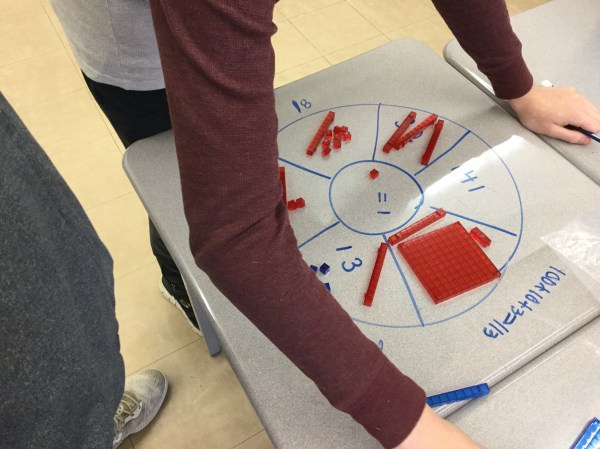
We used a concept circle to show our understanding. The center of the circle defines “one”, and then we used that to build larger numbers out of the base 10 blocks. Sometimes the base 10 blocks were given, and we needed to write the number.
Adding Tug of war

Because of popular requests we did worksheets today with a focus on place value and money. After considerable practice, we learned a new game: tug of war. Each player takes their turn to roll 2 dice and move that number of spaces towards their end of the game board. The winner is the one who gets the game piece to exit the game board on their side.
 Ms. Bearse's Site